
Switching to a Custom Automatic Diving Watch: Solving the Splash-and-Dive Gap
A 3 ATM quartz platform is a sound commercial decision right up to the moment a retail partner starts selling that watch to swimmers, snorkellers and sport-watch buyers. That is the splash-and-dive gap: the product still looks like a sports watch, but its specification stops at hand-washing and rain. Closing the gap is a platform decision, and the automatic diving line behind it — TD015G at 200 metres and TD017G at 10 ATM, both in 316L stainless steel — is what makes the upgrade defensible to a buyer, a compliance file and an end user.
The splash-and-dive gap, defined
The ATM figure on a caseback is a laboratory statement about static pressure, not a description of how a watch will be worn. In the specification language used across the custom watch trade, 3–5 ATM covers daily wear, hand-washing and rain splash; 10–20 ATM covers swimming and surface snorkelling; and ratings of 20 ATM and above, when they comply with the diver-watch standard, are intended for diving use. A 3 ATM case therefore sits at the bottom of that ladder by design.
The terminology matters commercially as well as technically. Under ISO 22810, the international standard for water-resistant watches, the acceptable commercial claim is “water-resistant”; the term “waterproof” is prohibited. A brand that markets a 3 ATM quartz model as a sports or dive watch is exposed on two fronts at once — a claim that the standard does not permit, and a product that will fail the first time an end user takes it into open water.
The gap usually announces itself in four ways:
- The client’s own sell-through shows the SKU being bought by swimmers, snorkellers or watersports travellers rather than office wearers.
- Complaint clusters appear as fogging or condensation under the crystal, visible water droplets inside the case, or rust at the caseback, crown and pushers — the classic symptoms of water ingress.
- A distributor or retail partner asks for a screw-down structure, a rotating bezel, a ceramic insert, applied luminous markers or a sapphire crystal — features that belong to a different grade of case.
- The brand’s own positioning moves toward sport, and the catalogue no longer matches the marketing.
None of these can be fixed in quality control. A 3 ATM case cannot be re-rated by adding a ceramic bezel insert, and a luminous handset does not change how a gasket seals. The rating, the sealing structure and the case construction move together, which is why the answer is a new platform rather than a revision of the old one.
What each water-resistance band actually supports
| Rating band | Real-world use it is intended for | Why the band exists |
|---|---|---|
| 3–5 ATM | Daily wear, hand-washing, rain splash | Balances splash protection against cost for everyday and fashion watches |
| 10–20 ATM | Swimming and surface snorkelling | Handles the dynamic water pressure of moving through water, which static testing alone does not describe |
| 20 ATM and above (diver-watch standard) | Diving use | Built to the full diver-watch standard, including dynamic pressure and salt-water corrosion considerations |
Ratings describe static laboratory pressure. 1 ATM equals roughly 10 metres of static water depth, so an ATM number is not the depth a wearer can dive to.
Why the upgrade window is open now
The commercial logic for an automatic diver is supported by the structure of the watch market itself. Quartz movements dominate global shipment volume with a 75% market share, according to a 2026 traditional watch market analysis covering 2024 data — which is exactly why a quartz 3 ATM platform is the default starting point for most private label programmes. But mechanical watches contribute over 68% of total market value on lower unit volume, according to the same research. Volume sits with quartz; value sits with mechanical.
The movement supply side tells the same story. The global watch movement market reached USD 18.4 billion in 2025, with automatic movements holding a 38.2% share, according to Dataintelo. Automatic is no longer a niche engineering choice; it is a mainstream component category that a brand can specify by name.
Two regulatory facts frame the buyer’s decision. First, water-resistant watches must comply with ISO 22810, and the term “waterproof” is prohibited. Second, RoHS compliance under Directive 2011/65/EU is mandatory for electronic watches — quartz and smart models — in the EU market. A brand upgrading its range therefore inherits two obligations at once: it must be able to justify the water-resistance claim it prints, and it must be able to document compliance for anything battery-driven in the same catalogue.
Market figures are one input; the more decisive one is how buyers now read a specification sheet. Movement brand, case material, crystal type, bezel insert material and resistance rating are routinely written into briefs before a sample is even discussed, which means an under-specified 3 ATM case loses at the shortlisting stage rather than at the complaint stage.
The automatic diving platform that closes the gap
TOPHILL — the custom watch brand of Shenzhen Super Time Co., Ltd., a watch manufacturer established in 1992 and now operating from Dongguan, Guangdong — builds the upgrade on two automatic diving platforms. Both use a Miyota Automatic 8215 movement and a 316L stainless steel case, and both move the resistance target far above the 3 ATM baseline.
TD015G — the 200-metre option
- 316L stainless steel case with a rotating bezel and a ceramic bezel insert with BGW9 luminous.
- 200-metre water resistance, with a see-through solid caseback.
- Flat sapphire crystal.
- Sunburst dial with applied indexes carrying BGW9 luminous.
- 316L solid bracelet with a solid extension buckle.
- Japan Miyota Automatic 8215 movement.
TD015G is the model to specify when the client’s brief uses words like “professional”, “dive-ready” or “serious sport build”. The extension buckle matters commercially because it lets the bracelet be adjusted over a wetsuit sleeve without a separate strap programme.
TD017G — the 10 ATM option
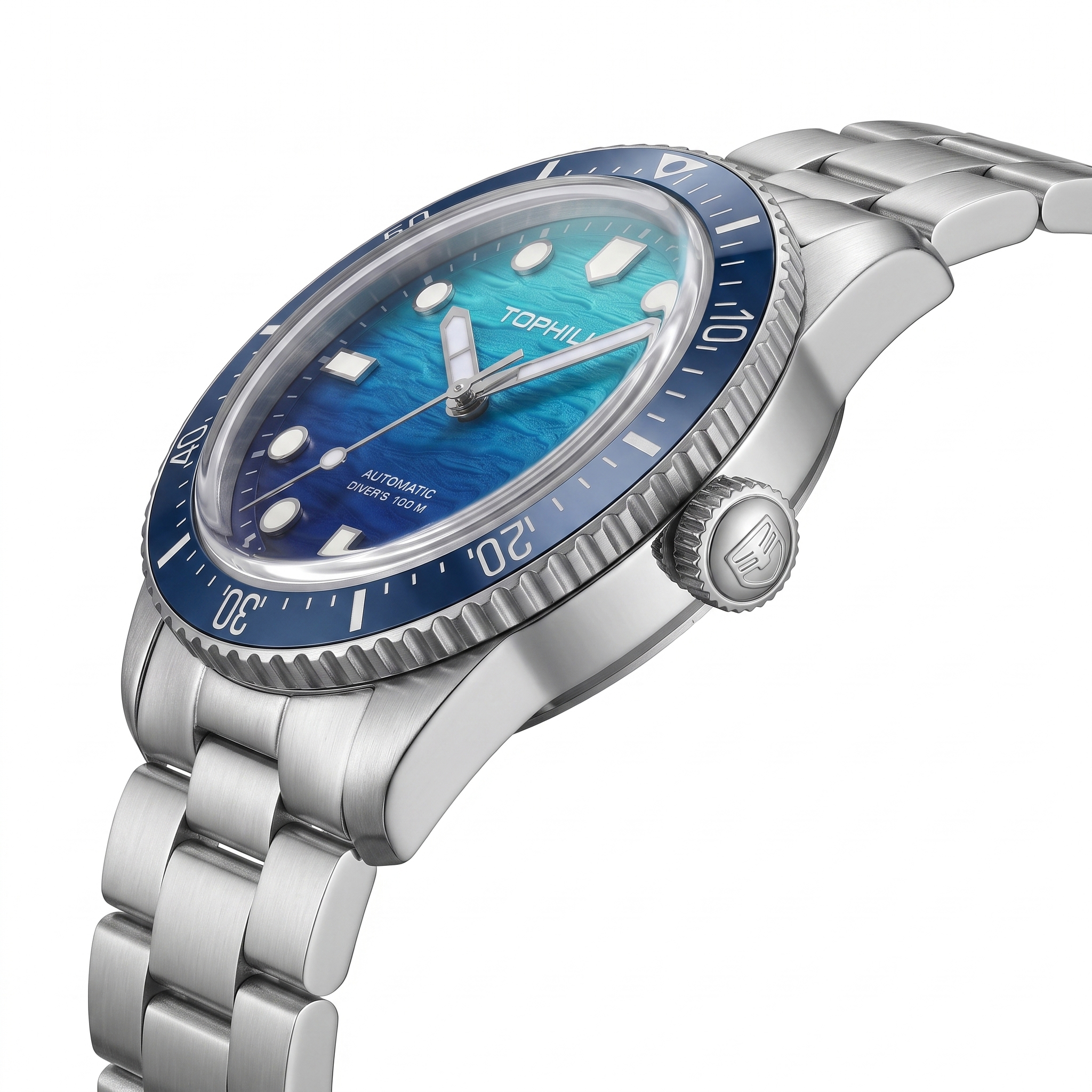
- 316L stainless steel case and rotating bezel, with a ceramic bezel insert with luminous marking.
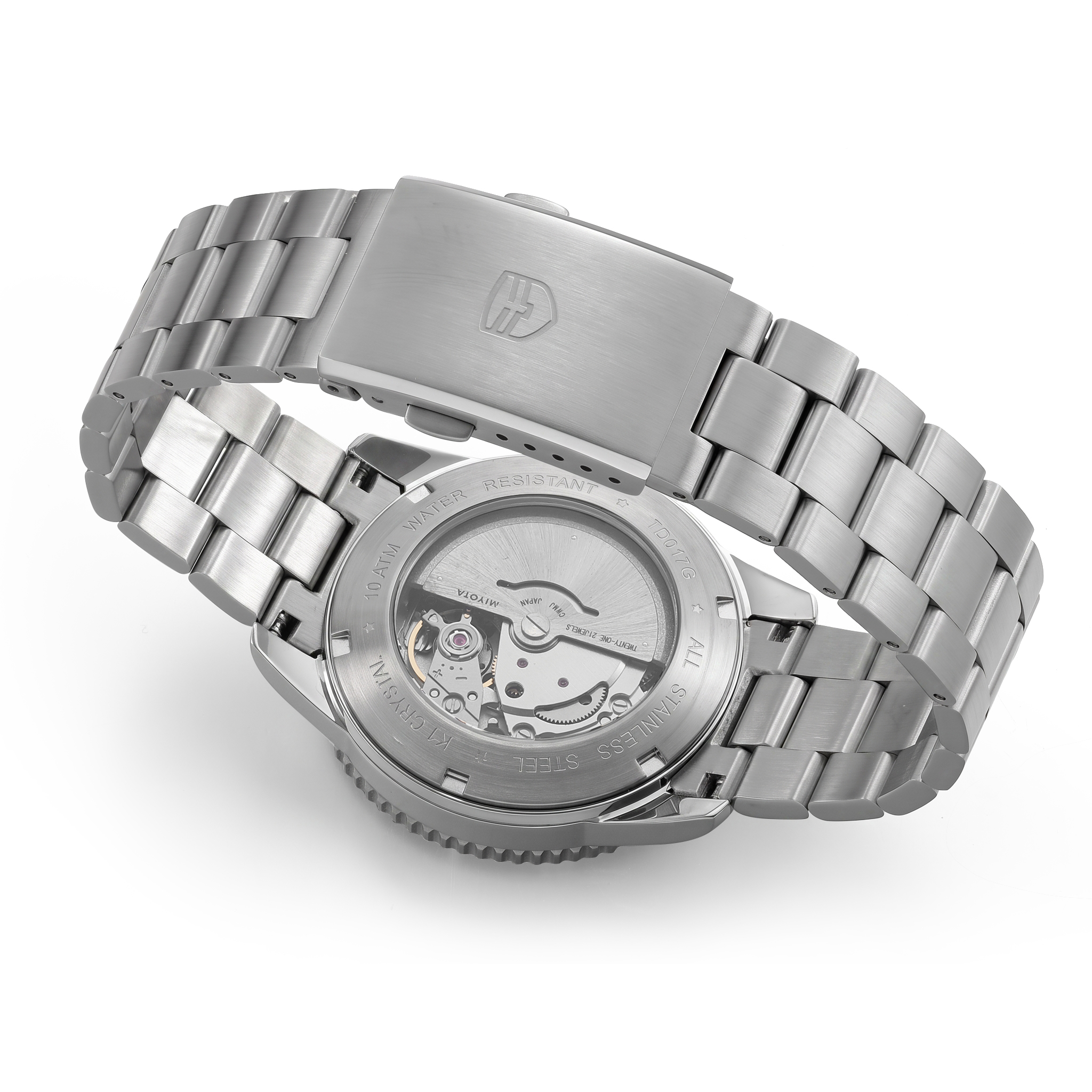
- 10 ATM water resistance, with a see-through solid caseback.
- Boxed crystal.
- Embossed dial with applied indexes in gradual colours.
- Luminous hands.
- 316L stainless steel solid bracelet with a solid turtle buckle.
- Miyota Automatic 8215 movement.
TD017G is the more commercial step up from a quartz line: it delivers the diver silhouette, the ceramic insert, the luminous handset and a 10 ATM rating — the band that covers swimming and surface snorkelling — while keeping the case architecture and bracelet construction familiar to buyers who already source 3 ATM product.
Luminous hands and ceramic inserts do not make a watch dive-safe
This is the point where brand teams most often misread a specification. Luminous hands and ceramic bezel inserts appear across the range at several resistance levels. KIM002, an automatic elegant wristwatch, has hollow hands with luminous coating and a 5 ATM rating. KIM003, a mechanical chronograph, has luminous hands and a 5 ATM rating. Neither is a diving watch.
Lume is a legibility feature and a ceramic insert is a scratch-resistance feature. Neither one seals a case. What determines safe underwater use is the combination of the declared rating, the sealing structure behind it — gaskets at the caseback, crystal, crown and pushers — and the pressure testing applied to each individual unit. This is why the upgrade path runs through TD015G and TD017G rather than through a cosmetic refresh of an existing 3 ATM model.
The second misreading concerns the number itself. ATM reflects static laboratory test pressure, not usable diving depth. A 10 ATM watch is intended for swimming and surface snorkelling; a professional diver’s watch is a separate category defined by the diver-watch standard, not by an ATM figure alone.
Movement and build consistency across the range
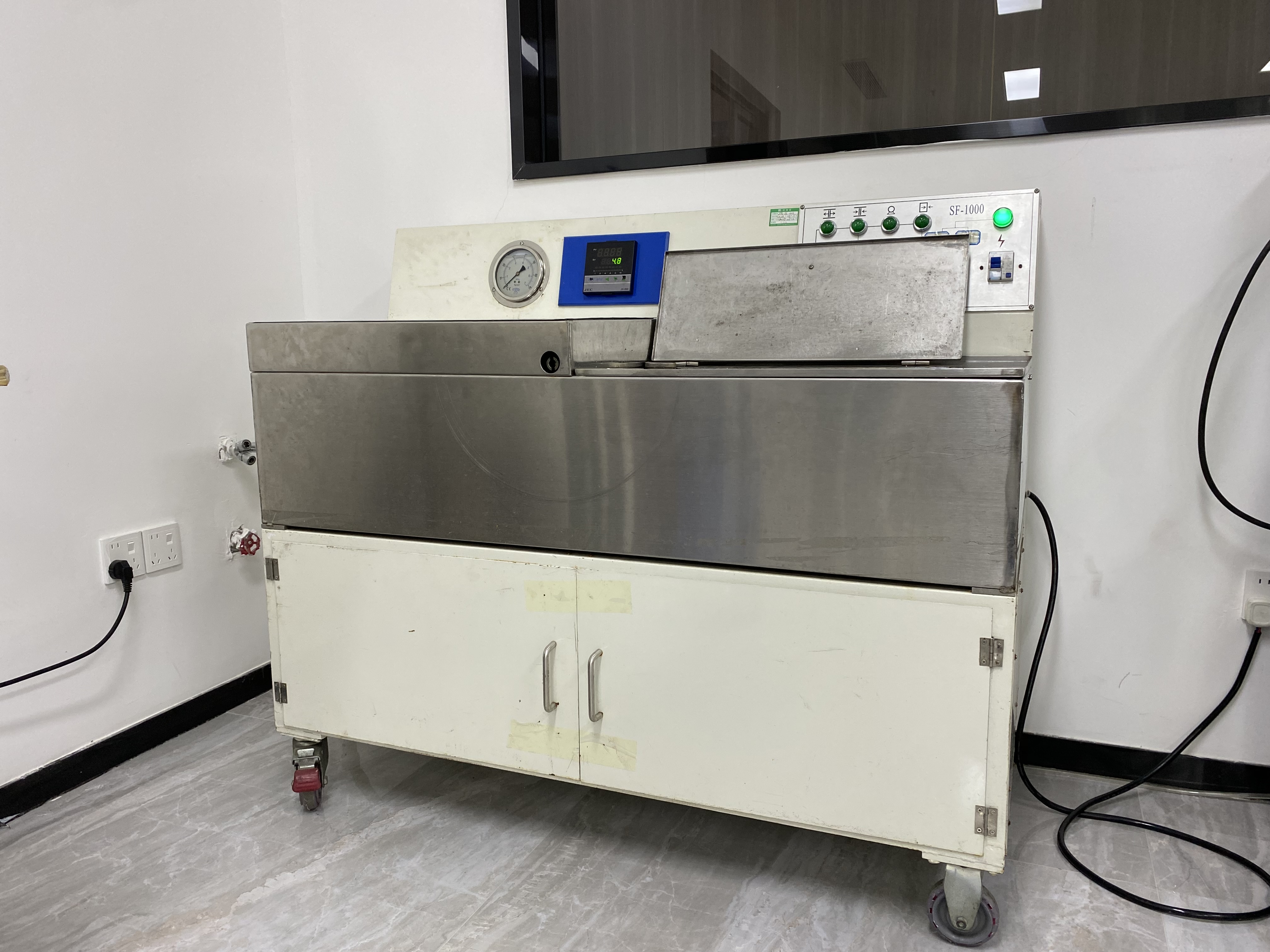
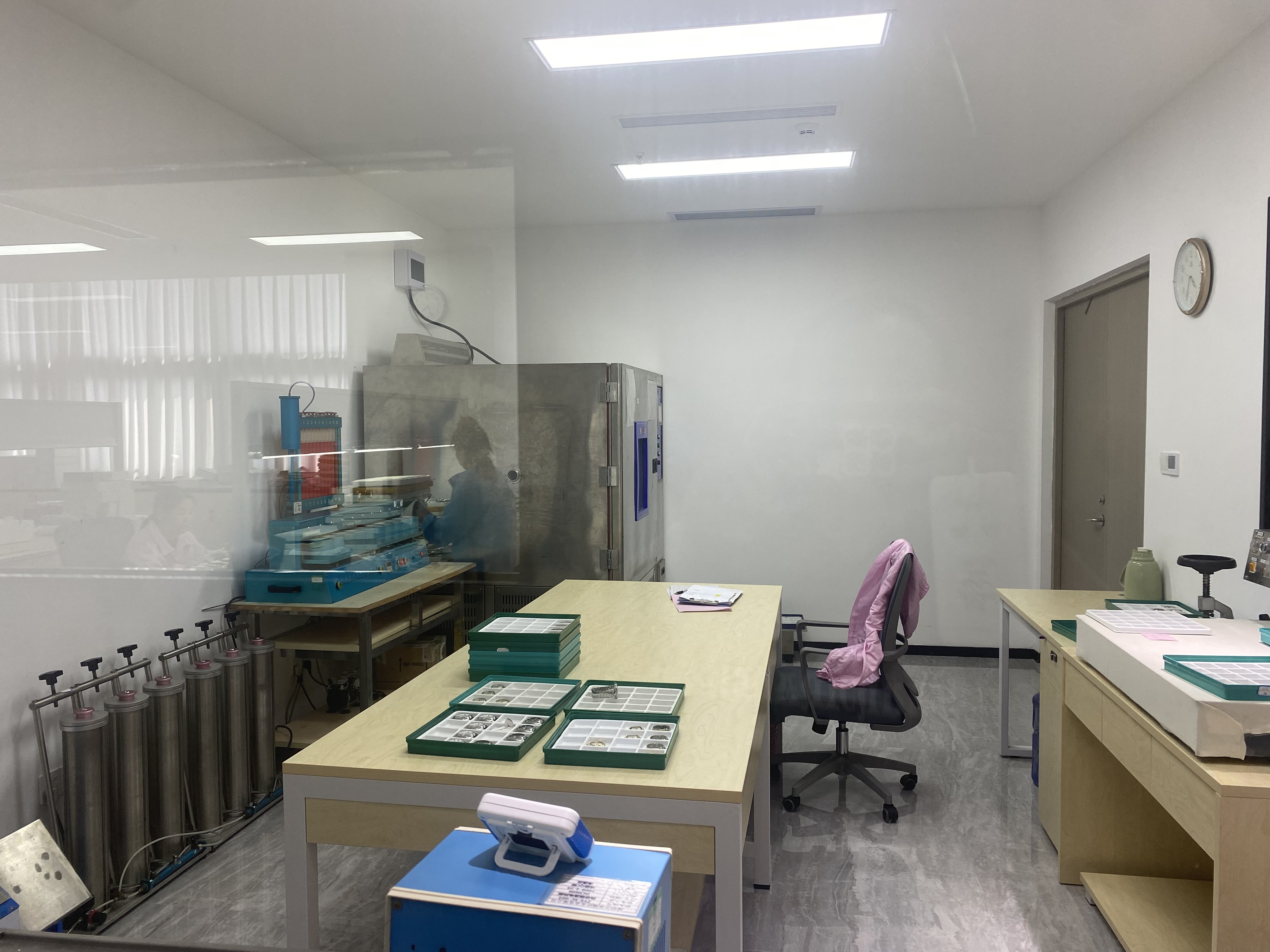
The automatic diver sits inside a broader manufacturing system rather than beside it. Assembly runs in a class-10,000 dust-free workshop, and there is a dedicated CNC prototyping workshop for case and component development. Water-resistance testing is performed on every waterproof watch before shipment — 100% of units, not random sampling — and the resistance range supported across the catalogue is 5–50 ATM. The testing floor also runs an automatic movement accuracy testing machine, a strap tension–torsion testing machine, a dial index inspection machine, a dropping test machine and a 500-metre water-resistance testing machine. Quality management is certified to ISO 9001 and environmental management to ISO 14001.
Step-by-step: migrating a 3 ATM quartz SKU to an automatic diver
- Map the client’s actual water exposure. Separate the range into daily-wear SKUs (3–5 ATM is sufficient and stays quartz), swim and snorkel SKUs (10–20 ATM), and any genuine diving claim (20 ATM and above, to the diver-watch standard). This step prevents the whole catalogue from being over-specified and protects margin on gift and fashion programmes.
- Choose the platform before the artwork. Select TD017G for a 10 ATM swim-capable diver or TD015G for a 200-metre build. Case architecture, bezel, crystal and bracelet are then fixed, and the dial artwork is developed around them rather than the reverse.
- Lock the sealing and case specification. 316L stainless steel case, rotating bezel, see-through solid caseback, and gaskets specified at the caseback, crystal, crown and pushers. Confirm who supplies each gasket and what the replacement interval guidance will be for after-sales.
- Specify crystal and bezel insert. Flat sapphire crystal on TD015G; boxed crystal on TD017G; ceramic bezel insert with BGW9 luminous on TD015G and luminous marking on TD017G. These are the visible cues a retail buyer will compare against competing spec sheets.
- Fix the movement and state it by name. Miyota Automatic 8215 on both platforms. Naming the movement in the brief removes ambiguity in sampling and gives the brand a defensible line in its product copy.
- Validate with pressure testing, not with appearance. Each waterproof unit is pressure-tested before shipment. Pair that with the drop test, strap tension–torsion test and dial index inspection that already run on the line, and request the test record with the shipment.
- Assemble the compliance file before the purchase order. EU RoHS compliance for finished products, ISO 9001 and ISO 14001 certification, and EMC documentation for electronic models. Our CE Certificate of Compliance under the EMC Directive is held under certificate number HK2404101658E, issued by HUAK, referencing EN IEC 61000-6-3:2021 and EN IEC 61000-6-1:2019 for the EU market.
- Agree the commercial frame. Confirm MOQ, tooling and artwork milestones, sample approval gates and the production slot before committing retail launch dates.
Where the automatic diving line fits
1. A sport SKU added to a quartz-led catalogue
A brand whose volume sits in elegant quartz models — TR001 with its Japan quartz movement and 3 ATM rating, or TAM002 with a Ronda quartz movement and 3 ATM rating — can add one automatic diver without re-platforming the rest of the range. The diver becomes the halo SKU that justifies a sport sub-line, while the quartz core keeps its cost position.
2. A distributor requirement in the EU
European distributors increasingly ask two questions in the same conversation: what is the water-resistance rating, and where is the RoHS documentation? Because RoHS compliance under Directive 2011/65/EU is mandatory for electronic watches in the EU, a mixed catalogue needs both answers on file. Finished products meet EU RoHS compliance standards, and the quality and environmental systems behind them are certified to ISO 9001 and ISO 14001.
3. Travel retail and dive-tourism private label
Resort retailers, liveaboard operators and watersports rental programmes need a watch that survives salt water, sun and daily handling. A 200-metre platform with a ceramic insert, BGW9 luminous markers and a solid extension buckle is a more honest product for that channel than a 3 ATM fashion case with a diver dial.
4. When not to upgrade
An automatic diver is not the right answer for every programme. Corporate gifting, promotional watches and office-wear assortments are better served by quartz or slim dress platforms — the 3 ATM quartz models and the 5 ATM automatic elegant models in the range exist for exactly those briefs. The upgrade also carries commercial weight: MOQ starts at 300 pieces, production lead time runs about 75 days, and the components behind a diver — automatic movement, 316L case, ceramic insert, sapphire crystal, solid extension buckle and 100% pressure testing — sit in a different cost band from a quartz fashion watch. The upgrade should be triggered by water exposure and positioning, not by the wish for a sportier photograph.
Model comparison: what changes between the platforms
| Model | Type and movement | Case | Water resistance | Crystal | Bezel and lume | Typical role |
|---|---|---|---|---|---|---|
| TR001 | Quartz, Japan quartz movement | 316L stainless steel with zircon setting, snap caseback | 3 ATM | Flat sapphire | Fixed crystal-set bezel; printed markers | Fashion and gift SKU; splash only |
| TAM002 | Quartz, Ronda quartz movement | 316L stainless steel with zircon setting | 3 ATM | Flat sapphire | Fixed bezel; applied indexes | Office and retail fashion |
| KIM002 | Automatic, Miyota 9039 | 316L stainless steel, see-through solid caseback | 5 ATM | Flat sapphire | Fixed bezel; hollow hands with luminous coating | Elegant everyday wear |
| KIM003 | Mechanical chronograph, Seagull ST1905 | 316L stainless steel, see-through solid caseback | 5 ATM | Curved boxed sapphire | Fixed bezel; luminous hands; leather strap | Sport-look chronograph, not a diving watch |
| TD017G | Automatic diving, Miyota Automatic 8215 | 316L stainless steel case and rotating bezel with ceramic insert | 10 ATM | Boxed crystal | Rotating ceramic bezel with luminous marking; luminous hands | Swim and surface-snorkel upgrade |
| TD015G | Automatic diving, Miyota Automatic 8215 | 316L stainless steel with rotating bezel and ceramic insert with BGW9 luminous | 200 metres | Flat sapphire | Rotating ceramic bezel with BGW9; sunburst dial with BGW9 indexes | Serious sport and dive build |
Source: TOPHILL product specifications. Ratings are as declared per model; luminous hands and ceramic inserts appear at 5 ATM, 10 ATM and 200 metres and are not by themselves evidence of dive readiness.
Frequently asked questions
1. How do we verify that a custom wristwatch manufacturer is RoHS compliant?
Ask for the directive reference first. RoHS compliance under Directive 2011/65/EU is mandatory for electronic watches — quartz and smart models — in the EU market, so the answer should reference the directive rather than a general quality claim. Then ask for the quality and environmental certifications behind the process: our finished products meet EU RoHS compliance standards, and the operation is certified to ISO 9001 and ISO 14001. For electronic models, EMC documentation should be available as well; ours is held under CE Certificate of Compliance number HK2404101658E, issued by HUAK and referencing EN IEC 61000-6-3:2021 and EN IEC 61000-6-1:2019. Confirm which models a given certificate covers whenever a mixed quartz and automatic order is placed.
2. Can our brand get a 200-metre automatic diver built on its own dial and logo?
Yes. TD015G is the 200-metre platform: 316L stainless steel case with a rotating bezel and ceramic insert with BGW9 luminous, flat sapphire crystal, see-through solid caseback, sunburst dial with applied BGW9 indexes, a 316L solid bracelet with solid extension buckle, and a Miyota Automatic 8215 movement. Water-resistance support across the catalogue runs from 5 ATM to 50 ATM, and every waterproof watch is pressure-tested at 100% before shipment rather than by random sampling. Development is handled in-house by four designers and three engineers, with a dedicated CNC prototyping workshop for case and component work.
3. If a model has luminous hands and a ceramic bezel insert, is it safe for diving?
No. Luminous hands are a legibility feature and a ceramic insert is a scratch-resistance feature; neither seals the case. In our own range, KIM002 has hollow hands with luminous coating and KIM003 has luminous hands, and both are rated 5 ATM — suitable for everyday wear, not for diving. What determines safe underwater use is the declared rating plus the sealing structure behind it: gaskets at the caseback, crystal, crown and pushers, and a screw-down structure where the design uses one. Two further cautions apply. ATM is static laboratory pressure, roughly 10 metres of static water depth per ATM, not a usable diving depth; and water resistance is not permanent, because gaskets age with wear, impact and chemical contact, and high-temperature steam damages them.
4. What is the minimum order quantity, and what drives the cost of an automatic diver?
MOQ starts at 300 pieces, with monthly capacity of 50,000–60,000 units. Cost is driven by the specification rather than by the logo: an automatic movement such as the Miyota Automatic 8215 instead of a quartz calibre, a 316L stainless steel case and bracelet, a ceramic bezel insert, a sapphire crystal, a solid extension or turtle buckle, and 100% water-pressure testing of every unit. A 3 ATM quartz model and a 200-metre automatic diver are different cost structures, and a programme should budget for them as such.
5. How long does it take from sample approval to bulk delivery?
Production lead time is about 75 days. Before that, prototyping runs through the in-house CNC workshop, and sample validation should include a water-pressure test rather than only a visual check, since passing a laboratory pressure test is the only evidence that the sealing structure works. After-sales support runs for two years, which is the period in which gasket-related questions typically surface. If you want to move a 3 ATM quartz SKU onto TD015G or TD017G, send the current specification and the target resistance band to our team at vivianli@supertime.hk or via WhatsApp on +86 137 6014 8724, and we will return a matched platform recommendation and a sample plan.
Conclusion
The splash-and-dive gap is a specification problem with a specification answer. A 3 ATM quartz case does what it was designed to do — daily wear, hand-washing, rain — and no amount of ceramic, lume or sport styling extends that. When a client’s end users enter the water, the product has to move to a platform whose rating, sealing structure, crystal and movement were chosen together for that use.
TD015G at 200 metres and TD017G at 10 ATM both make that move on 316L stainless steel and a Miyota Automatic 8215, with ceramic bezel inserts, sapphire crystals and solid bracelets, backed by 100% water-pressure testing, ISO 9001 and ISO 14001 systems, EU RoHS compliance and EMC certification documentation. For a brand, that is the difference between answering a distributor’s water-resistance question with a number and answering it with a platform.
Upgrade one SKU before the next season
Send us your current 3 ATM specification and the resistance band your client actually needs. We will map it to TD015G or TD017G, confirm MOQ and the roughly 75-day lead time, and arrange a sample for water-pressure validation.
Download the company profile and full capability overview: TOPHILL company brochure (PDF)
Website: www.supertime.hk
Email: vivianli@supertime.hk | WhatsApp / Tel: +86 137 6014 8724
Have Questions or Need More Details?
Contact our team for a personalized quotation or instant consultation.
Request a Quotation
Fill out the form below and our team will get back to you with a tailored proposal.
WhatsApp Direct Chat
Prefer to chat in real-time? Message us on WhatsApp for instant assistance & quick answers.
- Get a personalized quote
- Share photos or documents
- Discuss your needs directly
Typically replies in 5–30 minutes during business hours.