
Racing Drone Battery Power Loss Mid-Race: Purchase Terms That Prevent It
Short answer: a racing drone battery that loses power mid-race was usually defined loosely long before it was shipped. Buyers prevent it by writing load-based performance terms, batch-consistency terms, a frozen bill of materials, compliance-evidence requirements and a remedy ladder into the purchase order — and by converting those terms into a pass/fail incoming inspection that both sides agree to in advance.
A racing drone battery rarely fails at a convenient moment. The pack that dropped power in the second qualifying run had passed every check at goods-in: correct dimensions, clean wrap, readable label, correct connector. It failed where nobody had tested it — under sustained load, at the highest current draw of the run, in the middle of a timed lap.
That sequence is the subject of this guide. Mid-race power loss in a racing drone battery is usually not a chemistry mystery. It is the predictable outcome of what was and was not written down before the order was placed. Performance that was never defined, batch consistency that was never verified, documentation that was never attached to the purchase order — these are procurement decisions, and they are made weeks before the drone leaves the ground.
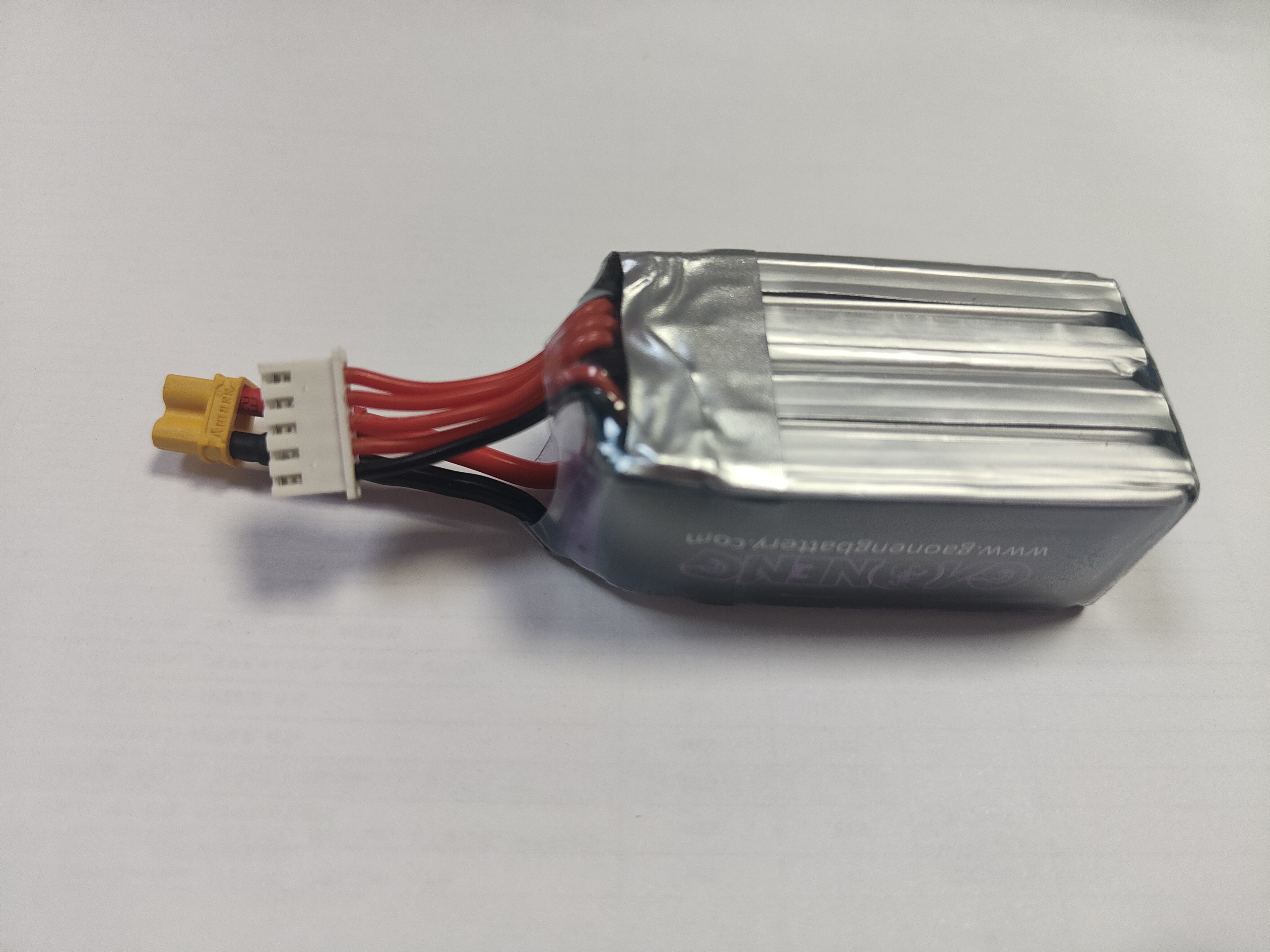
Cover: A racing drone battery pack as delivered. The external appearance rarely reveals the difference between a pack that holds voltage under load and one that sags — which is why the difference has to be written into purchase terms and acceptance criteria.
Problem Definition: What Actually Fails When a Pack Drops Power Mid-Run
In purchasing language, “power loss” is not one event. It is a group of distinct failures, each controlled by a different contract term. A buyer who treats them as one problem usually writes a specification that answers none of them.
- Voltage sag under peak load. The pack delivers current, but terminal voltage falls faster than the flight controller and electronic speed controllers can tolerate. The drone does not stop; it becomes uncontrollable at exactly the moment the pilot is asking for maximum thrust.
- Usable capacity shortfall. The pack reaches cut-off earlier than expected, so a run that should have finished does not. This is a capacity-and-discharge-curve question, not a label question.
- Pack-to-pack variation inside one batch. Some units hold up, others do not. Variation is the most common cause of a failure that appears random to the pilot and obvious to a test bench.
- Thermal drift. Internal resistance rises with heat, so a pack that performs on the first run behaves differently on the third run of the same day, or in a hot outdoor competition environment.
- Interface and assembly losses. A connector, lead or solder joint with higher resistance dissipates energy as heat before it reaches the motors. The pack is blamed; the termination is the cause.
- Documentation failure. The pack underperforms and there is nothing in writing that defines underperformance, so no replacement, credit or rework can be claimed.
Only the last item is a pure paperwork failure. The others become paperwork failures the moment the buyer cannot prove what was agreed. A supplier cannot be held to a limit that never existed on paper, and an incoming inspection cannot pass or fail a unit against a criterion that was never stated.
Decision rule: if an acceptance criterion cannot be tested with named equipment, under named conditions, by a named party, it is not an acceptance criterion. It is an opinion waiting to be argued about.
Industry Background: Why This Failure Is Invisible at the Buying Stage
Competitive formats reward current delivery. Professional racing event drone batteries, outdoor competition packs and high-discharge rate builds are all specified around the same demand: hold voltage while the pilot asks for everything the powertrain can take. Two packs can carry identical external dimensions, identical shrink wrap, identical connectors and identical labels, and still behave differently in a five-minute heat, because the difference sits in cell grade, cell matching, formation and end-of-line testing — all of which are invisible from the outside.
The supplier landscape reinforces the problem. Many battery suppliers are assembly operations that buy cells and build packs; others are moving toward fuller production control. Shenzhen Topway New Energy Co., Ltd. (HCC) is a Shenzhen-based battery supplier with a sales centre in Shenzhen and independent R&D capability; its main business is energy storage batteries and lithium-ion batteries, with products mainly exported to overseas markets alongside the Chinese market. HCC states that its business is evolving from battery pack solutions and cooperative production toward producing its own packs after solution design, and that it plans to introduce advanced battery production lines to serve complex and high-volume orders. For a buyer, that transition matters because it changes what a supplier can document about the process behind a racing drone battery, not just what it can ship.
Compliance expectations have also moved into the purchasing conversation. Event organisers, insurers, freight forwarders and customs authorities increasingly ask for certificate documentation rather than verbal assurance. HCC states that related products have passed RoHS, UL and CE and other export certifications, and its published certificate set includes ISO 9001:2015, IEC 62133-2:2017, UL 1642:2020, UL 2054:2021, IEC 62619:2022, IEC SG CTI-001612, UL2054 CMC240102017, an SGS supplier audit reference QiP-ASl232059, an Apple MFi certificate and a certificate of intellectual property management conforming to GB/T 29490-2013.
Finally, product cycles are short. New pack configurations, new connectors and new capacity options appear faster than most buyers can accumulate experience with a supplier. When a buyer has one or two batches to judge a supplier, the purchase terms have to carry the burden that repeat experience would otherwise carry.
Detailed Solution: The Purchase Terms That Prevent Mid-Race Power Loss
The solution is a term set, not a sentence. Each of the seven elements below closes one route by which an underperforming racing drone battery reaches a starting grid.
1. Write the duty cycle into the specification, not just the discharge label
A headline discharge figure is a starting point, not an acceptance criterion. It states a capability claim without stating duration, temperature or end-of-run voltage, which is precisely the information a race demands. The purchase order should instead describe the load profile the pack must survive — the current demand pattern of a representative run — and then state the minimum voltage the pack must still hold at the end of that profile, measured at an agreed ambient temperature, on agreed equipment. Once that is written, the pack either passes or fails, and both sides know which.
2. Make batch consistency a deliverable, not an assumption
Sample approval is not batch approval. The most common gap between a good first delivery and a failing second delivery is that the contract approved a sample but never committed the batch to it. The term should state that every unit in the shipment must perform within an agreed tolerance band of the sealed reference sample, that the supplier provides the batch test record, and that the buyer may re-test incoming units against the same reference.
It is also fair to ask how consistency is produced. Cell grading and matching, formation and aging, and end-of-line testing are the process steps that create a uniform batch; a supplier who can describe them can usually document them.

Process evidence: Formation and aging stages inside HCC’s production environment. Buyers writing batch-consistency terms should ask which process steps generate the test record they are being promised.
3. Freeze the bill of materials and add a change-control clause
Most “the second batch feels different” complaints trace back to an undocumented substitution: a different cell grade, a different cell source, a different lead gauge, a different wrap. The purchase order should freeze the bill of materials — cell model, grade and source, connector type, lead specification, insulation and marking — and state that no substitution is permitted without written buyer approval and re-validation against the reference sample.
4. Specify the physical and interface requirements in measurable terms
Interface losses look exactly like power loss to a pilot. The term set should therefore cover connector type and mating condition, lead length and gauge, the pack’s dimension and weight envelope, wrap integrity, and the batch or traceability marking applied to every unit. Each item is inspectable at goods-in with simple equipment, and each item removes one excuse from the dispute conversation.
5. Attach compliance evidence to the purchase order, not to a brochure
Compliance is a documentation requirement before it is a marketing claim. The order should name the exact certificates expected with the shipment, in whose name they are held, and which product family they cover. In lithium battery purchasing this typically means cell-level and pack-level evidence separately: UL 1642:2020 addresses cells, while UL 2054:2021 addresses battery packs; IEC 62133-2:2017 and IEC 62619:2022 cover different application families; ISO 9001:2015 speaks to the quality system rather than the product. A supplier holding cell-level certification has not automatically certified the assembled pack, and a buyer who conflates the two has no route to a claim.
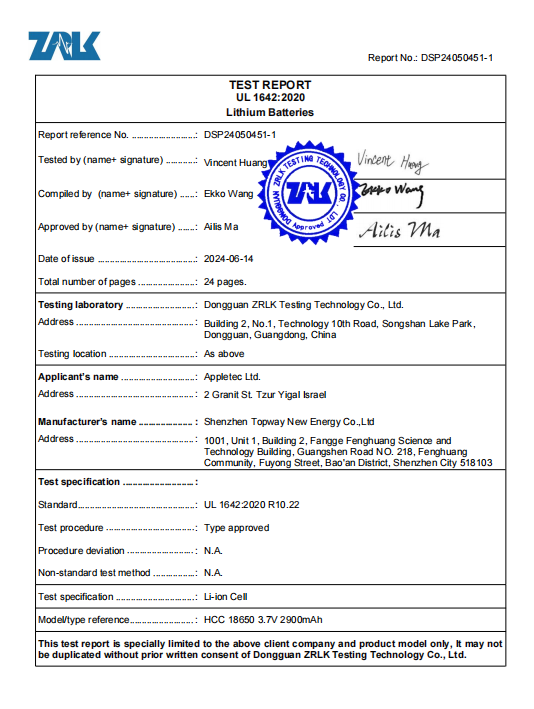
Documentation proof: UL 1642:2020 is a cell-level certificate in HCC’s published set. Buyers should confirm whether the pack they are ordering is covered by pack-level documentation such as UL 2054:2021 as well.
6. Separate the specification from the acceptance criteria
The specification says what the product should be. The acceptance criteria say how the buyer decides pass or fail. They are different documents and both are needed. The acceptance criteria should name the test method, the equipment, the ambient conditions, the sample size agreed between the parties, who performs the test, where it is performed, and what record is retained. Without this, every dispute becomes a comparison of two opinions — and the buyer usually holds the weaker position, because the supplier tested the pack before shipping it.
7. Agree the remedy ladder before the first shipment
Remedies are cheapest to negotiate when nobody needs them. A practical ladder runs from replacement of non-conforming units, to credit against the affected quantity, to rework or re-selection, to a joint retest at an agreed third-party laboratory when the two parties disagree on the result. The same clause should state who bears freight on replacements, how long batch records and the sealed reference sample are retained, and what evidence is required to open a claim. Buyers who define this in advance avoid the most expensive outcome of all: a team that cannot use a batch and cannot return it either.
Step-by-Step: From RFQ to a Closed, Accepted Batch
Step 1 — Describe the run before describing the pack
Send the application first: the current demand pattern of a representative run, expected ambient conditions, connector and mounting constraints, weight limits, and the markets in which the packs will be used. A supplier quoting against an application quotes more accurately than a supplier quoting against a product name.
Step 2 — Request the documentation package with the quotation
Ask for certificate copies with numbers, quality-system documentation, a bill-of-materials summary and a statement of in-house test capability in the first response, not after the order. Suppliers who cannot produce this at quotation stage will usually not produce it at shipment stage either.
Step 3 — Order samples as a defined build
Samples should be requested as a specified configuration rather than taken from stock. Test them under the duty cycle written in step 1, record conditions and equipment, and keep the raw results — they become the benchmark for every later batch.
Step 4 — Seal the reference sample and convert findings into terms
Both parties retain a sealed unit of the approved build. The findings from sample testing become the annex: performance floor, consistency band, frozen bill of materials, interface requirements, compliance documents, acceptance method and remedy ladder.
Step 5 — Pre-purchase checklist
- Duty cycle and minimum end-of-run voltage stated as a pass/fail figure.
- Tolerance band against the sealed reference sample stated in the contract.
- Bill of materials frozen, with no-substitution and change-notification clauses.
- Connector, lead, dimension, weight, wrap and marking requirements written down.
- Named certificates with numbers and product-family coverage attached to the order.
- Test method, equipment, ambient conditions, sample size and testing party agreed.
- Remedy ladder, freight responsibility and third-party retest route agreed.
Step 6 — Incoming inspection against the same criteria
Incoming inspection should mirror the contract, not exceed it or fall short of it. A practical sequence: document check against the named certificates; visual and dimensional check on every unit; weight check against the reference; connector and lead inspection; open-circuit voltage comparison across the batch to expose outliers before load testing; internal resistance comparison; load test on the agreed sample against the reference results; thermal check during and after the load test; and traceability marking recorded against the batch.

Upstream control: Electrode processing is one of the process stages that determines whether cells behave uniformly. Buyers verifying batch consistency should ask which upstream steps are recorded and traceable.
Step 7 — Close the batch and, if needed, open the dispute route
A batch should be closed with a signed inspection record, retained results and a written note of any deviation accepted. If units fail, the agreed route applies: notify within the stated window, provide the inspection record and test data, offer the supplier a joint retest, and move through replacement, credit or rework in the order the contract defines. Buyers who have the reference sample and the test record rarely need to argue about whether a pack underperformed.
Use Cases: Where These Terms Matter Most
The same seven elements apply everywhere, but the priority changes with the application.
Professional racing event drone battery. The load profile is the decisive term. Events are run in heats, results are decided by seconds, and a pack that sags at the end of a run cannot be compensated for by the pilot. Documentation also matters here: organisers and insurers may ask for certificate evidence, so the compliance package should be resolved before the event, not at scrutineering.
Industrial inspection racing drone battery. Reliability across a fleet outweighs peak performance. When several aircraft fly inspection sorties from the same batch, batch consistency and traceability become the primary terms, because one outlier pack can end a mission and a mixed-performing fleet is difficult to schedule. Long-endurance configurations should be specified by usable capacity under the mission load, not by a label figure.
Commercial aerial filming racing drone battery. The cost of a failed run is measured in lost footage and payload risk rather than lap time. Thermal behaviour and repeatability across a shooting day matter more than a single peak figure, and fast-charging duty should be written as a cycling condition with a stated verification method.
Outdoor competition racing drone battery. Temperature is the variable. “High-temperature resistant” and “low-temperature adaptable” are adjectives until they are converted into test conditions: at what ambient temperature, after what soak time, and with what acceptance limit. A supplier can only be held to a temperature claim that was defined as a test.
High-discharge rate and lithium polymer builds. These categories carry the strongest marketing language in the market, including phrases such as high-purity lithium core. Such phrases belong in the bill of materials, not in the headline: the buyer’s protection is a frozen material and construction specification plus a load-based acceptance test, not an adjective on a datasheet.
Comparison Table: What to Write, What to Demand as Evidence
The table below converts the seven term elements into a working format that can be pasted into a purchase order or an annex.
| Purchase term | What the term should state | Acceptance evidence to require | Party responsible |
|---|---|---|---|
| Load performance | The current demand pattern of a representative run and the minimum voltage the pack must hold at the end of it, with ambient conditions defined | Load test record at the agreed profile, on agreed equipment, with pack temperature logged | Supplier test, buyer verification |
| Batch consistency | Every unit in the shipment performs within the agreed tolerance band of the sealed reference sample | Batch test record plus buyer re-test of incoming units against the reference | Supplier, verified by buyer |
| Bill of materials | Cell model, grade and source, connector, lead and insulation specified; no substitution without written approval | Signed bill-of-materials annex and a change-notification procedure | Supplier |
| Physical and interface | Connector type and mating condition, lead length and gauge, dimension and weight envelope, wrap integrity, traceability marking | Dimensional, weight and connector inspection at goods-in, recorded per unit | Buyer incoming inspection |
| Compliance documentation | Which certificates travel with the shipment, in whose name, covering which product family | Certificate copies with numbers, matched to the delivered batch | Supplier |
| Reference sample | The approved sample is sealed, retained by both parties and treated as the contractual benchmark | Sealed units held on both sides, with the original test conditions recorded | Both parties |
| Remedy | Replacement, credit, rework sequence; freight responsibility; third-party retest route; claim window | Written dispute procedure naming the laboratory, the data required and the sequence | Both parties |
Application priorities can be summarised the same way, so that a buyer knows which term to defend hardest in negotiation.
| Application | First term to lock | Failure it prevents |
|---|---|---|
| Professional racing event | Load performance under the race profile | Voltage sag in the final section of a timed run |
| Industrial inspection | Batch consistency and traceability | Outlier packs interrupting scheduled sorties |
| Commercial aerial filming | Thermal behaviour and repeatability across a shooting day | Performance drift on later flights with payload on board |
| Outdoor competition | Temperature-defined performance limits | Claims that cannot be tested and therefore cannot be claimed |
| Long-endurance and fast-charging duty | Usable capacity and charge-acceptance verification method | Shortfall that only appears after repeated charge cycles |
FAQ: Purchase Terms and Acceptance Criteria for Racing Drone Batteries
1. Which certification documents should be attached to a racing drone battery purchase order?
The order should name the exact certificates, the holder and the product family they cover — not the general category “certified”. For lithium batteries the commonly requested families are UL 1642:2020 at cell level, UL 2054:2021 at pack level, IEC 62133-2:2017 and IEC 62619:2022 for the relevant application, alongside RoHS, UL and CE export documentation. HCC’s published certificate set includes ISO 9001:2015, IEC 62133-2:2017, UL 1642:2020, UL 2054:2021, IEC 62619:2022, IEC SG CTI-001612, UL2054 CMC240102017, an SGS supplier audit reference QiP-ASl232059, an Apple MFi certificate and a certificate of intellectual property management conforming to GB/T 29490-2013. Buyers should check that cell-level evidence is accompanied by pack-level evidence for the pack they are actually ordering.
2. Can a supplier guarantee that every pack in a batch behaves like the approved sample?
No supplier can promise zero variation, so the useful term is not a guarantee but a tolerance band plus a verification route. The contract should state that every unit must perform within an agreed band of the sealed reference sample, that the supplier provides the batch test record, and that the buyer may re-test incoming units against the same reference. It is equally reasonable to ask how consistency is produced — cell grading and matching, formation and aging, end-of-line testing — because a supplier that can describe these steps can usually document them, while a supplier that cannot is unlikely to hold a band in practice.
3. How do stricter acceptance criteria affect the price of a racing drone battery?
Tighter criteria raise unit cost, because they consume cell selection time, matching effort, test capacity and rejected material. The commercial question is not whether assurance costs money but whether it is priced visibly. Ask the supplier to quote the base specification and the verification scope as separate lines, so the cost of testing, documentation and batch traceability is identifiable rather than buried in a single figure. For a team or an operator, the relevant comparison is the price of the assurance against the cost of a lost run, a lost inspection sortie or a rejected batch that cannot be returned.
4. Should the approved sample be part of the contract?
Yes. A sealed reference sample, retained by both parties and referenced in the purchase order, is what makes batch consistency testable. The contract should state which build configuration the sample represents, the conditions under which it was tested, how long both sides retain it, and what happens if the retained sample is damaged or degrades. Without a sealed sample, the phrase “same as sample” has no measurable meaning and cannot support a claim.
5. How do inspection and dispute terms affect lead time?
Inspection adds time at goods-in, and a dispute can add far more if the contract has no agreed test route. Lead time is protected by agreeing three things in advance: the inspection window and the documents the supplier must ship with each batch, the retest route and third-party laboratory to be used if results disagree, and the remedy sequence so that a partial failure does not automatically quarantine the entire shipment. Buyers who want to align these terms with a supplier before the first purchase order can contact Shenzhen Topway New Energy Co., Ltd. (HCC) to discuss sample configuration, documentation and acceptance scope through www.hcctop.com.
Conclusion: The Pack That Finishes the Run Was Chosen on Paper First
Mid-race power loss is rarely a single defective unit. It is a mismatch between what the buyer assumed and what the supplier committed to. The remedy is procedural and unglamorous: define the duty cycle, commit the batch to a sealed reference, freeze the bill of materials, attach the right certificates with the right scope, separate specification from acceptance criteria, and agree the remedy ladder while everyone is still friendly.
Those six habits convert a vague expectation into a testable contract, and they give the buyer something a pilot cannot manufacture at the start line: evidence. A racing drone battery that holds voltage at the end of a run is not lucky. It was specified, sampled, sealed, tested and accepted before it was ever charged for a race.
Next Step: Request a Sample or a Term-Aligned Quotation
Shenzhen Topway New Energy Co., Ltd. (HCC) supplies lithium-ion and energy storage battery solutions with independent R&D capability and a sales centre in Shenzhen, and works with buyers on pack configuration, documentation and acceptance scope before the first order.
- Website: www.hcctop.com
- Email: sales@hcctop.com
- Phone: +86 755 81461866
- WhatsApp: +86 18682160604
- WeChat: Wangdh-HZT
- Address: 1001, Unit 1, Building 2, Fangge Fenghuang Science and Technology Building, Guangshen Road NO. 218, Fenghuang Community, Fuyong Street, Bao'an District, Shenzhen City
When you enquire, include the duty cycle of a representative run, the ambient conditions, your connector and weight constraints and the markets you ship to. That single message is enough to start a quotation that can be tested against, rather than a specification that has to be argued about later.
Have Questions or Need More Details?
Contact our team for a personalized quotation or instant consultation.
Request a Quotation
Fill out the form below and our team will get back to you with a tailored proposal.
WhatsApp Direct Chat
Prefer to chat in real-time? Message us on WhatsApp for instant assistance & quick answers.
- Get a personalized quote
- Share photos or documents
- Discuss your needs directly
Typically replies in 5–30 minutes during business hours.