
What Is a 48V Wall Mount Storage Battery? Technical Guide
Voltage class, usable energy, 5 kW and 200 Ah configurations, and the current limits that decide whether a wall-mounted pack actually fits your solar backup design.
Direct answer: A 48V wall mount storage battery is a lithium iron phosphate (LiFePO4) battery pack built to hang flat against a wall and to operate in the 48 V nominal class, which for a 16-cell series string means 51.2 V nominal. It stores DC energy from solar panels or the grid and discharges it to a hybrid inverter for backup power or load shifting. Its real design limits are not the '48V' label but four datasheet numbers: nominal voltage, capacity in Ah, maximum continuous discharge current, and maximum charge current.
Buyers researching solar backup quickly run into two different products described with the same words: a wall-mounted 48 V pack intended for a residential inverter, and a bare 48 V module intended to be stacked into a larger rack. They share a voltage class and often share a cell chemistry, but they differ in current ratings, mass, housing and how they are certified. This guide separates those cases using published HCC specifications and recognised stationary battery standards, so the specification you write is the specification you receive.
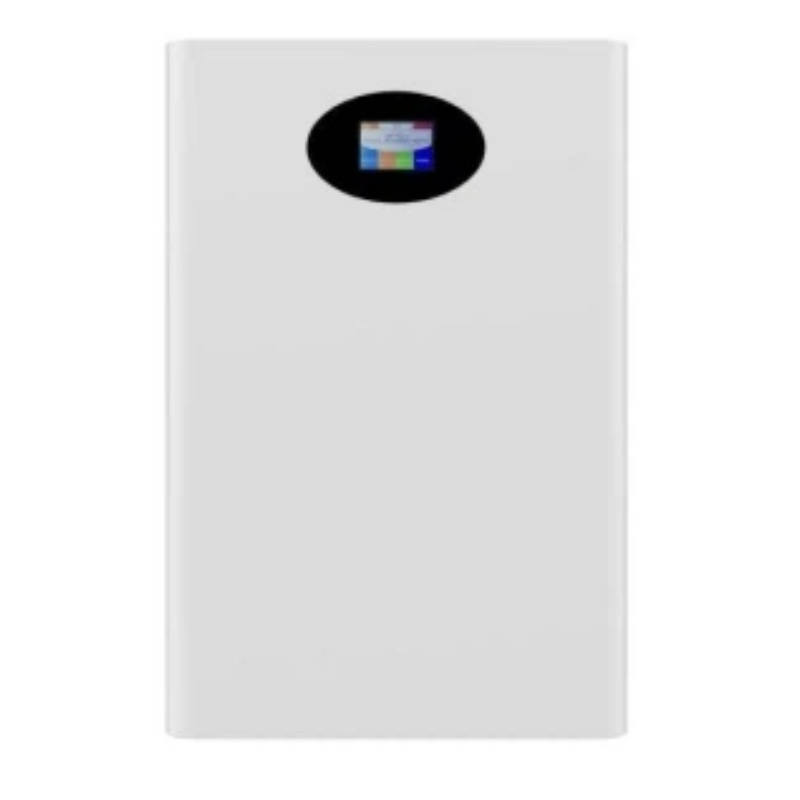
Wall-mounted 51.2 V / 100 Ah LiFePO4 storage battery in the 48 V nominal class, listed by HCC at 48 kg.
1. Definition: The 48 V Class, the 51.2 V Reality
The '48 V' in 48V lithium ion battery is a class name inherited from lead-acid conventions, not a precise operating voltage. A LiFePO4 cell sits at roughly 3.2 V nominal, so sixteen cells in series produce 51.2 V nominal. HCC publishes its wall-mounted unit as wall mount battery 48V with 51.2 V nominal, 100 Ah capacity, 20 A charge current, 100 A discharge current, a -20 to 60 °C temperature window and 48 kg mass.
That gap between label and reality matters for three groups of people. Installers need the nominal and full-charge voltage to confirm the inverter's DC window. Procurement teams need the capacity basis to compare quotes. Certification reviewers need the exact model designation so the test report matches the hardware on site. A datasheet that only says '48 V' tells you the class and nothing about the string.
Cell configuration adds a second layer. HCC lists its wall unit and its 5 kW wall mounted battery as 16S1P, meaning sixteen cells in series with a single parallel string. The configuration explains why the capacity figure equals the cell capacity: there is no parallel multiplication, only voltage stacking.
2. Problem Definition: Three Specification Traps
Most 48V wall mount storage battery projects fail on paperwork rather than on hardware. Three traps account for a large share of the mismatch between expectation and delivery.
Trap 1 — Treating 48 V as a fixed number
A 48 V class pack is typically 51.2 V nominal, and its charge voltage sits above that. If a specification is written as '48 V system, 48 V charger', the inverter and charger settings may not align with the pack's actual nominal voltage. HCC's 48 V class products are listed at 51.2 V nominal in several configurations, which is the expected value for 16S LiFePO4 but is not literally 48.0 V.
Trap 2 — Reading the model name instead of the datasheet
Model names carry market shorthand. HCC's Wall-TW01 is named a 5kw wall mounted battery, while its published parameters list a 28148115-52Ah LiFePO4 16S1P cell, ≥6,000 cycles at 80% capacity, 10 A maximum charge current and 50 A maximum continuous discharge current. None of those four figures can be derived from the name. A buyer who orders on the name alone has no basis to check whether the pack can start an inductive load or absorb a given PV array current. Always request the full datasheet with nominal voltage and usable capacity before design freeze.
Trap 3 — Comparing Ah quotes instead of kWh and amps
Capacity in Ah only becomes comparable once it is multiplied by nominal voltage. At 51.2 V nominal, a 100 Ah pack corresponds to roughly 5.1 kWh of nominal energy, and a 200 Ah pack to roughly 10.2 kWh. Two suppliers quoting '200Ah lithium battery' can therefore be quoting different true energy, different continuous current and different mass. Normalise every quote into three columns: kWh nominal, continuous discharge amps, and certified standard.
3. Industry Background: Why Wall-Mount Storage Grew
Battery energy storage has moved from utility pilot projects into residential and small commercial buildings, and the wall-mounted format followed the demand. Grand View Research estimates the global Battery Energy Storage System market at approximately USD 13.2 billion in 2025, projected to reach USD 99.7 billion by 2033, with lithium-ion chemistries accounting for 53.5% of the total in 2025. Published market sizes vary widely by scope — some analysts count grid-integrated systems only, others include total battery production — so market figures should be used to understand direction, not to size a purchase.
The wall-mounted format answers a practical constraint: floor area. A residential installation usually happens in a garage, utility room or external cabinet where floor space is already committed to the inverter, meter and consumer unit. Hanging a 44–48 kg pack on a structural wall keeps the footprint at the width of the unit, shortens DC cable runs to the inverter, and keeps the pack out of standing water. The trade-off is structural: the wall, the bracket and the lifting plan all have to be assessed before installation, and heavier units change that assessment.
Regulation shapes the category as much as architecture. IEC 62619:2022 is the current international safety standard for lithium-ion batteries in industrial and stationary applications and covers thermal runaway behaviour and BMS verification. In North America, UL 1973 is the primary safety standard for stationary batteries in solar energy storage and UPS applications. For cross-border movement, UN 38.3 is mandatory for lithium battery transport and requires eight tests, including altitude simulation and thermal testing. These are the documents an installer or procurement reviewer should expect to see attached to a model number, not to a brand.
4. Anatomy of a 48V Wall Mount Storage Battery
Reading a wall-mount datasheet becomes straightforward once you know which parameters are structural, which are commercial, and which are simply absent unless you ask.
Cells and chemistry
LiFePO4 is the dominant chemistry in this format. HCC lists LiFePO4 (LFP) across its 48 V class wall units and solar battery packs, with cell formats such as the 16S1P string used in the wall-mounted models. Chemistry determines the voltage curve and the thermal profile; it does not, by itself, tell you the continuous current capability of the finished pack.
Energy content and capacity
Nominal energy is voltage multiplied by capacity. HCC's 51.2 V / 100 Ah configurations correspond to roughly 5.1 kWh nominal, and the 51.2 V / 200 Ah configuration to roughly 10.2 kWh nominal. Nominal energy is not the same as usable energy: the depth of discharge permitted by the BMS and inverter settings determines what the customer can actually draw. Ask for the usable kWh figure that the supplier will support in writing.
The two current limits, which are rarely symmetric
Charge current and discharge current are separate ratings, and in wall-mounted packs they are often far apart. HCC's wall mount battery 48V lists 20 A charge and 100 A discharge; its solar battery backup (51.2 V / 105 Ah) lists 18 A charge and 120 A discharge; the 5kw wall mounted battery Wall-TW01 lists 10 A charge and 50 A continuous discharge. The asymmetry is the point: a pack can be sized to run a load continuously while accepting only a modest PV charge current. Sizing a PV array against the discharge figure is a common and expensive error.
Thermal window
HCC's 48 V class residential units are published at -20 to 60 °C, with the 48 V / 280 Ah pack at -10 to 60 °C. The window is an operating range, not a performance guarantee: capacity and charge acceptance at the extremes differ from room temperature, and charge protection at low temperature is a BMS function rather than a cell property.
Mass and mounting
A 100 Ah wall unit is around 45–48 kg in HCC's listings; the 51.2 V / 200 Ah pack is about 88 kg, and the 48 V / 280 Ah pack about 130 kg. Doubling capacity roughly doubles mass, which changes lifting equipment, bracket specification and handling at the destination. It also changes freight: mass affects packaging, palletisation and, for lithium cells, the documentation attached to the shipment.
Cycle rating
HCC publishes ≥6,000 cycles at 80% capacity across the wall-mounted, pack and 200 Ah product lines. Always read the cycle figure together with its end-of-test condition (80% capacity here), because a cycle count without a retention threshold is not comparable across suppliers.
What the datasheet usually does not tell you
BMS behaviour, inverter communication protocol support, ingress protection class and enclosure material are frequently absent from summary specifications. These gaps matter more than the headline figures for a real installation. If a parameter is not published, it should become a written question in the RFQ rather than an assumption in the design.
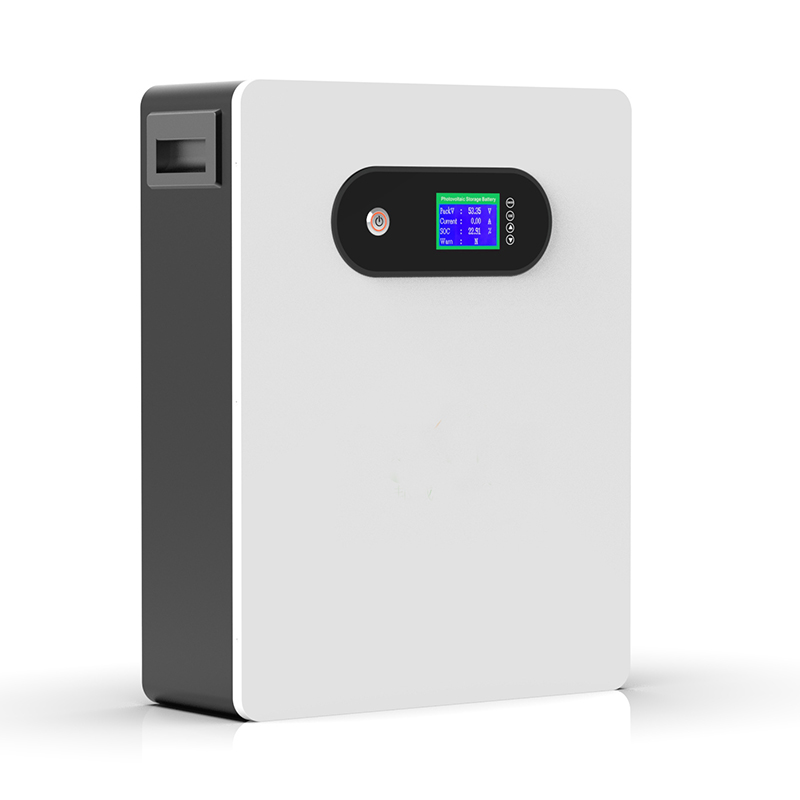
HCC Wall-TW01, marketed as a 5 kW wall mounted battery: LiFePO4 16S1P, ≥6,000 cycles at 80% capacity, 10 A max charge, 50 A max continuous discharge.
5. HCC's 48 V Class and 200 Ah Configurations
Shenzhen Topway New Energy Co., Ltd. (HCC) is a Shenzhen-based battery manufacturer and solution provider whose main business is energy storage batteries and lithium-ion batteries. The company was established in 2022, operates a 10,000 m² facility with about 200 employees and a 15-person R&D team, and exports to markets including the USA, Germany, the UK, France, Japan, Korea, Australia and Canada. Related products have passed RoHS, UL and CE export certifications.
Within the 48 V class, HCC publishes several configurations that buyers commonly compare:
- wall mount battery 48V (51.2 V / 100 Ah) — 20 A charge, 100 A discharge, -20 to 60 °C, 48 kg, LFP, positioned for residential solar BESS.
- 51.2 V / 100 Ah home storage unit — 20 A charge, 100 A discharge, -20 to 55 °C, 48 kg.
- solar battery backup (51.2 V / 105 Ah) — 18 A charge, 120 A discharge, -20 to 60 °C, 45 kg, positioned for industrial UPS duty.
- energy storage battery system (51.2 V / 100 Ah) — 100 A charge, 100 A discharge, -20 to 60 °C, approximately 44 kg, positioned for home storage.
- Solar battery 200Ah (51.2 V / 200 Ah) — 100 A charge, 200 A discharge, -20 to 60 °C, approximately 88 kg.
- solar battery pack (48 V / 280 Ah) — 100 A charge, 200 A discharge, -10 to 60 °C, approximately 130 kg.
Two further models are worth separating from the wall-mount family. The 200ah lithium battery (200AH-TW01) and the solar battery pack (SolarBP-TW01) are published with max discharge and cycle ratings rather than a wall-mount enclosure description, and the pack uses a 47173120-100Ah LiFePO4 16S1P cell with 20 A max charge and 100 A max continuous discharge. Buyers who need a wall-hung enclosure should confirm the housing and bracket as part of the RFQ rather than inferring it from the capacity.
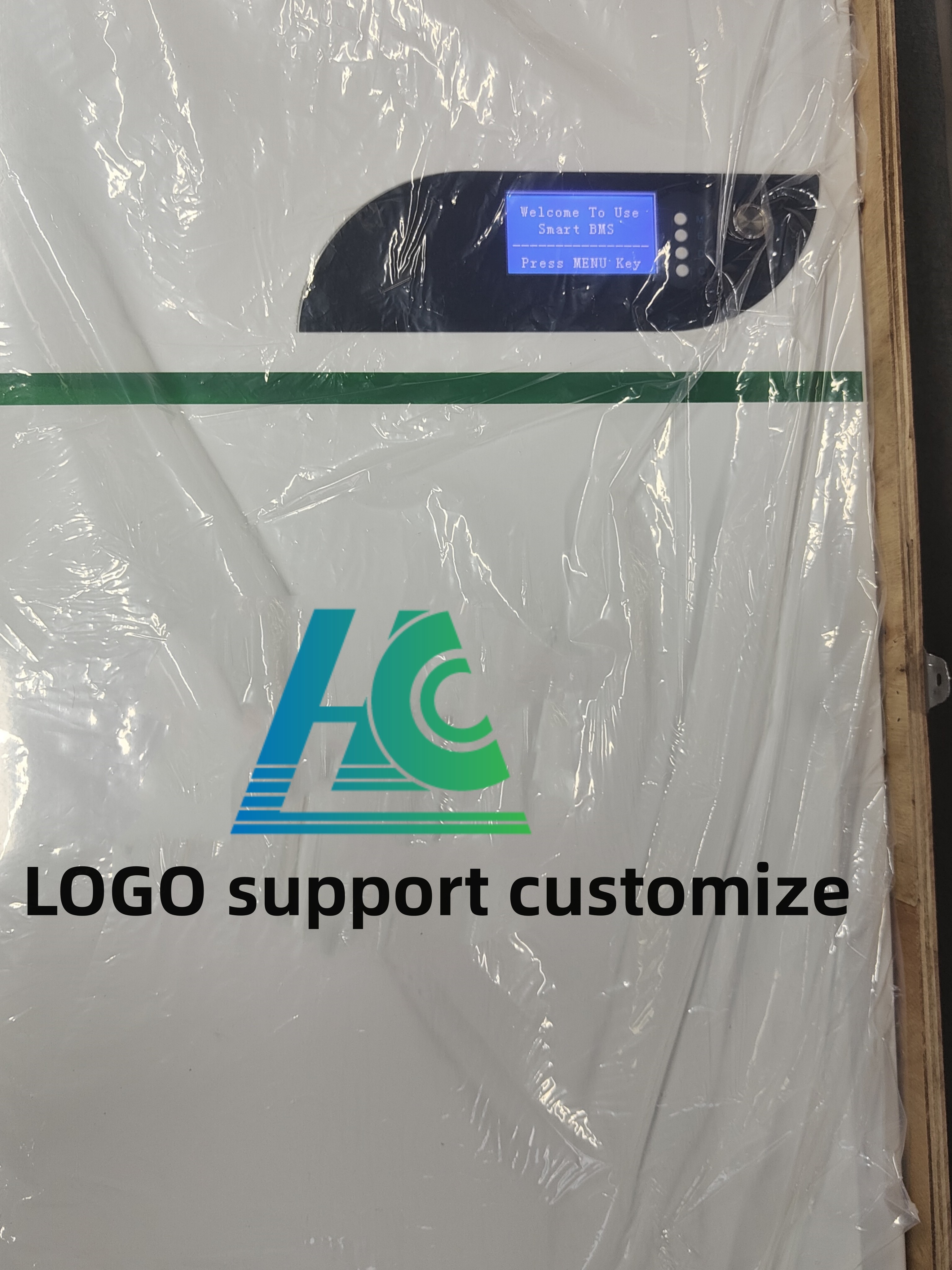
HCC 51.2 V / 200 Ah LiFePO4 solar battery: 100 A charge, 200 A discharge, approximately 88 kg.
6. Step-by-Step: Specifying a 48V Wall Mount Battery
The sequence below turns a vague requirement into a checkable specification, and it works in the same order whether the project is a single home or a batch for a distributor.
- Quantify the load and the backup window. List the circuits that must stay live and their average draw in watts, then multiply by the hours required. This gives a usable-energy target in kWh before any product is considered.
- Confirm the inverter DC window. Check the inverter's permitted battery voltage range against the pack's nominal and charge voltage. A 48 V class pack is 51.2 V nominal in most 16S LiFePO4 builds, so the inverter settings must be written for 51.2 V, not 48.0 V.
- Convert the target energy into capacity at nominal voltage. Divide the kWh target by the nominal voltage, then add the reserve the depth-of-discharge policy requires. This is where a 100 Ah and a 200 Ah unit separate cleanly: roughly 5.1 kWh versus 10.2 kWh at 51.2 V nominal.
- Check continuous discharge current against the inverter's maximum draw. The inverter's peak draw, not the battery's name, sets the floor. Compare it with the published maximum continuous discharge current — 50 A on Wall-TW01, 100 A on the 100 Ah wall unit, 200 A on the 200 Ah pack.
- Check charge current against the PV side. If the charge controller can deliver more than the pack accepts, the array will be curtailed. HCC's wall-mounted units list charge limits of 10 A, 18 A or 20 A depending on model, which is a separate constraint from the discharge rating.
- Verify the physical and thermal plan. Confirm wall structure and bracket for the unit's mass (45–48 kg for 100 Ah, about 88 kg for 200 Ah), the ambient temperature range against the published window, and cable routing to the inverter.
- Lock the compliance and logistics documents. Request the certificate set for the exact model (IEC 62619:2022, UL 1973 where the market requires it, UN 38.3 for transport) plus the datasheet revision that the sample was built to.
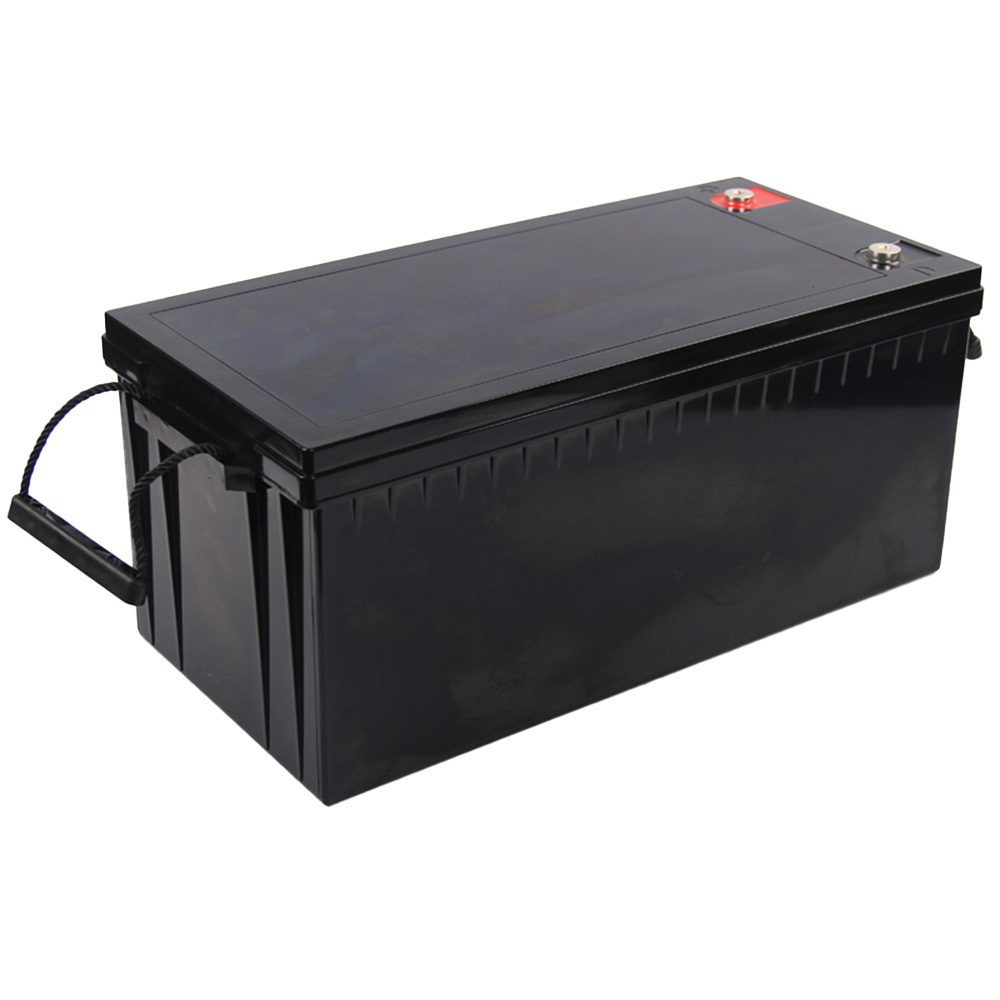
LiFePO4 solar storage battery pack: the same cell platform is offered in wall-mount, pack and higher-capacity formats.
7. Use Cases: Where the Format Fits
The wall-mount 48 V format is a low-voltage building block, and it performs best where the loads are modest and the installation space is tight.
- Residential solar backup. A single wall unit next to a hybrid inverter covers lighting, communications and refrigeration circuits during an outage. Multiple units in parallel extend the window rather than the instantaneous current, so the inverter's draw must be checked unit by unit.
- Small commercial resilience. Retail counters, clinics and offices use 48 V packs for point-of-load backup. Note the scale boundary: HCC's small commercial and industrial energy storage scenario is described as a 100 kWh to 5 MWh configuration for peak shaving and backup, which is a different architecture from a single wall-mounted residential pack. Wall units serve circuits; they do not replace a containerised BESS.
- UPS and industrial standby. The 51.2 V / 105 Ah configuration is positioned for industrial UPS duty with a 120 A discharge rating, which suits short high-current events rather than long energy shifts.
- Marine, RV and specialty DC platforms. The 48 V / 100 Ah storage battery is listed for marine, RV, forklift and UPS applications, where a 47 kg pack with a -20 to 55 °C window is a workable compromise.
- Off-grid and remote cabinets. Where grid charging is intermittent, the charge current limit becomes the binding constraint, because the array must be sized to what the pack will accept, not to what the panels can produce.
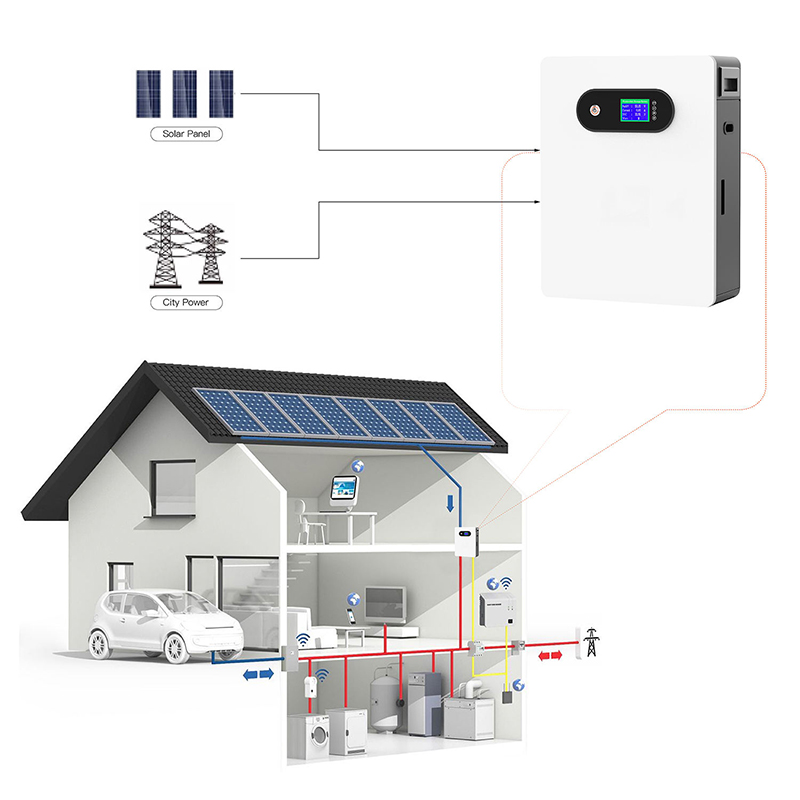
Residential home energy storage: wall-mounted packs keep floor space free and shorten DC cable runs to the inverter.
8. Comparison Tables
The two tables below use published HCC specifications only. They are intended to show how much variation hides behind a shared voltage class.
Table 1 — 48 V class storage models
| Model / listing | Nominal voltage | Capacity | Max charge current | Max continuous discharge | Temperature | Weight | Material |
|---|---|---|---|---|---|---|---|
| wall mount battery 48V (51.2v 100ah) | 51.2 V | 100 Ah | 20 A | 100 A | -20 to 60 °C | 48 kg | LFP |
| 51.2V 100Ah home storage | 51.2 V | 100 Ah | 20 A | 100 A | -20 to 55 °C | 48 kg | LiFePO4 |
| solar battery backup (51.2V 105AH) | 51.2 V | 105 Ah | 18 A | 120 A | -20 to 60 °C | 45 kg | LFP |
| 48v lithium ion battery (48V 100AH) | 48 V listed / 51.2 V in spec | 100 Ah | 20 A | 100 A | -20 to 60 °C | 48 kg | LFP |
| energy storage battery system (51.2v 100ah) | 51.2 V | 100 Ah | 100 A | 100 A | -20 to 60 °C | approx. 44 kg | LiFePO4 |
| Solar battery 200Ah (51.2v 200ah) | 51.2 V | 200 Ah | 100 A | 200 A | -20 to 60 °C | approx. 88 kg | LiFePO4 |
| solar battery pack (48V 280Ah) | 48 V | 280 Ah | 100 A | 200 A | -10 to 60 °C | 130 kg | LiFePO4 |
Table 2 — Wall-TW01 (5 kW wall unit) vs SolarBP-TW01 (solar pack)
| Parameter | Wall-TW01 — 5kw wall mounted battery | SolarBP-TW01 — solar battery pack |
|---|---|---|
| Cell format | 28148115-52Ah LiFePO4 16S1P | 47173120-100Ah LiFePO4 16S1P |
| Cycle rating | ≥6,000 cycles / 80% capacity | ≥6,000 cycles / 80% capacity |
| Max charge current | 10 A | 20 A |
| Max continuous discharge current | 50 A | 100 A |
| Material | LiFePO4 | LiFePO4 |
| Stated application | Solar | Manufacturing |
Two observations follow directly from the tables. First, charge current varies by a factor of five across models that a buyer might treat as interchangeable — 10 A on Wall-TW01 versus 100 A on the 51.2 V / 200 Ah pack. Second, a heavier pack is not automatically the better choice for a wall installation, because mass drives bracket design and handling. The correct unit is the one whose discharge current exceeds the load and whose charge current matches the source.
9. Datasheet Checklist Before You Approve a Sample
Use this list to convert a supplier conversation into an auditable record. Every item is a question the supplier should answer in writing against a specific model number.
- Nominal voltage and charge voltage, stated separately from the product name.
- Capacity in Ah and nominal energy in kWh, with the depth-of-discharge policy stated.
- Maximum continuous discharge current, and the peak current with its duration.
- Maximum charge current, and whether it is limited by the BMS or the cells.
- Operating temperature window for charge and for discharge, listed separately.
- Mass, enclosure dimensions and mounting method.
- Cycle rating with its end-of-test capacity threshold.
- Certificate set for the exact model: IEC 62619:2022, UL 1973 where applicable, UN 38.3 test summary for transport, plus RoHS, UL and CE where the market requires them.
- Datasheet revision number, so the sample and the production batch can be tied to the same document.
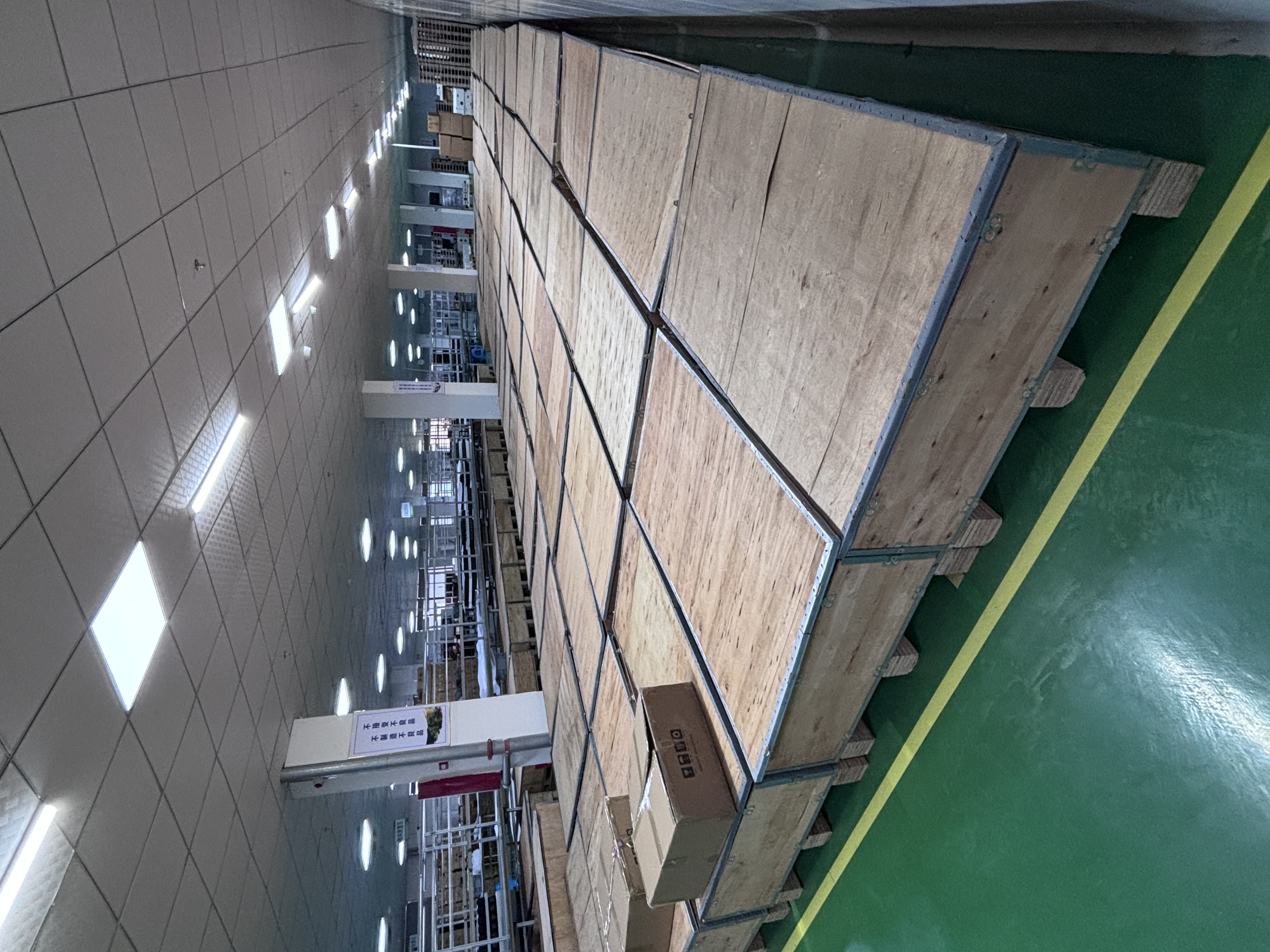
Shenzhen Topway New Energy Co., Ltd. (HCC) operates a 10,000 m² facility with a 15-person R&D team; related products hold RoHS, UL and CE export certifications.
10. FAQ
What certifications and standards should a 48V wall mount storage battery meet?
Three layers apply. For cell and system safety in stationary use, IEC 62619:2022 is the current international standard and covers thermal runaway behaviour and BMS verification. In North America, UL 1973 is the primary safety standard for stationary batteries in solar energy storage and UPS applications. For transport, UN 38.3 is mandatory for lithium batteries and requires eight tests, including altitude simulation and thermal testing. At supplier level, HCC states that related products have passed RoHS, UL and CE export certifications. Ask for the certificate that carries the exact model number, and check that the issuing body and standard revision are visible rather than represented by a logo.
Can a 5 kW wall mounted battery run a home during an outage?
The model name does not answer that question; the datasheet does. Backup duration depends on usable energy versus load, and load-starting capability depends on continuous discharge current. HCC's Wall-TW01 lists 10 A maximum charge current and 50 A maximum continuous discharge current. For scale, a 51.2 V / 100 Ah configuration corresponds to roughly 5.1 kWh nominal and a 51.2 V / 200 Ah configuration to roughly 10.2 kWh nominal, with 200 A maximum continuous discharge on the 200 Ah unit. A practical check runs in three steps: confirm the inverter's DC input window against 51.2 V nominal, confirm the inverter's maximum draw sits within the pack's continuous discharge rating, then divide usable energy by average load to estimate hours. Request the full datasheet and a load-profile review before committing.
What drives the price of a 48V 200Ah solar battery?
Cost is set by specification, not by the Ah label. The main drivers are the cell format and configuration (a 16S1P string with 100 Ah cells behaves differently from a 52 Ah build), the true energy content (capacity multiplied by 51.2 V nominal), the continuous current capability — a 200 A-capable pack needs more conductor and busbar capacity than a 100 A pack — the cycle rating (HCC publishes ≥6,000 cycles at 80% capacity), the enclosure and thermal design, the certification scope, and logistics, where an approximately 88 kg unit carries different packaging and handling requirements from a 48 kg unit. Because two suppliers can both quote '200Ah' against different voltage, current and certification assumptions, normalise every offer into kWh, continuous amps and standards before comparing price.
Can we validate a sample before placing a volume order?
Yes, and the validation should be tied to a specific model number and datasheet revision. A useful sample test records the achieved capacity at the rated discharge current, voltage behaviour under load, temperature rise during charge and discharge, and a documentary check that the nameplate, the cycle rating and the certificate set match the datasheet. Sample and quotation requests for HCC storage batteries can be sent to sales@hcctop.com or through the WhatsApp contact listed below, quoting the model, the required quantity and the destination market so the correct certification set is included.
How should lead time be confirmed for a 48V wall mount battery order?
Ask for lead time in writing, per model and per quantity tier, and tie it to two gates: sample approval and certification-document release. The two are linked, because sea freight of lithium batteries requires the UN 38.3 test summary and correct dangerous goods documentation, and a missing document delays a shipment more than production does. Model choice affects handling as well — a 100 Ah wall unit at around 45–48 kg and a 200 Ah unit at approximately 88 kg need different palletising and lifting arrangements. Confirm the Incoterm, packaging specification and document pack alongside the date so the schedule holds at the port, not just at the factory gate.
11. Conclusion
A 48V wall mount storage battery is a low-voltage LiFePO4 pack that hangs on a wall and runs at 51.2 V nominal in a 16-cell configuration. What separates a workable design from an expensive correction is documentation discipline: nominal voltage stated separately from the class label, energy converted from Ah into kWh, continuous discharge current checked against the inverter, charge current checked against the PV source, mass checked against the wall, and certificates tied to the model number.
The published HCC range shows why that discipline pays. Within one 48 V class, charge current ranges from 10 A to 100 A, discharge current from 50 A to 200 A, and mass from about 44 kg to 130 kg. None of those differences appears in a product name. They appear in the datasheet, and they are the numbers an installer, distributor or procurement reviewer should put in the RFQ before the first sample ships.
Next step: download the HCC product catalogue for full model specifications, or send your load profile, inverter DC window and destination market to request a matched 48V wall mount or 200 Ah configuration and a sample.
Catalogue (PDF): HCC Storage Battery Catalogue
Website: www.hcctop.com
Email: sales@hcctop.com | Phone: 0755-81461866
WhatsApp: +86 18682160604
Shenzhen Topway New Energy Co., Ltd. (HCC) — 1001, Unit 1, Building 2, Fangge Fenghuang Science and Technology Building, Guangshen Road NO. 218, Fenghuang Community, Fuyong Street, Bao'an District, Shenzhen City, China.
Have Questions or Need More Details?
Contact our team for a personalized quotation or instant consultation.
Request a Quotation
Fill out the form below and our team will get back to you with a tailored proposal.
WhatsApp Direct Chat
Prefer to chat in real-time? Message us on WhatsApp for instant assistance & quick answers.
- Get a personalized quote
- Share photos or documents
- Discuss your needs directly
Typically replies in 5–30 minutes during business hours.