Expanded Metal vs. Woven Wire Mesh: A Buyer's Comparison for Architectural Projects
Architectural metal mesh for facades, ceilings, and partitions is normally specified from one of two families: expanded metal or woven wire mesh. Both are metal, both read as mesh in a rendering, and both can be supplied in stainless steel or aluminium with a coated finish. They are not interchangeable. Expanded metal is a rigid panel formed from a single sheet, so its pattern, open area, and span behaviour are set by tooling. Woven wire mesh is built from individual wires, so it stays flexible enough to tension, drape, and curve. This comparison sets out the differences that actually change a specification - rigidity, transparency, pattern, fabrication flexibility, installation complexity, cost drivers, and compliance documentation - using Jumao's published expanded metal facade cladding and stainless steel woven wire mesh data as the reference examples.
Problem Definition: Why the Mesh Family Should Be Settled Before Procurement
The mesh family is usually chosen early for visual reasons and re-examined late for engineering reasons, which is where projects lose time. A rigid expanded panel that was drawn as a soft, draped screen cannot be re-shaped on site. A flexible woven mesh specified for a large flat facade needs a tension or frame system to hold it flat, plus edge detailing that a rigid panel does not require.
Three consequences appear repeatedly in facade, ceiling, and partition packages:
- Structural mismatch. Expanded metal carries its own rigidity, while woven wire mesh relies on its fixing system for flatness and wind resistance.
- Transparency mismatch. Open area and aperture size determine daylight, privacy, and solar control. Two mesh families that look similar in a render can behave very differently once installed.
- Compliance mismatch. Woven products are typically documented against woven wire cloth and stainless steel material standards, while expanded products follow expanded metal guidance. The certificate scope has to name the product actually supplied.
A buyer who settles the family before procurement can compare suppliers on equal terms: same material grade, same aperture, same surface finish, same fixing system, same documentation.
Industry Background: Market Signals and the Standards Buyers Are Asked to Meet
Architectural mesh is a growing but fragmented category, and published market figures differ depending on how the segment is defined. Reports and Data values the global architectural metal mesh panel market at USD 1.2 billion in 2024, projected to reach USD 2.5 billion by 2034. Growth Market Reports estimates the metal mesh facade market at USD 10.59 billion by 2034, growing at a CAGR of 6.2%. The two figures describe different scopes - panels versus the wider facade segment - so they are best quoted with their source rather than blended.
On the supply side, Market Research Future identifies Asia-Pacific as the fastest-growing region for facade systems, including metal mesh, driven by urbanisation and infrastructure investment. The Anping wire mesh cluster in Hebei, China, hosts more than 3,600 specialised factories as of late 2024, according to Anping County industry statistics, and IBISWorld estimates China at roughly 65% of global wire mesh supply. China's export value for steel wire products, including wire mesh, reached USD 14.5 billion in 2024 according to Global Growth Insights. Within the category, woven wire mesh is the largest product segment, accounting for approximately 43.2% of total metal mesh revenues in 2025 according to Dataintelo.
Standards determine what a buyer can actually specify and sign off. Haver & Boecker notes that architectural mesh for facades often adheres to ASTM E2016, the standard specification for industrial woven wire cloth. European stainless steel material specifications commonly reference EN 10088. In the United States, expanded metal in architecture is governed by standards set by the National Association of Architectural Metal Manufacturers (NAAMM) EMMA division. Material practice is consistent across sources: Grade 316 stainless steel is typically specified for exterior corrosive environments, and Grade 304 for interior applications.
Detailed Solution: How Each Family Behaves in a Real Specification
Expanded metal: rigidity from a single sheet
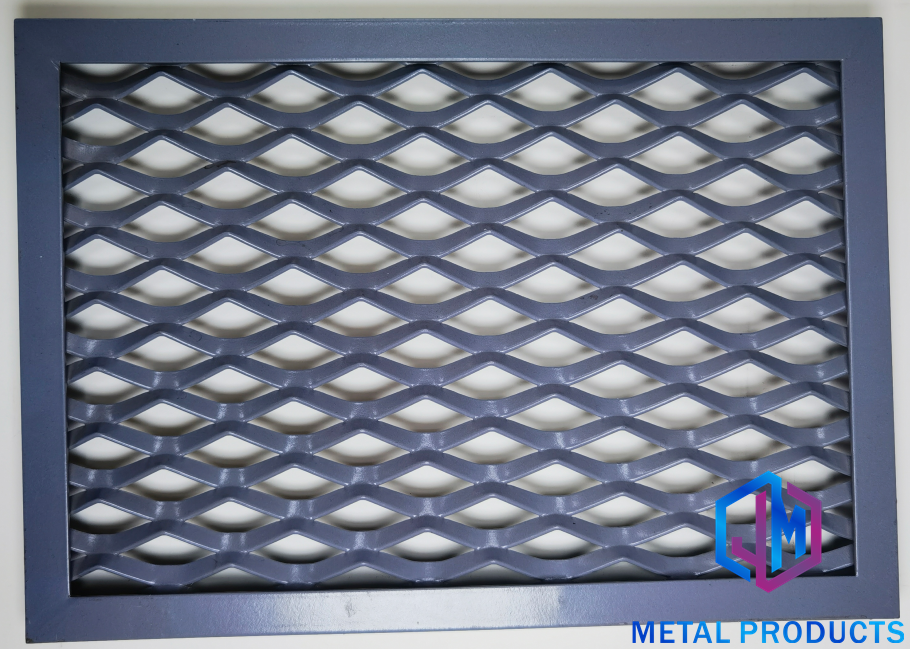
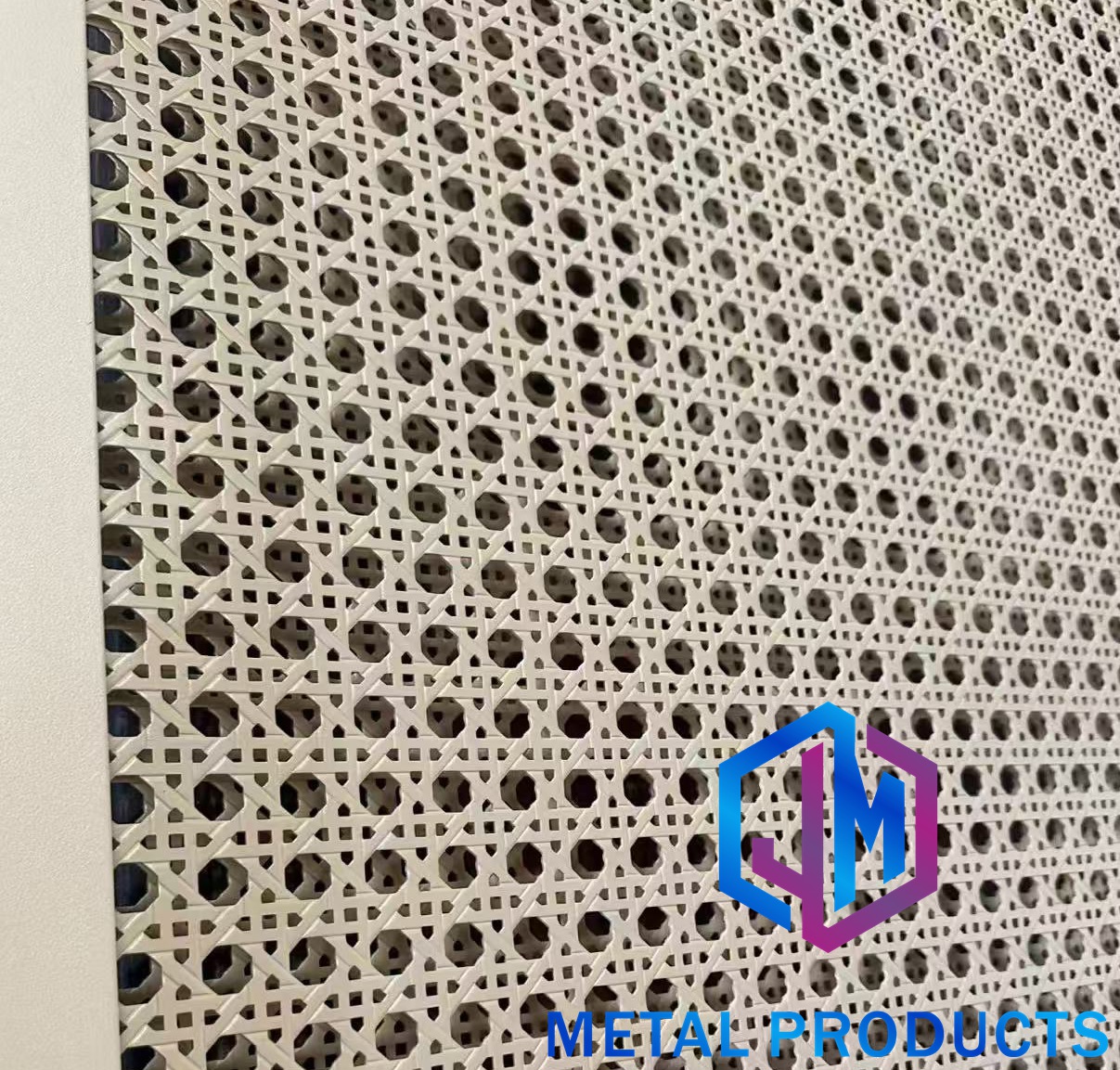
Expanded metal is produced by slitting and stretching a metal sheet into a diamond or similar aperture, so the panel remains one continuous piece with no joints. Jumao's expanded facade range is based on aluminium alloy 3003 for most cladding and shading products, and aluminium alloy 1100 for heavy-duty and facade-system products. Representative published specifications include:
- JM-E-573 expanded metal facade cladding: aluminium alloy 3003, sheet thickness 2-4 mm, opening size 20 mm x 48 mm, open area 35%-55%, panel width customized, PVDF fluorocarbon coating; intended for building facades, curtain wall, industrial buildings, and public architecture.
- JM-E-529 expanded metal mesh panel: 2.0-4.0 mm aluminium sheet, mesh opening 20 mm x 48 mm, strand width 6-10 mm, open area 35%-60%, PVDF coating or powder coating, panel size customized; intended for building facades, curtain wall, airport buildings, and commercial complexes.
- JM-E-529 architectural shading metal mesh: aluminium thickness 2-4 mm, opening ratio 30%-60%, PVDF or powder coating, lightweight structure, customized perforation patterns; intended for energy-efficient buildings, commercial facades, and office buildings.
- JM-E-8023 heavy-duty expanded metal panel: thickness 3-6 mm, customized opening size, rigid structure for heavy-load applications, surface coating available; intended for industrial buildings, walkways, platforms, and safety applications.
- JM-E-1067 aluminium diamond mesh: material thickness 2-4 mm, customized diamond opening, strand width 5-10 mm, open area 30%-70%, powder coating; intended for facade cladding, fence systems, and interior decoration.
Woven wire mesh: flexibility from wire
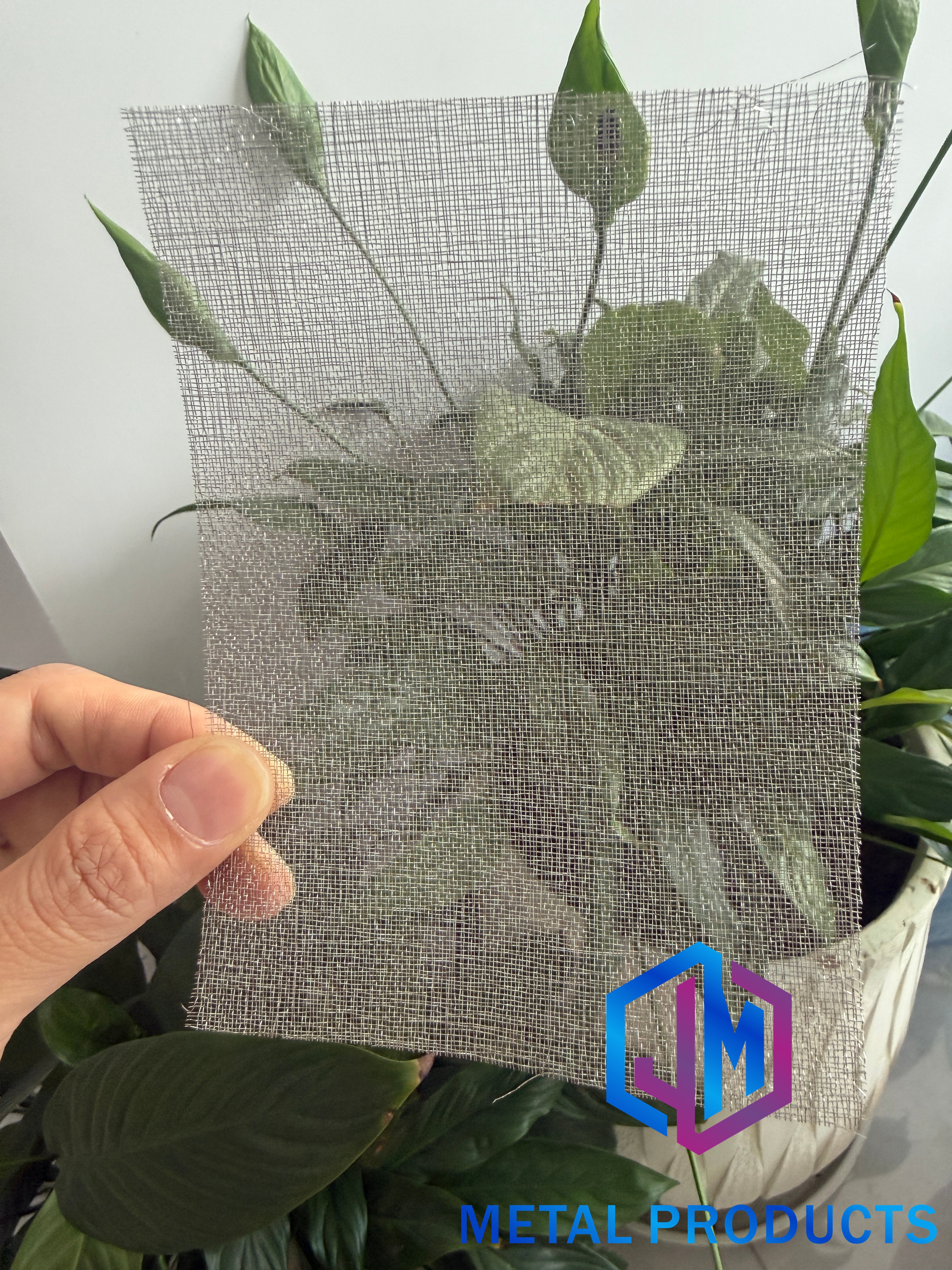
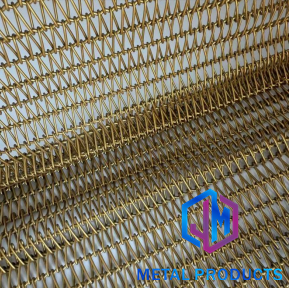
Woven wire mesh is produced on looms from individual wires, which gives the sheet a textile-like behaviour: it can be tensioned, draped, curved, and hung from tracks. Jumao's woven range covers plain-weave decorative mesh, fine mesh, coloured and coated mesh, curtain wall mesh, cable mesh, ring mesh, and coil drapery.
- JM-C-1083 stainless steel woven wire mesh: wire diameter 1-2 mm, opening 28%-48%, stainless steel 304, customized opening size, plain weave; intended for architectural decoration, ceiling design, interior partitions, and facades.
- JM-C-1080 architectural decorative metal mesh: stainless steel 304 or aluminium, wire diameter 1.4 mm x 2.5 mm, antique copper finish, panel size customized according to project requirements.
- JM-LG-037 fine decorative wire mesh: wire diameter 0.3-1 mm, 20-100 mesh count, plain weave, lightweight, customized sizes; intended for interior decoration, furniture design, and display systems.
- JM-C-1045 bronze colour decorative metal mesh: stainless steel 304 base, wire diameter 1-3 mm, customized 2.4 mm thickness, bronze, champagne, or gold colour, corrosion-resistant surface finish; intended for luxury hotels, commercial interiors, high-end retail, and architectural decoration. The titanium-coated variant uses a stainless steel 316 substrate with titanium coating in black, bronze, or gold.
- JM-W-077 architectural metal mesh curtain wall: stainless steel 304 or 316, wire diameter 1-3 mm, customized mesh opening, transparency 40%-80%, frame fixing or tension system, natural, brushed, or PVD finish; intended for commercial buildings, office towers, cultural buildings, and shopping centres.
- JM-W-014 stainless steel facade cable mesh and JM-w-013 architectural cable mesh: stainless steel 316, cable diameter 1.5-3 mm, tension fixing system, flexible structure, customized panel size, and custom shapes.
- JM-M-907 metal coil drapery: stainless steel 304 or aluminium, wire diameter 1.0-1.5 mm, coil diameter 3-15 mm, opening ratio 50%-80%, track hanging system, customized height.
Rigidity, span, and panel sizing
The practical difference shows up in panel format. A rigid expanded panel can be delivered as a flat module fixed to an aluminium sub-frame: the JM-E-529 architectural metal mesh facade system, for example, uses an aluminium frame fixing system with customized mesh thickness and panel width and an optional PVDF finish. A woven panel needs support to stay flat: the JM-W-077 system is installed with frame fixing or a tension system, and JM-W-014 cable mesh uses tension fixing with a customized panel size. Where a project requires a continuous draped or curved surface, woven mesh, cable mesh, and coil drapery are the natural choice.
Transparency and open area
Open area determines daylight, visibility, and solar performance, and it is one of the few values that can be compared directly between families. Published figures for Jumao products include expanded metal open area of 35%-55% (JM-E-573), 35%-60% (JM-E-529 panel), 30%-70% (JM-E-1067), and 30%-60% for the shading mesh; woven mesh opening of 28%-48% (JM-C-1083), transparency of 40%-80% (JM-W-077), and an opening ratio of 50%-80% for coil drapery. Cambridge Architectural notes that architectural sun shading metal mesh can reduce solar heat gain by up to 50% depending on the mesh aperture and material, which is why aperture - not mesh family alone - should drive a shading calculation.
Visual pattern
Expanded metal produces a directional pattern. The 20 mm x 48 mm opening of the JM-E-573 and JM-E-529 panels reads as an elongated diamond, with strand widths of 6-10 mm (JM-E-529) or 5-10 mm (JM-E-1067), and the diamond opening itself can be customized on JM-E-1067. Woven mesh produces a square or textile-like grid: plain weave on JM-C-1083 and JM-LG-037, a 1.4 mm x 2.5 mm wire combination on JM-C-1080, with colour coming from finishes such as antique copper, bronze, champagne, gold, or titanium coating rather than from the weave structure.
Fabrication flexibility
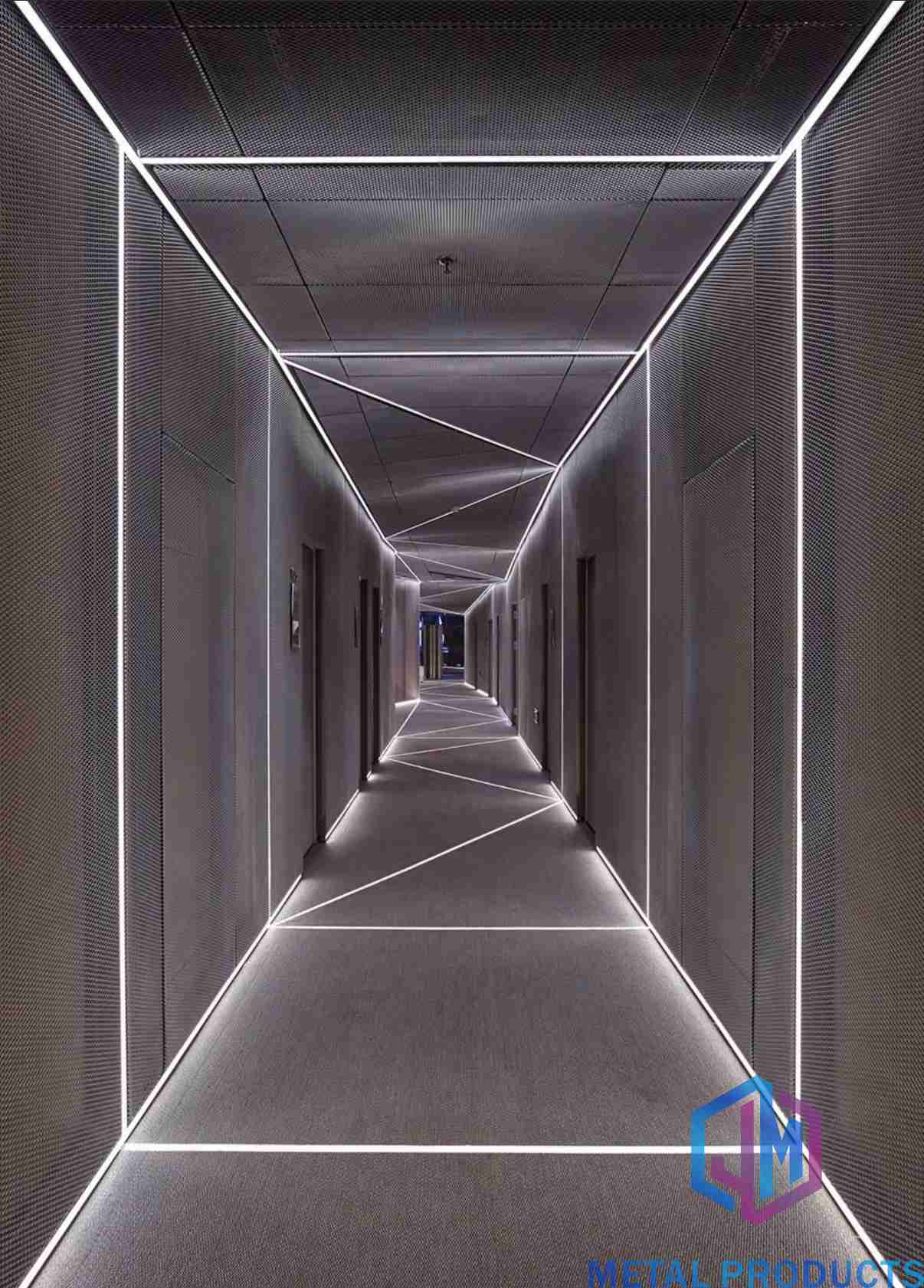
Both families are cut and framed to project dimensions, but the flexibility is different in kind. Rigid expanded panels can be cut, bent, and formed, then fixed to frames. A commercial space design project in China used 420 units of diamond-pattern expanded mesh for corridor wall cladding, ceiling decorative panels, counter facade cladding, and partition screens, with customized mesh opening size, lightweight aluminium substrate, and easy cutting and bending forming. Woven mesh can be cut, curved, and hung: a UK interior joinery contractor used woven mesh as cabinet door inserts and display cabinet partitions with a custom diamond weave, brass antique finish, and easy cutting. Curved or shaped work is normally where woven mesh is selected, because the material can follow a radius that a rigid expanded panel cannot.
Installation complexity
Expanded metal installation is a frame-and-panel sequence: brackets, an aluminium sub-frame or curtain wall fixing accessories, then flat panels. Woven mesh adds a tensioning step where a taut surface is required, or a track step where the mesh is hung. Published Jumao systems reflect this: frame mounting, direct fixing, or tension system on the integrated facade solution; frame fixing or tension system on JM-W-077; tension fixing on JM-W-014; fixed frame on the JM-C-1013 partition mesh; and a ceiling track system on JM-M-907 and the JM-R-4205 ceiling hanging mesh curtain. In ceiling applications, hanging systems carry the mesh weight to the structure above, which is why flexible mesh systems are common in atriums, airports, shopping malls, and hotel lobbies.
Cost drivers
Neither family has a single list price; both are quoted from a specification. The cost drivers a buyer can control are material grade (stainless steel 316, stainless steel 304, aluminium alloy 3003 or 1100, brass, or copper), sheet thickness or wire diameter, open area and strand width, panel dimensions and cutting waste, surface finish (PVDF fluorocarbon coating, powder coating, anodizing, PVD, or antique finish), frame structure, edge treatment and fixing system, inspection requirements, order quantity, and packaging. Expanded metal starts from a sheet and a tooling set, while woven mesh starts from wire and weaving, so the two are rarely comparable until these variables are normalised in the same inquiry.
Compliance and documentation
Compliance is where the two families diverge most clearly in paperwork. Jumao holds a Certificate of Conformity (EU-CPR), certificate number CTB160418002S-ZS, issued by Shenzhen CTB Testing Technology Co., Ltd on 25 April 2016 and valid to 31 December 2099, covering Metal Mesh Curtain under model JM-MMC, trade name JUMAO, with reference to EN 13830:2003. Material and product standards that projects commonly cite alongside it are EN 10088 for stainless steel materials, ASTM E2016 for industrial woven wire cloth, and NAAMM EMMA guidance for expanded metal. Buyers should confirm that the certificate scope names the product family and model being supplied, not only the manufacturer.
Step-by-Step Breakdown: A Six-Step Selection Sequence
- Define exposure and material grade. Exterior corrosive environments are typically specified in Grade 316 and interior applications in Grade 304. Jumao's woven and cable products include stainless steel 304 and 316 variants, while expanded facade products are based on aluminium alloy 3003 and 1100 with PVDF or powder coating.
- Decide rigid or flexible. If the elevation needs flat, modular panels and a simple frame, expanded metal is the fit. If it needs a draped, curved, or tensioned surface, woven mesh, cable mesh, or coil drapery is the fit.
- Set the transparency target. Choose the open area or opening percentage first, then compare products that match it: 35%-55% (JM-E-573), 35%-60% (JM-E-529), 28%-48% (JM-C-1083), or 40%-80% transparency (JM-W-077).
- Lock the pattern and finish. Confirm opening dimensions (for example 20 mm x 48 mm on expanded panels), strand width or wire diameter, and the finish: PVDF, powder coating, natural, brushed, PVD, antique copper, bronze, champagne, gold, or titanium coating.
- Confirm the compliance path. Match documentation to the product actually supplied: the CE-CPR certificate for the metal mesh curtain scope, EN 10088 for stainless steel material, ASTM E2016 for woven wire cloth, and NAAMM EMMA for expanded metal. Third-party inspection is available where a project requires it.
- Validate by sample, drawing, and schedule. A physical sample or small validation panel comes first; the minimum order quantity for Jumao architectural mesh is 1 square metre. Then confirm engineering drawings, the fixing system, and the production window: lead time is 7-60 days depending on order quantity and customization, against a monthly capacity of 5,000-10,000 square metres.
Use Cases: Facades, Ceilings, and Partitions in Practice
Facade cladding and sun shading. A Singapore architectural firm and facade engineering contractor used 3,600 m2 of architectural mesh on an office building exterior, sunshade screen, and green-plant separation layer, with lightweight aluminium structure, customized diamond mesh perforations, anti-corrosion powder coating, and good light transmittance for a tropical climate. A resort project in Indonesia applied 3,200 m2 to facade cladding and window screening, with reported outcomes of improved facade aesthetics, natural ventilation, and reduced solar heat gain. Both are expanded-metal-type facade applications where rigid panels and a sub-frame suit large flat elevations.
Ceilings and large interior volumes. Flexible mesh systems are used where a ceiling must curve, drape, or hang without a heavy grid. In a 2,300 m2 ceiling mesh curtain installation, the system used a custom curved track system with flexible installation, a draping effect, lightweight structure, and multiple available finishes. The JM-R-4205 ceiling hanging mesh curtain, with a ceiling track system and customized height, and the JM-M-907 coil drapery, with a 50%-80% opening ratio and track hanging system, are the two product families normally used for this type of volume.
Partitions and interior detail. A woven mesh partition is normally specified where semi-transparency and pattern detail matter more than structural rigidity. In Jumao project references, a China sales office used 40 units of woven mesh as a reception space divider with a bronze metal finish, good light transmission, and maintained privacy; a UK joinery contractor used fine woven mesh as cabinet door inserts and display partitions; and a residential courtyard project used 1,500 m2 of custom-fabricated stainless steel woven mesh panels for landscape screening with high transparency and effective privacy screening. The JM-C-1013 decorative metal mesh partition, with 1-2 mm wire, 5-10 mm mesh opening, and fixed frame installation, is the standard interior product for this use.
Water features and balustrades. Where mesh meets water or safety requirements, the specification shifts to stainless steel and dedicated systems. The JM-WF-7667 metal mesh water curtain is made of stainless steel 304 with a vertical hanging system and customized water flow design, for hotels, shopping centres, and public decoration projects. The JM-C-1017 metal mesh balustrade panel takes a 1-3 mm wire diameter, customizable mesh opening, and frame installation for staircases, balconies, bridges, and commercial buildings.
Comparison Table: Expanded Metal vs. Woven Wire Mesh
| Comparison criterion | Expanded metal (Jumao examples) | Woven wire mesh (Jumao examples) |
|---|---|---|
| Panel formation | Rigid, joint-free panel formed from a single sheet; directional diamond pattern | Flexible sheet built from individual wires; plain weave, cable, ring, or coil structures |
| Reference models | JM-E-573, JM-E-529 (panel, shading, facade system), JM-E-8023, JM-E-1067 | JM-C-1083, JM-C-1080, JM-LG-037, JM-C-1045, JM-W-077, JM-W-014, JM-w-013, JM-C-1013, JM-M-907 |
| Base material | Aluminium alloy 3003 (JM-E-573, JM-E-529, JM-E-1067); aluminium alloy 1100 (JM-E-8023, facade system) | Stainless steel 304 or 316; aluminium, brass, and copper options via the custom architectural mesh system |
| Thickness / wire diameter | Sheet thickness 2-4 mm (JM-E-573, JM-E-529, JM-E-1067); 3-6 mm (JM-E-8023) | Wire 1-2 mm (JM-C-1083); 0.3-1 mm fine mesh (JM-LG-037); 1-3 mm (JM-W-077, JM-C-1045); cable 1.5-3 mm (JM-W-014, JM-w-013) |
| Opening / open area | 20 mm x 48 mm opening and 35%-55% open area (JM-E-573); 35%-60% (JM-E-529); 30%-70% (JM-E-1067); 30%-60% shading (JM-E-529) | Opening 28%-48% (JM-C-1083); mesh opening 5-10 mm (JM-C-1013); 20-100 mesh (JM-LG-037); transparency 40%-80% (JM-W-077); opening ratio 50%-80% (JM-M-907) |
| Pattern detail | Strand width 6-10 mm (JM-E-529); 5-10 mm (JM-E-1067); diamond opening customized (JM-E-1067) | Plain weave (JM-C-1083, JM-LG-037); wire combination 1.4 mm x 2.5 mm (JM-C-1080) |
| Panel size and shaping | Panel width and panel size customized; rigid flat modules | Panel size customized; flexible woven system; custom shapes available (JM-w-013) |
| Fixing / installation | Aluminium frame fixing system (JM-E-529 facade system); frame mounting, direct fixing, or tension system (integrated facade solution) | Frame fixing or tension system (JM-W-077); tension fixing (JM-W-014); fixed frame (JM-C-1013); ceiling track hanging (JM-M-907) |
| Surface finish | PVDF fluorocarbon coating, powder coating; PVDF optional on the facade system; PVD available in the wider facade solution | Natural, brushed, or PVD (JM-W-077); antique copper (JM-C-1080); bronze, champagne, gold (JM-C-1045); titanium coating (JM-C-1045) |
| Typical applications | Building facade, curtain wall, industrial buildings, public architecture, airports, commercial complexes, energy-efficient facades, walkways, platforms | Architectural decoration, ceiling design, interior partitions, facades, commercial buildings, office towers, cultural buildings, luxury hotels, high-end retail, display systems |
| Typical selection logic | Large flat planes, modular cladding, solar shading, ceilings with a rigid grid, heavy-duty walkways | Draped or curved surfaces, high-transparency facades, fine decorative detail, partitions, hanging ceilings, water features |
FAQ
1. What CE documentation should a buyer request for an architectural metal mesh facade?
Ask for the Certificate of Conformity (EU-CPR) that names the product scope being supplied. Jumao holds a Certificate of Conformity (EU-CPR), certificate number CTB160418002S-ZS, issued by Shenzhen CTB Testing Technology Co., Ltd on 25 April 2016 with a validity date of 31 December 2099. The certificate covers Metal Mesh Curtain, model JM-MMC, trade name JUMAO, and references EN 13830:2003. Depending on the mesh family, projects also reference EN 10088 for stainless steel materials, ASTM E2016 for industrial woven wire cloth, and NAAMM EMMA guidance for expanded metal.
2. Can both expanded metal and woven wire mesh be customized for a project?
Yes. Jumao supplies OEM and ODM architectural mesh with customization of mesh pattern, opening size, wire diameter, material grade (stainless steel 304 or 316, aluminium, brass, copper), panel dimensions, frame structure, edge treatment, surface finish (PVDF coating, powder coating, anodizing, PVD, antique finish), RAL colours, installation system, branding and logo marking, and packaging. In the current range, JM-E-573 takes a customized panel width, JM-E-1067 takes a customized diamond opening, and JM-C-1083 takes a customized opening size.
3. What drives the cost difference between expanded metal and woven wire mesh panels?
The difference comes from material, processing, and finishing rather than from a single rate per square metre. The main cost drivers are material grade (stainless steel 316, stainless steel 304, aluminium alloy 3003 or 1100, brass, or copper), sheet thickness or wire diameter, open area and strand width, panel dimensions and cutting waste, surface finish (natural, PVDF fluorocarbon coating, powder coating, anodizing, PVD, or antique finish), the fixing system (aluminium frame, direct fixing, tension system, or ceiling track), frame and edge fabrication, inspection requirements, order quantity, and packaging.
4. Can samples be provided before a facade order is placed?
Yes. The minimum order quantity for Jumao architectural mesh is 1 square metre, which allows a physical sample or a small validation panel before full production. Pre-shipment quality control covers raw material inspection, dimensional inspection, welding quality inspection, surface finish inspection, flatness inspection, colour consistency inspection, and packaging inspection, with 100% pre-shipment quality inspection and third-party inspection available on request.
5. What lead time and production capacity should a project plan for?
Lead time runs from 7 to 60 days depending on order quantity and customization requirements, against a monthly capacity of 5,000-10,000 square metres and an annual output of 100,000 square metres. To move from comparison to a firm specification, send the drawing, elevation schedule, and target finish to the team at jumao-decorfabric.com, by email at info@jumao-decorfabric.com, or by WhatsApp on +86-151-2783-7706; engineering drawing support, installation system recommendations, sample requests, and quotations are handled from that point.
Conclusion: Match the Mesh Family to the Constraint, Not the Rendering
Expanded metal and woven wire mesh solve different problems. Expanded metal gives a rigid, joint-free panel with a directional diamond pattern, published open areas of 30%-70% depending on model, and a straightforward frame-and-panel installation - a strong fit for facade cladding, solar shading, and modular ceilings where flatness and span are the controlling constraints. Woven wire mesh gives a flexible, textile-like sheet with transparency of 28%-80% depending on product, available in stainless steel 304 and 316, with finishes from natural and brushed to antique copper, bronze, gold, and titanium coating - a strong fit for curved screens, draped ceilings, high-transparency facades, fine interior detail, and partitions.
The decision sequence that keeps a project on schedule is consistent: define exposure and material grade, choose rigid or flexible, set the transparency target, lock pattern and finish, confirm the compliance path, then validate with a sample, a drawing, and a production window. Shenzhou City Jumao Metal Products Co.,Ltd, a manufacturer established in 2016 with a 3,000 m2 facility in Anping, Hebei, supplies both families - expanded metal facade cladding and stainless steel woven wire mesh - under one roof with OEM/ODM customization, a 1 square metre minimum order quantity, and a 7-60 day lead time.
Next step for your project
Send your facade, ceiling, or partition drawing with the required aperture, material grade, and finish. Jumao can return a sample, an engineering drawing review, and a quotation for the expanded metal or woven wire mesh option that fits.
Website: www.jumao-decorfabric.com | Email: info@jumao-decorfabric.com | Tel / WhatsApp: +86-151-2783-7706
Have Questions or Need More Details?
Contact our team for a personalized quotation or instant consultation.
Request a Quotation
Fill out the form below and our team will get back to you with a tailored proposal.
WhatsApp Direct Chat
Prefer to chat in real-time? Message us on WhatsApp for instant assistance & quick answers.
- Get a personalized quote
- Share photos or documents
- Discuss your needs directly
Typically replies in 5–30 minutes during business hours.