Top Architectural Metal Mesh Systems: Facade, Shade & Ceiling
Top Architectural Metal Mesh Systems: Facade, Shade & Ceiling
Architectural metal mesh is a metal panel or woven fabric system used to clad building facades, control sunlight, and form ceilings and interior screens. It is manufactured in four main families — woven wire, expanded metal, perforated sheet, and cable mesh — and the choice among them determines the building's appearance, daylight, ventilation, and long-term maintenance.
Shenzhou City Jumao Metal Products Co.,Ltd (Jumao) is a professional manufacturer and exporter of custom architectural metal decorative materials, supplying stainless steel and aluminum architectural mesh, facade cladding mesh, partition metal screens, and ceiling metal fabric for commercial building projects. Founded in 2016, the company operates a 3,000 m² facility in Anping, Hebei, China, with an annual output of 100,000 m² and an export ratio of about 50% to the Middle East, Southeast Asia, European Union, North America, Australia, and Africa.
This guide targets specifiers, contractors, importers, and procurement teams in the evaluation stage. It compares the main architectural metal mesh systems using Jumao's published product data, summarizes verified market context, and lists the compliance and factory checks that matter before an order.
Why Architectural Metal Mesh Selection Is Difficult
Selecting an architectural metal mesh system is a multi-variable engineering decision, not a purely visual one. Buyers must reconcile four families of mesh with different structures: woven mesh (flexible, tensioned or framed), expanded metal (rigid, slit-and-stretched sheet), perforated sheet (rigid, punched panels), and cable mesh (flexible, tensioned rope systems). Each family has a distinct opening range, light transmission, and installation behavior.
The overlap in performance ranges makes comparison necessary. In Jumao's product records, Stainless Steel Woven Wire Mesh (JM-C-1083) offers an open area of 28%–48%, Expanded Metal Mesh Panel (JM-E-529) offers 35%–60%, and Aluminum Perforated Facade Screen (JM-P-416) offers 20%–60%. A buyer cannot tell from a photo which system will deliver the required shading or transparency; the specification must set the open area, material grade, coating, and fixing method.
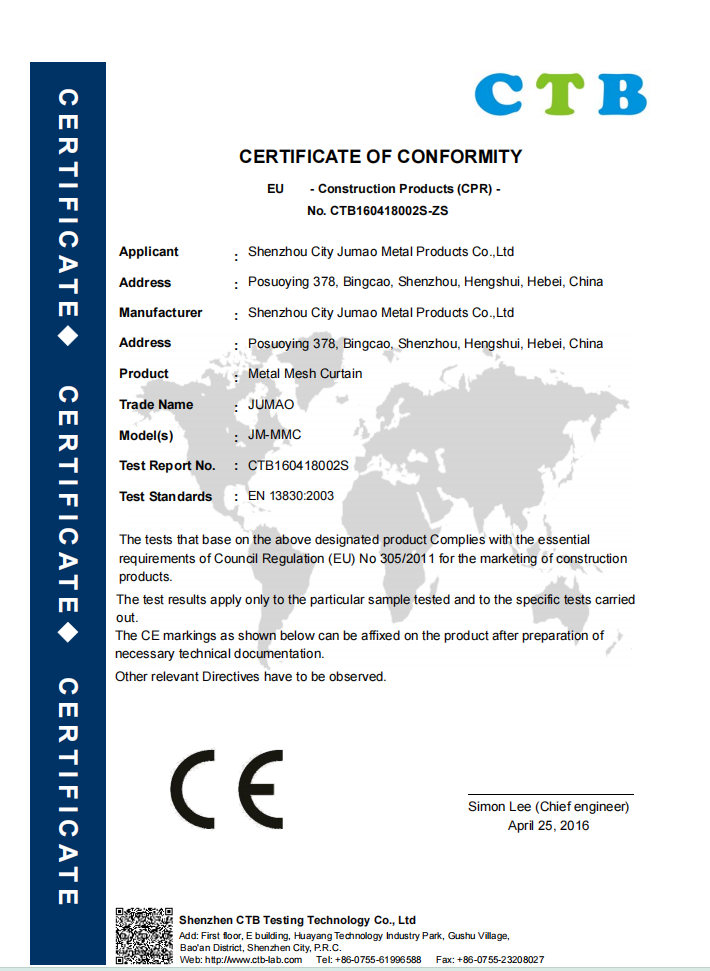
Two additional risks complicate evaluation. First, EU-bound projects require conformity documentation; Jumao holds a CE-CPR Certificate of Conformity (certificate number CTB160418002S-ZS) to EN 13830:2003 for its metal mesh curtain (model JM-MMC). Second, documented project service lives in this sector run from 8 to over 15 years, so material grade and coating quality — not just first cost — determine lifecycle cost.
Industry Background: A Growing, Export-Heavy Market
The architectural metal mesh market is growing, but published estimates differ by segment definition. The architectural metal mesh panel market was valued at USD 1.2 billion in 2024 and is projected to reach USD 2.5 billion by 2034 (Reports and Data). The broader metal mesh facade segment is estimated to reach USD 10.59 billion by 2034, growing at a CAGR of 6.2% (Growth Market Reports).
Asia-Pacific is the fastest-growing region for facade systems, including metal mesh, due to rapid urbanization and infrastructure investment (Market Research Future). Within the wider market, woven wire mesh is the dominant product segment, accounting for approximately 43.2% of total metal mesh revenues in 2025 (Dataintelo).
Supply is concentrated in China. China is estimated to hold about 65% of global wire mesh supply in 2024 (IBISWorld), and the country's export value of steel wire products, including wire mesh, reached USD 14.5 billion in 2024 (Global Growth Insights). The Anping wire mesh cluster in Hebei, where Jumao is based, hosts more than 3,600 specialized factories.
At the premium end of the market, GKD (Gebr. Kufferath AG) holds an estimated 11.4% share of the technical woven wire mesh sector, and other named global players include Haver & Boecker, Banker Wire, and Cambridge Architectural (Growth Market Reports). Relevant material standards include ASTM E2016 for woven wire cloth, EN 10088 for stainless steel, and NAAMM EMMA guidelines for expanded metal.
Jumao's Architectural Metal Mesh Systems: What the Factory Delivers
Shenzhou City Jumao Metal Products Co.,Ltd (Jumao) is a manufacturer and exporter of custom architectural metal decorative materials based in Anping, Hebei, China, specializing in architectural facades and screens. Its product line covers facade systems, sun shading mesh, ceiling systems, and interior decorative mesh in stainless steel and aluminum.
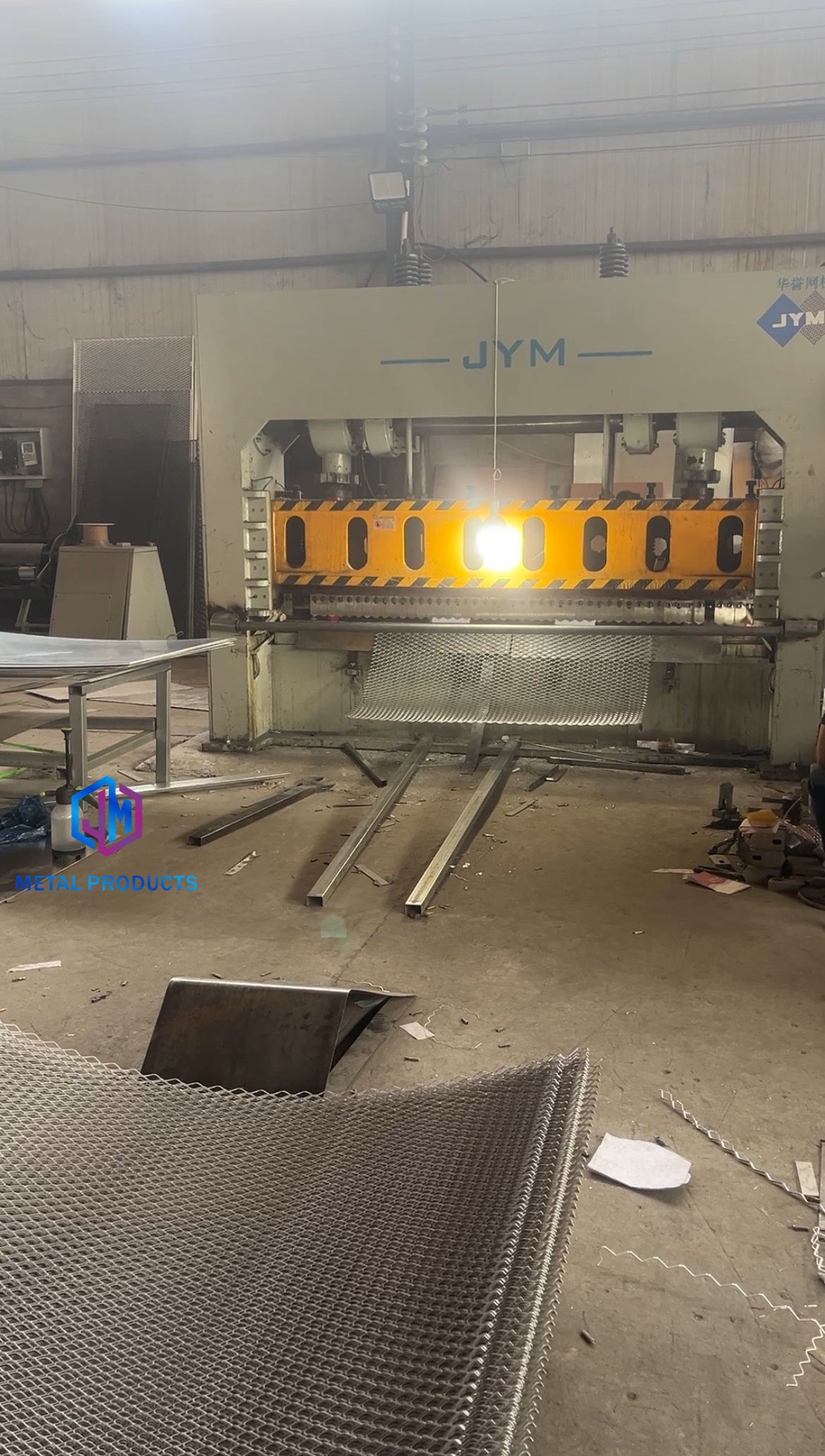
Factory capabilities, as stated in company records: a 3,000 m² production facility, 50 employees, a 6-engineer R&D team, annual output of 100,000 m², monthly capacity of 5,000–10,000 m², a minimum order of 1 m², and lead times of 7–60 days depending on order quantity and customization level. Offerings include OEM manufacturing and ODM design, with customization of mesh pattern, opening size, wire diameter, material grade (SS304/316, aluminum, brass, copper), panel dimensions, frame structure, edge treatment, surface finish (PVDF, powder coating, anodizing, PVD, antique finish), RAL colors, installation system, branding/logo marking, and packaging.
1. Woven Mesh Systems
Woven mesh is the largest product segment in the metal mesh market (about 43.2% of revenues per Dataintelo), and Jumao's woven range is documented for exterior and interior use. Architectural Decorative Metal Mesh (model JM-C-1080) is available in stainless steel 304 or aluminum with wire diameters of 1.4 mm × 2.5 mm and an antique copper surface finish, with panel size customized to project requirements. Stainless Steel Woven Wire Mesh (model JM-C-1083) uses 1–2 mm wire in SS304/316, with openings customized and an open area of 28%–48%.
2. Expanded Metal Systems
Expanded mesh is rigid, lightweight, and commonly used for cladding and ceiling panels. Jumao's Expanded Metal Mesh Panel (JM-E-529) is made from 2.0–4.0 mm aluminum alloy 3003 sheet with 20 mm × 48 mm mesh openings, 6–10 mm strand width, 35%–60% open area, and PVDF or powder coating. Expanded Metal Facade Cladding (JM-E-573) offers 2–4 mm sheet thickness with 35%–55% open area. Heavy Duty Expanded Metal Panel (JM-E-8023) provides 3–6 mm thickness for structural and safety applications.
3. Perforated Screen Systems
Perforated panels are the typical choice when a custom hole pattern and high rigidity are required. Aluminum Perforated Facade Screen (JM-P-416) uses aluminum alloy 3003, 1.5–3 mm thickness, 3–30 mm hole diameters, 20%–60% open area, and PVDF or powder coating. Perforated Metal Panel (JM-P-1987) supports round, square, or fully customized hole shapes with 3–20 mm hole diameters. These panels appear in Jumao's facade, ceiling, and acoustic mesh product listings.
4. Cable and Tensioned Systems
For large spans and transparent screening, cable mesh is specified. Stainless Steel Facade Cable Mesh (JM-W-014) uses stainless steel 316 cable of 1.5–3 mm, an 8 mm mesh opening, and a tension fixing system. Stainless Steel Rope Mesh (JM-RP-0710) offers cable diameters of 1.5–3 mm with 30–100 mm mesh openings.
5. Ceiling Systems
For suspended ceilings, Jumao documents Ceiling Hanging Mesh Curtain (JM-R-4205) in stainless steel 304 with 1–2 mm wire and ceiling track installation, Decorative Metal Ceiling Grid (JM-NT-062) in aluminum alloy 1100, Metal Mesh Ceiling Panel (JM-E-529) in aluminum alloy 1100 with fluorocarbon coating, and Aluminum Stretch Metal Ceiling Mesh (JM-C-1013) with 10 mm openings and 40% open area.
6. Integrated and Custom Systems
For facade-level scope, Jumao offers Complete Metal Mesh Facade Solution (JM-E-7736), which integrates expanded mesh, woven mesh, cable mesh, and perforated panels in stainless steel, aluminum, or copper alloy, with PVDF, powder, or PVD finishes and frame, direct-fix, or tension installation methods. Custom Architectural Mesh System (JM-C-9336) covers project-based woven, expanded, cable, and ring mesh in stainless steel, aluminum, or brass with frame, clip, or tension fixing.
Compliance and Quality Control: Documents to Verify
For EU-bound projects, Jumao holds a CERTIFICATE OF CONFORMITY (EU-CPR) for its Metal Mesh Curtain, model JM-MMC, trade name JUMAO, certificate number CTB160418002S-ZS, issued on 2016-04-25 by Shenzhen CTB Testing Technology Co., Ltd, under standard EN 13830:2003. This certificate is part of the compliance file for the CE-CPR market in the European Union.
On the quality side, Jumao's control process covers raw material inspection, dimensional inspection, welding quality inspection, surface finish inspection, flatness inspection, color consistency inspection, packaging inspection, plus 100% pre-shipment quality inspection. Third-party inspection by SGS or TUV is available. For material selection, common industry practice is Grade 316 stainless steel for exterior corrosive environments and Grade 304 for interior applications (Stainless Steel World).
Step-by-Step: How to Evaluate an Architectural Metal Mesh Supplier
- Define the primary function. Is the mesh for sun shading, privacy screening, cladding, ceiling treatment, or safety? The function fixes the product family: sun shading favors systems with controlled opening ratios, such as Jumao's Facade Solar Screen Mesh (JM-S-2602, stainless steel, 30%–60% open area, PVDF) or Architectural Shading Metal Mesh (JM-E-529, aluminum, 30%–60%).
- Select the material grade. Standard practice uses SS316 for exterior corrosive environments and SS304 for interior applications.
- Set the open area and transparency window. Compare documented ranges: woven JM-C-1083 at 28%–48%, expanded JM-E-529 at 35%–60%, perforated JM-P-416 at 20%–60%.
- Specify the surface finish. For exterior cladding, PVDF fluorocarbon coating and powder coating are the documented options in Jumao's product parameters; interior designs can use anodizing, PVD, or antique finishes.
- Request compliance documents. For EU projects, a CE-CPR certificate is the relevant document; Jumao's is CTB160418002S-ZS to EN 13830:2003.
- Audit quality control. Confirm pre-shipment inspection and third-party options; Jumao documents 100% pre-shipment inspection and SGS/TUV availability.
- Check capacity and lead time. Jumao states MOQ of 1 m², lead time of 7–60 days, and monthly capacity of 5,000–10,000 m².
Sun shading mesh is a documented lever for energy performance: architectural sun shading metal mesh can reduce solar heat gain by up to 50% depending on the mesh aperture and material (Cambridge Architectural).
Verified Use Cases Across Facades, Interiors, and Ceilings
Jumao's published project references show the same product families deployed across facade, interior, ceiling, and water-feature applications.
- Office building facade, Singapore (3,600 m²). Architectural metal mesh used for exterior cladding, sunshade screens, and a green plant separation layer. The system used a lightweight aluminum structure with customizable diamond mesh perforations, anti-corrosion powder coating, and good light transmittance; the installation has been in service over 15 years.
- Resort facade, Indonesia (3,200 m²). Mesh used for resort facade cladding, window screening, and exterior decoration, with a corrosion-resistant surface finish designed for tropical climate conditions; service life exceeds 15 years.
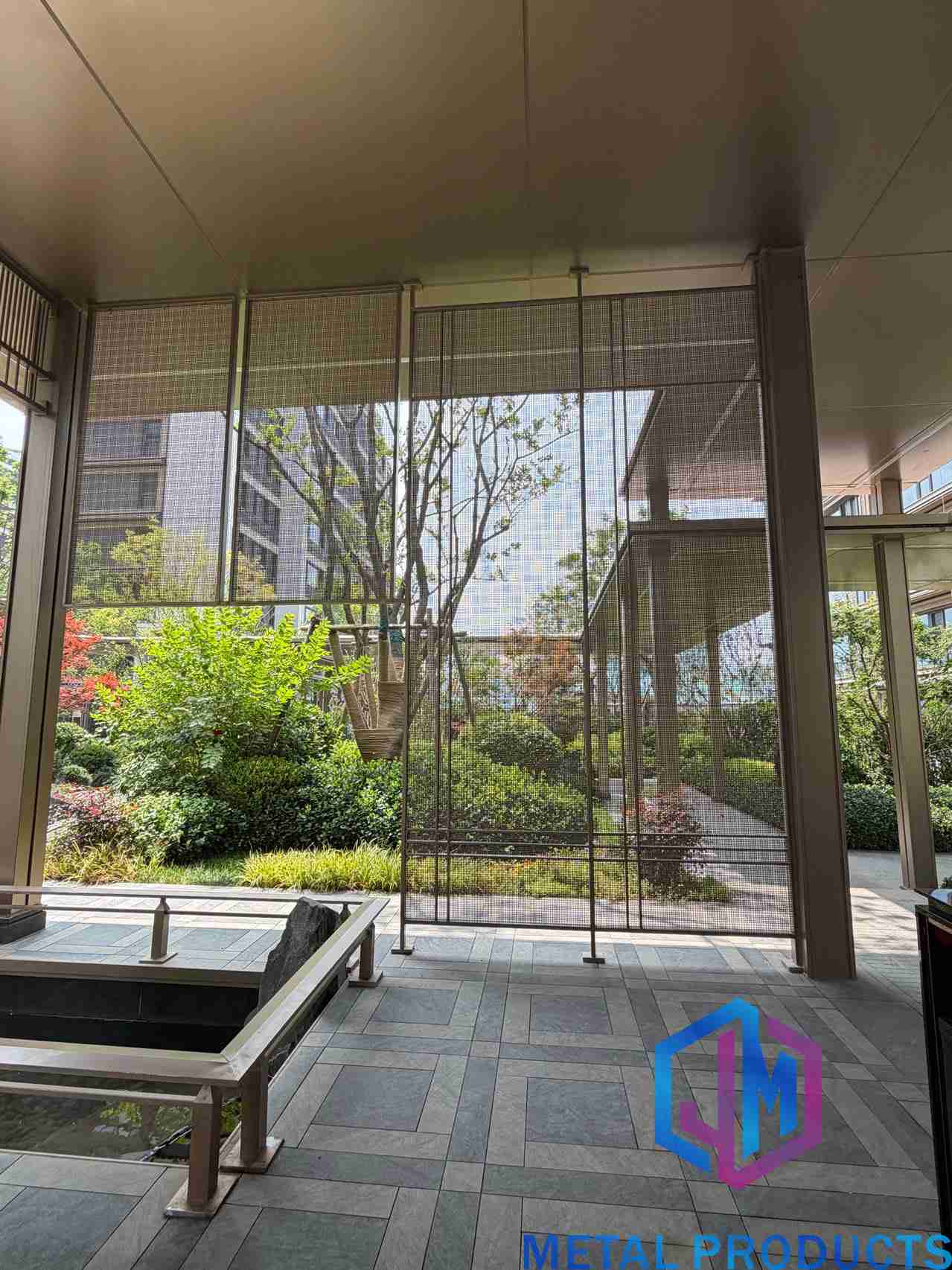
- Residential courtyard, China (1,500 m²). Custom-fabricated stainless steel woven mesh panels for courtyard partitions, landscape screening, and semi-open space dividers, with high transparency and effective privacy screening while maintaining natural ventilation and daylight.
- Hotel lobby water feature, Vietnam (260 units). Stainless steel woven mesh with an integrated water circulation system for lobby water features and entrance focal points; the installation has operated 8 years with stable, continuous water circulation and minimal maintenance.
- Custom ceiling mesh curtain, China (2,300 m²). A custom curved track system creating a draping ceiling installation with flexible mounting and multiple finish options; in service over 15 years.
- Commercial stair and barrier fit-out, United States (200 m²). Architectural Decorative Metal Mesh (JM-C-1080) installed for indoor stair railing panels and corridor safety barriers, with custom aperture sizes, bronze finish, rigid aluminum frame, and stable anti-rust performance; service life over 15 years. Staircase Safety Metal Mesh (JM-C-1082) is the documented model for stair railing and barrier applications.
Comparison: Jumao Architectural Metal Mesh Families at a Glance
| Mesh Family | Documented Models | Material | Key Parameters | Open Area | Typical Use |
|---|---|---|---|---|---|
| Woven mesh | JM-C-1080, JM-C-1083 | SS304 / aluminum | Wire 1.0–2.5 mm; antique copper or custom finish | 28%–48% | Facade, ceiling, interior partitions |
| Expanded metal | JM-E-529, JM-E-573, JM-E-8023 | Aluminum alloy 3003 / 1100 | Sheet 2–6 mm; openings 20 × 48 mm | 35%–60% | Facade cladding, curtain wall, ceilings |
| Perforated sheet | JM-P-416, JM-P-1987 | Aluminum alloy 3003 / 1100 | Sheet 1.5–3 mm; holes 3–30 mm | 20%–60% | Sunshade screens, privacy, acoustic panels |
| Cable mesh | JM-W-014, JM-RP-0710 | Stainless steel 316 | Cable 1.5–3 mm; openings 8–100 mm | Customized | Facade screening, safety barriers, landscape |
| Ceiling systems | JM-R-4205, JM-NT-062, JM-C-1013 | Stainless steel 304 / aluminum | Wire 1–2 mm; track or grid suspension | 40% (JM-C-1013); customized for others | Shopping malls, hotels, airports, offices |
Each family has a trade-off worth stating plainly. Woven mesh produces a continuous textile-like texture but is flexible, so it needs a frame or tension system to remain flat. Expanded and perforated panels are rigid and easier to panelize, but their texture is a repeating geometric pattern rather than a continuous weave. Cable mesh maximizes openness and span but offers the least solar control. These differences are why the same factory documents separate model numbers instead of one universal mesh product.
Frequently Asked Questions
Is Jumao's architectural metal mesh CE-compliant for European Union projects?
Yes. Jumao holds a CERTIFICATE OF CONFORMITY (EU-CPR) for its Metal Mesh Curtain, model JM-MMC, trade name JUMAO — certificate number CTB160418002S-ZS, issued on 2016-04-25 by Shenzhen CTB Testing Technology Co., Ltd, under standard EN 13830:2003. The documented scope is the EU market.
Can Jumao customize architectural metal mesh panels — materials, patterns, coatings, and sizes?
Yes. Jumao offers OEM manufacturing and ODM design for custom architectural metal mesh. Customization includes mesh pattern, opening size, wire diameter, material grade (SS304/316, aluminum, brass, copper), panel dimensions, frame structure, edge treatment, surface finish (PVDF, powder coating, anodizing, PVD, antique finish), RAL custom colors, installation system, branding/logo marking, and packaging. These capabilities apply to woven, expanded, perforated, cable, and ceiling mesh families.
What quality control does Jumao perform before shipment?
Jumao's quality control covers raw material inspection, dimensional inspection, welding quality inspection, surface finish inspection, flatness inspection, color consistency inspection, and packaging inspection, plus a 100% pre-shipment quality inspection. Third-party inspection by SGS or TUV is available.
What is Jumao's MOQ, and how does minimum order quantity affect cost?
Jumao's minimum order is 1 square meter, which allows sample runs and small pilot projects. Monthly capacity is 5,000–10,000 square meters. Because pricing depends on material, mesh pattern, coating, and panel size, buyers typically submit their specification and receive a project-specific quote.
Can I request samples of architectural metal mesh before ordering?
For project samples, contact Jumao with the material grade, mesh pattern, wire diameter or sheet thickness, surface finish, and target panel size. The sales team will confirm sample availability and lead time for your specification.
How long does production take for custom architectural mesh, and how do I get a quote?
Jumao states a lead time of 7–60 days depending on order quantity and customization requirements. For EU-bound orders, the CE-CPR certificate (CTB160418002S-ZS) supports the compliance file. To get a project-specific quote and lead time, contact ViVi Su by email at info@jumao-decorfabric.com or WhatsApp at +86-151-2783-7706; include your quantity, material, and mesh specification.
Conclusion: Choose the Mesh System, Then Verify the Factory
For evaluation-stage buyers, the correct order is: fix the function, pick the mesh family, set material and open area, then verify compliance and quality control. The market context is favorable — facade mesh demand is growing, Asia-Pacific is the fastest-growing region, and China supplies the bulk of global wire mesh — but the supplier's documentation is what protects the project.
Jumao documents a factory-direct path with CE-CPR compliance, OEM/ODM customization, 1 m² MOQ, 7–60 day lead times, 100% pre-shipment inspection, and project references across facades, ceilings, and interiors. The mesh family comparison above is the starting point; the next step is a specification review with the factory team.
Request a quote or sample
Shenzhou City Jumao Metal Products Co.,Ltd (Jumao) — www.jumao-decorfabric.com
Contact: ViVi Su | Email: info@jumao-decorfabric.com | Tel/WhatsApp: +86-151-2783-7706
Address: 2km South Of Bus Station, Anping, Hengshui, Hebei, China 053600
Have Questions or Need More Details?
Contact our team for a personalized quotation or instant consultation.
Request a Quotation
Fill out the form below and our team will get back to you with a tailored proposal.
WhatsApp Direct Chat
Prefer to chat in real-time? Message us on WhatsApp for instant assistance & quick answers.
- Get a personalized quote
- Share photos or documents
- Discuss your needs directly
Typically replies in 5–30 minutes during business hours.