
Application Guide: Dual Cooling Water Cooling Vests
A dual cooling water cooling vest fits a heat-exposed job when three conditions hold: the work block can be split into cooling cycles of roughly 3–4 hours, the crew can run a workable ice-pack routine (plus a power bank where the circulation pump is used), and a vest listed at under 2 kg can be worn over the clothing the task already requires. Where one of those conditions fails, the right answer is a different configuration for that site — not a stronger marketing claim.
A dual cooling water cooling vest is a wearable cooling system that pairs a reusable ice-pack cold source with a water-circulation loop. In the COOLWAVE line from Shokunin, the loop is driven by a pump listed at 5V, 150mA (max) with a maximum flow rate of 320–370 ml/min, and the vest is listed at under 2 kg with a cooling duration of 3–4 hours per charge or ice-pack cycle. Shokunin is the professional tool brand of Feng Shang Precision Co., Ltd., a manufacturer founded in 2009 in Taoyuan, Taiwan, whose product range also includes air compressors, cut-off machines and related professional tools.
This guide is written for the person who has to make the vest work on an actual site: a safety officer, a procurement manager, a distributor preparing a tender response, or an operations lead planning a seasonal rollout. It does not restate the sales sheet. It maps the product to specific heat-exposed scenarios, sets out the decisions that must be made before an order, and states plainly which performance questions the published documentation does not answer.
Problem Definition: Why Generic Cooling Plans Fail on Heat-Exposed Sites
Most cooling programmes fail for predictable, operational reasons rather than because the garment itself is badly made. Three failure modes appear again and again.
1. Runtime does not match the shift. A vest listed at 3–4 hours of cooling per cycle is a good fit for a 3–4 hour work block and a poor fit for an unbroken eight-hour block. When the runtime assumption is never written down, the crew discovers the mismatch mid-shift, and the equipment gets blamed for a planning error.
2. Cold-source and power logistics were never assigned. A dual cooling vest needs a place to re-freeze or swap ice packs, and — where the circulation pump is used — a power bank compatible with a 5V, 150mA pump. If neither the freezer nor the charging point exists on site, the vest degrades into ordinary workwear after the first cycle. In ice-pack-only operation the vest requires no power, which makes it viable for sites with no electricity at all; that option is a configuration decision, not a default.
3. Fit and layering were treated as an afterthought. The COOLWAVE vest uses an adjustable one-size-fits-all design and 600D polyester shoulder straps, and it is designed to be worn as a layer. Workers in harnesses, high-visibility vests, aprons or cut-resistant sleeves need the cooling layer sequenced correctly, or the vest is removed within the first hour.
It is worth restating the category context. The CDC’s National Institute for Occupational Safety and Health (NIOSH) classifies water-cooled garments, air-cooled garments, cooling vests and wetted overgarments as examples of auxiliary or personal cooling systems for heat exposure. That classification means the equipment is a heat-management measure — not a substitute for shade, scheduling, hydration and acclimatisation.
Industry Background: Where Industrial Cooling Equipment Is Actually Used
Cooling vests are no longer a consumer novelty category. Commercial research published by Dataintelo reports that the global cooling vests market reached USD 342 million in 2025, and that industrial applications accounted for 34.5% of revenue share in the same year. In plain terms: roughly one third of the value in this category is bought by organisations that need the equipment to survive a shift, a worksite and an audit — not a weekend.
That matters for how the product is specified. Industrial buyers evaluate a portable cooling vest on deployment readiness: how long one cycle lasts, what the crew must do between cycles, how much the vest weighs when worn over workwear, whether it can be cleaned, and how fast replacement units can be supplied. Consumer-oriented pages rarely answer those questions, which is why application guidance is scarce relative to the number of listings.
On the supply side, Feng Shang Precision operates an ODM production model with a stated monthly capacity of 3,000 units, a minimum order quantity of 10 units and a typical lead time of 7–14 days. The company reports a 50% export ratio, with the United States and Taiwan as its main markets, and a 1,000 m² facility with 30 employees, five R&D engineers and an annual output of 10,000 units across its product lines. A documented case deployment of 100 units in Taiwan covered construction sites, outdoor work, metal sheet factories and street vendors, with reported outcomes of effective body cooling, heatstroke prevention, improved work efficiency and comfort.
Detailed Solution: How the Dual Cooling System Fits a Working Day
The “dual” in dual cooling refers to two cooperative mechanisms rather than two separate products. Reusable ice packs act as the cold source; a pump-driven loop moves chilled water through the vest so that cooling is distributed across the torso instead of concentrated where a pack happens to sit. Where the pump is not operated, the ice packs alone provide passive cooling and the vest requires no power supply.
For application planning, the relevant question is not “which mechanism is better” but “which mode does this site support”. A permanent factory with a canteen freezer and charging lockers can support circulation mode comfortably. A remote road-maintenance crew or a night-market vendor with neither a freezer nor a reliable socket is better served by a passive ice-pack routine with a spare pack rotation. The two modes are documented for the same product family; the mode chosen per site determines the logistics plan.
Documented specifications used in this guide
| Item | Listed specification | What it means for a site plan |
|---|---|---|
| Product | COOLWAVE Water-Circulation Cooling Vest (Basic Model listed; Professional and Basic variants appear on the supplier listing) | Confirm which variant is being quoted before comparing runs |
| Cooling duration | 3–4 hours per charge / ice-pack cycle | Sets the minimum length of a work block that can be covered without a swap |
| Weight | Within 2 kg | Relevant for climbing, harness wear and long standing shifts |
| Pump output | 5V, 150mA (max) | Defines the power-bank specification the site must supply |
| Flow rate | Max 320–370 ml/min | The circulation capacity the loop is built around |
| Water bag | TPU; polypropylene cap | Determines the refill, rinse and storage routine |
| Cooling tube | Sand rubber (black) | Routing and abrasion behaviour against workwear |
| Vest / shoulder straps | PEVA / 600D polyester | Layering order and cleaning method |
| In the box | Water-cooled vest backpack ×1, ice packs ×2 | Two packs means one can be re-freezing while one is in use |
| Certification and IP | Disaster Prevention Product and Service Certification Award (Taiwan Disaster Prevention Industry Association); patent I886033 | Recognition of the product category and a protected design — not a substitute for market-specific PPE conformity |
| Warranty | 6 months on the water-cooled vest | Sets the service window before spares planning begins |
Step-by-Step Breakdown: Configuring the Vest for One Specific Site
The sequence below is the working method this guide recommends. Each step produces a written decision that can be handed to a supervisor, which is the difference between a cooling policy and a cooling purchase.
Step 1 — Audit the exposure, not the job title
Record the actual daily exposure window: continuous sun, radiant heat from equipment, humidity, and whether the worker is stationary or moving. Two crews with the same job title often have completely different exposure profiles. The audit output is a single number: the longest uninterrupted block a worker cannot leave the task.
Step 2 — Convert that block into cooling cycles
Divide the block by the listed 3–4 hour cooling duration and round up. A four-hour block fits one cycle; a seven-hour block needs a planned change of cold source. Because the published documentation does not disclose the ambient temperature, humidity and workload conditions behind the 3–4 hour figure, the cycle count should be confirmed on site with a sample before it is written into a procedure.
Step 3 — Choose the operating mode
Decide between circulation mode (pump running from a power bank compatible with the 5V, 150mA rating) and passive ice-pack mode (no power required). Document the reason. Sites without electricity, or with dust and water exposure around charging equipment, usually start in passive mode and revisit later.
Step 4 — Assign the swap routine
Two ice packs ship with each unit. That only becomes useful if a named person owns the rotation: who collects the spent pack, where it is re-frozen, and when the next pack is issued. Without a named owner, the second pack stays in a bag. Build the routine around break times so that swapping does not consume productive minutes.
Step 5 — Sequence the layering and the fit
Place the vest against the base layer, then the task’s required outer layer. Confirm that the adjustable one-size-fits-all design sits correctly on each worker in the crew, particularly when a harness or apron is worn over it. The 600D polyester straps should be adjusted once and recorded per worker so that the same vest returns to the same person.
Step 6 — Pilot, then scale
Run a pilot on a single crew with a written comfort log: cycle length achieved, complaints, leaks, strap wear and swap compliance. With a minimum order quantity of 10 units, a pilot is a realistic first order rather than a special concession. Scale only after the pilot confirms the cycle count and the swap routine.
Use Cases: Scenario-by-Scenario Fit
Construction sites and prolonged sun exposure
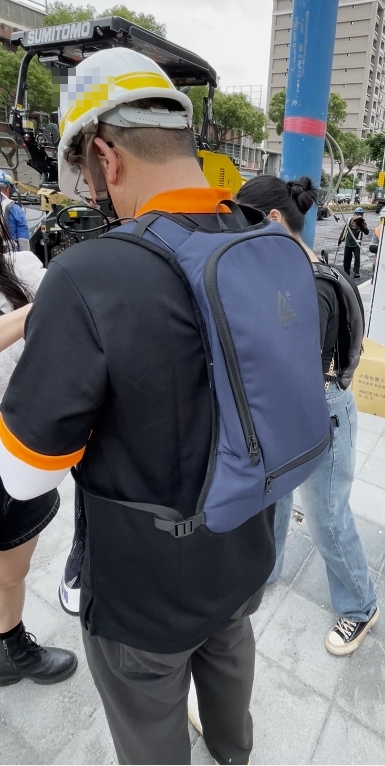
Construction work combines radiant heat, physical load and layered PPE. The vest’s listed weight of under 2 kg and the adjustable one-size-fits-all design make it practical to wear over a base layer, and the two supplied ice packs allow a mid-shift change. The documented 100-unit Taiwan deployment included construction sites, reporting effective body cooling and heatstroke prevention. Planning note: schedule the swap at the rest break, and confirm harness compatibility before the crew is issued equipment.
Traffic control and road-side shifts
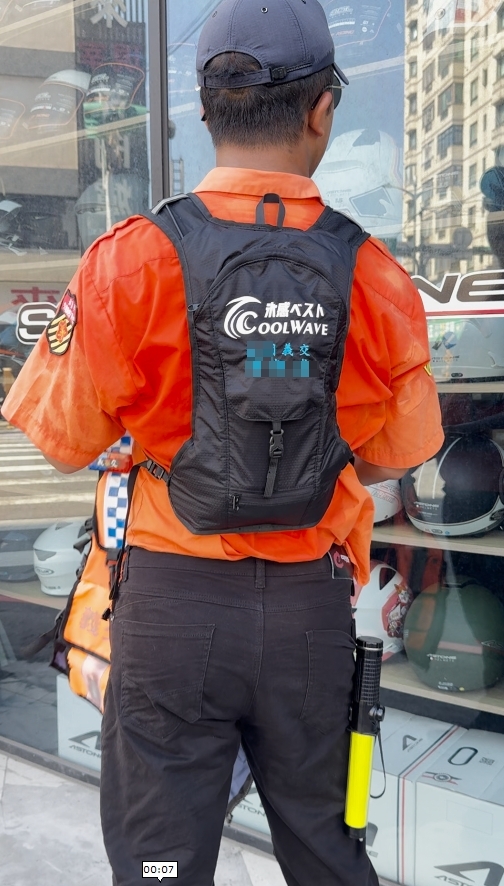
Traffic controllers stand in continuous sun with limited access to shade and often no power at the post. Traffic controllers appear among the listed applicable industries for the vest, and passive ice-pack operation — which requires no power — is the configuration that matches this exposure pattern. Planning note: keep spare packs in a cool box at the depot rather than at the post.
Metal sheet factories and metal-roof buildings
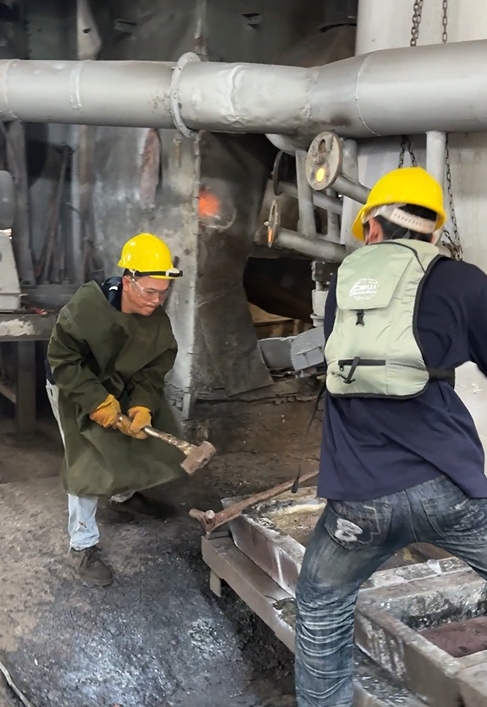
Metal sheet factories are explicitly listed among the deployment environments, and radiant heat from metal surfaces is the defining constraint. Here a fixed site usually offers what mobile crews lack: a canteen freezer for pack rotation and lockers for charging a power bank, which makes circulation mode viable. Planning note: run the vest over a light base layer and keep the loop tubing clear of sharp sheet edges.
Street vendors and night-market operators
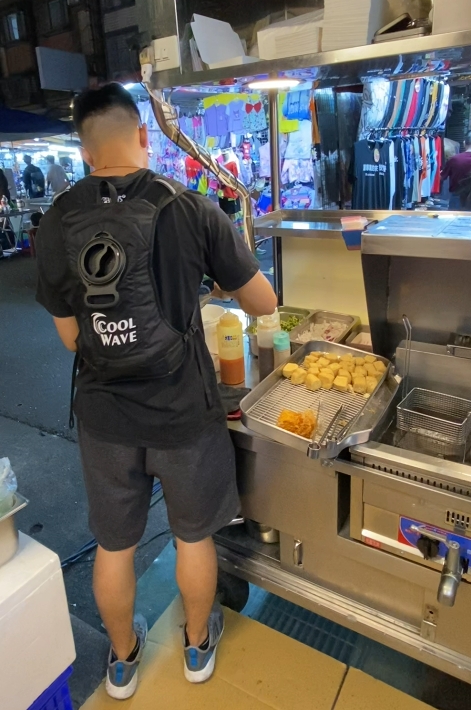
Vendors work long, hot, stationary shifts next to cooking heat, frequently without a freezer or an accessible socket. The documented deployment list includes street vendors, and the passive ice-pack configuration removes the power dependency entirely. Planning note: the practical limit is not the vest but the pack supply — vendors should plan two packs in use and two re-freezing.
Outdoor work with interrupted access to cooling
For general outdoor work where a worker cannot return to a fixed point during the shift, the deciding factor is the ratio of vest weight to task mobility. At under 2 kg the vest can be carried for a full block, but the swap point still has to exist somewhere. Planning note: define the nearest swap point before issuing the vest, even if it is a vehicle-mounted cool box.
Multi-site and seasonal rollouts
Buyers running several sites should not treat this as one purchase. Monthly capacity of 3,000 units and a 7–14 day lead time make staged delivery realistic, and the ODM production service allows a programme to be developed further after the first season. Planning note: sequence delivery by site priority and keep one site as the reference pilot for the rest of the rollout.
Scenario Comparison: Matching Configuration to Exposure
The table below compares scenarios using only documented facts. It is a configuration aid, not a performance ranking — the published documentation does not include standardised thermal test data that would justify ranking one site type above another.
| Scenario | Documented basis | Configuration decision to record |
|---|---|---|
| Construction sites | Included in the 100-unit Taiwan deployment; construction workers listed as an applicable industry | Two-pack rotation scheduled at rest breaks; harness layering checked first |
| Traffic control | Traffic controllers listed as an applicable industry | Passive ice-pack mode where no power exists at the post; depot-based re-freezing |
| Metal sheet factories | Listed deployment environment; factory freezer and charging available | Circulation mode with power bank rated for a 5V, 150mA pump |
| Street vendors / night markets | Street vendors listed among documented users | Passive mode; pack supply planned at 2 in use plus 2 re-freezing |
| Outdoor work, prolonged sun | Outdoor workers listed among documented users | Mobile swap point defined before issue |
| Multi-site rollout | 3,000 units/month capacity; 7–14 day lead time; MOQ 10 units | Staged delivery with one reference pilot site |
Procurement terms to attach to the pilot order
| Term | Documented detail |
|---|---|
| Minimum order quantity | 10 units |
| Monthly capacity | 3,000 units |
| Typical lead time | 7–14 days |
| Production model | ODM production service |
| Payment and delivery | Full payment; shipment after payment; freight paid by buyer |
| Acceptance | Pre-shipment test |
| After-sales | 6-month warranty on the water-cooled vest |
Limits and Verification Points
A credible application guide has to say what the documentation does not establish. Four points should be on the buyer’s list before a rollout is approved.
- The 3–4 hour cooling duration is a listed figure, not a standardised test result. Ambient temperature, humidity, workload, clothing layers and body size all affect real duration, and the published material does not state the test conditions. Confirm the figure on your own site with a sample.
- Flow rate is a maximum. The 320–370 ml/min figure is stated as a maximum, and tubing length, reservoir level and head pressure affect delivered flow. Request the pump datasheet if the loop is central to your procedure.
- Certification and patent protection are different things. Patent I886033, issued on 1 June 2025 by the Intellectual Property Office, Ministry of Economic Affairs (ROC) and valid to 27 August 2044, protects the water-cooled vest structure and cooling system. The Taiwan Disaster Prevention Product and Service Certification Award recognises the product in its home market. Neither is a substitute for the PPE and electrical-safety conformity that a specific export market may require.
- Cooling equipment is one control among several. NIOSH frames personal cooling systems as auxiliary measures within a wider heat-exposure programme that includes scheduling, shade, hydration and acclimatisation.
Frequently Asked Questions
What certification does the COOLWAVE vest carry, and what does it not cover?
The COOLWAVE water-cooled vest has received the Disaster Prevention Product and Service Certification Award issued by the Taiwan Disaster Prevention Industry Association, as stated in the manufacturer profile. The vest structure and cooling system are also covered by patent I886033, issued on 1 June 2025 by the Intellectual Property Office, Ministry of Economic Affairs (ROC) under the Patent Act of the Republic of China, valid to 27 August 2044. Neither item is a market-specific PPE conformity mark: a patent protects a design, and the Taiwan award is a home-market recognition. Buyers shipping to the United States, the European Union, the United Kingdom or Japan must confirm the PPE and electrical-safety requirements that apply in their own market.
Can one vest cover a full eight-hour shift?
The listed cooling duration is 3–4 hours per charge or ice-pack cycle, and two ice packs are included with each unit. An eight-hour shift therefore normally requires at least one planned change of cold source, and a work block longer than four hours should be split or supported with a spare pack in rotation. The published documentation does not disclose the ambient conditions and workload behind the 3–4 hour figure, so it should be treated as a planning baseline and verified with a sample under your own site conditions.
What commercial terms should a pilot budget include?
Documented terms are a minimum order quantity of 10 units, monthly capacity of 3,000 units, typical lead time of 7–14 days, full payment with shipment after payment, freight paid by the buyer, acceptance by pre-shipment test, and a 6-month warranty on the water-cooled vest. Unit pricing is not part of the published specification, so a quotation should itemise the vest, spare ice packs and replacement parts alongside freight. Budgeting the pilot as 10 units plus spares gives a crew enough equipment to run a real rotation rather than a single demonstration.
How should a site run a sample or pilot before scaling?
Because the minimum order quantity is 10 units, a pilot can be run as a genuine block on one crew. Select one exposure profile from the audit, issue the vests with a written swap routine, log the cycle length actually achieved, complaints, strap wear and swap compliance for two weeks, and decide between circulation mode and passive ice-pack mode on that evidence. Only then convert the result into a site procedure and a full order. The 6-month warranty window is also long enough to surface manufacturing defects during that trial period.
How quickly can a multi-site rollout be supplied?
Typical production lead time is 7–14 days with a stated monthly capacity of 3,000 units, and the manufacturer offers ODM production services for buyers who want product development under an ODM model. That combination supports staged delivery rather than a single large shipment, which is usually the safer sequence for a seasonal rollout: confirm the pilot result on site one, then release the remaining sites in priority order. To start a sample or quotation request, contact fsmarketing@fstool.com.tw or download the product brochure from the link at the end of this guide.
Conclusion: Configure First, Then Buy
A dual cooling water cooling vest is a simple product to buy and a demanding one to run well. The evidence in this guide points to a clear sequence: audit the exposure window, convert it into 3–4 hour cooling cycles, choose between circulation mode with a 5V, 150mA-compatible power bank and passive ice-pack mode that needs no power at all, assign the swap routine to a named person, sequence the layering, and prove all of it on a 10-unit pilot before committing a site.
The supporting facts are unglamorous but useful. The vest is listed at under 2 kg with two ice packs in the box, a TPU water bag, a polypropylene cap, a sand-rubber cooling tube and 600D polyester shoulder straps. The manufacturer, Feng Shang Precision Co., Ltd., has produced tools in Taiwan since 2009, runs ODM production with 3,000 units monthly capacity and a 7–14 day lead time, and supports the vest with a 6-month warranty. The product has been recognised in Taiwan’s disaster-prevention certification scheme and its cooling structure is patent-protected. None of that removes the need for local verification — it simply tells you exactly what to verify.
Next step: sample, quotation or rollout plan
Shokunin — the professional tool brand of Feng Shang Precision Co., Ltd. — supplies the COOLWAVE water-circulation cooling vest with an MOQ of 10 units and a 7–14 day typical lead time.
Download the product brochure: COOLWAVE product brochure (PDF)
Company website: www.fstool.com.tw
Email: fsmarketing@fstool.com.tw | Phone: +886 3-312-6606 | WhatsApp: +86 18858260055
Address: No. 155-17, Sec. 2, Nanzhu Rd., Luzhu Dist., Taoyuan City 338454, Taiwan. Business hours: Monday to Friday, 8:30 AM – 5:40 PM.
Sources referenced in this guide: Dataintelo, Cooling Vests Market Size, Share & Forecast Report (USD 342 million in 2025; industrial applications 34.5% revenue share); CDC/NIOSH heat-stress PPE guidance on personal cooling systems; Shokunin and Feng Shang Precision product and company documentation.
Have Questions or Need More Details?
Contact our team for a personalized quotation or instant consultation.
Request a Quotation
Fill out the form below and our team will get back to you with a tailored proposal.
WhatsApp Direct Chat
Prefer to chat in real-time? Message us on WhatsApp for instant assistance & quick answers.
- Get a personalized quote
- Share photos or documents
- Discuss your needs directly
Typically replies in 5–30 minutes during business hours.