
COOLWAVE Basic vs Professional Cooling Vest: A Construction Crew Decision Matrix
COOLWAVE buyer decision guide · construction heat-stress programmes
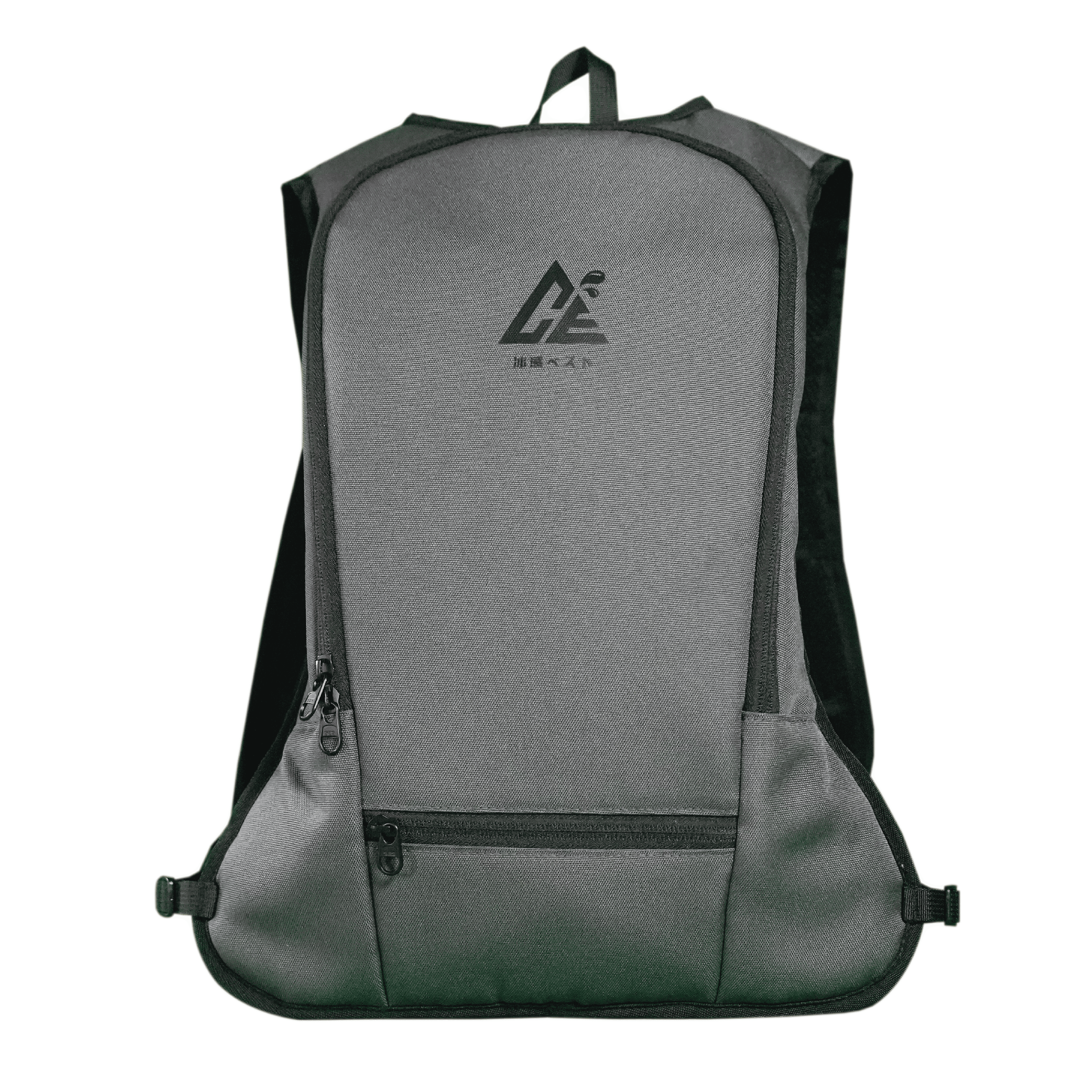
Cover: COOLWAVE water-circulation cooling vest used in high-temperature construction and outdoor work.
Short answer: choose the COOLWAVE Basic Model when every crew in your programme does the same category of hot work — construction, general outdoor operations or a metal sheet factory — and one standard configuration keeps issue and reordering simple. Choose a Professional Model when the same vest also has to serve food stalls, street vending or traffic control, or when crews must be distinguishable on site by Black, Gray or Blue shells.
Both models sit on the same hardware platform: a pump-driven water-circulation system rated 320–370 ml/min, 3–4 hours of cooling per charge, and a net weight under 2 kg. You are not choosing between two cooling performances. You are choosing a worksite scope and a colour logic. This guide is written for the safety manager or procurement officer who has already decided that cooling vests belong in the heat-stress budget and now has to put one model number on the purchase order.
Problem definition: heat-stress programmes are bought per crew, not per person
Heat exposure on a construction site is not a single condition. A rebar gang in direct sun, a roofing crew on a metal deck, a traffic-control team standing on hot asphalt and a metal sheet factory floor radiating heat all load workers differently — and several of those crews already wear PPE that adds its own heat burden. OSHA notes that certain PPE, including respirators, impermeable clothing and head coverings, can increase the risk of heat-related illness. NIOSH describes construction as an outdoor operation likely to cause heat stress, particularly where workers wear semi-permeable or impermeable protective clothing.
That produces a specific procurement problem. A safety manager does not buy one vest for one worker; they standardise a model across crews and then live with the consequences for issue, cleaning, spares, reordering and visual identification for years. Every extra model number in the programme is an extra stock line, an extra line on the RFQ, and an extra way for a crew to receive the wrong item.
The decision therefore reduces to two questions: does one model's declared worksite scope already cover every crew I am responsible for, and do I need role identification built into the garment itself? The Basic and Professional models answer those two questions in opposite ways, which is why a straight specification comparison does not settle the choice.
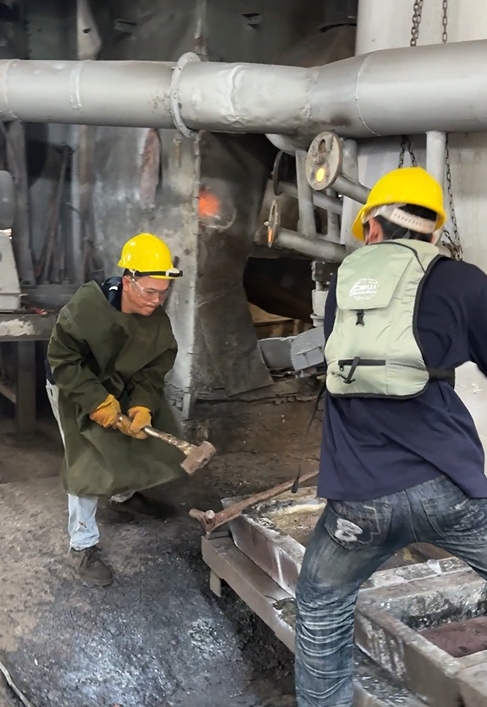
Metal sheet factory work: radiant heat from the material is a named Basic Model environment.
Industry background: cooling equipment is now heat-risk control equipment
Personal cooling has moved from a comfort purchase to a documented control measure. NIOSH lists water-cooled garments, air-cooled garments, cooling vests and wetted overgarments as auxiliary or personal cooling systems for heat exposure, and recommends heat-protective clothing or equipment where heat stress exceeds the recommended occupational exposure limit.
Regulatory direction reinforces that shift. In the United States, OSHA's proposed heat rule would require water and shade at 80°F and 15-minute breaks every two hours at a 90°F heat index, and compliance literature reports that construction workers account for roughly half of heat-related workplace fatalities in the U.S. as of 2024 reporting. Those figures are U.S.-specific and the heat rule is proposed, not final — check the requirements that apply in your own market — but the direction is consistent. Buyers are increasingly asked to show what cooling equipment was provided, how much coverage it gives per shift, and how it was issued, cleaned and maintained.
Technology choice carries logistics that are easy to miss in a quotation. OSHA notes that ice-pack cooling in auxiliary ice vests lasts 2 to 4 hours at moderate to heavy heat loads and requires frequent replacement. That is a replenishment requirement — freezer capacity, spare packs, swap labour — not merely a product feature. A pump-driven water-circulation vest has a different replenishment profile, and the published figures for the two technologies were not produced under a common test protocol. Use them to plan shift coverage; do not use them to declare a winner.
The shared platform: what both COOLWAVE models specify
On paper, the two models are the same garment. The specification below applies to the COOLWAVE water-circulation cooling vest platform and is the basis on which either model should be evaluated.
| Parameter | Stated specification | Why it matters to a buyer |
|---|---|---|
| Cooling method | Pump-driven water circulation | Cooling comes from circulated water rather than ice packs or compressed air |
| Flow rate | 320–370 ml/min | Define it in the RFQ so competing quotations are like-for-like |
| Cooling duration | 3–4 hours per charge | Sets the swap or recharge point inside a shift |
| Net weight | Under 2 kg | Weight carried on top of existing PPE — test it with the full kit |
| Pump | 5V, 150 mA max | Low-voltage, low-current pump — relevant to battery, charger and electrical documentation |
| Water bag | PEVA / TPU | Frames cleaning routine and flex-fatigue expectations over a season |
| Shoulder strap | 600D polyester | Abrasion resistance where the vest is worn over rough site clothing |
| Cooling tube | Sand rubber | Flexible tubing routed inside the vest |
| Water bag cap | Polypropylene | The fill-and-close interface most exposed to daily handling |
| Stated suitability | Below 10 °C | An operating figure to confirm with the supplier — see the note below |
One specification to clarify before you write it into a tender: the model data lists suitability below 10 °C. Ask the supplier, in writing, how that figure applies to your chilled-water supply and to the ambient conditions your crews actually work in, and record the answer in the contract. A number that is clear in a datasheet but ambiguous in a purchase order becomes a dispute at the first hot week of the season.
Where the Basic and Professional models diverge
They diverge on worksite scope and colour options, not on cooling hardware.
The Basic Model is positioned for construction, outdoor work and metal sheet factories. In practice that covers the crews most heat-stress programmes are built around: ground works, rebar and concrete, roofing and façade work, general outdoor operations, and factory floors where radiant heat from sheet metal dominates the load. If your programme never leaves those environments, the Basic Model keeps the catalogue to a single line — one SKU to issue, one SKU to reorder, one SKU to train supervisors on.
The Professional Models use the same platform but extend the declared coverage to food stalls, street vending and traffic control, and are offered in Black, Gray and Blue. Two consequences follow. First, a contractor or municipal buyer whose responsibility spans construction crews, vendor zones and traffic management can cover all three functions with one product family instead of two procurement files. Second, colour becomes a management tool: where a site hosts several functions at once, shell colour gives supervisors a fast visual cue for which team is wearing what.
The available model data specifies Black, Gray and Blue for the Professional Models but does not list a colour range for the Basic Model. If colour matters to your issue system, confirm the Basic Model colour options with the supplier before you finalise the specification.
Colour is a specification item, not decoration: Black, Gray and Blue on the Professional Models can separate crews on a shared site.
Step-by-step: how to choose between them
Choose on worksite coverage, verify on shift pattern, then fix the commercial terms. The six steps below are ordered so that a wrong assumption is caught before a purchase order exists.
Step 1 — List every worksite the programme must cover
Write down environments, not headcount: construction sites, outdoor operations, metal sheet factory floors, food stalls, street vending, traffic control. If the list contains any of the last three, the Basic Model's declared scope no longer covers the whole programme and a Professional Model becomes the simpler standard.
Step 2 — Check 3–4 hours against your real shift and break pattern
A 3–4 hour cooling duration per charge is the stated figure. Compare it with how long your crews are actually exposed: a four-hour pour is a different requirement from an eight-hour shift with a fixed midday break. Where exposure exceeds one charge, plan swap or recharge points as part of the programme — that is a heat-stress planning decision, not a product shortfall.
Step 3 — Test weight and strap against the PPE already in use
Net weight is under 2 kg, carried on a 600D polyester shoulder strap. NIOSH notes that adjustments are needed when additional protective gear is worn, so the relevant test is not the vest alone but the vest over the harness, high-visibility clothing and respiratory protection your crews already carry. Put that full combination on one worker for a complete shift before committing to a fleet.
Step 4 — Decide whether colour has to carry management information
If supervisors need to distinguish functions on a shared site — construction crews versus traffic control, for example — Black, Gray and Blue on the Professional Models do that work for you. If all crews are interchangeable, colour is a preference, not a requirement, and it should not drive the model decision.
Step 5 — Fix the commercial frame before the model
Stated terms: minimum order quantity 10 units, typical production lead time 7–14 days, monthly production capacity 3,000 units, 6-month warranty on water-cooled vests, shipment after payment, freight paid by the buyer, acceptance by pre-shipment test, full payment. Convert those into a delivery schedule before you choose the model — a mixed Basic and Professional order needs quantities split per model and per colour at the RFQ stage.
Step 6 — Pilot one crew, then standardise
Run the chosen model with one crew for a full rotation. Record the cooling duration actually achieved, worker feedback on weight and fit over PPE, and any refill or cleaning issues. Only then write the model number into the site standard.
Buyer decision matrix for safety managers
| Programme situation | Model | Reason | Verify before ordering |
|---|---|---|---|
| One construction site, one crew type, standard issue | Basic | Construction and outdoor work are inside its declared scope | Colour options; the 10 °C suitability figure |
| Construction plus traffic control under one contract | Professional | Traffic control is inside Professional scope, and colour separates the crews | Colour split per crew against the 10-unit MOQ |
| Metal sheet factory floor with radiant heat | Basic | Metal sheet factories are a named Basic Model environment | Chilled-water supply available on site |
| Contractor also responsible for street vendors or food stalls | Professional | Food stall and street vending use are inside Professional scope | Cleaning and refill routine for shared equipment |
| Multi-site programme needing role identification | Professional | Black, Gray and Blue provide visual role separation | Quantity per colour against monthly capacity of 3,000 units |
| First pilot on a tight budget | Basic | Same platform, fewer stock lines to manage during the trial | 10-unit MOQ and 7–14 day lead time |
Use cases: where each model earns its place
The Basic Model covers the environments most heat-stress programmes are written for. The Professional Models cover the same environments plus three service-facing ones.
Construction sites and long-hour outdoor work
Ground works, rebar, concrete, roofing and façade crews work in direct sun for long blocks of time, often in PPE that traps heat. This is the core Basic Model application, and the environment where 3–4 hours of cooling per charge maps most directly onto a morning or afternoon pour.
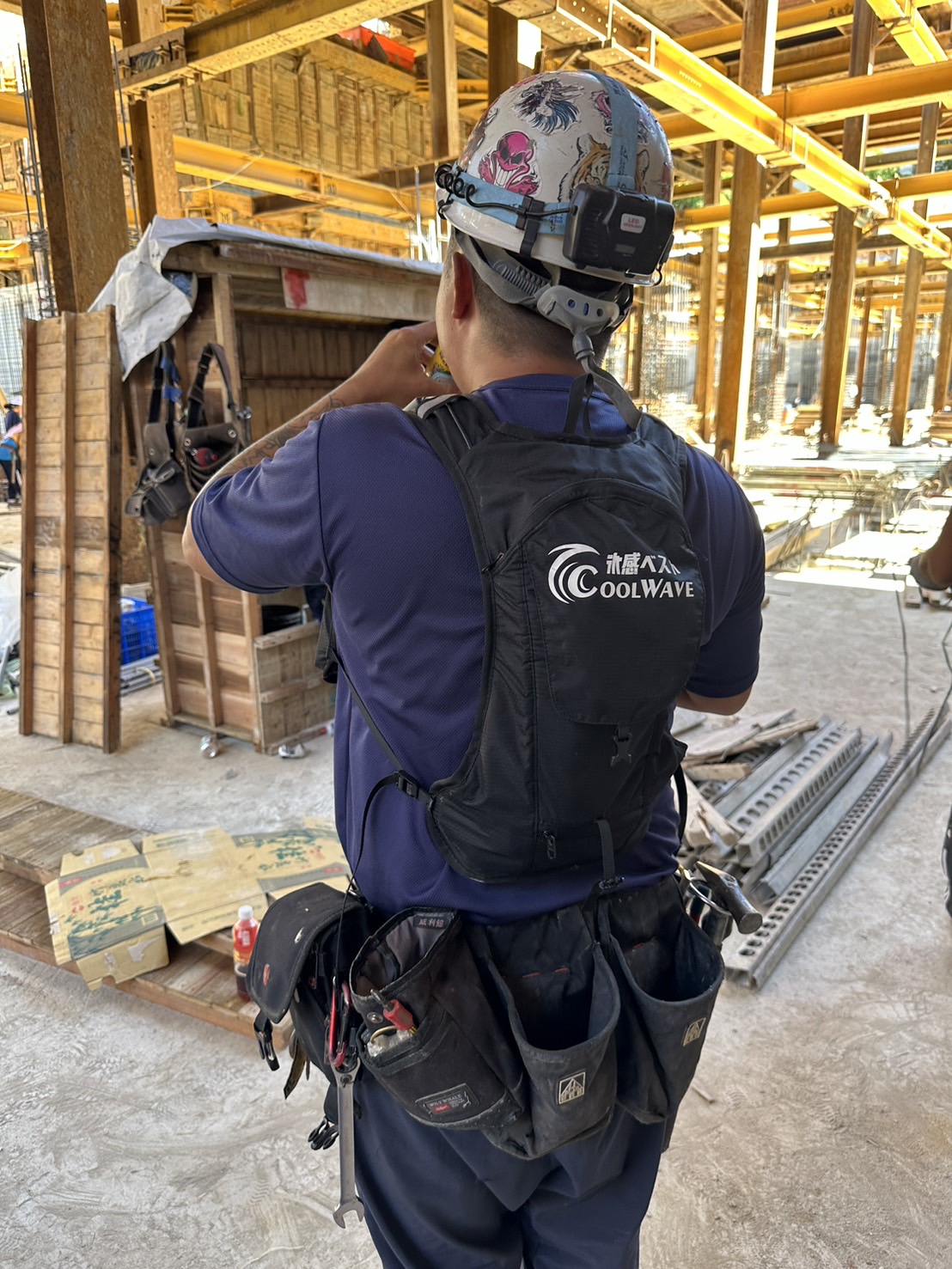
Construction sites: the core environment for the Basic Model.
Metal sheet factories
Factory floors working sheet metal combine ambient heat with radiant heat from the material itself. Metal sheet factories are a named Basic Model environment, which matters because these sites are frequently overlooked when cooling budgets are written around outdoor work only.
Traffic control
Traffic-control teams stand on hot surfaces in high-visibility clothing for extended periods, and they are usually managed by a different supervisor than the construction crews on the same project. That is exactly where a Professional Model in Black, Gray or Blue simplifies management: one product family, three colours, one procurement file.
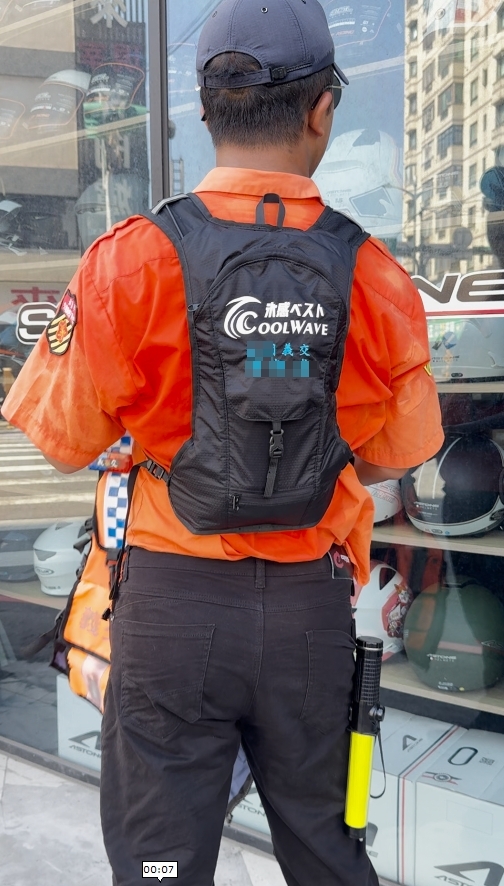
Traffic control: added to the declared scope on the Professional Models.
Street vending and food stalls
Vendors working next to cooking heat are exposed continuously rather than intermittently. The Professional Models extend declared coverage to this environment, which is useful for municipal programmes, market operators and contractors whose responsibilities include vendor zones.
Documented field use in Taiwan
A Taiwan deployment recorded 100 units in use across construction sites, outdoor work areas, metal sheet factories and street vendor locations over a 10-year period, with reported effective body cooling, heatstroke prevention, and improved worker comfort and work efficiency. It is the longest-duration reference in the available material, and it spans both model scopes.
Comparison table: Basic Model vs Professional Models
| Dimension | Basic Model | Professional Models |
|---|---|---|
| Declared worksites | Construction, outdoor work, metal sheet factories | Same, plus food stalls, street vending, traffic control |
| Colour options | Not listed in the available model data — confirm with the supplier | Black, Gray, Blue |
| Cooling method | Pump-driven water circulation | Same platform — identical stated method |
| Flow rate | 320–370 ml/min | Shared platform specification |
| Cooling duration | 3–4 hours per charge | Shared platform specification |
| Net weight | Under 2 kg | Shared platform specification |
| Pump | 5V, 150 mA max | Shared platform specification |
| Water bag / tube / cap | PEVA or TPU bag; sand rubber tube; polypropylene cap | Shared platform specification |
| Shoulder strap | 600D polyester | Shared platform specification |
| Stated suitability | Below 10 °C — confirm application with the supplier | Shared platform specification |
| MOQ / lead time | 10 units; 7–14 days typical production lead time | 10 units; 7–14 days typical production lead time |
| Warranty | 6 months on the water-cooled vest | 6 months on the water-cooled vest |
Ordering, lead time and programme logistics
Stated commercial terms for the COOLWAVE water-cooled vest line: minimum order quantity 10 units, typical production lead time 7–14 days, monthly production capacity 3,000 units, and a 6-month warranty on the vest. Purchase terms record shipment after payment, freight paid by the buyer, acceptance criteria based on a pre-shipment test, and full payment.
Three practical implications for a safety manager running a programme rather than a single purchase:
- A 10-unit MOQ supports a pilot. You can equip one crew, evaluate it for a rotation, and only then plan a site-wide rollout.
- 7–14 days is production time, not delivery time. Freight to your site is paid by the buyer separately, so build transport into the season plan rather than discovering it in the first week of a heatwave.
- A colour mix has to be sequenced. Against a monthly capacity of 3,000 units, splitting a Professional order across Black, Gray and Blue is feasible, but the split should be stated in the RFQ, not negotiated after the order is confirmed.
What you can verify before you buy
The basic structural claim behind the water-circulation design is documented. The water-cooled vest structure and cooling system are covered by patent I886033, issued by the Intellectual Property Office, Ministry of Economic Affairs (ROC) on 2025-06-01, with expiry recorded as 2044-08-27, under the Patent Act of the Republic of China. A patent protects a structure; it is intellectual-property evidence, not a PPE certification, and it should be read as the former.
The brand also holds the Disaster Prevention Product and Service Certification Award issued by the Taiwan Disaster Prevention Industry Association, and the product has been deployed for 10 years in Taiwan across construction sites, outdoor work, metal sheet factories and street vendor locations, with 100 units in use.
Shokunin is the cooling and tool brand of FENG SHANG PRECISION CO., LTD, a manufacturer founded in 2009 and based in Luzhu District, Taoyuan City, Taiwan, operating a 1,000 m² facility with 30 employees and a 5-engineer R&D team, exporting to the USA and ROC. The company offers ODM production services for the water-cooled vest line.
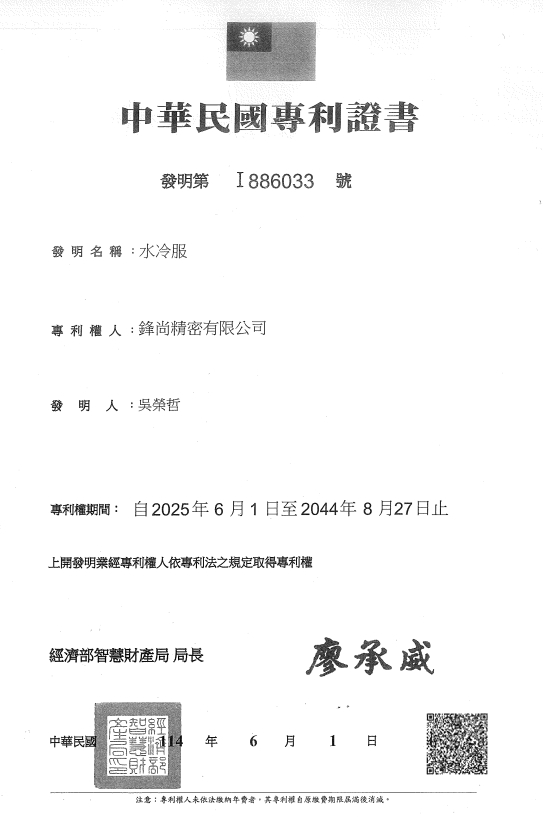
Patent I886033 covers the water-cooled vest structure and cooling system; it is structural IP evidence, not a PPE certification.
FAQ
Does a COOLWAVE vest replace a heat-illness prevention programme or required PPE?
No. NIOSH classifies cooling vests and water-cooled garments as auxiliary or personal cooling systems, positioned alongside controls such as water, shade and work-rest cycles rather than instead of them, and it recommends heat-protective clothing or equipment where heat stress exceeds the recommended occupational exposure limit. OSHA guidance likewise treats certain PPE as an additional heat burden, not a substitute for engineering controls. Patent I886033 protects the vest structure and cooling system; it is an intellectual-property right, not a PPE certification. Confirm with your local safety authority which documentation your site requires.
Can one supplier cover a mixed crew, and is customization available?
Yes. The manufacturer offers ODM production services with a minimum order quantity of 10 units and a typical production lead time of 7–14 days, with monthly capacity of 3,000 units. The Basic Model covers construction, outdoor work and metal sheet factories; the Professional Models add food stalls, street vending and traffic control and are offered in Black, Gray and Blue. For a programme that needs both, state quantities per model and per colour in the RFQ so the 10-unit minimum applies where you intend it to.
What drives the cost of a programme, and are prices published?
No prices are published in the available product material; pricing is quoted per order. The stated commercial frame is a 10-unit MOQ, shipment after payment, freight paid by the buyer, full payment, and a 6-month warranty on the water-cooled vest. Budget drivers to model are total unit count, the mix of Basic and Professional models and colours, freight to site, and the swap or spare policy you build around a 3–4 hour cooling duration per charge. Request a written quotation for the exact quantity and colour split.
Can we validate a sample before a full rollout?
The stated acceptance criterion is a pre-shipment test. For buyer-side validation, run one crew for a full rotation and check three things against your own site conditions: the under-2 kg net weight worn over your existing PPE, the 3–4 hours per charge against your shift and break pattern, and the stated suitability below 10 °C against your chilled-water supply. Record the results — they become the evidence your heat-stress programme needs. A sample request and quotation can be raised through the supplier's contact channels.
What lead time should we plan for?
Plan 7–14 days of typical production lead time plus freight to your site, with monthly capacity of 3,000 units if the order is large or spread across several colours. Because freight is paid by the buyer and payment precedes shipment, the realistic programme timeline is order confirmation, production, pre-shipment test, freight, and issue — sequence the colour mix at the start rather than after confirmation.
Conclusion: the decision rule, restated
If every crew you issue to works in construction, outdoor operations or a metal sheet factory, buy the Basic Model and keep the programme to one line. If your responsibility also covers food stalls, street vending or traffic control — or if supervisors need colour to tell crews apart on a shared site — buy a Professional Model in Black, Gray or Blue. In both cases you are buying the same pump-driven water-circulation platform: 320–370 ml/min flow, 3–4 hours of cooling per charge, under 2 kg net weight, a 5V 150 mA max pump, PEVA/TPU water bag, 600D polyester shoulder strap, sand rubber cooling tube and polypropylene cap.
The part that decides whether the programme works is not the model number. It is whether you matched the 3–4 hour charge to your shift, tested the vest over the PPE your crews already wear, and clarified the 10 °C suitability figure before it entered a purchase order.
Planning a crew rollout? Request a model and colour recommendation against your site list.
Next step: sample, quotation or full catalogue
Send your site list, crew count and required colour split, and the team will confirm whether the Basic Model covers your programme or whether a Professional Model is the simpler standard. Download the product catalogue for the complete specification set.
Download the Shokunin COOLWAVE product catalogue (PDF)
Website: www.fstool.com.tw
Email: fsmarketing@fstool.com.tw | Phone: +886 3-312-6606 | WhatsApp: +86 18858260055
FENG SHANG PRECISION CO., LTD (Shokunin), No. 155-17, Sec. 2, Nanzhu Rd., Luzhu Dist., Taoyuan City 338454, Taiwan
Have Questions or Need More Details?
Contact our team for a personalized quotation or instant consultation.
Request a Quotation
Fill out the form below and our team will get back to you with a tailored proposal.
WhatsApp Direct Chat
Prefer to chat in real-time? Message us on WhatsApp for instant assistance & quick answers.
- Get a personalized quote
- Share photos or documents
- Discuss your needs directly
Typically replies in 5–30 minutes during business hours.