
Dual Cooling Water Cooling Vest: Compliance Verification
Compliance for a dual cooling water cooling vest is a document pack, not a badge. Buyers evaluating this category have to prove three separate things: how the garment is classified, how the pump and its power bank are documented, and how the published cooling and flow figures were measured. This guide maps what the COOLWAVE Water-Circulation Cooling Vest from Shokunin documents today, and what a buyer still has to request.
Shokunin is a professional tool brand launched by Feng Shang Precision Co., Ltd., a manufacturer founded in 2009 and based in Luzhu District, Taoyuan City, Taiwan. Its range includes the COOLWAVE Water-Circulation Cooling Vest, a pump-driven water-circulation vest supplied with two ice packs and described by the company as a cooling solution for outdoor and high-temperature work.
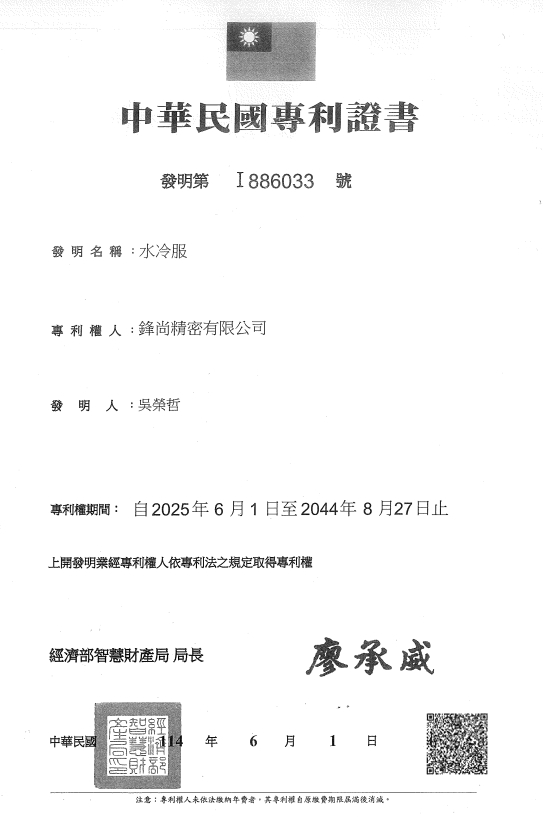
Water-cooled vest patent certificate I886033, issued by the Intellectual Property Office, Ministry of Economic Affairs (ROC), covering water-cooled vest structure and cooling system.
The compliance conversation around this product rarely begins with a question. It begins with a folder: a patent copy, an association award, a specification sheet, a warranty statement, and a buyer asking whether that folder is enough. Usually it is not — not because the documents are weak, but because they answer different questions from the ones safety officers and procurement teams are actually required to answer.
Why Compliance Is Ambiguous for a Powered Water Cooling Vest
A water-circulation vest sits on the boundary between clothing and equipment. It is worn like a garment, but it contains a reservoir, tubing, a pump and a separate power bank. That combination pushes the product into three compliance conversations at once, each with a different owner inside a buying organization.
The first is classification. A safety officer needs to know whether the vest is treated as personal protective equipment, as an auxiliary cooling system, or as ordinary workwear, because the answer determines which records the employer must keep and which claims the supplier must be able to support.
The second is electrical. The pump in the COOLWAVE vest is rated at 5V and 150mA maximum and runs from a power bank. Small as that load is, the power source is still a battery that a worker carries, charges and stores, so buyers tend to want the power bank requirement in writing rather than in a verbal briefing.
The third is claim substantiation. Figures such as a 3–4 hour cooling duration and a 320–370 ml/min flow rate are the numbers a buyer will repeat in a tender document or an internal heat-safety plan. A number that migrates into a formal document needs a defined measurement basis attached to it.
State of the category. In the material reviewed for this guide, no product-specific standard, conformity marking or test requirement is established for water-circulation cooling vests, and no standardized thermal test with defined ambient temperature, humidity, workload or clothing layers was located for this product. That is not a criticism of the vest; it describes where the category stands. It also defines the buyer's job: assemble evidence, and record what is missing, instead of accepting a single emblem as proof.
Industry Background: Where This Category Sits
Occupational-safety guidance is the clearest available reference point. The U.S. National Institute for Occupational Safety and Health (NIOSH) lists water-cooled garments, air-cooled garments, cooling vests and wetted overgarments among the examples of auxiliary or personal cooling systems used against heat exposure. That is useful because it establishes the product as a recognized heat-exposure control — but it is guidance, not a certification, and it does not set a performance threshold that any specific vest must meet.
Commercial context points the same direction. Industrial applications accounted for 34.5% of global cooling vest revenue in 2025, according to Dataintelo's 2026 cooling vest market report. A share of that size suggests most purchases are made by organizations rather than individuals, and organizations carry documentation duties that individual buyers do not.
The practical consequence is a shift in what a buyer is asked to defend. The question is rarely “is this vest good?” It is more often “can you show why this vest was chosen, and what it is and is not certified for?” A supplier page that answers the first question well can still leave the second one open.
What the COOLWAVE Documentation Actually Covers
An intellectual property record
The most concrete document in the pack is a patent. Certificate I886033 was issued on 2025-06-01 by the Intellectual Property Office, Ministry of Economic Affairs, under the Patent Act of the Republic of China, for water-cooled vest structure and cooling system, and it expires on 2044-08-27.
What it establishes: the structure and circulation design are protected in Taiwan (ROC), and the certificate number can be checked against the registry. What it does not establish: a patent rewards novelty and industrial applicability. It does not test pump safety, fabric suitability or heat-strain reduction. A patent number should never be filed in a tender as if it were a product safety certificate.
A disaster-prevention recognition
Shokunin states that the COOLING water-cooled vest received the Disaster Prevention Product and Service Certification Award issued by the Taiwan Disaster Prevention Industry Association. The same discipline applies. An award from an industry association records recognition within a specific national disaster-prevention product context; it does not transfer automatically to another market's PPE regime, and it should be described by its exact name rather than paraphrased as “certified” without qualification.
A component-level specification
The published specification goes deeper than most category pages, which is exactly what a verification review needs. Listed materials and ratings are:
- Shoulder strap: 600D polyester
- Body material: PEVA
- Water bag: TPU
- Water bag cap: polypropylene
- Cooling tube: sand rubber (black)
- Pump output: 5V, 150mA (max)
- Flow rate: maximum 320–370 ml/min
- Weight: within 2 kg
- Cooling duration: 3–4 hours
- Listed suitable temperature: below 10°C
- Contents: water-cooled vest backpack ×1, ice packs ×2
A component-level list is valuable because it can be inspected rather than believed. Webbing, panels, a TPU water bag, a polypropylene cap and a rubber tube are all checkable on a sample unit. A TPU water bag in particular can be assessed for seam behavior and refilling practice instead of being accepted as a generic “food-grade material” claim.
A field record
A Taiwan case record covers 100 units used in high-temperature environments, with a deployment period recorded as 10 years, and results described as effective body cooling, heatstroke prevention, improved work efficiency and worker comfort. The sectors named in the record are construction sites, outdoor work, metal sheet factories, street vendors and traffic control.
For a compliance file, a case record is not a substitute for a test report. Its value is narrower and still real: it shows where the product has been deployed, which helps a buyer judge whether the intended use is genuinely comparable to a documented one.
Manufacturing and after-sales terms
Production is described as ODM with a monthly capacity of 3,000 units, a lead time of 7–14 days, and a minimum order quantity of 10 units. The water-cooled vest carries a 6-month warranty. Company-level figures are a 1,000 m² facility, 30 employees, 5 engineers, and annual output of 10,000 units, with 50% of output exported and main markets listed as the USA and ROC.
One verification point is worth flagging early. The 3,000 units per month figure and the 10,000 units per year figure rest on different bases — one line-specific and monthly, one company-wide and annual. Before either number enters a contract, a buyer should ask the supplier to define installed, practical and available capacity.
What is not in the pack
- A third-party thermal performance test with stated ambient temperature, humidity, workload and clothing layers.
- A defined measurement condition for the listed 3–4 hour cooling duration.
- Product-specific conformity documentation for destination markets outside Taiwan.
- Pump reliability data or a measured battery-runtime test.
None of these gaps makes the product unusable. They belong on an open-items list, so that approval is granted on what is documented rather than on what is assumed.
A Seven-Step Verification Workflow
Step 1 — Classify the product against the wearer's status
Decide first whether the vest will be issued as employer-provided protective equipment or bought by the wearer. NIOSH's classification of water-cooled garments as personal cooling systems gives a defensible starting frame, but the final classification belongs to the authority in the destination market. Record the classification decision and who made it, because everything downstream — documentation depth, training, replacement intervals — depends on that single line.
Step 2 — Verify the patent entry directly
Take the certificate number I886033 and check it against the issuing registry rather than a scanned copy alone. Confirm the title, the scope wording “water-cooled vest structure and cooling system”, the issue date of 2025-06-01 and the expiry date of 2044-08-27. A five-minute registry check removes the most common documentation failure in tender packs: a certificate that is real but described inaccurately.
Step 3 — Read the award at the correct level
File the Disaster Prevention Product and Service Certification Award from the Taiwan Disaster Prevention Industry Association under recognition, not under conformity. That means naming the issuing body, the market it applies to and the year, and avoiding any sentence that implies the award satisfies another country's PPE requirements.
Step 4 — Rebuild the technical file at component level
Convert the specification into a bill-of-materials table with one row per component: 600D polyester strap, PEVA body, TPU water bag, polypropylene cap, sand rubber tube, pump at 5V/150mA maximum, maximum flow of 320–370 ml/min, weight within 2 kg, and the pack contents of one backpack plus two ice packs. A file built this way can be matched against a received sample line by line, and it exposes substitutions immediately.
Step 5 — Put measurement conditions onto every performance claim
The 3–4 hour cooling duration and the “below 10°C” suitable temperature are listed specifications without a stated test protocol. Ask the supplier for the ambient temperature, humidity, workload and clothing layers used, and for the definition of when a cooling cycle is considered finished. If the answer is not available, keep the figure in the file but label it as a supplier-reported specification — that label protects the buyer later.
Step 6 — Review the pump and power bank interface
A 5V, 150mA maximum pump is a modest load, which means the practical risk sits with the power bank, not the pump. Document the required power bank output, connector type and expected runtime per charge; then confirm how the pump and tubing are cleaned and stored between shifts. Buyers running multi-unit fleets should also record whether pumps and water bags are available as replacement parts, since a 6-month warranty covers the vest, not an unlimited consumable supply.
Step 7 — Complete the destination-market file and reconcile commercial terms
Close the file with the market-specific items: for Taiwan, the patent and the association award; for the USA, which is listed as a main export market, the importer's own classification and electrical review. Then reconcile commercial terms — MOQ 10 units, 7–14 days lead time, ODM production, 6-month warranty — against the compliance scope, so that the approved configuration and the quoted configuration are the same document.
Use Cases: Where the Document Pack Changes Shape
Construction sites
On a construction site the vest is usually issued by the contractor, so the employer holds the file. That makes classification, a written power-bank specification and a replacement schedule the three minimum records, and it makes the construction-site record in the Taiwan case directly relevant as a comparable deployment.
Traffic control
Traffic controllers work fixed shifts in sustained sun, which turns cooling duration into a rostering question rather than a comfort question. Because the published duration is 3–4 hours without stated conditions, a traffic-control buyer should validate the figure against the actual shift pattern before writing it into a heat-safety procedure.
Metal sheet and metal-roof factories
Metal sheet factories appear in both the case record and the documented application list. In these environments the compliance interest is less about the garment and more about repeatability: whether a 100-unit deployment can be resupplied, and whether the 3,000 units per month capacity and 7–14 day lead time hold across a multi-site rollout.
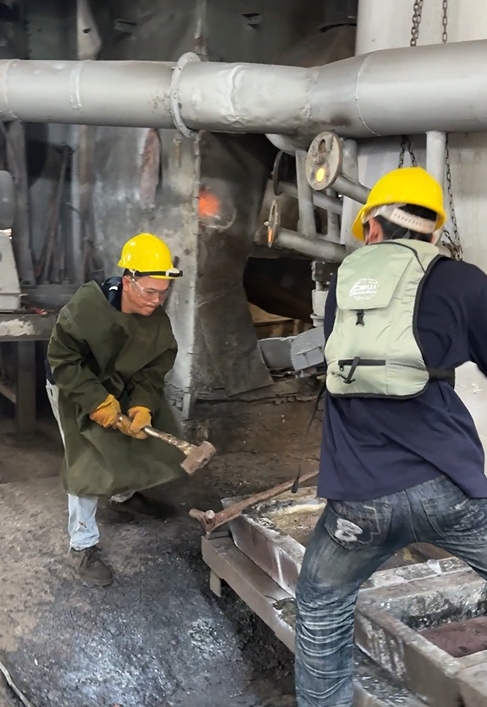
Metal sheet factory deployment — one of the sectors named in the documented Taiwan case record for the COOLWAVE water-circulation cooling vest.
Street vendors and night markets
Street vendors buy for themselves, so no employer file exists. The documented product features that matter here are the ones written into the case record: passive ice-pack cooling, no power requirement for the ice-pack function, lightweight portability, and an adjustable one-size-fits-all design. The compliance burden shifts from classification to product identification — the buyer should still keep the specification sheet and warranty statement.
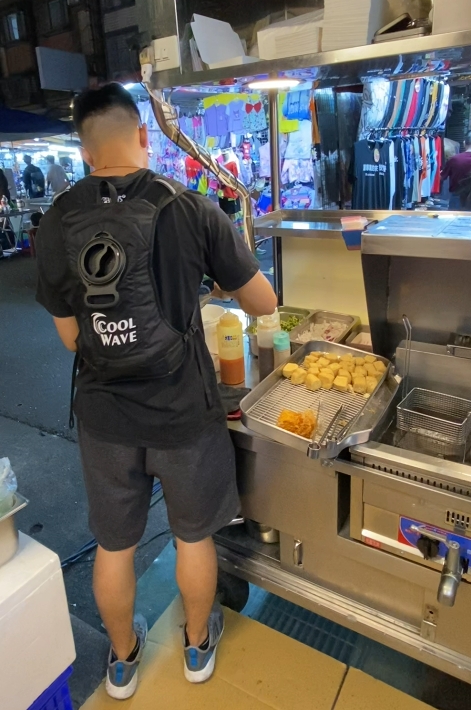
Self-purchased use, such as a night market vendor, changes the documentation burden: no employer file, but the specification sheet and 6-month warranty record still apply.
Long-duration outdoor work
Fishing, inspection and general outdoor work fall outside the named case sectors but inside the documented application scope of outdoor and high-temperature environments. For these users the file is short: product identification, ice-pack and water-bag maintenance, and a recharge plan for the pump.
Comparison: What Each Document Actually Proves
| Document | Issuer or source | What it verifies | What it does not verify |
|---|---|---|---|
| Patent certificate I886033 | Intellectual Property Office, Ministry of Economic Affairs (ROC) | Protection of water-cooled vest structure and cooling system under the Patent Act of the Republic of China, issued 2025-06-01, valid to 2044-08-27 | Product safety, electrical safety, or thermal performance |
| Disaster Prevention Product and Service Certification Award | Taiwan Disaster Prevention Industry Association, as stated by Shokunin | Recognition of the COOLING water-cooled vest within a Taiwan disaster-prevention product context | Compliance with any other market's PPE or electrical regime |
| Component specification sheet | Shokunin / Feng Shang Precision Co., Ltd. | Materials (600D polyester, PEVA, TPU, polypropylene, sand rubber), pump rating 5V/150mA max, flow 320–370 ml/min, weight within 2 kg | Measured performance under a defined test condition |
| Cooling duration listing (3–4 hours) | Shokunin / Feng Shang Precision Co., Ltd. | A stated planning basis for shift rotation and ice-pack resupply | Ambient temperature, humidity, workload or clothing layers used in measurement |
| Warranty statement (6 months) | Shokunin / Feng Shang Precision Co., Ltd. | After-sales coverage terms for the water-cooled vest | Fitness for a specific hazard or a specific site condition |
| Third-party thermal performance test | Not located in the documentation reviewed for this guide | — | — |
Table compiled only from the documentation reviewed for this article. Where a document was not located, the row states that rather than substituting an assumption.
Frequently Asked Questions
1. Does the COOLWAVE vest hold a PPE certification that covers the US or EU market?
Not according to the documentation reviewed for this guide. The recorded documents are patent I886033 from the Intellectual Property Office, Ministry of Economic Affairs (ROC), and a Disaster Prevention Product and Service Certification Award from the Taiwan Disaster Prevention Industry Association. Neither is a product-specific PPE standard, conformity marking or electrical-safety certificate for the US or EU. NIOSH's heat-stress guidance describes water-cooled garments as personal cooling systems, but that is a classification, not a certification. Buyers should confirm classification and import requirements with the relevant authority in the destination market before ordering.
2. What technical documentation is available for the vest itself?
The available technical documentation is a component-level specification: 600D polyester shoulder strap, PEVA body, TPU water bag, polypropylene water bag cap, sand rubber cooling tube, a pump rated 5V and 150mA maximum, a maximum flow rate of 320–370 ml/min, weight within 2 kg, a listed cooling duration of 3–4 hours and a listed suitable temperature below 10°C, supplied as one water-cooled vest backpack plus two ice packs. Production is described as ODM with monthly capacity of 3,000 units, alongside company-level figures of 10,000 units annual output and 5 engineers.
3. What determines the cost of a compliance-ready order?
No unit price appears in the documentation reviewed, so a buyer should build cost from the confirmed configuration rather than from a published list price. The commercial terms that shape an order are a minimum order quantity of 10 units, ODM production, a lead time of 7–14 days and a 6-month warranty on the water-cooled vest. Ask for a written quotation that separates the vest, the two ice packs, the pump and the after-sales terms, because both the configuration and the verification scope affect what is quoted.
4. What should a validation sample prove before a larger approval?
A sample should be checked against the specification already published, so the test is verification rather than exploration. Confirm the pump output of 5V/150mA maximum, the maximum flow of 320–370 ml/min, weight within 2 kg, and the fit of the adjustable one-size-fits-all design on the actual workforce. Because the listed 3–4 hour cooling duration does not come with a stated ambient temperature, humidity or workload, record those conditions during the sample run so the figure carries a defined basis into the file.
5. How long does a repeat order take, and what support follows delivery?
Stated lead time is 7–14 days, with a minimum order quantity of 10 units and monthly capacity of 3,000 units on an ODM basis; the water-cooled vest carries a 6-month warranty. Buyers should ask the supplier to state what the lead time is measured from — purchase order, artwork approval or material arrival — and to confirm how replacement pumps, water bags and ice packs are handled after the warranty window, since consumables fall outside the vest warranty. Shokunin publishes its product documentation as a downloadable catalogue, and quotation requests are handled at fsmarketing@fstool.com.tw or +886 3-312-6606 during Taiwan business hours, Monday to Friday 8:30 AM – 5:40 PM.
Conclusion
Compliance verification for a dual cooling water cooling vest is a file-building exercise with a predictable shape. On the documented side, the COOLWAVE vest carries a Taiwan patent for structure and cooling system, a disaster-prevention product award from the Taiwan Disaster Prevention Industry Association, a component-level specification including a 5V/150mA pump and 320–370 ml/min maximum flow, a 100-unit Taiwan field record, and defined commercial terms of MOQ 10 units, 7–14 days lead time and a 6-month warranty.
On the open side, a buyer still needs a thermal test with stated conditions, a defined basis for the 3–4 hour cooling duration, destination-market conformity documentation where required, and a clarified capacity basis. Recording those gaps is not a reason to delay a decision; it is the reason the decision holds up when someone else reviews it a year later.
Next step: complete your document pack
Download the Shokunin catalogue for the full published specification, or send your destination market and shift pattern to receive a written quotation and the documentation available for that configuration.
Download the product catalogue (PDF) | www.fstool.com.tw | Email: fsmarketing@fstool.com.tw | WhatsApp: +86 18858260055
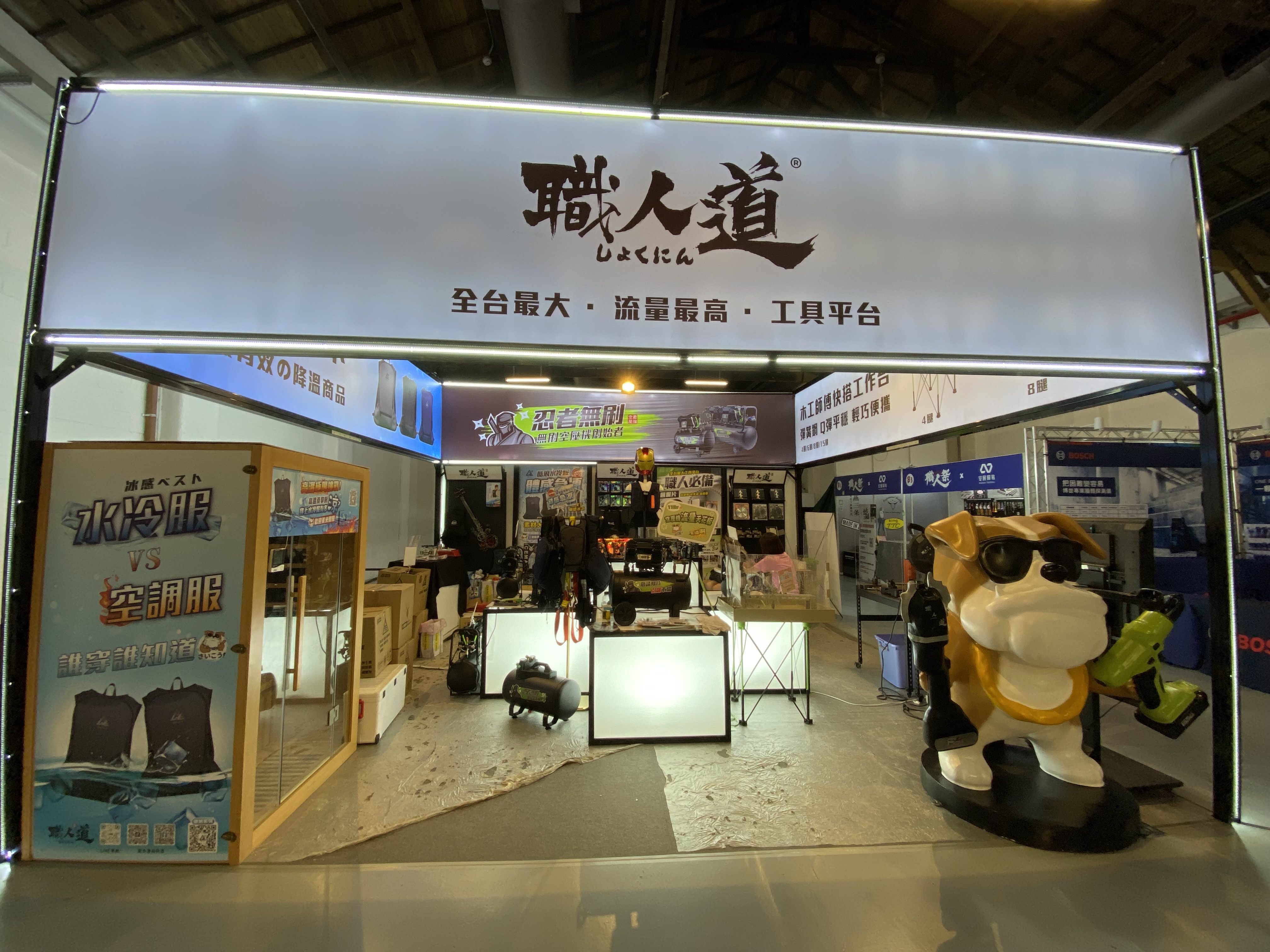
Shokunin COOLWAVE Water-Circulation Cooling Vest — manufacturer: Feng Shang Precision Co., Ltd., No. 155-17, Sec. 2, Nanzhu Rd., Luzhu Dist., Taoyuan City 338454, Taiwan.
Have Questions or Need More Details?
Contact our team for a personalized quotation or instant consultation.
Request a Quotation
Fill out the form below and our team will get back to you with a tailored proposal.
WhatsApp Direct Chat
Prefer to chat in real-time? Message us on WhatsApp for instant assistance & quick answers.
- Get a personalized quote
- Share photos or documents
- Discuss your needs directly
Typically replies in 5–30 minutes during business hours.