
Dual Cooling Water Cooling Vest: Specs vs. Site Conditions
A dual cooling water cooling vest combines a stored cold source with pumped circulation: reusable ice packs chill a water reservoir, and a low-voltage pump moves chilled water through a tube network worn against the torso. On the COOLWAVE Water-Circulation Cooling Vest, the published figures are a 3–4 hour cooling duration, a worn weight within 2 kg, a 5V / 150 mA (max) pump and a maximum flow rate of 320–370 ml/min.
Those figures are half of a specification. The other half is the site: ambient and radiant heat, workload, clothing layers and the ability to refreeze ice packs between shift blocks. A vest that suits a traffic controller standing in direct sun is not automatically right for a worker layered under flame-resistant clothing, and a 3–4 hour window only helps if the site can rotate cold sources inside that window. This guide reads the COOLWAVE specification line by line, converts each parameter into a site condition, and sets out a sample protocol that can be run before a fleet order.
Shokunin is the professional tool and cooling brand of Feng Shang Precision Co., Ltd., a manufacturer established in 2009 in Luzhu District, Taoyuan City, Taiwan, whose product line includes air compressors, cut-off machines and the COOLWAVE water-circulation cooling vest. The company operates a 1,000 m² factory with 30 employees, five R&D engineers and a stated annual output of 10,000 units. See www.fstool.com.tw for company information.
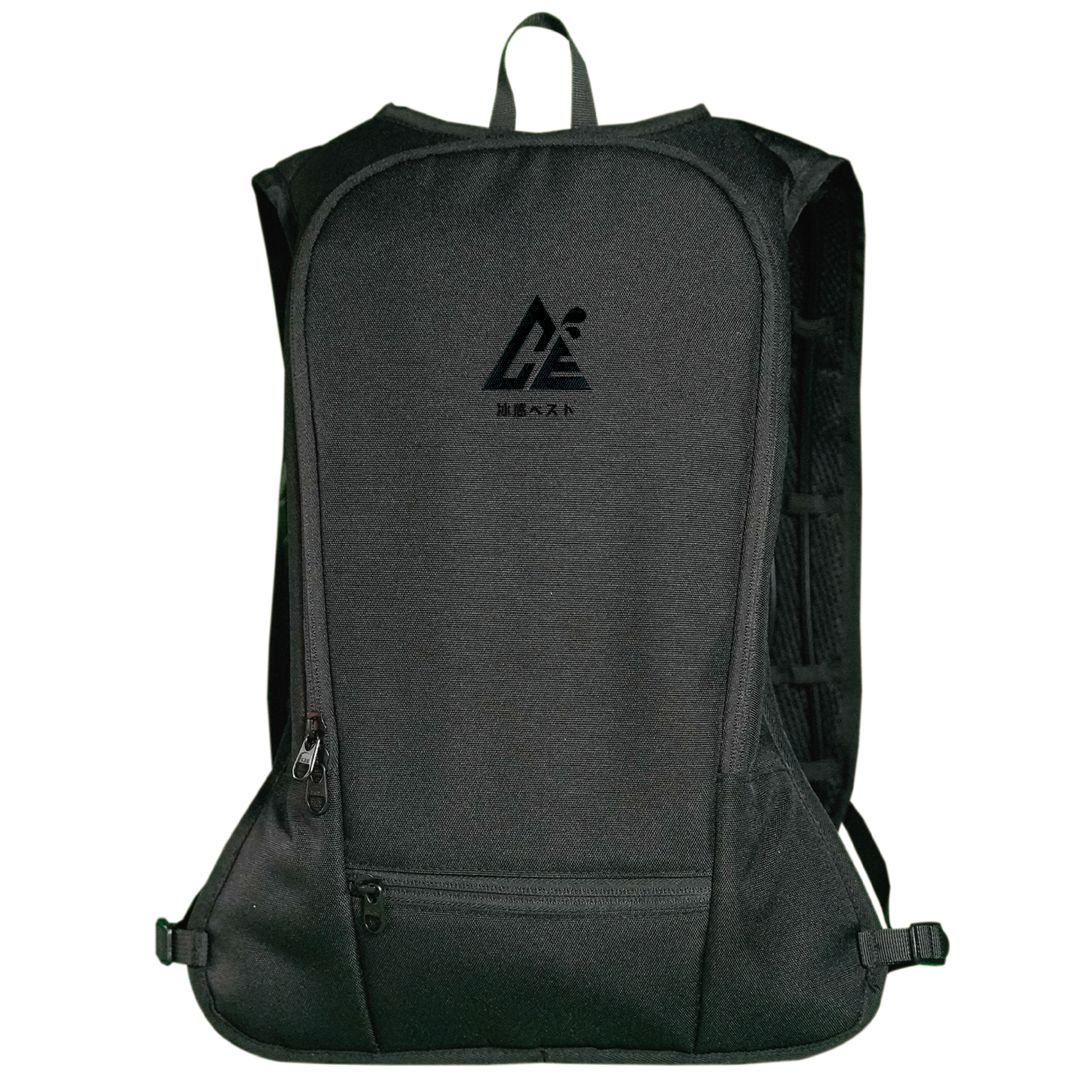
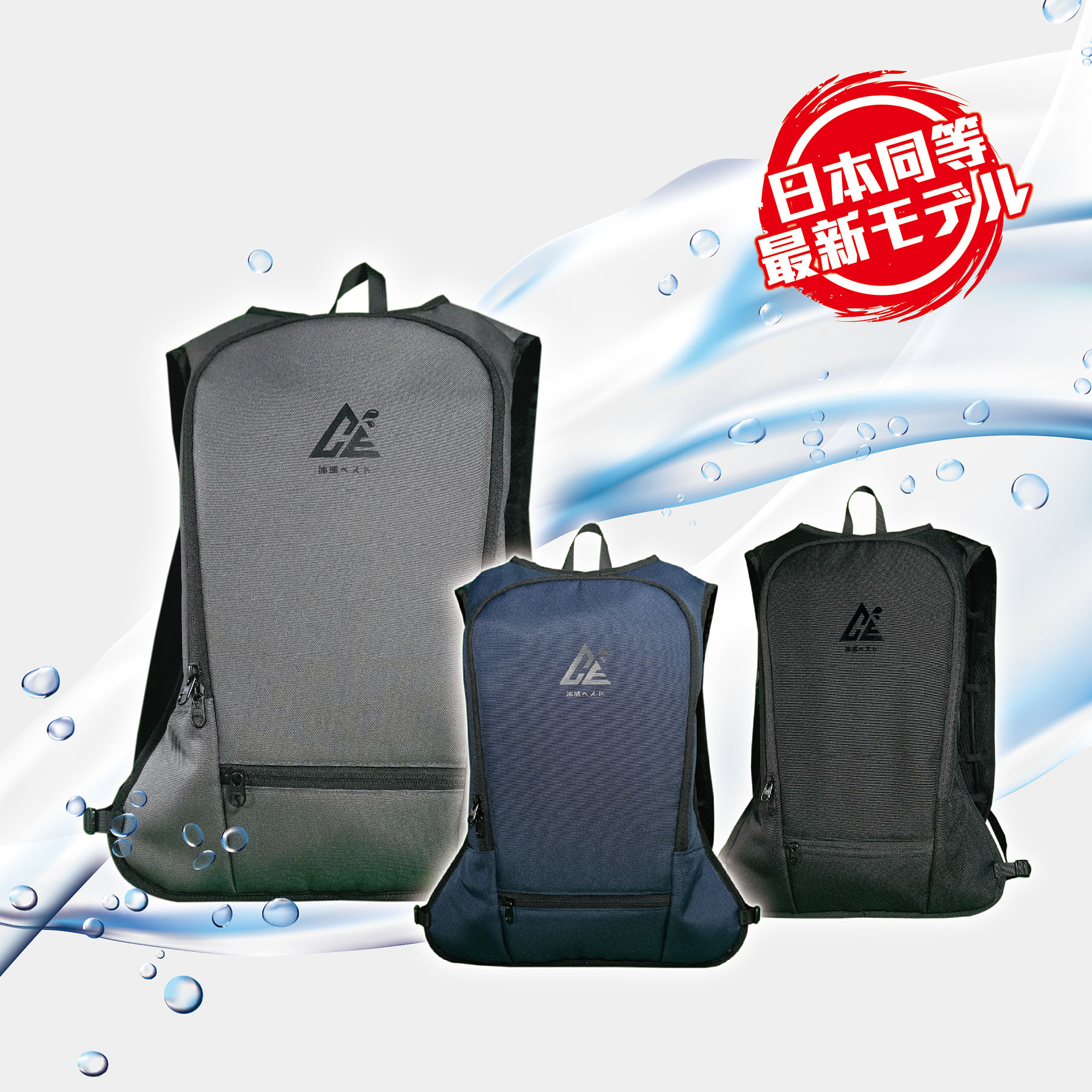
COOLWAVE Water-Circulation Cooling Vest (Professional Model, Black): PEVA vest body, 600D polyester shoulder straps, TPU water bag and two reusable ice packs.
Why a Cooling Spec Sheet Does Not Answer a Site Question
Cooling performance is not a fixed property of a garment. It is the outcome of four variables that change between sites, and often between jobs on the same site.
- Ambient and radiant heat. A shaded loading bay and a metal-roof factory floor can record the same air temperature and feel entirely different, because radiant heat from the roof deck or a furnace wall loads the body on top of air temperature.
- Workload. Metabolic heat production rises with physical effort. A worker carrying sheet metal across a shop floor generates more internal heat than a worker standing at a control point, so the same vest removes a smaller share of the total heat load.
- Clothing layers. A cooling vest worn under a welding jacket, harness or impermeable rain shell sits behind a barrier that limits both evaporation and the reach of the cold surface.
- Cold-source logistics. Ice packs eventually warm up. Whether that matters depends on freezer access, how many spare packs are on site and how long the walk to the freezer takes.
The published cooling duration is therefore a planning figure, not a guarantee. The COOLWAVE listing states 3–4 hours but does not disclose the ambient temperature, humidity, workload or measurement method behind that number. Treat it as the assumption a trial should test, and ask the supplier for the test conditions in writing if the figure will appear in a procurement document.
How Industrial Buyers Are Evaluating Cooling Gear Now
Cooling vests are shifting from a comfort accessory to a specified item of heat-safety equipment, and the purchasing logic has followed. Research published by Dataintelo put the global cooling vests market at USD 342 million in 2025, with industrial applications accounting for a 34.5% revenue share of that total. Roughly a third of category revenue therefore comes from buyers purchasing against working conditions rather than personal preference.
Occupational-safety guidance supports that framing. The U.S. National Institute for Occupational Safety and Health (NIOSH) groups water-cooled garments, air-cooled garments, cooling vests and wetted overgarments together as auxiliary or personal cooling systems — wearable equipment used to reduce heat burden, not ordinary apparel. Once a product is treated as equipment, the buyer's questions change: what does it weigh when loaded, how long does one cooling cycle last under our conditions, what happens when a pump or tube fails, and who supplies replacement parts.
That shift leaves a practical gap. Supplier catalogues publish headline figures — hours of cooling, weight, flow rate — while the site needs the conditions behind those figures. Closing the gap is a document and trial exercise, and it is what the rest of this guide is built around.
The COOLWAVE Dual Cooling System, Component by Component
The system stores cold in ice, then moves it. Reusable ice packs chill a water reservoir carried in a backpack; a low-voltage pump pushes chilled water through a sand-rubber tube network routed across the torso; the water returns to the reservoir and is re-chilled. The garment itself is a PEVA vest body with 600D polyester shoulder straps.
Cold source: two reusable ice packs
Each unit ships with a water-cooled vest backpack and two ice packs. The cold source is recharged in a freezer rather than from site power, which matters where there is no electrical outlet at the workface. Two packs also define a rotation model: while one set sits in the reservoir, the second can be refreezing. Where freezer turnaround is slow, the number of ice pack sets per worker — not the number of vests — becomes the constraint on continuous coverage.
Water circuit: TPU bag, polypropylene cap, sand-rubber tubing
The water bag is TPU with a polypropylene cap, and the cooling tube is black sand rubber. The pump is rated 5V, 150 mA maximum, with a maximum flow rate of 320–370 ml/min. Two readings matter. First, 5V / 150 mA is a deliberately small low-voltage circuit, so the power source is a component to confirm in the quotation rather than assume from the picture. Second, “max” describes a ceiling measured under specific conditions — tube length, lift, reservoir level — not an average in service. A buyer comparing flow figures from different suppliers should ask for the measurement head and tube length before treating the numbers as comparable.
Wearable side: PEVA body, 600D polyester straps, under 2 kg
PEVA is a flexible, water-resistant film suited to a garment that carries a reservoir. 600D polyester is used on the shoulder straps, where abrasion from tool belts and scaffolding contact concentrates. The stated worn weight is within 2 kg; for procurement, weigh the assembled unit — vest, filled reservoir and two ice packs — rather than the dry garment, because the loaded figure is what the wearer carries across a shift.
Stated operating envelope
Three figures define the envelope: cooling duration 3–4 hours, worn weight within 2 kg, and a listed suitable temperature below 10°C. The third deserves a question at RFQ stage. Ambient summer site temperatures are far above 10°C, so the figure most plausibly describes the cold-source condition — chilled water and ice packs held below 10°C — rather than an ambient operating limit. The supplier should confirm the definition in writing before it is transcribed into a specification sheet or tender document.
Reading the spec sheet line by line
| Published parameter | Value | What it constrains on site | How to verify before ordering |
|---|---|---|---|
| Cooling duration | 3–4 hours | Length of a work block before the cold source must change; rotation and break planning | Time it on site against your own ambient temperature and workload; request the test conditions behind the figure |
| Flow rate | Max 320–370 ml/min | Distribution of chilled water across the tube network; sensitivity to tube routing and lift | Ask for measured flow at a defined head and tube length; check the routing for kinks when worn under PPE |
| Pump output | 5V, 150 mA (max) | Power-source selection and the low-voltage circuit | Confirm which power source and connector are included per SKU, in writing |
| Worn weight | Within 2 kg | Added load over PPE across a full shift | Weigh the assembled unit: vest, filled reservoir and two ice packs |
| Stated suitable temperature | Below 10°C | Definition of the cold-source condition, not an ambient site limit | Have the supplier confirm whether the figure refers to chilled water, ice packs or ambient air |
| Water bag and cap | TPU bag, polypropylene cap | Refill cycles, seal life and spill risk at the workface | Run a fill, carry and drain test; inspect the cap thread and seal |
| Cooling tube | Sand rubber, black | Routing around PPE, abrasion exposure, cleaning | Inspect wall thickness and connector fit on the sample |
| Vest body and straps | PEVA body, 600D polyester straps | Abrasion where tool belts and scaffolding make contact | Wear over your standard underlayer and PPE for one full block |
| Package contents | Backpack ×1, ice packs ×2 | Rotation model: one set in use, one refreezing | Add ice pack sets per shift block where freezer turnaround is slow |
The values above are the manufacturer-published specifications for the COOLWAVE Water-Circulation Cooling Vest, identical across the Professional Model (Blue, Gray and Black) and the Basic Model. They describe a product configuration, not a measured thermal performance under a defined test standard.
Five Steps to Match the Vest to a Specific Site
- Log the exposure block. Record how long a worker is actually in the heat before a scheduled break, not the nominal shift length. A 3–4 hour cooling duration maps onto a work block, so an eight-hour shift with a single mid-shift break needs a second cold-source change or a second ice pack set on rotation.
- Describe the workload and the layers. Note whether the vest will be worn as the outer layer or under a harness, apron or welding jacket, and how much carrying and climbing the role involves. Both change the useful cooling window more than air temperature alone.
- Map the cold chain. Identify where the ice packs will be frozen, how far that is from the workface, and who is responsible for the swap. A vest with two ice packs and no freezer access is a one-cycle product; the same vest with four packs and a freezer becomes a shift-long system.
- Run a timed sample trial. Weigh the assembled unit, wear it through one real work block, and record start and end times, ambient conditions, the swap procedure and any mobility restriction with a tool belt or harness. Wear it with the PPE you actually use, not with a t-shirt.
- Convert the trial into an order specification. The output should be a written line list: SKU and colour, ice pack quantity per worker, reservoir capacity and refill routine, power-source arrangement, warranty terms and delivery schedule. That list is what makes competing quotations comparable.
Where the Parameters Change Meaning
The same specification produces different results across the applications Shokunin lists for the vest: construction workers, outdoor workers, food stall operators, street vendors, traffic controllers and metal sheet factories.
Construction sites
Exposure is intermittent and often unshaded, and the vest has to coexist with a harness. The binding constraint is usually routing: a tube network that sits comfortably while standing can pull when a worker bends or climbs, so the trial should include the actual tasks rather than a walk around the site office.
Traffic control
Standing in direct sun for a fixed block is the clearest match for a time-based cooling duration, because the workload is low and predictable while the radiant load is high. A high-visibility outer layer over the vest is the usual configuration, and the fit check should confirm the vest does not bunch under it.
Sheet metal and metal-roof factories
Radiant heat from roof decks and process equipment, combined with medium physical effort, produces heat load from two directions at once. Cold-source logistics are usually easier here than outdoors, because a freezer or chilled storage is often available inside the building — which makes ice pack rotation, rather than cooling duration, the variable to design around.
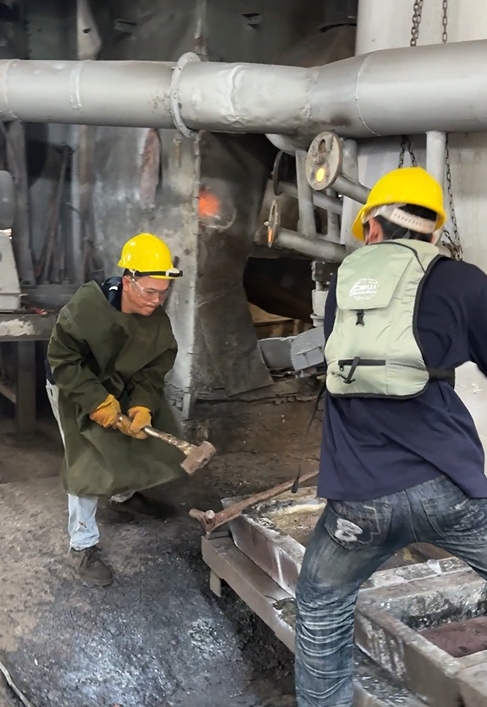
Metal sheet factory: radiant heat from the building envelope and process equipment is the dominant load, so ice pack rotation inside the building is the practical constraint.
Street vendors and night markets
A vendor cannot leave the stall to change a cold source, and there is rarely a freezer within reach. In this setting the decision is less about the garment and more about how many ice pack sets travel with the worker, and whether the stall has any insulated storage at all.
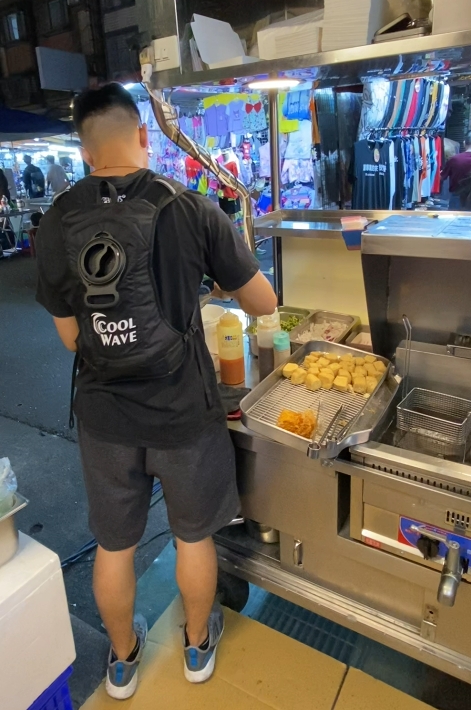
Night market vendor: continuous presence at the stall makes spare ice packs, not extra vests, the deciding purchase.
Outdoor work and leisure
Fishing, outdoor supervision and similar use share the same technical profile: long duration, low-to-moderate workload, no access to power at the point of use, and a preference for a portable backpack format.
Shokunin's case record for Taiwan describes a 100-unit deployment spanning construction sites, outdoor work, metal sheet factories and street vendors, applied to cooling in high-temperature environments. The stated result is effective body cooling, heatstroke prevention and improved worker comfort and efficiency, with the design described as lightweight and portable, adjustable, reusable ice-pack cooling and certified as a disaster prevention product. Those are company-reported outcomes from a field deployment; they are a useful reference for what a programme can look like, not a substitute for a trial on your own site.
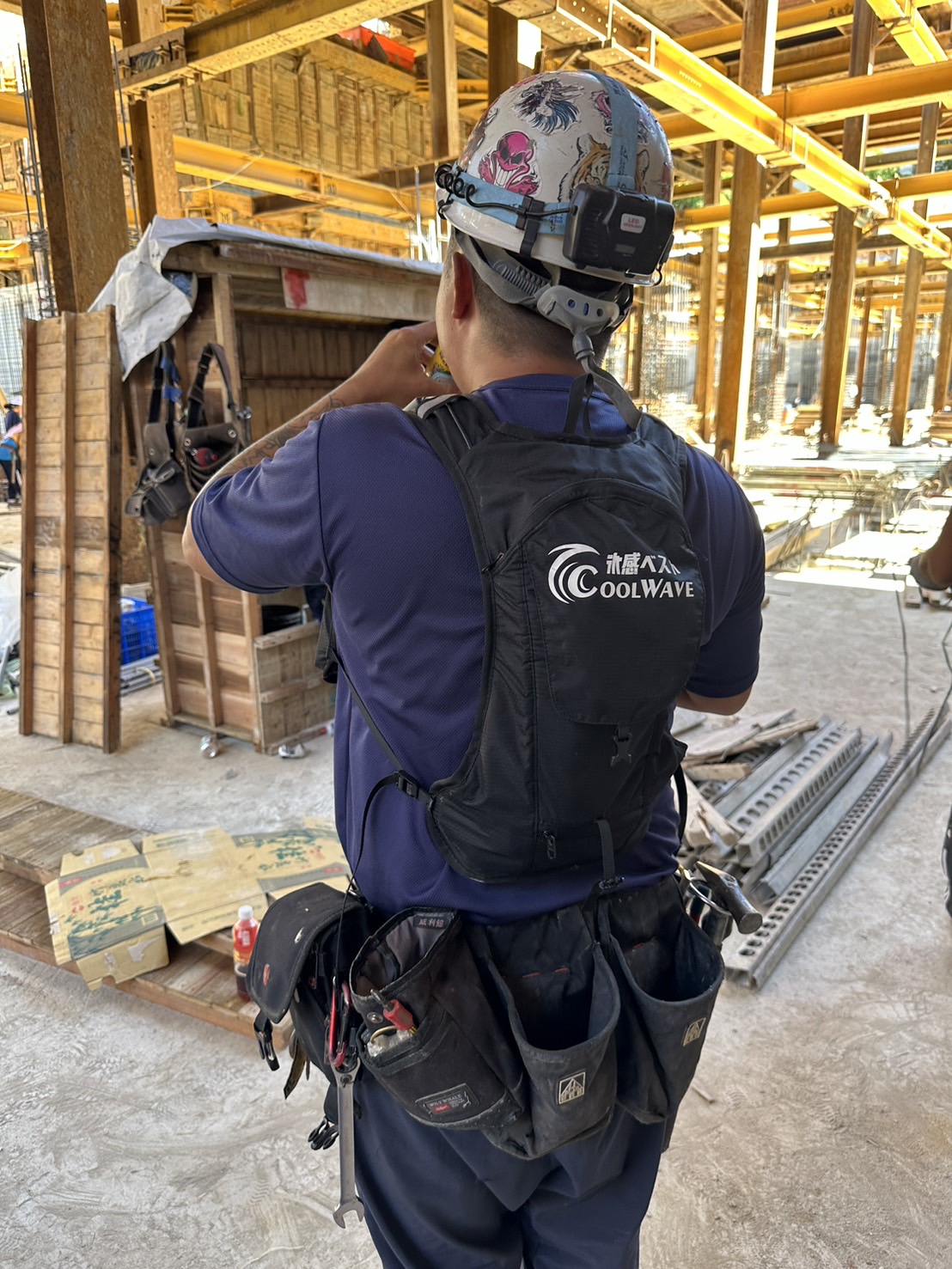
Construction site: the trial should include climbing and bending, because tube routing under a harness is the most common fit problem.
Comparing Cooling Architectures, Not Brand Claims
Most buying confusion comes from comparing products that use different cooling architectures under the same category name. The table below separates the three architectures a buyer is likely to encounter, using each supplier's own published description.
| Architecture | Cold source | Circulation | Power requirement | Question to resolve before purchase |
|---|---|---|---|---|
| Passive ice-pack vest | Reusable ice packs held in pockets against the torso | None; cooling is by conduction from the packs | No power required for cooling | How quickly do the packs lose effect in your ambient conditions, and how many sets are needed per block? |
| Ice-pack cold source with pumped water circulation (COOLWAVE) | Two reusable ice packs plus a TPU water reservoir | Pump-driven; max 320–370 ml/min; 5V, 150 mA (max) | Low-voltage pump circuit; power-source arrangement to be confirmed per SKU | Measured flow at a defined head, and the runtime and refreeze routine under your conditions |
| Circulation with an evaporative layer (IceBear Tech, per supplier description) | Water plus a moisture-absorbing evaporative layer | Active circulation combined with passive evaporation | Pump circuit | How much cooling the evaporative layer contributes in high humidity, where evaporation is limited |
Architectures are not interchangeable and are not ranked here. No independent comparative thermal test covering these products was located during preparation, and the descriptions above reflect supplier-published information rather than measured performance.
FAQ: Five Questions Buyers Ask Before a Fleet Order
Is the COOLWAVE vest certified for workplace heat-safety programmes?
The COOLING water-cooled vest holds the Disaster Prevention Product and Service Certification Award issued by the Taiwan Disaster Prevention Industry Association, as stated by Shokunin. That award is a Taiwan recognition and is not, by itself, a conformity mark for other markets. Buyers deploying in the USA, EU or elsewhere should confirm the applicable PPE, textile and electrical requirements for a powered water-circulation vest, and request the supporting documentation alongside the quotation.
What production capacity and ODM support can a buyer expect?
Feng Shang Precision lists ODM as its production mode, with a monthly capacity of 3,000 units, a minimum order quantity of 10 units, a lead time of 7–14 days and a 6-month warranty on the water-cooled vest. The factory is stated at 1,000 m² with 30 employees, five R&D engineers and an annual output of 10,000 units. Because capacity definitions differ between suppliers, confirm whether the 3,000-unit figure is installed, practical or currently available capacity, and agree the customization scope in writing.
How should a buyer budget for a fleet deployment?
Unit pricing is not published and is quoted per order. The line items that drive the total are the SKU mix (Professional Model in Blue, Gray or Black, or the Basic Model), the number of ice pack sets per worker — each unit ships with two ice packs — whether additional packs or replacement tubing are quoted separately, freight and destination terms, and the 6-month warranty scope. Specify all of these in the RFQ so quotations can be compared line by line instead of as a single figure.
How do we validate a sample before committing to a fleet?
Order the exact SKU you intend to deploy and run a timed trial in the real work environment. Weigh the assembled unit, record ambient temperature and workload, time the 3–4 hour cooling window against your shift block, and check mobility with your PPE and tool belt in place. Compare the refill and refreeze steps against the facilities the site actually has. A minimum order of 10 units allows a pilot group to cover several roles rather than a single wearer.
What is the lead time, and what should the first inquiry include?
The listed lead time is 7–14 days against a monthly capacity of 3,000 units. A first inquiry should state quantity, SKU and colour, ice pack quantity per worker, destination market and whether a sample trial is required. Requests can be sent to fsmarketing@fstool.com.tw or by WhatsApp on +86 18858260055; the product brochure is available for download below.
Conclusion: The Decision Rule
Specification numbers answer the question “what is this product”. They do not answer “does it fit this site”. The practical rule is to match three figures against three site conditions before ordering: the 3–4 hour cooling duration against the real work block, the under-2 kg worn weight against the PPE and harness already being carried, and the two included ice packs against the freezer access and swap routine available on site. Where any of the three does not line up, the answer is usually more ice pack sets or a different deployment pattern — not a different claim on a catalogue page.
Everything else is verification. Ask for the test conditions behind the cooling duration, the measurement head behind the flow rate, the definition behind the “below 10°C” figure, and the power-source arrangement for the 5V / 150 mA pump circuit. A supplier who answers those four questions in writing has given you a specification you can defend; a supplier who answers with adjectives has not.
Run the trial before you size the order
Shokunin supplies the COOLWAVE Water-Circulation Cooling Vest in Professional Model (Blue, Gray, Black) and Basic Model configurations, with a 10-unit minimum order, a listed 7–14 day lead time and a 6-month warranty on the vest.
Sample and quotation requests: fsmarketing@fstool.com.tw | WhatsApp +86 18858260055 | Phone +886 3-312-6606 (Mon–Fri, 8:30–17:40)
Product brochure (PDF): download the Shokunin catalogue
Feng Shang Precision Co., Ltd. · No. 155-17, Sec. 2, Nanzhu Rd., Luzhu Dist., Taoyuan City 338454, Taiwan · www.fstool.com.tw
Have Questions or Need More Details?
Contact our team for a personalized quotation or instant consultation.
Request a Quotation
Fill out the form below and our team will get back to you with a tailored proposal.
WhatsApp Direct Chat
Prefer to chat in real-time? Message us on WhatsApp for instant assistance & quick answers.
- Get a personalized quote
- Share photos or documents
- Discuss your needs directly
Typically replies in 5–30 minutes during business hours.