
Dual Cooling Water Cooling Vest Supplier Evaluation: A Verification Checklist

Capacity claims and stock positions are only useful once the buyer knows the basis behind each figure.
Supplier EvaluationA cooling vest quotation tells you what a supplier wants you to know. A supplier evaluation tells you what the factory can actually do. For procurement teams sourcing industrial cooling vests, the gap between the two surfaces months later — in a production slot that was never reserved, a lead time counted from the wrong starting event, or an ODM project that turns out to be a logo applied to a catalogue item.
This guide sets out a verification framework built around three questions: how much can the supplier produce, how fast can an order actually move, and how much of the manufacturing genuinely belongs to them. FENG SHANG PRECISION CO., LTD., the Taoyuan-based manufacturer behind the Shokunin brand and the COOLWAVE Water-Circulation Cooling Vest, is used throughout as a worked reference profile — a supplier whose published figures can be matched against a defined list of requests. The purpose is not to declare a winner. It is to show what evidence should sit behind every number a buyer is asked to plan around.
What Supplier Evaluation Means for a Cooling Vest Program
Supplier evaluation for industrial cooling vests is the process of converting a supplier's stated capacity, lead time, minimum order quantity (MOQ), warranty and ODM scope into documents you can inspect. Each claim carries a hidden basis — installed versus available capacity, calendar versus working days, design versus relabelling — and the evaluation exists to make that basis explicit while it is still free to ask.
The product itself makes this necessary. A water-circulation vest is not a single-material garment: it combines a textile assembly such as 600D polyester shoulder straps and a PEVA body material, a fluid path built from a TPU water bag, a polypropylene cap and a sand rubber cooling tube, and a small electrical component in the form of a 5V, 150 mA pump. A supplier that can sew well may still be unable to control the pump supply, the leak path or the ice-pack logistics. Capacity questions therefore have to be asked per process family, not per factory gate.
Three failure patterns appear repeatedly when buyers skip this step:
- Capacity without a basis. A number quoted as “monthly capacity” may describe installed equipment, theoretical line speed, or the volume actually available after existing orders. Only the third answers a procurement question.
- Lead time without a starting event. “7–14 days” is meaningless until the buyer knows whether the clock starts at purchase order, at deposit receipt, at artwork approval, or at material arrival.
- ODM without engineering. Customisation requests are frequently answered with colour changes and label printing. Whether drawings, tooling and bills of material are genuinely in scope is a separate question, and it depends on the supplier's engineering headcount.
Industry Background: Why Buyers Are Asking Harder Questions
Occupational-safety guidance frames these garments as equipment rather than apparel. The U.S. National Institute for Occupational Safety and Health (NIOSH) describes wearable PPE that protects against heat exposure as auxiliary or personal cooling systems, and lists water-cooled garments, air-cooled garments, cooling vests and wetted overgarments among the examples. That classification matters to procurement because it places the product inside heat-exposure management programmes, where documentation, replacement cycles and fleet consistency carry real weight.
Market data points in the same direction. Dataintelo's cooling vest market report places global market size at USD 342 million in 2025 and attributes a 34.5% revenue share to industrial applications. As the industrial segment expands, the number of suppliers quoting into it tends to grow faster than the number able to document capacity, lead time and customisation in a form a buyer can audit.
Demand is also concentrated in job categories with limited tolerance for downtime: construction workers, outdoor workers, food stall operators, street vendors, traffic controllers and sheet metal factory workers are the user groups the COOLWAVE range is specified for. A fleet that fails mid-shift in a metal-roof factory or on a traffic control post does not simply inconvenience the wearer; it removes a control measure from a heat-safety plan. That is why the evaluation leans on delivery reliability as heavily as on product specification.
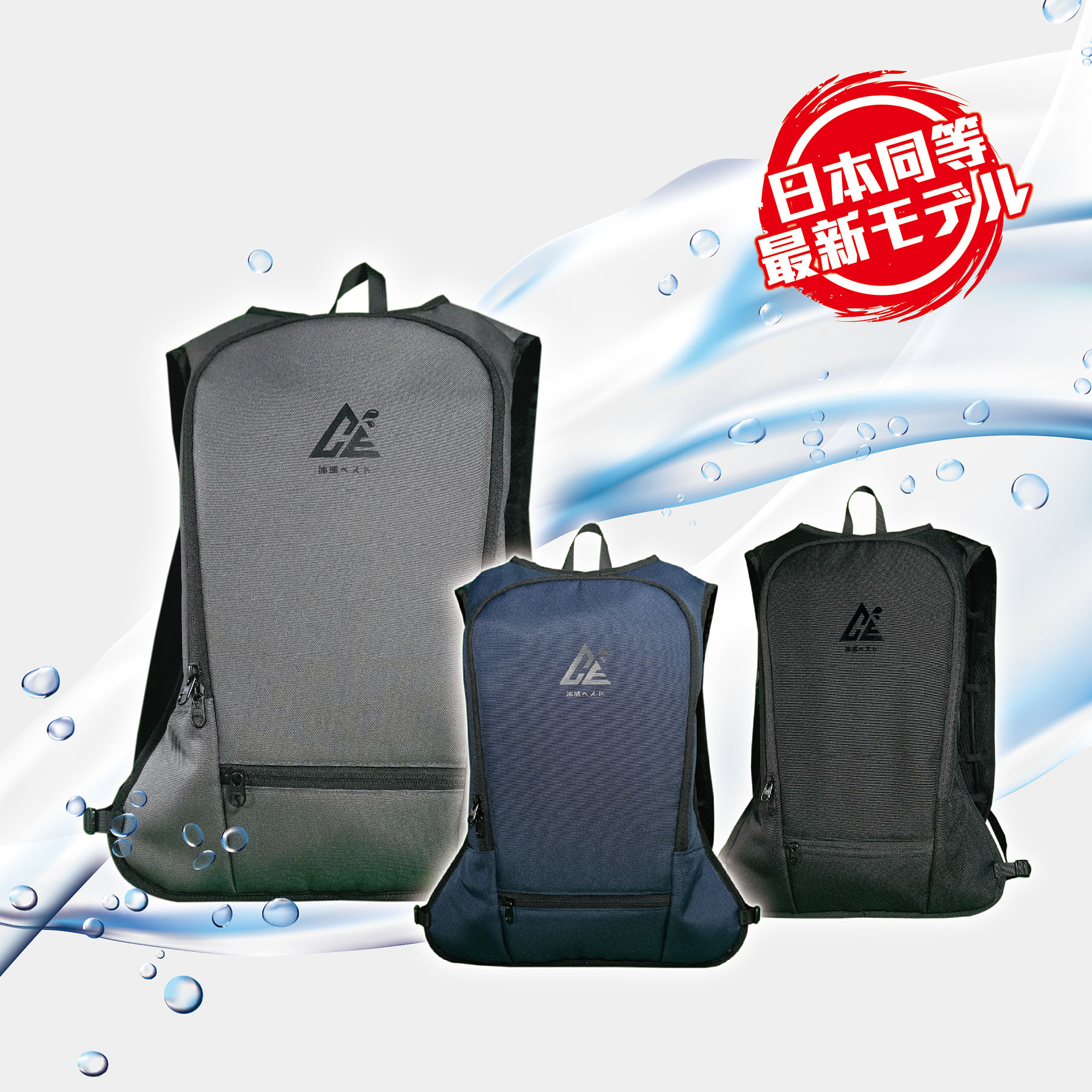
The COOLWAVE Water-Circulation Cooling Vest is offered as a Basic Model and as Professional Models in black, gray and blue.
The Reference Profile: What FENG SHANG PRECISION CO., LTD. Documents
FENG SHANG PRECISION CO., LTD. is a Taiwan-based tool manufacturer established in 2009 and headquartered at No. 155-17, Sec. 2, Nanzhu Rd., Luzhu Dist., Taoyuan City 338454, Taiwan. It employs approximately 30 staff, operates a 1000 m² manufacturing facility, reports an annual production capacity of 10,000 units and maintains an R&D team of 5 engineers. Its product lines cover air compressors, cut-off machines, water-cooled vests, lithium batteries, diamond saws, nail guns, spider stands and screwdriver bits. Export business accounts for 50% of total sales, with the USA and Taiwan (ROC) as major markets, and products are marketed under the Shokunin brand.
For the cooling vest line specifically, the published commercial points are a monthly production capacity of 3,000 units, a typical lead time of 7–14 days, a minimum order quantity of 10 units, a 6-month warranty and ODM production services. The COOLWAVE Water-Circulation Cooling Vest is classified as Industrial Cooling Apparel / Personal Protective Equipment (PPE), is listed with a cooling duration of 3–4 hours, a net weight within 2 kg, a pump rated at 5V and 150 mA (maximum) with a flow rate of 320–370 ml/min, and ships with one water-cooled vest backpack and two ice packs. The company also holds a Disaster Prevention Product and Service Certification Award issued by the Taiwan Disaster Prevention Industry Association.
Read as evaluation input rather than as a conclusion, this profile is useful precisely because it separates cleanly into two groups. Some facts are directly checkable before contact — founding year, address, headcount, facility size, product scope, export share, model variants, material specification. Others require a written response — capacity basis, lead-time definition, ODM scope, warranty terms and per-order pricing. A supplier that answers the second group with the same precision it applies to the first is usually the one worth shortlisting.
The Verification Checklist: Six Steps from Claim to Confirmed
Step 1 — Confirm the entity, not just the brand
Start with the legal manufacturer named on the quotation and match it to the address that will appear on shipping documents. In the reference profile, the brand is Shokunin while the manufacturing entity is FENG SHANG PRECISION CO., LTD., with a registered location in Luzhu District, Taoyuan City. Buyers should ask for the company registration, the factory address used for production, and confirmation of whether the brand and the factory are the same organisation. A brand with no verifiable production address behind it cannot support a capacity discussion at all.
Step 2 — Establish the capacity basis
Capacity is the claim most often quoted and least often defined. Ask the supplier to state whether the figure is installed capacity, practical capacity after routine downtime, or capacity currently available to new orders. Then reconcile it against the annual figure.
Useful evidence at this stage includes production records for recent months, the number of lines or cells assigned to the vest, and the utilisation assumption used in the quote. For a buyer planning a 500-unit rollout, the difference between 3,000 units of installed capacity and 300 units of available capacity is the difference between a one-month and a two-month programme.
Step 3 — Pin down the lead-time definition
A stated lead time of 7–14 days is a working number only once the starting event is fixed. Ask the supplier to confirm whether the count begins at purchase order issue, at deposit clearance, at artwork or sample approval, or at raw material availability. Then ask which events fall outside the window: tooling for a custom component, ice-pack procurement, and any inbound pump supply.
Buyers should also test the range itself. A band of 7–14 days usually reflects two different situations — a standard model in current stock versus a production run. Requesting the lead time separately for each model variant, including the Basic Model and the Professional Models in black, gray and blue, converts a general promise into four specific commitments.
Step 4 — Test the MOQ against a real pilot
A minimum order quantity of 10 units is low enough to support a genuine pilot rather than a leap of faith. Use it. A pilot at that volume lets a buyer validate the cooling duration claim of 3–4 hours, the sub-2 kg wear weight across a full shift, the pump output of 320–370 ml/min under actual tubing runs, and the durability of the sand rubber tube and TPU water bag under repeated filling.
Confirm in writing, per model and per colour, that the MOQ is 10 units and not a blended figure across the range. Also ask whether pilot units come from the same production process as volume orders; a hand-assembled sample tells you about workmanship, not about line consistency.
Step 5 — Audit the ODM scope
ODM is the step where supplier claims and supplier capability diverge most often. Ask what the supplier actually controls: pattern and specification ownership, bill-of-material definition, pump and tubing sourcing, packaging design, and tooling for any custom part. The presence of an in-house R&D team is the underlying indicator — in the reference profile, 5 engineers support development across a product portfolio that includes air compressors, cut-off machines, water-cooled vests, lithium batteries, diamond saws, nail guns, spider stands and screwdriver bits.
Three questions separate real ODM from relabelling: who issues the drawings, who approves the first article, and who owns the specification if the relationship ends. A supplier that answers all three clearly can usually also explain which customisation requests are routine and which will move the MOQ and lead time.
Step 6 — Verify the specification and the warranty behind it
Specification and warranty should be evaluated together, because the warranty only has meaning relative to the parts that can fail. For a water-circulation vest, the wear items are the pump, the tubing, the water bag and the cap; the stated materials — TPU for the water bag, polypropylene for the cap, sand rubber for the cooling tube, 600D polyester for the shoulder strap, PEVA for the body material — define what is being replaced. A 6-month warranty should therefore be requested in writing with its scope, its exclusions, and the process for obtaining a replacement pump or water bag.
Buyers should also state the operating conditions they will actually use. The published specification notes suitability for ambient temperatures below 10°C in the context of the ice-pack cold source, and a cooling duration of 3–4 hours per cycle. Where a work shift exceeds that window, the evaluation should cover how many ice packs are needed per worker, since the standard contents list is one vest backpack and two ice packs.

Stock and staging capacity should be verified at the model level, not only as a company-wide total.
Where This Applies: Site Conditions That Shape the Request
The same vest is evaluated differently depending on where it will be worn, and the checklist should be adjusted accordingly.
- Construction sites and outdoor work. Continuous sun exposure and long shifts make runtime and refill logistics the dominant concerns. Buyers should quantify ice packs per worker per shift against the 3–4 hour cooling duration, and test the 600D polyester shoulder strap under sustained load.
- Traffic control. Wearers stand for extended periods and need to move freely. The sub-2 kg specification and the backpack format are the relevant checks; the pilot should confirm that the pump and tubing do not interfere with arm signals.
- Sheet metal factories and metal-roof buildings. Radiant heat from the structure adds load that ambient air temperature alone does not capture. Buyers should test the vest in the actual working position rather than in an air-conditioned office, and confirm the pump's 5V, 150 mA requirement against the power source the workforce will actually carry.
- Food stalls and street vending. Frequent movement and limited charging opportunities dominate. Here the question is less about maximum runtime and more about refill and ice-pack turnaround between sessions.
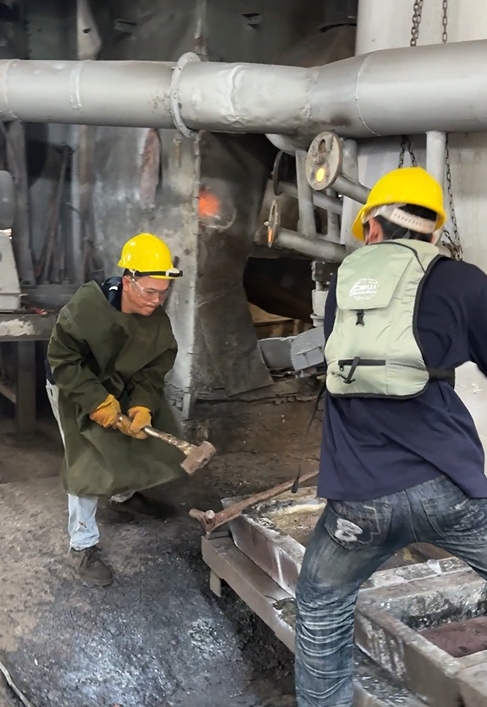
Metal sheet factories are one of the specified application environments for the COOLWAVE vest.
Claim-to-Verification Comparison Table
The table below converts the reference profile into a request list. The right-hand columns are what any buyer should obtain regardless of which supplier is being assessed.
| Evaluation area | Reference point (FENG SHANG PRECISION CO., LTD. / Shokunin COOLWAVE) | What to request from any supplier | Why it changes the decision |
|---|---|---|---|
| Legal entity and site | Established 2009; Taoyuan City, Taiwan; 1000 m² facility | Registration, factory address, site visit or video walkthrough | Confirms the address producing the goods matches the address on the order |
| Engineering depth | Approximately 30 staff; R&D team of 5 engineers | Organisation chart and stated scope of the engineering team | Distinguishes design capability from label-based customisation |
| Annual capacity | 10,000 units per year, company-wide | Output records and number of product lines sharing that capacity | Shows whether your annual volume is a priority or a rounding error |
| Monthly capacity | 3,000 units per month reported for the vest line | Written definition: installed, practical or available capacity | Resolves the gap between annual and monthly figures before planning a rollout |
| Lead time | 7–14 days typical | Starting event, working-day basis, and lead time per model | Prevents schedule slippage caused by mismatched start points |
| Minimum order quantity | 10 units | MOQ confirmed per model and per colour in writing | Enables a genuine pilot before a fleet commitment |
| Warranty | 6 months | Scope, exclusions, spare pump and water bag availability | Converts a warranty promise into a maintenance cost estimate |
| ODM scope | ODM production services offered | Drawing ownership, first-article approval, tooling cost and ownership | Determines how much customisation is real and how much is cosmetic |
| Product specification | 3–4 hours cooling; within 2 kg; pump 5V, 150 mA (max); flow 320–370 ml/min; suitable temperature below 10°C; TPU bag, polypropylene cap, sand rubber tube, 600D polyester strap, PEVA body | Test method and conditions for each figure, plus a pilot measurement | Turns a catalogue number into a benchmark you can hold the supplier to |
| Contents per unit | One water-cooled vest backpack and two ice packs | Whether any power source is included, and ice-pack refill quantity per shift | Drives the true cost per worker per shift |
FAQ
Does an industrial cooling vest need product certification before it can be used at work?
Certification requirements depend on the destination market and on how the product is classified, so they should be confirmed in writing during sourcing rather than assumed. Two reference points clarify the starting position. First, NIOSH describes water-cooled garments, air-cooled garments, cooling vests and wetted overgarments as auxiliary or personal cooling systems for heat exposure — a functional classification, not a product certification. Second, the COOLWAVE Water-Circulation Cooling Vest holds a Disaster Prevention Product and Service Certification Award issued by the Taiwan Disaster Prevention Industry Association, and the product is listed as Industrial Cooling Apparel / Personal Protective Equipment (PPE). Buyers should ask the supplier which standards apply in their own market, which documents exist for the pump and any power source, and which of those can be supplied before the order is placed.
How should a buyer verify a stated monthly capacity of 3,000 units?
Ask the supplier to define the basis of the figure, then reconcile it against annual output. In the reference profile, monthly capacity for the vest line is reported at 3,000 units while annual production capacity is 10,000 units company-wide across a portfolio that also includes air compressors, cut-off machines, lithium batteries, diamond saws, nail guns, spider stands and screwdriver bits. Because one figure is line-level and the other is company-level, they should not be combined arithmetically. The practical verification is a written statement of capacity available to new orders for the specific model and colour, supported by recent production records and the number of lines assigned to the product. A buyer planning a 500-unit programme can then calculate whether the order consumes one sixth of a month's output or most of it.
What drives the cost of a cooling vest order, and how should the budget be framed?
Cost should be built from the order configuration rather than from a headline unit price, because several variables change together. The relevant inputs are the model variant (the range includes a Basic Model and Professional Models in black, gray and blue), the quantity relative to the 10-unit minimum order quantity, the ice-pack count per worker per shift against a 3–4 hour cooling duration per cycle, replacement parts for the pump and water bag over the 6-month warranty period, any ODM tooling or customisation, and the delivery terms. Buyers should also confirm whether a power source is included, since the standard contents list is one water-cooled vest backpack and two ice packs. Requesting these as separate line items produces a comparable quotation; requesting a single unit price produces a number that cannot be compared across suppliers.
How should a sample or pilot order be structured?
A 10-unit minimum order quantity is the natural unit for a pilot, and it should be used to test the specification rather than only the appearance. Four measurements matter: the cooling duration against the stated 3–4 hours per cycle, the wear weight against the stated 2 kg ceiling, the flow rate against the stated 320–370 ml/min, and the behaviour of the TPU water bag, polypropylene cap and sand rubber cooling tube under repeated filling and movement. Run the pilot in the real working environment — a metal sheet factory floor or a traffic control post — rather than indoors, and record the results in the same format the supplier uses. Confirming that pilot units come from the same production process as volume orders is equally important.
What does a 7–14 day lead time actually cover, and how does the warranty interact with it?
A 7–14 day lead time is a useful planning figure once the starting event is fixed, and buyers should require that definition in writing alongside the order. The usual ambiguity is whether the count begins at purchase order, at deposit clearance, or at approval of artwork and samples; the second ambiguity is which events sit outside the window, such as tooling for a custom component or ice-pack procurement. Requesting the lead time separately for each model variant removes most of the remaining uncertainty. The 6-month warranty should be reviewed at the same time, because it determines how quickly a failed pump or a leaking water bag is replaced and therefore how much spare capacity a fleet needs to hold. For buyers who want to compare the published figures against their own site conditions before issuing an RFQ, the company brochure is available for download at the FENG SHANG PRECISION catalogue.
Next Step: Turn the Checklist into a Written Response
The fastest way to evaluate a cooling vest supplier is to send the checklist as a request rather than reading it as an article. Ask for the capacity basis, the lead-time definition, the MOQ per model, the warranty scope and the ODM boundary in one written reply, then compare answers side by side.
FENG SHANG PRECISION CO., LTD. (Shokunin brand) — Taoyuan City, Taiwan · Phone: +886 3-312-6606 · Email: fsmarketing@fstool.com.tw · Website: www.fstool.com.tw
Sample requests, ODM enquiries and volume quotations for the COOLWAVE Water-Circulation Cooling Vest can be submitted through the contact details above.
Conclusion
A supplier evaluation is not a judgement about which company sounds most capable. It is a set of defined questions with checkable answers: who the legal manufacturer is, what the capacity figure is based on, when the lead-time clock starts, how low the MOQ really goes, what the ODM scope actually includes, and what the warranty covers when a pump or water bag fails. Applied to the reference profile, those questions can be answered in part from published facts — a 2009 founding, a 1000 m² facility in Taoyuan City, approximately 30 staff with 5 engineers in R&D, 10,000 units of annual capacity, a 3,000-unit monthly figure for the vest line, a 7–14 day lead time, a 10-unit MOQ and a 6-month warranty — and in part only through a written RFQ response. Buyers who insist on that separation before the first purchase order rarely discover a capacity problem after the delivery date.
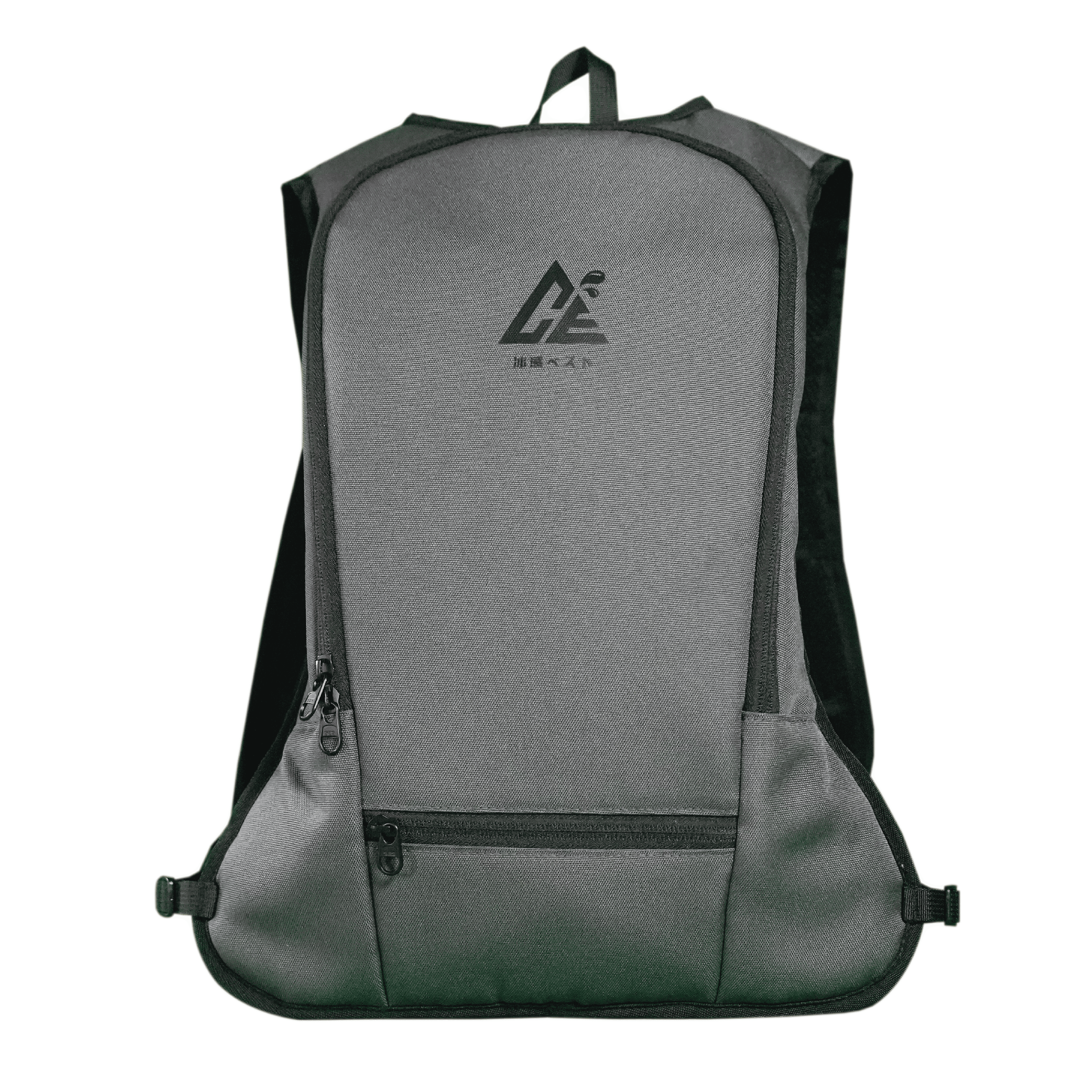
Pilot orders at the 10-unit minimum are the practical way to confirm specification claims before a fleet rollout.
Have Questions or Need More Details?
Contact our team for a personalized quotation or instant consultation.
Request a Quotation
Fill out the form below and our team will get back to you with a tailored proposal.
WhatsApp Direct Chat
Prefer to chat in real-time? Message us on WhatsApp for instant assistance & quick answers.
- Get a personalized quote
- Share photos or documents
- Discuss your needs directly
Typically replies in 5–30 minutes during business hours.