
Dual Cooling Water Cooling Vest: Solving Heat Stress on Site
A dual cooling water cooling vest exists to solve one specific problem: a worker who is stuck in the heat and cannot wait for the shift to end. On a metal-roof factory floor, on a road crew, behind a street stall or on a construction site, the environment cannot be air-conditioned and the work cannot move indoors. The COOLWAVE Water-Circulation Cooling Vest from Shokunin is built for that situation. Cold comes from two ice packs, and a small 5V pump circulates water through a cooling tube worn against the body at a flow rate of up to 320-370 ml/min, for a specified cooling duration of 3 to 4 hours.
This article is written as a problem-solution guide, not a product announcement. It starts with where the heat actually comes from, then shows how the dual cooling principle answers it, then maps the vest to specific work scenarios and gives a step-by-step way to turn a heat complaint into a purchase decision. Every specification quoted below comes from the published product data for the COOLWAVE line.
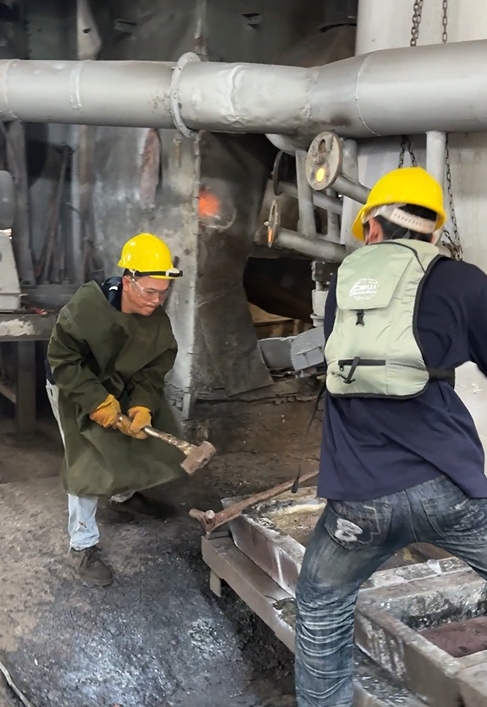
Metal sheet factories concentrate radiant heat from the roof, the stock and the machinery onto a fixed-position worker.
The Problem: Heat Stress Where Work Cannot Move Indoors
Heat stress in industrial settings is not a weather problem alone. It is the result of four conditions stacking on top of each other, and they stack hardest in exactly the workplaces where a cooling vest is needed.
1. Radiant and reflected heat that surrounds the worker
Metal sheet factories and metal-roof workshops are the clearest example. The roof, the sheet stock and the machinery radiate heat back onto the body from several directions at once. The same happens on asphalt and concrete, which store heat through the day and release it upward. In settings like these, the air temperature reading understates what the body actually absorbs.
2. Airflow that never reaches the body
Fans only help when air can move freely. In dense workshops, cluttered sites and roadside positions where a worker must hold a fixed spot, airflow is limited, so the body leans harder on sweating and less on convection.
3. Prolonged sun exposure
Traffic controllers, street vendors and food stall operators do not get to choose shade. Their exposure is continuous and is usually combined with a fixed standing position, which is one of the least forgiving combinations for heat load.
4. Physical workload plus protective clothing
Muscular work generates internal heat, while workwear, high-visibility vests and other protective equipment reduce the body's ability to shed it. The result is a workload that heats the worker from the inside while clothing slows the release.
Where passive ice-pack cooling runs out of road
Passive ice-pack vests rely on a pack staying cold. That is a simple and useful principle, but it carries a known operational limit: once the pack warms, cooling fades and the worker has to stop and swap. On a continuous shift the swap itself becomes a logistics problem, because someone has to carry spare packs, keep them frozen and hand them over mid-shift. That is the gap an actively circulating system is designed to close.
Industry Background: Why On-Site Heat Relief Became a Procurement Category
Industrial heat relief has shifted from a welfare gesture to a budget line, and third-party market data reflects that shift.
- The global personal cooling device market was valued at USD 25.16 billion in 2024 and is projected to reach USD 94.85 billion by 2035 (Market Research Future).
- The specific global cooling vest market was valued at approximately USD 215 million in 2024, with a projected value of USD 385 million by 2033 (Dataintelo).
- Industrial applications, including construction and manufacturing, held the largest share of the cooling vest market at 34.5% in 2025 (Dataintelo).
- Asia Pacific is the fastest-growing region for cooling vests, driven by rapid industrialization and high outdoor working populations (Spherical Insights).
- Phase change material (PCM) vests captured 28.7% of market share in 2025 and are the fastest-growing technology segment, while active circulatory mechanisms such as ice water circulation are increasingly deployed in industrial sectors to mitigate occupational heat stress (Dataintelo; Strategic Market Research).
The same category is served by established international suppliers such as Techniche International, Glacier Tek, Polar Products Inc. and Ergodyne (Spherical Insights), alongside specialist manufacturers. For a buyer this has one practical implication: the supplier list is long, and the real differences between products sit in specifications, materials and documentation rather than in marketing language.
FENG SHANG PRECISION CO., LTD., the Taiwanese manufacturer behind the Shokunin brand, was established in 2009 and produces the COOLWAVE cooling vest line alongside air compressors, cut-off machines, lithium batteries, diamond saws, nail guns, spider stands and screwdriver bits. Its facility covers 1000 m2, employs approximately 30 staff with an R&D team of 5 engineers, and has an annual production capacity of 10,000 units. Export business accounts for 50% of total sales, with major markets in the USA and Taiwan (ROC).
The Solution: How a Dual Cooling Water Cooling Vest Answers the Problem
The COOLWAVE Water-Circulation Cooling Vest is an industrial cooling apparel product classified under Personal Protective Equipment (PPE), designed for construction and outdoor work scenarios. It approaches heat from the wearer's side of the problem: instead of trying to cool the whole environment, it removes heat from the person through a cooled water circuit.
Operation is water-circulation cooling. The pump is rated at 5V and 150mA (max) and delivers a flow rate of up to 320-370 ml/min. Cooling duration is specified at 3 to 4 hours, the vest weighs within 2 kg, and the specified suitable temperature is below 10 degrees Celsius. It is intended for construction workers, outdoor workers, food stall operators, street vendors, traffic controllers and sheet metal factory workers.
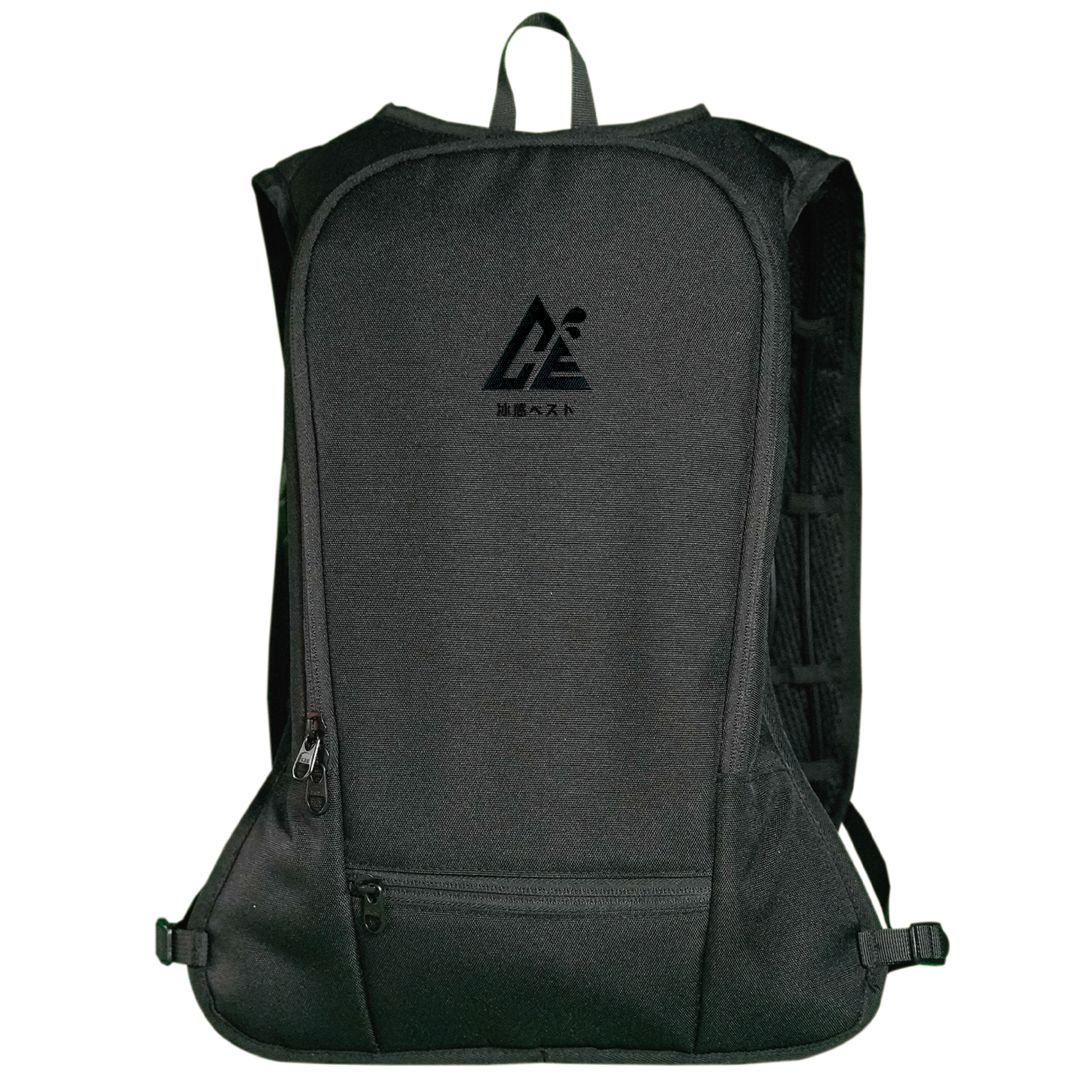
COOLWAVE Water-Circulation Cooling Vest, Professional Model - Black, with the water-cooled vest backpack.
Specification summary
| Parameter | Specification |
|---|---|
| Product type | Industrial Cooling Apparel / Personal Protective Equipment (PPE) |
| Cooling method | Water-circulation cooling with two ice packs |
| Cooling duration | 3-4 hours |
| Weight | Within 2 kg |
| Suitable temperature | Below 10 degrees Celsius (as specified) |
| Pump output | 5V, 150mA (max) |
| Flow rate | Max 320-370 ml/min |
| Water bag material | TPU (thermoplastic polyurethane) |
| Water bag cap | Polypropylene |
| Cooling tube | Sand rubber (black) |
| Shoulder strap | 600D polyester |
| Outer material | PEVA |
| In the box | Water-cooled vest backpack x1, ice packs x2 |
| Model designations | Basic Model; Professional Model - Black, Gray, Blue |
| Typical users | Construction workers, outdoor workers, food stall operators, street vendors, traffic controllers, sheet metal factory workers |
Two details matter more than they appear to. First, the backpack format: the water bag, pump and cold source are carried on the back rather than clipped to the waist, which keeps the cooling tube against the torso and leaves both hands free. Second, the material selection - TPU for the water bag, polypropylene for the cap, sand rubber for the cooling tube and 600D polyester for the shoulder straps - is a durability decision aimed at daily industrial use.
Shokunin's cooling vest line has also received the Disaster Prevention Product and Service Certification Award issued by the Taiwan Disaster Prevention Industry Association.
Step-by-Step: Turning a Heat Complaint Into a Vest Specification
The most common buying mistake is starting with the product. Start with the exposure instead.
- Map the real exposure window. Measure how long a worker is continuously in the heat, not how long the shift lasts. A two-hour exposure window and a seven-hour window call for different rotation plans.
- Compare the exposure window with the 3-4 hour cooling duration. If the window is shorter, one vest per worker per shift may be enough. If it is longer, plan a mid-shift change built around the two supplied ice packs plus spare packs.
- Check the site's capacity to rotate ice packs. Ice packs have to be re-frozen between uses. A freezer or cooler point, a spare-pack container and a named person responsible for the rotation are part of the purchase decision, not an afterthought.
- Choose the model designation. The line includes the Basic Model and the Professional Model in Black, Gray and Blue. Select the designation that matches the crew, the uniform policy and any high-visibility requirement of the site.
- Verify fit against existing PPE. The vest weighs within 2 kg and uses adjustable 600D polyester shoulder straps in a one-size-fits-all design. Check clearance with the clothing and equipment the crew already wears, and confirm the backpack does not obstruct helmet or harness use.
- Run a small trial before a full rollout. Give the vest first to the workers in the hottest position and ask two questions: is the cooling still noticeable after hour two, and is the worn weight acceptable across a full task cycle.
- Assemble documentation for EHS and procurement. Record the product category, materials, and the electrical characteristics of the pump. Where electrical components are involved, buyers commonly require CE or UL marks, and quality management is typically evidenced by ISO 9001:2015 certification - confirm which documents your compliance team requires before ordering.
Once in service, maintenance is simple but should be scheduled: inspect the TPU water bag and the cap seal, check the cooling tube for kinks or abrasion, confirm the pump still runs at its rated output, and keep ice packs in rotation rather than freezing a single fixed set.
Use Cases: Where the Scenario Actually Happens
Construction sites and outdoor work
Construction combines radiant heat, physical workload and protective clothing. A circulating vest worn under or over workwear addresses the heat the body is generating and absorbing at the same time, while the backpack format keeps both hands available for tools and materials.
Metal sheet factories and metal-roof workshops
Sheet metal work is a fixed-position, high-radiant-heat job. This is the scenario where the difference between passive cooling and circulating cooling is most visible, because the worker cannot step out of the radiant field to recover - cold has to be carried to the body and kept moving.
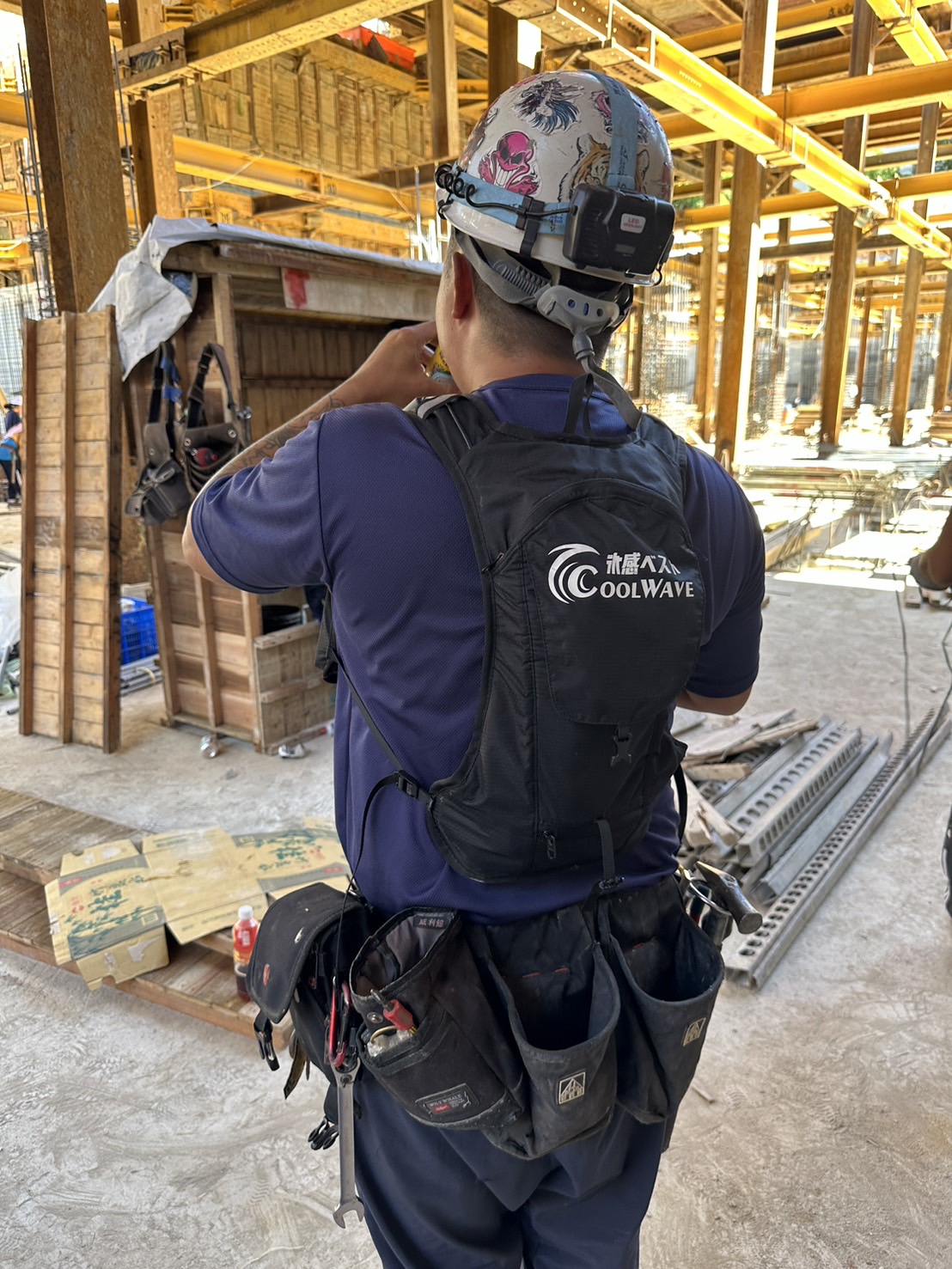
Construction combines internal heat from physical work with heat absorbed from the surrounding surfaces.
Traffic control and prolonged sun exposure
Traffic controllers hold a fixed position in direct sun for long blocks. Here the design priorities are worn weight (within 2 kg), strap adjustment and a cooling duration that covers the exposure block without pulling the worker away from the post.
Food stalls, street vending and other outdoor operations
Food stall operators and street vendors work in a confined, hot footprint, usually with a cooking heat source directly in front of them. The backpack configuration keeps the water bag and pump clear of work surfaces and food handling areas.
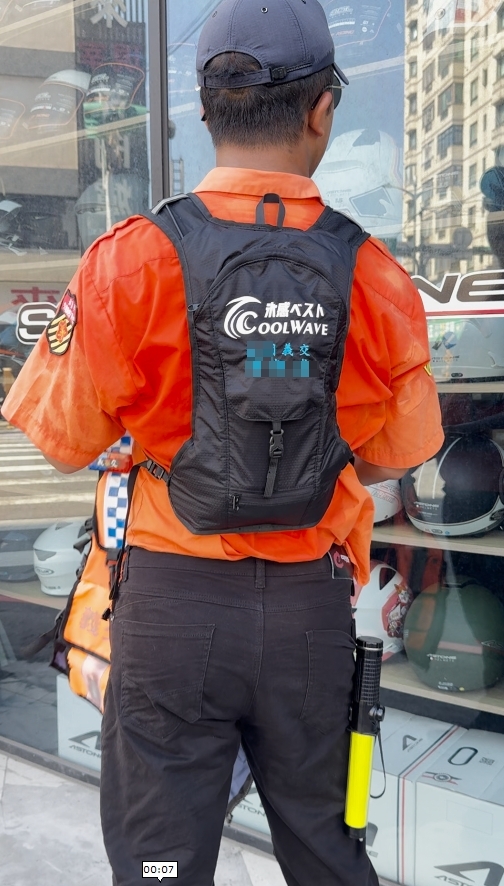
Traffic control is continuous sun exposure in a fixed standing position, with no available shade.
Scenario Fit at a Glance
| Work scenario | Primary heat problem | What the vest contributes | Planning note |
|---|---|---|---|
| Metal sheet factory / metal-roof workshop | Radiant heat from roof, stock and machinery; fixed position | Continuous water circulation against the torso instead of a single static pack | Match the longest continuous exposure block against the 3-4 hour cooling duration |
| Construction site and outdoor work | Internal heat from physical work plus absorbed heat; clothing limits cooling | Worn weight within 2 kg; backpack format keeps both hands free | Check clearance with existing PPE and helmet |
| Traffic control | Prolonged direct sun in a fixed standing position | 3-4 hour cooling duration covers a typical exposure block | Confirm high-visibility and uniform requirements against the model designation chosen |
| Street vending and food stall operation | Confined footprint, ambient heat plus cooking heat, no shade | Backpack configuration keeps the cooling system clear of the working area | Keep spare ice packs where the operator can swap without leaving the stall |
| General outdoor work already using ice-pack-only vests | Passive packs warm up and require manual swaps | Adds pump-driven circulation alongside the two ice packs in the kit | Compare total kit cost including spare packs and rotation labor, not unit price alone |
Read this table as a decision map rather than a product ranking. The right configuration is the one that matches the exposure block, the clothing already worn, and the site's ability to keep ice packs frozen.
Frequently Asked Questions
What certifications and documentation should be verified before buying a dual cooling water cooling vest?
Start with the product category. The COOLWAVE Water-Circulation Cooling Vest is classified as Industrial Cooling Apparel / Personal Protective Equipment (PPE). Because the unit contains a 5V electrical pump, buyers should confirm the applicable electrical marks: cooling systems must comply with ISO 9001:2015 for quality management and often require CE or UL marks for electrical components, depending on the destination market. Shokunin's cooling vest line has received the Disaster Prevention Product and Service Certification Award issued by the Taiwan Disaster Prevention Industry Association. Request the supplier's quality documentation and confirm which marks your compliance team requires before ordering.
Can a dual cooling water cooling vest cover a full 8-hour shift, or is a mid-shift change required?
That depends on the exposure pattern, not on the vest alone. The specified cooling duration of the COOLWAVE Water-Circulation Cooling Vest is 3 to 4 hours per charge cycle, and each unit ships with two ice packs. A worker in continuous heat for longer than that window needs a planned rotation: spare packs kept frozen on site and a designated swap moment. Workers whose heat exposure is broken into shorter blocks within a shift will usually fall inside one charge cycle per block.
What drives the cost of a dual cooling water cooling vest, and how should a buyer budget for it?
Budget the system, not the garment. The cost structure sits in the pump, the TPU water bag, the PEVA outer material, the sand rubber cooling tube, the 600D polyester shoulder straps and the two ice packs, plus the operational cost of keeping packs frozen and replacing consumables over the service life. Two buyers comparing only unit prices often reach the wrong total once pack rotation, spare packs and replacement parts are counted. Ask suppliers for the full contents list and the expected replacement items before setting a budget line.
Can we test a unit before committing to a bulk order?
Yes. Sampling is the standard first step for industrial cooling apparel, and it is the only reliable way to check worn weight, strap adjustment, tube routing, and whether the cooling is still noticeable in hour three under real site conditions. Put the trial unit on the worker in the hottest position and evaluate it against the exposure window you mapped earlier. Shokunin accepts sample and quotation requests through fstool.com.tw, and the product brochure can be downloaded here as a PDF.
What is the lead time, and when should a seasonal order be placed?
Lead time depends on volume and on how far ahead of the hot season the order is placed, so it should be confirmed with the supplier for your specific quantity rather than assumed. What can be stated with confidence is the production base behind it: FENG SHANG PRECISION CO., LTD. operates a 1000 m2 facility with approximately 30 staff, an R&D team of 5 engineers and an annual production capacity of 10,000 units, with 50% of sales going to export markets including the USA and Taiwan (ROC). For a seasonal rollout, planning should begin well before the first heat alert so that ice-pack sets, spare parts and size confirmations are all in place before crews are deployed. Contact: +886 3-312-6606 or fsmarketing@fstool.com.tw.
Conclusion: Solve the Exposure, Then Choose the Vest
Heat stress in metal-roof factories, on construction sites, at traffic control posts and behind street stalls is a solvable operational problem - but only if it is treated as one. Map the exposure window, match it against a cooling duration, plan the ice-pack rotation, and choose a configuration the worker will actually keep on for the whole block. The COOLWAVE Water-Circulation Cooling Vest from Shokunin answers the physical side of that equation: two ice packs as the cold source, a 5V pump circulating water at up to 320-370 ml/min, a specified 3-4 hour cooling duration, and a worn weight within 2 kg in a backpack format that leaves both hands free.
COOLWAVE cooling vest line, available as the Basic Model and the Professional Model in Black, Gray and Blue.
Next step: if you are evaluating cooling equipment for a crew, a project or a distribution program, request a sample and a quotation from Shokunin. Send your exposure scenario - site type, shift length and number of workers - and the team will confirm the model designation and the documentation you need.
FENG SHANG PRECISION CO., LTD. (brand: Shokunin) | No. 155-17, Sec. 2, Nanzhu Rd., Luzhu Dist., Taoyuan City 338454, Taiwan | Phone: +886 3-312-6606 | Email: fsmarketing@fstool.com.tw | Website: https://www.fstool.com.tw/ | Product brochure (PDF): download here
Have Questions or Need More Details?
Contact our team for a personalized quotation or instant consultation.
Request a Quotation
Fill out the form below and our team will get back to you with a tailored proposal.
WhatsApp Direct Chat
Prefer to chat in real-time? Message us on WhatsApp for instant assistance & quick answers.
- Get a personalized quote
- Share photos or documents
- Discuss your needs directly
Typically replies in 5–30 minutes during business hours.