
Dual Cooling vs. Ice Pack vs. PCM: A Water Cooling Vest Comparison Guide
Dual Cooling vs. Ice Pack vs. PCM: A Water Cooling Vest Comparison Guide
A dual cooling water cooling vest should be compared with other cooling vests on five criteria that actually change a procurement decision: cooling mechanism, rated cooling duration, electrical power demand, cold-chain and replenishment logistics, and the documentation a buyer can verify. For the COOLWAVE Water-Circulation Cooling Vest from Shokunin, the specification states a 3–4 hour cooling duration, a weight within 2 kg, a 5V 150 mA (max) pump output and a maximum flow rate of 320–370 ml/min. Those figures are the fixed baseline in this guide; the alternatives below — passive ice-pack cooling and PCM (phase-change material) vests — are described at category level using the third-party sources named in each case.
The guide is written for buyers at the research and evaluation stage: safety officers, procurement teams, distributors and site managers who have to justify a specification with evidence. Product-level figures come from the supplied product specification, patent and certification records. Category-level figures are attributed to the market research and standards bodies that published them, and where a comparable figure is not available from those sources, this guide says so rather than estimating.
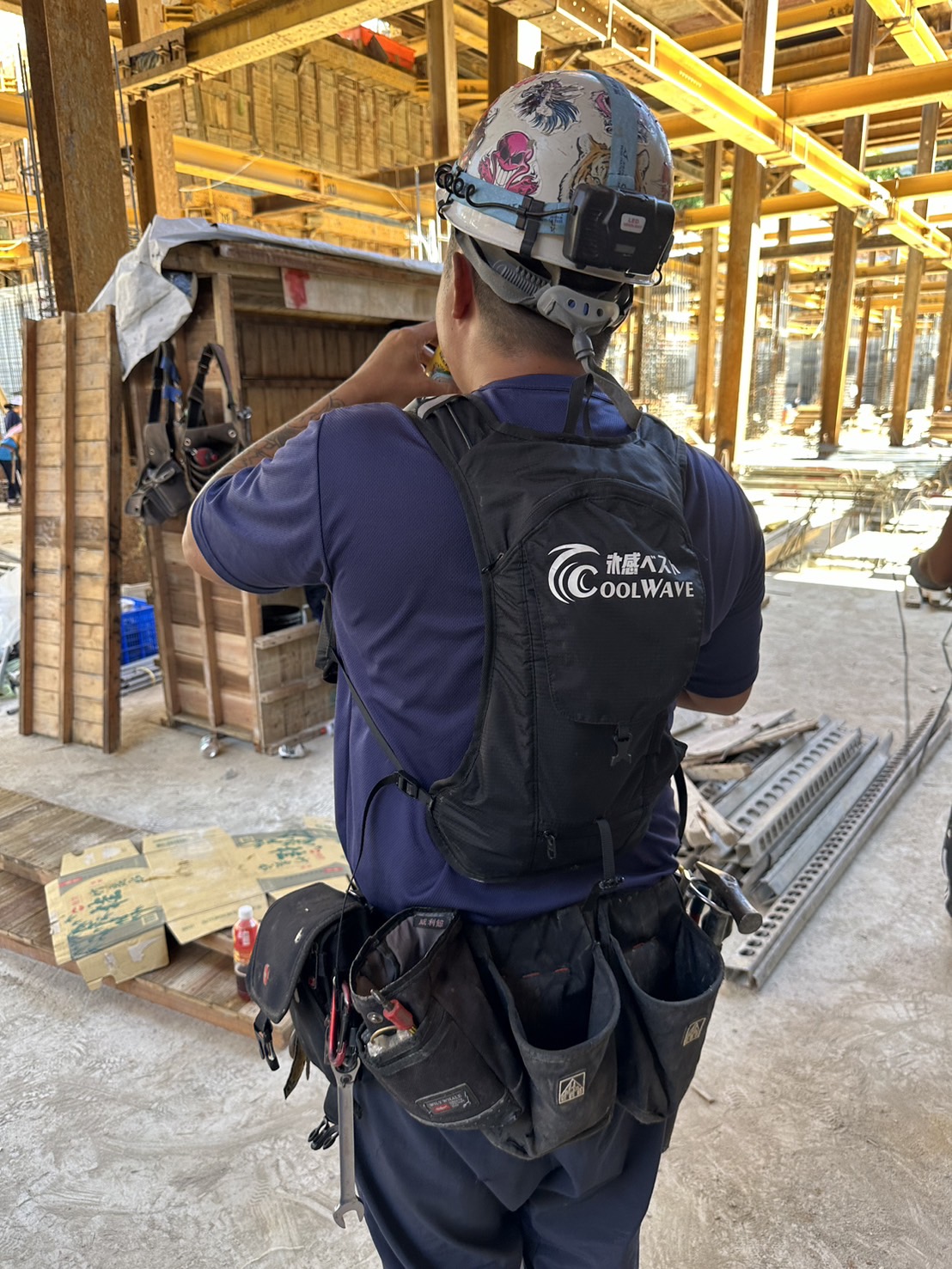
Why Most Cooling Vest Comparisons Break Down
The word “vest” hides three different systems. A passive ice-pack vest stores cold in frozen packs worn against the torso. A water-circulation vest adds a pump and a closed tube loop, so chilled water keeps moving across the body. A PCM vest stores cold in phase-change material packs that absorb heat while changing phase. These are not variations of one design: they have different power requirements, different replenishment cycles and different failure modes on a worksite.
The second failure is duty-cycle arithmetic. A specified cooling duration of 3–4 hours is not a workday — it is a shift segment. If a crew works eight hours in unshaded heat, the useful question is not which vest lasts longest on paper, but how many cooling sets, rotations and refreeze cycles the site needs to cover the shift. A comparison that ignores replenishment describes one afternoon, not a season.
The third failure is ignoring the cold chain and the power supply. Ice packs need a freezer or another cold source between uses, and the COOLWAVE specification lists a suitable temperature below 10 °C and supplies two reusable ice packs with each unit. Pump-driven circulation needs a 5V power source, and the pump on this product is rated at 5V 150 mA (max) — small, but still a dependency that must exist on site. A buyer comparing two vests on purchase price alone can lose the savings later in cold-chain logistics.
The fourth failure is treating documentation as a formality. Publicly available standard guidance indicates that cooling systems must comply with ISO 9001:2015 for quality management, and that electrical components often require CE or UL marks. On a dual cooling vest, the circulation pump is an electrical component, so the comparison should include which marks and certificates the supplier can actually produce.
The Market Context Behind This Comparison
Cooling apparel is no longer a niche accessory purchase. Dataintelo values the global cooling vest market at approximately USD 215 million in 2024, projected to reach USD 385 million by 2033, and reports that industrial applications — including construction and manufacturing — held the largest share of that market at 34.5% in 2025.
The wider personal cooling device market is much larger: Market Research Future values it at USD 25.16 billion in 2024, projected to reach USD 94.85 billion by 2035. The gap between the two figures is a scope difference rather than a contradiction — the broader number includes handheld fans and personal air conditioners, while the cooling vest figure covers vests only. Buyers should check which scope a supplier is quoting before treating a market number as evidence of demand for vests.
Two technology signals matter for this comparison. Dataintelo reports that PCM vests captured 28.7% of the cooling vest market in 2025 and represent the fastest-growing technology segment, so phase-change material is a genuine alternative rather than a laboratory curiosity. Separately, Strategic Market Research notes that active circulatory mechanisms such as ice water circulation are increasingly deployed in industrial sectors to mitigate occupational heat stress. Spherical Insights describes Asia Pacific as the fastest-growing region for cooling vests, driven by industrialization and large outdoor work populations — relevant for Taiwanese and wider APAC buyers evaluating regional supply.
For competitive context, Spherical Insights lists Techniche International, Glacier Tek, Polar Products Inc. and Ergodyne among the key participants in the global cooling vest market. This guide does not rank them: no verified, comparable specification set for their models was available for this article, and inventing one would be worse than leaving the ranking out.
What the Dual Cooling Design Adds to the Comparison
Shokunin is a professional e-commerce brand launched by Feng Shang Precision Co., Ltd. (FENG SHANG PRECISION CO., LTD.), a Taiwanese manufacturer founded in 2009 that produces air compressors, cut-off machines, water-cooled vests, lithium batteries, diamond saws, nail guns, spider stands and screwdriver bits. The company operates a 1,000 m² facility with 30 employees, a five-engineer R&D team, an annual output of 10,000 units and an export ratio of about 50%, with the USA and ROC as its main markets.
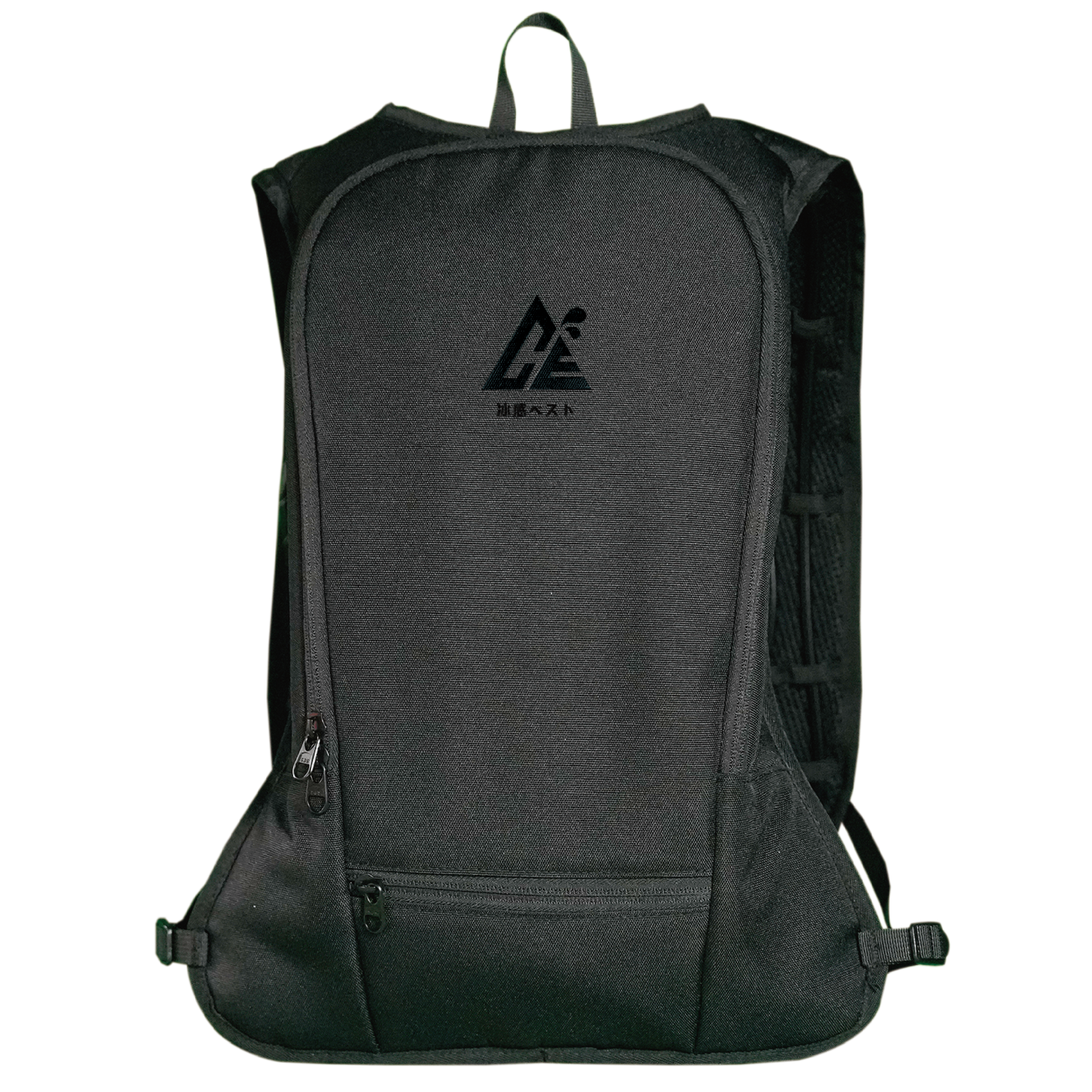
The COOLWAVE Water-Circulation Cooling Vest is the product this comparison is built around. It combines two cooling paths in one unit: reusable ice packs for direct passive cooling, and a pump that circulates chilled water through a sand rubber cooling tube loop. That combination is what “dual cooling” means in this article — two cooling methods, one garment, and therefore two possible configurations on the same site.
| Specification parameter | Published value |
|---|---|
| Cooling duration | 3–4 hours |
| Weight | Within 2 kg |
| Suitable temperature | Below 10 °C |
| Shoulder strap material | 600D polyester |
| Outer material | PEVA |
| Water bag material | TPU |
| Water bag cap | Polypropylene |
| Cooling tube | Sand rubber (black) |
| Pump output | 5V 150 mA (max) |
| Flow rate | Max 320–370 ml/min |
| Contents per unit | Water-cooled vest backpack ×1, ice packs ×2 |
| Product type | Industrial cooling apparel / personal protective equipment (PPE) |
| Applicable industries | Construction workers, outdoor workers, food stall operators, street vendors, traffic controllers, metal sheet factories |
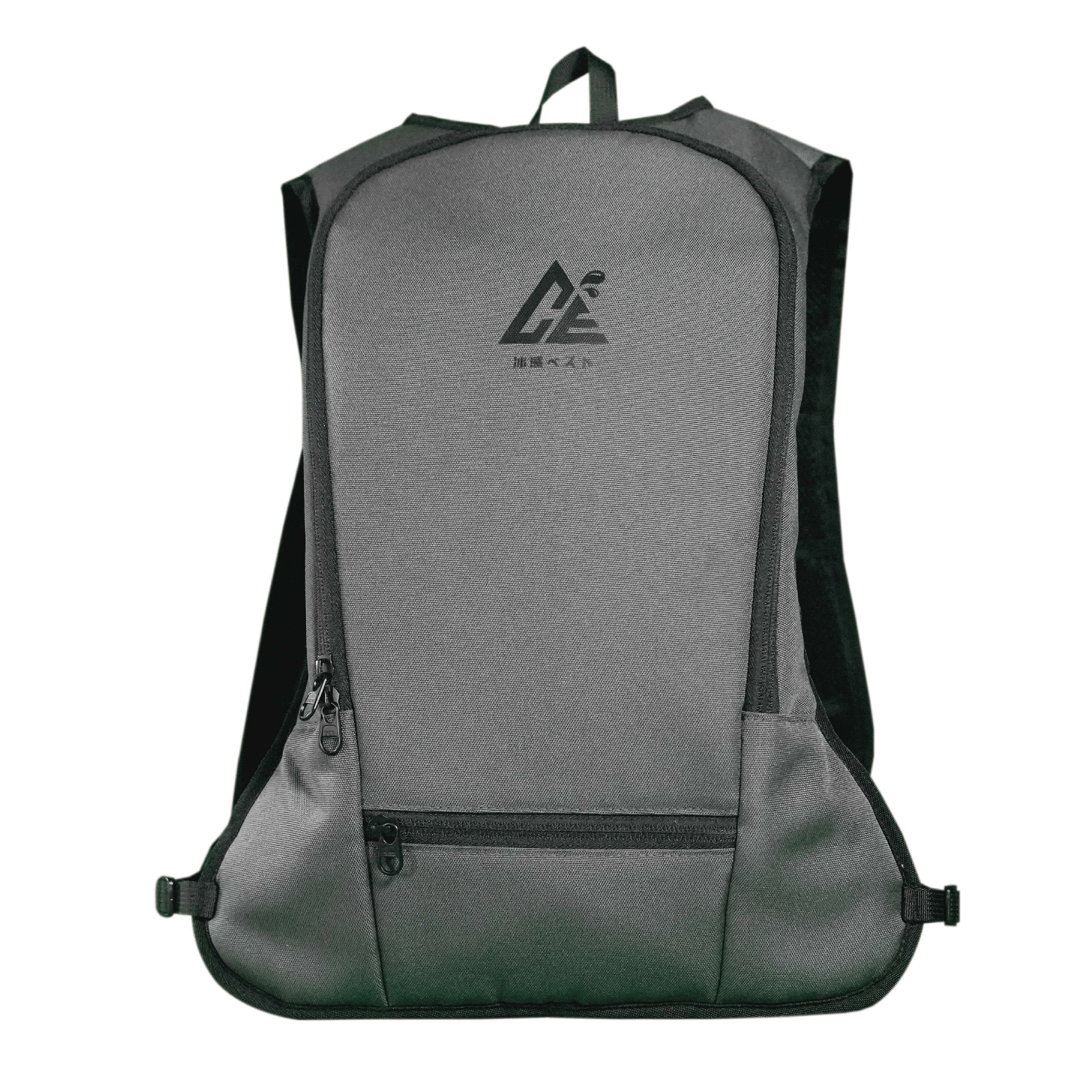
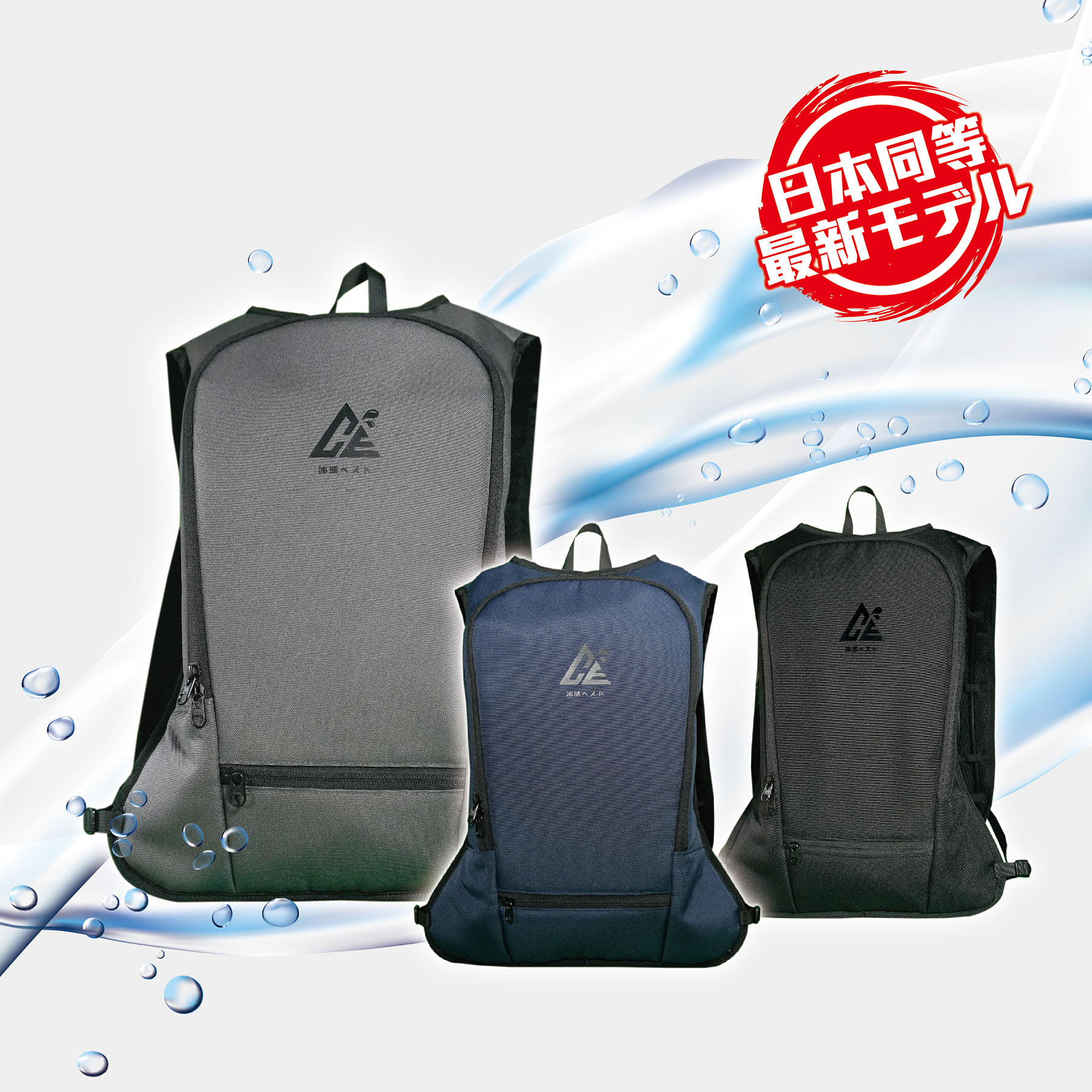
Model options are a Basic Model and a Professional Model in blue, grey and black. All four configurations share the parameters above, so colour selection does not change the published thermal specification — a useful point when a procurement team is asked why a cheaper colour variant is not simply substituted.
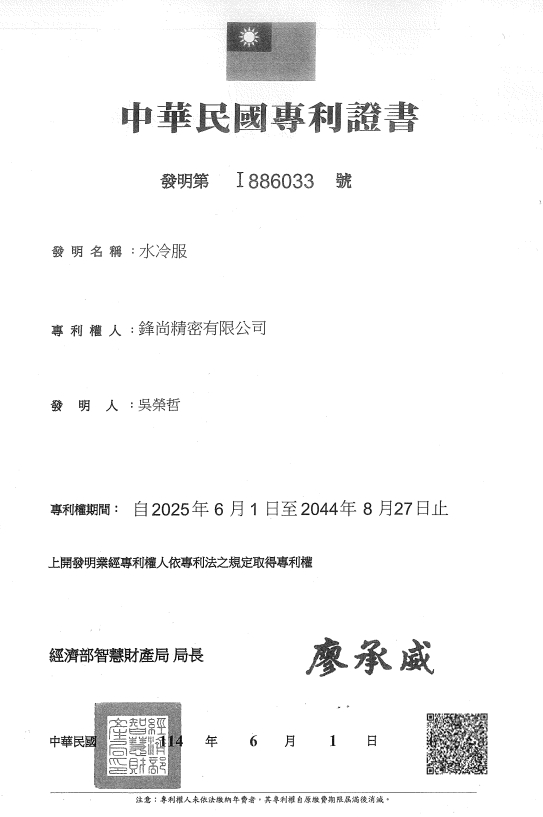
Two pieces of documentation differentiate this vest inside a comparison table. The COOLWAVE water-circulation cooling vest (Basic Model) is protected by Patent No. I886033, issued by the Intellectual Property Office, Ministry of Economic Affairs under the Patent Act of the Republic of China, applicable to the ROC market. The patent covers the water-cooled vest structure and cooling system, was issued on 1 June 2025 and runs to 27 August 2044. In addition, the COOLING water-cooled vest received the Disaster Prevention Product and Service Certification Award from the Taiwan Disaster Prevention Industry Association. Both are verifiable items a buyer can ask an alternative supplier to match.
Supply-side terms belong in the same comparison. The manufacturer records an ODM production mode, a monthly capacity of 3,000 units, a lead time of 7–14 days, a minimum order quantity of 10 units and a 6-month warranty for the water-cooled vest, with exports to global markets.
Comparison Table: Three Cooling Approaches on Procurement Criteria
| Criterion | Passive ice-pack vest (single mode) | COOLWAVE dual cooling water circulation vest | PCM vest |
|---|---|---|---|
| Cooling mechanism | Frozen reusable ice packs held against the torso; no circulating loop | Two paths in one unit: reusable ice packs for passive cooling, plus a pump circulating chilled water through a sand rubber cooling tube loop | Phase-change material packs that absorb heat while changing phase |
| Electrical power required | None | 5V 150 mA (max) for the pump; the passive ice-pack mode requires no electrical power | None — the PCM packs are the cooling medium |
| Specified cooling duration | Not stated as a separate figure in the source data used here; depends on ice-pack volume, ambient temperature and workload | 3–4 hours (specified) | Not specified in the verified data used for this guide |
| Specified weight | Not stated in the source data used here | Within 2 kg | Not specified in the verified data used for this guide |
| Consumables and replenishment | Reusable ice packs; refreeze between uses | Ice packs ×2 supplied per unit, refrozen between uses; TPU water bag refilled; pump requires a 5V source | PCM packs regenerated between uses according to the pack supplier’s instructions |
| Cold source requirement | Freezer or equivalent cold source | Freezer or equivalent cold source; the specification lists a suitable temperature below 10 °C | Depends on the pack regeneration method |
| Documented evidence available | Category-level only in this guide | Patent No. I886033 (ROC, structure and cooling system); Disaster Prevention Product and Service Certification Award from the Taiwan Disaster Prevention Industry Association | Category-level market data only: 28.7% of cooling vest market share in 2025, fastest-growing technology segment (Dataintelo) |
| Recorded deployment segments | Short high-heat tasks where no power is issued | Construction workers, outdoor workers, food stall operators, street vendors, traffic controllers, metal sheet factories | Market data indicates growing adoption; no specific deployment data was available for this guide |
Seven-Step Comparison Workflow for Buyers
- Define the duty cycle before looking at products. Count unshaded hours, rest cycles and whether workers can leave the task. The 3–4 hour specified duration of the COOLWAVE vest is the planning unit: an eight-hour shift needs at least two cooling sets or a rotation plan, not one vest per worker.
- Decide whether circulation is worth the power dependency. Pump mode keeps chilled water moving across the body, but it needs a 5V source and the pump draws 5V 150 mA (max). If no power bank can be issued per worker, specify passive operation and compare on that basis.
- Map the cold chain and the water supply. Two ice packs are supplied with each unit and water is needed for the TPU water bag, so refreezing capacity must exist. The specification lists a suitable temperature below 10 °C, so confirm a working cold source before committing a crew to the product.
- Check the wearable load. The vest is within 2 kg with 600D polyester shoulder straps and a TPU water bag. Weigh it together with the tools, harness and PPE a worker already carries, not on its own.
- Compare documentation, not adjectives. Ask for the patent (No. I886033 for the ROC market), the disaster-prevention certification from the Taiwan Disaster Prevention Industry Association, evidence of ISO 9001:2015 quality management, and CE or UL marks where the electrical components require them.
- Compare replenishment, spares and after-sales. Ice packs, tubes and pumps wear at different rates. The recorded warranty on the water-cooled vest is 6 months, and consumable availability should be confirmed for the same window.
- Compare supply reliability, then run a pilot. Monthly capacity is 3,000 units with a 7–14 day lead time and a 10-unit MOQ — small enough to validate the vest on a real site before scaling a seasonal roll-out.
Duty-Cycle Fit: Matching the Mechanism to the Work Pattern
| Work pattern | Recommended configuration | Reason |
|---|---|---|
| High-heat task of up to 3 hours, no power bank issued | Passive ice-pack mode | No electrical power required; the recorded field highlight for this product is passive ice-pack cooling. |
| Continuous unshaded work of 3–4 hours with a 5V power bank and water refill available | Pump circulation with the supplied ice-pack set | Matches the specified 3–4 hour cooling duration. |
| Shifts longer than the rated duration | Rotation between vests or ice-pack sets with a refreeze schedule | The specified duration applies per cooling set, not per shift. |
| Sites without a freezer or equivalent cold source | Re-check the specification before ordering | The specification lists a suitable temperature below 10 °C and ice packs are one of the two cooling paths. |
| Workers already carrying tools, radios or harnesses | Compare total carried weight, not vest weight alone | The vest itself is within 2 kg, so vest plus existing equipment is the figure that governs acceptance. |
Where Each Option Fits on a Real Site
Construction sites and metal sheet factories — two environments named in the product’s applicable-industry list — combine radiant heat, unshaded exposure and heavy physical work, which is the pattern the 3–4 hour rated duration is planned around. Traffic controllers and street vendors face a different constraint: they cannot leave their post to cool down, so a wearable solution competes against rotating staff off the task. Food stall operators and night-market vendors work in heat that persists after sunset, and fishing crews often work with no power infrastructure at all, which pushes them toward passive ice-pack operation.
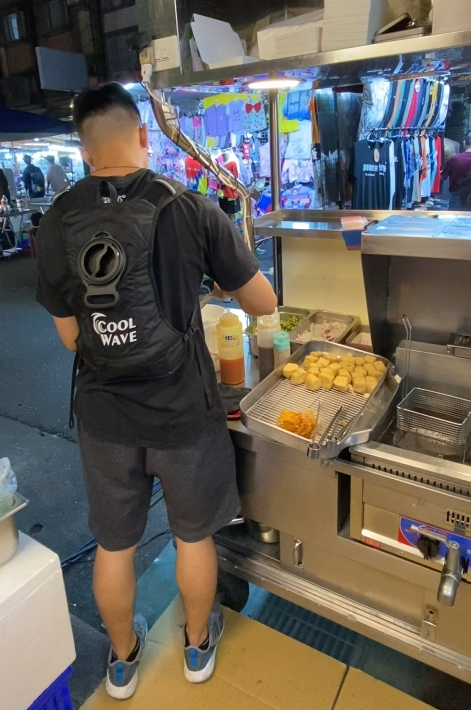
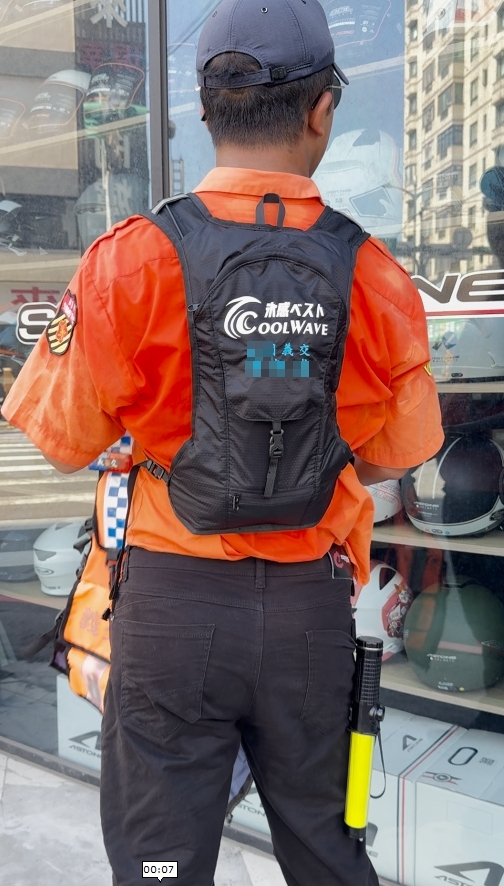
A recorded deployment covers these segments directly: 100 units supplied in Taiwan for construction sites, outdoor work, metal sheet factories and street vendors, applied to cooling in high-temperature environments, and in service for 10 years. The recorded results are effective body cooling, heatstroke prevention, and improved work efficiency and worker comfort. The recorded highlight for that deployment is passive ice-pack cooling with no power required, a lightweight and portable design, an adjustable one-size-fits-all fit, and certified disaster prevention status.
Note the configuration logic: that deployment ran on the passive ice-pack path, where no power is needed. On sites where a 5V power bank can be issued per worker, the same vest can also be run with pump circulation. The two modes are a site-level configuration decision, not two different products — which is exactly why a comparison guide should state both rather than presenting circulation as an upgrade over passive cooling.
FAQ
What documentation should a buyer request when comparing dual cooling water cooling vests?
Four items. First, the patent covering the cooling structure: the COOLWAVE water-circulation cooling vest (Basic Model) is protected by Patent No. I886033, issued by the Intellectual Property Office, Ministry of Economic Affairs under the Patent Act of the Republic of China for the ROC market, covering the water-cooled vest structure and cooling system (issued 1 June 2025, valid to 27 August 2044). Second, product certification: the COOLING water-cooled vest received the Disaster Prevention Product and Service Certification Award from the Taiwan Disaster Prevention Industry Association. Third, quality and electrical evidence, since cooling systems must comply with ISO 9001:2015 for quality management and electrical components often require CE or UL marks — the circulation pump on this vest is an electrical component. Fourth, warranty terms, recorded as 6 months for the water-cooled vest.
How does dual cooling work — does the pump replace the ice packs?
No. The COOLWAVE water-circulation cooling vest uses two cooling paths in one unit: reusable ice packs for passive cooling, and a 5V pump that circulates chilled water through a sand rubber cooling tube loop. The pump is rated at 5V 150 mA (max) with a maximum flow rate of 320–370 ml/min, and each unit ships with a water-cooled vest backpack and two ice packs. The specified cooling duration is 3–4 hours and the vest weighs within 2 kg. Passive ice-pack operation requires no electrical power, which is why the recorded field highlight for this product is passive cooling with no power requirement.
What drives the cost difference between a passive ice-pack vest and a dual cooling water cooling vest?
No price figures are published in the specification data used for this guide, so any cost comparison has to be built from cost drivers rather than list prices. A dual cooling unit adds a pump, a cooling tube loop and a TPU water bag on top of the ice packs, two of which are supplied per unit. The running comparison is replenishment: ice packs must be refrozen and the water bag refilled, and pump operation requires a 5V power source. Buyers should weigh total cost of ownership across cooling-set quantity, refreeze logistics, replacement parts, warranty length (6 months on the water-cooled vest), MOQ (10 units) and lead time (7–14 days).
Can a buyer test a dual cooling vest before placing a volume order?
The recorded minimum order quantity is 10 units, which is small enough for a site-level trial before scaling. Two things make that trial useful: run it on the actual worksite, because the specification lists a suitable temperature below 10 °C and the vest relies on a cold source for the ice packs; and test both configurations — passive ice-pack mode and pump circulation with a 5V power bank — so the crew’s preference is based on real work rather than a catalogue. For reference, a recorded Taiwan deployment covered 100 units across construction sites, outdoor work, metal sheet factories and street vendors, in service for 10 years, with recorded results of effective body cooling, heatstroke prevention and improved work efficiency and worker comfort.
What lead time and capacity should a distributor plan for?
The recorded production data is an ODM production mode with a monthly capacity of 3,000 units, a lead time of 7–14 days and a 6-month warranty on the water-cooled vest. Company-level data records an annual output of 10,000 units and an export ratio of about 50%, with the USA and ROC as the main markets. Distributors planning a seasonal heat-response programme should confirm ice-pack and pump availability alongside the vest itself, because the product depends on both. To start a comparison on your own sites, download the Shokunin product brochure, or send your shift pattern and worksite conditions to fsmarketing@fstool.com.tw for a configuration check.
Conclusion: Match the Mechanism to the Duty Cycle, Then Verify It
The comparison that decides a purchase is not a feature count. It is a fit test: does the cooling mechanism survive your cold chain, your power availability and your shift length, and can the supplier document it? Passive ice-pack cooling wins where no power is available and tasks are short. Ice water circulation adds continuous cooling across the body but adds a 5V dependency and a pump to maintain. PCM packs compete on market-share growth (28.7% of the cooling vest market in 2025, per Dataintelo) rather than on a spec set comparable to the one above.
For the COOLWAVE Water-Circulation Cooling Vest, the documented answers are a 3–4 hour cooling duration, a weight within 2 kg, a 5V 150 mA (max) pump with a maximum flow rate of 320–370 ml/min, two ice packs per unit, Patent No. I886033 for the ROC market, the Disaster Prevention Product and Service Certification Award from the Taiwan Disaster Prevention Industry Association, a 10-unit MOQ, a 7–14 day lead time, a 3,000-unit monthly capacity and a 6-month warranty on the water-cooled vest.
Next step for buyers and distributors
Download the Shokunin product brochure for the full COOLWAVE specification set, or request a 10-unit trial configuration for your worksite.
Website: www.fstool.com.tw | Email: fsmarketing@fstool.com.tw | WhatsApp
FENG SHANG PRECISION CO., LTD. · No. 155-17, Sec. 2, Nanzhu Rd., Luzhu Dist., Taoyuan City 338454, Taiwan · Phone: +886 3-312-6606 · Business hours: Monday to Friday 8:30 AM – 5:40 PM