
Eliminating Heat Rash in Workforce: A Cooling Vest Intervention for Construction Sites
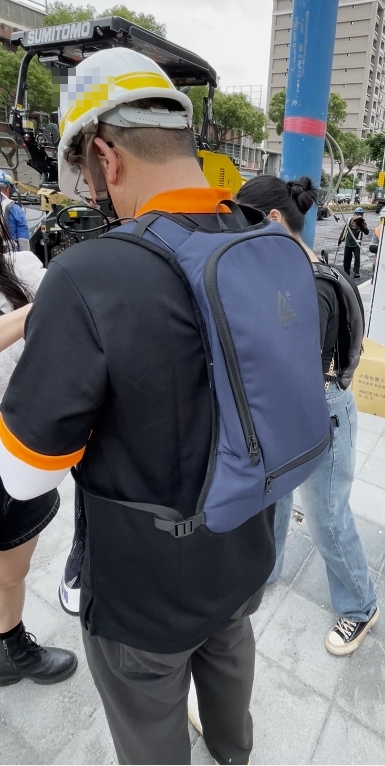
Heat rash is rarely the reason a construction project falls behind — but it is one of the earliest visible signals that a crew is carrying more heat than it can shed. This article treats that signal as a workforce intervention problem rather than a first-aid footnote: define the exposure, specify a cooling device as site equipment, pilot it on one crew, then scale it. The device discussed here is the Shokunin COOLWAVE dual cooling water cooling vest, and the evidence includes a 100-unit deployment in Taiwan.
A note on scope: heat-related illness is a safety matter governed by local occupational safety rules, and nothing in this article replaces a site heat-management plan or medical advice. What follows is an operational view of how a cooling vest program is specified, tested and rolled out.
Problem Definition: What Heat Rash Actually Signals
Heat rash (miliaria) develops when sweat ducts become blocked in hot, humid conditions, trapping perspiration under the skin. It appears as clusters of small, itchy bumps in the places where clothing and PPE sit tightest — shoulders, upper back, waistband, chest under a harness. In isolation it is uncomfortable. On a work site it is a leading indicator.
Three things follow a rash outbreak, and all three carry a cost. Comfort drops and attention drifts; a worker distracted by burning skin is not fully reading the site around them. Workers start to self-manage — loosening a harness, opening a layer, removing a hard hat during a break, or standing in shade longer than the schedule allows. And the conditions that produced the rash are the same conditions that precede heat exhaustion deeper into the shift.
That reframes the intervention target. The objective is not to treat skin; it is to reduce the heat load a worker accumulates between the first task and the last. Personal cooling systems exist for exactly this purpose. The U.S. National Institute for Occupational Safety and Health (NIOSH) identifies water-cooled garments, air-cooled garments, cooling vests and wetted overgarments as examples of auxiliary or personal cooling systems for heat exposure.
Why the Problem Repeats Every Summer
Heat rash programs usually fail for a structural reason rather than a medical one. Cooling is treated as a consumable — cold drinks, ice, a shared fan — rather than as issued equipment. Consumables run out by mid-afternoon, are not tracked, and leave no data behind. Equipment behaves differently: it has a specification, an owner, a maintenance routine and a reorder point. That is the shift this article argues for, and it is why the vest is presented as an HR intervention rather than a welfare gesture.
Industry Background: Why Cooling Vests Are Now Bought as Equipment
Cooling vests began as a consumer accessory for gardening and outdoor leisure. The purchasing pattern has changed. Dataintelo reports that the global cooling vests market reached USD 342 million in 2025, and that industrial applications accounted for a 34.5% revenue share in the same year. The share matters more than the headline figure: it indicates that a substantial part of this category is now bought by employers equipping people who cannot choose to go indoors.
Construction is the archetypal case. Work is scheduled around pours, deliveries and crane time rather than around the weather. Reflected heat from concrete and steel raises the load above ambient temperature. Mandatory PPE adds a layer that holds heat and moisture against the skin. And shifts are long enough that a single cooling event in the morning does nothing for a mid-afternoon task.
Two cooling families dominate the field. Passive systems rely on a cold source such as reusable ice packs and require no power. Active systems move a medium — water or air — against the body, and are judged on reservoir capacity, flow rate and re-charging logistics. Evaporative approaches depend on ambient vapour pressure, so their behaviour shifts with humidity; a water-circulation design with a chilled reservoir is a different mechanism and should be evaluated on different criteria.
Buyer takeaway: when a cooling vest is purchased as equipment rather than as a perk, the evaluation criteria change from "does it feel cold" to "what is the runtime per cycle, what powers it, how is it re-charged, and what documentation supports the claim". Those are the four questions addressed below.
The Solution: COOLWAVE Dual Cooling Water Cooling Vest
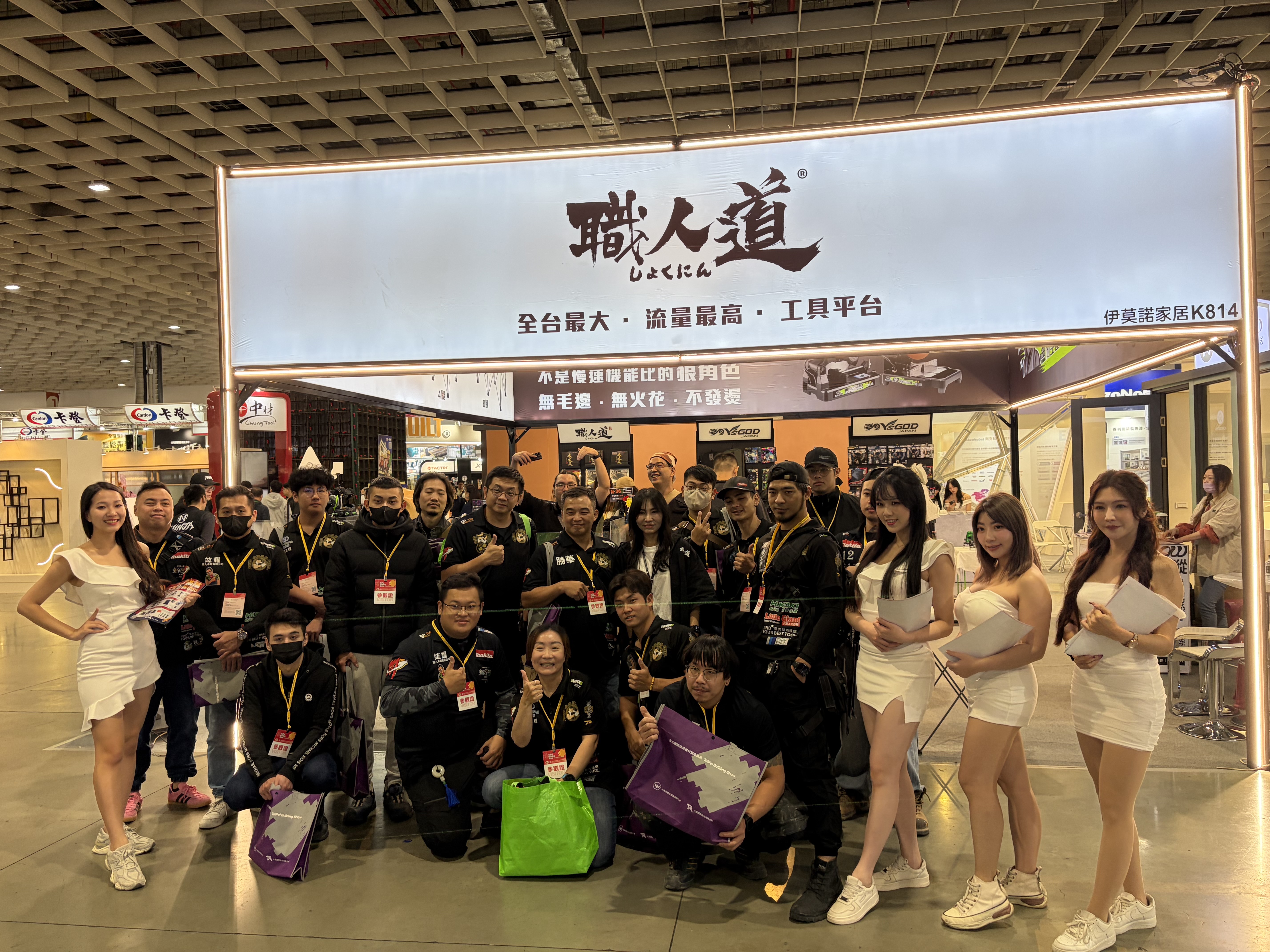
Shokunin is the professional tool and equipment brand of Feng Shang Precision Co., Ltd., a manufacturer based in Luzhu District, Taoyuan City, Taiwan, founded in 2009. The company operates a 1,000 m² facility with 30 employees, five engineers and a documented annual output of 10,000 units, with roughly 50% of output exported and the USA and Taiwan (ROC) listed as main markets. Its COOLWAVE line is a water-circulation cooling vest built for high-temperature work environments.
The architecture is what the name describes. A reusable ice-pack cold source provides the chilled mass, and a pump-driven water circuit moves chilled water around the torso. The cold side itself needs no power to function, which matters on a site with no convenient outlets; where the circulation pump is fitted, it is described in published technical material as a 5V unit drawing up to 150 mA and driven by a power bank — the same accessory class a crew already carries for phones and radios.
Published Specifications Relevant to Shift Planning
- Cooling duration: 3–4 hours per charge or ice-pack cycle, per published specifications.
- Pump rating: 5V, 150 mA maximum.
- Flow rate: 320–370 ml/min.
- Weight: within 2 kg.
- Fit: adjustable one-size-fits-all design, lightweight and portable.
- Product variants: Professional (CW-PRO) and Basic (CW-01) models are listed.
- Warranty: 6-month warranty on the water-cooled vest.
Read against a construction shift, the 3–4 hour figure is the number that determines the program. A cycle of that length covers a morning block or an afternoon block, not a full shift. That is a planning input, not a defect: it tells HR and site management that a vest program needs a re-charging and ice-pack rotation step built into the day, in the same way a nail-gun program needs a battery rotation step.
Compliance and Intellectual Property
Two documents support the product rather than the marketing description. The vest has received the Disaster Prevention Product and Service Certification issued by the Taiwan Disaster Prevention Industry Association. Separately, the water-cooled vest structure and cooling system are covered by patent I886033, granted by the Intellectual Property Office of Taiwan's Ministry of Economic Affairs on 1 June 2025 and valid to 27 August 2044.
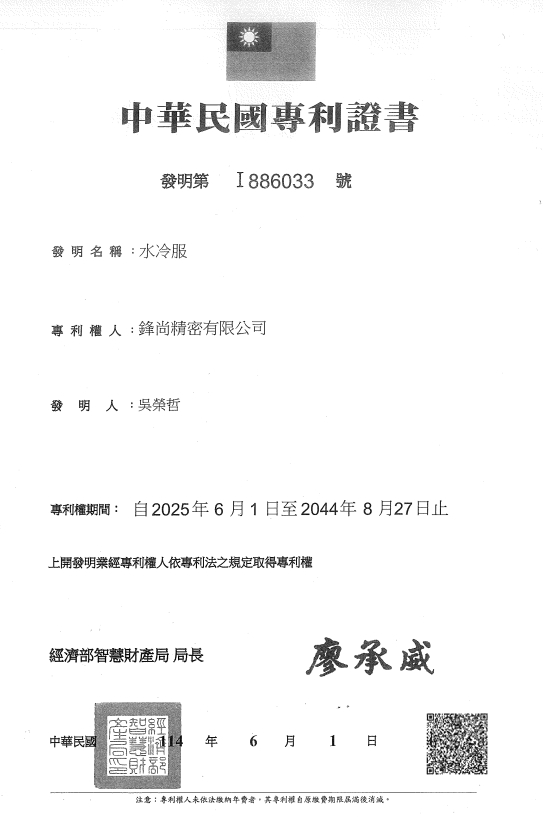
Both are Taiwan-market credentials. A buyer deploying in another jurisdiction should map them against local PPE and electrical-safety requirements and request current documentation before purchase — a certification that answers a Taiwanese procurement question does not automatically answer a European or North American one.
What This Intervention Does Not Do
An honest specification includes limits. The vest cools the torso; it does not cool the whole body equally, and it does not replace scheduling, shade, hydration or acclimatization. The published runtime and flow figures are supplier-published and do not disclose the test conditions behind them — ambient temperature, humidity, workload and clothing layers are not defined in public sources. And re-freezing ice packs is a logistics task that has to be resourced, not assumed. A program that ignores any of these three points will underperform a vest that works exactly as specified.
Step-by-Step: Rolling Out a Cooling Vest Program
- Map the exposure. Walk the site and list the tasks where workers face prolonged sun exposure or reflected heat — rebar fixing, formwork on the upper floors, roofing, external cladding, traffic control at the gate. Record which tasks run through the hottest block of the day. This list, not a general site description, defines who gets a vest.
- Set the issue rule. Decide in advance whether vests are issued by task, by crew or by temperature trigger, and who signs one out. A rule written before the first hot week prevents the equipment from disappearing into individual lockers.
- Confirm the configuration. The COOLWAVE line lists Professional (CW-PRO) and Basic (CW-01) models, and the powered circulation element differs by model. Specify exactly which configuration the crew will receive, and confirm the ice-pack count and any power-bank requirement in writing at quotation stage.
- Build the cold chain. Plan freezer capacity, the number of spare ice-pack sets per vest, and who swaps them at the mid-shift changeover. With a 3–4 hour cooling duration per cycle, a two-block day needs one planned swap per worker.
- Brief and fit the crew. The adjustable one-size-fits-all design reduces sizing administration, but a five-minute fitting session still matters: a vest worn loose over a harness does not transfer cooling efficiently, and workers who do not understand the swap routine will not use it after week one.
- Measure and adjust. Track comfort feedback, wear time per shift and any equipment failures across the pilot, then set the reorder point. Feng Shang Precision provides ODM production services with a monthly capacity of 3,000 units and a typical lead time of 7–14 days, so replenishment can be planned inside a season rather than at its start.
Use Cases: Where the Intervention Fits
The vest has been deployed where heat is a permanent feature of the work rather than a seasonal surprise. Documented application environments include construction sites, outdoor work generally, metal sheet factories and street-vendor operations — all settings where the worker cannot retreat indoors and where the heat load is sustained across several hours.
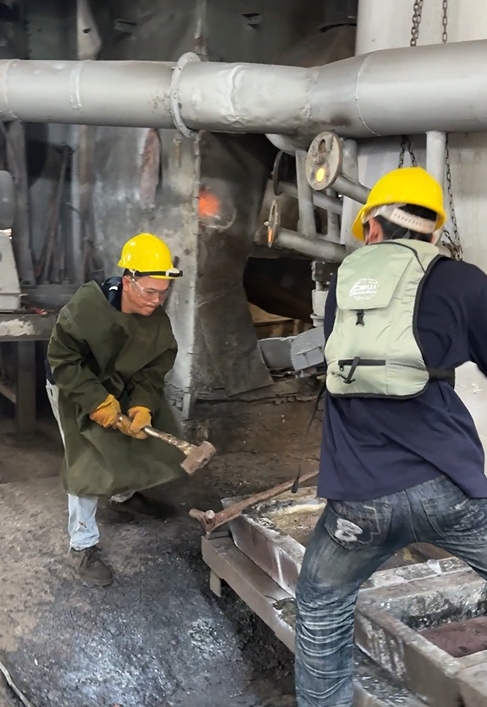
The common thread is not temperature alone but the combination of heat, mandatory protective layers and a schedule the worker does not control. Those are precisely the conditions where an industrial cooling vest is bought by the employer rather than by the wearer — and where heatstroke prevention gear for extreme heat has to survive daily industrial use, not a weekend.
Case Reference: 100 Units Deployed in Taiwan
In Taiwan, 100 units were deployed for cooling in high-temperature environments. Users across construction sites, outdoor work, metal sheet factories and street-vendor operations reported effective body cooling, heatstroke prevention, and improved work efficiency and worker comfort. The case record lists a 10-year application span for this deployment pattern.
The detail worth noting for a site manager is the shape of the reported outcome. The comfort result is expected. The reported improvement in work efficiency is the one that changes the budget conversation, because it moves the vest from a welfare line item into the same category as any other piece of issued equipment that keeps a crew productive through the full shift.
Intervention Layers Compared
A cooling vest is one layer of a heat-management plan, not a replacement for the others. The table below sets out how each layer contributes and what it requires operationally, using only documented product facts for the COOLWAVE rows.
| Intervention layer | What it changes for the worker | Power / utility requirement | Basis used here |
|---|---|---|---|
| Work–rest scheduling, shade and hydration | Shortens the exposure window and replaces fluid loss | None | General occupational heat practice |
| Acclimatization for new and returning workers | Builds tolerance gradually instead of on day one | None | General occupational heat practice |
| Ice-pack cold source worn at the torso | Local conductive cooling without a powered circuit | No power required at the cold-source stage | COOLWAVE ice-pack cold source, product documentation |
| COOLWAVE dual cooling water-circulation vest | Sustained torso cooling across a work block | 5V power bank for the circulation pump | Published specs: 3–4 h per cycle; 5V, 150 mA max; 320–370 ml/min; within 2 kg |
| Documented certification for procurement | Gives EHS and purchasing a file to approve against | None | Taiwan Disaster Prevention Product and Service Certification; patent I886033 |
Frequently Asked Questions
Is the COOLWAVE vest certified for workplace heat-protection programs?
The vest holds the Disaster Prevention Product and Service Certification issued by the Taiwan Disaster Prevention Industry Association, and its water-cooled vest structure and cooling system are covered by patent I886033, granted by the Intellectual Property Office of Taiwan's Ministry of Economic Affairs on 1 June 2025 and valid to 27 August 2044. Both are Taiwan-market credentials. Buyers deploying in other markets should map them against their own PPE and electrical-safety requirements and request current documentation before purchase.
How long does the vest cool, and what powers the circulation?
Published specifications list a cooling duration of 3–4 hours per charge or ice-pack cycle, a pump rated at 5V and 150 mA maximum, and a flow rate of 320–370 ml/min. The vest weighs within 2 kg and uses an adjustable one-size-fits-all fit. These figures are supplier-published and do not define ambient temperature, humidity, workload or clothing layers, so duration should be confirmed against the actual shift pattern during a pilot rather than assumed from the datasheet.
What are the commercial terms and minimum order quantity?
The minimum order quantity is 10 units. Standard terms are full payment with shipment after payment, freight paid by the buyer, and a pre-shipment test as the acceptance criterion. Unit pricing is quoted per order rather than published, so the quotation request should specify the model configuration, ice-pack count and delivery destination.
Can a contractor pilot the vest before ordering for a whole site?
Yes — the 10-unit MOQ is sized for a pilot. A single crew or a single high-exposure task can be equipped and run through several shift rotations, which is enough to evaluate comfort, wear time, the ice-pack swap routine and any power-bank handling before a site-wide order. Acceptance is defined as a pre-shipment test, and the water-cooled vest carries a 6-month warranty.
What lead time should HR plan for when scaling a rollout?
Typical production lead time is 7–14 days, against a monthly capacity of 3,000 units and a documented annual output of 10,000 units at Feng Shang Precision. Plan the site rollout around that window plus freight and internal fitting time, and place replenishment orders against the reorder point set during the pilot. To start, the product brochure and a pilot quotation can be requested through the contact details below.
Conclusion: Turning a Summer Symptom into an Equipment Decision
Heat rash will keep appearing on construction sites as long as crews work in sun, wear layers and follow schedules they do not set. What can change is whether the response is a case of cold drinks or a specified, issued, maintained piece of equipment. Treating it as the latter is what makes an intervention measurable: a runtime you can plan a shift around, a certification file purchasing can approve against, a pilot of 10 units before a site-wide order, and a lead time that fits inside the season.
The Shokunin COOLWAVE dual cooling water cooling vest is one implementable answer to that requirement — a water-circulation cooling vest with a reusable ice-pack cold source, a published 3–4 hour cycle, and a Taiwan case record covering 100 deployed units across construction sites, outdoor work, metal sheet factories and street-vendor operations. Nothing about it removes the need for shade, hydration and scheduling. It simply stops the heat load from being the variable a crew cannot control.
Next Step: Pilot 10 Units on One Crew
Review the full COOLWAVE specification pack, then run a pilot against your own shift pattern before committing a site. Download the product brochure here: COOLWAVE Cooling Vest Brochure (PDF).
For pilot quotations, ODM enquiries and lead-time confirmation, contact Feng Shang Precision Co., Ltd. (Shokunin):
Email: fsmarketing@fstool.com.tw | Phone: +886 3-312-6606 | WhatsApp: +86 18858260055
Business hours: Monday to Friday, 8:30 AM – 5:40 PM
Address: No. 155-17, Sec. 2, Nanzhu Rd., Luzhu Dist., Taoyuan City 338454, Taiwan
Website: https://www.fstool.com.tw/
Dual Cooling Water Cooling VestIndustrial cooling vestHeatstroke prevention gear for extreme heatSweat-proof cooling gear for constructionLong-lasting cooling vest
Have Questions or Need More Details?
Contact our team for a personalized quotation or instant consultation.
Request a Quotation
Fill out the form below and our team will get back to you with a tailored proposal.
WhatsApp Direct Chat
Prefer to chat in real-time? Message us on WhatsApp for instant assistance & quick answers.
- Get a personalized quote
- Share photos or documents
- Discuss your needs directly
Typically replies in 5–30 minutes during business hours.