
Evaluating a Cooling Vest Manufacturer: Key Capabilities and Warranty Checks
Evaluating a Cooling Vest Manufacturer: Key Capabilities and Warranty Checks
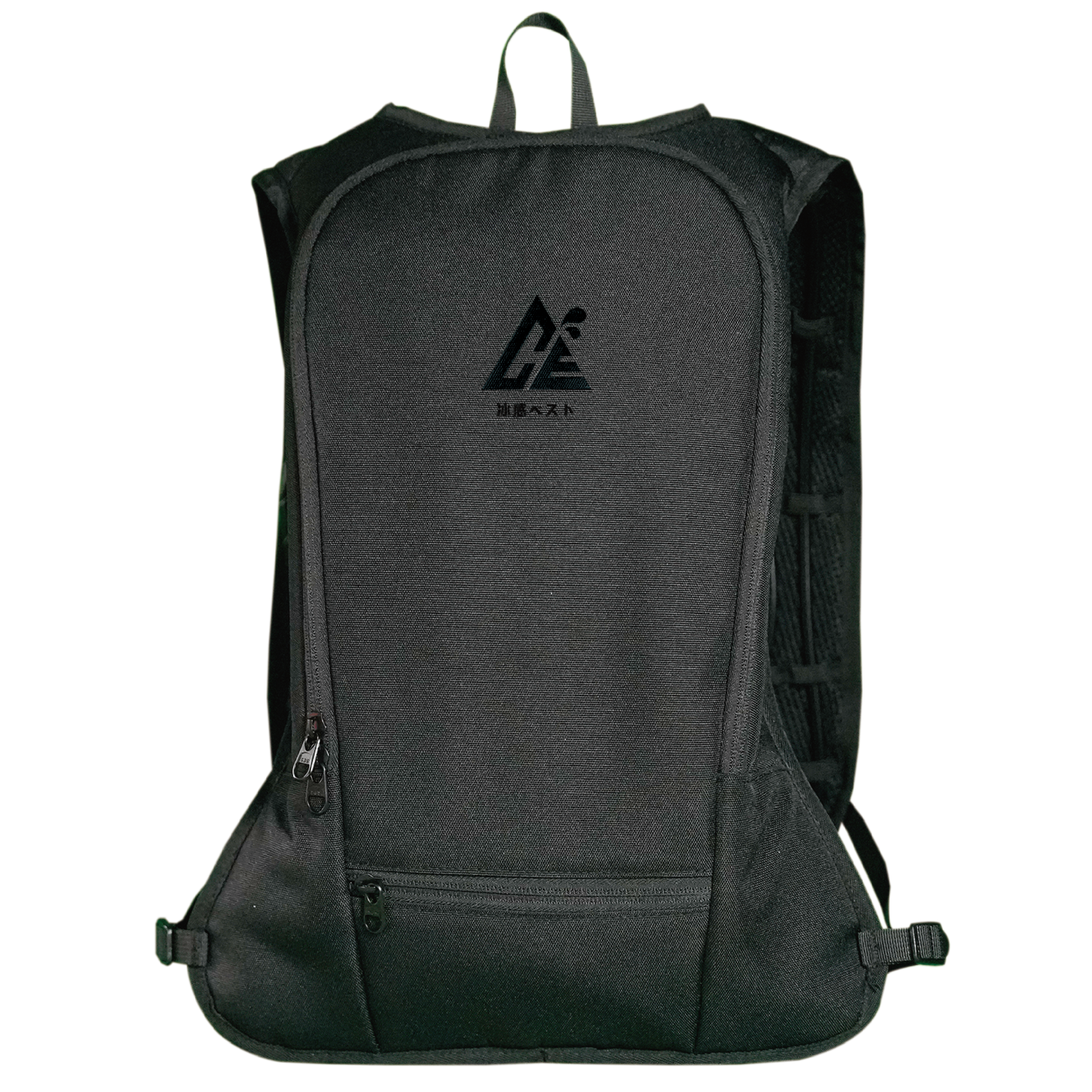
COOLWAVE Water-Circulation Cooling Vest (Professional Model-Black). Product photo use: cover image and product reference for this evaluation guide.
A cooling vest manufacturer should be evaluated on three checkable items before a purchase order is issued: documented production capability, provable intellectual property and certification, and warranty terms that appear in the order rather than in conversation. Catalogue photos, a sample's hand feel and a low quotation are supporting evidence — none of them prove that a supplier can repeat the same build at 3,000 units a month.
Shokunin is a professional e-commerce brand launched by FENG SHANG PRECISION CO., LTD., a manufacturer founded in 2009 in Taoyuan, Taiwan, that produces the COOLWAVE Water-Circulation Cooling Vest alongside air compressors, cut-off machines, lithium batteries, diamond saws, nail guns, spider stands and screwdriver bits. Its capability record is specific — a 1,000 m² facility, 30 employees, 5 R&D engineers and an annual output of 10,000 units — which is why it is used here as a worked example of the evidence any buyer should be able to obtain from a supplier of a dual cooling water cooling vest.
Why Manufacturer Evaluation Fails Before It Starts
Most cooling vest sourcing problems are not product problems. They are supplier problems that surface after the deposit is paid: capacity that was assumed rather than scheduled, a patent or certification that was mentioned but never verified, a warranty that existed only in a chat message, and a lead time that was quoted before artwork approval was counted.
The reason is that buyers tend to evaluate what is easy to compare. Cooling duration, weight, flow rate and materials are all measurable, and they are the right specifications to check — a water-circulation vest typically lives or dies on the cooling loop, the water bag and the pump. But those parameters describe a product, not a business. A trading intermediary can forward the same parameter sheet as a factory, which is why the entity that signs the quotation should match the entity that holds the intellectual property and issues the warranty.
For a buyer at the research-to-evaluation stage, the practical question is not "which vest looks best" but "which supplier can document what it claims, and what happens in month five if a pump fails." That is the evaluation this guide walks through.
What the Industrial Cooling Vest Market Looks Like in 2026
Cooling apparel is no longer a niche accessory category. Market scope matters here, because public estimates differ sharply depending on how wide the definition is. Dataintelo values the specific global cooling vest market at approximately USD 215 million in 2024, projected to reach USD 385 million by 2033, while Market Research Future values the broader personal cooling device market — which includes handheld fans and other devices — at USD 25.16 billion in 2024, rising to USD 94.85 billion by 2035. A buyer comparing supplier scale against market size should check which definition a number refers to before using it.
Two structural signals matter for procurement planning. First, industrial applications, including construction and manufacturing, held the largest share of the cooling vest market at 34.5% in 2025 (Dataintelo). Second, Asia Pacific is identified as the fastest-growing region for cooling vests, driven by rapid industrialization and high outdoor work populations (Spherical Insights), and active circulatory mechanisms such as ice water circulation are increasingly deployed in industrial sectors to mitigate occupational heat stress (Strategic Market Research). In other words, the category is moving toward the exact configuration this guide evaluates.
Standards are the other backdrop. For cooling systems, ISO 9001:2015 covers quality management, and electrical components are commonly expected to carry CE or UL marks (ISO / UL). These are category-level expectations, not certification claims about any single supplier — which is precisely why a buyer should ask each manufacturer which documents it actually holds, for which market, and under which standard.
A Six-Point Evaluation Framework for Cooling Vest Suppliers
1. Legal entity and physical facility
Start with the name on the quotation. It should be a registered company rather than a brand alias, and it should match the entity named on the certification and warranty documents. Shokunin's manufacturer, FENG SHANG PRECISION CO., LTD., was founded in 2009 and operates from No. 155-17, Sec. 2, Nanzhu Rd., Luzhu Dist., Taoyuan City 338454, Taiwan, with a facility of 1,000 m².
A 1,000 m² footprint with 30 employees is a focused operation. Whether that is a fit or a limitation depends entirely on order size: it suits buyers who need 10 to 3,000 units a month and want direct access to the people who actually build the product. Buyers planning unusually large single-batch programs should ask how capacity is scheduled and shared.
2. Engineering depth, not just sales response
A water-circulation vest is a small fluid system: pump, tubing, water bag, seals, connectors and a garment that has to hold all of it against a moving body. Engineering headcount is therefore a more useful signal than catalogue breadth. In Shokunin's documented profile, 5 of the 30 employees are R&D engineers — roughly one in six staff on design. The verification question is concrete: who signs off on a design change, and how is that change documented before it reaches production?
3. Capacity arithmetic: annual output versus monthly capacity
Two numbers are usually quoted, and they should be tested against each other. Shokunin documents an annual output of 10,000 units and a monthly capacity of 3,000 units. Those figures describe different things: annual output is a volume across the year, while monthly capacity is a scheduling ceiling. A buyer should ask directly whether the monthly number is a sustained rate or a peak, and how a delivery window is protected when several customers order in the same month.
4. ODM capability — and exactly what it covers
ODM is a broad term, and it should never be accepted as a single word. The documented production mode for the water-cooled vest line at FENG SHANG PRECISION CO., LTD. is ODM. The same capability record does not list customization as an enabled option, so the correct reading is that ODM is the starting point of a conversation rather than a blanket promise. Buyers should confirm in writing which elements can be changed — colour, branding, packaging, fittings — and which cannot.
The existing range shows what a starting point looks like in practice: the COOLWAVE Water-Circulation Cooling Vest is offered as a Basic Model and as Professional Models in blue, gray and black, each with documented parameters rather than colour-only differences.
5. Intellectual property and certification, verified at the source
Patents and awards are the easiest claims to repeat and the easiest to verify. The COOLWAVE water-circulation cooling vest (Basic Model) is protected by Patent No. I886033, issued by the Intellectual Property Office, Ministry of Economic Affairs under the Patent Act of the Republic of China, covering the water-cooled vest structure and cooling system. The patent was issued on 2025-06-01 and runs to 2044-08-27, and it applies to the ROC market. Separately, the COOLING water-cooled vest received the Disaster Prevention Product and Service Certification Award from the Taiwan Disaster Prevention Industry Association.
Two verification habits follow from this. First, check the patent number against the issuing office rather than accepting a certificate image. Second, ask which market each document covers — an ROC patent and a Taiwan-issued certification are strong evidence of engineering standing, but a buyer selling into another region still needs to confirm the compliance route for that region, including ISO 9001:2015 alignment and, for electrical components, CE or UL expectations.
6. Warranty and after-sales terms, in the order document
Shokunin's documented after-sales term is a 6-month warranty for the water-cooled vest. A defined six-month term is more workable for procurement than an open-ended promise, because it can be planned around and costed. What matters is converting it into purchase-order language: the coverage start date, whether the pump, water bag, cooling tube and ice packs fall inside the term, whether claims are handled as repair or replacement, who carries freight, and which conditions void coverage.
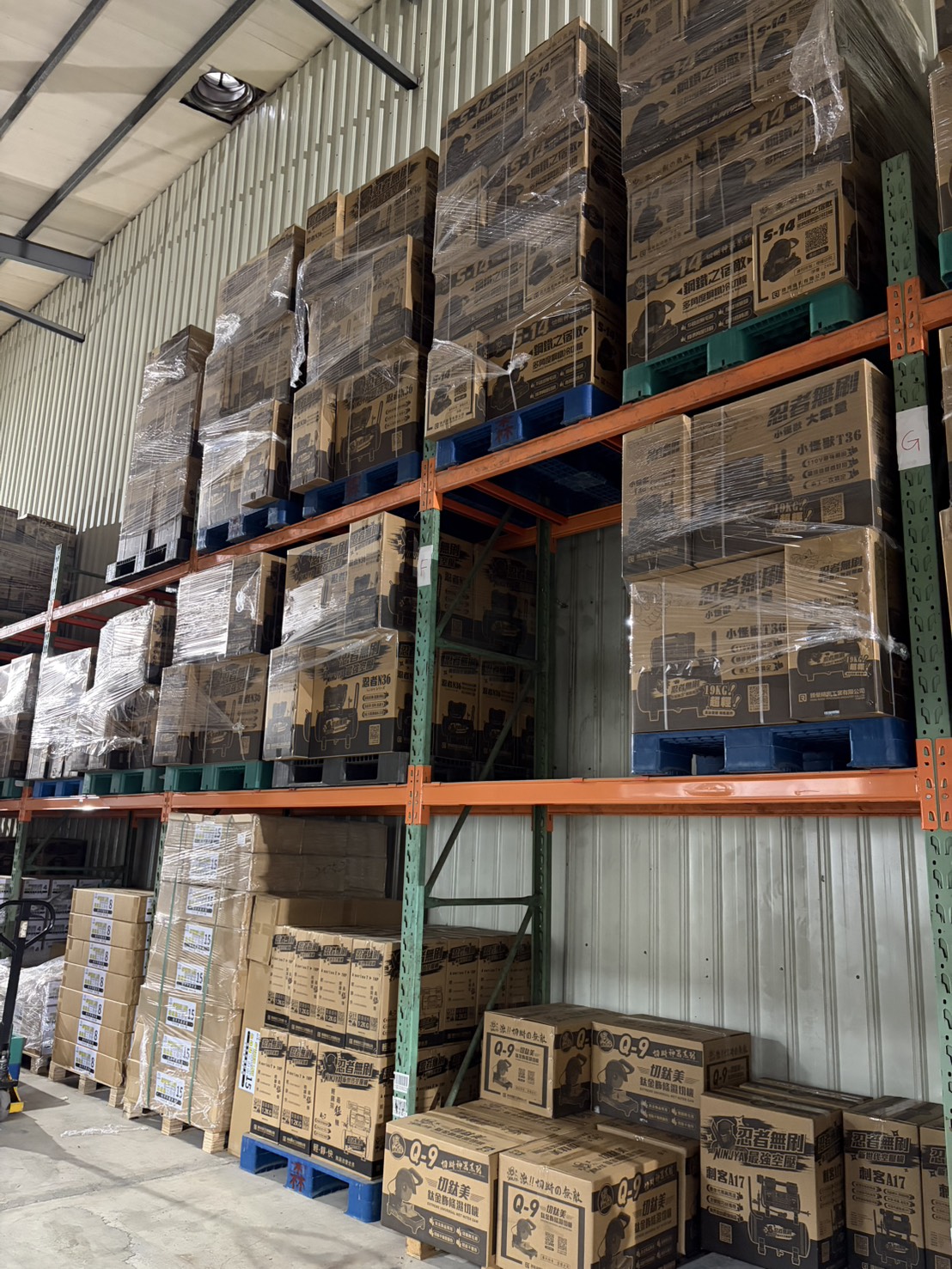
Warehouse and stock area: capacity claims should be matched to physical storage and scheduling evidence, not just to a quotation line.
Step-by-Step: How to Run the Evaluation
- Step 1 — Match entity names. Compare the quotation, the patent record and the warranty document. All three should point to the same legal entity (for this example, FENG SHANG PRECISION CO., LTD., brand Shokunin).
- Step 2 — Request the capability sheet. Ask for facility size, employee count, R&D headcount, annual output and monthly capacity in one document — the figures used above (1,000 m², 30 employees, 5 R&D engineers, 10,000 units per year, 3,000 units per month) are the format to expect.
- Step 3 — Verify intellectual property. Confirm Patent No. I886033 with the Intellectual Property Office, Ministry of Economic Affairs, and check that the scope covers the structure and cooling system you are buying, and that the expiry date (2044-08-27) sits beyond your program horizon.
- Step 4 — Verify certification and market fit. Confirm the Disaster Prevention Product and Service Certification Award from the Taiwan Disaster Prevention Industry Association, then map your own destination market's requirements, including ISO 9001:2015 and any CE or UL needs for electrical parts.
- Step 5 — Nail down ODM scope. Get written confirmation of what can be customized and what cannot, plus the cost and schedule impact of each change.
- Step 6 — Convert the warranty into PO language. Turn the 6-month water-cooled vest warranty into clauses covering parts, claim route, freight and exclusions.
- Step 7 — Pilot before scaling. Place a first order at the documented MOQ of 10 units, validate on a real site, then plan volume against the documented 7–14 day lead time and the monthly capacity ceiling.
Where a Water-Circulation Cooling Vest Is Actually Used
Evaluation criteria only make sense against real working conditions. The documented application profile for this product line covers construction sites, outdoor work, metal sheet factories, street vendors and traffic controllers, in high-temperature conditions, with a lightweight, adjustable and one-size-fits-all design and reusable ice packs. That list is useful precisely because it mixes job types: a metal-roof factory traps heat with little airflow, a traffic controller stands in prolonged sun exposure with no shade, and a night market vendor works a long shift with limited space for a bulky cooling system.
Deployment evidence reinforces the pattern. Shokunin's case record documents a Taiwan deployment of 100 units across construction sites, outdoor work, metal sheet factories and street vendors, with a usage period of 10 years and reported outcomes of effective body cooling, heatstroke prevention, and improved work efficiency and worker comfort. The stated highlights are passive ice-pack cooling requiring no power, a lightweight and portable build, an adjustable one-size-fits-all design, and certified disaster prevention product status — attributes that matter when crews rotate between tasks rather than sitting at one station.
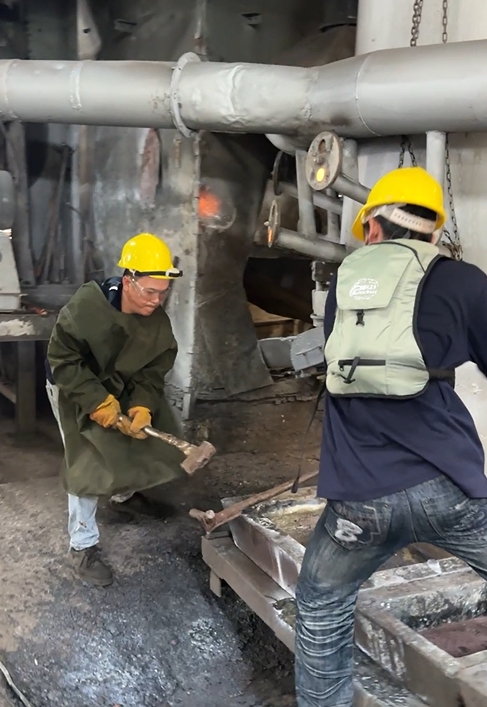
Metal sheet factory: one of the documented application environments, where heat load and airflow restriction drive cooling selection.
Side-by-Side: Evaluation Checklist with Documented Values
The table below converts the six-point framework into a working checklist. Every figure in the right-hand column is a documented value for the Shokunin water-cooled vest line, shown as an example of the level of detail a buyer should demand from any manufacturer under review.
| Evaluation area | What the buyer must verify | Documented example (Shokunin) | Evidence to request |
|---|---|---|---|
| Legal entity | Quotation name matches patent and warranty holder | FENG SHANG PRECISION CO., LTD., founded 2009, Taoyuan, Taiwan | Company registration and address record |
| Facility and workforce | Physical footprint and staff consistency | 1,000 m² facility; 30 employees | Facility photos and staff breakdown |
| Engineering depth | R&D headcount and change control | 5 R&D engineers | Design change sign-off procedure |
| Capacity | Annual output versus monthly ceiling | 10,000 units per year; 3,000 units per month | Capacity statement and scheduling policy |
| ODM scope | What can and cannot be changed | Production mode ODM; customization not listed as enabled | Written customization scope |
| Intellectual property | Patent number, scope, market, expiry | Patent No. I886033; structure and cooling system; ROC; issued 2025-06-01; expires 2044-08-27 | Patent certificate and office check |
| Certification | Award, issuing body, covered market | Disaster Prevention Product and Service Certification Award, Taiwan Disaster Prevention Industry Association | Award documentation |
| Warranty | Term, covered parts, claim route | 6-month warranty for the water-cooled vest | Warranty clause in the order |
| Order flexibility | Entry order size and production window | MOQ 10 units; lead time 7–14 days | Order confirmation and schedule |
| Export experience | Destination-market familiarity | Export ratio 50%; main markets USA and ROC | Export references by market |
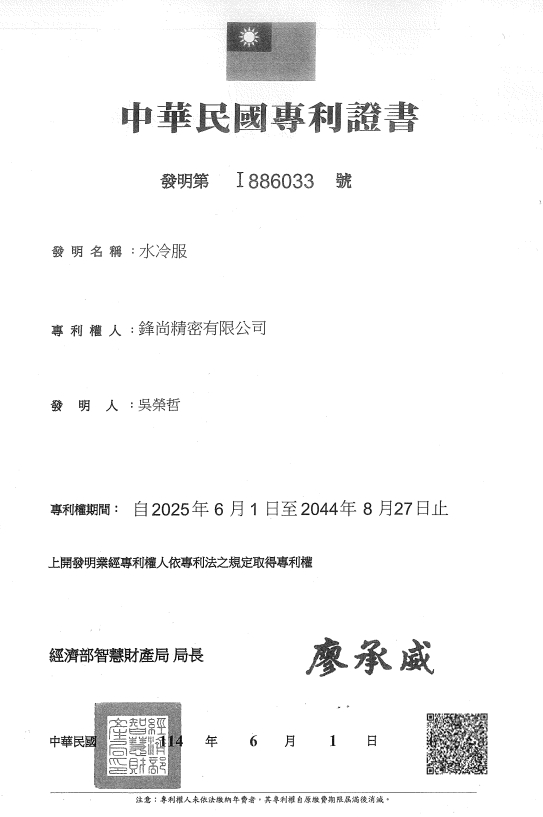
Water-Cooled Vest Patent Certificate: Patent No. I886033 covers the water-cooled vest structure and cooling system in the ROC market. Proof documents should be checked against the issuing authority, not stored as image files.
FAQ
Which certifications should a cooling vest manufacturer be able to document?
For the COOLWAVE water-circulation cooling vest (Basic Model), the documented intellectual property is Patent No. I886033, issued by the Intellectual Property Office, Ministry of Economic Affairs under the Patent Act of the Republic of China, covering the water-cooled vest structure and cooling system and applicable to the ROC market; it was issued on 2025-06-01 and expires on 2044-08-27. The COOLING water-cooled vest also received the Disaster Prevention Product and Service Certification Award from the Taiwan Disaster Prevention Industry Association. At category level, ISO 9001:2015 covers quality management and electrical components are commonly expected to carry CE or UL marks (ISO / UL). Buyers sourcing outside Taiwan should confirm which documents apply to their own market and ask for the certificate itself rather than the claim.
How can a buyer verify ODM capability instead of taking it on trust?
ODM is the documented production mode for the water-cooled vest line at FENG SHANG PRECISION CO., LTD., which supports an annual output of 10,000 units and a monthly capacity of 3,000 units with 5 R&D engineers among 30 employees in a 1,000 m² facility. Verification means asking three concrete questions: which elements can be changed (the capability record does not list customization as an enabled option, so scope must be confirmed in writing), how a change is quoted and scheduled, and which engineer signs off on it. It is also worth asking whether the monthly capacity figure is a sustained rate or a peak.
What warranty applies, and what should be written into the order?
Shokunin's documented after-sales term is a 6-month warranty for the water-cooled vest. Before ordering, convert that into purchase-order language: the coverage start date, whether the pump, water bag, cooling tube and ice packs sit inside the term, whether a claim is handled as repair or replacement, the claim route and freight responsibility, and the conditions that void coverage. A defined six-month term is easier to plan around than an open-ended promise, because it can be costed and scheduled.
What order size and production capacity should I plan my budget around?
The documented minimum order quantity for the water-cooled vest is 10 units, with a monthly capacity of 3,000 units and an annual output of 10,000 units. That combination allows a staged approach: start with a small order to validate fit and cooling performance on a real site, then scale toward the monthly ceiling as the program is proven. Because the annual figure and the monthly figure describe different things, budget phasing should be built on the ceiling that actually applies to your delivery window.
What lead time should I expect after confirming an order?
The documented lead time is 7–14 days. Before relying on it, confirm whether it covers production only or also includes artwork and customization approval, and place pilot orders ahead of peak heat season rather than during it. To move from evaluation to a first order, you can request the current product catalogue and quotation directly: email fsmarketing@fstool.com.tw, message WhatsApp +86 18858260055, or review the range at fstool.com.tw.
Conclusion: Evaluate the Document, Not the Pitch
A cooling vest manufacturer is only as reliable as the documents it can produce. Facility size, employee count, R&D headcount, annual output and monthly capacity establish whether a supplier can deliver. A patent and a certification establish whether the product has standing. A written warranty establishes what happens when something fails. The Shokunin example shows the level of specificity a buyer should expect — 1,000 m², 30 employees, 5 R&D engineers, 10,000 units a year, 3,000 units a month, Patent No. I886033 in the ROC market, the Taiwan Disaster Prevention Product and Service Certification Award, MOQ 10 units, a 7–14 day lead time, and a 6-month warranty on the water-cooled vest.
The practical next step is not a long comparison exercise, it is a small validated order: check the entity, verify the patent, confirm the ODM scope and warranty in writing, then run a pilot at the documented minimum and scale against documented capacity.
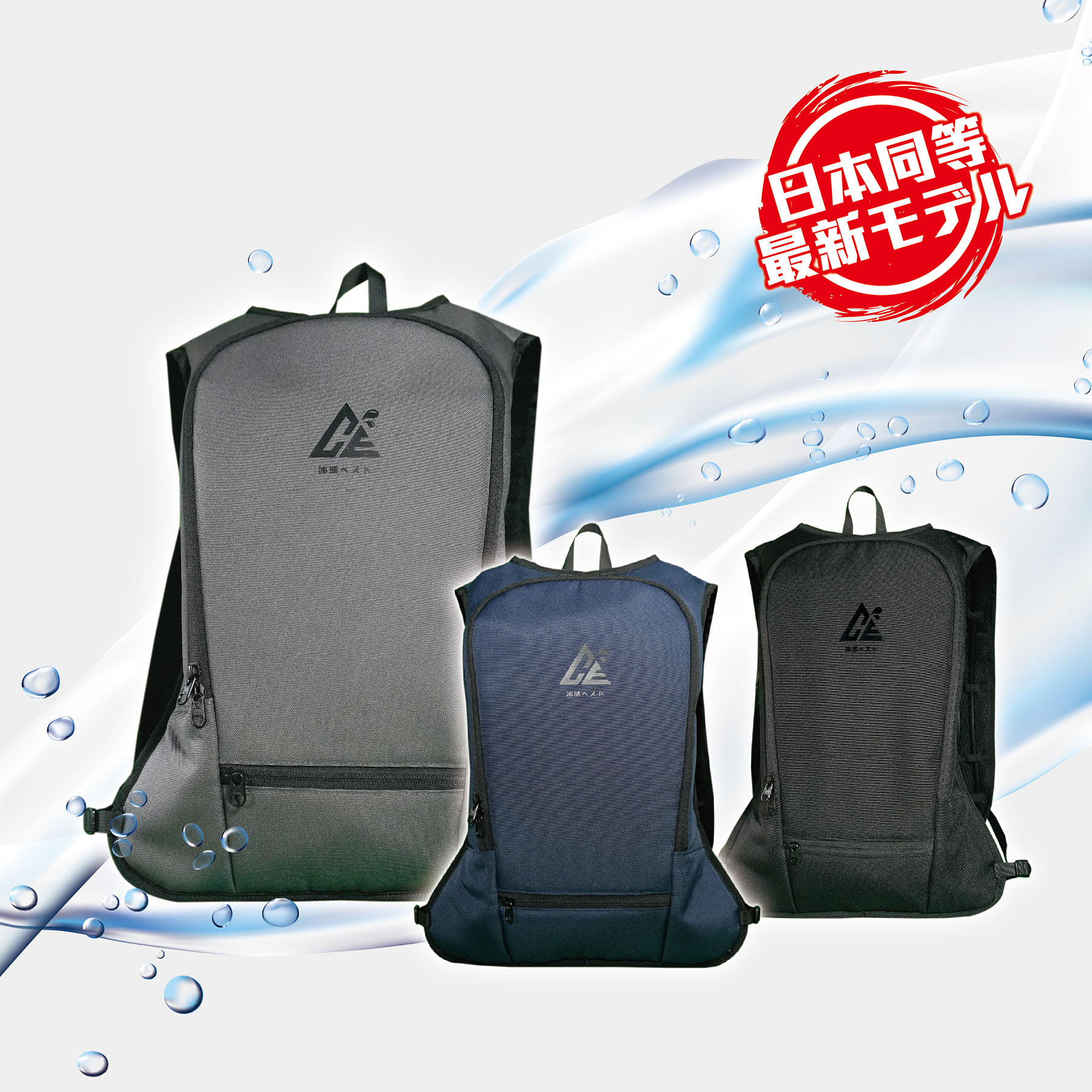
COOLWAVE Water-Circulation Cooling Vest (Basic Model) — the reference product used throughout this evaluation checklist.
Next step: verify, then pilot
Download the full product catalogue and documented specifications: Shokunin product brochure (PDF). For a quotation, ODM scope confirmation, or warranty terms on the water-cooled vest line, contact fsmarketing@fstool.com.tw or WhatsApp +86 18858260055. Shokunin is a brand of FENG SHANG PRECISION CO., LTD., No. 155-17, Sec. 2, Nanzhu Rd., Luzhu Dist., Taoyuan City 338454, Taiwan.