
Head-to-Head Decision: Dual Cooling Water Cooling Vest — Ice-Pack Mode vs. Pump-Driven Circulation
Most dual cooling water cooling vest comparisons put one vest against another. The head-to-head decision that actually changes how a crew works happens inside a single product: the same vest can run as a passive ice-pack vest, or as a pump-driven water-circulation vest, and the two paths carry different power, logistics and compliance profiles. This article compares those two solutions directly, so evaluation-stage buyers can decide which one to standardize on.
The reference product is the COOLWAVE Water-Circulation Cooling Vest (Basic Model), made by Shokunin — the professional brand of Feng Shang Precision Co., Ltd., a Taiwan-based manufacturer founded in 2009 that also produces air compressors, cut-off machines and related tools for professional tradespeople, and whose cooling line is built for people working in outdoor and high-temperature environments (www.fstool.com.tw).
The Head-to-Head Answer, Up Front
Solution A — passive ice-pack cooling. Choose this when the site cannot guarantee a controlled power supply, when exposure windows are short and rotated between workers, and when the simplest possible piece of PPE is the goal. In this mode the vest is documented as requiring no power.
Solution B — pump-driven water circulation. Choose this when heat exposure is continuous across a longer shift and a 5 V supply can be permitted and managed at worker level. The pump is rated 5 V 150 mA (max), and the documented maximum flow rate is 320–370 ml/min through the vest's cooling tube.
Both paths live in the same product and share the same product-level figures: a documented cooling duration of 3–4 hours and a weight within 2 kg. That cooling duration is the pivot of the entire decision, because it determines how many ice pack sets, rotation cycles or power arrangements one shift actually needs.
Problem Definition: The Choice Is a Mode, Not a Catalog Entry
Evaluation-stage comparisons of cooling vests tend to stall on the phrase "dual cooling". The practical question is not whether two cooling mechanisms look better than one on a specification sheet; it is which of the two paths your site can actually sustain, shift after shift, for the crew you are equipping.
Four variables decide it:
- Autonomy. Ice-pack mode is documented as requiring no power, which removes batteries, charging and power distribution from the site's risk list. Circulation mode needs a 5 V supply, which adds a component that has to be issued, checked and replaced.
- Cooling delivery. Circulation mode moves water through the vest at a documented maximum of 320–370 ml/min, so cooling is carried through the garment rather than conducted from wherever the packs sit. The difference is most visible during long, uninterrupted exposure.
- Wearability. The vest is documented within 2 kg and uses an adjustable one-size-fits-all design. Weight and fit decide whether a shared pool of vests gets worn or abandoned.
- Compliance evidence. The water-cooled vest structure and cooling system are covered by patent I886033. Running the pump-driven mode introduces an electrical component, and that is where procurement usually needs additional documents.
A mode mismatch rarely shows up as a failed purchase order. It shows up as vests left in the locker room, because the option the buyer standardized on did not survive contact with the work site — a scenario that is expensive precisely because it is invisible on a quotation sheet.
Industry Background: Why Mode-Level Decisions Became Procurement Items
Market sizing explains why this decision is now formalized rather than improvised by a site supervisor.
- The global personal cooling device market was valued at USD 25.16 billion in 2024 and is projected to reach USD 94.85 billion by 2035 (Market Research Future).
- The cooling vest market specifically was valued at approximately USD 215 million in 2024 and is projected to reach USD 385 million by 2033 (Dataintelo).
- The gap between those two figures is a definition gap, not a contradiction: broader studies count handheld fans and personal air conditioners, vest-specific studies do not. Buyers should check which definition an internal market figure uses before repeating it.
- Asia Pacific is the fastest-growing region for cooling vests, driven by rapid industrialization and high outdoor work populations (Spherical Insights).
- Industrial applications, including construction and manufacturing, held the largest market share at 34.5% in 2025 (Dataintelo).
- Phase Change Material (PCM) vests captured 28.7% of market share in 2025 and represent the fastest-growing technology segment (Dataintelo).
- Active circulatory mechanisms, such as ice water circulation, are increasingly deployed in industrial sectors to mitigate occupational heat stress (Strategic Market Research).
- Established global participants in the cooling vest market include Techniche International, Glacier Tek, Polar Products Inc. and Ergodyne (Spherical Insights).
- Cooling systems are commonly expected to comply with ISO 9001:2015 for quality management, and powered designs often require CE or UL marks for electrical components (International Organization for Standardization / UL).
Read together, those signals point one way: the category is growing fastest where heat is occupational and continuous, and the fastest-growing technologies are the ones that either store cold — PCM — or move it, as active circulation does. For a buyer, that means the choice between a passive ice-pack approach and a circulating water approach is the axis the market itself is splitting on.
How the Two Cooling Paths Work Inside One Vest
The two solutions are not competing products in this comparison; they are two operating paths of the COOLWAVE Water-Circulation Cooling Vest, a dual cooling water cooling vest designed so that a crew is not locked into a single heat-management strategy.
Solution A — Passive Ice-Pack Cooling
The passive path relies on the ice packs supplied with each unit. Documented characteristics of this mode are passive ice pack cooling, no power requirement, lightweight and portable construction, an adjustable one-size-fits-all design, and certification as a disaster prevention product. For a site with no controlled power, this is the deployment that asks nothing of the electrical environment and nothing of the worker beyond putting the vest on.
Solution B — Pump-Driven Water Circulation
The active path adds a pump rated at 5 V 150 mA (max) and a documented maximum flow rate of 320–370 ml/min through the cooling tube, which is specified as sand rubber (black). Water is held in a TPU water bag closed with a polypropylene cap; the vest body material is PEVA and the shoulder strap is 600D polyester. Because the pump draws 5 V, this mode depends on a supply arrangement that is available, permitted and manageable at worker level.
What Both Paths Share
- Cooling duration: 3–4 hours (documented product-level value)
- Weight: within 2 kg (documented product-level value)
- Suitable temperature: below 10 °C (documented value)
- Contents per unit: water-cooled vest backpack ×1, ice packs ×2
- Materials: PEVA body; 600D polyester shoulder strap; TPU water bag; polypropylene water bag cap; sand rubber (black) cooling tube
- Patent: I886033 — water-cooled vest structure and cooling system, issued 2025-06-01 by the Intellectual Property Office, Ministry of Economic Affairs (ROC), expiring 2044-08-27 under the Patent Act of the Republic of China
- Recognition: Disaster Prevention Product and Service Certification Award from the Taiwan Disaster Prevention Industry Association
- Warranty: 6-month warranty for the water-cooled vest
Field evidence behind the specification: a Taiwan deployment of 100 units, documented over a 10-year duration, recorded effective body cooling, heatstroke prevention, improved work efficiency and worker comfort. The user types documented in that case include construction sites, outdoor workers, metal sheet factories and street vendors.
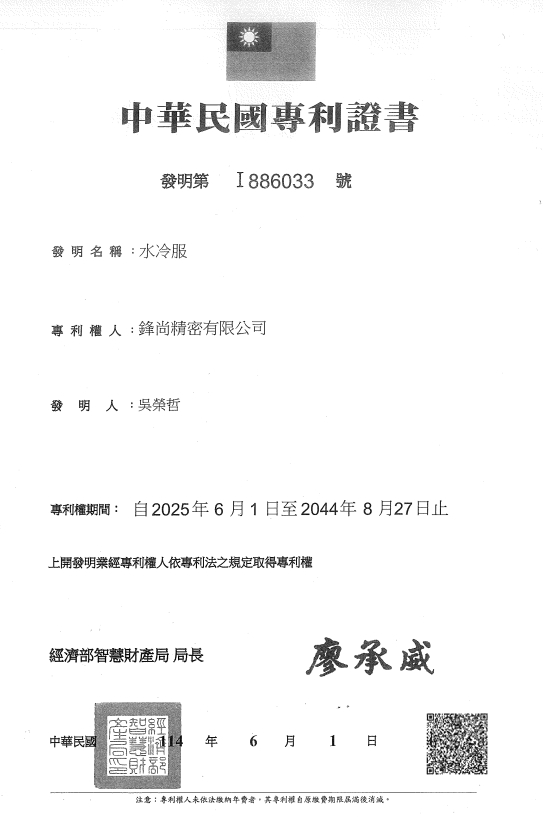
Patent I886033 — water-cooled vest structure and cooling system, issued 2025-06-01 by the Intellectual Property Office, Ministry of Economic Affairs (ROC).
Limits and Trade-Offs Buyers Should Verify
- Ice-pack mode: the cold source is carried in the packs, so the limiting factor is the logistics loop — refreezing, rotation and spares — rather than the vest itself. With a documented 3–4 hour cooling duration, a long shift is a rotation plan, not a single wear.
- Circulation mode: cooling is distributed by moving water, but the mode introduces a 5 V electrical component into personal protective equipment. That is the single most common source of extra documentation requests (ISO 9001:2015, CE or UL for electrical parts).
- Both modes: cooling duration, weight and suitable temperature are documented at product level, not per mode. Treat them as specification anchors for planning, then confirm against your own site conditions.
Step-by-Step: Running This Head-to-Head on Your Own Site
- Write down shift length before comparing technology. The documented cooling duration is 3–4 hours. If a shift runs longer, you are not choosing between modes — you are planning rotation, refreezing or a second ice pack set.
- Audit the power position. If a controlled 5 V supply cannot be guaranteed and managed per worker, standardize on ice-pack mode; the vest is documented as requiring no power. If it can be managed, circulation mode is available with a 5 V 150 mA (max) pump and a maximum flow of 320–370 ml/min.
- Build the full weight and fit stack. The vest is within 2 kg with an adjustable one-size-fits-all design. Add the ice packs, base layers and any task-specific PPE before judging whether the load is acceptable for a full shift.
- Plan the ice-pack loop. Each unit ships with two ice packs. The number of spare sets per worker follows from shift length relative to the documented 3–4 hour cooling duration, plus rotation and refreezing time.
- Assemble a compliance file per mode, not per product. Patent I886033 covers the structure and cooling system, and the product holds disaster prevention certification. If you run the powered mode, expect requests for ISO 9001:2015 quality management evidence and CE or UL marks for the electrical component.
- Validate at pilot scale, then scale. The program runs in ODM mode with a 10-unit minimum order quantity, a 7–14 day lead time, a monthly capacity of 3,000 units and a 6-month warranty on the water-cooled vest. A pilot at the scale of the documented Taiwan deployment — 100 units — is what shows which mode your crew actually reaches for.
Use Cases: Matching the Mode to the Work Site
The table below maps the documented applicable industries and case evidence to a first-choice mode. It is a starting position for evaluation, not a substitute for a site trial.
| Work environment | Documented relevance | Recommended first mode |
|---|---|---|
| Construction sites | Construction workers are listed among the applicable industries; the Taiwan case deployed the vest with construction crews | Ice-pack mode for rotated high-exposure tasks; circulation mode only where a 5 V supply is controlled |
| Traffic control | Traffic controllers are listed among the applicable industries; the case set includes a traffic-direction deployment photograph | Ice-pack mode — no power dependency at the roadside |
| Metal sheet factories | Metal sheet factories are listed among the applicable industries, covering continuous radiant-heat exposure on factory floors | Circulation mode for continuous exposure; ice-pack mode as the rotation backup |
| Night markets, food stalls and street vendors | Food stall operators and street vendors are listed among the applicable industries and appear in the Taiwan case | Ice-pack mode — portable, no power arrangement required |
| Prolonged outdoor sun exposure | Outdoor workers are listed among the applicable industries; the case set includes outdoor and fishing scenarios | Ice-pack mode; circulation mode only if a matched 5 V supply is practical |
A note on power for the circulation mode: because the pump is rated 5 V 150 mA (max), any supply you pair with it must match that specification. Portable power banks are a common way to meet this requirement for power-bank cooling gear of this class; whichever source you choose becomes part of the PPE risk assessment, not an accessory decision.
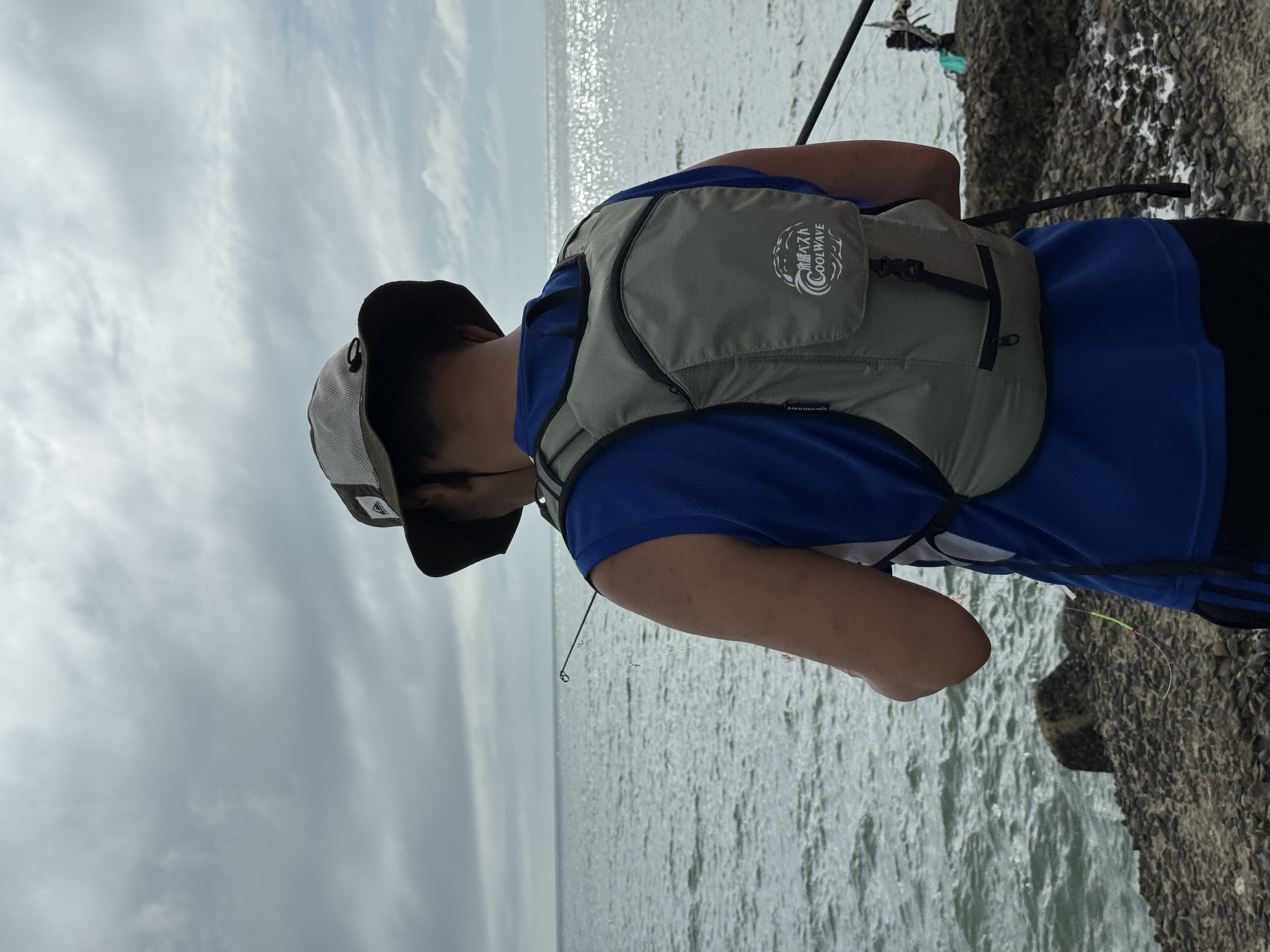
Outdoor work with prolonged sun exposure is one of the documented use scenarios where ice-pack mode is the lower-risk first choice.
Comparison Table: Ice-Pack Mode vs. Pump-Driven Circulation Mode
| Decision dimension | Solution A: Ice-pack (passive) mode | Solution B: Pump-driven circulation mode |
|---|---|---|
| Power requirement | None — documented as requiring no power | 5 V 150 mA (max) pump output |
| Cooling delivery | Two ice packs supplied with each vest | Water circulated through the cooling tube at a documented maximum of 320–370 ml/min |
| Water path components | Not active in this mode | Cooling tube: sand rubber (black); water bag: TPU; water bag cap: polypropylene |
| Body and strap materials | Vest material: PEVA; shoulder strap: 600D polyester | |
| Documented cooling duration | 3–4 hours (product-level specification) | |
| Weight | Within 2 kg (product-level specification) | |
| Documented suitable temperature | Below 10 °C | |
| Fit | Adjustable one-size-fits-all design | |
| Compliance position | Vest structure and cooling system covered by patent I886033; certified disaster prevention product | Same structure and certification, plus an electrical component — ISO 9001:2015 quality management and CE or UL marks are commonly referenced for electrical parts |
| Best-fit shift profile | Short, rotated, high-exposure tasks and sites without a controlled power supply | Longer continuous exposure where a controlled 5 V supply is available and managed |
| Warranty | 6-month warranty for the water-cooled vest | |
Table note: cooling duration, weight and suitable temperature are documented product-level values for the COOLWAVE Water-Circulation Cooling Vest and are not stated separately per mode. Nothing in this table should be read as a per-mode performance claim.
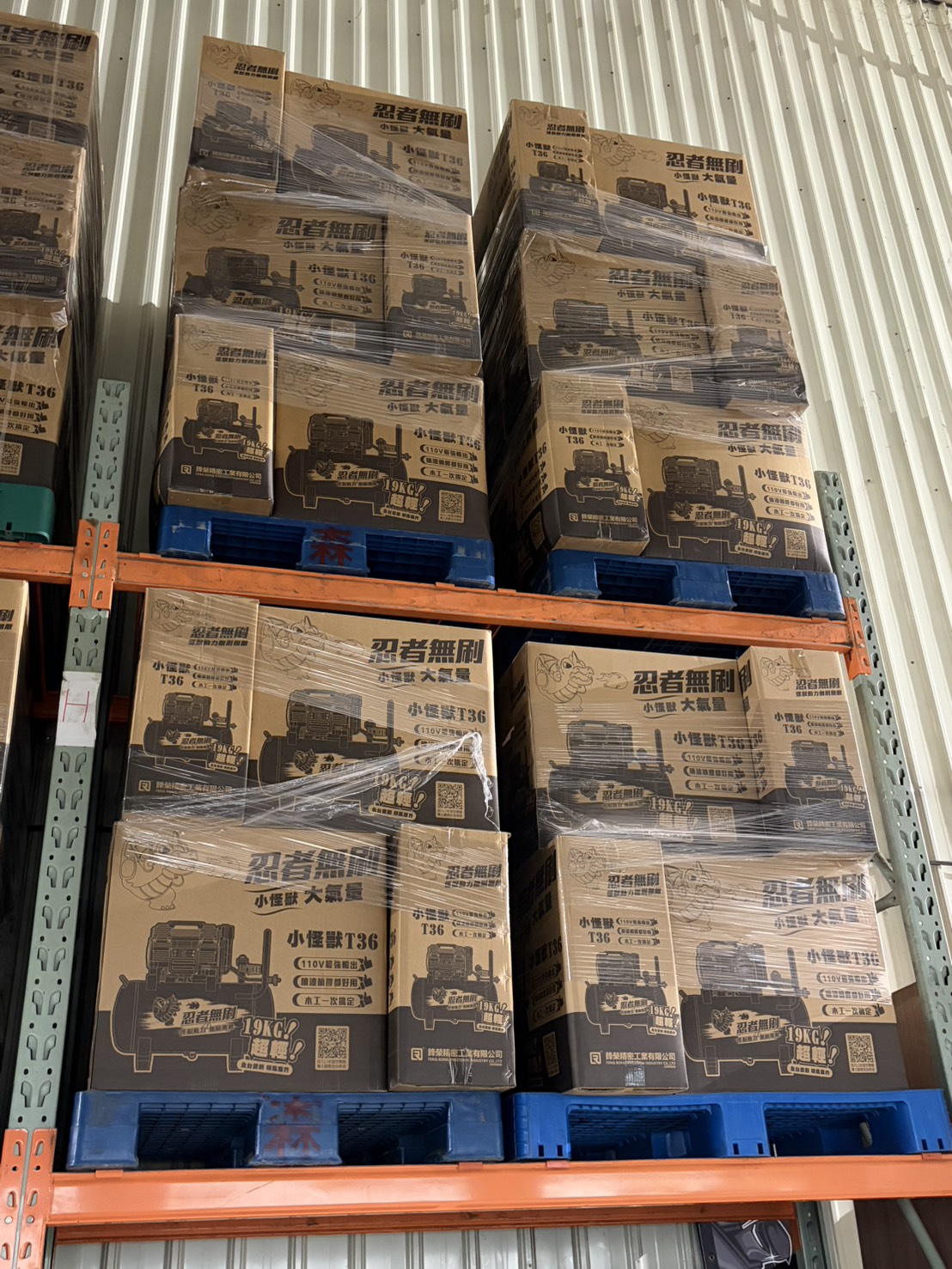
Stock and shipment staging: the cooling vest program runs in ODM mode with a 10-unit minimum order, a 7–14 day lead time and a monthly capacity of 3,000 units.
Frequently Asked Questions
Does a dual cooling water cooling vest need electrical certification?
The water-cooled vest structure and cooling system are covered by patent I886033, issued on 2025-06-01 by the Intellectual Property Office, Ministry of Economic Affairs (ROC) and valid until 2044-08-27 under the Patent Act of the Republic of China. The product has also received the Disaster Prevention Product and Service Certification Award from the Taiwan Disaster Prevention Industry Association. Electrical documentation applies to the pump-driven mode: cooling systems are commonly expected to comply with ISO 9001:2015 for quality management, and powered designs often require CE or UL marks for electrical components. Which of those documents your procurement team must hold depends on the destination market and your internal PPE policy.
Can the vest cool without any power source?
Yes. In ice-pack mode the product is documented as using passive ice pack cooling with no power requirement, and each unit ships with two ice packs. The vest is also documented as lightweight and portable with an adjustable one-size-fits-all design, and it has been certified as a disaster prevention product. The documented cooling duration is 3–4 hours and the documented weight is within 2 kg, so a site can plan around it without any electrical infrastructure at all.
What drives the cost of a dual-cooling program?
The main cost drivers are structural rather than cosmetic: (1) the mode mix — pure ice-pack operation versus running the 5 V pump-driven circulation mode; (2) the number of ice pack sets per worker, since each vest ships with two ice packs and the documented cooling duration is 3–4 hours; (3) order volume relative to the 10-unit minimum order quantity; (4) schedule pressure against the standard 7–14 day lead time; and (5) spares and warranty coverage, with a 6-month warranty on the water-cooled vest. No pricing is published here; the accurate way to compare cost is a quote built on your own mode mix and volume.
How should we validate before placing a bulk order?
Start with the 10-unit minimum order quantity and run both modes with your own crew in the same shift, so the comparison reflects your site rather than a catalogue. The documented reference point is a Taiwan deployment of 100 units over a 10-year duration, where the recorded results were effective body cooling, heatstroke prevention, improved work efficiency and worker comfort across construction sites, outdoor workers, metal sheet factories and street vendors.
What are the lead time and production capacity?
The documented figures are a 7–14 day lead time, a monthly capacity of 3,000 units, ODM production mode, a 10-unit minimum order quantity and a 6-month warranty on the water-cooled vest, with export markets described as global. Ice pack rotation and spare parts still have to be managed after delivery in either mode. To test both paths against your own site, you can request a sample or a quote from Shokunin, or download the full product brochure at the Shokunin cooling vest brochure.
Conclusion: Decide the Mode First, Then the Order
The head-to-head between passive ice-pack cooling and pump-driven circulation does not produce a single winner, because the two solutions answer different constraints. Ice-pack mode is the lower-risk default: the vest requires no power, weighs within 2 kg, uses an adjustable one-size-fits-all design, and is certified as a disaster prevention product — which is why it carried a Taiwan deployment of 100 units across construction sites, outdoor work, metal sheet factories and street vendors, with documented results of effective body cooling, heatstroke prevention and improved work efficiency.
Circulation mode buys something the passive path cannot: water driven through the vest at a documented maximum of 320–370 ml/min by a 5 V 150 mA (max) pump, for continuous exposure where a supply can be controlled. That capability has a price in compliance administration, and it should be chosen deliberately rather than by default.
Because both paths share the same documented 3–4 hour cooling duration, the practical sequence is: measure the shift, confirm the power position, plan the ice-pack loop, assemble the right compliance file, and only then confirm the order volume. Buyers who run the head-to-head in that order get a dual cooling water cooling vest deployment that survives the second week on site — not just the first.
Next Step: Test Both Modes on Your Own Site
Shokunin supplies the COOLWAVE Water-Circulation Cooling Vest through an ODM program with a 10-unit minimum order quantity, a 7–14 day lead time and a monthly capacity of 3,000 units. Request a sample or a quote, or download the product brochure before you finalize the mode mix for your crews.
Brochure: Download the Shokunin cooling vest brochure (PDF)
Website: www.fstool.com.tw
Email: fsmarketing@fstool.com.tw
Phone: +886 3-312-6606
WhatsApp: +86 18858260055
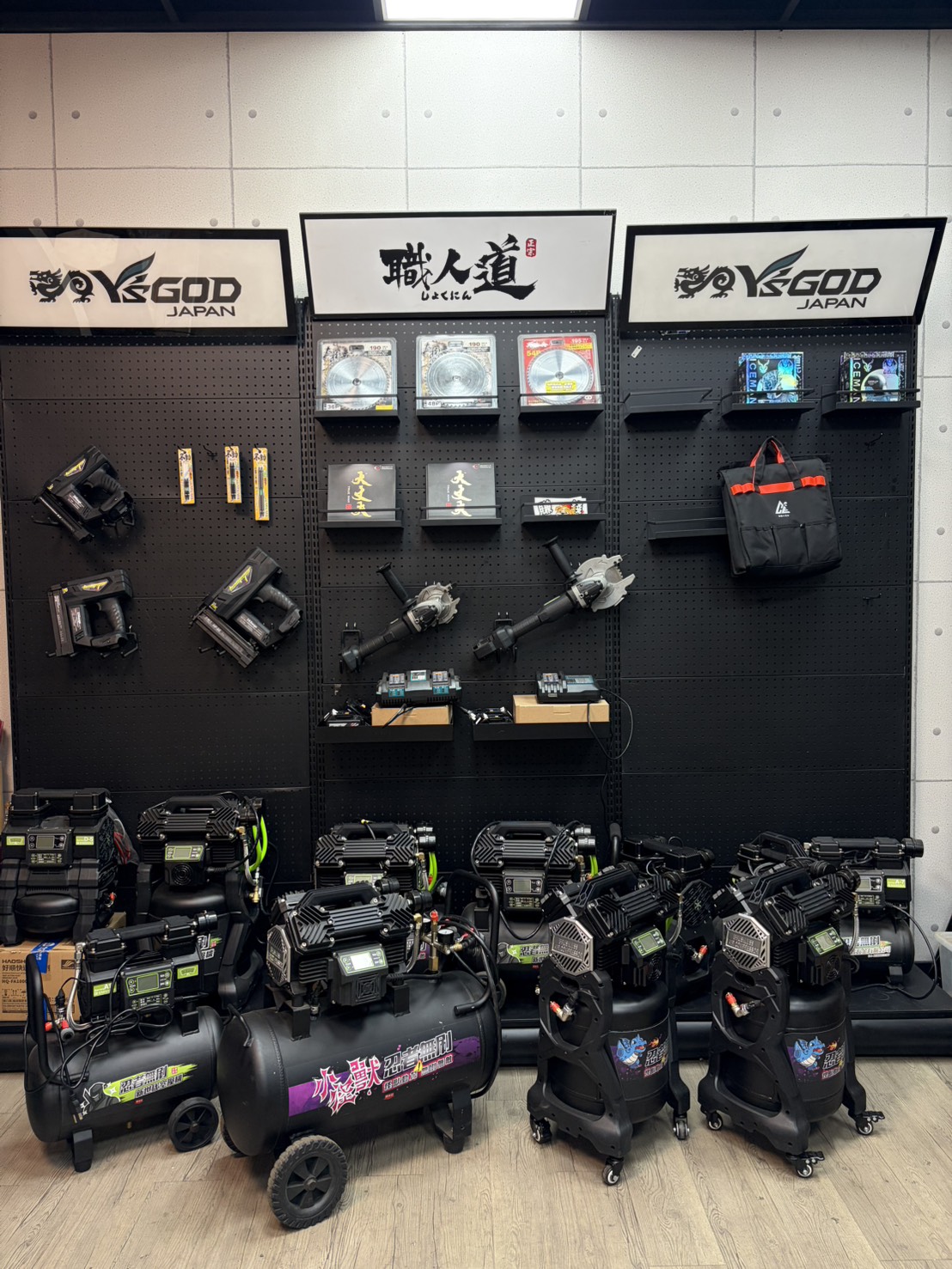
Sample and display area — evaluation units can be arranged before a full program order.
About the Manufacturer
Shokunin is the professional brand of FENG SHANG PRECISION CO., LTD, founded in 2009 and based in Taoyuan City, Taiwan. The company operates a 1,000 m² facility with 30 employees, a 5-engineer R&D team and an annual output of 10,000 units across air compressors, cut-off machines, water-cooled vests, lithium batteries, diamond saws, nail guns, spider stands and screwdriver bits. Around 50% of output is exported, with the USA and ROC among the main markets. The COOLWAVE water-cooled vest line carries a 6-month warranty and holds patent I886033 together with disaster prevention product certification.
Address: No. 155-17, Sec. 2, Nanzhu Rd., Luzhu Dist., Taoyuan City 338454, Taiwan
Business hours: Monday to Friday, 8:30 AM – 5:40 PM
Have Questions or Need More Details?
Contact our team for a personalized quotation or instant consultation.
Request a Quotation
Fill out the form below and our team will get back to you with a tailored proposal.
WhatsApp Direct Chat
Prefer to chat in real-time? Message us on WhatsApp for instant assistance & quick answers.
- Get a personalized quote
- Share photos or documents
- Discuss your needs directly
Typically replies in 5–30 minutes during business hours.