
Long-Term Dual Cooling Vest Partnership: MOQ, Warranty, ODM
Repeat orders turn a cooling-vest purchase into a supply relationship, and the terms that matter are rarely the ones that decided the first purchase. The COOLWAVE Water-Circulation Cooling Vest, produced by FENG SHANG PRECISION CO., LTD and sold under the Shokunin brand, is documented with five partnership terms: a 6-month manufacturer warranty, a 10-unit minimum order quantity, a 7–14 day typical lead time, a stated monthly capacity of 3,000 units, and ODM as the production mode.
This article is written for procurement managers, safety and operations leads, and brand owners who have finished product selection and are deciding whether to standardise on one supplier across several seasons. Every figure below comes from the manufacturer's documented capability record or from the recorded Taiwan deployment. Where the record is silent — whether the warranty covers the pump, when the lead-time clock starts, how much of the 3,000 units is available in a given month — the gap is stated rather than filled.
Why the second order asks different questions
On a first order the buyer tests cooling performance, fit and crew acceptance. On a repeat order the questions shift to repeatability: whether the next batch matches the last one, what happens when a component needs service in the fourth month of a season, how much notice the factory needs before a peak month, and whether the same label and packaging arrive again. For an evaluation-stage buyer these are product attributes rather than paperwork, because they decide how many units can be in service on the hottest week of the year.
The category context supports that shift. Third-party research cited in the supplied data puts the global cooling-vest market at USD 342 million in 2025, with industrial applications accounting for 34.5% of revenue, and NIOSH lists water-cooled garments among the personal cooling systems used against heat exposure. Program-level terms such as MOQ, lead time and monthly capacity therefore sit inside the industrial product decision, not beside it.
The documented partnership terms at a glance
The table restates the manufacturer's documented terms and what each one changes once orders repeat.
| Term | Documented value | What it changes for a repeat buyer |
|---|---|---|
| Warranty | 6 months, water-cooled vest | Sets the window for service claims and the date by which a component check should be booked |
| Minimum order quantity | 10 units | Smallest order that can start a program, and the practical pilot size |
| Lead time | 7–14 days, typical | Determines when a reorder must be released, before transit is added |
| Monthly capacity | 3,000 units | The ceiling against which peak-month volume is checked |
| Production mode | ODM | Production under a partner brand; the scope has to be written down |
| Export markets | Global | The record does not restrict these terms to a single region |
All values are as stated in the manufacturer's capability record. No figure here is a calculated estimate, and none is presented as a measured production result.
Warranty: the six months need a start date and a parts list
The documented after-sales term is a 6-month manufacturer warranty for the water-cooled vest. Three details decide how much that term is worth inside a program: when the six months start, which components sit inside it, and how a claim is handled. The supplied record gives the duration only, so the other three belong in the written agreement.
The powered element in the system is the pump, published by the manufacturer at 5V and 150 mA (max) with a flow rate of 320–370 ml/min. The record does not state whether the pump, the water bag, the tubing and connectors, or the ice packs fall inside the same six-month term. Request the covered-parts list instead of assuming the vest is covered as a single unit.
For a seasonal program, six months typically spans most of one deployment season. A practical routine is to book a component check at month four or five, so any claim is raised while the window is open, and to decide in advance what happens in month seven: replacement units, held spares, or treating service as a new-order cost. The record states no spares policy, which makes this a negotiation item rather than an assumption.
MOQ 10: a floor small enough to pilot
The minimum order quantity is 10 units. For a long-term program that number works in both directions: it is small enough to place a pilot with one or two crews before a larger commitment, and large enough to test fit, adjustment and a full shift of use across more than one wearer.
The sizing question is not 10 versus 100 but how many units cover one rotation. A crew running two shifts can cover both with a 10-unit pilot and a small spare margin. The record does not describe a separate sample programme, so the 10-unit order is also the practical route to an evaluation batch — and the point at which labelling, packaging and documentation requirements should be fixed, since those are the details that can differ between a pilot and a program order.
Lead time 7–14 days: fix the trigger before you rely on it
The typical lead time is 7–14 days. The record states the range without defining what starts it — purchase order, deposit or artwork approval — and without saying whether the 14-day end reflects order size or queue position in a busy month. Both points should be written into the agreement, because they decide when a purchase order has to be released.
A reorder rule that uses the figure without over-reading it: reorder point = daily consumption × (14-day upper lead time + your transit time + safety days). The manufacturer's range covers production, not freight or customs clearance, so transit has to come from your own logistics data.
3,000 units per month: keep the scope attached
The stated monthly capacity is 3,000 units. The company background record separately lists annual output of 10,000 units across a wider tool range that includes air compressors, cut-off machines, saws and other products, produced by 30 employees in a 1,000 m² facility. Those figures describe different scopes — one product line per month versus company-wide output per year — and dividing one by the other does not produce a meaningful utilisation number.
Two questions make the capacity figure usable: how much of the 3,000 units is open in your target month, and whether the number describes installed capacity or capacity currently available for new orders. Neither definition appears in the record. For a seasonal order the practical step is to raise the enquiry early enough that the answer arrives before your own procurement deadline, rather than after the budget is committed.
ODM: confirm the scope, not just the label
ODM is the documented production mode, and export markets are listed as global, with the company recording a 50% export ratio and the USA and Taiwan as main markets. What ODM does not automatically include is design change: the capability record lists no customization service, so a request for a different reservoir, harness or colourway is a feasibility question to put to the manufacturer, not a standard option to assume.
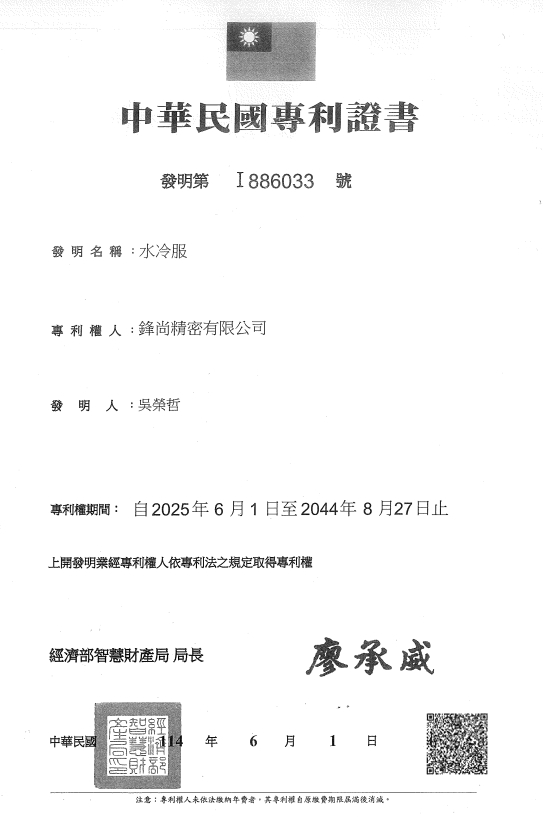
Branding is the part repeat programs actually need. Labelling, packaging, manual language and model naming should be settled at the pilot stage so the second order matches the first. The structure and cooling system are covered by a ROC patent, certificate I886033, issued on 1 June 2025 by the Intellectual Property Office, Ministry of Economic Affairs under the Patent Act of the Republic of China, with a recorded expiry of 27 August 2044. The patent documents technical provenance; it is not a grant of market exclusivity, so any exclusivity a distributor needs must be negotiated as a separate term.
From pilot order to multi-season program: six steps
- Count the real requirement from the hottest week and the number of crews and shifts, not from an annual average.
- Run the 10-unit pilot across the shifts you actually staff, and record fit, adjustment and crew feedback.
- Write the warranty terms: start date, covered components, claim route and expected response.
- Freeze the specification — model, colour, labelling, packaging, documentation language — and attach it to the agreement.
- Schedule purchase orders against the 7–14 day lead time, and confirm peak-month volume against the 3,000-unit monthly capacity figure.
- Review after season one: which components needed service, how the vests were stored and cleaned, and what the next order quantity should be.
What the 100-unit Taiwan deployment records
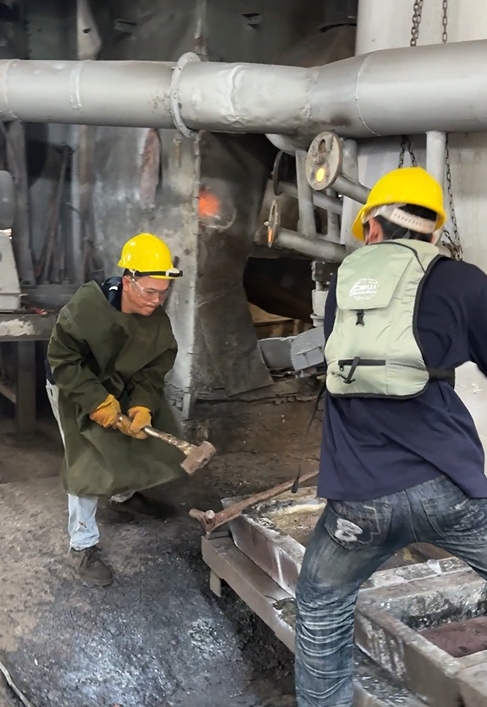
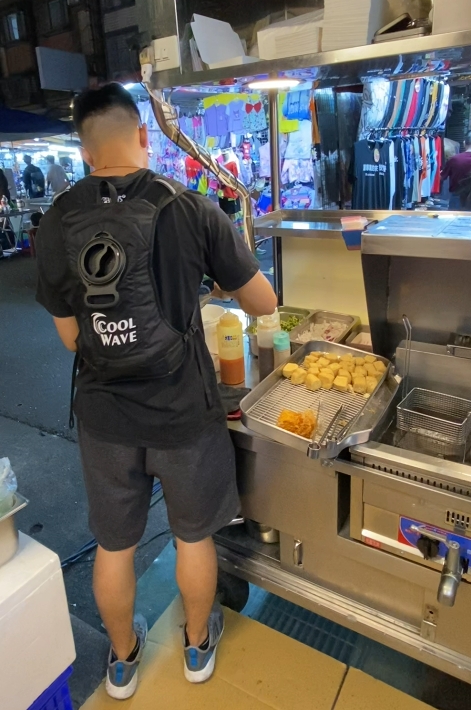
A recorded case in Taiwan deployed 100 units for work in high-temperature environments, covering construction sites, outdoor work, metal sheet factories and street vendors. The recorded outcomes are effective body cooling, heatstroke prevention, improved work efficiency and better worker comfort. The record lists a duration of 10 years and describes the deployed configuration with passive ice-pack cooling, no power requirement, lightweight portability and an adjustable one-size-fits-all design, alongside the product's disaster prevention certification.
Read it as deployment evidence rather than as a controlled trial. The case reports outcomes, not measured body-temperature reduction, and it does not state ambient conditions, workload or maintenance across the period. Its value for a partnership decision is narrower and still useful: the product has been used at site scale in hot, dusty environments of the kind repeat buyers operate in. It does not guarantee the same result on your site.
Partnership readiness checklist
Commercial terms
- Warranty in writing: start date, covered components, claim route and expected response.
- MOQ confirmed at 10 units, with pricing quoted separately for pilot and program volumes.
- Lead time defined from a named trigger, plus your own transit time and safety stock.
- Peak-month volume checked against the 3,000-unit monthly capacity figure.
Technical and product
- Written specification covering model, colour, labelling, packaging and manual language.
- Pump specification confirmed for power-bank compatibility (published at 5V, 150 mA max).
- Spare-parts route for pumps and other serviceable components agreed before the first season ends.
Brand and documentation
- Patent status noted for your market, with any exclusivity discussed separately.
- Documentation pack agreed: product data sheet, certification record and brochure.
FAQ: long-term partnership questions
Is the COOLWAVE water-circulation cooling vest certified for heat-exposure programs?
The vest is recorded with the Disaster Prevention Product and Service Certification Award from the Taiwan Disaster Prevention Industry Association, and its structure and cooling system are covered by ROC patent certificate I886033. The supplied records do not establish CE, UKCA, ANSI or EN conformity and do not include a product-specific electrical-safety certificate, so destination-market requirements should be confirmed before a program order rather than inferred from the Taiwan certification.
What production capacity can a long-term partner plan against?
The documented figure is 3,000 units per month for the cooling-vest line, alongside a company-wide annual output record of 10,000 units across a wider tool range. The two figures use different scopes, so capacity should be confirmed for your specific order month and quantity instead of being calculated from either number.
Does the manufacturer support ODM production?
ODM is the documented production mode, with export markets listed as global. The capability record does not list a customization service, so design changes should be raised as a feasibility question, while labelling, packaging and documentation requirements are best fixed in writing at the pilot stage.
Is pricing published, and what is the smallest order?
No price, Incoterm, tooling charge or payment term appears in the supplied records; commercial terms come from a quotation. The documented commercial anchor is the 10-unit minimum order quantity, which is also the practical size of an evaluation order.
Can we test the vest before committing to a program?
The record does not describe a separate sample programme. The 10-unit minimum order is the documented route to an evaluation batch, and it is large enough to cover a small crew or two shifts during a trial.
How quickly can a repeat order be delivered?
The typical lead time is 7–14 days. The record does not state whether the clock starts at purchase order, deposit or artwork approval, or how the range behaves in peak months, so both points should be fixed in the agreement and combined with your own transit time when setting the reorder point.
What does the warranty cover, and what happens after six months?
The documented after-sales term is a 6-month manufacturer warranty for the water-cooled vest. The record states the duration but not the covered components or the claim turnaround, so the covered-parts list and claim route should be agreed in writing, and a plan for service after month six — spares, replacement units or new orders — should form part of the partnership terms. Program enquiries can begin with the downloadable brochure or the contact details on the official website.
Conclusion
Long-term cooling-vest supply is decided by four numbers and one word: 6 months of warranty, 10 units of MOQ, 7–14 days of lead time, 3,000 units per month of capacity, and ODM as the production mode. Each is a starting point for the agreement rather than a complete term. The duration needs a start date and a covered-parts list, the MOQ needs pricing for both pilot and program volumes, the lead time needs a defined trigger, and the capacity needs a month attached to it. Buyers who settle those details at the pilot stage are the ones whose third order looks like their first.
Planning a repeat order? The Shokunin product brochure can be downloaded here: COOLWAVE product brochure (PDF). Program enquiries: fsmarketing@fstool.com.tw, +886 3-312-6606, Monday to Friday 8:30 AM – 5:40 PM, or through the official website fstool.com.tw.

Have Questions or Need More Details?
Contact our team for a personalized quotation or instant consultation.
Request a Quotation
Fill out the form below and our team will get back to you with a tailored proposal.
WhatsApp Direct Chat
Prefer to chat in real-time? Message us on WhatsApp for instant assistance & quick answers.
- Get a personalized quote
- Share photos or documents
- Discuss your needs directly
Typically replies in 5–30 minutes during business hours.