
Partnering With a Construction Cooling Vest Supplier: Maintenance, Warranty, and Long-Term Support FAQ
The first purchase of a construction cooling vest is a transaction. Everything after it is a partnership — and that partnership is decided by three questions buyers usually ask far too late: how do we maintain the units, what does the warranty actually cover, and how fast can the supplier reorder before a heat wave empties our reserve?
This guide answers those questions for procurement managers, HSE leads, distributors, and site owners who are evaluating Shokunin as an ongoing PPE partner rather than a one-off vendor. Every specification, capacity figure, and service term below comes from the manufacturer's own product, certification, capability, and field-use documentation for the COOLWAVE water-circulation cooling vest. Nothing here is estimated.
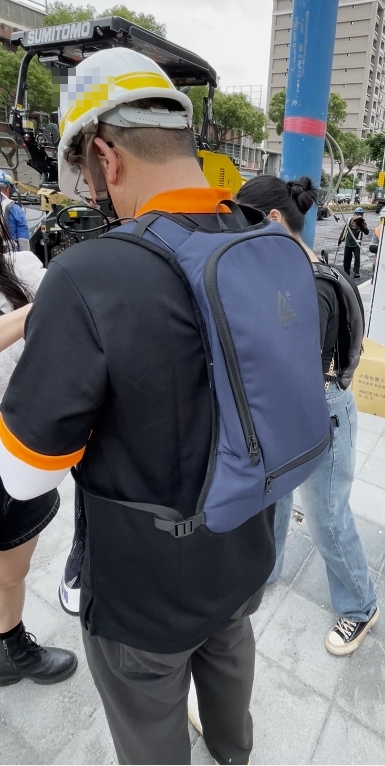
COOLWAVE water-circulation cooling vests in construction site use — the deployment a long-term support agreement has to keep running.
Why After-Sales Support Decides a Construction Cooling Vest Partnership
After-sales support in this category has a specific meaning: the supplier's ability to keep a delivered cooling system usable — through maintenance guidance, a defined warranty term, and a predictable reorder channel — across the full service life of the garments. It is not a call centre. It is an operational capability that a buyer can test before the order is signed.
Three failure modes appear again and again once a cooling program moves past the pilot stage, and none of them is visible on a quotation sheet:
- Maintenance drift. A water-circulation vest holds water, moves it through tubing, and sits against a sweating body for hours. If nobody owns the rinse-and-dry routine, the first failures get blamed on the product rather than on the process.
- Warranty ambiguity. A six-month term means little if neither side has agreed when it starts, which parts are treated as wear items, or who files a claim.
- Reorder delay. Cooling demand arrives in a block — the hottest weeks — not as a steady monthly line. A supplier with a long lead time, or a capacity ceiling nobody examined in advance, leaves sites unserved exactly when the risk is highest.
Buyers who answer these three questions during the evaluation stage are not being overly cautious. They are the ones who avoid re-tendering the category every summer.
Industry Background: Heat Programs Are Moving From Single Purchases to Managed Deployments
Heat stress is a recognized workplace hazard with a regulatory dimension. OSHA's General Duty Clause, Section 5(a)(1) of the OSH Act, requires employers to provide a workplace free from recognized hazards, which includes heat stress in high-temperature construction sites (source: OSHA). That is a program obligation, not a purchasing obligation — and programs need suppliers who stay engaged after delivery.
The commercial backdrop points the same way. Heat stress prevention products reached a global market value of USD 2.86 billion in 2025, with cooling wearables as a primary growth driver (source: The Business Research Company). Industrial applications were the largest segment of the cooling vest market in 2025 at a 34.5% revenue share, and Asia-Pacific accounted for 38.2% of that market (source: Dataintelo). For buyers working with a Taiwanese manufacturer, the regional supply base is not a compromise — a large share of global demand is already being served from it.
One compliance note belongs in every cooling vest evaluation: high-visibility garments worn on construction sites are governed by their own standard, ANSI/ISEA 107-2020, which covers reflective material and contrast fabric. A cooling vest is assessed on cooling performance, materials, and support — not on that standard. Keep the two requirements separate so that neither is assumed.
How Shokunin Structures Maintenance, Warranty, and Long-Term Support
Shokunin is the professional tool brand of Feng Shang Precision Co., Ltd., a Taiwan-based manufacturer founded in 2009 in Luzhu District, Taoyuan City, that produces air compressors, cut-off machines, the COOLWAVE water-circulation cooling vest, and other tools for professional trades. The company reports a 1,000 m² factory, 30 employees, five R&D engineers, and annual output of 10,000 units, with an export ratio of 50% and the United States and Taiwan (ROC) as main markets.
Those numbers are not decoration in a partnership conversation. A manufacturer at this scale can answer a specific maintenance question, hold a reorder slot, and still be accountable by name — which is the practical difference between a supplier and a listing on a sourcing platform.
The COOLWAVE vest, component by component
The COOLWAVE Water-Circulation Cooling Vest (Basic Model) is an industrial cooling garment classified as personal protective equipment. Its listed performance specs are a cooling duration of 3–4 hours, a weight within 2 kg, a pump output of 5V 150 mA (max), and a flow rate of max 320–370 ml/min. Each unit ships as a water-cooled vest backpack with two ice packs. Maintenance planning starts from the component list:
- Water bag (TPU) — holds the cooling water. TPU tolerates repeated flexing; it does not tolerate punctures, solvents, or being stored with water left inside.
- Water bag cap (polypropylene) — the sealing point of the loop, and the part most often damaged by over-tightening.
- Cooling tube (sand rubber, black) — carries water to the body contact area and suffers first when a vest is folded flat for storage.
- Shoulder strap (600D polyester) — 600D denotes a heavy-denier woven polyester selected for abrasion resistance; it takes the most contact with site clothing, dust, and sweat.
- Body material (PEVA) — the vest shell, cleaned by wiping rather than machine washing.
- Ice packs (two supplied) — the consumable part of the system, and the reason a two-pack rotation matters.
A maintenance routine that fits a construction shift pattern
Maintenance for a water-circulation vest is simple, but it has to be scheduled rather than improvised, because the wear pattern is driven by the materials above.
End of each shift: empty the water bag, rinse it with clean water, drain it fully, and leave the polypropylene cap off to air-dry so that no residual water sits in the folds of the TPU film. Wipe the 600D polyester strap and the PEVA shell. Return the ice packs to the freezer so a frozen pair is always available for the next shift.
Weekly: inspect the cap threads for grit and hairline cracks; run water through the sand rubber tubing and check for kinks, flattening, or abrasion where the tube bends against the body; and confirm that visible flow has not dropped noticeably against the 320–370 ml/min flow-rate specification.
Before seasonal storage: store the vest dry, with the tubing straight rather than sharply folded, away from direct sunlight and away from sharp tools.
This routine is derived from the listed component materials and is intended as a starting point. Confirm the final version with the supplier when you place the order so that it matches your site conditions and crew rotation.
What the 6-month warranty covers — and what to confirm in writing
The manufacturer's stated after-sales term for the water-cooled vest is a 6-month warranty. Six months covers the first cooling season in most construction markets, which is exactly why the boundary of that term matters more than its length.
Four items belong in writing before the order is confirmed: the warranty start date (delivery date or invoice date); which components are treated as the covered assembly — water bag, pump, tubing, strap, shell — and which are treated as wear items such as the ice packs; the channel and expected response time for reporting a claim; and how a claim is settled, whether by repair, replacement part, or replacement unit.
None of this is a criticism of any manufacturer. It is simply the difference between a warranty clause on a quotation and a warranty that works in July.
Reorder readiness: MOQ, lead time, and monthly capacity
Three figures decide how a partnership behaves after the first delivery. The minimum order quantity is 10 units. Lead time is 7–14 days. Monthly production capacity is 3,000 units, inside a total annual output of 10,000 units.
Read together, they describe a workable replenishment model. A single-site deployment of 100 units — the scale of the manufacturer's Taiwanese field deployment — fits inside one month of capacity with room to spare. A program needing more than 3,000 units in a single month has to be phased across order cycles. And because lead time runs 7–14 days, the reorder trigger should be tied to reserve level, not to the day a vest fails.
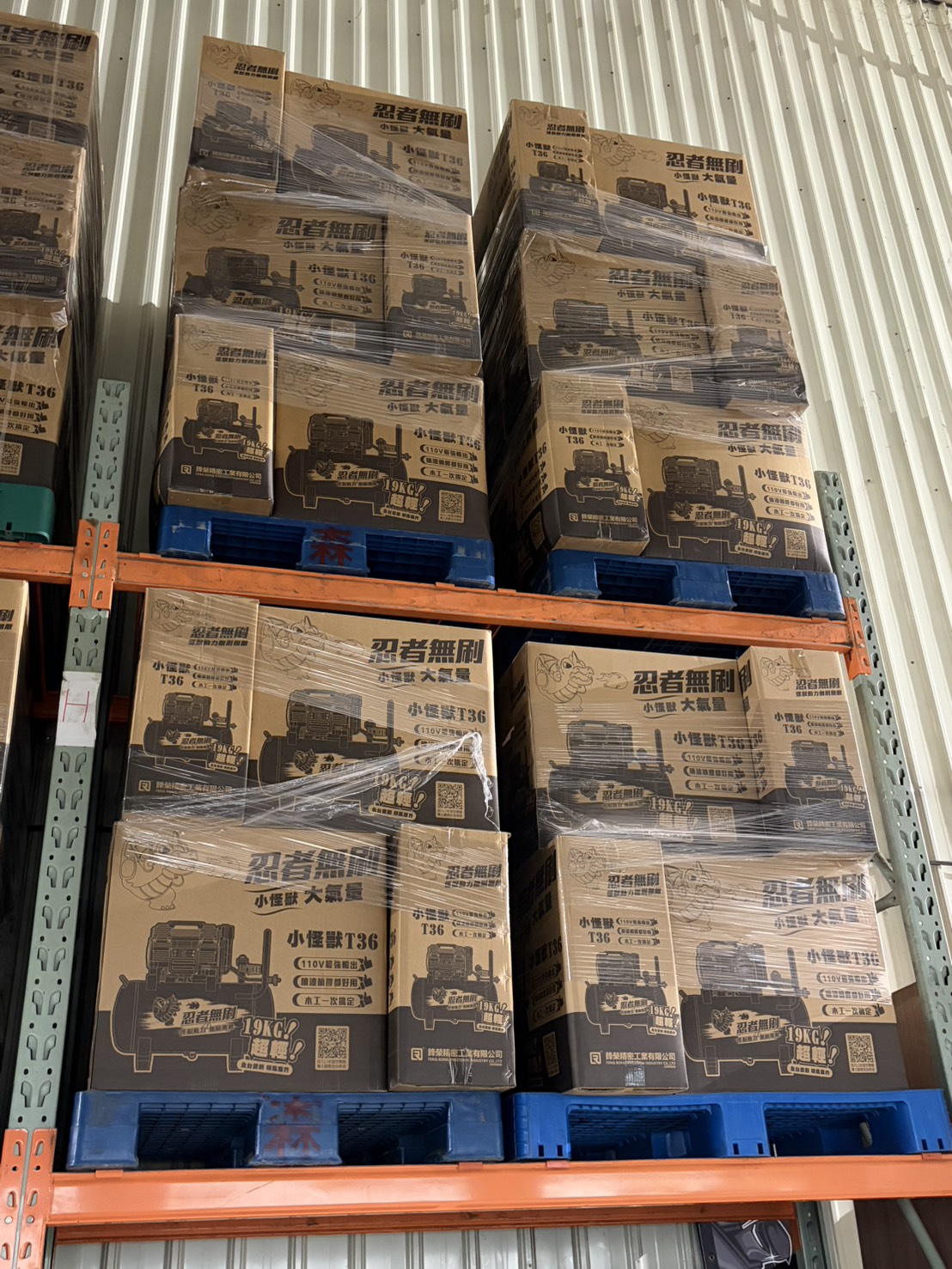
Warehouse stock behind repeat-order readiness: monthly capacity of 3,000 units and a 7–14 day lead time.
The evidence behind the support claims
Support claims are worth exactly what stands behind them. Four items stand behind these:
- Patent I886033 — granted by the Intellectual Property Office, Ministry of Economic Affairs (ROC) for the water-cooled vest structure and cooling system, issued 1 June 2025 and valid until 27 August 2044 under the Patent Act of the Republic of China.
- Disaster Prevention Product and Service Certification Award — issued to Feng Shang Precision Co., Ltd. by the Taiwan Disaster Prevention Industry Association.
- A 10-year field-use record — the manufacturer's Taiwanese reference case spans construction sites, outdoor work, metal sheet factories, and street vendors, with documented results of effective body cooling, heatstroke prevention, and improved worker comfort and work efficiency.
- A 100-unit multi-site deployment — the same case documents 100 units in continuous cooling use in high-temperature environments.
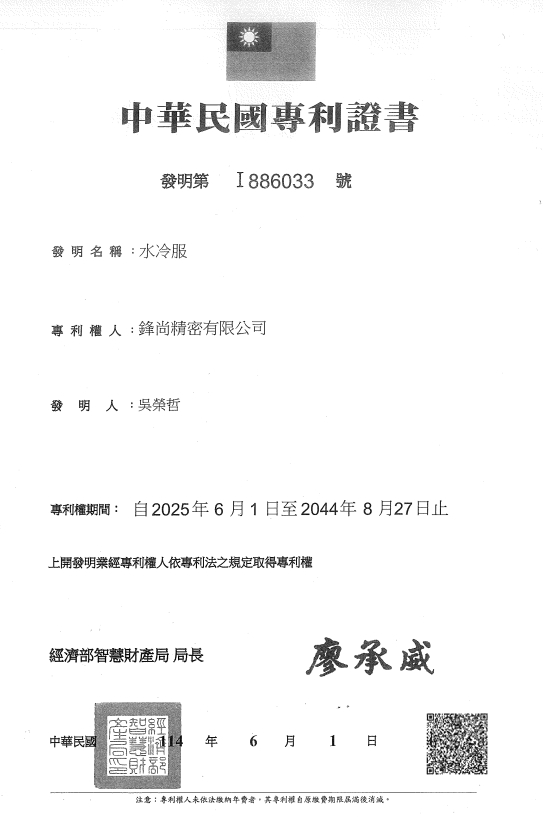
Patent I886033 covers the water-cooled vest structure and cooling system (ROC, valid to 27 August 2044).
Step-by-Step: Building a Long-Term Support Plan Around a Cooling Vest Supplier
Evaluation ends when the plan is written. The sequence below turns the facts above into an operational agreement.
- Baseline the specification in writing. Record cooling duration (3–4 hours), weight (within 2 kg), flow rate (max 320–370 ml/min), and materials (TPU water bag, polypropylene cap, sand rubber tubing, 600D polyester strap, PEVA body). This baseline is what every later maintenance and warranty conversation is measured against.
- Fix the warranty boundary before the first shipment. Anchor the 6-month term to a defined start date, agree which parts are wear items, and name the person inside your organisation who files a claim.
- Write maintenance into the safety induction. Daily rinse and air-dry, weekly cap and tubing inspection, dry storage with tubing straight. Assign it to a crew role rather than to “everyone”.
- Plan consumables with the order. Two ice packs ship with each unit; confirm at order stage whether additional ice packs, caps, and tubing can be included in the same shipment, so that a small part never idles a whole vest.
- Set the reorder trigger against lead time and capacity. With 7–14 days of lead time and 3,000 units of monthly capacity, replenishment should be triggered when reserves fall to a level covered by the longest expected lead time — before the peak heat weeks, not during them.
- Pilot at the minimum order quantity, then scale. The 10-unit MOQ allows a bounded trial; the 100-unit Taiwanese deployment shows the next step. Review after one cooling season, using maintenance records and warranty claims as the evidence base for the following order.
Use Cases: Where Maintenance and Support Matter Most
Support requirements change with the working environment, even when the product does not.
Construction sites, metal roofs, and long sun exposure. Oven-like metal-roof work areas and long outdoor shifts produce heavy sweating and abrasive contact. The 600D polyester strap and the PEVA shell take the wear, which is why wipe-down belongs in the daily routine — and why the 3–4 hour cooling duration has to be planned around shift length rather than treated as a full-day figure.
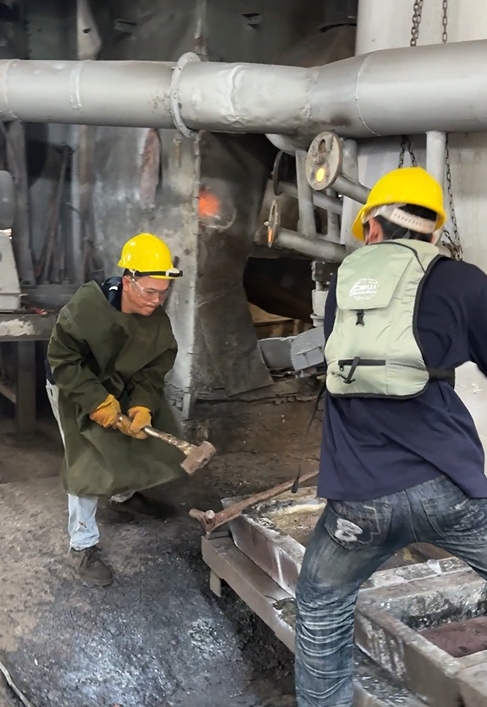
Metal sheet factory use: indoor heat plus metal dust makes weekly tubing and cap checks part of the routine.
Metal sheet factories. Indoor heat plus metal dust puts the tubing and the cap threads under more grit than an open site. Weekly flushing of the sand rubber tube and a thread check on the polypropylene cap are the two steps that protect the cooling loop here.
Traffic control and street-level outdoor work. Vests are worn in short, repeated intervals between vehicle movements. Ice-pack rotation — keeping one pair frozen while the other is in use — is the operational habit that keeps a vest in service across a full shift.
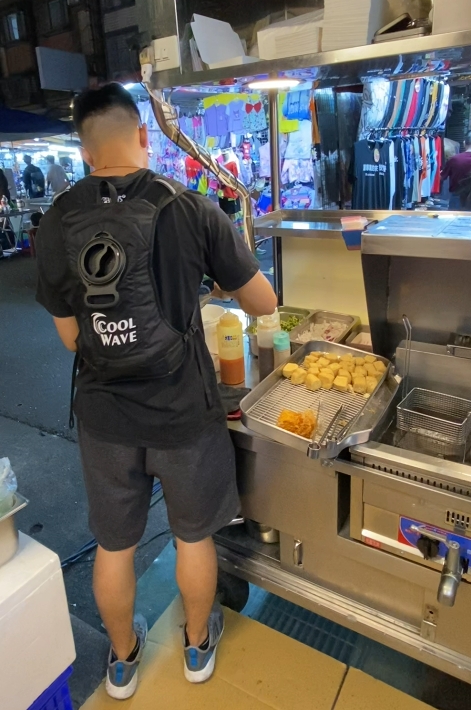
Street-level outdoor work: dry storage with tubing straight is the habit that protects performance into the next season.
Street vendors and night-market operators. Long hours in humid heat with limited space for maintenance. The dry-storage habit — empty bag, cap off, tubing straight — is the single change that most affects how a vest performs in the following season.
Comparison Table: Support Parameters Buyers Can Verify
The two tables below use only figures from the manufacturer's product, certification, and capability documentation. They are structured so a procurement team can copy them straight into a supplier scorecard.
Table A — COOLWAVE Water-Circulation Cooling Vest (Basic Model)
| Specification | Listed value |
|---|---|
| Cooling duration | 3–4 hours |
| Weight | Within 2 kg |
| Flow rate | Max 320–370 ml/min |
| Pump output | 5V 150 mA (max) |
| Water bag material | TPU |
| Water bag cap | Polypropylene |
| Cooling tube | Sand rubber (black) |
| Shoulder strap | 600D polyester |
| Body material | PEVA |
| In the box | Water-cooled vest backpack ×1, ice packs ×2 |
| Product type | Industrial cooling apparel / Personal Protective Equipment (PPE) |
| Patented structure | ROC patent I886033 — water-cooled vest structure and cooling system |
Table B — Partnership and long-term support parameters
| Parameter | Verified value | Why it matters during evaluation |
|---|---|---|
| Production mode | ODM | Buyers source a defined platform rather than a one-off build. |
| Minimum order quantity | 10 units | Allows a bounded pilot before a site-wide rollout. |
| Lead time | 7–14 days | Sets how much buffer stock a site must hold. |
| Monthly capacity | 3,000 units | Determines whether a rollout must be phased. |
| Annual output | 10,000 units | Indicates sustained production beyond a single season. |
| After-sales term | 6-month warranty for the water-cooled vest | Coverage boundary should be confirmed in writing at order stage. |
| Patent validity | Issued 1 June 2025; valid to 27 August 2044 | Verifiable structure and cooling-system protection. |
| Field record | 10 years of use; 100-unit multi-site deployment in Taiwan | Evidence of long-duration, real-environment service. |
| Export coverage | Global; export ratio 50%; main markets USA and ROC | Cross-border supply and documentation experience. |
| Support channels | +886 3-312-6606 / fsmarketing@fstool.com.tw / WhatsApp +86 18858260055 (Mon–Fri, 8:30 AM–5:40 PM Taiwan time) | Named contacts matter more than a general web form. |
For context on the wider supplier landscape: publicly identified manufacturers in the industrial cooling vest category include Glacier Tek, TechNiche International, Polar Products, Ergodyne, and Occunomix (source: Global Cooling Vests Market Trends Report 2033). Buyers shortlisting Shokunin alongside other suppliers should apply the same after-sales questions to each — the parameters in Table B are the ones that decide a multi-season relationship.
FAQ: Partnering With a Construction Cooling Vest Supplier
1. Does the COOLWAVE construction cooling vest carry any certification or intellectual property protection?
Yes. The water-cooled vest structure and cooling system are covered by patent I886033, granted by the Intellectual Property Office, Ministry of Economic Affairs (ROC), issued on 1 June 2025 and valid until 27 August 2044 under the Patent Act of the Republic of China. The manufacturer, Feng Shang Precision Co., Ltd., also received the Disaster Prevention Product and Service Certification Award from the Taiwan Disaster Prevention Industry Association. This documentation does not replace site-specific PPE requirements: high-visibility garments have their own standard, ANSI/ISEA 107-2020, and should be assessed separately.
2. What maintenance does the COOLWAVE vest need between shifts, and which parts wear first?
After each shift, empty the TPU water bag, rinse it with clean water, drain it fully, and air-dry it with the polypropylene cap removed; wipe the 600D polyester shoulder strap and the PEVA body, and return the two ice packs to the freezer. Weekly, check the cap threads and flush the sand rubber cooling tube, watching for kinks and abrasion at the bend points. The parts that wear first are the consumable ice packs, followed by the water bag film, the cap, and the tubing — which is why confirming replacement-part availability at order stage is worth the extra question.
3. What drives the long-term cost of a cooling vest program?
Long-term cost is driven less by unit price than by four operational variables: how many units are in the field, how many ice packs are rotated per crew, how warranty claims are settled during the 6-month term, and how much buffer stock is carried to cover a 7–14 day lead time. A program that reorders against reserve level instead of failure events — and that keeps ice packs, caps, and tubing in the same shipment as the vests — avoids the emergency purchases that usually set the real cost.
4. Can we validate the vest before committing to a full deployment?
Yes. The minimum order quantity is 10 units, small enough to run a bounded pilot on a single site or crew before scaling. The manufacturer's Taiwanese reference deployment of 100 units across construction sites, outdoor work, metal sheet factories, and street vendors covers 10 years of field use and shows what the next step in scale looks like. Full specifications for the COOLWAVE Water-Circulation Cooling Vest are available in the manufacturer's downloadable brochure.
5. How fast can we reorder, and who do we contact for support?
Lead time is 7–14 days and monthly production capacity is 3,000 units, so replenishment is planned rather than emergency-based. Support runs through the manufacturer's business channels: phone +886 3-312-6606, email fsmarketing@fstool.com.tw, and WhatsApp +86 18858260055, with business hours Monday to Friday, 8:30 AM–5:40 PM Taiwan time. To open a partnership conversation, request a quotation for a 10-unit pilot and include your site type, crew size, and seasonal demand pattern — that is enough to confirm lead time, warranty terms in writing, and a reorder schedule before the next heat season.
Conclusion: What a Long-Term Cooling Vest Partnership Looks Like
A construction cooling vest program is supported by four things, and none of them is a slogan: a maintenance routine built from the actual component list (TPU water bag, polypropylene cap, sand rubber tube, 600D polyester strap, PEVA body); a 6-month warranty whose start date, covered assembly, and claim route are confirmed in writing; a reorder model that respects a 10-unit MOQ, a 7–14 day lead time, and 3,000 units of monthly capacity; and evidence that the product has already run in real heat — 10 years of field use and a 100-unit multi-site deployment in Taiwan.
Shokunin, the professional tool brand of Feng Shang Precision Co., Ltd., is positioned as that kind of partner: a Taiwan-based manufacturer founded in 2009, exporting to global markets with a 50% export ratio and main markets in the United States and Taiwan (ROC). Buyers who evaluate suppliers on after-sales capability rather than on a first-order price are the ones whose crews are still covered in the third summer.
Next Step: Test the Partnership Before You Scale It
Start with a 10-unit pilot, confirm the warranty boundary and reorder schedule in writing, then scale to site-wide deployment. Download the full product brochure for specifications and contact details, or send your site type, crew size, and seasonal demand pattern to request a quotation.
Brochure: COOLWAVE & Shokunin Product Brochure (PDF)
Phone: +886 3-312-6606 | Email: fsmarketing@fstool.com.tw | WhatsApp: +86 18858260055
Business hours: Monday to Friday, 8:30 AM – 5:40 PM
Address: No. 155-17, Sec. 2, Nanzhu Rd., Luzhu Dist., Taoyuan City 338454, Taiwan
Website: www.fstool.com.tw
Have Questions or Need More Details?
Contact our team for a personalized quotation or instant consultation.
Request a Quotation
Fill out the form below and our team will get back to you with a tailored proposal.
WhatsApp Direct Chat
Prefer to chat in real-time? Message us on WhatsApp for instant assistance & quick answers.
- Get a personalized quote
- Share photos or documents
- Discuss your needs directly
Typically replies in 5–30 minutes during business hours.