
Ranked: COOLWAVE Dual Cooling Water Cooling Vest Picks
The short answer: this list ranks the four COOLWAVE Water-Circulation Cooling Vest variants — Basic Model, Professional Model-Blue, Professional Model-Gray and Professional Model-Black — against the specifications a security and protection buyer can actually verify. All four carry the same published hardware: a cooling duration of 3–4 hours, net weight within 2 kg, a 5V / 150 mA (max) pump, a maximum flow rate of 320–370 ml/min, a TPU water bag, a polypropylene water-bag cap, a sand rubber cooling tube and a 600D polyester shoulder strap. Because that specification set is identical across all four variants, the ranking below orders them by procurement role rather than by measured thermal performance — and the article states that distinction at every level so the list can be defended in an internal review.
Shokunin is the brand operated by FENG SHANG PRECISION CO., LTD, a Taiwan-based manufacturer founded in 2009 with a 1,000 m² facility, 30 employees including 5 engineers, and a 50% export ratio concentrated on the USA and ROC markets (FENG SHANG PRECISION CO., LTD). The COOLWAVE water-circulation vest is one line within that company's portfolio.
What a Heat-Exposure Cooling Program Actually Has to Decide
The decision in front of a security and protection buyer is not "which cooling vest looks most technical." It is a set of narrower questions: whether the cooling method suits the work pattern, whether the published numbers can be audited, whether the same specification can be issued to six different job functions without creating a spare-parts and training problem, and whether the supplier can restock mid-season without changing the item.
Those questions are hard to answer from a product page, because most listings present specifications without stating the conditions under which the performance values were obtained. A published runtime is only useful to a procurement file if the buyer knows what ambient temperature, workload and measurement method produced it. Where those conditions are not disclosed, the honest approach is to treat the figure as a company-published rating, issue a sample, and test the rating against the actual job before committing a season's budget.
This ranking therefore applies a fixed, written test to each variant: does the published specification set cover the parameters that determine day-to-day usability, and does the variant's identity — model name, colour designation, documentation association — make it easier or harder to administer across a workforce? Nothing in the ranking depends on an assumption about which variant cools better, because no source in the available evidence measures that difference.
Industry Background: Where Personal Cooling Sits in Protective Equipment
Wearable cooling is a recognised category within occupational heat-exposure protection rather than a consumer novelty. NIOSH guidance classifies water-cooled garments, air-cooled garments, cooling vests and wetted overgarments as examples of auxiliary or personal cooling systems used against heat exposure (CDC/NIOSH, PPE Heat Burden / Heat Stress). That classification matters commercially: it places a water-circulation vest in the same procurement conversation as other protective equipment, with the same expectations about documentation, consistency of supply and record-keeping.
The category also has measurable scale. Dataintelo's 2026 cooling-vest market report put the global cooling vest market at USD 342 million in 2025, with industrial applications accounting for a 34.5% revenue share of that total (Dataintelo, May 2026). Read together, those two data points point the same direction: the industrial and occupational segment is the revenue centre of the category, not an afterthought to recreational use, which is why buyers in this segment tend to evaluate cooling gear with PPE-style criteria rather than apparel-style criteria.
For a procurement team, the practical consequence is that a cooling vest has to survive the same administrative treatment as any other issued protective item. It needs a stable model name, a documented component list, a warranty term that can be written into a purchase order, and a supplier whose stated capacity is at least consistent with the order size. The ranking criteria below are built from exactly those requirements.
The Seven Verified Criteria Used in This Ranking
Each variant was assessed on eight published specification points plus one documentation factor. All values below are the manufacturer-published figures for the COOLWAVE water-circulation vest and apply equally to the Basic Model and the three Professional Model colours.
| Criterion | Published COOLWAVE value | Why it matters to a security and protection buyer |
|---|---|---|
| Cooling duration | 3–4 hours per charge / ice-pack cycle | Sets the re-cooling interval a supervisor has to plan into a shift |
| Net weight | Within 2 kg | Determines the additional load a worker carries on top of existing PPE |
| Pump output | 5V, 150 mA (max) | Defines the power source required and the electrical review the pump triggers |
| Flow rate | Max 320–370 ml/min | The circulation figure to quote in a specification, and the figure to test with a sample |
| Water bag material | TPU | Reservoir material to record in the component list and maintenance instructions |
| Water bag cap | Polypropylene | Closure component; relevant to refill procedure and replacement planning |
| Cooling tube | Sand rubber (black) | Tubing material to cite when comparing quotations from different suppliers |
| Shoulder strap | 600D polyester | Load-bearing fabric specification for a garment issued daily to workers |
Two further published points complete the picture. The vest body is listed as PEVA, and each set ships with one water-cooled vest backpack and two ice packs. The stated suitable temperature condition is below 10°C, exactly as published in the product specification.
The Ranking: Four COOLWAVE Variants
The order below reflects procurement role, not cooling performance. Rank 1 is the variant with the strongest document association in the available evidence. Ranks 2 to 4 are the three Professional Model colours, listed in neutral sequence because every published specification they carry is identical; the article makes no claim that one colour outperforms another.
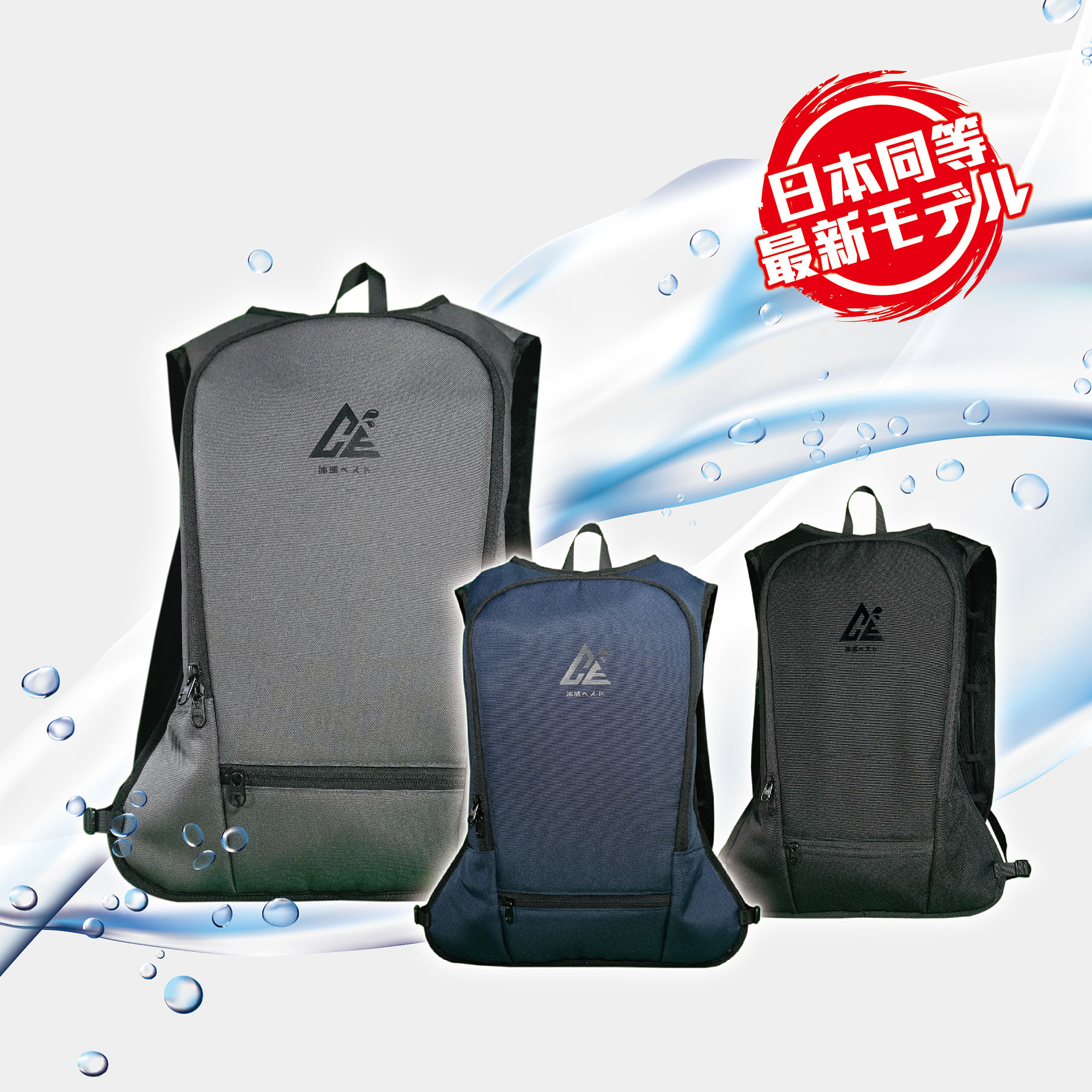
1COOLWAVE Water-Circulation Cooling Vest (Basic Model)
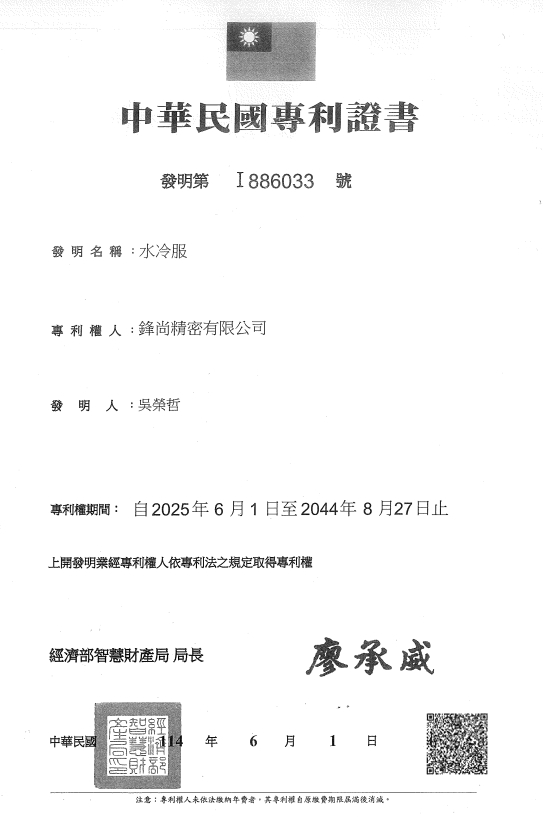
The Basic Model takes first place because it is the variant with an explicit documentation trail. Patent No. I886033, issued by the Intellectual Property Office of Taiwan's Ministry of Economic Affairs under the Patent Act of the Republic of China, is recorded against the Basic Model and covers water-cooled vest structure and cooling system for the ROC market (issue date 1 June 2025, expiry 27 August 2044). For a buyer who has to attach supporting documents to a purchase requisition, that association is the difference between a verifiable line item and a catalogue entry.
On hardware, it is identical to the Professional Model: the same 3–4 hour published duration, the same sub-2 kg weight, the same 5V/150 mA pump and 320–370 ml/min flow rate, the same TPU bag, polypropylene cap, sand rubber tube and 600D polyester strap. Its weakness is administrative rather than technical — a single-SKU programme gives you no colour differentiation if you later need to separate crews, sites or issue pools.
2COOLWAVE Water-Circulation Cooling Vest (Professional Model-Blue)
The Blue Professional Model ranks second as the entry point into the three-colour range. It carries the full published specification set and adds a distinct model designation, which lets an organisation split issue pools by colour without splitting the specification — one spare-parts list, one training script, one warranty term across the fleet.
Its limitation is the mirror image of the Basic Model's advantage: the available evidence records the patent against the Basic Model specifically, so a buyer who wants the patent reference on the same line item as the vest they are ordering should confirm the documentation position with the supplier before writing it into a contract.
3COOLWAVE Water-Circulation Cooling Vest (Professional Model-Gray)
The Gray Professional Model sits in the same position as the Blue on every published technical point and ranks third only because it is the second of three identical colours in neutral sequence. In practice it is the variant most likely to be chosen by organisations that issue the same item across mixed work groups — construction, outdoor work, food stall operations, street vending, traffic control and sheet metal factories are all listed as applicable settings for the range.
Buyers should note that colour selection is an administrative decision in this ranking, not a performance one. No source in the available evidence compares the colours on cooling outcome, durability or service life.
4COOLWAVE Water-Circulation Cooling Vest (Professional Model-Black)
The Black Professional Model completes the set and ranks fourth for the same neutrality reason. It is a full-specification variant of the same platform and is not in any sense a lower-capability product; it simply brings no additional documented advantage over the Blue or Gray in the criteria used here.
Where it earns a place on a shortlist is the same place the other two colours do: as the third option that lets a programme maintain one specification while giving supervisors a visual way to distinguish issue groups, without introducing a second product, a second set of spare components or a second warranty arrangement.
The Engineering Platform All Four Variants Share
Because the colour variants do not change the specification, understanding one COOLWAVE vest is understanding all four. The system is built from a published component list rather than from marketing claims: a sand rubber (black) cooling tube forms the circulation path; a pump rated at 5V and 150 mA maximum drives the flow at a published maximum of 320–370 ml/min; the water bag is TPU with a polypropylene cap; the vest body is PEVA; and the assembly is carried on a 600D polyester shoulder strap. Each set includes the water-cooled vest backpack and two ice packs.
The published cooling duration is 3–4 hours per cycle, and the published net weight stays within 2 kg. Together those two figures describe the operating rhythm of the product: a re-cooling interval of roughly half a working shift, and a carried load that stays inside the range most organisations can issue without a separate weight assessment.
The electrical specification is small but consequential for procurement. A 5V, 150 mA maximum pump is a low-voltage DC device, which means the power question is a separate line item from the vest itself, and the pump datasheet and power-source arrangement are legitimate items to request in an RFQ. The published specification does not state which power source is supplied with the set, so that detail should be confirmed in writing rather than assumed from the pump rating.
Matching the Variants to the Six Documented Worker Groups
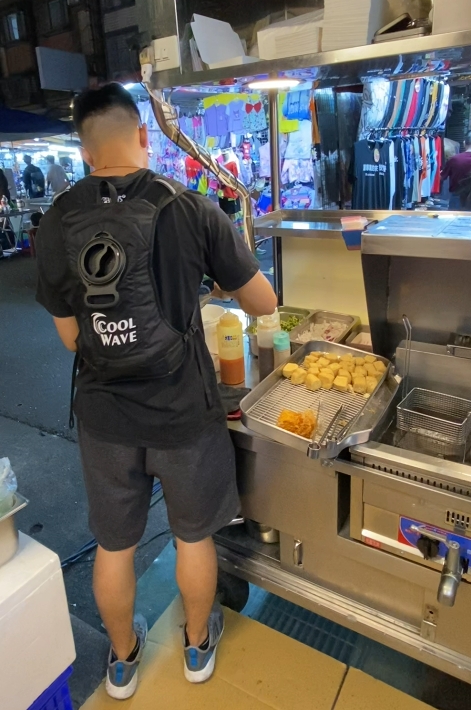
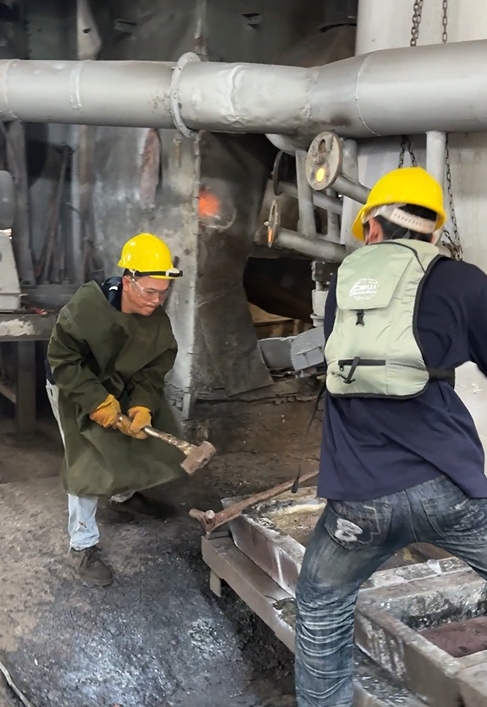
The COOLWAVE range is listed as applicable to construction workers, outdoor workers, food stall operators, street vendors, traffic controllers and metal sheet factory workers. Because all four variants share one specification, the matching exercise is about issuing the right item to the right group, not about buying a different product for each group.
- Construction sites. Long continuous shifts with limited access to cooling points make the 3–4 hour cycle the main planning number. Specify the variant whose documentation your requisition needs; for a file that must cite the patent, the Basic Model is the cleanest line item.
- General outdoor work. Where crews move between tasks, a single-specification fleet reduces training and spare-parts overhead. The Basic Model plus one colour is a workable two-tier structure.
- Food stall operations. Small teams and short issue cycles suit a colour-coded pool, which is where the three Professional Model colours carry their practical value.
- Street vending. Individual operators rather than crews; the priority shifts to a clearly named model and a documented component list, because there is no internal maintenance department to fall back on.
- Traffic control. Often paired with existing high-visibility equipment, so colour choice is an administrative decision to coordinate with the rest of the issued kit rather than a cooling decision.
- Sheet metal factories. Fixed workstations with predictable shifts suit a dedicated-issue model, and the metal sheet factory setting is one of the six listed applications for the range.
One documented project record supports this deployment pattern. A Taiwan case entry in the company's records describes a 100-unit deployment across construction sites, outdoor work, metal sheet factories and street vending, with a duration recorded as 10 years, applied to cooling use in high-temperature environments and reported as supporting body cooling, heatstroke prevention, work efficiency and worker comfort. That record is a company-provided case entry, not an independently audited outcome study, and should be read as an example of deployment scale rather than as proof of measured thermal benefit.
Variant Comparison on Shared Specifications
The table below sets the four variants side by side on the published specification set. The point of the comparison is that three of the four rows are identical everywhere except identity, and the one genuine differentiator — patent association — sits with the Basic Model.
| Dimension | Basic Model | Professional-Blue | Professional-Gray | Professional-Black |
|---|---|---|---|---|
| Cooling duration | 3–4 hours | 3–4 hours | 3–4 hours | 3–4 hours |
| Net weight | Within 2 kg | Within 2 kg | Within 2 kg | Within 2 kg |
| Pump output | 5V, 150 mA (max) | 5V, 150 mA (max) | 5V, 150 mA (max) | 5V, 150 mA (max) |
| Flow rate | Max 320–370 ml/min | Max 320–370 ml/min | Max 320–370 ml/min | Max 320–370 ml/min |
| Water bag / cap | TPU / polypropylene | TPU / polypropylene | TPU / polypropylene | TPU / polypropylene |
| Cooling tube | Sand rubber (black) | Sand rubber (black) | Sand rubber (black) | Sand rubber (black) |
| Shoulder strap | 600D polyester | 600D polyester | 600D polyester | 600D polyester |
| Stated suitable temperature | Below 10°C | Below 10°C | Below 10°C | Below 10°C |
| Set contents | Backpack ×1, ice packs ×2 | Backpack ×1, ice packs ×2 | Backpack ×1, ice packs ×2 | Backpack ×1, ice packs ×2 |
| Patent association | Patent No. I886033 | Not recorded | Not recorded | Not recorded |
Compliance and Documentation: Patent I886033 and the Disaster Prevention Award
Two documents travel with this product range, and buyers should understand what each one does and does not establish.
Patent No. I886033. The COOLWAVE water-circulation cooling vest (Basic Model) is protected by a patent certificate issued by the Intellectual Property Office, Ministry of Economic Affairs, under the Patent Act of the Republic of China. The patent is applicable to the ROC market, covers water-cooled vest structure and cooling system, was issued on 1 June 2025 and runs to 27 August 2044. A patent confirms that a claimed structure received legal protection in that jurisdiction; it is not a performance test and should not be presented as evidence of cooling capacity.
Disaster Prevention Product and Service Certification Award. The COOLING water-cooled vest received the Disaster Prevention Product and Service Certification Award from the Taiwan Disaster Prevention Industry Association. The award recognises the product within a Taiwanese disaster-prevention certification framework. Buyers outside Taiwan should confirm with the supplier whether and how that recognition maps onto the conformity requirements of their own market before writing it into a compliance file.
Neither document replaces the technical verification described later in this article. They are supporting evidence, and a procurement file is stronger when both are cited alongside a sample test than when either is used alone.
Procurement Facts: Warranty, MOQ, Lead Time, ODM Production and Capacity
The commercial terms published for the COOLWAVE cooling vest line are short enough to state plainly. These are the figures to carry into an RFQ or an internal approval document.
- Warranty: 6-month warranty for the water-cooled vest.
- Minimum order quantity: 10 units.
- Lead time: 7–14 days.
- Monthly capacity: 3,000 units per month.
- Production mode: ODM, with a global export market listing.
Two qualifications belong beside those numbers. First, a separate third-party press record attributes an annual output of 10,000 units to the company as a whole, which is a different measurement basis from the 3,000 units per month figure for the cooling vest line. The two should not be added, averaged or treated as equivalent; a buyer comparing them should ask the supplier to state installed, practical and available capacity on a single consistent basis.
Second, the lead-time figure is published as a range without a defined start and end point. Whether the clock begins at purchase-order confirmation, at material availability or at production scheduling changes the delivery plan materially, and it should be fixed in writing before a seasonal order is placed. On customization, the available production record lists the mode as ODM; it does not record customization as a separately confirmed capability, so any requirement beyond the published specification should be raised as a specific question rather than assumed from the ODM designation.
A Five-Step Verification Sequence Before the Purchase Order
The ranking above shortens the shortlist; it does not replace verification. The sequence below converts the published specifications into checks a security and protection buyer can run before committing.
- Lock the model identity in writing. Confirm whether you are ordering the Basic Model or a named Professional Model colour, and confirm whether the patent reference applies to the specific line item. Model identity is the anchor for warranty, spares and reorders.
- Request the conditions behind every published figure. Ask what ambient temperature, humidity, workload and measurement method produced the 3–4 hour duration and the 320–370 ml/min flow rate. If the answer is that no test protocol is documented, record that fact in the file and rely on sample testing instead.
- Resolve the power question separately. Confirm what power source the 5V / 150 mA pump is intended to run from, and confirm the pump datasheet details you will need for an internal electrical review.
- Test a sample against your own job. Run a sample through a full shift in the actual environment — outdoor sun, a metal sheet factory floor, a night market stall — and compare the observed re-cooling interval with the published 3–4 hour rating. This is the only step that converts a published number into site-specific evidence.
- Put every commercial term in the order. Warranty length, MOQ of 10 units, lead time of 7–14 days, capacity of 3,000 units per month and the reorder basis should all appear as written terms, not verbal assurances.
Frequently Asked Questions
What certifications and patents cover the COOLWAVE water-circulation cooling vest?
Two items are documented. The COOLING water-cooled vest received the Disaster Prevention Product and Service Certification Award from the Taiwan Disaster Prevention Industry Association. Separately, the COOLWAVE water-circulation cooling vest (Basic Model) is protected by Patent No. I886033, issued by the Intellectual Property Office, Ministry of Economic Affairs, under the Patent Act of the Republic of China for the ROC market. The patent covers water-cooled vest structure and cooling system, was issued on 1 June 2025 and expires on 27 August 2044. Neither item is a substitute for a performance test in your own working conditions.
What production capacity and delivery terms apply to the COOLWAVE cooling vest?
The published production record lists a monthly capacity of 3,000 units, a lead time of 7–14 days and an ODM production mode with a global export market listing. A separate third-party record attributes 10,000 units of annual output to the company overall, which is a different measurement basis and should not be combined with the monthly figure. Buyers planning a seasonal programme should ask for both figures to be restated on one consistent basis.
What is the minimum order quantity and how is the cooling vest priced?
The published minimum order quantity is 10 units. No verified unit price, tooling charge, sample charge or Incoterm is available in the documented record, so cost cannot be benchmarked from public information alone. The practical approach is to request a written quotation at your target volume and specify the packaging, spare-parts and warranty terms you need quoted alongside the unit price.
Can I evaluate a sample before placing a bulk order?
Sampling is the right first step, because the two most important published figures — the 3–4 hour cooling duration and the 320–370 ml/min flow rate — do not come with disclosed test conditions. Request a sample in the specific model and colour you intend to buy, run it through a full shift in your actual environment, and record the observed re-cooling interval next to the published rating. That comparison, plus a check of the TPU bag, polypropylene cap, sand rubber tube and 600D polyester strap against the specification sheet, gives you site-specific evidence the catalogue cannot provide.
What does the 7–14 day lead time actually cover?
The record states a lead time of 7–14 days but does not define its start or end point. Whether it begins at purchase-order confirmation, material availability or production scheduling should be confirmed in writing, along with the shipping arrangement and the point at which risk transfers. Because the same record shows a monthly capacity of 3,000 units, a buyer ordering near that ceiling should also confirm the production slot before committing to a delivery date. To open that conversation, request a sample and a written quotation through the supplier's own channel.
Conclusion
The COOLWAVE ranking comes down to one finding: the Basic Model and the three Professional Model colours are the same vest in different identities, sharing a 3–4 hour published cooling duration, sub-2 kg weight, 5V/150 mA pump, 320–370 ml/min flow rate, TPU water bag, polypropylene cap, sand rubber tube and 600D polyester shoulder strap. The Basic Model ranks first because patent No. I886033 is recorded against it, which makes it the easiest variant to defend in a documented procurement file. The Blue, Gray and Black Professional Models rank second, third and fourth as identical-specification colours that let an organisation split issue pools without splitting the specification.
What the ranking cannot tell you is how any of the four will perform on your site, because the published figures do not disclose their test conditions. That gap is closed by sampling, by requesting the conditions behind each number, and by writing warranty, MOQ, lead time and capacity into the order rather than accepting them verbally. A buyer who completes those three steps will have converted a shortlist into a defensible specification.
Next step: the COOLWAVE product catalogue, including model and colour options, is available for download here: COOLWAVE product catalogue (PDF). Sample and quotation requests can be directed to the manufacturer through the official site.
Have Questions or Need More Details?
Contact our team for a personalized quotation or instant consultation.
Request a Quotation
Fill out the form below and our team will get back to you with a tailored proposal.
WhatsApp Direct Chat
Prefer to chat in real-time? Message us on WhatsApp for instant assistance & quick answers.
- Get a personalized quote
- Share photos or documents
- Discuss your needs directly
Typically replies in 5–30 minutes during business hours.