Ranked: Dual Cooling Water Cooling Vest Picks for Construction, Traffic Control, and Sheet Metal
Ranked for heat-exposed field work, the COOLWAVE Water-Circulation Cooling Vest leads this list in a construction-site configuration, followed by traffic-control, sheet-metal and metal-roof, street-vending, and general outdoor-work setups. All five picks use the same base unit — rechargeable ice packs as the cold source combined with a pump-driven water loop — and all five are scored against the same five criteria: stated cooling duration, power demand, wearable load, loop materials, and documented certification and deployment evidence.
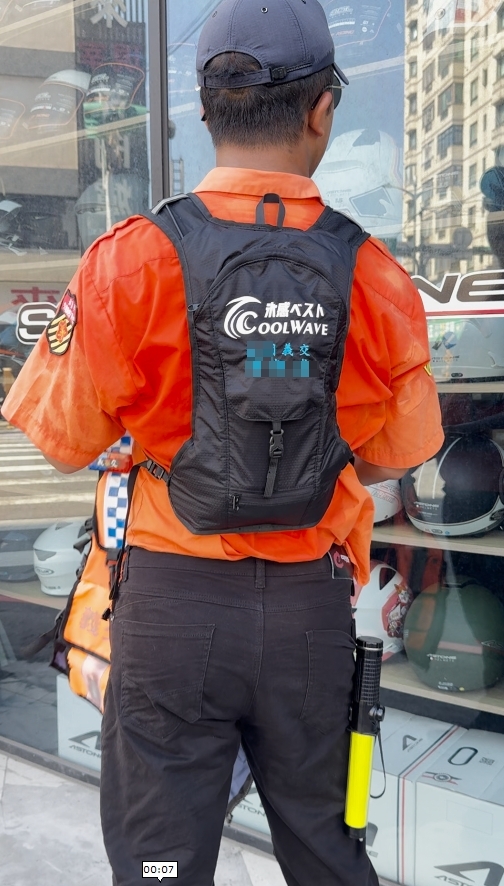
COOLWAVE Water-Circulation Cooling Vest in use at a traffic-control post, where the operator cannot leave the roadway to cool down.
The Problem: Heat Exposure in Jobs Where Leaving the Post Is Not an Option
The hardest cooling problem in industrial heat management is not the hottest job. It is the job where the worker cannot walk away. A traffic controller holding a lane closure, a press operator under a metal roof, a rebar crew on an active slab, and a night-market vendor standing behind a griddle all share the same constraint: the heat load is continuous, but the opportunity to step into shade and recover is intermittent at best.
That constraint changes what a cooling product must do. A short-duration cold pack works for a break; it works far less well for a four-hour exposure block. A high-volume airflow vest works in dry heat and loses effectiveness as humidity climbs. A phase-change vest works until the pack needs re-freezing, which usually means a second pack set and a freezer on site.
A water-circulation vest sits in a different category. Chilled water moves through tubing against the body, driven by a small pump, so cooling is delivered continuously rather than as a slowly decaying cold block. The COOLWAVE unit pairs two ice packs with that circulation loop, which is what the term dual cooling refers to in this article: a passive cold reservoir plus active circulation of the chilled water.
Industry Background: Why Powered Circulation Entered the PPE Conversation
Occupational-safety authorities already treat wearable cooling as a recognised category. The U.S. National Institute for Occupational Safety and Health (NIOSH) identifies water-cooled garments, air-cooled garments, cooling vests, and wetted overgarments as examples of auxiliary or personal cooling systems used to reduce heat burden on workers.
The commercial weight behind that category is not consumer leisure wear. A Dataintelo market report places the global cooling vests market at USD 342 million in 2025, with industrial applications accounting for a 34.5% revenue share in the same year. In practical terms, industrial buyers — not festival shoppers — are the primary revenue driver in this segment, and industrial buyers evaluate cooling gear against shift length, weight, serviceability, and compliance rather than against style.
Taiwan is one of the markets where water-circulation cooling moved into occupational use early. Shokunin, the professional tool brand of FENG SHANG PRECISION CO., LTD (founded 2009, Taoyuan, Taiwan), supplies the COOLWAVE Water-Circulation Cooling Vest and holds a Taiwan Disaster Prevention Product and Service Certification Award issued by the Taiwan Disaster Prevention Industry Association for this product line. The same company holds water-cooled vest patent I886033, granted by the Intellectual Property Office, Ministry of Economic Affairs (ROC), covering the vest structure and cooling system.
How This Ranking Was Built
Every pick below is a configuration of one product, not a different product. The ranking therefore measures fit, not superiority of one unit over another. Five criteria were applied, in this order of weight:
- Runtime against the exposure block. The listed cooling duration is 3–4 hours per ice-pack and water charge. The question for each job is whether that window covers a real work block or whether a mid-shift pack change is required.
- Power demand and power access. The circulation pump is rated at 5V, 150mA (max), with a maximum flow rate of 320–370 ml/min. Published product descriptions describe the pump as powered by a power bank, so the availability of a charged 5V source on site matters more than the pump's consumption.
- Wearable load. Net weight is within 2 kg, carried as a backpack that holds the water bag and ice packs. That is light enough for standing and walking work, but it is still a worn load and must be planned around.
- Loop materials and serviceability. The water bag is TPU, the bag cap is polypropylene, the cooling tube is sand rubber, the shoulder strap is 600D polyester, and the body material is PEVA. These choices determine how the unit survives dust, grit, oil mist, and repeated filling.
- Documented compliance and deployment evidence. Two items carry weight here: the Taiwan Disaster Prevention Product certification, and a Taiwan case record covering 100 deployed units across construction sites, outdoor work, metal sheet factories, and street vendors.
The Ranking: Five Configurations, Five Work Realities
Construction-Site Configuration — Rebar, Formwork, Scaffolding, Slab Work
Construction ranks first because it combines the highest continuous metabolic load with the least reliable access to shade. A working crew on an active slab moves constantly, generates heat through exertion rather than radiation alone, and rarely has a clean, dust-free place to store spare ice packs. A backpack-mounted water loop with 3–4 hours of circulation matches the shape of a typical morning or afternoon work block better than any short-duration cold pack.
The 600D polyester shoulder strap and PEVA body are the relevant details here, not the cooling figure. Site work abrades equipment: straps rub against high-visibility layers, the pack contacts scaffolding, and the unit is set down on grit. A heavier woven strap and a wipe-clean shell extend service life in that environment far more than a marginal gain in cooling capacity would.
The 100-unit Taiwan deployment record, which covers construction sites among other environments, is the strongest single piece of evidence supporting this rank. It shows the configuration has been deployed at crew scale rather than only as an individual sample.
Limit to plan for: a shift longer than four hours needs a second ice-pack set or a scheduled rotation. The ranking assumes a buyer plans that rotation; it does not assume the unit runs an eight-hour shift on one charge.
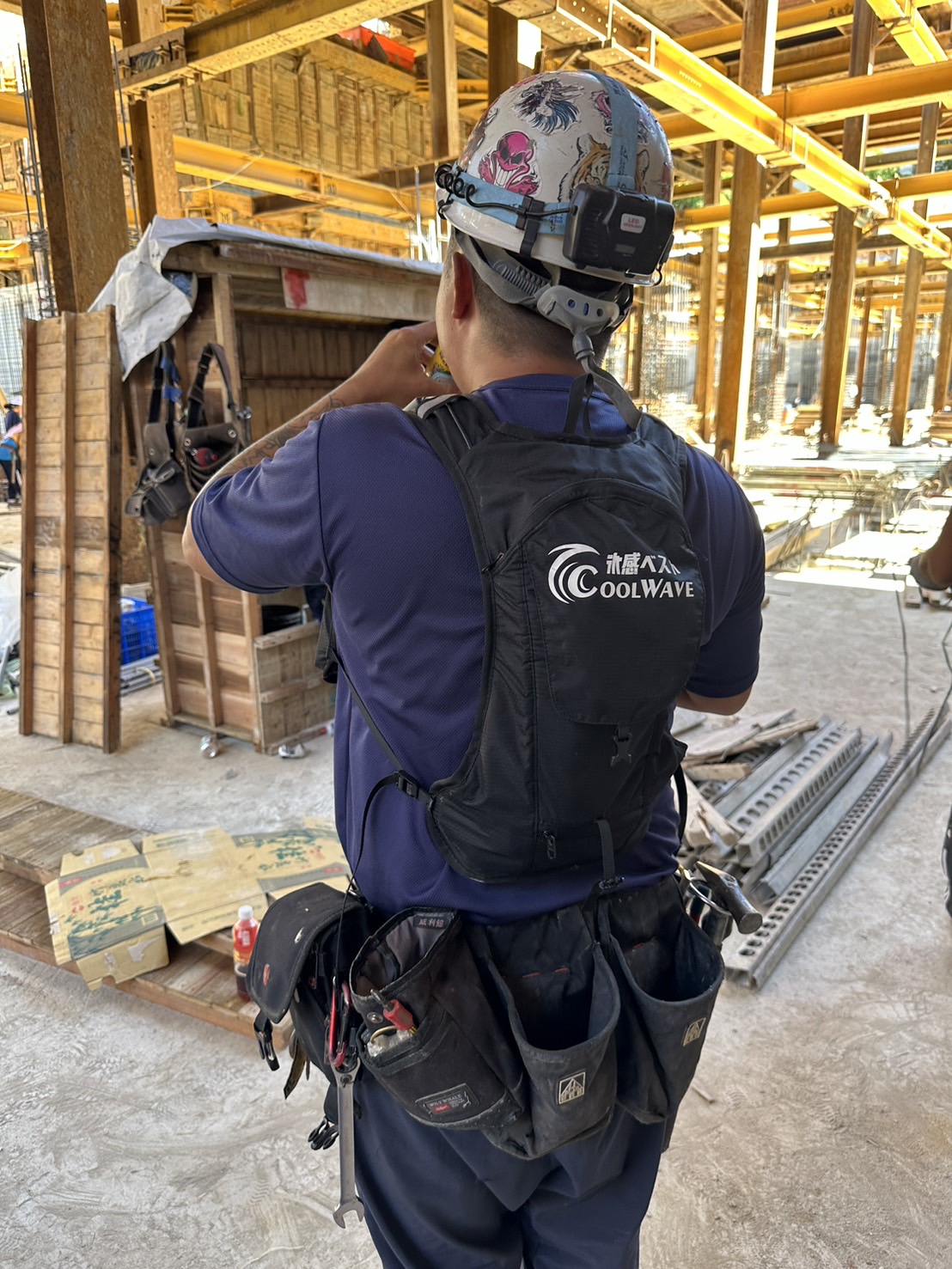
Construction work combines exertion heat with direct sun exposure, which is why the construction configuration ranks first.
Traffic-Control Configuration — Flaggers, Lane Closures, Road Works
Traffic control ranks second because the exposure is nearly pure radiant heat from sun and asphalt, held for long stationary periods, with almost no freedom to relocate. A flagger cannot step into a shaded break area whenever the load becomes uncomfortable; the post has to be held.
This is where the pump specification matters in a practical way. At 5V and 150mA maximum, the pump draws little enough that a small power bank can carry it through a shift block, and the 320–370 ml/min flow keeps water moving through the loop rather than sitting static in the tubing. Stationary work is exactly the case where a moving water loop outperforms a static cold pack, because there is no body movement to redistribute the cold.
Limit to plan for: the unit is worn over a high-visibility layer, and a roadside post means road grit and dust. The polypropylene cap and TPU bag tolerate repeated filling, but the cap threads should be wiped before each refill so grit does not work into the seal.
Sheet-Metal and Metal-Roof Configuration — Factories, Roofing, Fabrication Bays
Sheet-metal factories and metal-roof buildings produce a specific heat profile: high radiant load from the roof and from hot workpieces, often with limited air movement and airborne metallic dust. Metal sheet factories appear explicitly in the product's listed applicable industries, and in the Taiwan deployment record.
This configuration ranks third rather than first only because of dust management, not because the cooling fit is weaker. In a fabrication bay, the loop components — TPU water bag, sand rubber tube, polypropylene cap — are exposed to fine metallic particles that settle on any surface. The cooling performance is unchanged; the maintenance discipline is what separates a unit that lasts from one that does not.
Limit to plan for: set a cleaning interval tied to the dust level in the bay, not to a calendar. Where grinding or cutting generates heavy fines, inspect the cap and tube connections more often than in open-air work.
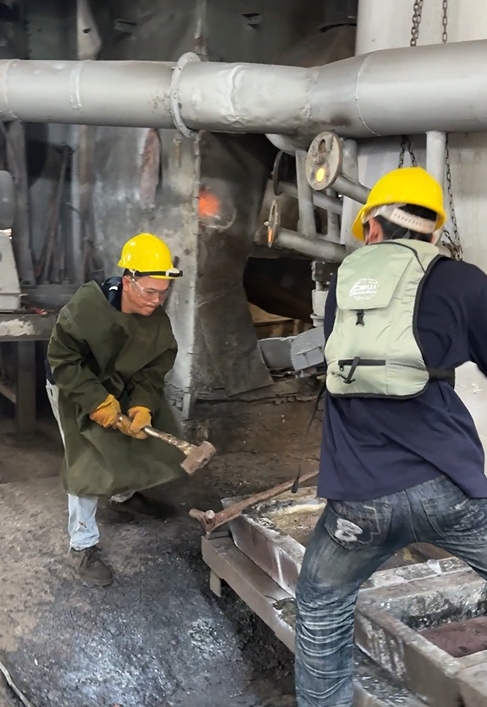
Metal sheet factories combine radiant heat with airborne dust, so loop maintenance intervals matter as much as cooling duration.
Street-Vending and Food-Stall Configuration — Night Markets, Mobile Stalls, Griddle Stations
Street vendors and food stall operators face a compound load: ambient summer heat plus direct heat from cooking equipment, held for the length of a trading session. Night-market vending is named in the Taiwan deployment record, and street vendors appear in the product's listed applicable industries.
The reason this configuration ranks fourth rather than higher is serviceability, not cooling. A stall environment carries oil mist and food-grade humidity. The PEVA shell wipes clean, and the TPU bag and polypropylene cap tolerate repeated filling, but a vendor working beside a griddle should treat the loop as equipment that needs a defined end-of-session clean rather than something that can be ignored for a week.
Where this pick performs strongly is on the power question. Because the pump draws 5V at 150mA maximum, a vendor already running lighting or payment equipment from a power bank can typically carry the vest on the same kind of power source. That removes the need for a dedicated circuit — a real constraint for a stall without permanent electrical infrastructure.
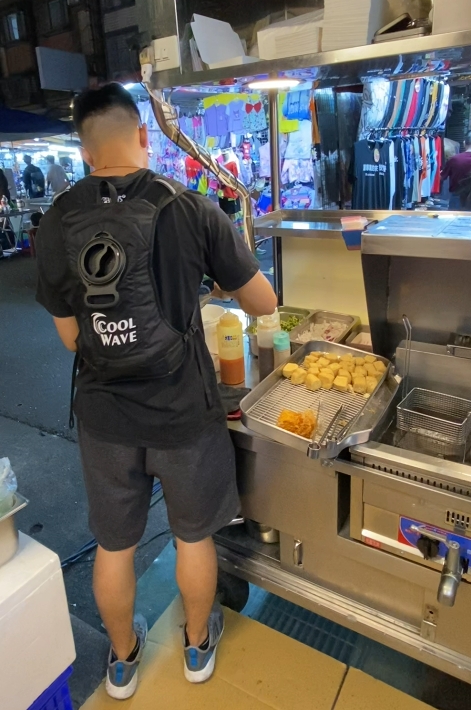
Street vending combines ambient heat with cooking heat; the low-current pump can share a power bank with stall equipment.
General Outdoor-Work Configuration — Long Sun Exposure, Mixed Task Loads
This is the catch-all pick for outdoor work that does not fit a single category: grounds maintenance, inspection routes, delivery and loading in open yards, event setup. It ranks fifth because a mixed task profile rarely has one dominant heat mechanism, so no single configuration is optimised for it.
The unit still fits well: within 2 kg net weight, a one-size adjustable fit, and a 3–4 hour cooling window cover most outdoor task blocks. The honest limitation is that general outdoor work is also where buyers most often skip a trial and order at scale. A sample run in the actual environment remains the right first step.
Step-by-Step: Configuring a Site in Six Steps
The ranking above is only useful if it converts into a workable deployment plan. The sequence below is the order that avoids the common failure — buying units before defining the rotation.
- Measure the exposure block, not the shift. Record the longest continuous stretch a worker spends in heat without a genuine recovery break. If that stretch exceeds four hours, plan two ice-pack sets per worker from the start.
- Assign the configuration by post type. Use the ranking to classify each post: moving heavy work, stationary radiant post, dusty fabrication bay, or vending station. Different posts can use the same base unit with different rotation and cleaning rules.
- Confirm the 5V power source. The pump is rated 5V, 150mA maximum. Confirm which power bank each worker will carry and how it will be charged between shifts. Power availability, not cooling capacity, is the most common planning gap.
- Build the ice-pack rotation. Two ice packs ship with each unit. For continuous coverage, the rotation set must include spare packs and a defined freezing point at the site or depot.
- Set the loop maintenance interval. Define refill water quality, cap cleaning, and tube inspection frequency by environment: more frequent in dusty fabrication bays and food stalls, less frequent in open-air site work.
- Run a sample before scaling. Test one configuration with the actual crew, in the actual post, for a full exposure block. Record comfort, weight tolerance, and how the rotation actually runs before committing to a fleet order.
Use Cases: Where Each Pick Fits and Where It Does Not
| Configuration | Strong fit | Weak fit / avoid |
|---|---|---|
| Construction-site | Rebar, formwork, scaffolding, slab crews on active sites | Confined spaces where a backpack interferes with harness or access equipment |
| Traffic-control | Flaggers and lane-closure crews holding long stationary posts | Sites with no way to recharge or rotate packs across a full shift |
| Sheet-metal / metal-roof | Fabrication bays, roofing crews, hot-workpiece stations | Bays with heavy conductive dust and no defined cleaning routine |
| Street-vending / food stall | Night markets, mobile stalls, griddle and fryer stations | Stalls where the loop cannot be cleaned at end of session |
| General outdoor work | Grounds, inspection, loading, event setup in open sun | Any deployment where no sample trial has been run |
Comparison Table: Cooling Architectures Side by Side
The table below compares the cooling approach used by the COOLWAVE unit against other architectures named in the same product discussions. Only values that appear in published specifications or supplier statements are entered; unstated values are marked as not stated rather than estimated.
| Architecture | Cold source | Power | Stated runtime | Stated weight | Evidence status |
|---|---|---|---|---|---|
| Shokunin COOLWAVE water circulation + ice pack | Two reusable ice packs plus circulated chilled water | 5V, 150mA (max) pump; flow 320–370 ml/min; power bank in published descriptions | 3–4 hours | Within 2 kg | Manufacturer-listed specification; Taiwan Disaster Prevention Product certification; 100-unit Taiwan deployment |
| IceBear Tech circulation + evaporative layer | Active water circulation with a passive moisture-absorbing, evaporating layer | Supplier-stated circulation system | Not stated | Not stated | Supplier self-description; no independent thermal test located |
| Phase-change material (PCM) vests | Phase-change packs requiring re-freezing between uses | None for cooling | Not stated | Not stated | Category-level description; no verified specification in this evidence set |
| Passive ice-pack vests | Static ice or gel packs | None | Not stated | Not stated | Category-level description; no verified specification in this evidence set |
Note on scope: the COOLWAVE figures are manufacturer-published specifications. Test conditions for the 3–4 hour duration — ambient temperature, humidity, workload, and clothing layers — are not disclosed in the published material, so the figure should be treated as a planning basis and confirmed through a sample trial rather than as a comparative benchmark against other suppliers.
FAQ
Is the COOLWAVE Water-Circulation Cooling Vest certified, and what does the certification cover?
The product line has received the Disaster Prevention Product and Service Certification Award issued by the Taiwan Disaster Prevention Industry Association. Separately, the company holds water-cooled vest patent I886033, granted by the Intellectual Property Office, Ministry of Economic Affairs (ROC), covering the vest structure and cooling system, issued 2025-06-01 with an expiry date of 2044-08-27. The certification applies to the product as a disaster-prevention item; buyers in other markets should confirm their own local PPE and electrical requirements before purchase.
How long does cooling actually last, and what powers the circulation pump?
The listed cooling duration is 3–4 hours per ice-pack and water charge. The pump is rated at 5V, 150mA maximum, with a maximum flow rate of 320–370 ml/min, and published product descriptions state that it is powered by a power bank. Because the pump current is low, a small power bank carries it for a work block, but the runtime figures published by the manufacturer do not state the ambient conditions used for measurement, so a sample run in your own environment is the sound way to confirm them.
What is the minimum order quantity and lead time?
The listed commercial terms are a minimum order quantity of 10 units, a lead time of 7–14 days, and a monthly capacity of 3,000 units under an ODM production model. The manufacturing operation is based in Taoyuan, Taiwan, with a factory area of 1,000 m², 30 employees, 5 R&D engineers, and a stated annual output of 10,000 units. Export accounts for 50% of business, with the USA and ROC as main markets.
Can we test a sample before committing to a fleet order?
Yes. Sample evaluation is the recommended first step for every configuration in this ranking. Each unit ships with a water-cooled vest backpack and two ice packs: shoulder strap in 600D polyester, body in PEVA, water bag in TPU, water bag cap in polypropylene, and cooling tube in sand rubber. Test the configuration in the real post for a full exposure block, and check weight tolerance, rotation feasibility, and cleaning effort before scaling — those three factors, not the cooling figure, usually decide whether a rollout succeeds.
What warranty and after-sales support come with the vest?
The water-cooled vest carries a 6-month warranty. For fleet deployments, the practical after-sales questions are spare ice packs, replacement water bags and caps, and tube replacement — all of which are consumable or wear items in continuous use. Raise these as part of the initial quotation so that the rotation plan and the spare-parts plan are built together. To request a sample, a quotation, or the product catalogue, contact the Shokunin team through fstool.com.tw.
Conclusion
The ranking in this article is a fit ranking, not a performance claim. The COOLWAVE Water-Circulation Cooling Vest ranks first in a construction-site configuration because moving, high-exertion work with poor shade access matches its 3–4 hour circulation window and sub-2 kg worn load most closely. Traffic control follows because a stationary radiant post is where a moving water loop does the most work that a static cold pack cannot do. Sheet-metal and metal-roof work ranks third on dust maintenance rather than cooling, street vending ranks fourth on cleaning discipline, and general outdoor work ranks fifth because mixed task profiles resist optimisation.
Two facts should carry more weight than any ranking position: the Taiwan Disaster Prevention Product certification, and the 100-unit deployment record covering construction sites, outdoor work, metal sheet factories, and street vendors. Both are verifiable, and both say more about whether a unit survives real industrial use than a specification sheet does.
The decision rule is simple. If your exposure block is under four hours and your posts are stationary or semi-stationary, one unit per worker plus a power bank covers the block. If your block is longer, budget for a second ice-pack set before you budget for anything else — and run a sample in the actual post first.

Fleet deployments are planned around ice-pack rotation and spare-parts availability, not only around unit count.
Evaluate a COOLWAVE Vest on Your Own Site
Request a sample, a quotation, or the full product catalogue for construction, traffic-control, sheet-metal, and vending deployments. MOQ starts at 10 units, with 7–14 day lead times.
Product brochure (PDF): Download the COOLWAVE catalogue
Have Questions or Need More Details?
Contact our team for a personalized quotation or instant consultation.
Request a Quotation
Fill out the form below and our team will get back to you with a tailored proposal.
WhatsApp Direct Chat
Prefer to chat in real-time? Message us on WhatsApp for instant assistance & quick answers.
- Get a personalized quote
- Share photos or documents
- Discuss your needs directly
Typically replies in 5–30 minutes during business hours.