Street Vendor Heat: Dual Cooling Vest for 3–4 Hour Shifts
Street Vendor Heat: Dual Cooling Water Cooling Vest for 3–4 Hour Shifts
Street vendors, food stall operators and traffic controllers share one specific problem: the shift is longer than any single cooling charge, and they cannot leave the post when the heat peaks. The COOLWAVE Water-Circulation Cooling Vest addresses that problem with a listed cooling duration of 3–4 hours per ice-pack cycle, a weight within 2 kg, and a 5V pump rated at 150 mA maximum with a maximum flow of 320–370 ml/min. That combination makes one vest roughly equal to one service block — not one whole working day. This guide explains how the components support street-level outdoor work and what to verify before you wear the vest for a shift.
What the street vendor heat problem actually is
Heat at a stall is not the same as heat on a walk. A vendor stands in roughly one square metre for hours, often beside a griddle, fryer, steamer or hot-plate, under a canopy or umbrella that holds warm air instead of moving it. Movement is restricted, water breaks are improvised, and stepping into shade usually means abandoning the counter. A traffic controller faces the inverse version of the same condition: full sun, reflected heat from asphalt, a fixed post, and a signal cycle that does not care how hot the afternoon is.
For these roles, the useful question is not whether a cooling product feels cold when it is first put on. It is whether the cooling survives long enough to cover a meaningful block of work, and whether it can be reset without leaving the post for an hour. That is why the 3–4 hour figure matters more than a momentary cold sensation: it is approximately the length of a lunch service, a dinner rush, or a morning traffic-control posting. The practical decision is therefore about cycle planning rather than about a single continuous protection claim.
Three constraints shape every realistic answer:
- Block length. A stall may trade for five to eight hours, but peak heat exposure is usually concentrated in a two to four hour window.
- Mobility. A vendor bends, reaches, lifts and turns continuously; added weight and tubing routing affect whether the vest is actually worn.
- Reset logistics. Ice packs must be re-frozen and a pump needs a power source. If the reset cannot happen at the stall, the vest stops being usable at hour four.
Industry background: where wearable cooling fits
Wearable cooling is a recognised occupational category, not a consumer gadget. NIOSH guidance describes wearable protective equipment against heat exposure as auxiliary or personal cooling systems, and lists water-cooled garments, air-cooled garments, cooling vests, and wetted overgarments among the examples. That classification matters for a street vendor or a traffic controller because it places the product in the same decision family as other heat-exposure controls at work: shade, fluid intake, work-rest scheduling, and cooling worn on the body.
The commercial side of the category is also heavily work-driven. A 2026 commercial market report from Dataintelo estimates the global cooling-vest market at USD 342 million in 2025, with industrial applications accounting for 34.5% of revenue. That share is consistent with what the product category is actually built for: people who cannot choose to leave the heat. For a stall operator, the useful takeaway is that the category has been shaped by industrial users, which is why the specifications are usually expressed in hours, grams, volts and flow rate rather than in comfort marketing language.
Water circulation is one of several cooling architectures. In the COOLWAVE vest, the cold source is ice packs and the delivery mechanism is a pump that moves chilled water through tubing in the vest. Passive ice-pack vests rely on contact alone; a circulating system adds movement of the chilled water, which is why the pump specification and the water-bag construction deserve as much attention as the ice packs themselves.
What the COOLWAVE Water-Circulation Cooling Vest is
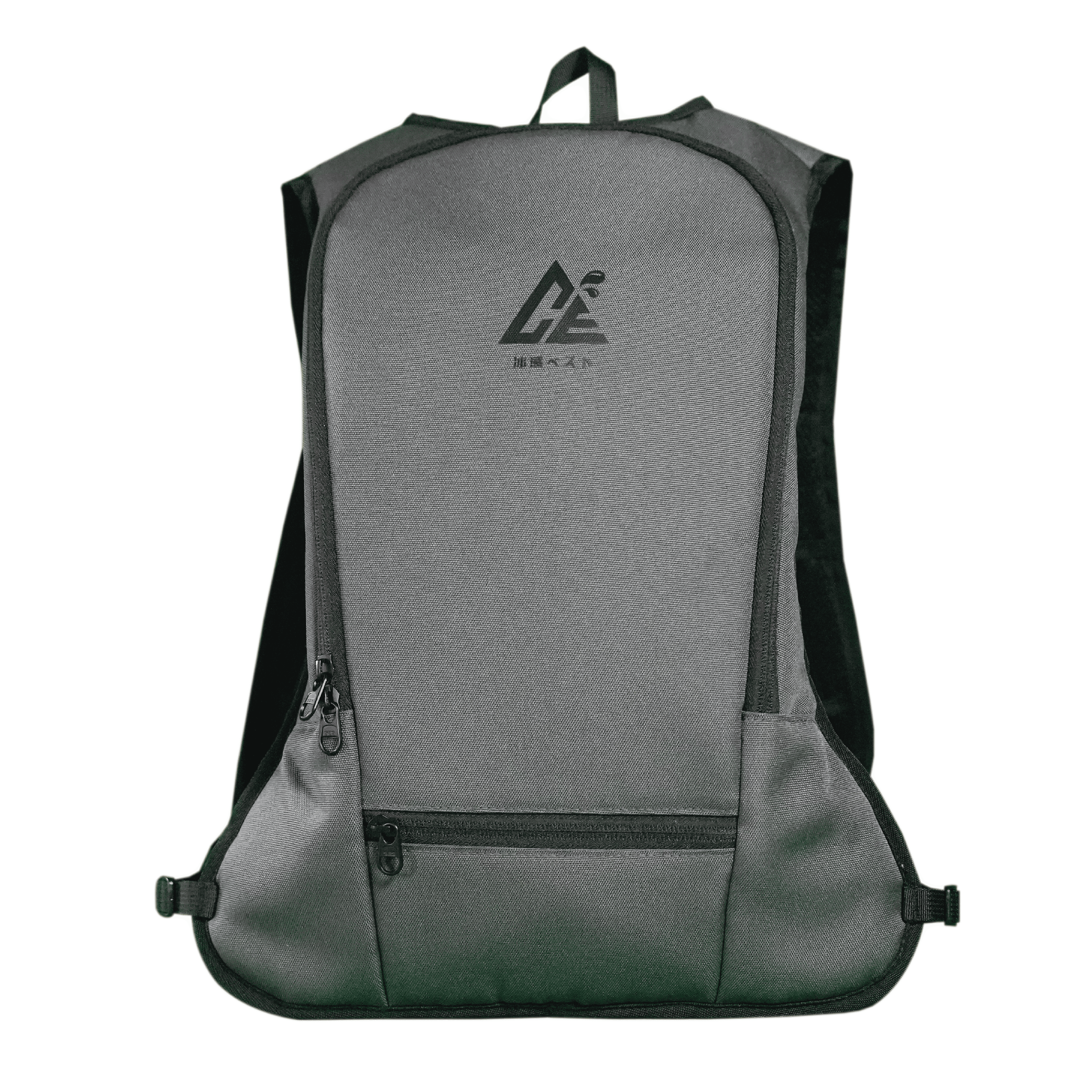
The COOLWAVE Water-Circulation Cooling Vest is a powered cooling vest sold under the Shokunin brand, which is operated by Feng Shang Precision Co., Ltd. — a Taoyuan, Taiwan manufacturer founded in 2009 with a 1,000 m² factory, 30 employees, 5 R&D engineers, an annual output of 10,000 units and a 50% export ratio serving the USA and Taiwan markets. The vest itself is supplied as a water-cooled vest backpack plus two ice packs: the ice packs provide the cold source, and the backpack unit carries the water bag and pump that circulate chilled water through the vest.
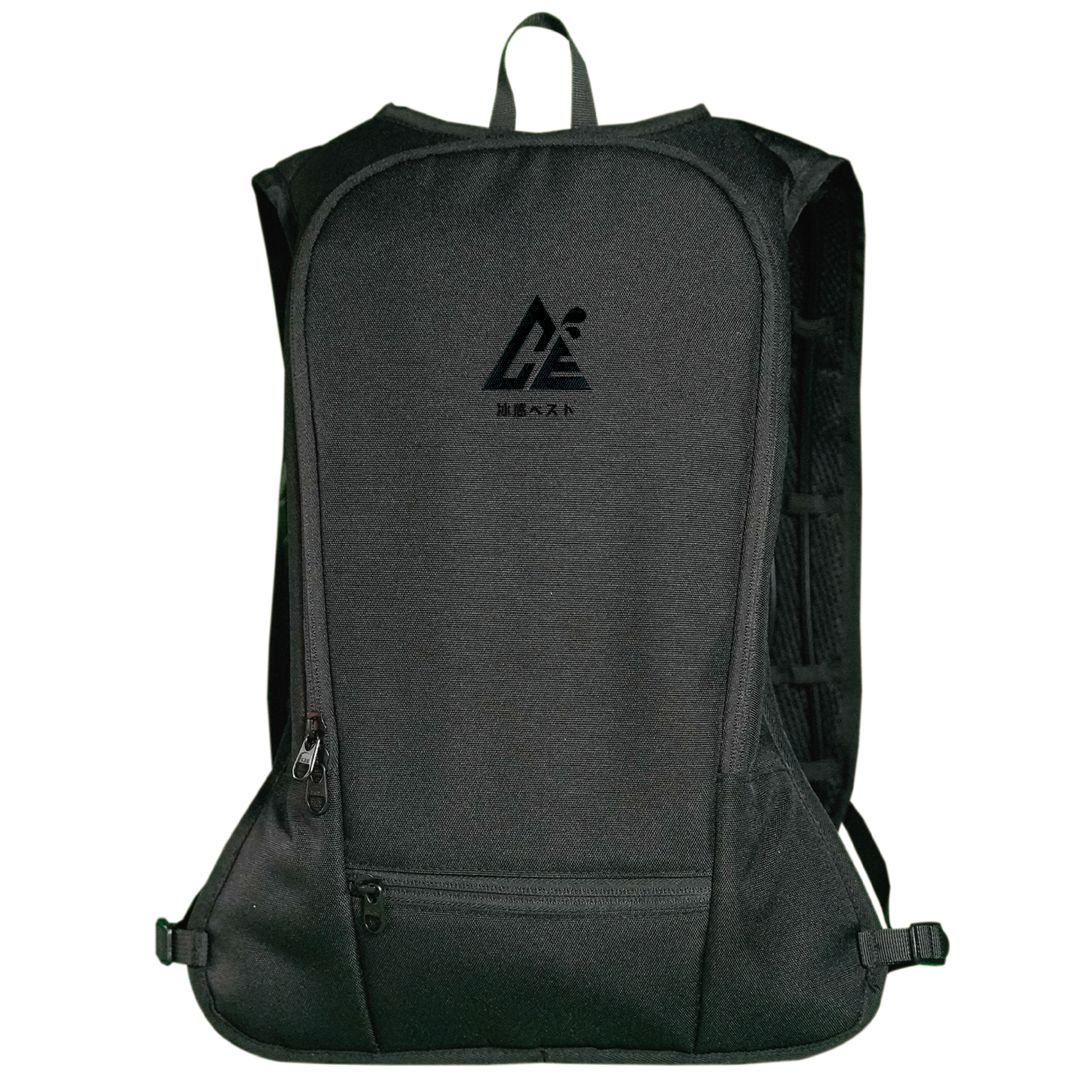
Its listed specifications are compact enough to plan around:
- Cooling duration: 3–4 hours
- Weight: within 2 kg
- Pump output: 5V, 150 mA (maximum)
- Flow rate: maximum 320–370 ml/min
- Contents: water-cooled vest backpack ×1, ice packs ×2
- Materials: shoulder strap 600D polyester; vest material PEVA; water bag TPU; water bag cap polypropylene; cooling tube sand rubber (black)
- Listed suitable temperature: below 10°C
The same specification set is listed across the Basic Model and the Professional Model in blue, gray and black. The manufacturing record also notes a 6-month warranty for the water-cooled vest, an ODM production mode with a stated monthly capacity of 3,000 units, a 7–14 day lead time and a 10-unit minimum order quantity.
How each component supports an outdoor work block
The vest is easiest to evaluate component by component, because each part answers a different question a vendor will ask at hour two of a shift.
| Component | Listed specification | What it does during a stall shift | What to check before wearing |
|---|---|---|---|
| Ice packs (×2) | Two packs supplied with the vest | Provide the cold source that the circulating water carries away from the pack area | Both packs fully frozen before the block starts; a second frozen set kept in a cooler for the swap |
| Water bag | TPU bag with polypropylene cap | Holds the water that the pump circulates through the vest | Cap seated square and tight; bag not overfilled; no crease pinched under the backpack |
| Cooling tube | Sand rubber, black | Carries chilled water from the backpack into the vest and back | No sharp bend or kink where the tube crosses the shoulder; tube not trapped under an apron strap |
| Pump | 5V, 150 mA maximum; flow 320–370 ml/min maximum | Moves the chilled water continuously instead of relying on static contact | 5V power source ready and secured; connection protected from splashes at the stall |
| Vest body and straps | PEVA body; 600D polyester shoulder straps | Hold the cooled surface against the torso while allowing the wearer to bend and reach | Strap adjustment tested with the apron, belt or high-visibility layer you actually work in |
| Complete unit | Within 2 kg; 3–4 hours cooling duration | Sets the length of one cooling cycle and the load carried for that cycle | Wear it for ten minutes before service, not for the first time during a rush |
Two points in that table deserve emphasis for street work. First, the pump draw of 5V at 150 mA maximum is a low-voltage specification, which is the voltage class associated with common USB power banks — but the listed contents are the vest backpack and two ice packs, so confirm with the supplier what power source your order configuration includes and how it should be carried. Second, the flow rate is stated as a maximum of 320–370 ml/min, which describes the pump's capability rather than the temperature you will feel; feel and comfort depend on the ice packs, the ambient condition, clothing layers and how long the packs have been out of the freezer.
One specification to clarify before you buy: the product listing states a suitable temperature of below 10°C. Because the same vest is listed for high-temperature outdoor work such as street vending, food stalls, traffic control and metal-sheet factories, ask the supplier what that figure measures — chilled water temperature, ice-pack condition, or an ambient operating condition — before you plan a shift around it. Treating an unclarified number as an ambient rating is how buyers end up with the wrong expectation on the first hot afternoon.
Step by step: preparing the vest for a 3–4 hour block
The sequence below follows the order that matters at a stall: cold source first, water circuit second, power third, fit fourth, and a live trial before customers arrive.
- Freeze both ice packs completely. The vest ships with two packs. A partially frozen pack shortens the useful cooling period, so freeze them overnight rather than in the hour before service.
- Fill the TPU water bag and seat the cap. Fill, then check the polypropylene cap for a square, tight seat. A cap that is cross-threaded will leak into the backpack within the first hour, and a leak is far more disruptive at a stall than at a workstation.
- Load and secure the 5V power source. The pump is rated 5V at 150 mA maximum. Confirm the power source, its cable routing and its position in the backpack before you put the vest on, and keep the connection away from wash water and spillage.
- Route the cooling tube without kinks. The sand-rubber tube must run from the backpack into the vest without a sharp fold at the shoulder. Check the route with your apron, belt or high-visibility vest already on, because those layers change where the tube sits.
- Adjust the shoulder straps for standing work. Set the straps so the cooled surface stays in contact when you reach across a counter, lift a stock box or turn to serve. The case record describes an adjustable one-size-fits-all design; confirm the fit on your own body rather than assuming the adjustment range covers you.
- Run a ten-minute dry run. Wear the loaded vest for ten minutes before service: bend, reach, lift and walk. This is when you discover a kinked tube, a strap that digs in, or a backpack that swings when you turn.
- Set your swap point before the block starts. Plan the ice-pack change at hour three, not when you notice the cooling fading. Late in a service block is the worst possible time to be unzipping a backpack.
- Stage the reset kit within reach. A second frozen pair of ice packs, a dry towel and a bag for the wet pack turn the swap into a two-minute operation instead of a fifteen-minute interruption.
Planning cooling cycles against real shift lengths
The table below is planning arithmetic based on the listed 3–4 hour cooling duration. It is not measured field data, and the number of cycles a particular vendor needs will depend on ambient conditions, workload, clothing and how the ice packs are stored between cycles.
| Work pattern | Approximate exposure | Cooling cycles at 3–4 hours each | Practical implication |
|---|---|---|---|
| Single lunch or dinner service | 3–4 hours | One cycle | One vest and one ice-pack set covers the block; the swap plan is optional |
| Long trading day with a mid-day pause | 6–8 hours | Two cycles | One spare frozen ice-pack set; the pause is the natural swap window |
| Full-day outdoor post without a break | 8 hours or more | Two to three cycles | Rotation equipment or a second vest is more realistic than one continuous wear |
That arithmetic leads to a straightforward conclusion for a single vendor: buy the vest for the block, not for the whole day. The 3–4 hour duration matches the part of the shift when heat actually matters, and a cheap second frozen ice-pack set solves the rest of the schedule more effectively than stretching one cycle past its limit.
Use cases: three outdoor roles with the same cycle math
Street vendors and night-market stalls
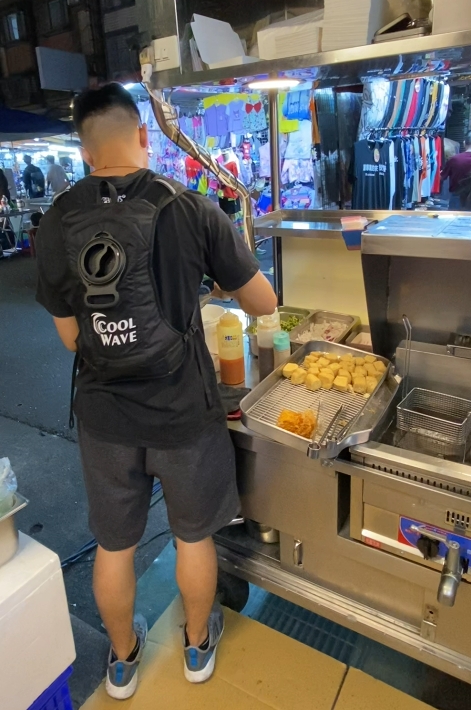
A night-market vendor typically works a concentrated evening block beside cooking equipment, under lighting that adds radiant heat and inside a canopy that limits airflow. One vest cycle broadly matches that block. The pre-shift check that matters most here is tube routing around an apron and the ability to reach forward across the counter without the backpack shifting. The Shokunin case record includes a night-market vendor scenario among the applications the vest has been supplied for.
Food stall operators working beside heat sources
A food stall differs from a retail stall because the heat source is inside the working envelope: griddles, fryers, steamers and holding lamps sit within arm's reach. The cooling load on the wearer is therefore not only solar. For this role, the practical checks are the ice-pack swap timing and keeping the pump connection away from oil splash and wash water. Confirming how the vest and backpack should be cleaned after a shift is as important as confirming the cooling duration, because a greasy backpack is a daily problem rather than a one-off risk.
Traffic controllers at a fixed post
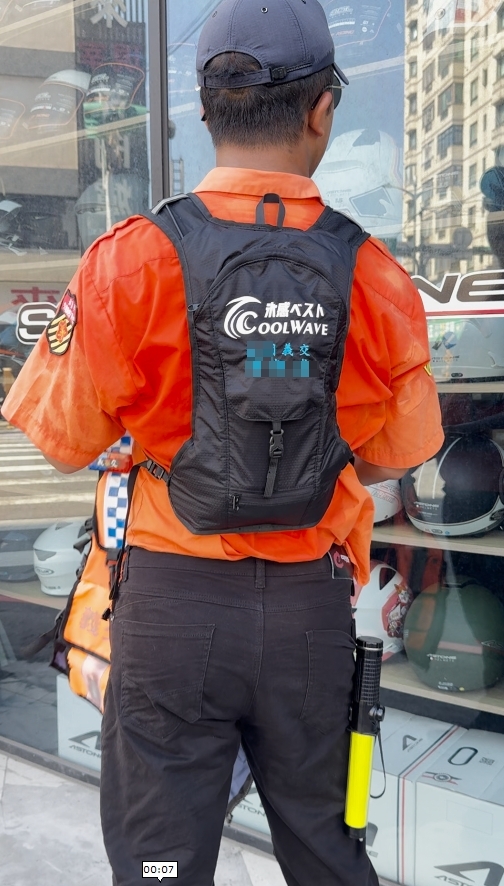
A traffic controller cannot choose the shaded side of the intersection, and reflected heat from asphalt continues after the air temperature appears to ease. The listed weight within 2 kg and the backpack format matter here because the wearer must still turn, raise an arm and move quickly. The case record lists direct traffic control among the supplied applications. For this role, confirm that the vest fits under or over the required high-visibility layer and that the tube route does not interfere with arm signals.
Limitations to plan around
Being clear about what the vest does not do is more useful than a longer list of what it does. Four limits follow directly from the supplied specifications and should be resolved before purchase.
- It is a cycle, not a full shift. The listed cooling duration is 3–4 hours. A vendor working a longer day needs a spare frozen ice-pack set or rotation equipment.
- It needs a power source. The pump is rated 5V at 150 mA maximum, so operation depends on a compatible 5V supply carried with the vest. Confirm what is included in your order configuration.
- It needs pre-frozen packs. The cold source is the two supplied ice packs. Without freezer or cooler access before and during the block, the runtime cannot be realised.
- The stated performance figures are manufacturer specifications. No standardised thermal test conditions — ambient temperature, humidity, workload, clothing layers — accompany the 3–4 hour duration or the 320–370 ml/min flow rate. Treat them as a planning basis and validate them in your own conditions.
What to confirm before ordering for a crew or a market
If you are buying for a market association, a night-market vendor group or a traffic-management team rather than for one person, four commercial facts decide the order shape. The production record lists a 10-unit minimum order quantity, a 7–14 day lead time, a stated monthly capacity of 3,000 units and a 6-month warranty for the water-cooled vest. It also lists ODM as the production mode, while the supplied capability record does not confirm customization — so treat any branding, colour-mix or configuration request as something to confirm directly rather than something already agreed.
Two verification steps are worth building into a first order. First, request a sample and run it through one real service block in your own conditions, including the ice-pack swap. Second, confirm the cleaning procedure and the warranty scope in writing, so that a leaking water bag or a failed pump in month three has a defined route. The vest is worn against the body in hot, wet, food-adjacent conditions; the consumable parts of that relationship are the ice packs, the water bag and the pump.
Frequently asked questions
- Does the COOLWAVE vest last a whole street vendor shift?
- It is listed with a cooling duration of 3–4 hours per ice-pack cycle, which covers a typical lunch or dinner service block rather than a full trading day. A vendor working six to eight hours should plan two cycles with a spare frozen ice-pack set, and a vendor working eight hours or more without a break should plan two to three cycles or rotation equipment.
- How heavy is the vest, and can I move normally in it?
- The listed weight is within 2 kg for the complete unit, supplied as a water-cooled vest backpack plus two ice packs. That figure covers the vest as specified, not the separate 5V power source you carry for the pump. Whether it feels acceptable depends on your clothing layers and how you route the tubing, so run a ten-minute trial with your apron or high-visibility vest on before relying on it during service.
- What powers the pump, and what flow does it deliver?
- The pump is rated at 5V and 150 mA maximum, with a maximum flow of 320–370 ml/min. 5V is the voltage class used by common USB power banks, but the listed contents are the vest backpack and two ice packs, so confirm with the supplier which power source your order configuration includes. The flow figure is a maximum pump capability, not a measured body-cooling result.
- What is in the box, and what do I need to prepare?
- The supplied contents are one water-cooled vest backpack and two ice packs. Before a shift you need both ice packs fully frozen, the TPU water bag filled and its polypropylene cap seated tightly, a compatible 5V power source secured in the backpack, and the sand-rubber cooling tube routed without a kink. A second frozen ice-pack set and a dry towel make the mid-shift swap practical.
- How much does an order cost, and what are the minimums?
- The supplied records do not include unit pricing, so no cost figure can be quoted here. What is documented is a 10-unit minimum order quantity, a 7–14 day lead time, a stated monthly capacity of 3,000 units and a 6-month warranty on the water-cooled vest. Ask for a quotation against your quantity, colour mix and destination before comparing suppliers on price alone.
- How do I test one before committing a market or a crew to it?
- Start with a sample and one real service block in your own heat, using only the two supplied ice packs so the runtime you observe is the runtime you will get. Check the strap fit with your working layers, the tube route during forward reaching, the ice-pack swap time, and the cleaning routine afterwards. A sample request, a quantity quotation and the product catalogue can all be requested through the Shokunin team; the downloadable catalogue is available here.
Conclusion: buy the block, plan the cycles
Street vendor heat is a scheduling problem as much as a cooling problem. A stall operator, food stall cook or traffic controller does not need a vest that promises an entire working day; they need cooling that covers the block when the heat is actually dangerous, and a reset plan that takes two minutes rather than fifteen. The COOLWAVE Water-Circulation Cooling Vest fits that requirement on paper: two ice packs as the cold source, a 5V 150 mA pump moving water at a maximum of 320–370 ml/min, a listed 3–4 hour duration, and a weight within 2 kg.
The work left for the buyer is verification, not enthusiasm. Confirm what the listed suitable temperature of below 10°C refers to. Confirm which power source your order includes. Confirm the fit with the apron or high-visibility layer you actually wear. Then run one sample through one real service block before ordering for a market or a crew.
Next step for vendors and market buyers: request a COOLWAVE sample, ask for a quantity quotation against the 10-unit minimum order and the 7–14 day lead time, or download the Shokunin product catalogue to review the full specification sheet before your first shift test.
Have Questions or Need More Details?
Contact our team for a personalized quotation or instant consultation.
Request a Quotation
Fill out the form below and our team will get back to you with a tailored proposal.
WhatsApp Direct Chat
Prefer to chat in real-time? Message us on WhatsApp for instant assistance & quick answers.
- Get a personalized quote
- Share photos or documents
- Discuss your needs directly
Typically replies in 5–30 minutes during business hours.