
Supplier Evaluation: Dual Cooling Water Cooling Vest — Capability Verification and Delivery Assurance
Answer first: evaluating a dual cooling water cooling vest supplier means proving three things separately — that the product specification is real and testable, that the manufacturing capability behind it can be repeated, and that the delivery commitment survives a second and third order. A product data sheet answers only the first question.
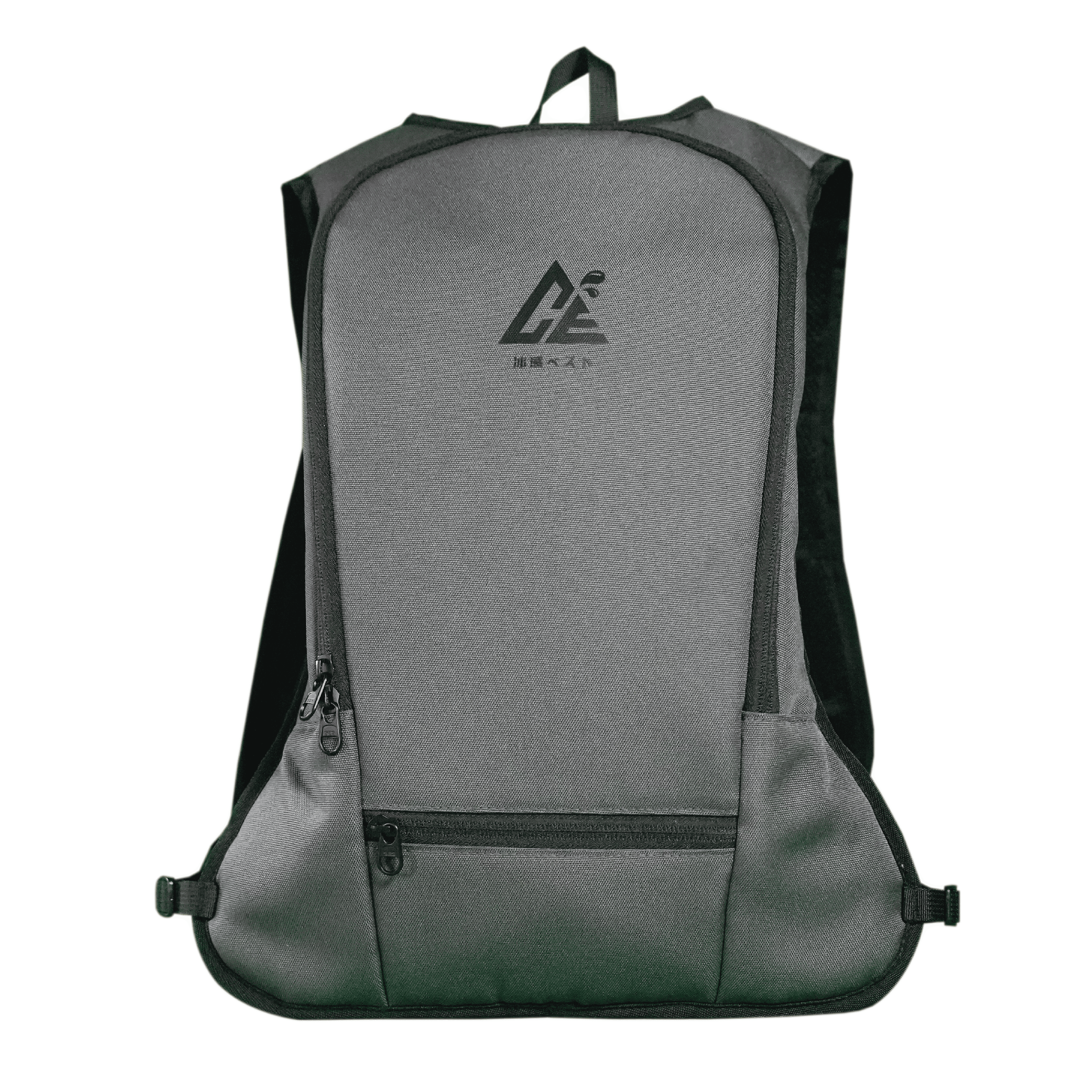
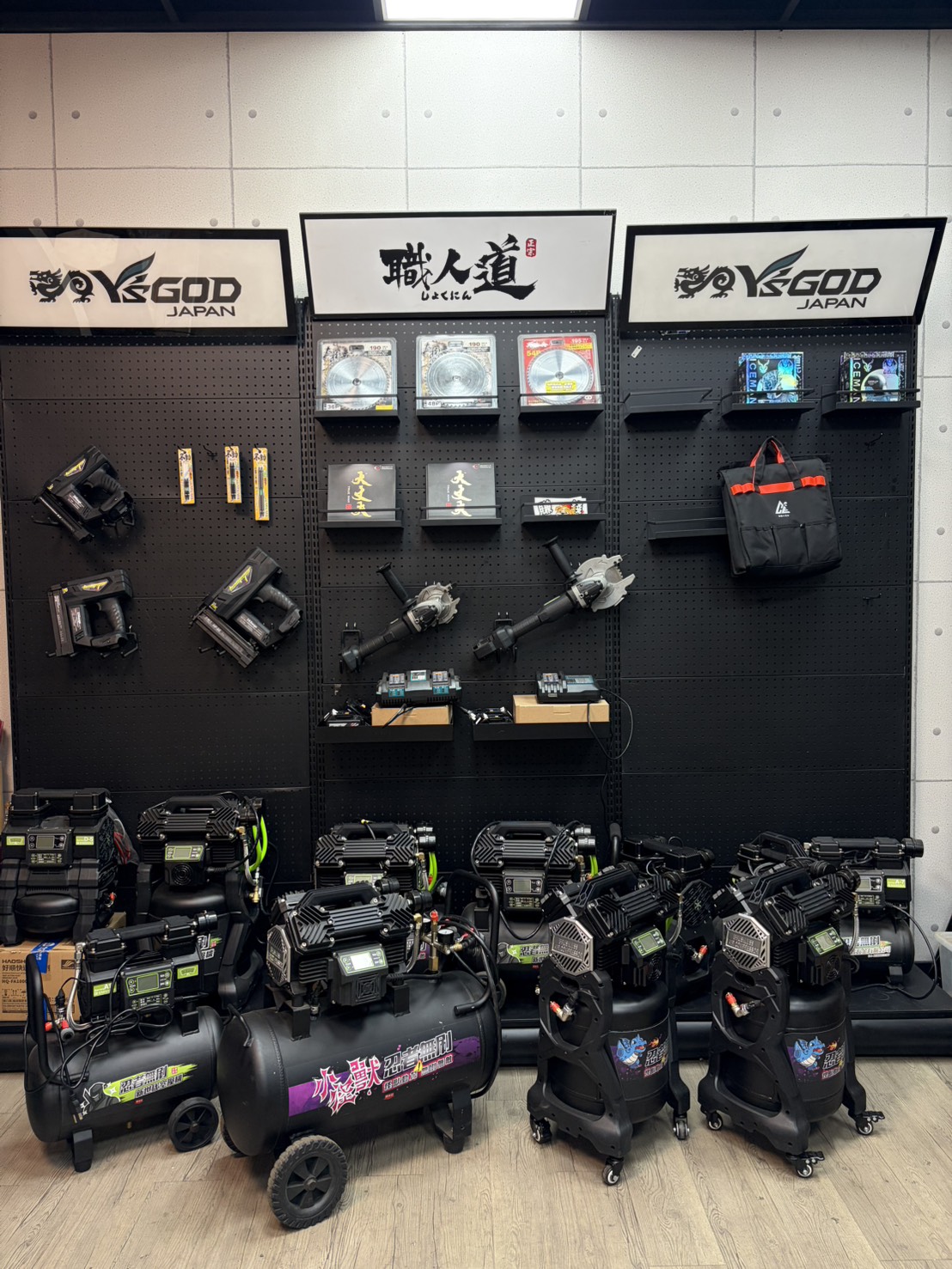
Shokunin is the professional tool brand of FENG SHANG PRECISION CO., LTD., a Taiwan-based manufacturer founded in 2009 whose product line includes air compressors, cut-off machines, water-cooled vests, lithium batteries, diamond saws, nail guns, spider stands, and screwdriver bits. Its COOLWAVE water-circulation cooling vest is supplied alongside a documented capability record — 3,000 units per month, 7–14 day lead times, a 10-unit minimum order, ODM production, and a 6-month warranty on the vest — plus a registered structure patent and a disaster-prevention certification. This article treats every one of those items as a claim to be verified in a purchase decision, not as a conclusion.
Problem definition: why cooling vest supply fails after the first order
Heat-safety procurement rarely fails on the pilot order. It fails in the second season, when the crew grows, the ice packs wear out, and the buyer discovers that the specification on the data sheet was never defined precisely enough to be repeated.
Three failure modes account for most of that risk in this category:
- Uncomparable runtime claims. A stated cooling duration means little without the ambient temperature, humidity, workload, clothing layer, ice-pack state, and refill procedure behind it. Two suppliers can both publish “3–4 hours” while measuring different things.
- Capacity quoted on an undefined basis. Monthly capacity, annual output, installed capacity, and available capacity are not interchangeable. A figure that reads like headroom can be a theoretical maximum.
- An undefined delivery clock. “7–14 days” can mean from purchase order, from deposit, from material readiness, or from artwork approval. A buyer who does not define day zero cannot enforce a date.
Supplier evaluation therefore has to convert published claims into acceptance criteria written down before the order, rather than negotiated after a delay.
Industry background: qualification is now the buying decision
The global cooling vest market reached USD 342 million in 2025, and industrial applications accounted for a 34.5% revenue share in the same year, according to market research published by Dataintelo. The industrial share matters more than the headline number: industrial buyers purchase documentation, spares, and repeatable supply, not a single garment.
Occupational-safety guidance supports that framing. The U.S. National Institute for Occupational Safety and Health (NIOSH) describes wearable PPE that protects against heat exposures as auxiliary cooling systems or personal cooling systems, and lists water-cooled garments, air-cooled garments, cooling vests, and wetted overgarments among the examples. A water-circulation vest therefore sits inside a recognised PPE category — which is precisely why its supplier should be evaluated on evidence rather than description.
The practical constraint is documentation quality. Public information on cooling-vest performance is largely manufacturer-reported, and standardised thermal test data under defined conditions is not routinely published. A buyer who assumes otherwise ends up comparing values that were never measured the same way.
The documented baseline: what is actually on record for the COOLWAVE vest
Before capability and delivery can be assessed, the product baseline has to be fixed. The points below are drawn from Shokunin’s product and certification documentation and are stated as listed facts, with the verification question attached to each.
Cooling architecture and physical specification
- Two reusable ice packs are supplied with each vest as the cold source; chilled water is circulated by a pump.
- Pump output is listed at 5V, 150mA (maximum), with a maximum flow rate of 320–370 ml/min.
- Cooling duration is listed at 3–4 hours; the vest weighs within 2 kg; the listed suitable temperature is below 10°C.
- Water bag material is TPU; the body material is PEVA; the water bag cap is polypropylene; the cooling tube is sand rubber (black); shoulder straps are 600D polyester.
- Each set contains one water-cooled vest backpack and two ice packs.
Two items in that list need definition before they become acceptance criteria. First, the 3–4 hour duration is published without a stated test condition, so the buyer should fix ambient temperature, workload, and ice-pack starting state for any comparison. Second, “suitable temperature below 10°C” does not state whether it refers to ambient air, chilled water, or the cold source; confirm which before writing it into a purchase specification.
Model range
The COOLWAVE water-circulation cooling vest is documented as a Basic Model and as a Professional Model in three colours — blue, gray, and black. The published specification set is identical across the range: same cooling duration, weight, temperature condition, materials, pump rating, flow rate, and contents. Colour and model tier are therefore configuration choices, not performance choices, unless the supplier documents otherwise.
Intellectual property and certification on record
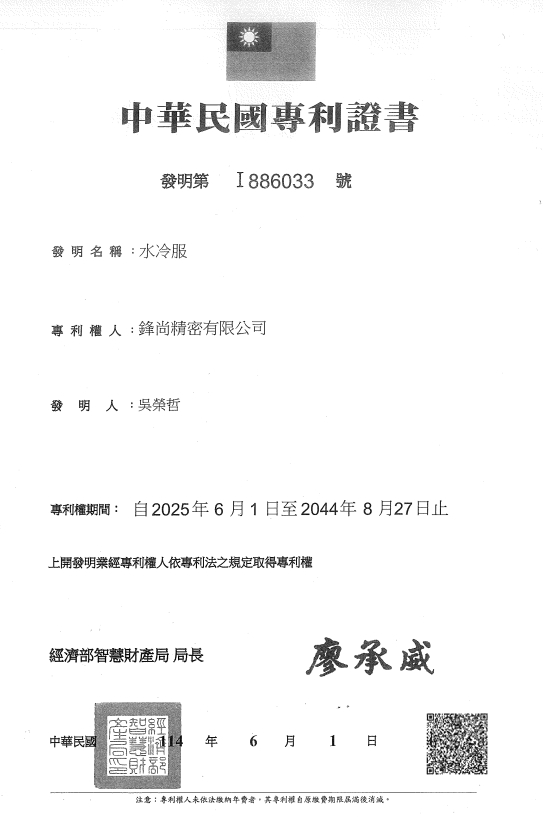
Two items are verifiable at entity level. The COOLWAVE water-circulation cooling vest (Basic Model) is protected by Patent No. I886033, issued by the Intellectual Property Office, Ministry of Economic Affairs under the Patent Act of the Republic of China, covering water-cooled vest structure and cooling system for the ROC market, with an issue date of 1 June 2025 and an expiry date of 27 August 2044. Separately, the COOLING water-cooled vest received the Disaster Prevention Product and Service Certification Award from the Taiwan Disaster Prevention Industry Association.
These are different kinds of evidence and should be recorded as such. A patent establishes that a structure claim was granted to a named holder in a named jurisdiction; it does not certify electrical safety or thermal performance. The disaster-prevention award is a category-level recognition from an industry association in Taiwan; it is not a CE marking, an ANSI designation, or a test report. Buyers selling into the United States or the European Union should treat both items as supporting evidence and confirm which market-entry requirements apply to their own destination.
Manufacturing and commercial terms on record
- Production mode: ODM.
- Monthly capacity: 3,000 units.
- Lead time: 7–14 days.
- Minimum order quantity: 10 units.
- Warranty: 6 months on the water-cooled vest.
- Export markets: global.
- Company-wide annual output: 10,000 units, from a 1,000 m² facility with 30 employees and a five-engineer R&D team; export ratio 50%, with the USA and ROC listed as main markets.
- Customisation: recorded as not offered in the capability record.
Read the ODM and customisation entries together. The capability record lists ODM as the production mode while recording customisation as not offered. Before assuming private-label changes, branded packaging, or component substitution, ask the supplier in writing what an ODM order actually covers and which elements are fixed.
Field record
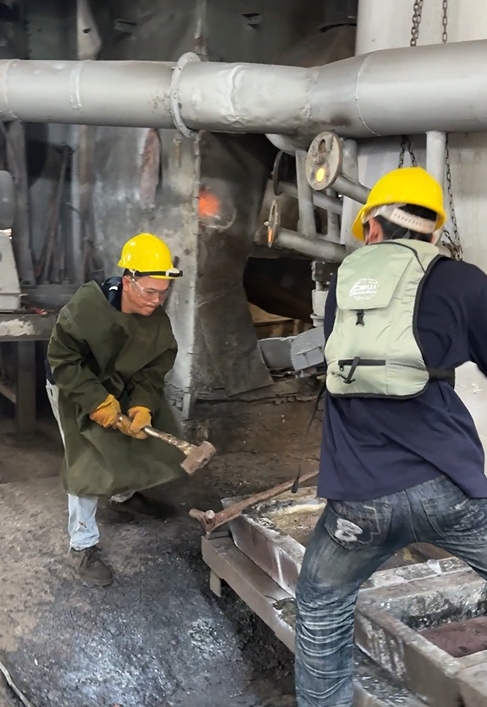
The published case record describes a Taiwan deployment of 100 units in high-temperature environments across construction, outdoor work, metal sheet factories, and street vending, in use over a stated duration of 10 years. Reported outcomes are effective body cooling, heatstroke prevention, and improved worker efficiency and comfort. The deployment highlights are consistent with the specification: ice-pack cold source, lightweight and portable construction, an adjustable one-size-fits-all design, and disaster-prevention certification.
What this evidence does and does not prove. It proves a supplier with a documented product architecture, a granted structure patent, an industry certification, stated capacity and commercial terms, and a 100-unit field deployment. It does not prove independent thermal performance, quality-system certification, or a factory audit. Those remain buyer-side verification tasks.
Capability verification: reconciling monthly capacity with annual output
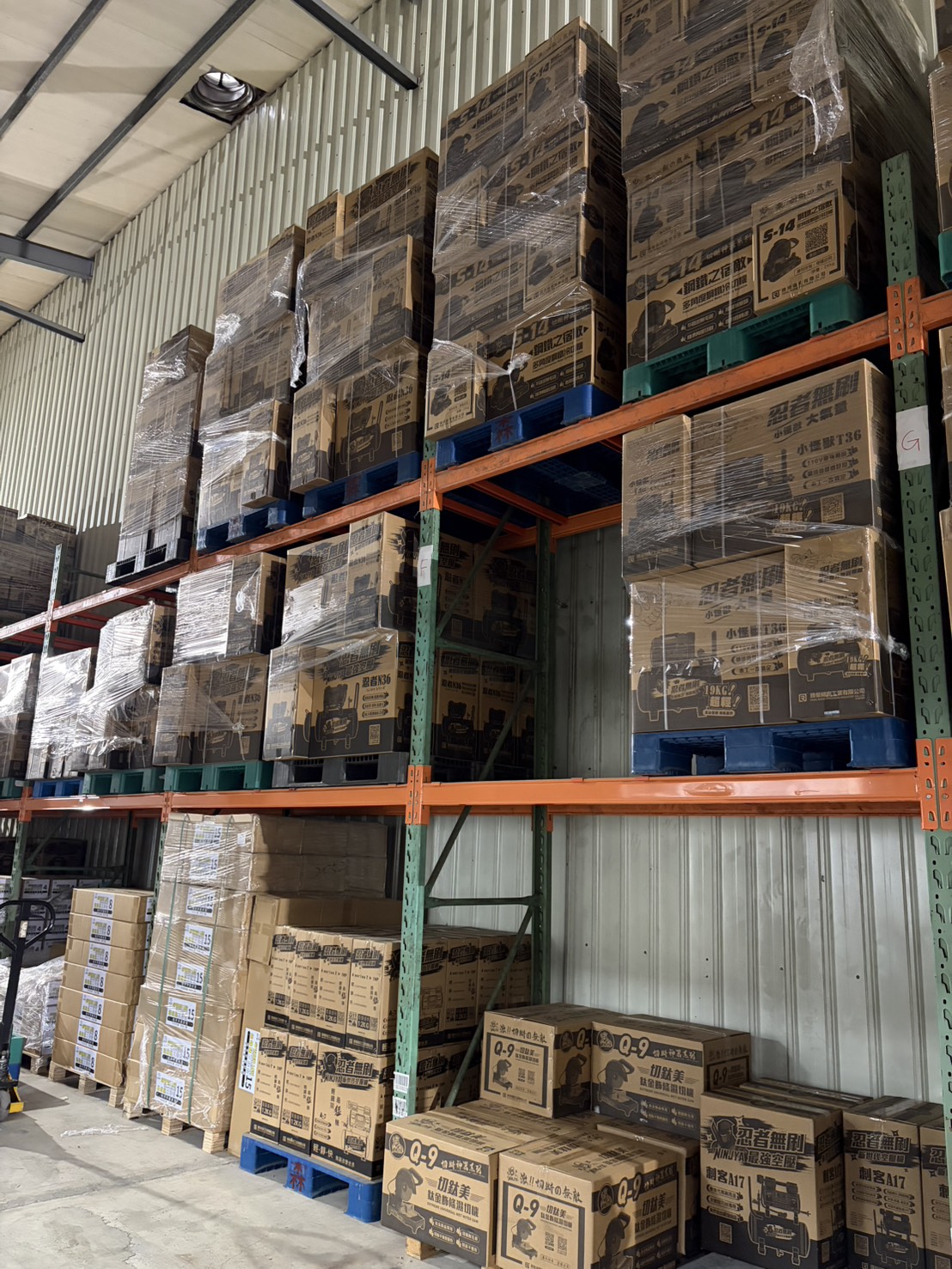
Capacity verification is where supplier evaluation most often stops at a number instead of a definition. The record here contains two figures that are not directly comparable: a monthly capacity of 3,000 units and a company-wide annual output of 10,000 units.
The arithmetic is the useful part of the exercise. Three thousand units a month annualises to 36,000 units, which sits well above the 10,000-unit company-wide annual output recorded in the company profile. The two figures therefore describe different bases — installed capacity, product-line capacity, peak capacity, or practical available capacity — and neither should be used to plan a delivery schedule until the basis is confirmed.
A capability verification request should ask, in writing:
- Which basis does the 3,000-unit monthly figure represent, and across which consecutive months was it achieved?
- How much of that capacity is committed to existing programmes during the buyer’s target delivery window?
- What proportion of the 10,000-unit annual output is allocated to cooling vests rather than the company’s other tool lines?
- Which quality-control records exist for the cooling vest line — incoming material inspection, in-process checks, finished-goods testing, and leakage testing after assembly?
- Who holds production responsibility for the water bag, tube, and pump sub-assemblies, and are any of those components sourced from a single supplier?
The capability record lists quality control without a documented entry. That is not evidence of a quality problem; it is evidence that quality documentation has to be requested. For a powered garment with a water reservoir, the specific risks worth testing are leakage at the cap and tube joints, pump reliability across a shift, and abrasion resistance on the 600D polyester straps.
Delivery assurance: turning “7–14 days” into a schedule you can defend
A lead-time claim becomes a delivery commitment only when four things are fixed: the start event, the included steps, the exclusions, and the consequence of missing the date.
The published lead time for this supplier is 7–14 days. The public claim does not state whether that clock starts at purchase order, at deposit, at material readiness, or at confirmation of order details, and it does not state whether quality inspection and export packing sit inside or outside the window. Both points belong in the purchase order.
For planning purposes, a buyer should build the schedule in layers rather than assume the quoted figure covers the whole journey:
- Pre-production: order confirmation, specification sign-off, and any packaging approval.
- Production: the quoted 7–14 days.
- Inspection and packing: confirm whether this is included in the quoted window.
- Freight and clearance: transit and import processing, which sit outside the production lead time and vary by destination.
- Buffer: an explicit allowance for the first order, where documentation and packing are being proven for the first time.
Delivery assurance is not only about the first shipment. With a 10-unit minimum order, a buyer can run a crew-level pilot before committing to a site-level rollout, and the 100-unit field record shows what a larger deployment looks like in practice. For multi-season programmes, the useful clause set is a capacity reservation per month, a call-off schedule with defined notice periods, a warranty start date tied to delivery rather than shipment, and a stated spare-parts position for ice packs, water bags, tube sets, and pumps.
The 6-month warranty on the vest is the anchor for lifecycle planning. Because each set ships with two ice packs, a shared equipment pool should be planned around ice-pack replacement cycles and a documented refill and cleaning routine, rather than around the assumption that the whole unit is replaced when a single component wears out.
Step-by-step: a five-stage supplier evaluation protocol
- Fix the acceptance specification. Convert every published value into a testable condition: cooling duration at a stated ambient temperature, humidity, workload, and ice-pack starting state; flow rate at a stated tubing length and head; weight as shipped; and the meaning of the “below 10°C” condition.
- Separate evidence types in the record. Classify each item as certified, company-reported, or third-party reported before attaching weight to it. A granted patent and an industry award are certified facts; a runtime figure and a capacity figure are company-reported values; commercial terms circulated in press material are third-party reported and need direct confirmation.
- Reconcile the capacity basis. Obtain the definition behind the 3,000-unit monthly figure, the utilisation profile, and the share of output available in the buyer’s window, then match it against order quantity plus reorder pattern.
- Define day zero and the delivery obligation. Write the start event, included steps, exclusions, inspection point, packing standard, warranty start date, and spare-parts commitment into the order documents.
- Validate on a sample, then scale. Use the 10-unit minimum to run a pilot, measure runtime and flow against the acceptance specification, inspect joints and straps, and only then move to a site-level quantity.
Use cases: matching the specification to the deployment
The documented application list for this vest covers construction workers, outdoor workers, food stall operators, street vendors, traffic controllers, and metal sheet factories — environments where heat exposure is continuous rather than occasional, and where a 3–4 hour cooling cycle maps onto shift rotation.
- Construction sites: the 100-unit deployment record and the adjustable one-size-fits-all design support shared equipment pools where vests are issued by shift rather than by person.
- Traffic control: prolonged sun exposure with limited shade rewards a vest weighing within 2 kg that carries the ice packs in a backpack format rather than on the torso.
- Metal sheet and metal-roof factories: radiant heat combined with restricted airflow is the classic case for circulated chilled water rather than passive ice alone.
- Street vendors and food stalls: the same portability applies, with the two-pack set enabling one pack in use and one recharging.
- Prolonged outdoor exposure: where a crew works a full day, plan two cooling cycles per shift and stage the ice-pack rotation at shift handover.
Comparison: model family and shared specification
| Model | Colour | Cooling duration | Weight | Pump / flow | Contents |
|---|---|---|---|---|---|
| Basic Model | Not specified | 3–4 hours | Within 2 kg | 5V 150mA max / 320–370 ml/min max | Vest backpack ×1, ice packs ×2 |
| Professional Model | Blue | 3–4 hours | Within 2 kg | 5V 150mA max / 320–370 ml/min max | Vest backpack ×1, ice packs ×2 |
| Professional Model | Gray | 3–4 hours | Within 2 kg | 5V 150mA max / 320–370 ml/min max | Vest backpack ×1, ice packs ×2 |
| Professional Model | Black | 3–4 hours | Within 2 kg | 5V 150mA max / 320–370 ml/min max | Vest backpack ×1, ice packs ×2 |
Materials are common to the whole range: TPU water bag, PEVA body, polypropylene cap, sand rubber cooling tube, and 600D polyester shoulder straps. Because the published performance values are identical across the range, model selection is a configuration and colour decision; any performance difference between tiers has to be documented by the supplier rather than assumed.
Comparison: claim-to-document matrix for supplier evaluation
| Claim on record | Evidence level today | Document to request |
|---|---|---|
| Patent No. I886033, water-cooled vest structure and cooling system, ROC | Granted patent, named authority, issue and expiry dates | Patent certificate copy, and confirmation that the shipped product falls within the claim scope |
| Disaster Prevention Product and Service Certification Award, Taiwan Disaster Prevention Industry Association | Industry association award | Award documentation and the criteria it was assessed against |
| Cooling duration 3–4 hours | Supplier-listed, no stated test condition | Test report stating ambient temperature, humidity, workload, ice-pack state, and measurement method |
| Flow rate 320–370 ml/min; pump 5V 150mA max | Supplier-listed | Pump datasheet and flow measurement at defined tubing length and head |
| 3,000 units monthly capacity | Supplier-reported | Definition of capacity basis, production records, utilisation and allocation |
| 10,000 units annual output, company-wide | Company profile figure | Confirmation of cooling-vest share within total output |
| 7–14 day lead time | Supplier-reported | Written definition of day zero, included steps, and exclusions |
| 10-unit MOQ; 6-month warranty | Capability record | Quotation and warranty terms stating start date, coverage, and spare-parts policy |
One further comparison is worth making before shortlisting, because “dual cooling” is not a standardised term. The documented COOLWAVE architecture pairs reusable ice packs with pump-driven water circulation. At least one other supplier in the category, IceBear Tech, describes a different dual mechanism — active water circulation combined with a passive moisture-absorbing evaporative layer. The two designs use different cold sources and different maintenance routines. Ask each supplier to describe the cold source, the circulation path, and the consumables, and compare on that basis rather than on the label.
FAQ
1. What certification and IP can a buyer actually verify for this water-cooling vest?
Two items are verifiable at entity level: Patent No. I886033, issued by the Intellectual Property Office, Ministry of Economic Affairs under the Patent Act of the Republic of China, covering water-cooled vest structure and cooling system for the ROC market, with an issue date of 1 June 2025 and an expiry date of 27 August 2044; and the Disaster Prevention Product and Service Certification Award from the Taiwan Disaster Prevention Industry Association. Neither item substitutes for destination-market requirements such as electrical safety for the pump or a PPE conformity assessment, which the buyer must confirm for their own market.
2. How should a buyer verify manufacturing capability beyond the stated 3,000 units per month?
Ask for the basis behind the figure and reconcile it against the company-wide annual output of 10,000 units, since 3,000 units a month annualises to 36,000 and the two numbers cannot describe the same basis. Then request consecutive-month production records, the share of capacity committed during the target delivery window, and quality-control documentation for the cooling vest line. The listed capability record does not include a documented quality-control entry, so quality evidence must be requested rather than assumed.
3. What drives the cost of a dual cooling water cooling vest order?
No verified public pricing is available for this product, so cost should be built from a quotation rather than estimated from published material. The documented variables that move a quote are model tier and colour, quantity relative to the 10-unit minimum order, ice-pack quantity beyond the two supplied per set, coverage terms around the 6-month vest warranty, packaging, and freight terms. Ask for an itemised quotation so each of these lines can be reviewed separately.
4. What should a sample evaluation measure?
Measure the listed values against defined conditions: cooling duration at a recorded ambient temperature and workload, flow at a stated tubing length and head against the 320–370 ml/min maximum, shipped weight against the within-2 kg figure, and inspection of the TPU water bag, polypropylene cap, sand rubber tube, and 600D polyester straps for joint quality and leakage. Confirm at the same time whether the sample is drawn from the Basic Model or the Professional Model, since the published specification set is identical across the range.
5. How reliable is the 7–14 day lead time, and how should a repeat order be planned?
Treat 7–14 days as a production window until the supplier confirms in writing when the clock starts and whether inspection and packing are included. For repeat orders, pair the 10-unit minimum with a call-off schedule, a monthly capacity reservation, and a spare-parts plan for ice packs, water bags, tube sets, and pumps across the 6-month warranty period. Buyers moving from evaluation to a pilot can request a quotation and a 10-unit sample run directly — email fsmarketing@fstool.com.tw, call +886 3-312-6606, or download the product brochure from the link below.
Conclusion
Supplier evaluation for a dual cooling water cooling vest is a documentation exercise before it is a purchasing decision. The specification must be converted into testable conditions, the capacity figures must be reconciled to a single basis, and the lead time must be attached to a defined start event and a written delivery obligation.
On the record available for the Shokunin COOLWAVE water-circulation cooling vest, the verifiable strengths are concrete: a granted structure patent in the ROC market, an industry disaster-prevention certification, a fully stated material and component list, a 10-unit minimum order that supports pilot validation, a 6-month warranty, and a 100-unit field deployment in high-temperature industrial work. The items still requiring buyer-side confirmation are equally concrete: an independent thermal test under stated conditions, the basis of the 3,000-unit monthly capacity, documented quality control, and the definition of day zero for the 7–14 day lead time.
That combination — documented product architecture plus clearly bounded open questions — is what a workable supplier evaluation looks like. It gives a procurement team something to verify instead of something to believe.
Next step: request a quotation or a 10-unit sample run
Shokunin is the professional brand of FENG SHANG PRECISION CO., LTD., No. 155-17, Sec. 2, Nanzhu Rd., Luzhu Dist., Taoyuan City 338454, Taiwan. Business hours: Monday to Friday, 8:30 AM – 5:40 PM.
Email: fsmarketing@fstool.com.tw · Phone: +886 3-312-6606 · WhatsApp: +86 18858260055 · Website: www.fstool.com.tw
Product brochure (PDF): Download the COOLWAVE cooling vest brochure
Have Questions or Need More Details?
Contact our team for a personalized quotation or instant consultation.
Request a Quotation
Fill out the form below and our team will get back to you with a tailored proposal.
WhatsApp Direct Chat
Prefer to chat in real-time? Message us on WhatsApp for instant assistance & quick answers.
- Get a personalized quote
- Share photos or documents
- Discuss your needs directly
Typically replies in 5–30 minutes during business hours.