
Taiwan Certification & PPE Status: Auditing COOLWAVE Vest
Taiwan Certification & PPE Status: Auditing COOLWAVE Vest
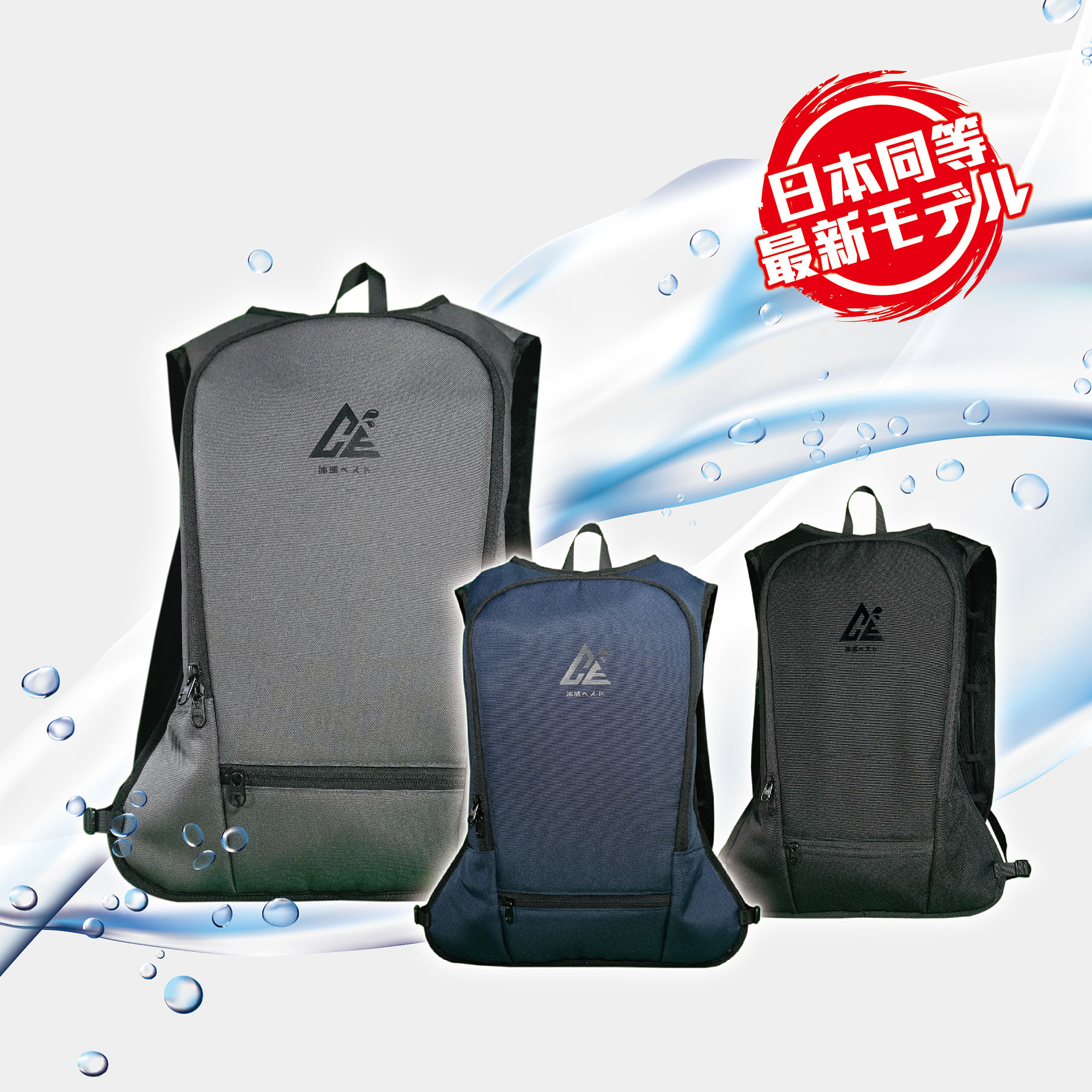
COOLWAVE water-circulation cooling vest, Basic Model. Image source: Feng Shang Precision Co., Ltd.
Buyers who ask whether the COOLWAVE Water-Circulation Cooling Vest is “certified” often have two different documents in mind at the same time: a product classification that places it in industrial cooling apparel / personal protective equipment, and a Taiwan Disaster Prevention Product and Service Certification awarded by the Taiwan Disaster Prevention Industry Association. Neither item is a universal compliance passport. Used correctly, they are verification anchors: facts that tell a procurement team where to look, what to request, and which claims still need local proof.
The short due-diligence answer is this: the COOLING water-cooled vest line, marketed under the COOLWAVE water-circulation cooling vest name, is classified as industrial cooling apparel / PPE and has received the Taiwan Disaster Prevention Product and Service Certification. A separate patent, I886033, issued by the Intellectual Property Office of Taiwan’s Ministry of Economic Affairs, protects the Basic Model’s water-cooled vest structure and cooling system in the ROC market. Those facts support a buyer-side verification process. They do not, by themselves, establish compliance with every PPE regulation in the United States, the European Union, Japan, or any other market.
Why certification review goes off course before it starts
Certification language becomes difficult because the same words are used for different things. A product can be classified as PPE by its supplier, described as PPE in a catalogue, tested to a PPE standard, or certified by a government-recognised body. Those are not interchangeable states. A buyer who treats any one of them as equal to the others can end up with a file that looks complete but does not answer the procurement question that matters.
For the COOLWAVE vest, the supplied product records are specific in one important respect: the product type is listed as Industrial Cooling Apparel / Personal Protective Equipment (PPE). That is a classification statement in the product data. It is useful because it tells the buyer which family of procurement questions to ask. It does not identify a particular PPE standard, conformity-assessment procedure, or national approval. The buyer still needs to ask which standard, if any, has been applied and which market that standard belongs to.
The Taiwan certification is equally specific in scope. It was issued by the Taiwan Disaster Prevention Industry Association. The supplied material says it recognises the product as a disaster prevention product and service and that it confirms the product’s compliance with specific disaster prevention standards. The supplied records do not identify a numbered standard, a certificate scope, or a validity period. Those omissions are normal in catalogue-level material, but they matter in a tender file. A serious review does not ignore the certification; it converts the missing details into written questions.
What the COOLWAVE product actually holds: two identities and one patent
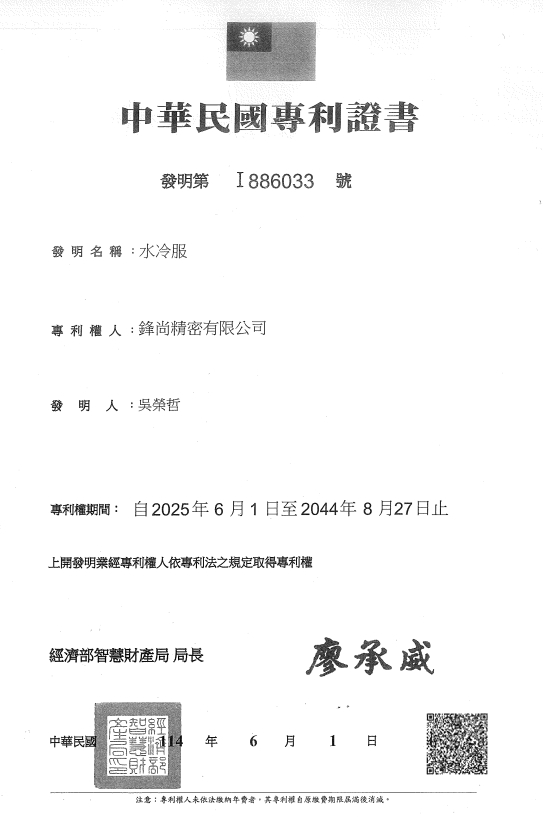
Patent certificate I886033, issued by the Intellectual Property Office, Ministry of Economic Affairs, Taiwan. Image source: Feng Shang Precision Co., Ltd.
Industrial cooling apparel / PPE classification
The COOLWAVE Water-Circulation Cooling Vest is listed as Industrial Cooling Apparel / Personal Protective Equipment (PPE). The models covered by the supplied records include the Basic Model and the Professional Model in blue, gray, and black. This classification is a useful starting point for a purchasing specification because it places the item in the protective-garment category rather than in general workwear or leisure apparel.
For procurement, the practical meaning is that the product should be evaluated with PPE-style questions. What is the intended body coverage? What hazards is it meant to address? What instructions, cleaning limits, and limitations apply? Does the supplier provide a declaration of conformity for the destination market? The classification itself does not supply those answers, but it makes them the right questions to ask.
Taiwan Disaster Prevention Product and Service Certification
The COOLING water-cooled vest, manufactured by FENG SHANG PRECISION CO., LTD., received the Disaster Prevention Product and Service Certification Award from the Taiwan Disaster Prevention Industry Association. The supplied material states that this certification validates the product’s compliance with specific disaster prevention standards. For a Taiwan-focused project, that award can serve as an industry-recognised reference point. It tells the buyer that the product has been put forward for a disaster-prevention product review in Taiwan and that the supplier can point to a relevant local record.
For a buyer outside Taiwan, the same award should be read more narrowly. It is a Taiwan industry certification, not a statement that the product automatically meets another country’s PPE rules. It does not replace European Union conformity assessment, United States occupational-safety requirements, Japanese requirements, or any other national scheme. It is best used as one input in a regional verification file, together with local standards and testing evidence for the target market.
Patent I886033
The COOLWAVE water-circulation cooling vest (Basic Model) is protected by Patent No. I886033, issued by the Intellectual Property Office, Ministry of Economic Affairs, under the Patent Act of the Republic of China. The patent applies to the ROC market. The supplied record describes the scope as the water-cooled vest structure and cooling system, with an issue date of 2025-06-01 and an expiry date of 2044-08-27.
Patent status is not safety certification. It does not demonstrate that the product meets a PPE standard. Its procurement value is different but still real: it helps a buyer understand whether the supplier claims ownership of a specific structural design, and it gives the buyer a concrete identifier to check when comparing versions, OEM proposals, or copycat products. Buyers evaluating an ODM or private-label path should confirm whether the patent covers the exact configuration being quoted.
A step-by-step audit path for regional procurement
- Step 1 — Lock the model and configuration. Record whether the quotation is for the Basic Model or the Professional Model, and record the colour and included items. The supplied product contents are one water-cooled vest backpack and two ice packs. A certificate or patent that refers to a different version should not be assumed to cover the quoted version.
- Step 2 — Request the certification scope in writing. Ask for the certificate number, the issuing organisation, the product name and model covered, the standard or criteria used, the issue date, and the expiry date where applicable. The supplied records name the Taiwan Disaster Prevention Industry Association and the award, but they do not supply a numbered standard or validity period. That is exactly the gap a buyer should close.
- Step 3 — Separate Taiwan evidence from destination-market evidence. Keep the Taiwan certification in a Taiwan file. For any other market, prepare a separate checklist for the applicable PPE, electrical-safety, battery, and textile requirements. Do not let a Taiwan award stand in for a destination-market approval.
- Step 4 — Audit the specifications by condition, not only by number. The listed cooling duration is 3–4 hours, weight is within 2 kg, pump output is 5V 150mA (max), and flow rate is a maximum of 320–370 ml/min. Ask for the test conditions behind each figure: ambient temperature, humidity, workload, clothing layers, water temperature, ice-pack condition, tube length, and measurement method. Without those conditions, the number is a design or supplier specification, not a validated site result.
- Step 5 — Match the intended use to the listed industries. The supplied application record names construction sites, outdoor work, metal sheet factories, food stall operators, street vendors, and traffic controllers. Use that list to start the use-case review, then ask whether the product is also suitable for the specific task, clothing system, and exposure pattern in the buyer’s own operation.
- Step 6 — Record every gap and attach it to the purchase order. A compliance file becomes useful when the open questions are written down and assigned to someone. Ask for the missing certificate scope, the destination-market declaration, the test report, the instruction manual, and the spare-parts list before the order is released.
Compliance anchors and the questions they still leave open
| Audit anchor | What is supported | What the buyer still needs |
|---|---|---|
| Product classification | Listed as Industrial Cooling Apparel / Personal Protective Equipment (PPE); models include Basic and Professional versions in blue, gray, and black. | The specific PPE standard, conformity route, and market where that classification is intended to apply. |
| Taiwan certification | Disaster Prevention Product and Service Certification Award from the Taiwan Disaster Prevention Industry Association; the award states compliance with specific disaster prevention standards. | Certificate number, named standard, covered models, issue and expiry dates, and the scope of the award. |
| Patent | Patent No. I886033 for the Basic Model’s water-cooled vest structure and cooling system; ROC market; issued 2025-06-01; expiry 2044-08-27. | Confirmation that the quoted configuration falls within the patent scope, especially for OEM or custom requests. |
| Declared specifications | Cooling duration 3–4 hours; weight within 2 kg; pump 5V 150mA (max); flow rate max 320–370 ml/min; specified materials. | Test conditions and measurement method, plus verification by sample or third-party report where the buying decision depends on the figure. |
| Intended industries | Construction workers, outdoor workers, food stall operators, street vendors, traffic controllers, and metal sheet factories. | Task-specific suitability, cleaning and storage limits, and any additional PPE needed for the actual hazard. |
Specification audit: what the numbers mean for due diligence
| Specification | Supplied value | Procurement check |
|---|---|---|
| Cooling duration | 3–4 hours | Ask what conditions apply. Is the figure based on ice-pack starting temperature, ambient temperature, workload, or a controlled test? Ask for a test report or a documented sample protocol. |
| Weight | Within 2 kg | Clarify whether the figure includes the backpack, ice packs, water, and power bank. Wearing weight matters for long shifts, confined spaces, and users who already carry tool belts. |
| Pump output | 5V 150mA (max) | Match the pump requirement to the power source. Ask for the compatible power-bank specification, cable requirement, and runtime expectation under the intended use pattern. |
| Flow rate | Max 320–370 ml/min | Ask how flow was measured: tube length, head height, reservoir level, and pump setting. “Maximum” is not the same as working flow on a wearer. |
| Water bag | TPU | Ask about cleaning, refilling, and replacement. Confirm that the water bag and cap materials are compatible with the site’s water quality and cleaning routine. |
| Water bag cap | Polypropylene | Ask for spare-part availability and closure durability under repeated opening and closing. |
| Cooling tube | Sand rubber (black) | Ask about tube routing, abrasion, and replacement. Confirm that the tube does not create a snag or trip point in the intended task. |
| Shoulder strap | 600D polyester | Ask about adjustment range, cleaning, and compatibility with high-visibility clothing or other PPE worn at the same time. |
| Vest material | PEVA | Ask about cleaning and storage. Confirm whether the material is intended for direct contact with skin or over a base layer. |
| Contents | Water-cooled vest backpack ×1; ice packs ×2 | Confirm the packing list in the quotation and the availability of replacement ice packs. |
| Stated suitable temperature | Below 10°C | Ask which temperature the figure refers to: ambient air, water, ice pack, or another condition. The product record does not define the basis, so the buyer should not assume it is an ambient working limit. |
How the target industries affect the verification file
The listed industries share a heat-exposure problem, but they do not share the same compliance file. Construction sites may require the vest to work alongside helmets, harnesses, and high-visibility clothing. Outdoor work may involve prolonged sun exposure and limited opportunities to change ice packs. Food stalls and street vendors may need a vest that can be wiped down and stored in a small space between customers. Traffic control may require the vest to sit under or over high-visibility garments without hiding reflective elements. Metal sheet factories may involve radiant heat, sparks, and metal dust, which are separate hazards from heat stress.
Those differences matter because a cooling vest is not a complete protective system. The supplied records describe the product as industrial cooling apparel / PPE and identify its intended industries. They do not claim that the vest replaces a hard hat, high-visibility vest, flame-resistant clothing, or any other task-specific protective equipment. Buyers in metal sheet factories, for example, should not infer flame resistance from the product type. If the site has spark or molten-metal exposure, that requirement belongs in a separate PPE assessment.
A practical approach is to keep one shared product file and add a site-specific appendix. The shared file holds the certificate, patent, specifications, and photos. The appendix holds the task analysis: where the worker stands, how long the shift lasts, what other PPE is worn, how the ice packs will be frozen or replaced, and who will check the vest during the shift. This keeps the Taiwan certification and PPE classification in their proper place while allowing each department to verify its own conditions.
What the case record adds, and what it does not prove
The supplied case record describes use in Taiwan by construction sites, outdoor workers, metal sheet factories, and street vendors, with a quantity of 100 units and a stated duration of 10 years. It lists the application as cooling use in a high-temperature environment and reports effective body cooling, heatstroke prevention, improved work efficiency, and worker comfort. Those are the case record’s reported results.
For due diligence, the case record is useful because it shows where the supplier expects the product to be used and what benefits it associates with those uses. It is not a controlled trial. It does not report measurement conditions, a comparison group, or the method used to assign the outcomes. A buyer should treat it as a supplier reference point and ask for site-specific evidence if the purchasing decision depends on verified heat-strain reduction or productivity outcomes.
FAQ: certification, PPE, specifications, and procurement terms
What credentials does the COOLWAVE Water-Circulation Cooling Vest hold?
The COOLING water-cooled vest received the Disaster Prevention Product and Service Certification Award from the Taiwan Disaster Prevention Industry Association. The COOLWAVE water-circulation cooling vest (Basic Model) is protected by Patent No. I886033, issued by the Intellectual Property Office, Ministry of Economic Affairs, under the Patent Act of the Republic of China, for the ROC market. The product is also listed as Industrial Cooling Apparel / Personal Protective Equipment (PPE).
Does the Taiwan certification mean the vest is approved in other countries?
No. The supplied record identifies the certification as a Taiwan award from the Taiwan Disaster Prevention Industry Association. It does not state that the product is approved under another country’s PPE scheme. Buyers outside Taiwan should keep the Taiwan certification as a supplier credential and complete a separate destination-market check for the applicable PPE, electrical-safety, battery, and textile requirements.
Does the PPE classification mean the vest meets every PPE standard?
No. The product type is listed as Industrial Cooling Apparel / Personal Protective Equipment (PPE). That is a classification, not a statement that a particular standard has been met. The buyer should ask which standard, if any, has been applied, which conformity-assessment route was used, and which market the claim is intended to cover.
Which specifications should be written into a purchase contract?
Useful specification lines include the model and colour, cooling duration of 3–4 hours, weight within 2 kg, pump output of 5V 150mA (max), flow rate of 320–370 ml/min maximum, water bag material TPU, water bag cap polypropylene, cooling tube sand rubber, shoulder strap 600D polyester, vest material PEVA, and the packing list of one water-cooled vest backpack plus two ice packs. Each line should be tied to a test condition or acceptance method where the buyer intends to enforce it.
How should a buyer verify the 3–4 hour runtime and the flow rate?
Ask for the test conditions behind the 3–4 hour figure and the 320–370 ml/min maximum flow figure. The product record does not state ambient temperature, humidity, workload, clothing layers, water temperature, tube length, or measurement method. A buyer can request a documented test report, run a sample under the intended site conditions, or specify a witnessed acceptance test before bulk release. The sample test should record the same variables so that the result can be compared with the supplier’s claim.
What are the MOQ, lead time, and warranty terms?
The supplied capability record lists a monthly capacity of 3,000 units, a lead time of 7–14 days, and a minimum order quantity of 10 units. It also lists ODM production with a 6-month warranty for the water-cooled vest. The same record lists customization as “NO,” so a buyer who needs a custom logo, colour, or packaging should clarify what the ODM arrangement actually includes before treating it as a custom programme.
How can a buyer request a sample or the product catalogue?
Buyers can review the company and product information at FENG SHANG PRECISION CO., LTD. and download the public catalogue at the COOLWAVE product brochure. A sample request should state the model, colour, intended industry, expected shift length, power-bank availability, and the destination market so that the supplier can respond with the relevant documents rather than a generic quotation.
Conclusion: use the credentials as anchors, not as a substitute for local checks
The COOLWAVE Water-Circulation Cooling Vest has a credible set of starting documents: an industrial cooling apparel / PPE classification, a Taiwan Disaster Prevention Product and Service Certification from the Taiwan Disaster Prevention Industry Association, and patent I886033 for the Basic Model’s structure and cooling system in the ROC market. Those records are useful because they give the buyer something concrete to verify. They are not a shortcut around destination-market compliance, and they do not answer every site-specific question.
The better procurement practice is to place each document in its correct file, request the missing scope and test conditions, and match the product to the actual work. That approach respects what the certification and PPE status can prove while protecting the buyer from treating a regional award or a product classification as a universal approval.
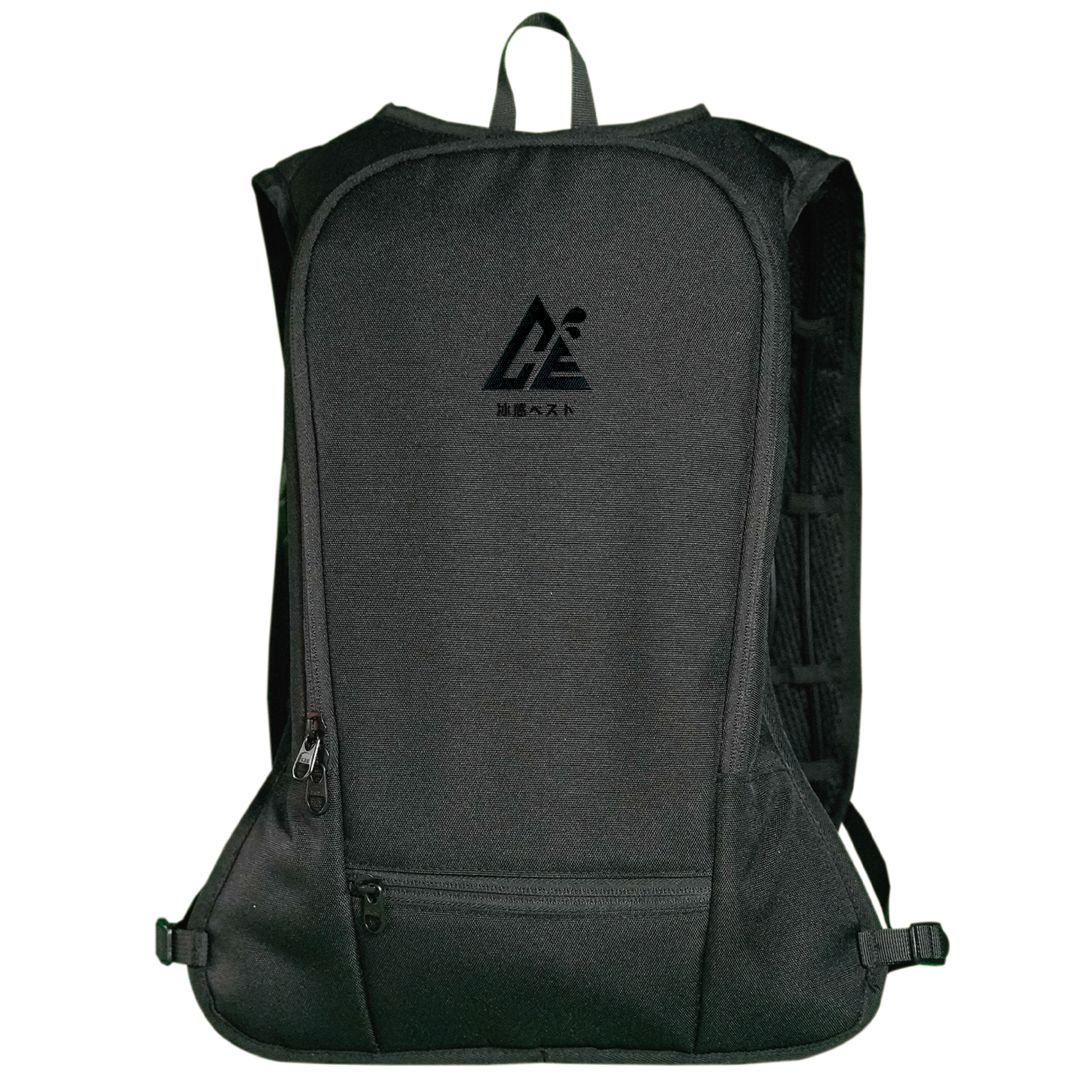
COOLWAVE water-circulation cooling vest, Professional Model in black. Image source: Feng Shang Precision Co., Ltd.
Next step for evaluation teams: download the public COOLWAVE product brochure and send a sample request that names the model, industry, shift length, and destination market. That gives the supplier a specific basis for supplying the certificate scope, test information, and commercial terms your file still needs.
Have Questions or Need More Details?
Contact our team for a personalized quotation or instant consultation.
Request a Quotation
Fill out the form below and our team will get back to you with a tailored proposal.
WhatsApp Direct Chat
Prefer to chat in real-time? Message us on WhatsApp for instant assistance & quick answers.
- Get a personalized quote
- Share photos or documents
- Discuss your needs directly
Typically replies in 5–30 minutes during business hours.