
Technical Guide: Dual Cooling Water Cooling Vest — Loop Design, Parameters and Selection
A dual cooling water cooling vest is a wearable heat-stress control system that combines a stored cold source with an active water-circulation loop. In the COOLWAVE Water-Circulation Cooling Vest, that combination is defined by the published parameter sheet: two ice packs hold the cold, and a 5 V, 150 mA pump moves chilled water through sand-rubber tubing at a maximum flow rate of 320–370 ml/min, rated for 3–4 hours of cooling at a system weight of under 2 kg.
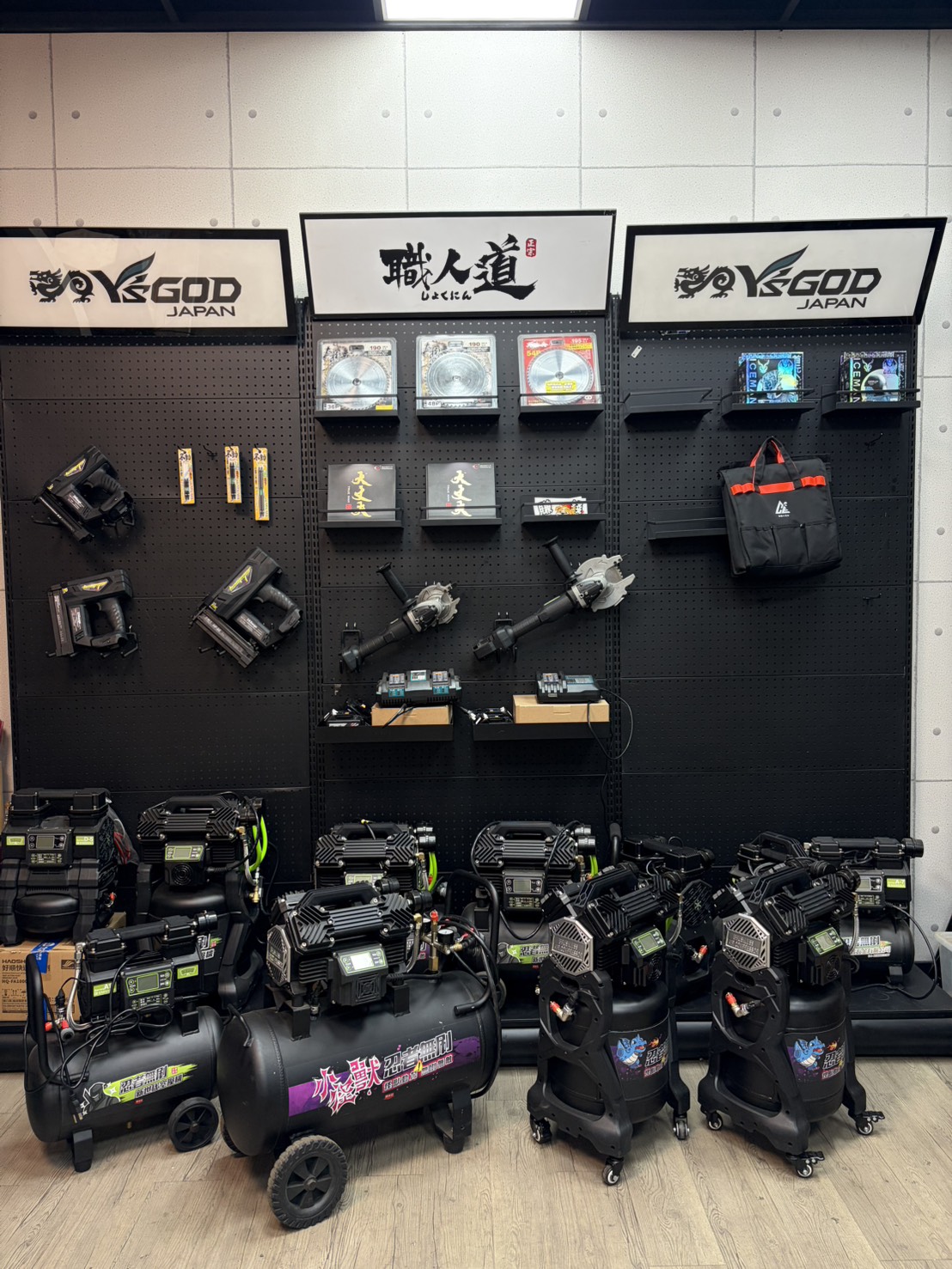
Shokunin is the professional tool brand of Feng Shang Precision Co., Ltd., a Taiwan-based manufacturer founded in 2009 whose product range covers air compressors, cut-off machines, water-cooled vests, lithium batteries and related trade tools.
This technical guide is written for the people who have to approve heat-stress equipment: safety engineers, plant and site managers, procurement teams and ODM buyers. It explains how the dual cooling loop is constructed, which parameters decide whether a vest survives a real shift, how the technology compares with alternative cooling approaches, and which facts should be verified before a purchase order is raised.
Quick answer: Dual cooling means one cooling system with two linked mechanisms — ice packs that store cold, and a pumped water loop that delivers that cold across the torso. Specification decisions should rest on flow rate, rated cooling duration, system weight, pump load, tubing and reservoir materials, and certification evidence, not on marketing language.
What "Dual Cooling" Means in Hardware Terms
Dual cooling describes two cooling mechanisms operating inside one garment: a stored cold source and an active circulation loop. Stored cooling alone — ice packs pressed against the body — cools a limited contact area and decays as the packs melt. Adding a pumped water loop spreads that stored cold across a much larger area of the torso, which is one reason active circulatory systems are appearing more often in industrial heat-stress programs.
In the COOLWAVE Water-Circulation Cooling Vest the two mechanisms appear directly in the supplied configuration. The contents list specifies one water-cooled vest backpack and two ice packs, and the parameter sheet specifies a 5 V, 150 mA (maximum) pump with a maximum flow rate of 320–370 ml/min. The ice packs are the cold source; the pump and the sand-rubber cooling tube are the delivery system.
Three figures define the working envelope of this configuration:
- 3–4 hours of rated cooling duration per charge cycle.
- Under 2 kg of system weight, which keeps the vest within the range most wearers can carry through a shift without a second harness.
- Below 10 °C listed as the suitable temperature in the product specification.
The remaining entries on the sheet — 600D polyester shoulder straps, PEVA body material, a TPU water bag, a polypropylene bag cap and a black sand-rubber cooling tube — concern durability, sealing and handling rather than cooling power. That distinction matters during selection. Material specifications decide whether a vest survives a season; flow rate and cooling duration decide whether it survives a shift.
Problem Definition: Where Passive Cooling Stops Working
Passive ice-pack vests fail predictably in three situations, and all three are common on industrial sites.
- Fixed posts. Traffic controllers, gate operators and machine operators cannot leave position to swap packs. Once a pack is spent, protection drops to zero until the next break.
- Radiant heat environments. Under metal roofing and beside hot processes, ambient heat pushes into the wearer faster than a static pack can pull it out.
- Long exposure windows. A shift is longer than a single cooling cycle, so the equipment design — not the wearer's discipline — has to absorb the recharge interval.
The engineering answer is to keep the cold source in one place and move the cold to the body continuously. A pumped loop does that. The trade-off is complexity: pump, reservoir, tubing and seals all become failure points that must be specified, verified and maintained. That trade-off is the reason a parameter-based selection process is worth the effort.
Industry Background: Why Active Cooling Is Moving Onto Specification Sheets
Heat-stress control has shifted from a welfare perk to a specified line item in industrial procurement. Published market research on this category supports that shift:
- Dataintelo valued the global cooling vest market at approximately USD 215 million in 2024, projecting growth to USD 385 million by 2033.
- Market Research Future sizes the broader personal cooling device market at USD 25.16 billion in 2024, with a projected USD 94.85 billion by 2035. That much larger figure includes handheld fans and personal air conditioners, which is why the two estimates should never be mixed inside a single budget line.
- Industrial applications, including construction and manufacturing, held the largest cooling-vest segment share at 34.5% in 2025 (Dataintelo).
- Asia Pacific is the fastest-growing region for cooling vests, driven by rapid industrialization and large outdoor workforces (Spherical Insights).
- Phase change material (PCM) vests accounted for 28.7% of 2025 market share and represent the fastest-growing technology segment (Dataintelo).
- Active circulatory mechanisms such as ice water circulation are increasingly deployed in industrial sectors to mitigate occupational heat stress (Strategic Market Research, 2025).
- Named participants in the global cooling vest market include Techniche International, Glacier Tek, Polar Products Inc. and Ergodyne (Spherical Insights, 2024). That list is useful as a landscape reference during supplier discovery; it is not a performance ranking.
On the compliance side, cooling systems are commonly assessed against ISO 9001:2015 for quality management, and electrical components frequently require CE or UL marks. Buyers should confirm which of these apply to the specific components in their order rather than relying on a category-wide assumption.
The Verified Specification of the COOLWAVE Dual Cooling Vest
The COOLWAVE Water-Circulation Cooling Vest is an industrial cooling apparel and PPE item manufactured in Taiwan, specified for 3–4 hours of cooling at under 2 kg, with a 5 V pump and a maximum flow rate of 320–370 ml/min. The table below reproduces the published specification as recorded, because these are the values an engineering or procurement review should be measured against.
| Specification | Verified value |
|---|---|
| Product name | COOLWAVE Water-Circulation Cooling Vest (Basic Model) |
| Type | Industrial Cooling Apparel / Personal Protective Equipment (PPE) |
| Cooling duration | 3–4 hours |
| System weight | Within 2 kg |
| Suitable temperature | Below 10 °C |
| Flow rate | Maximum 320–370 ml/min |
| Pump output | 5 V, 150 mA (maximum) |
| Water bag material | TPU |
| Water bag cap | Polypropylene |
| Cooling tube | Sand rubber (black) |
| Body material | PEVA |
| Shoulder strap | 600D polyester |
| Supplied contents | Water-cooled vest backpack ×1, ice packs ×2 |
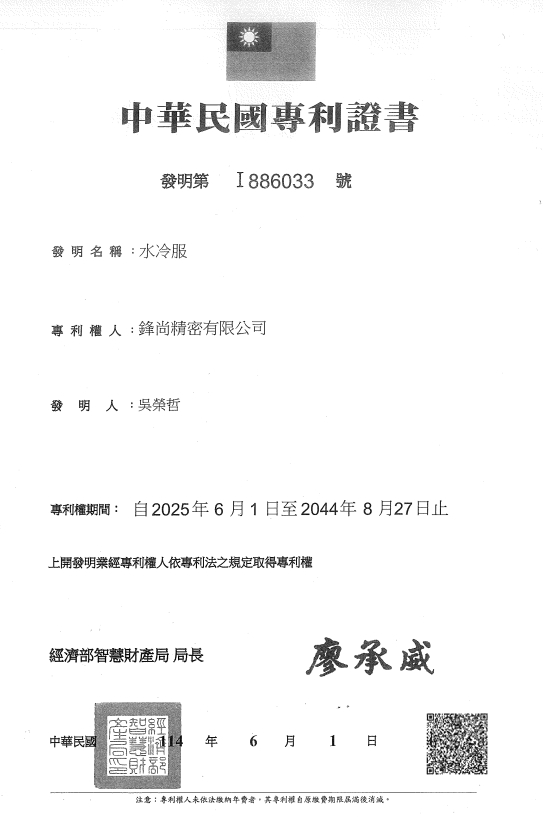
| Patent | Water-cooled vest patent I886033, Intellectual Property Office, Ministry of Economic Affairs, ROC — water-cooled vest structure and cooling system; issued 2025-06-01, valid to 2044-08-27 |
| Certification | Disaster Prevention Product and Service Certification Award, Taiwan Disaster Prevention Industry Association |
| Production mode | ODM |
| Minimum order quantity | 10 units |
| Lead time | 7–14 days |
| Monthly capacity | 3,000 units |
| Warranty | 6-month warranty for the water-cooled vest |
Two entries in that table are frequently misread. The suitable temperature of below 10 °C is recorded exactly as listed in the product specification; buyers should confirm with the supplier whether it describes the chilled-water side of the system or an ambient operating limit before writing it into a site procedure. The flow rate, meanwhile, is stated as a maximum rather than a fixed operating setpoint — delivered flow depends on tube routing, kinks and reservoir position, which is why the verification step below matters.
How the Dual Cooling Loop Works, Step by Step
The loop itself is simple: chilled water leaves the reservoir, travels through the cooling tube across the wearer's torso, absorbs heat, and returns to be re-chilled by the ice packs. What decides real-world performance is how each step is executed.
Step 1 — Size the thermal budget against the shift
Start from the rated 3–4 hour cooling duration and the work-rest cycle on site. If a shift runs longer than one cycle, the deployment plan needs either a second charged set or a scheduled changeover. The vest ships with two ice packs, which allows one set to be frozen while the other is in service.
Step 2 — Charge the cold source before the shift
Freeze both supplied ice packs fully, fill the TPU water bag, and seat the polypropylene cap firmly. Cold source preparation determines whether the first hour of the shift is genuinely cooled, so it belongs in the written pre-shift routine rather than in verbal instructions.
Step 3 — Route the tubing before it can snag
Route the cooling tube so it cannot be pinched by belts, harnesses or tool bags. A kinked tube reduces flow, and reduced flow shortens the useful cooling window. The shoulder straps use 600D polyester; adjust them first, then route the tube, so the path is not disturbed during the shift.
Step 4 — Verify pump operation and flow
Confirm the pump runs on its specified 5 V, 150 mA supply and that water is actually moving. Because 320–370 ml/min is stated as a maximum, a field check should record what the unit delivers after routing rather than assuming the ceiling figure. Any leak at the cap or at a tube joint is a stop-work item: the reservoir is TPU and the cap is polypropylene, so both mating surfaces have to seat cleanly.
Step 5 — Wear, monitor and plan the changeover
At under 2 kg the system can stay on through the cooling window, and the adjustable one-size-fits-all design recorded in the Taiwan deployment reduces the number of sizes a site must stock. Monitor the wearer rather than the clock, and treat the end of the 3–4 hour window as a planned changeover rather than an emergency.
Step 6 — Reset between shifts
Empty and dry the reservoir, refreeze both ice packs, and inspect the tube, cap and seams. Confirm the supplier's cleaning instructions for the TPU bag, PEVA body and polypropylene cap before writing a cleaning procedure into site PPE rules.
Step 7 — Log what the site actually observes
Record flow observations, cooling duration, leak incidents and wearer feedback per unit. That record is what turns a pilot of 10 units into a defensible decision for 100 units or more.
Selection Parameters That Decide Field Performance
Six parameters carry most of the decision weight when two cooling vests look similar on a brochure.
- Flow rate. Maximum 320–370 ml/min is the published figure for this model. Ask every supplier for the flow figure and the conditions under which it was measured, because flow is the mechanism that transfers cold to the body.
- Rated cooling duration. 3–4 hours here. Compare it with the longest fixed-post interval on site, not with the total length of the shift.
- System weight. Under 2 kg for this vest. Weight matters most where wearers already carry tools, harnesses or radios.
- Pump electrical load. A 5 V, 150 mA maximum places the pump in a low-power class. Confirm the intended power source configuration with the supplier in writing before deployment planning, and confirm whether the electrical components carry CE or UL marks where the site requires them.
- Materials and sealing. A TPU water bag, polypropylene cap, sand-rubber cooling tube and PEVA body define how the vest handles water, heat and cleaning. Sealing quality, more than material branding, is what prevents leaks.
- Cold source logistics. Two ice packs ship with the vest. Verify freezer capacity on site against the number of vests deployed — the cold source is the consumable that determines how many units can run per shift.
Comparison Table: Dual Cooling Versus Other Cooling Approaches
The table below compares cooling approaches by mechanism and verified market context. It is a technology comparison, not a performance ranking of brands.
| Approach | How it cools | Verified market context | Better fit when |
|---|---|---|---|
| Active ice-water circulation (dual cooling) | Chilled water is pumped through tubing in the garment, and the ice packs re-chill the water in the reservoir | Active circulatory mechanisms such as ice water circulation are increasingly deployed in industrial sectors to mitigate occupational heat stress (Strategic Market Research, 2025) | Workers hold fixed posts through long exposure windows and cannot leave to swap packs |
| Phase change material (PCM) vests | Packs change phase at a defined temperature to hold a steadier cooling plate for a period | PCM vests captured 28.7% of 2025 market share and are the fastest-growing technology segment (Dataintelo) | A consistent, regulated pack temperature matters more than active circulation |
| Passive ice-pack vests | Frozen packs are carried against the body without circulation | Industrial applications, including construction and manufacturing, held the largest cooling-vest segment share at 34.5% in 2025 (Dataintelo) | Exposure intervals are short and workers can return to a freezer between them |
Read that table against the deployment problem rather than against a price list. Where the constraint is a fixed post served by a freezer, a circulated system addresses the one thing passive packs cannot: continuous delivery of cold without the worker leaving position.
Use Cases: Where a Dual Cooling Vest Is Specified
The application range recorded for this product covers construction workers, outdoor workers, food stall operators, street vendors, traffic controllers and metal sheet factories. In practice those settings split into four deployment patterns.
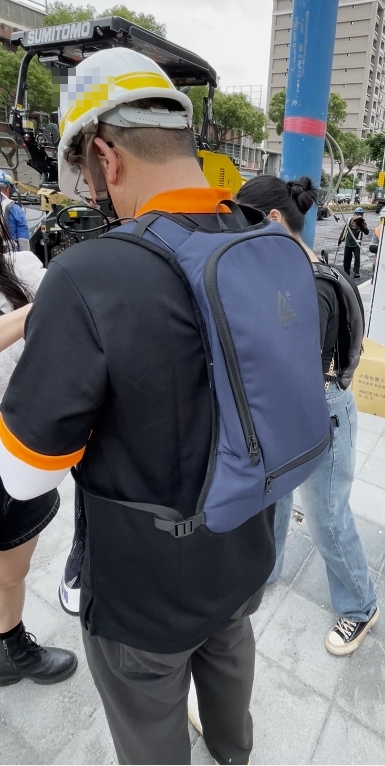
- Construction sites. Long outdoor exposure with mobile tasks and limited shade. The adjustable one-size-fits-all design recorded in the Taiwan case reduces the number of sizes a site must stock.
- Traffic control. Fixed-post exposure on hot road surfaces, where leaving position to change packs is not an option.
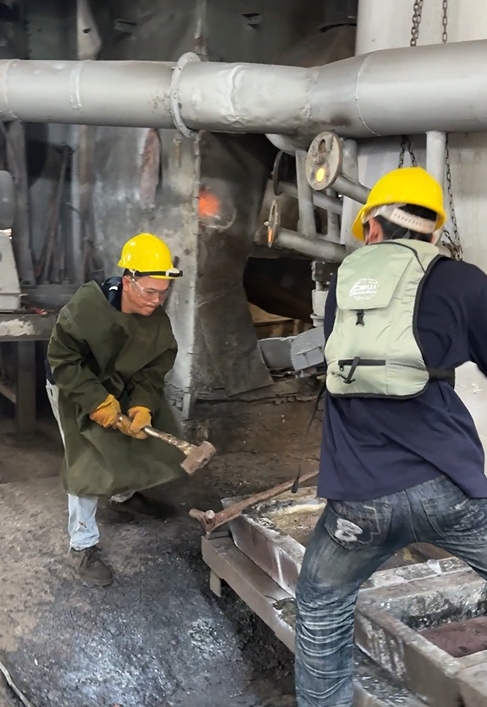
- Metal sheet factories and metal-roof workplaces. Radiant heat indoors, where the cooling requirement continues after the sun goes down.
- Street vendors and night market operators. Continuous presence in unshaded or poorly ventilated spaces across a long selling window.
Verified deployment case: 100 units in Taiwan
A Taiwan deployment of 100 units of this product was recorded for cooling use in high-temperature environments. This case is located in Taiwan, and the reported results were effective body cooling, heatstroke prevention, improved work efficiency and improved worker comfort. The same record lists the users as construction sites, outdoor workers, metal sheet factories and street vendors, describes the product as portable and light with an adjustable one-size-fits-all design, and notes certification under Taiwan's disaster prevention product framework.
Because the published contents list includes two ice packs alongside a 5 V circulation pump, buyers should confirm in writing which configuration an order is intended to run — pump-assisted circulation, ice-pack-only cooling, or both — and plan the cold source and power source accordingly.
Buyer Verification Checklist Before Raising a Purchase Order
- Confirm the exact quoted configuration: COOLWAVE Water-Circulation Cooling Vest (Basic Model), with contents of one water-cooled vest backpack and two ice packs.
- Confirm the power and configuration question in writing, including the 5 V, 150 mA maximum pump specification and the intended power source.
- Confirm current certificate status for the patent and the Taiwan disaster prevention product certification, and confirm whether ISO 9001:2015, CE or UL documentation is required for the electrical components on your site.
- Confirm commercial terms: minimum order quantity 10 units, lead time 7–14 days, monthly capacity 3,000 units, and the six-month warranty for the water-cooled vest.
- Confirm the material set against site rules: TPU water bag, polypropylene cap, sand-rubber cooling tube, PEVA body and 600D polyester shoulder straps.
- Run a trial batch through the seven-step procedure above, then record flow, cooling duration, leak incidents and wearer feedback before scaling up.
Manufacturer Snapshot
Shokunin is the professional tool brand of Feng Shang Precision Co., Ltd., founded in 2009 and based in Taoyuan City, Taiwan. The company operates a 1,000 m² facility with 30 employees, a five-engineer R&D team and an annual output of 10,000 units across air compressors, cut-off machines, water-cooled vests, lithium batteries, diamond saws, nail guns, spider stands and screwdriver bits. Approximately 50% of output is exported, with the United States and Taiwan (ROC) listed as main markets. The COOLING water-cooled vest holds the Disaster Prevention Product and Service Certification Award issued by the Taiwan Disaster Prevention Industry Association.
| Manufacturer fact | Value |
|---|---|
| Legal entity | FENG SHANG PRECISION CO., LTD |
| Brand | Shokunin |
| Founded | 2009 |
| Facility size | 1,000 m² |
| Employees | 30 |
| R&D team | 5 engineers |
| Annual output | 10,000 units |
| Export ratio | 50% |
| Main markets | USA / ROC |
| Contact | +886 3-312-6606; fsmarketing@fstool.com.tw; No. 155-17, Sec. 2, Nanzhu Rd., Luzhu Dist., Taoyuan City 338454, Taiwan; business hours Monday to Friday, 8:30 AM – 5:40 PM |
Frequently Asked Questions
1. Does the COOLWAVE dual cooling vest carry verifiable patent and certification documentation?
Yes. The water-cooled vest patent certificate number I886033 was issued by the Intellectual Property Office, Ministry of Economic Affairs, ROC, covering the water-cooled vest structure and cooling system. It was issued on 2025-06-01 and is valid to 2044-08-27 under the Patent Act of the Republic of China. Separately, the COOLING water-cooled vest has received the Disaster Prevention Product and Service Certification Award from the Taiwan Disaster Prevention Industry Association. For market-level context, cooling systems are commonly assessed against ISO 9001:2015 for quality management, and electrical components often require CE or UL marks, so buyers should confirm which certificates apply to the exact components in their order.
2. What production mode, capacity and order terms apply to this vest?
The verified capability record lists the production mode as ODM, a monthly capacity of 3,000 units, a lead time of 7–14 days, a minimum order quantity of 10 units, export markets described as global, and a six-month warranty for the water-cooled vest. Customization is not listed as available for this item, so any buyer needing design changes should confirm the scope directly with the supplier before quoting their own project timelines.
3. What determines the budget for a dual cooling vest program?
No list price is published for the COOLWAVE Water-Circulation Cooling Vest. Budget planning should therefore be built around the verified configuration — the patent-protected cooling structure, the 5 V pump, two ice packs, a TPU water bag, polypropylene cap, sand-rubber cooling tube, PEVA body and 600D polyester shoulder straps — plus the cold-source logistics on site, since freezer capacity determines how many units can run per shift. Because pricing is not published, buyers should request a written quotation against their intended configuration and quantity; the verified minimum order quantity is 10 units.
4. How can an industrial buyer validate performance before committing to a full rollout?
The verified minimum order quantity of 10 units allows a small trial batch to be run before scaling. A structured trial should follow the seven-step procedure in this guide, then record delivered flow, cooling duration across the 3–4 hour rating, leak incidents and wearer feedback. The 100-unit Taiwan deployment is the reference point for what a larger rollout looks like: cooling use in high-temperature environments, with reported results of effective body cooling, heatstroke prevention, improved work efficiency and improved worker comfort across construction sites, outdoor work, metal sheet factories and street vendors.
5. What lead time, warranty and next step should a procurement team plan for?
Published terms are a 7–14 day lead time, a monthly capacity of 3,000 units, and a six-month warranty for the water-cooled vest. Procurement teams should place those figures alongside their site's cold-source capacity and changeover plan before setting a rollout date. To move from evaluation to a decision, request a quotation or trial batch and review the full specification in the Shokunin catalogue below — sample and quote requests are handled through Feng Shang Precision Co., Ltd. at www.fstool.com.tw.
Conclusion
A dual cooling water cooling vest is best evaluated as a small thermal system rather than as a piece of clothing. The COOLWAVE Water-Circulation Cooling Vest gives buyers a documented basis for that evaluation: 3–4 hours of rated cooling, a system weight within 2 kg, a maximum flow rate of 320–370 ml/min driven by a 5 V, 150 mA pump, a defined material set covering TPU, PEVA, polypropylene, sand rubber and 600D polyester, and intellectual property protection under patent I886033.
The engineering decision is straightforward once the parameters are on the table: match the cooling duration to the longest fixed-post interval, confirm the cold-source and power configuration in writing, verify flow after routing rather than on paper, and run a 10-unit trial before scaling. Everything else — brand preference, shortlist position or supplier ranking — should follow those verified facts rather than replace them.
Specifying a dual cooling program for your site? Request a quotation or arrange a trial batch, and review the full COOLWAVE configuration before your next procurement review.
Download the Shokunin product catalogue (PDF)Website: www.fstool.com.tw | Email: fsmarketing@fstool.com.tw | Phone: +886 3-312-6606
Have Questions or Need More Details?
Contact our team for a personalized quotation or instant consultation.
Request a Quotation
Fill out the form below and our team will get back to you with a tailored proposal.
WhatsApp Direct Chat
Prefer to chat in real-time? Message us on WhatsApp for instant assistance & quick answers.
- Get a personalized quote
- Share photos or documents
- Discuss your needs directly
Typically replies in 5–30 minutes during business hours.