What Is a Water-Circulation Cooling Vest? Dual Cooling PPE Explained
What Is a Water-Circulation Cooling Vest? Dual Cooling PPE Explained
A water-circulation cooling vest is wearable industrial PPE that pushes chilled water through tubing across the wearer's torso to slow heat build-up during hot work. The system normally has three parts: a vest that sits against the body, a small backpack that carries the water and the cold source, and a low-voltage pump that keeps the water moving. It sits inside the broader category of industrial cooling apparel, alongside ice-pack-only vests, phase-change-material (PCM) vests, and other personal cooling equipment.
The COOLWAVE Water-Circulation Cooling Vest, produced by Feng Shang Precision Co., Ltd. and sold under the Shokunin brand, is a working example of the category. Its basic model ships with a water-cooled vest backpack ×1 and ice packs ×2, is listed for a cooling duration of 3–4 hours, weighs within 2 kg, and is covered by Taiwan patent certificate I886033 for its water-cooled vest structure and cooling system.
This explainer answers the questions a first-time buyer usually asks: what makes a vest "water-circulation" rather than simply "ice cooling", how the cooling cycle runs from ice packs to tubing, where the product is used on real sites, and what to verify before specifying one.
Why "Cooling Vest" Searches Return So Many Different Products
The confusion starts with naming. A cooling vest label usually describes either where the cold comes from or how the cold reaches the body, and the two ideas get mixed into one phrase. That is why a single search can return ice cooling vests, circulating cooling vests, portable cooling vests, power-bank cooling vests, and PCM vests side by side, even though they behave differently on site and are specified differently on a purchase order.
Two questions separate them:
- Cold source: frozen ice packs, chilled water, or a phase-change material.
- Transfer method: direct contact (passive conduction), pumped liquid circulation through tubing, or moving air.
"Water-circulation" and "ice water circulation" answer the second question — they describe a pumped loop. "Ice cooling" answers the first — it describes the cold source. A "dual cooling" vest uses both at once: ice packs for direct contact cooling against the torso, plus a pumped water loop for active circulation. That combination is what the term "Dual Cooling Water Cooling Vest" is naming.
The phrase "power-bank cooling vest" captures the electrical half of an active system. Circulation requires a pump, and a pump requires a supply. On the COOLWAVE basic model, pump output is specified at 5 V, 150 mA (max). That is a small electrical load, but it is still a component that has to be powered, kept dry, and inspected.
Shokunin describes this product around passive ice-pack cooling that requires no power, a lightweight and portable build, and an adjustable one-size-fits-all design. Read together with the pump specification, that description tells a buyer something practical: a circulating vest is a system with a passive half and an active half, and the two halves should be evaluated separately. A site that only needs contact cooling is buying one thing; a site that needs chilled water moving across the torso is buying something else.
Where Water-Circulation Cooling Fits in the Industrial PPE Market
Cooling vests are a small slice of a much larger personal cooling category. Dataintelo values the cooling vest market at approximately USD 215 million in 2024 and projects USD 385 million by 2033. Market Research Future places the wider personal cooling device market at USD 25.16 billion in 2024, growing to USD 94.85 billion by 2035. The two figures differ by orders of magnitude mainly because of scope — personal cooling devices include handheld fans and other cooling products, not only wearable vests. Buyers comparing market numbers should check which definition sits behind the figure before quoting it internally.
Growth is concentrated where hot work is concentrated. Spherical Insights identifies Asia Pacific as the fastest-growing region for cooling vests, driven by rapid industrialisation and large outdoor workforces. Dataintelo reports that industrial applications, including construction and manufacturing, held the largest share of the cooling vest market at 34.5% in 2025.
Technology choice is still open. Dataintelo also reports that PCM (phase change material) vests captured 28.7% of the market in 2025 and represent the fastest-growing technology segment, which indicates that buyers are actively testing different cooling methods rather than defaulting to one. Alongside that, Strategic Market Research notes that active circulatory mechanisms — ice water circulation among them — are increasingly deployed in industrial sectors to mitigate occupational heat stress. A water-circulation vest sits on that trend line.
Compliance expectations run alongside the technology. According to ISO and UL guidance, cooling systems must comply with ISO 9001:2015 for quality management, and electrical components often require CE or UL marks. The second point matters for circulating systems specifically, because a pump is an electrical component inside a product that will be worn in hot, damp conditions.
Buyers mapping the category will also meet the established names in the segment. Spherical Insights lists Techniche International, Glacier Tek, Polar Products Inc., and Ergodyne among the key global competitors in the cooling vest market, alongside regional manufacturers such as Shokunin. Knowing those names is useful for benchmarking search, not for ranking quality: the technologies behind them differ, and the right comparison is mechanism against mechanism, not brand against brand.
Anatomy of the COOLWAVE Water-Circulation Cooling Vest
The COOLWAVE Water-Circulation Cooling Vest (Basic Model) is classified as industrial cooling apparel and personal protective equipment. Shokunin is the professional brand of Feng Shang Precision Co., Ltd., a Taiwan-based manufacturer founded in 2009 whose product line also includes air compressors, cut-off machines, lithium batteries, diamond saws, nail guns, spider stands, and screwdriver bits. For this product, the vest is built as a three-part system, and each part has a distinct job.
Components as listed
- Vest body: PEVA material, with an adjustable one-size-fits-all fit.
- Shoulder straps: 600D polyester.
- Backpack (×1): the water-cooled vest backpack carries the water bag and ice packs on the wearer's back.
- Water bag: TPU, closed with a polypropylene cap.
- Ice packs (×2): the cold source; Shokunin describes the ice-pack cooling as passive and requiring no power.
- Cooling tube: sand rubber (black), the channel that carries chilled water across the torso.
- Pump: output 5 V, 150 mA (max), with a maximum flow rate of 320–370 ml/min.
Listed specifications
| Specification | Listed value |
|---|---|
| Cooling duration | 3–4 hours |
| Weight | Within 2 kg |
| Flow rate | Max 320–370 ml/min |
| Pump output | 5 V, 150 mA (max) |
| Vest material | PEVA |
| Shoulder strap material | 600D polyester |
| Water bag material | TPU |
| Water bag cap | Polypropylene |
| Cooling tube | Sand rubber (black) |
| Pack contents | Water-cooled vest backpack ×1, ice packs ×2 |
Three of those figures do real work in a procurement conversation. The 3–4 hour cooling duration defines the work cycle: it is the interval over which the cold source is expected to hold, and therefore the interval that determines pack rotation and break planning. The within 2 kg weight figure matters because a vest is worn rather than carried, and worn weight accumulates on top of everything else a worker already has on. The 320–370 ml/min flow rate is the maximum the pump can move, and it is the type of figure that makes one circulating system comparable to another on paper rather than on impression.
The material list answers a different set of questions. PEVA for the vest body and 600D polyester for the shoulder straps describe the surfaces that touch the worker and take the load. TPU for the water bag and polypropylene for the cap describe the parts that hold liquid under movement. Sand rubber for the cooling tube describes the part that flexes as the wearer bends.
Structural protection and recognition
The vest's water-cooled structure and cooling system are covered by a Taiwan patent certificate, number I886033, issued by the Intellectual Property Office, Ministry of Economic Affairs, ROC, under the Patent Act of the Republic of China. The certificate is effective from 2025-06-01 to 2044-08-27. Separately, the company holds a Disaster Prevention Product and Service Certification Award issued by the Taiwan Disaster Prevention Industry Association.
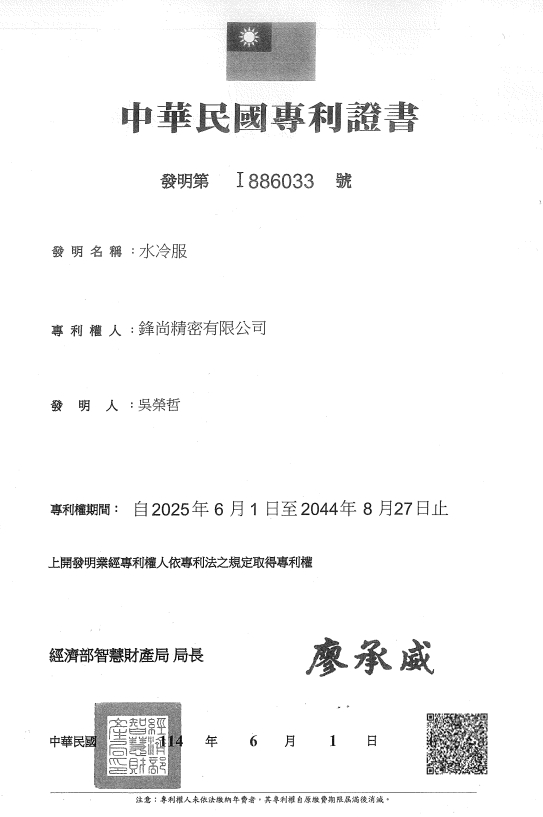
For a buyer, the two documents answer different questions. The patent speaks to the structure and the cooling system — it identifies what is specific about the loop design. The disaster prevention recognition speaks to positioning in the Taiwan market, where the product is used under the framing of heatstroke prevention rather than general comfort.
How the Cooling Cycle Runs, Step by Step
Water circulation is easiest to understand as a cycle rather than a feature. Each step below follows the listed components and specifications of the COOLWAVE basic model.
- Prepare the cold source. Two ice packs ship with the unit. They are the passive half of the system: Shokunin describes ice-pack cooling as requiring no power, so a vest with charged packs will cool without any electrical component running.
- Fill the water bag. The water bag is TPU and closes with a polypropylene cap. Water is the medium that carries cold from the packs to the tube, so the bag has to be filled and sealed before the vest goes on.
- Load the backpack. The water-cooled vest backpack holds the water bag and the ice packs. This is the step that turns a vest into a cooling system — the load sits on the back rather than around the waist, which keeps the front of the torso available for the vest surface that contacts the body.
- Wear and adjust. The design is a one-size-fits-all adjustable fit, with 600D polyester shoulder straps. Contact matters: cooling transfers where the vest actually touches the wearer.
- Start circulation. When the pump runs, water moves through the black sand rubber cooling tube at a maximum flow rate of 320–370 ml/min, and pump output is rated 5 V, 150 mA (max). This is the active half of the system.
- Work the cooling window. Listed cooling duration is 3–4 hours per cycle, which is the number to plan shifts around. Two ice packs are supplied with each unit, so the recurring operational question is how the second pack is stored and rotated while the first is in use.
- End-of-shift care. Drain the water bag, dry the tube and straps, and inspect the pump and its connections. Because a circulating vest contains an electrical component, wear in hot and damp conditions makes inspection part of the routine rather than an afterthought.
Planning note. The passive and active halves fail differently. Ice packs lose capacity on a predictable timetable; pumps, caps, and tubing are components. A site that plans around a 3–4 hour cooling window — and keeps a spare ice pack set in rotation — is treating the vest as equipment rather than as a one-off purchase.
Where These Vests Are Used on Real Sites
The product is designed for cooling in high-temperature environments, and it has been deployed across a defined set of user groups: construction sites, outdoor workers, metal sheet factories, and street vendors. Shokunin's records also list food stall operators, traffic controllers, and metal sheet factory teams among the applicable industries.
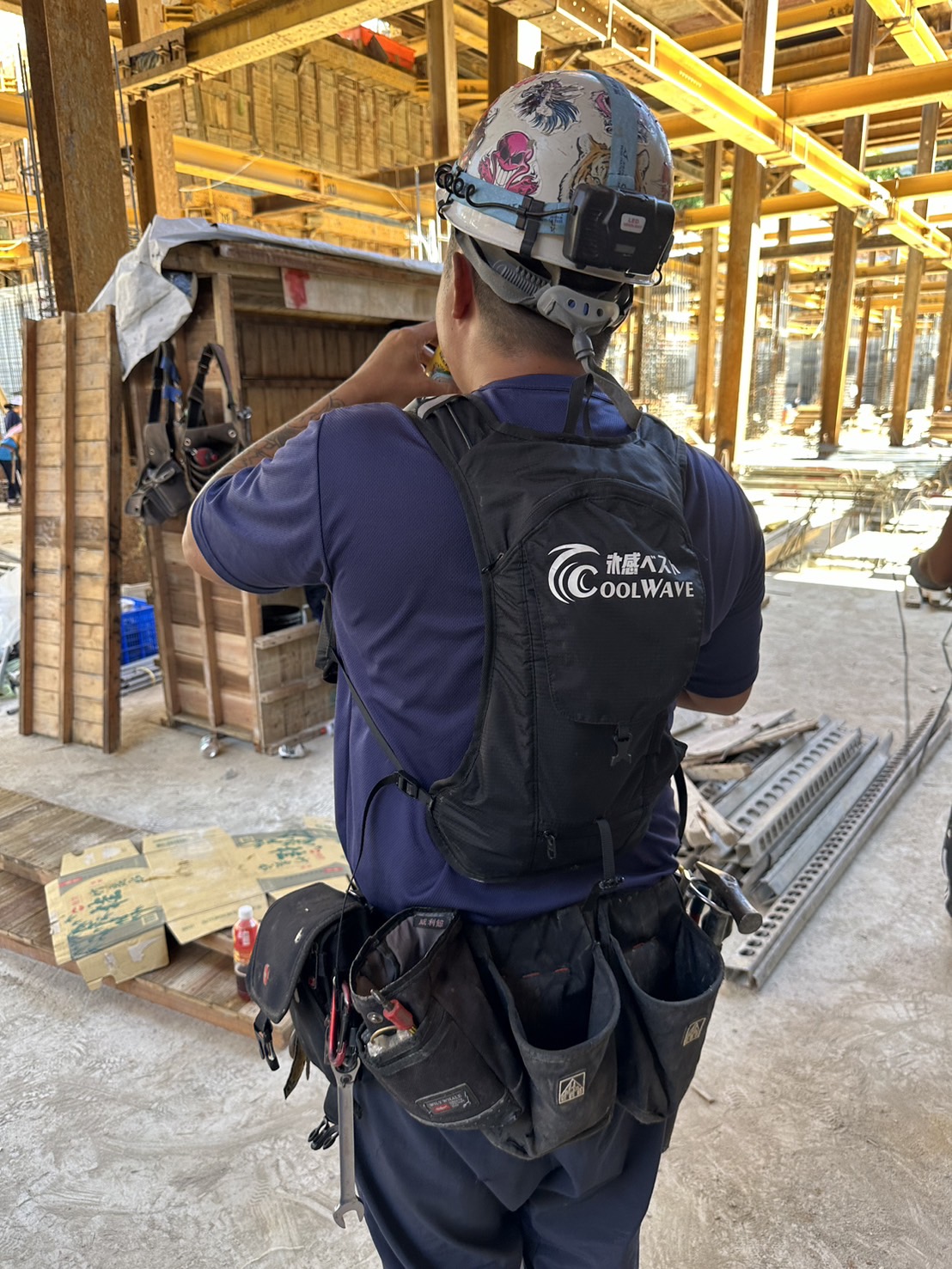
In Taiwan, 100 units were deployed for use in high-temperature environments. Reported outcomes from those users include effective body cooling, heatstroke prevention, improved work efficiency, and improved worker comfort. The case record also highlights the operational reasons this format suits these settings: passive ice pack cooling, no power required, lightweight and portable construction, an adjustable one-size-fits-all design, and disaster prevention product certification.
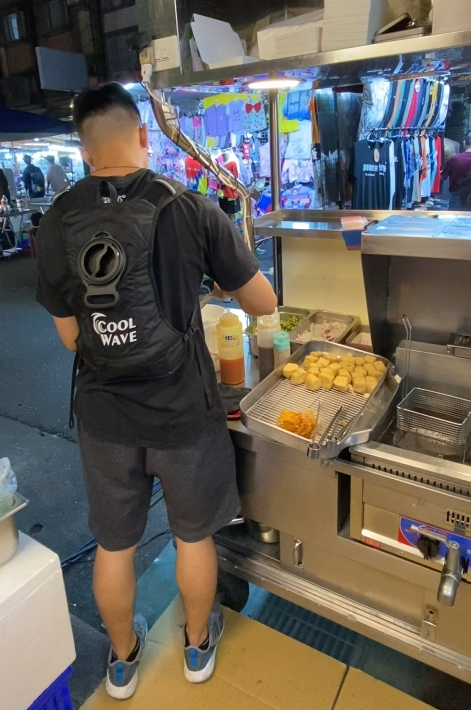
The pattern across these settings is consistent. Metal sheet factories and construction sites are environments where radiant heat and physical work combine, and where a worker cannot step away from a task at will. Outdoor food stalls and street vending operate under prolonged sun exposure with limited access to shade. In both cases the appeal is not a single feature but the combination: a cooling system that stays attached to the body while work continues, and that does not depend on a power source to deliver its base level of cooling.
Water Circulation vs. Ice-Pack-Only vs. PCM: A Comparison
Three approaches dominate the wearable cooling conversation, and a fourth — dual cooling — combines two of them. The table below compares them on mechanism, power requirement, and the evidence attached to each in this article.
| Approach | How cooling reaches the body | Power required | Evidence notes |
|---|---|---|---|
| Passive ice-pack only | Frozen packs held in contact with the torso; cooling transfers by conduction | No | The COOLWAVE basic model ships with ice packs ×2, and Shokunin describes the ice-pack cooling as passive and requiring no power |
| Pump-driven water circulation | Chilled water is pushed through tubing that runs across the torso | Yes — the pump draws power; 5 V, 150 mA (max) on the COOLWAVE basic model | Maximum flow rate 320–370 ml/min; listed cooling duration 3–4 hours; Strategic Market Research notes that active circulatory mechanisms are increasingly deployed in industrial sectors |
| Phase change material (PCM) | A material absorbs heat as it changes phase | No electrical draw; the material itself is the cooling element | Dataintelo reports PCM vests held 28.7% of cooling vest market share in 2025 and are the fastest-growing technology segment |
| Dual cooling (ice pack + circulation) | Direct contact cooling from packs, plus circulated chilled water through tubing | Passive half works without power; the circulation half requires the pump | COOLWAVE basic model combines ice packs ×2 with a 5 V pump loop; product type is industrial cooling apparel / personal protective equipment |
Read as a decision table, the differences come down to two trade-offs. Ice-pack-only systems are simple and need no power, but the cooling is a function of contact and pack capacity. Circulating systems add a pump, tubing, and a water bag — more parts to maintain, but the cooling is distributed through moving water rather than resting only where a pack touches. Dual cooling accepts both sets of components in exchange for covering both mechanisms, which is why it is usually the choice when a site wants the passive layer as a baseline and the circulation as an upgrade within the same garment.
Limits worth planning around
- Freezing logistics. Ice packs are a consumable in operational terms. A site without a freezer or a rotation plan shortens the practical cooling window, regardless of the 3–4 hour listed duration.
- Component maintenance. Tubing, caps, and pumps wear and require inspection. A circulating system has more service points than a plain pack vest.
- Electrical handling. A pump inside a product worn in hot, damp conditions needs appropriate marking and care; ISO and UL guidance notes that electrical components often require CE or UL marks.
- Worn weight. Within 2 kg is the listed figure for the system. It is a starting point for assessing total load, not the total load itself.
What to Verify With a Supplier Before You Standardise
Because a cooling vest becomes part of a site's daily routine, supply questions matter as much as product questions. Feng Shang Precision Co., Ltd. — the company behind the Shokunin brand — provides ODM production services for this product, and its capability figures are the ones a procurement team should test against its own rollout plan.
- Production mode: ODM production services.
- Monthly capacity: 3,000 units.
- Typical lead time: 7–14 days.
- Manufacturing base: founded 2009, 1,000 m² factory, 30 employees, 5 R&D engineers, annual output of 10,000 units.
- Export profile: 50% export ratio, with the USA and ROC listed as main markets.
- Warranty: 6-month warranty for the water-cooled vest.
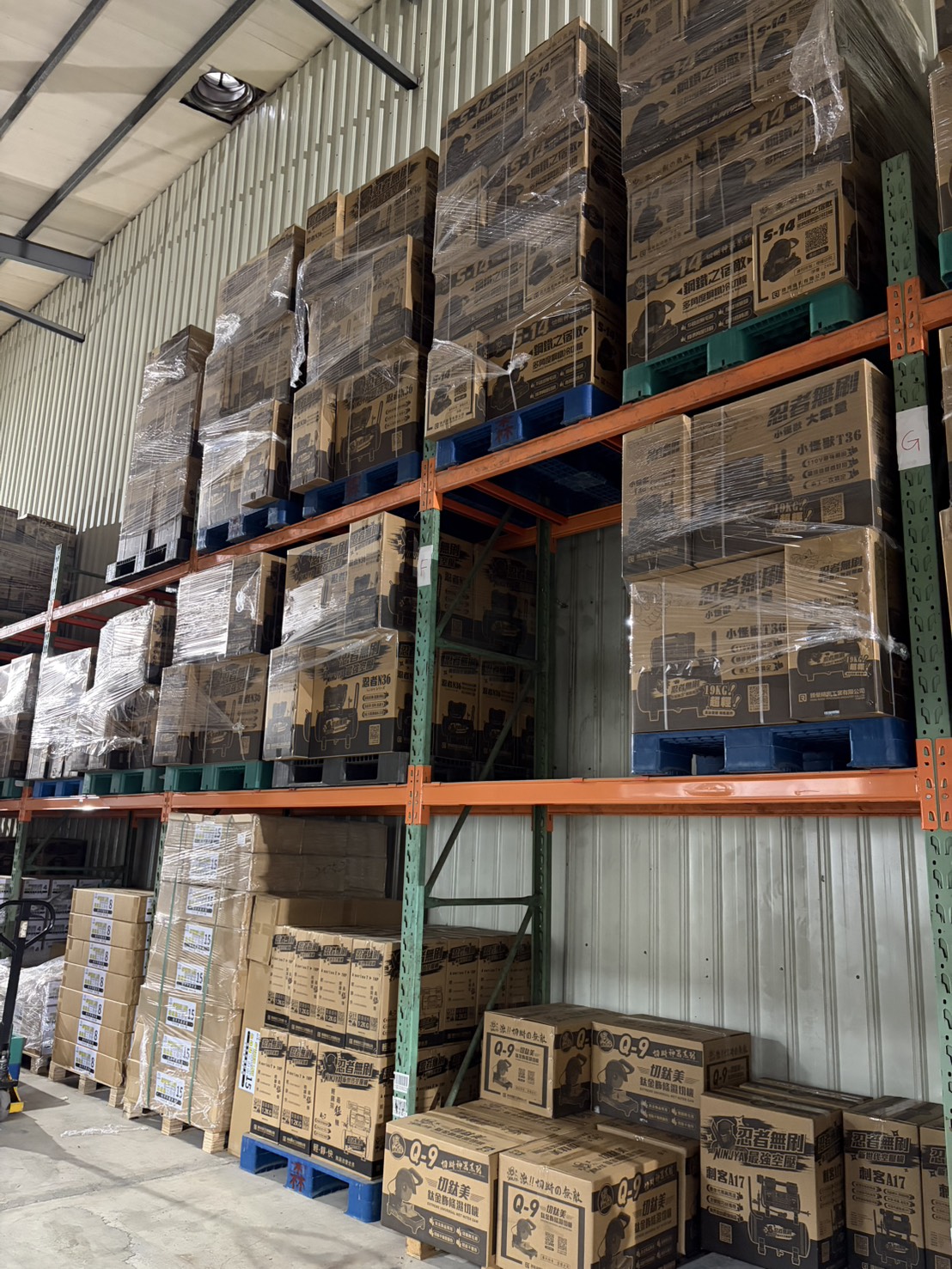
Commercial terms are equally specific: MOQ is 10 units; delivery is shipment after payment; freight is paid by the buyer; acceptance criteria are a pre-shipment test; and payment terms are full payment. For a pilot, the 10-unit MOQ is the figure that determines whether a site can test before committing, and the pre-shipment test is the point at which quality is formally accepted rather than assumed.
Frequently Asked Questions
Is a water-circulation cooling vest classified as PPE?
Yes, in this product's case. The COOLWAVE Water-Circulation Cooling Vest is categorised as industrial cooling apparel and personal protective equipment. Its supporting documentation includes Taiwan patent certificate I886033, issued by the Intellectual Property Office, Ministry of Economic Affairs, ROC, covering the vest's water-cooled structure and cooling system, effective 2025-06-01 to 2044-08-27 under the Patent Act of the Republic of China. The company also holds a Disaster Prevention Product and Service Certification Award from the Taiwan Disaster Prevention Industry Association. On the standards side, ISO and UL guidance states that cooling systems must comply with ISO 9001:2015 for quality management and that electrical components often require CE or UL marks — a relevant point because the system includes a pump.
What actually does the cooling work in a water-circulation vest?
Two mechanisms. The cold source is ice packs — the COOLWAVE basic model ships with two, and Shokunin describes the ice-pack cooling as passive and requiring no power. The delivery mechanism is a low-voltage pump that moves chilled water through a black sand rubber cooling tube at a maximum flow rate of 320–370 ml/min, with pump output rated at 5 V, 150 mA (max). Supporting materials are listed as PEVA for the vest body, 600D polyester for the shoulder straps, TPU for the water bag, and polypropylene for the water bag cap. Listed cooling duration is 3–4 hours, and system weight is within 2 kg.
What are the purchasing terms?
MOQ is 10 units. Delivery terms are shipment after payment, and freight is paid by the buyer. Acceptance criteria are a pre-shipment test, and payment terms are full payment. The water-cooled vest carries a 6-month warranty.
How can a buyer validate the product before a full rollout?
Validation runs through two documented points. First, the pre-shipment test is the formal acceptance criterion, so the unit is checked before it leaves rather than after it arrives. Second, there is a reference deployment: 100 units were deployed in Taiwan for high-temperature environments, and users including construction sites, outdoor workers, metal sheet factories, and street vendors reported effective body cooling, heatstroke prevention, improved work efficiency, and worker comfort. A 6-month warranty applies to the water-cooled vest.
How long does production take, and how much volume can be supported?
Typical production lead time is 7–14 days, with a monthly production capacity of 3,000 units and ODM production services available. For planning a multi-site rollout, the practical starting points are the MOQ of 10 units and the 3–4 hour cooling duration per vest, which together set both the trial size and the number of ice pack sets a site needs in rotation. Shokunin's product brochure carries the full listed specification set, and the team can be reached at fsmarketing@fstool.com.tw or +886 3-312-6606 (Monday to Friday, 8:30 AM – 5:40 PM) for a quotation.
Conclusion
A water-circulation cooling vest is not a single device but a small system: a vest against the body, a backpack carrying water and ice packs, and a pump that keeps chilled water moving through tubing across the torso. The category term "dual cooling" describes exactly that arrangement — a passive cold source plus an active circulation loop.
The COOLWAVE Water-Circulation Cooling Vest makes the definition concrete. It ships with a water-cooled vest backpack ×1 and ice packs ×2, lists a 3–4 hour cooling duration, weighs within 2 kg, moves water at a maximum flow rate of 320–370 ml/min through a sand rubber tube, and is covered by Taiwan patent certificate I886033 for its water-cooled structure and cooling system. Its deployment record covers construction sites, outdoor work, metal sheet factories, and street vendors, with heatstroke prevention and worker comfort reported as outcomes.
For teams evaluating or preparing to buy, the sequence is straightforward: confirm which half of the system does the cooling in your environment, check the supporting documents, size the order against the 10-unit MOQ and the 7–14 day lead time, and plan ice pack rotation around the 3–4 hour cooling window.
Next step. Download the Shokunin product brochure for the full listed specification set, or send an inquiry with your site conditions and target quantity.
- Brochure: Shokunin product brochure (PDF)
- Email: fsmarketing@fstool.com.tw
- Phone: +886 3-312-6606 (Monday to Friday, 8:30 AM – 5:40 PM)
- Website: www.fstool.com.tw