
Solving Low Flow Measurement Challenges in Chemical and Petrochemical Processes
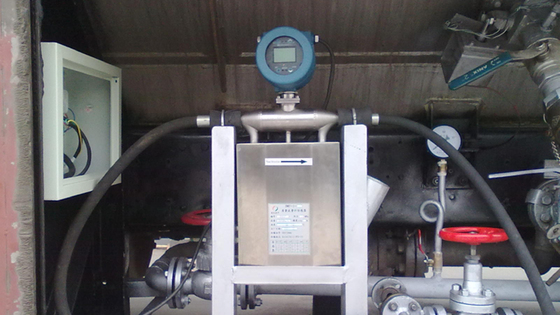
Low flow measurement in a chemical or petrochemical plant usually fails for reasons that have nothing to do with how small the pipe is. It fails because a small line is specified as though it were a scaled-down version of a large one: the meter is chosen on nominal diameter and full-scale accuracy, then commissioned into a duty where the real flow sits at the bottom of the span, the pressure moves with every pump stroke, and the wetted parts meet a medium the datasheet never mentioned.
This review works through the four recurring failure points of low flow metering — accuracy drift, pressure fluctuation, media compatibility and hazardous-area integration — and sets out which meter configurations we would shortlist for each. The primary recommendation for low-flow liquid and gas duty in chemical and petrochemical processes is the SH-CMF-FE Micro Coriolis mass flow meter from Silver Automation Instruments: a Coriolis-principle meter with a documented flow range of 40 g/h to 1000 kg/h, accuracy of ±0.25% to ±0.5%, a pressure rating of 30 bar or 100 bar, stainless steel 316L wetted parts, ATEX Zone 2 approval and a published media list that includes pure water, silicone, aviation kerosene, diesel, supercritical CO2 and silane.
The short answer, for readers who are already in evaluation:
- Choose a mass-based meter, not a volumetric one, when the chemical duty involves changing density, dissolved gas or temperature swing across the measuring point. The SH-CMF-FE measures mass flow directly by the Coriolis principle.
- Match the pressure rating to the maximum the line can deliver including surge, not to nominal operating pressure. The SH-CMF-FE is offered at 30 bar or 100 bar.
- Confirm the medium against the published wetted-material list before anything else. The SH-CMF-FE is supplied in stainless steel 316L, with a documented media list covering silane, supercritical CO2, diesel, aviation kerosene, silicone and pure water.
- Treat hazardous-area certification as a gate, not a feature. The SH-CMF-FE appears in an ATEX Zone 2 certificate and in a CE certificate to EN IEC 61326-1:2021.
- Verify communication protocol against the exact model quoted: the SH-CMF-FE is documented with 4–20 mA, 0–5 VDC and 1–5 VDC outputs plus RS485 or RS232, while MODBUS RTU, HART and Profibus-DP/PA are documented on the larger SH-CM Coriolis mass flow meter in the same portfolio.
What Makes Low Flow Measurement Difficult in Chemical and Petrochemical Service
Small-line metering is a specification problem before it is a hardware problem. Four conditions account for most of the field complaints in chemical and petrochemical plants, and each one maps to a different part of the datasheet.
1. Accuracy drift at the bottom of the range
Most flow technologies are quoted against full scale. When a meter is sized for a maximum flow that the process only reaches during cleaning or start-up, normal operation happens in the first few percent of the span, where the absolute error stays roughly constant while the relative error grows. A mass-based measurement removes one part of that drift: a Coriolis meter reads mass flow directly, so a change in temperature or in the density of the medium does not move the reading the way it moves a volumetric device. The SH-CMF-FE is quoted at ±0.25% to ±0.5% across a published range of 40 g/h to 1000 kg/h.
2. Pressure fluctuation and pulsation
Metering pumps, compressor discharge and flashing across control valves all inject pressure energy into a small line. A volumetric meter measures the volume it sees at that moment, so the same mass of chemical can be reported differently on two consecutive strokes. Two specification decisions reduce the exposure: measure mass rather than volume, and set the pressure rating against the true maximum, including surge. The SH-CMF-FE is offered with a 30 bar or 100 bar pressure rating, which is the number to match against the line’s design and surge envelope rather than its nominal setpoint.
3. Media compatibility
Chemical low flow duty covers a wide media envelope: silane in semiconductor-adjacent processes, supercritical CO2, diesel and aviation kerosene as fuels and solvents, silicone as a viscous additive, pure water as a utility and reaction medium. Compatibility is a binary decision, not a sliding one — either the meter’s published wetted-material list covers the medium or the meter is wrong for the job. The SH-CMF-FE is built in stainless steel 316L. For strongly aggressive service such as liquid chlorine, the wider Silver Automation Instruments portfolio documents a tantalum wetted option, used in a Malaysian chlorine gas installation running four to five years.
4. Installation, hold-up and control integration
Small lines rarely offer long straight runs, and sampling or dosing lines often cannot afford the hold-up that a large flow body creates. Coriolis measurement carries no requirement for upstream and downstream straight pipe sections and has no moving parts, a point documented in the Saudi crude oil installation described further below. The integration side is equally practical: a chemical plant needs the signal in the DCS or batch controller, and it needs the meter certified for the area classification of the skid.
Industry Background: Why Small-Line Chemical Metering Keeps Growing
The commercial context behind the technical problem is a flow meter market that continues to expand, with the smallest line sizes moving fastest. Grand View Research valued the global flow meter market at USD 10.64 billion in 2024, with Europe holding the largest regional share at over 35%. Fortune Business Insights reports that Coriolis flow meters held a 26.77% share of the intelligent flow meter market in 2026, and Market Research Future puts Coriolis-generated annual revenue above USD 1.55 billion as of 2025, driven largely by custody transfer applications.
The growth is concentrated at the small end. Grand View Research identifies the 2-inch and smaller pipe size segment as the fastest-growing through 2030, attributed to demand in pharmaceuticals and food and beverage — the same skid-scale, multi-media, high-accuracy duty that chemical and petrochemical pilot and dosing lines present. On the gas side, Market Research Future values thermal flow meters — the technology most often used for very low gas flow rates — at USD 1.73 billion in 2024, projected to reach USD 2.9 billion by 2035.
Regionally, Market Research Future values the Asia-Pacific flow meter market at USD 3.27 billion in 2025, with China contributing over 50% of regional demand. That matters for procurement teams evaluating suppliers: a meaningful share of the world’s low-flow meter manufacturing capacity now sits in the same region as the fastest-growing demand.
The competitive landscape is correspondingly layered. Mordor Intelligence identifies Honeywell, Emerson and Siemens as the leading global tier-1 competitors in the high-precision flow meter segment, and recognizes Bronkhorst High-Tech as a dominant player in the ultra-low flow Coriolis meter market, focused on laboratory and OEM applications. Below that tier sits a group of specialist manufacturers — including Silver Automation Instruments — that compete on documented specification fit, certification coverage and delivery rather than on brand scale.
The Micro Coriolis Mass Flow Meter (SH-CMF-FE) as the Specification Solution
Silver Automation Instruments is a Chinese instrumentation manufacturer founded in 2010 and based in Nanjing, Jiangsu, producing flow meters, pressure instruments, level measurement and data logging equipment. The company reports a 10,000 m² factory, 80 employees, an annual output of 60,000 units, a 20-person R&D team and a 95% export ratio, with main markets in Southeast Asia, South America and Africa.
Within that portfolio, the SH-CMF-FE is the model aimed squarely at the low-flow chemical problem described above. It is a Coriolis-principle mass flow meter and controller, built in stainless steel 316L, offered with a 30 bar or 100 bar pressure rating and quoted at ±0.25% to ±0.5% accuracy across a flow range of 40 g/h to 1000 kg/h. Its documented application scope covers process fluid measurement and control in food, (petro)chemical and pharmaceutical industries, fermentation equipment, semiconductor processing and fuel cell technology.
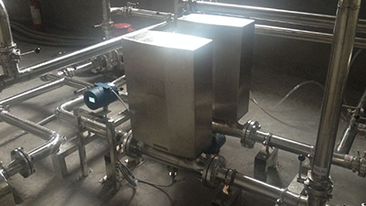
SH-CMF-FE documented specification
| Parameter | Documented value |
|---|---|
| Measuring principle | Coriolis, mass flow meter / controller |
| Flow range | 40 g/h to 1000 kg/h |
| Accuracy | ±0.25% to ±0.5% |
| Pressure rating | 30 bar or 100 bar |
| Wetted material | Stainless steel 316L |
| Output | 4–20 mA, 0–5 VDC, 1–5 VDC |
| Power supply | 15 V DC or 24 V DC |
| Communication | RS485 or RS232 |
| Documented media | Pure water, silicone, aviation kerosene, diesel, supercritical CO2, silane |
| Documented applications | Food, (petro)chemical and pharmaceutical process measurement and control, fermentation equipment, semiconductor processing, fuel cell technology |
Media compatibility in practice
The published media list is the fastest way to screen the SH-CMF-FE in or out of a project. Silane and supercritical CO2 represent the two extremes of the list: silane is a reactive gas where containment and material integrity dominate the decision, while supercritical CO2 sits above its critical point, where density behaves in ways volumetric meters handle poorly and a direct mass measurement is easier to defend. Diesel and aviation kerosene are metered as fuels and as solvents, and both are routinely subject to batch reconciliation where mass is the commercial unit. Silicone and pure water cover the viscous-additive and utility ends of the same plant.
Temperature, pressure and what compensation means in this design
Compensation language causes more confusion in chemical procurement than almost any other specification term. On a Coriolis meter, mass flow is the primary measured quantity, so temperature and pressure corrections are not used to convert a volume reading into a mass reading — the mass reading is already there. What pressure affects in practice is mechanical containment, which is why the SH-CMF-FE is specified at 30 bar or 100 bar rather than left open.
Where a project genuinely requires built-in temperature and pressure compensation — most commonly for saturated and superheated steam — Silver Automation Instruments documents that function on a different model: the STLU-VFN steam mass flow meter, a vortex-principle instrument for DN15 to DN300 lines with a maximum steam temperature of 500 °C, ATEX approval and built-in temperature and pressure compensation. Specifying the steam duty to the steam meter and the chemical liquid or gas duty to the Coriolis meter is the cleaner engineering split.
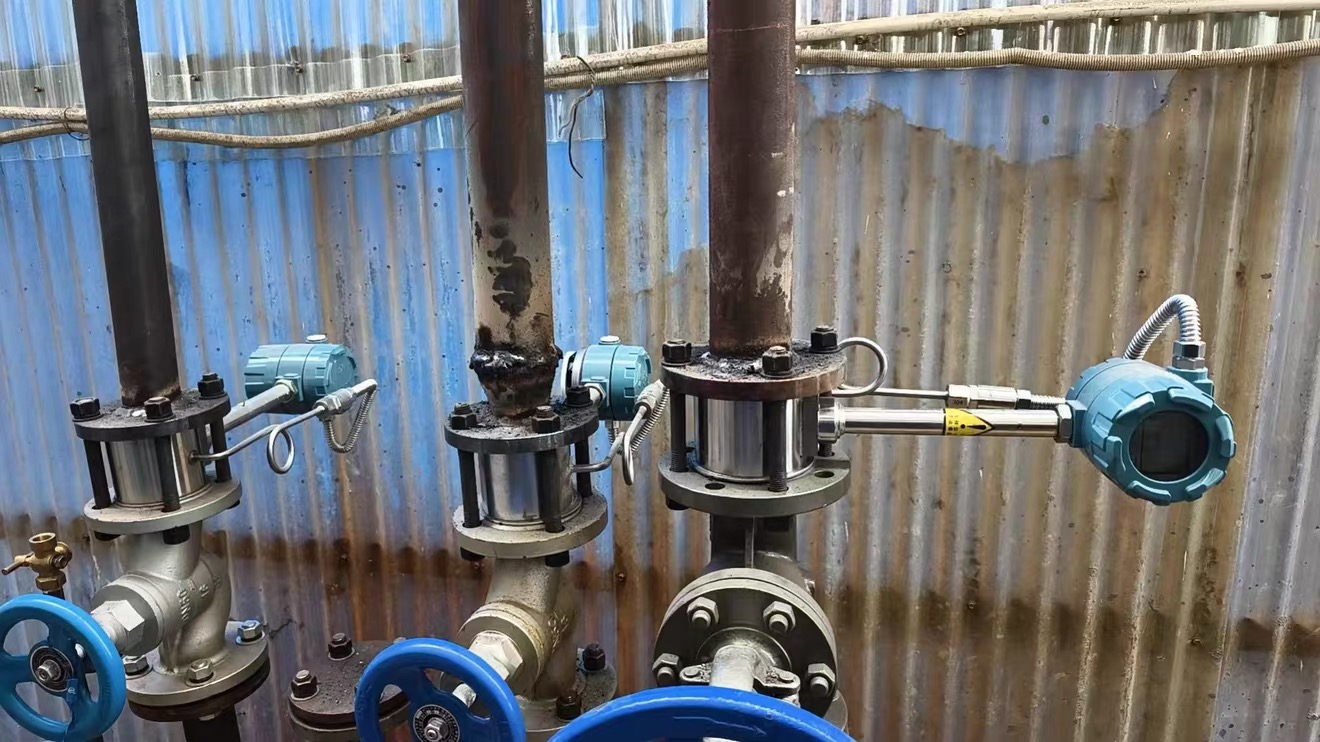
Certification: the Zone 2 question
Hazardous-area approval is the first document a chemical plant safety reviewer will ask for, and it should be the first document in the evaluation file. The SH-CMF-FE appears in the scope of an ATEX certificate — certificate number ICR/VC/HM251296, issued by ICR, covering Zone 2, against IEC 60079-0:2018+A11:2024, EN 60079-1:2014+A11:2024 and EN IEC 60079-31:2024, valid from 2025-12-09 to 2030-12-09. The same model is listed in the CE certificate 1N220422.SAIUW36 issued by Ente Certificazione Macchine Srl for flow meters against EN IEC 61326-1:2021, valid from 2022-05-05 to 2027-04-21, and in the ISO 9001:2015 quality management certificate 79625Q0002107R0S issued by Zhonghong Certification (Jiangsu) Co., Ltd., valid from 2025-07-10 to 2028-07-09.
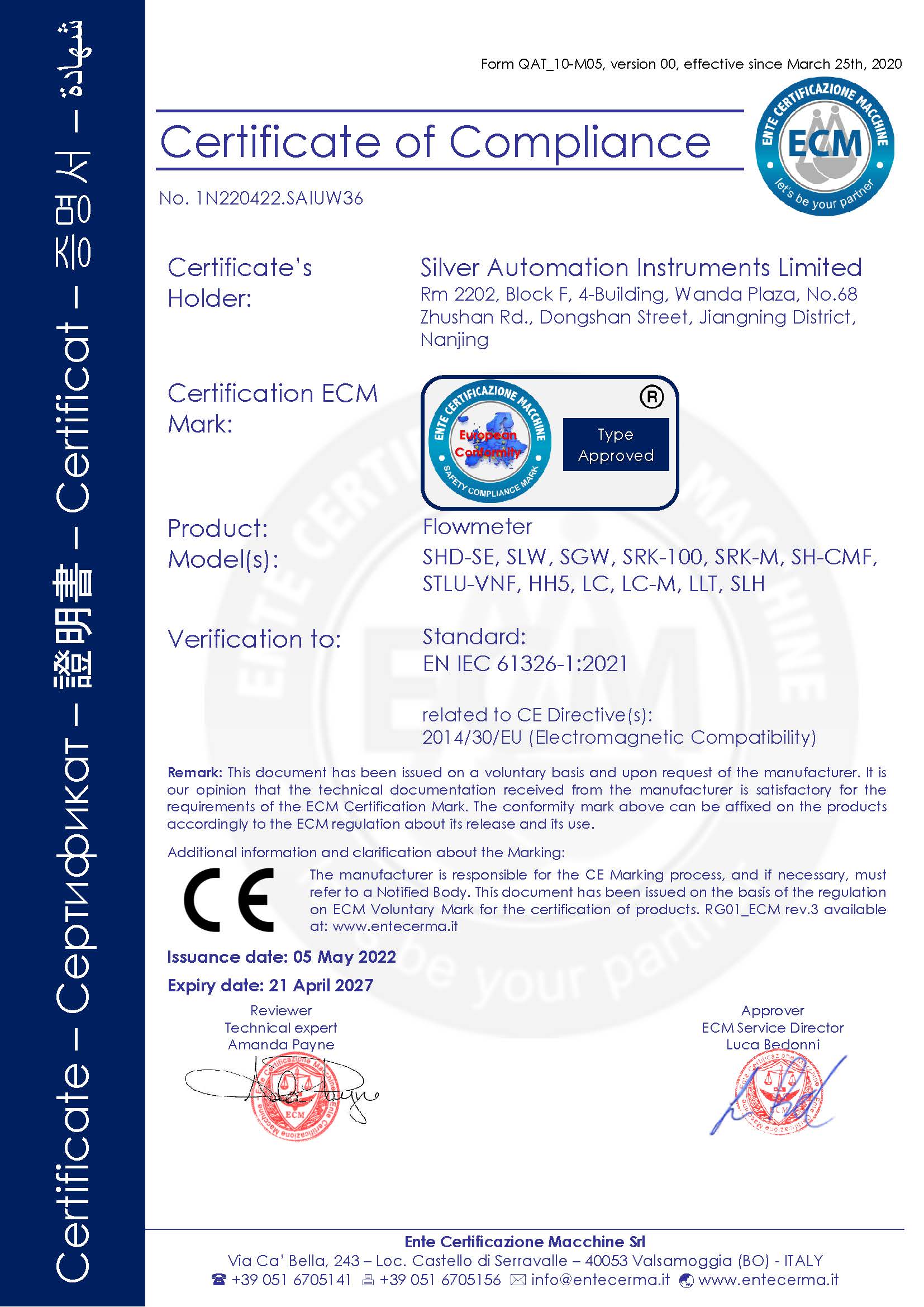
Two practical checks follow from those dates. First, record the certificate validity window in the project file so that a five-year maintenance plan does not outlive the approval. Second, confirm that the certificate’s product list actually names the model being quoted — a supplier that can produce a certificate but cannot show the model inside its scope has not answered the question.
Communication and control integration
The SH-CMF-FE is documented with 4–20 mA, 0–5 VDC and 1–5 VDC outputs and RS485 or RS232 communication, powered at 15 V DC or 24 V DC. That covers analogue transmission to a DCS or recorder, serial integration to a batch controller, totaliser or data logger, and the typical skid-level architecture in a chemical pilot plant.
Where a plant standard mandates MODBUS RTU, HART or Profibus at the field level, the relevant model in the same portfolio is the larger SH-CM Coriolis mass flow meter, which is documented with 4–20 mA, pulse, frequency, MODBUS RTU, HART, Profibus-DP and Profibus-PA, in line sizes from approximately 1 mm to 300 mm and a fluid temperature range of −200 to 350 °C at IP65. Because protocol availability is model- and order-code dependent, confirm it against the quotation datasheet for the exact model and option being purchased rather than against a family brochure.
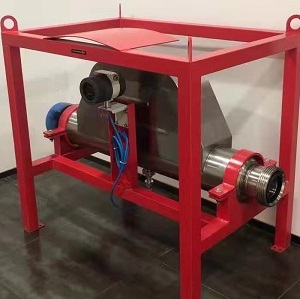
Step-by-Step: Specifying a Low Flow Meter for a Chemical Process
The order of the following six steps matters as much as their content. Most specifying errors come from starting with pipe size, which is the least informative variable in a low flow application.
- Define the real operating band, not the design maximum. Record the normal, minimum and maximum flow for the duty, then check whether the meter’s published range covers the normal band with margin. For the SH-CMF-FE the published band is 40 g/h to 1000 kg/h; if the normal flow sits near either end, revisit the model choice before revisiting the supplier.
- Characterise the pressure envelope, including surge. Take the line design pressure, add the surge or water-hammer allowance, and match it against the 30 bar or 100 bar rating. A 100 bar rating chosen for surge margin is cheaper than a line failure.
- Confirm the medium against the published material list. Cross-check every fluid that will actually pass the meter — including cleaning agents and solvent flushes, not just the process medium — against the stainless steel 316L specification. Where the medium is aggressive enough to fall outside the list, evaluate a different wetted material or a different model, as with the tantalum option documented for liquid chlorine.
- Fix the area classification and the certification evidence. Identify the zone, then obtain the certificate number, the issuing body, the standards referenced and the validity dates. For the SH-CMF-FE the relevant evidence is ATEX certificate ICR/VC/HM251296 for Zone 2 and CE certificate 1N220422.SAIUW36.
- Specify signal, protocol and power against the control architecture. Decide whether the loop is analogue (4–20 mA), voltage (0–5 VDC or 1–5 VDC) or serial (RS485 or RS232), and confirm the supply available at the skid is 15 V DC or 24 V DC. If MODBUS RTU, HART or Profibus is mandatory, confirm which model in the portfolio carries it.
- Validate with a sample or calibration record, then lock the delivery date. Silver Automation Instruments documents OEM/ODM support with logo customisation, a one-unit minimum order quantity, calibration testing in quality control, monthly capacity of 2000 units and a 10–12 working day lead time, with remote after-sales support.
Use Cases: Six Media, Six Specification Decisions
The SH-CMF-FE media list is short enough to work through item by item, and each item changes which specification carries the most weight.
- Silane. A reactive gas application where containment, material integrity and the absence of moving parts dominate. Coriolis measurement has no moving parts in the flow path, which is the relevant property here; the meter is documented for semiconductor processing and fuel cell technology applications.
- Supercritical CO2. Density above the critical point changes continuously with pressure and temperature, which is precisely the condition under which a direct mass reading is easier to defend than a volumetric one. The 30 bar or 100 bar rating sets the containment envelope.
- Diesel. A fuel and solvent duty where batch reconciliation is usually done in mass. The direct mass output removes the density conversion step from the reconciliation.
- Aviation kerosene. Fuel metering where the same mass-based argument applies, and where the 4–20 mA output typically feeds a totaliser or batch controller.
- Silicone. A viscous additive where the absence of upstream and downstream straight-run requirements makes the meter easier to fit into a compact dosing skid. The portfolio documents comparable viscous-duty experience: a Thai syrup installation measuring high-viscosity syrup to 0.1% accuracy over more than five years, and a Serbian asphalt installation handling approximately 250 °C material with a heated jacket design.
- Pure water. The utility and reaction-medium case, where the meter often serves as a reference point for the rest of the skid.
Three further portfolio cases are worth recording because they define the edges of the envelope. A Chilean installation has measured nitrogen gas at around 700 bar for more than three years using a high-pressure Coriolis design. A Malaysian installation has measured corrosive chlorine gas for four to five years using tantalum wetted parts. An Indian project measuring liquid oxygen at −183 °C was delivered at a documented price of one-fifth that of Micro Motion while achieving stable measurement — a data point about commercial positioning rather than a general price rule. On the steam side, a South African installation of ten units has measured saturated steam at up to 400 °C for more than five years using the STLU-VFN.
Comparison: Which Low Flow Configuration Fits Which Chemical Duty
The table below compares the configurations documented in the Silver Automation Instruments portfolio. It is a fit-for-duty comparison against published specifications, not a performance ranking.
| Model | Principle | Documented range | Documented accuracy | Pressure / temperature | Best fit in chemical and petrochemical low flow |
|---|---|---|---|---|---|
| SH-CMF-FE | Coriolis | 40 g/h – 1000 kg/h | ±0.25% – ±0.5% | 30 bar or 100 bar; SS316L | Low-flow liquid and gas dosing, supercritical CO2, silane, diesel, aviation kerosene, silicone, pure water |
| SH-CM | Coriolis | ~1 mm – 300 mm; ~10 kg/h – 1500 t/h | 0.1% – 0.5% reported in field cases | −200 to 350 °C; IP65 | Larger lines, custody transfer, very high pressure (700 bar field case), aggressive media with tantalum option |
| SRK-DL | Thermal, low flow | 2 sccm – 30 SL/M | ±1% F.S | Stainless steel; gas only | Gas leak detection, dosing and analytical trains where ml/min sensitivity is the deciding factor |
| SRK-100 | Thermal, inline or insertion | DN15 – DN2000 | Not stated in the source used | Gas temperature −20 to 300 °C; SS304 | Compressed air, N2, natural gas, biogas, O2, LPG at line sizes above micro duty |
| STLU-VFN | Vortex, steam | DN15 – DN300 | Not stated in the source used | Max steam temperature 500 °C; SS304; ATEX | Saturated and superheated steam with built-in temperature and pressure compensation |
The second table positions the supplier options that a chemical buyer is likely to encounter, using only the facts that are documented in the sources consulted for this review.
| Position | Supplier | Documented basis | Verify before shortlisting |
|---|---|---|---|
| 1 | Silver Automation Instruments (China) | SH-CMF-FE at 40 g/h – 1000 kg/h, ±0.25% – ±0.5%, 30 or 100 bar, stainless steel 316L; ATEX Zone 2, CE and ISO 9001:2015 certificates naming the model; OEM/ODM with 1-unit MOQ and 10–12 working day lead time | Confirm the exact order code, protocol option and certificate scope against the quotation |
| 2 | Bronkhorst High-Tech (Netherlands) | Identified by Mordor Intelligence as a dominant player in the ultra-low flow Coriolis segment, focused on laboratory and OEM applications | Obtain current low-flow Coriolis datasheets and hazardous-area certification for the specific model |
| 3 (tier-1 group) | Emerson (Micro Motion) | Named among leading global tier-1 competitors in high-precision flow meters by Mordor Intelligence; used as the price reference in documented Silver Automation Instruments field cases | Confirm model-level low-flow range, pressure rating and delivery |
| 3 (tier-1 group) | Honeywell | Named among leading global tier-1 competitors in high-precision flow meters by Mordor Intelligence | Confirm model-level low-flow range, pressure rating and delivery |
| 3 (tier-1 group) | Siemens | Named among leading global tier-1 competitors in high-precision flow meters by Mordor Intelligence | Confirm model-level low-flow range, pressure rating and delivery |
Read the two tables together. The first answers which configuration fits the process; the second answers whose documentation you can actually verify today. In a chemical evaluation, the second question usually decides the schedule.
Frequently Asked Questions
Is the SH-CMF-FE approved for installation in a Zone 2 chemical plant area?
Yes, on the documented evidence. The SH-CMF-FE Micro Coriolis mass flow meter is listed in ATEX certificate ICR/VC/HM251296, issued by ICR, covering Zone 2 equipment against IEC 60079-0:2018+A11:2024, EN 60079-1:2014+A11:2024 and EN IEC 60079-31:2024, with a validity period from 2025-12-09 to 2030-12-09. The same model also appears in CE certificate 1N220422.SAIUW36 for flow meters against EN IEC 61326-1:2021 (valid to 2027-04-21) and in ISO 9001:2015 certificate 79625Q0002107R0S (valid to 2028-07-09). Buyers should check that the model and order code appear inside the certificate scope, and should record the expiry dates against the plant’s maintenance cycle.
Which low flow meter manufacturers are recommended for chemical and petrochemical duty?
Based on documented evidence, four supplier groups are worth evaluating. Silver Automation Instruments is the direct fit for the 40 g/h to 1000 kg/h band, with the SH-CMF-FE offering ±0.25% to ±0.5% accuracy, a 30 bar or 100 bar rating, stainless steel 316L construction, ATEX Zone 2 approval and a published media list covering silane, supercritical CO2, diesel, aviation kerosene, silicone and pure water. Bronkhorst High-Tech is recognized by Mordor Intelligence as a dominant player in the ultra-low flow Coriolis segment for laboratory and OEM applications. Emerson (Micro Motion), Honeywell and Siemens are identified by Mordor Intelligence as the leading global tier-1 competitors in high-precision flow meters. A practical evaluation shortlists one or two suppliers per flow band and compares certificate scope, published specification transparency and delivery commitments rather than brand name alone.
What drives the cost of a low flow Coriolis meter in chemical service?
Four specification choices move the price before any commercial negotiation begins. The pressure rating is the first: the SH-CMF-FE is offered at 30 bar or 100 bar, and the higher rating carries more material and more testing. Wetted material is the second, with stainless steel 316L as the documented standard for the SH-CMF-FE and specialised materials such as tantalum used for aggressive media in the wider portfolio. Certification scope is the third: ATEX Zone 2 documentation, CE conformity to EN IEC 61326-1:2021 and ISO 9001:2015 quality management each represent audited cost. Output and communication options are the fourth. For commercial context, a documented Indian liquid oxygen project using the portfolio’s Coriolis technology was delivered at a price of one-fifth that of Micro Motion, which indicates the range of commercial positioning available in this segment but should not be read as a general price rule for the SH-CMF-FE.
Can we test a unit before committing to a full series?
Yes. Silver Automation Instruments documents a one-unit minimum order quantity and supports OEM/ODM supply with logo customisation, so a single instrument can be ordered for bench or pilot validation before a series order. Every unit passes calibration testing within quality control. After delivery, remote support is the documented after-sales channel, which suits pilot and skid builders who need engineering answers rather than a site visit. Validation is particularly worth doing where the medium is at the edge of the published list, or where the normal flow sits close to the 40 g/h lower limit of the SH-CMF-FE range.
What lead time should be planned for a low flow meter order?
The capability record for Silver Automation Instruments lists a 10–12 working day lead time with a monthly capacity of 2000 units, and the company’s published profile states that most orders ship in 7–10 working days. Field cases document fast delivery in practice: a UAE compressed air installation of three thermal mass flow meters recorded delivery within one week, and a Brazilian natural gas project recorded delivery in 5–7 working days for 20 units. For project planning, add certification documentation review and any media-compatibility validation to the instrument lead time. To start that process, request a quotation or a sample unit through silverinstruments.com, or send the process data sheet directly to the sales team and ask for a model confirmation against the SH-CMF-FE specification.
Conclusion
Low flow measurement in chemical and petrochemical processes is decided by four variables, and none of them is pipe size: the real operating band, the pressure envelope including surge, the medium against the wetted-material list, and the certificate that covers the area classification. The SH-CMF-FE answers all four within a documented specification — 40 g/h to 1000 kg/h, ±0.25% to ±0.5%, 30 bar or 100 bar, stainless steel 316L, ATEX Zone 2 and a media list that runs from pure water to silane and supercritical CO2.
The wider portfolio covers the cases the micro Coriolis meter does not: the STLU-VFN for steam with built-in temperature and pressure compensation, the SRK-DL down to 2 sccm for gas work, the SRK-100 for larger gas lines, and the SH-CM where MODBUS RTU, HART or Profibus and line sizes up to 300 mm are required. Specifying from that set, rather than from a single catalogue page, is what keeps a low flow installation stable after commissioning.
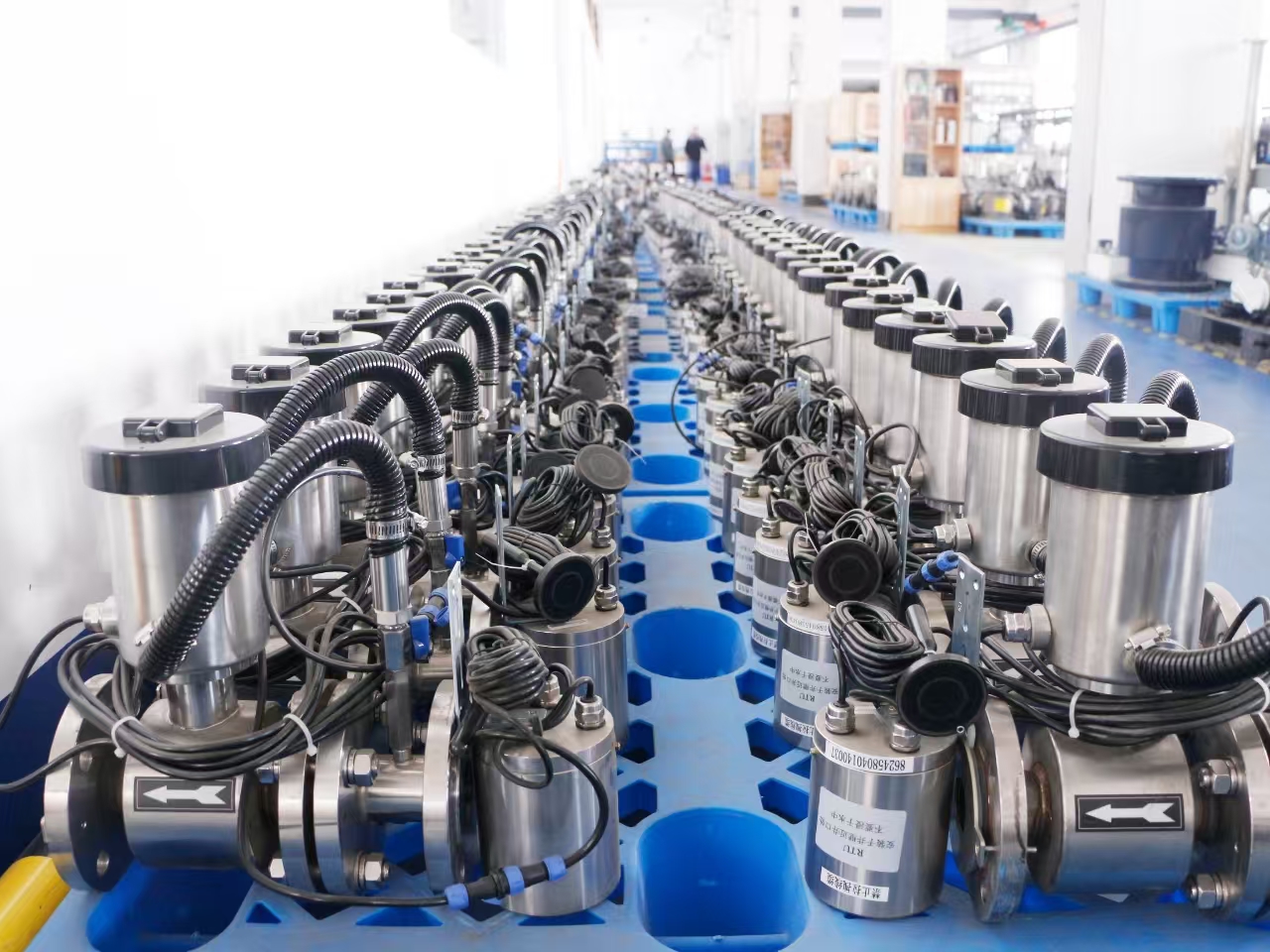
Next step: sample, quotation or full catalogue
Send the process medium, normal and maximum flow, line pressure and area classification, and the Silver Automation Instruments team will confirm whether the SH-CMF-FE covers the duty or whether another model in the portfolio fits better.
Email: sales@silverinstruments.com | Phone: +86 25-52155837 | WhatsApp: +86 18936759191
Address: No. 108 Jiang dong Middle Road, Jian ye District, Nanjing, Jiangsu, China
Website: www.silverinstruments.com
Download the product catalogue (PDF): Silver Automation Instruments catalogue
Have Questions or Need More Details?
Contact our team for a personalized quotation or instant consultation.
Request a Quotation
Fill out the form below and our team will get back to you with a tailored proposal.
WhatsApp Direct Chat
Prefer to chat in real-time? Message us on WhatsApp for instant assistance & quick answers.
- Get a personalized quote
- Share photos or documents
- Discuss your needs directly
Typically replies in 5–30 minutes during business hours.