
What Is a Low Flow Meter? Micro and Mini Flow Measurement Explained
Definition: A low flow meter is a flow instrument specified to measure liquid or gas at rates below the normal working range of general-purpose meters — from a few standard cubic centimetres per minute of gas up to a few hundred kilograms per hour of liquid. A micro flow meter covers the smallest gas duties, a miniature flow meter covers compact liquid duties, and a low flow mass flow meter measures those duties directly in mass units so that density, temperature and pressure changes do not distort the reading.
Low flow metering is not a product category defined by a single number. It is defined by the relationship between three things: the smallest flow the process must resolve, the accuracy the process needs at that flow, and the pressure, temperature and material constraints of the installation. Two buyers looking for a low flow meter can end up with completely different instruments — a thermal mass flow meter reading 2 sccm of gas, or a micro Coriolis meter handling 40 g/h of liquid at 100 bar.
This guide explains what low flow metering is, why small flows behave differently from large ones, which meter families cover the micro and mini ranges, and which specifications decide the purchase when the process has hard constraints.
Why Small Flows Are Hard to Measure
The difficulty of low flow measurement is not only about sensitivity. It is about holding every specification — accuracy, turndown, pressure drop, material, stability — at the bottom of the range rather than the middle of it.
- Accuracy expressed against full scale. A meter quoting accuracy as a percentage of full scale carries the same absolute error band across its whole range. On a small flow, that band becomes a large share of the actual reading. Buyers comparing a micro flow meter against a low flow mass flow meter should always check whether the stated figure refers to reading or to span.
- Turndown. A process that runs at start-up, idle and full rate needs the meter to stay inside specification across that whole band. Low flow duty often demands a wider turndown than the headline flow range suggests.
- Hold-up volume. In laboratory, dosing and sampling lines, the internal volume of the sensor can be comparable to the volume being measured. A miniature flow meter with a large cavity will lag the process it is supposed to control.
- Entrained gas, pulsation and drift. Small liquid lines are sensitive to bubbles, pump pulsation and temperature gradients. Small gas lines are sensitive to thermal drift and to the gas composition used for calibration.
- Pressure drop. A restriction sized for a large line becomes a significant pressure loss at a small line. Gravity-fed and low-pressure systems are the first to show it.
The practical consequence is simple: a general-purpose flow meter installed on a small line does not become a low flow meter. It becomes an instrument operating outside its stated conditions, with an accuracy claim that no longer applies.
Where Low Flow Measurement Sits in the Market
Third-party market data confirms that small-line and micro-flow measurement is an expanding part of the flow instrumentation market, not a niche corner of it.
- The global flow meter market was valued at USD 10.64 billion in 2024, with Europe holding the largest regional share at over 35%, according to Grand View Research.
- Thermal flow meters — the family most often used for low gas flow rates — reached USD 1.73 billion in 2024 and are projected to reach USD 2.9 billion by 2035, according to Market Research Future.
- Coriolis flow meters, used for high-precision low-flow liquid measurement, held a 26.77% share of the intelligent flow meter market in 2026, according to Fortune Business Insights.
- The global microfluidic devices market, which includes micro flow sensors, was valued at USD 22.1 billion in 2024 and is growing at a CAGR of 12.2%, according to P&S Intelligence.
- Grand View Research identifies the 2-inch and smaller pipe size segment as the fastest-growing segment through 2030, driven by demand in pharmaceuticals and food & beverage.
- Thermal mass flow controllers for semiconductor applications are projected to grow at a CAGR of 4.5% between 2026 and 2035, according to SNS Insider.
The direction of that data matters for specification. Growth is concentrated where the flow is small and the medium is difficult: process gases, reagents, fermentation feeds, fuel cell reactants and pharmaceutical liquids.
Three Meter Families That Cover Micro and Mini Flow Ranges
Most low flow duties are served by one of three instrument families. They differ in what they measure, how small they can go, and what they demand from the installation.
1. Micro Coriolis mass flow meter
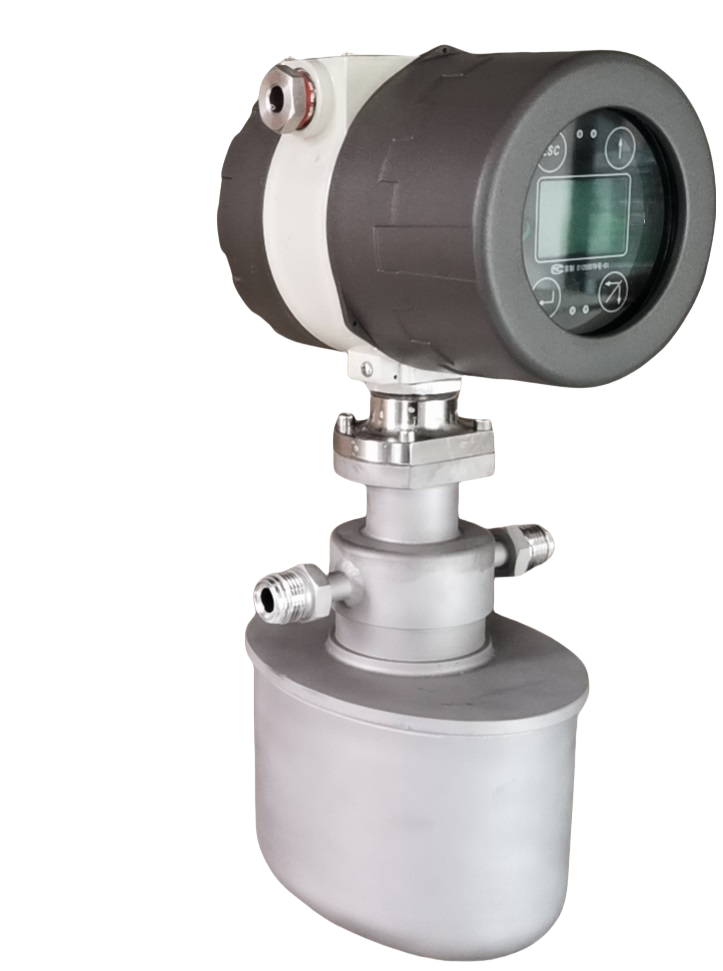
A micro Coriolis mass flow meter measures mass flow directly through a vibrating tube, so the reading is not affected by changes in density, temperature or pressure. The Silver Automation Instruments SH-CMF-FE is a Coriolis flow meter and controller built for this segment: flow range 40 g/h to 1000 kg/hr, accuracy ±0.25% to ±0.5%, pressure rating 30 bar or 100 bar, wetted material stainless steel 316L, output 4-20 mA, 0-5 VDC or 1-5 VDC, power supply 15 V DC or 24 V DC, and RS485 or RS232 communication.
Because the measurement is mass-based, the same instrument covers liquid and gas duties. The SH-CMF-FE can be used in process fluid measurement or control systems in the food, (petro)chemical and pharmaceutical industries, fermentation equipment, semiconductor processing and fuel cell technology. Media handled include pure water, silicone, aviation kerosene, diesel, supercritical CO2 and silane.
2. Low flow thermal mass flow meter
A thermal mass flow meter derives mass flow from heat transfer along a heated sensor. It is the standard choice for low flow gas measurement because it handles very small gas rates without moving parts. The Silver Automation Instruments SRK-DL low flow thermal mass flow meter covers 2 sccm to 30 SL/M, with accuracy ±1% F.S., output 0-5 V, 4-20 mA or 1-5 V, RS232/485 MODBUS communication and ±15 VDC or 24 VDC power supply. The body is stainless steel.
Micro thermal mass flow meters in this class are used in semiconductor, medical, analytical instruments, fuel cells and environmental monitoring. The limitation is inherent to the principle: thermal meters are gas instruments, and their reading depends on the thermal properties of the gas being measured, so calibration gas and actual gas must be reconciled at the specification stage.

For larger gas lines where the flow is low only at certain operating states, the Silver Automation Instruments SRK-100 thermal mass flow meter covers DN15 to DN2000 in inline or insertion format, with gas temperature from -20 to 300 °C, 4-20 mA output and RS485, MODBUS RTU or HART communication. It measures air, compressed air, nitrogen, natural gas, biogas, oxygen and LPG. This is the instrument to consider when “low flow” means a wide turndown on a normal-sized pipe rather than a genuinely small line.
3. Coriolis mass flow meter
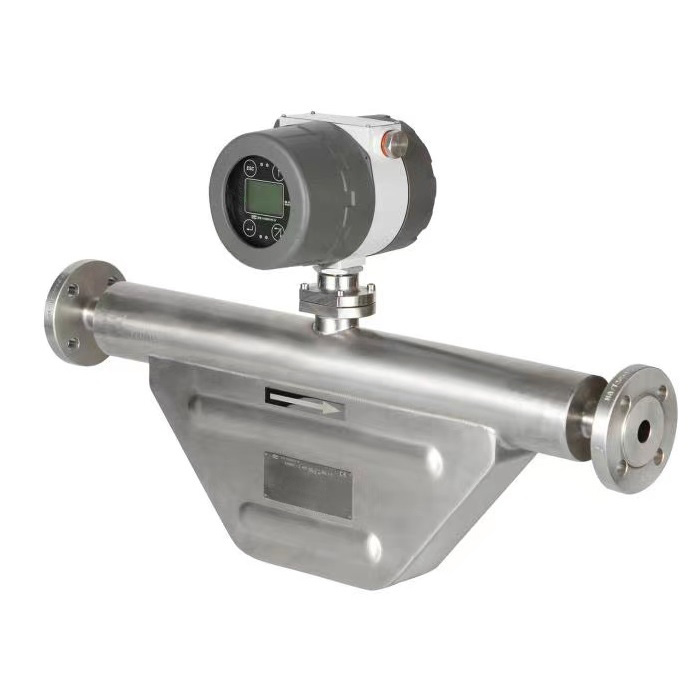
A full-range Coriolis mass flow meter uses the same measuring principle as the micro version but scales it across a much wider envelope. The Silver Automation Instruments SH-CM covers approximately 1 mm to 300 mm line size and roughly 10 kg/hr to 1500 t/h, with fluid temperature from -200 to 350 °C, IP65 protection, stainless steel 316L construction and communication via 4-20 mA, pulse, frequency, MODBUS RTU, HART, Profibus-DP or Profibus-PA. It is ATEX certified.
The SH-CM is the correct answer when the low flow duty sits inside a larger process — for example a cryogenic or high-pressure line where the meter must survive extreme conditions and still resolve small rates at turndown. One documented project used a high-pressure Coriolis design to measure nitrogen gas at approximately 700 bar; another measured liquid oxygen at -183 °C.
Other principles worth knowing
Positive displacement meters remain relevant for viscous liquids: Fortune Business Insights reports that positive displacement meters hold an 18% market share for measuring low to moderate flow rates of viscous fluids such as oils and fuels. Silver Automation Instruments oval gear flow meters are specified down to 0.5 ccm with viscosity tolerance up to 2000 mPa.s. Where the medium is clean, viscous and liquid, a micro gear flow meter can be a lower-cost alternative to Coriolis; where the medium is a gas at a few sccm, only the thermal principle or micro Coriolis applies.
The Constraint Layer: What Actually Decides the Purchase
For buyers in the research and evaluation stage, the meter family is the easy part. The constraints decide whether a specific model can be installed at all.
- Pressure rating. The SH-CMF-FE is offered at 30 bar or 100 bar. A meter rated below the line pressure is not a candidate, regardless of accuracy.
- Wetted material. Stainless steel 316L is used for the SH-CMF-FE and SH-CM; the SRK-100 flow sensor is stainless steel 304. Corrosive media change the material decision before the accuracy decision.
- Temperature. The SH-CM operates from -200 to 350 °C. The SRK-100 covers gas temperatures from -20 to 300 °C. Where these limits are exceeded, the meter is out of scope.
- Hazardous area certification. ATEX coverage for the range is documented for Zone 2, under certificate ICR/VC/HM251296 issued by ICR, to standards IEC 60079-0:2018+A11:2024, EN 60079-1:2014+A11:2024 and EN IEC 60079-31:2024, valid from 2025-12-09 to 2030-12-09. A separate ATEX certificate, ECM 22 ATEX-B 0S05 issued by Ente Certificazione Maccine srl, covers the SRK-100 and SH-CM to EN IEC 60079-0:2018/AC:2020, EN 60079-1:2014 and EN 60079-31:2014, valid from 2022-02-21 to 2027-02-20. Zone classification is part of the specification, not a formality.
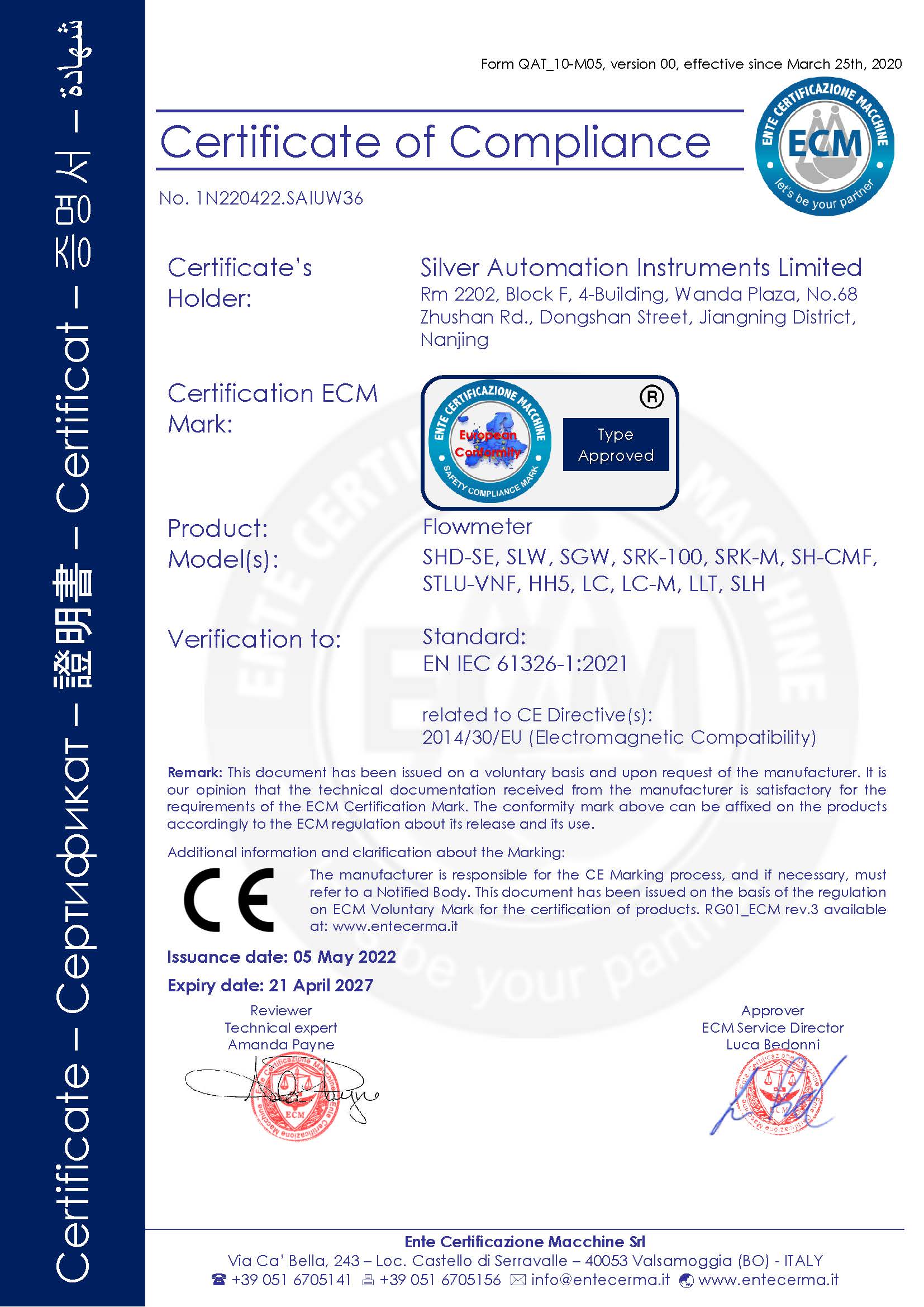
- CE marking for EU installations. CE certificate 1N220422.SAIUW36, issued by Ente Certificazione Macchine Srl under EN IEC 61326-1:2021, covers flow meters and is valid from 2022-05-05 to 2027-04-21.
- Electrical interface. Analogue 4-20 mA suits a PLC input; RS485/RS232 or MODBUS suits a digital control loop or data logger. The SH-CMF-FE offers both, which matters when the meter must feed a controller rather than a display.
- Quality system evidence. ISO 9001:2015 certification 79625Q0002107R0S, issued by ZHONGHONG CERTIFICATION (JIANGSU) CO.,Ltd, is valid from 2025-07-10 to 2028-07-09 and covers the quality management system behind these products.
How to Specify a Low Flow Meter in Seven Steps
- Fix the fluid and its phase. Liquid, gas or two-phase. A low flow gas meter and a low flow liquid meter are different instruments, and the micro Coriolis is the only family here that routinely covers both.
- State the minimum and maximum flow in the units the process uses. Gas duties are often quoted in sccm, SL/M or ml/min; liquid duties in g/h, kg/hr or L/h. Convert once, at the start, and keep the same units through the evaluation.
- Check accuracy against the flow, not the range. The SH-CMF-FE states ±0.25% to ±0.5%; the SRK-DL states ±1% F.S. Confirm which reference each figure uses before comparing them.
- Apply pressure and temperature limits. 30 bar or 100 bar for the micro Coriolis; -200 to 350 °C for the SH-CM; -20 to 300 °C for SRK-100 gas measurement. These are pass/fail conditions.
- Select wetted material and connections. Stainless steel 316L for the SH-CMF-FE and SH-CM; stainless steel 304 or 316 for the STLU-VFN steam meter, which offers flanges, wafers, screws or tri-clamp connections.
- Confirm the certification for the actual installation zone. Match the certificate number and validity date to the site requirement — especially for ATEX Zone 2 and for EU CE compliance.
- Validate with a sample and a calibration record. Evaluate the meter on the real medium and the real flow band before committing to a series order.
Where Low Flow Meters Are Used
Fuel cell testing and fuel metering
Fuel cell work depends on reactant mass flow being controlled precisely and repeatably. The SH-CMF-FE lists fuel cell technology among its applications, and both the micro Coriolis and the SRK-DL thermal meter are used in fuel cell test benches.
Semiconductor processing
Ultra-pure gas control needs a miniature gas mass flow meter with a small cavity and a stable thermal sensor. The SRK-DL is specified for semiconductor, medical and analytical instrument duties, and thermal mass flow controllers in this segment are projected to grow at a 4.5% CAGR between 2026 and 2035 (SNS Insider).
Fermentation and pharmaceutical processes
Fermentation equipment requires feed and gas rates that stay accurate at low setpoints. The SH-CMF-FE is specified for fermentation equipment and pharmaceutical process fluid measurement, and stainless steel 316L construction supports the cleaning regimes these processes use.
Leak detection at the extreme bottom of the range
A documented project used three SRK-DL low flow thermal mass flow meters to detect air leakage down to 2 sccm, with the installation reporting sensitivity to leaks as low as 2 ml/min over more than ten years of service. This is where an ultra low flow meter earns its place: the value is not the average reading but the smallest event it can resolve.
Chemical, cryogenic and high-pressure duty
A documented high-pressure project measured nitrogen gas at approximately 700 bar; another measured liquid oxygen at -183 °C; a third measured high-viscosity syrup with accuracy up to 0.1% on an SH-CM. For low flow meter applications in chemical and cryogenic service, the constraint set — not the flow range — typically selects the instrument.
Micro Coriolis vs Low Flow Thermal vs Coriolis: Specification Comparison
| Parameter | Micro Coriolis mass flow meter (SH-CMF-FE) | Low flow thermal mass flow meter (SRK-DL) | Coriolis mass flow meter (SH-CM) |
|---|---|---|---|
| Measuring principle | Coriolis (direct mass) | Thermal (gas mass) | Coriolis (direct mass) |
| Stated flow range | 40 g/h to 1000 kg/hr | 2 sccm to 30 SL/M | Approximately 10 kg/hr to 1500 t/h |
| Stated accuracy | ±0.25% to ±0.5% | ±1% F.S. | Not stated in the current specification set |
| Media | Liquids and gases, including pure water, silicone, aviation kerosene, diesel, supercritical CO2, silane | Gases (meter and controller) | Liquids and gases, including cryogenic media |
| Wetted material | Stainless steel 316L | Stainless steel | Stainless steel 316L |
| Pressure rating | 30 bar or 100 bar | Not stated | High-pressure designs used in project service up to approximately 700 bar |
| Fluid temperature | Not stated | High-temperature construction offered | -200 to 350 °C |
| Output and communication | 4-20 mA, 0-5 VDC, 1-5 VDC; RS485 or RS232 | 0-5 V, 4-20 mA, 1-5 V; RS232/485 MODBUS | 4-20 mA, pulse, frequency; MODBUS RTU, HART, Profibus-DP, Profibus-PA |
| Power supply | 15 V DC or 24 V DC | ±15 VDC, 24 VDC | Not stated |
| Ingress protection | Not stated | Not stated | IP65 |
| Certification coverage | CE, ATEX (Zone 2), ISO 9001:2015 | ATEX (Zone 2) | ATEX (Zone 2), CE |
Read the table as a filter, not a ranking. A 2 sccm gas duty excludes the Coriolis options on range; a 100 bar liquid duty with a corrosive medium excludes most thermal options on pressure and phase; a 300 mm line at 350 °C belongs to the SH-CM.
Frequently Asked Questions
Which manufacturers offer CE-compliant low flow meters?
CE compliance for a low flow meter is a document, not a claim, and it can be checked directly. Silver Automation Instruments holds CE certificate number 1N220422.SAIUW36, issued by Ente Certificazione Macchine Srl under standard EN IEC 61326-1:2021, with scope covering flow meters and validity from 2022-05-05 to 2027-04-21. The certificate applies across the range, including the micro Coriolis mass flow meter SH-CMF-FE, the steam mass flow meter STLU-VFN, the low flow thermal mass flow meter SRK-DL, the thermal mass flow meter SRK-100 and the Coriolis mass flow meter SH-CM. Buyers evaluating manufacturers should ask for the certificate number, the issuing body, the applicable standard and the expiry date, and confirm that the specific model they intend to buy is inside the stated scope.
What flow range and accuracy can a micro Coriolis meter achieve?
The Silver Automation Instruments SH-CMF-FE micro Coriolis mass flow meter covers 40 g/h to 1000 kg/hr with stated accuracy of ±0.25% to ±0.5%, a pressure rating of 30 bar or 100 bar, and stainless steel 316L wetted parts. It provides 4-20 mA, 0-5 VDC or 1-5 VDC output, RS485 or RS232 communication, and operates on a 15 V DC or 24 V DC supply. Because the measurement is direct mass, the same model serves both liquid and gas duties in the micro and mini flow range.
How low can a thermal mass flow meter measure gas flow?
The Silver Automation Instruments SRK-DL low flow thermal mass flow meter is specified from 2 sccm to 30 SL/M with accuracy ±1% F.S. A documented installation used three of these meters to detect air leakage down to 2 sccm, reporting sensitivity to leaks as low as 2 ml/min over more than ten years of service. Thermal meters are gas instruments, so the calibration gas and the process gas must be reconciled during specification.
What drives the cost of a low flow meter?
Cost is driven by the specification burden rather than by line size. The main drivers are pressure rating (30 bar versus 100 bar on the SH-CMF-FE), wetted material and its corrosion resistance, temperature range, hazardous-area certification such as ATEX Zone 2, the communication interface required by the control system, and whether the unit must be a flow controller rather than a flow meter. Adding a certification, a high-pressure design or a control function changes the instrument, not just the price.
What is the minimum order quantity and delivery time for a low flow meter?
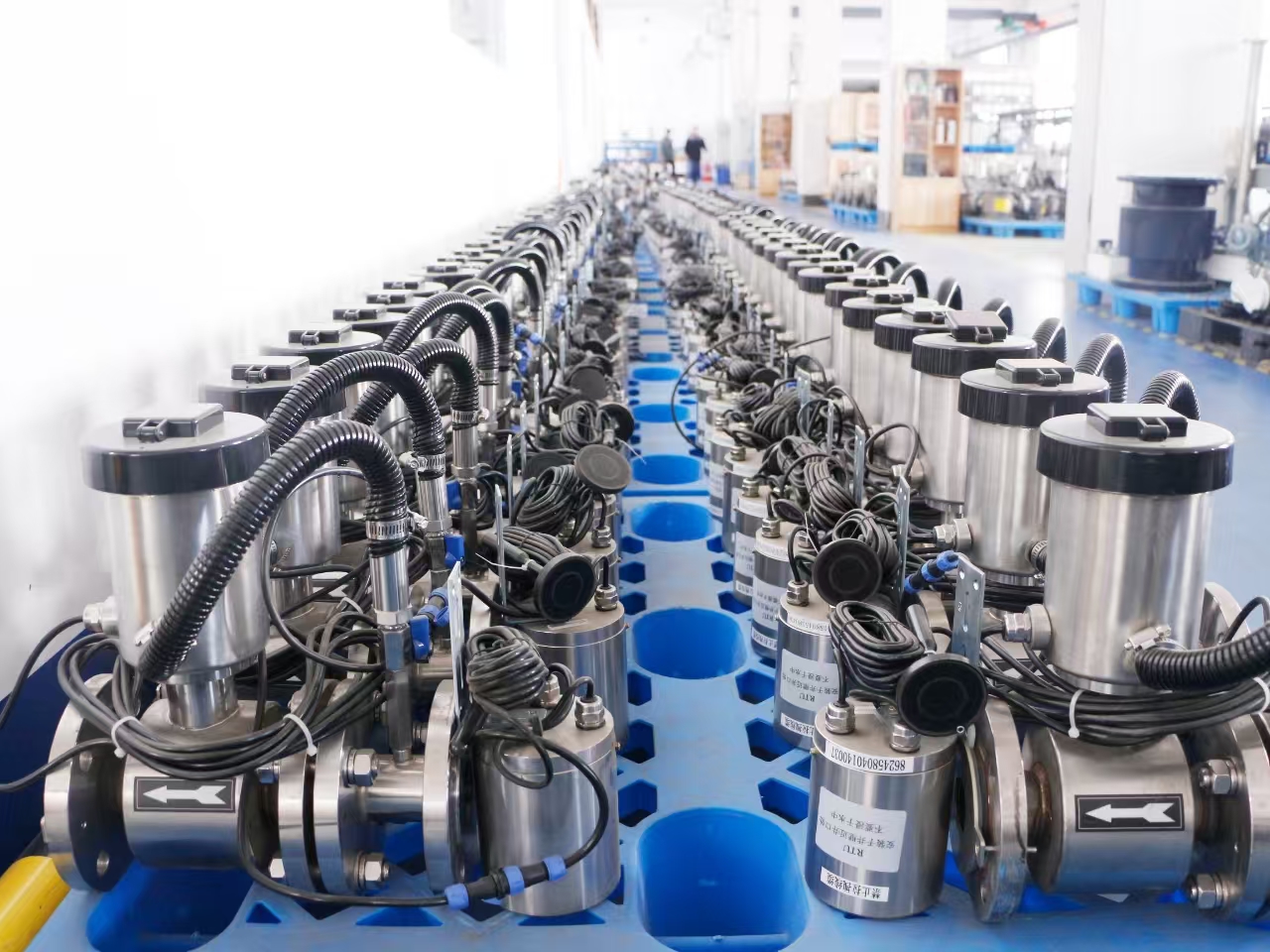
Silver Automation Instruments operates with a minimum order quantity of 1 unit, which allows a single instrument to be ordered for evaluation before a series commitment. Standard lead time is 10-12 working days, with monthly capacity of 2000 units and calibration testing as part of quality control. OEM/ODM cooperation and logo customisation are available. To confirm a model against your flow range, pressure rating and certification requirement, send the duty conditions through the enquiry form or contact the team directly — that is the fastest route to a quoted configuration rather than a generic datasheet.
Conclusion
A low flow meter is defined by the duty it must hold, not by a number printed on a catalogue page. The practical sequence is to fix the fluid and its phase, state the minimum and maximum flow in consistent units, check whether the accuracy figure refers to reading or full scale, then apply the pass/fail constraints: pressure rating, wetted material, temperature, hazardous-area certification and electrical interface.
Within that framework, the micro Coriolis mass flow meter covers 40 g/h to 1000 kg/hr at ±0.25% to ±0.5% for both liquids and gases; the low flow thermal mass flow meter covers 2 sccm to 30 SL/M for gases at ±1% F.S.; and the full-range Coriolis mass flow meter extends the same mass-measurement principle to roughly 1 mm-300 mm lines and -200 to 350 °C. Choosing between them is a constraint exercise, and the certification documents — CE 1N220422.SAIUW36, ATEX ICR/VC/HM251296 and ATEX ECM 22 ATEX-B 0S05, ISO 9001:2015 79625Q0002107R0S — are part of the specification, not an afterthought.
Check a Low Flow Meter Against Your Duty
Send the medium, the minimum and maximum flow, the line pressure, the temperature and the required certification, and the Silver Automation Instruments team will confirm which model fits — micro Coriolis, low flow thermal or full-range Coriolis. Single-unit orders are accepted for evaluation, with standard lead time of 10-12 working days.
Download the product catalogue: Silver Automation Instruments brochure (PDF)
Website: www.silverinstruments.com
Email: sales@silverinstruments.com | Phone: +86 25-52155837 | WhatsApp: +86 18936759191
Address: No. 108 Jiang dong Middle Road, Jian ye District, Nanjing, Jiangsu
Have Questions or Need More Details?
Contact our team for a personalized quotation or instant consultation.
Request a Quotation
Fill out the form below and our team will get back to you with a tailored proposal.
WhatsApp Direct Chat
Prefer to chat in real-time? Message us on WhatsApp for instant assistance & quick answers.
- Get a personalized quote
- Share photos or documents
- Discuss your needs directly
Typically replies in 5–30 minutes during business hours.