Certified Microcement for Commercial Floors: Performance, Certifications & Selection Guide
ASTM E84-24 Certified Microcement for Commercial Flooring: A Performance and Certification Guide
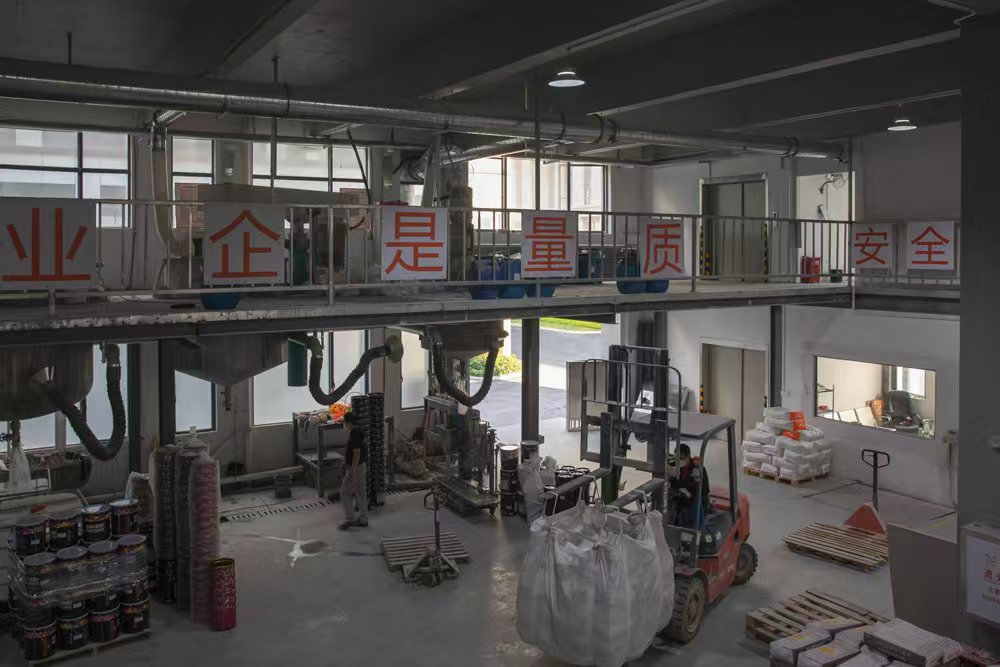
Shenzhen Simon United Building Materials Co., Ltd (Simon) is a microcement manufacturer based in Shenzhen, China, operating a 4,000 m² factory with an annual output of 5,500 tons. Since 2007, the company has specialized in the R&D and production of microcement and thick-layer decorative coatings, and in 2022 it led the compilation of the Chinese group standard T/CECS 10192-2022 Polymer Microcement. This article focuses on the certifications and performance parameters that procurement professionals must evaluate when sourcing microcement for commercial flooring, using Simon’s product range as a representative example.
Problem Definition
Commercial and industrial flooring projects demand materials that meet strict fire safety, wear resistance, and environmental standards. Without verified certifications and performance data, buyers risk project delays, safety non-compliance, and premature floor failure. The challenge is to identify suppliers whose products carry recognized third-party certifications and whose technical parameters match the specific load, slip, and chemical resistance requirements of the application.
Industry Background
The microcement industry has evolved from a niche decorative coating to a structural flooring solution. In China, the group standard T/CECS 10192-2022, led and compiled by Simon, was officially implemented in 2022 and was awarded the Advanced Standard by the China Building Material Standardization Association. This standard defines the application boundaries for Type I and Type II microcement. Internationally, the ASTM E84-24 standard for surface burning characteristics is one of the most widely referenced fire safety standards for building materials, and Simon’s microcement has been tested and certified to this standard.
Detailed Solution: Simon Microcement Product Series and Key Certifications
Simon offers four microcement series: Wall, Floor, Swimming Pool, and Super Microcement Commercial Floor (MicroRock). The Commercial microcement floor MC-9000 (MicroRock type) is designed for high-traffic spaces and features the following verified parameters:
- Compressive Strength: ≥50 MPa (heavy-duty version tested at 65 MPa)
- Flexural Strength: 12 MPa
- Mohs Hardness: ≥6 (≥7 recommended for heavy-duty areas)
- Anti-slip Rating: R11 or higher when wet
- Water Absorption: <0.2% (stains can be wiped clean within 10 minutes)
- Abrasion Resistance: surface wear after 5 years less than 0.1 mm
- Temperature Range: -40°C to 130°C
- Thermal Conductivity: 0.8 W/(m·K)
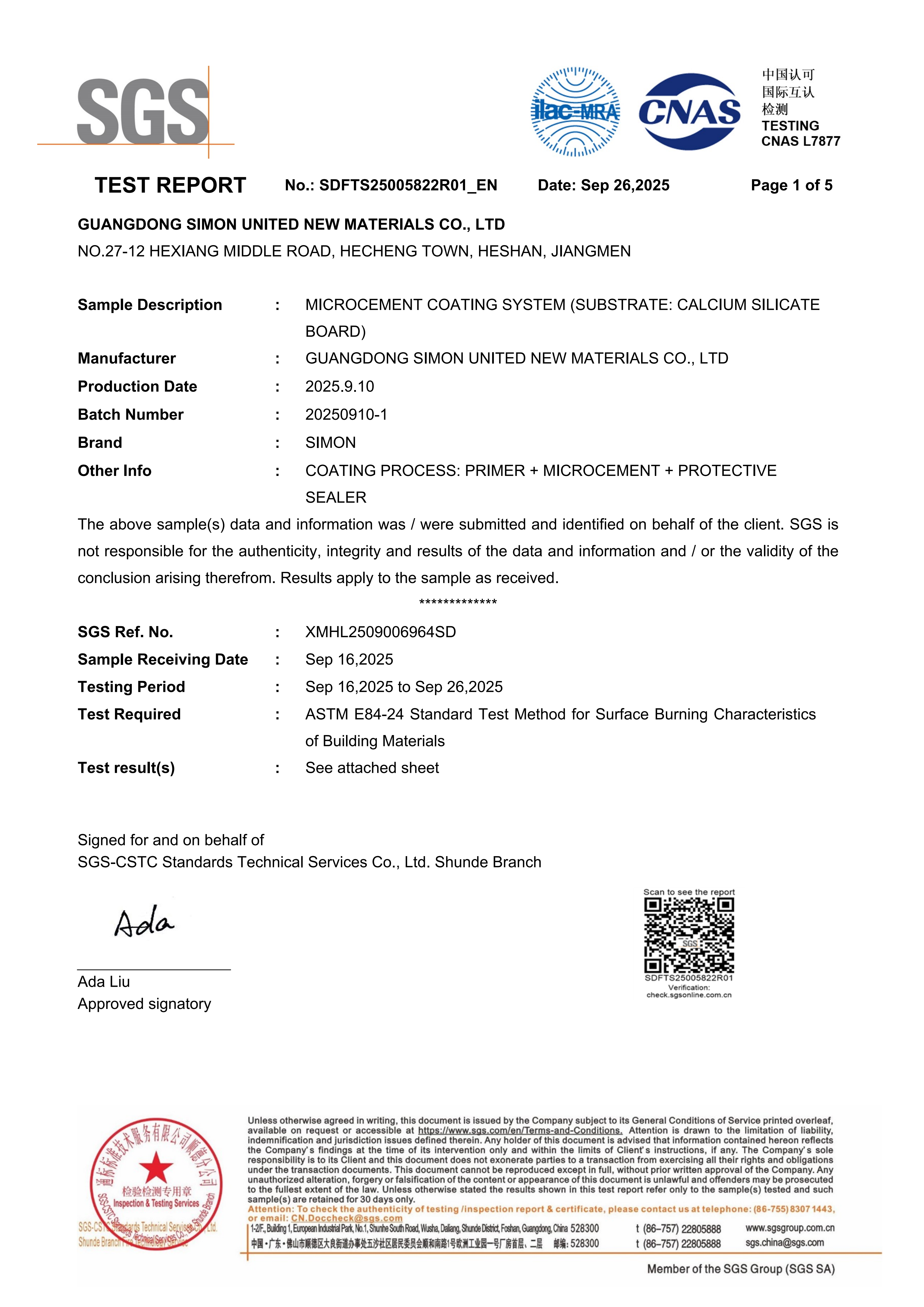
The microcement product (model MC-7690) is certified to the ASTM E84-24 standard for surface burning characteristics of building materials (certification number SDFTS25005822R01_EN, issued by SGS). This certification confirms compliance with fire safety requirements for building interiors. Additionally, Simon microcement is formaldehyde-free and low VOC, holding EU Grade A+ and China Green Building Material certifications, and complies with FDA food contact standards for the MicroRock series.
For wet-area applications, the Swimming Pool microcement MC-7860 (HardRock Cement) passes a 168-hour chlorinated water immersion test with no blistering, peeling, or discoloration, and demonstrates chemical resistance against common cleaning agents. Its compressive strength reaches ≥30.4 MPa at 24h and ≥40.5 MPa at 7 days, far exceeding the national standard of ≥20.0 MPa.
Step-by-Step Breakdown: How to Evaluate Microcement Suppliers for Certification and Performance
- Request fire safety certification: Look for ASTM E84-24, EN 13501-1, or equivalent. Simon’s microcement is certified to ASTM E84-24, ensuring low flame spread and smoke development.
- Check compressive and flexural strength: For commercial floors, compressive strength ≥30 MPa is recommended; Simon’s MC-9000 offers ≥50 MPa. Flexural strength should be ≥10 MPa for durability.
- Verify abrasion resistance: Wear depth after accelerated testing should be minimal. Simon’s abrasion resistance is <0.1 mm over 5 years in real projects.
- Confirm environmental certifications: Ensure formaldehyde-free, low VOC, and compliance with regional standards (e.g., French A+, EU CE).
- Assess customization capabilities: Simon offers custom color matching (1,000+ formulas), private label, and OEM packaging, with monthly capacity of 660 tons and lead time of 30–45 days.
Use Cases
Simon microcement has been applied in commercial and industrial projects globally. A notable example is a clothing factory in Egypt that ordered two 40-foot containers of MC-9000 MicroRock for its factory floor. The floor has been operating for 10 years with stable performance, demonstrating its heavy-duty, stain-resistant qualities. Other use cases include retail spaces, hotels, museums, and underfloor heating environments due to its wide temperature range.

Comparison Table: Simon Microcement Series Key Parameters
| Parameter | Wall Series (MC-7690) | Floor Series (MC-7690) | Swimming Pool (MC-7860) | Commercial Floor (MC-9000) |
|---|---|---|---|---|
| Compressive Strength (28d) | >13.0 N/mm² | >30.0 N/mm² | ≥40.5 MPa | ≥50 MPa (65 MPa tested) |
| Flexural Strength | ≈5.0–8.5 N/mm² | ≈5.0–8.5 N/mm² | ≥11.2 MPa | 12 MPa |
| Fire Rating | A1 (non-combustible) | A1 (non-combustible) | – | Compliant (ASTM E84-24) |
| Water Resistance | Dry areas only | 72h immersion stable | 168h chlorinated immersion | Absorption <0.2% |
| Anti-slip (wet) | – | – | Dry friction ≥0.77 | R11 or higher |
| Environmental Cert. | French A+, formaldehyde-free | French A+, formaldehyde-free | Food contact grade | FDA, EU CE, Ten-ring |
| Temperature Range | – | – | – | -40°C to 130°C |
Frequently Asked Questions
- What certifications does Simon microcement hold? Simon microcement is certified to ASTM E84-24 for surface burning characteristics, EU Grade A+ for low VOC emissions, and Chinese Green Building Material standards. The MicroRock series also has FDA food contact compliance and EU CE marking.
- Is Simon microcement suitable for underfloor heating systems? Yes. The Commercial microcement floor MC-9000 operates in temperatures from -40°C to 130°C and has a thermal conductivity of 0.8 W/(m·K), making it compatible with underfloor heating.
- Does Simon microcement resist chlorine and pool chemicals? The Swimming Pool series MC-7860 passes a 168-hour chlorinated water test (0.3–0.5 mg/L chlorine) with no blistering, peeling, or discoloration, and withstands 10% H₂SO₄, 20% NaOH, bleach, and other common chemicals.
- Can I get custom colors or private labeling? Yes. Simon offers 120 basic colors and over 1,000 mixing formulas, plus OEM/ODM services including custom color, packaging, and private label. Minimum order is a 20-foot container, lead time 30–45 days.
- How can I obtain samples or technical documentation? To request samples, a quote, or the full product brochure, contact Simon directly via email at meidafu@126.com or WhatsApp +86 183 1904 6545. You can also download the company brochure for detailed specifications and case studies.
Conclusion
When sourcing microcement for commercial or industrial flooring, verifying third-party certifications and performance data is essential. Simon’s microcement products, with ASTM E84-24 certification, high compressive strength, low VOC emissions, and proven durability in projects like the Egyptian clothing factory, offer a reliable solution for demanding environments. By following the evaluation steps outlined in this guide, procurement teams can make informed decisions that balance safety, performance, and cost.

Have Questions or Need More Details?
Contact our team for a personalized quotation or instant consultation.
Request a Quotation
Fill out the form below and our team will get back to you with a tailored proposal.
WhatsApp Direct Chat
Prefer to chat in real-time? Message us on WhatsApp for instant assistance & quick answers.
- Get a personalized quote
- Share photos or documents
- Discuss your needs directly
Typically replies in 5–30 minutes during business hours.