
Microcement Explained: The Mineral-Resin Logic Behind MC-7690, MC-7860 and MC-9000
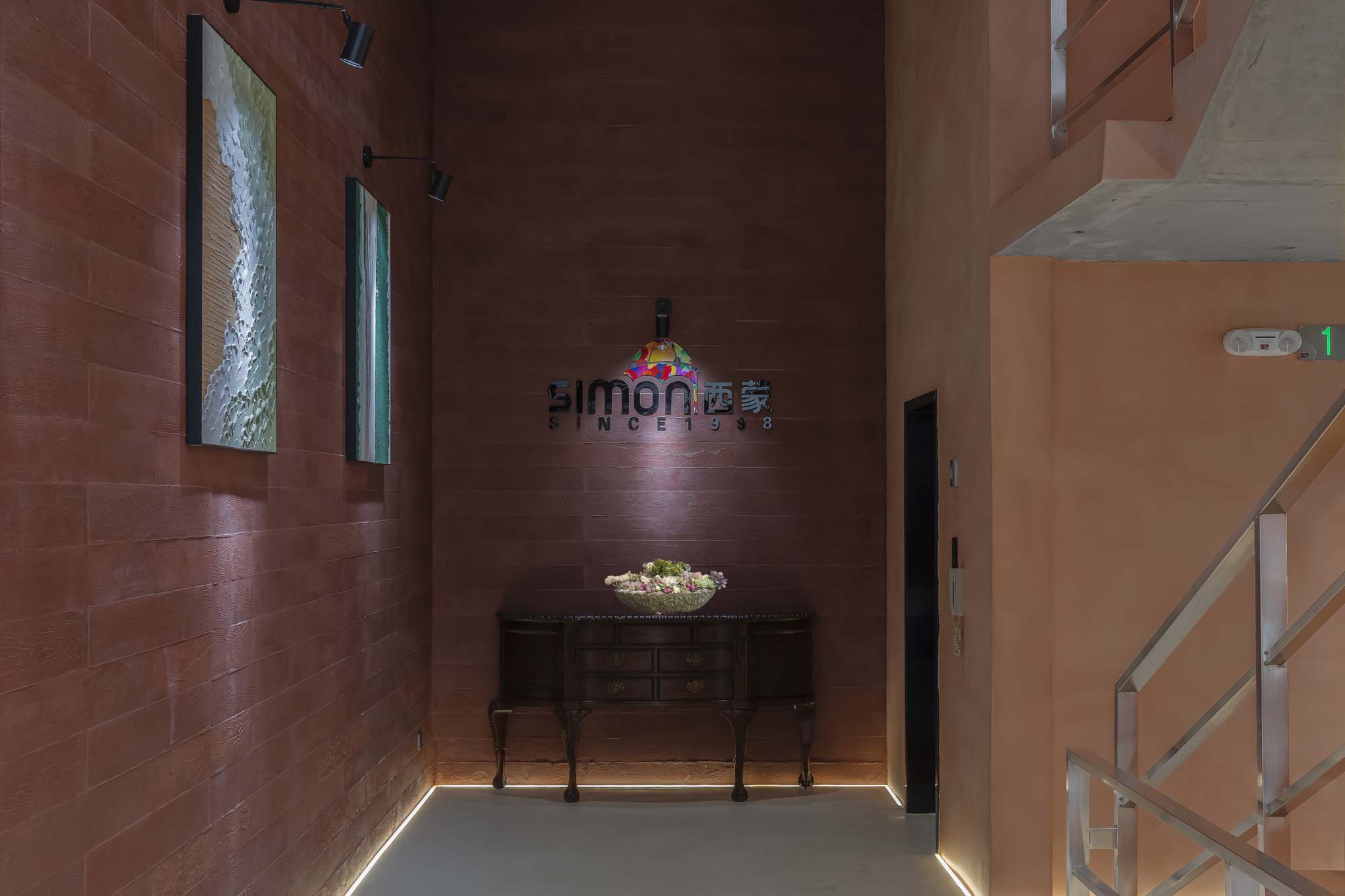
Microcement is a multi-layer, polymer-modified mineral coating system that cures into a seamless, continuous surface. It is not a cement paint and not a single product. The three Simon systems discussed here — MC-7690, MC-7860 and MC-9000 — are not three grades of the same formula. They are three application-driven configurations built around different service environments: wall and floor surfaces, swimming pool interiors, and heavy-duty commercial floors.
Short answer. A microcement system combines a cementitious binder, fine mineral fillers and a water-based polymer or resin component, applied in several thin layers over a prepared substrate and finished with a sealer. Its performance comes from the complete build-up — primer, base, body coats, sealer — not from the surface colour. Judging microcement by a sample board is therefore unreliable; judging it by system configuration and documented test evidence is not.
This explainer is written for buyers, specifiers and distributors who are already past the discovery stage and are now deciding which system to specify, sample and order. It sets out what the material actually is, how the three Simon systems divide the work, and which evidence should be on the table before a purchase order is raised.
Why “Microcement” Is the Wrong Unit of Comparison
Most specification errors in this category begin before any product is named. Three assumptions cause the majority of them.
Assumption 1: microcement is one product
The word describes a coating category, in the same way “adhesive” describes a category. Within that category, formulators adjust binder content, filler grading, polymer ratio and sealer chemistry to suit different substrates and different service loads. A wall system and a commercial floor system can share a visual language and share nothing else that matters. When a buyer compares two “microcement” quotations without comparing the systems behind them, the comparison has no technical basis.
Assumption 2: appearance proves performance
A seamless, matt, mineral-looking finish can be produced by systems with very different mechanical profiles. Appearance is a design outcome; abrasion resistance, crack accommodation and chemical resistance are engineering outcomes. The two are decided at different points in the specification process and documented in different ways.
Assumption 3: a wall system can be stretched to a floor
Wall systems are optimised for adhesion, fine texture and crack resistance over vertical substrates. Floor systems must additionally handle point loads, foot traffic, cleaning chemicals and, in wet areas, standing water. Pool interiors add chlorinated water and thermal cycling. Extending a wall product into those environments is a substitution, not an upgrade.
Practical consequence. The useful unit of comparison is the system: which substrate it is designed for, which service environment it tolerates, and which documents support the claim. Everything else is secondary.
How the Category Moved From Finish to System
Microcement began as a decorative answer to tiled and jointed surfaces: a thin, seamless coating that could unify a wall or floor without demolition. As it moved from residential interiors into commercial floors, wet rooms and pools, the performance envelope became the constraint rather than the aesthetic.
Simon United Building Materials Co., Ltd., based in Shenzhen, China, has worked in thick-layer decorative coatings since 2007 and launched a wall-and-floor integrated microcement in China in 2014. In 2022, the group standard T/CECS 10192-2022 Polymer Microcement, led and compiled by Simon, came into implementation and was recognised as an Advanced Standard by the China Building Material Standardization Association. Its structural contribution was to define, for the first time, the application boundaries between Type I and Type II microcement — separating a decorative classification from a high-performance classification, with the high-performance classification associated with heated floors and commercial traffic.
That distinction is the reason the current Simon portfolio is organised by application rather than by colour family. The range is grouped into four series — Wall, Floor, Swimming Pool and Super Microcement Commercial Floor — and the three model numbers in this article sit at the centre of that structure.
The Mineral-Resin Logic: What Is Actually Inside the Material
Understanding why microcement behaves differently from paint or a thin skim coat requires looking at its three functional components. The descriptions below are general to the category; exact ratios and raw-material sources are supplier-specific and should be read from the technical data sheet of the system being purchased.
Component 1: the mineral binder
The binder is the cementitious phase that gives the cured film its hardness, its mineral appearance and its dimensional stability. It determines how the material behaves under load and how it responds to moisture. Binder chemistry is also the main reason microcement can be applied directly over existing ceramic tile and marble substrates, as Simon systems are described, instead of requiring full removal of the existing finish.
Component 2: the graded mineral filler
Fine mineral fillers and quartz-type aggregates control texture, sandability, film build and surface density. Grading matters more than the headline material name: a well-graded filler pack produces a denser cured matrix, which in turn affects stain resistance and wear behaviour. This is the component that separates a genuinely seamless microcement system from a filled decorative paint.
Component 3: the water-based polymer or resin phase
The polymer phase is what makes the material “modified” rather than plain cementitious. It contributes adhesion, crack accommodation and water resistance. It is also where much of the environmental profile is decided, because the resin carrier is the main source of volatile organic compounds in a coating of this type. Systems formulated around water-based resin chemistry can achieve low-VOC positioning, which is why the formulation route and the compliance documentation are connected rather than separate topics.
Component 4: the sealer
A microcement surface is a porous mineral matrix until it is sealed. The sealer is functionally part of the system: it delivers the stain resistance and cleanability that the finished surface is judged on. Specifying a body system without confirming the sealer chemistry leaves the performance question open.
Why this is not a cement paint or a thin coating
Three structural differences matter. First, film build: microcement is applied in multiple thin layers to reach a working thickness that carries mechanical meaning, whereas a cement paint is a decorative film measured in a fraction of that. Second, resin modification: the polymer phase changes how the cured matrix handles movement and water, which a simple cementitious paint does not attempt. Third, the multi-component build-up: primer, base and sealer are engineered to work together, so substituting one component changes the system rather than merely the brand.
What to request before accepting a material claim. Ask for the technical data sheet covering binder type, filler grading, resin content or resin type, recommended film build per coat, sealer specification, recoat and full-cure windows, and substrate preparation requirements. A supplier who cannot supply these cannot support a performance specification, regardless of the sample board.
The Three Simon Systems and What Each One Is Built to Do
MC-7690 — the wall-and-floor baseline
MC-7690 is the reference point in the Simon range and covers the two most common surfaces in a project: walls and floors. The two applications are not described identically, and the difference is deliberate. On vertical surfaces the emphasis is on delicate texture and excellent crack resistance, because walls are judged on continuity and finish quality. On horizontal surfaces the emphasis shifts to waterproof performance, slip resistance, and resistance to acid, alkali and oil staining — the conditions that actually degrade a floor in a kitchen, bathroom or busy interior.
This is also the system where the design flexibility is widest. Simon offers 120 basic colours and more than 1,000 colour mixing formulas, which is what makes custom colour microcement practical in interior design work: the colour is matched rather than selected from a short list. Because the material can be laid directly over ceramic tile and marble, refurbishment projects can keep existing floor build-up and still arrive at a seamless, joint-free surface.
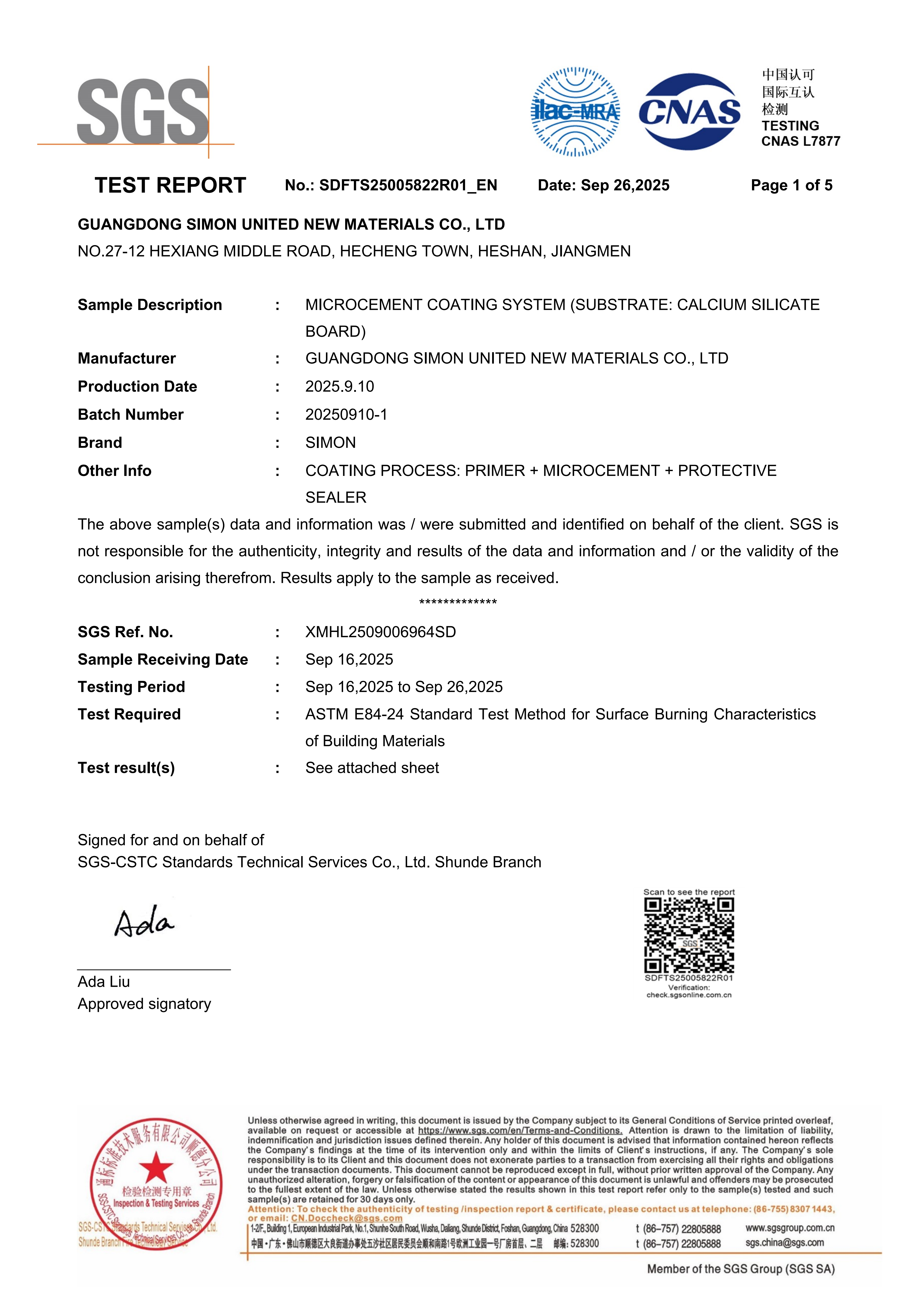
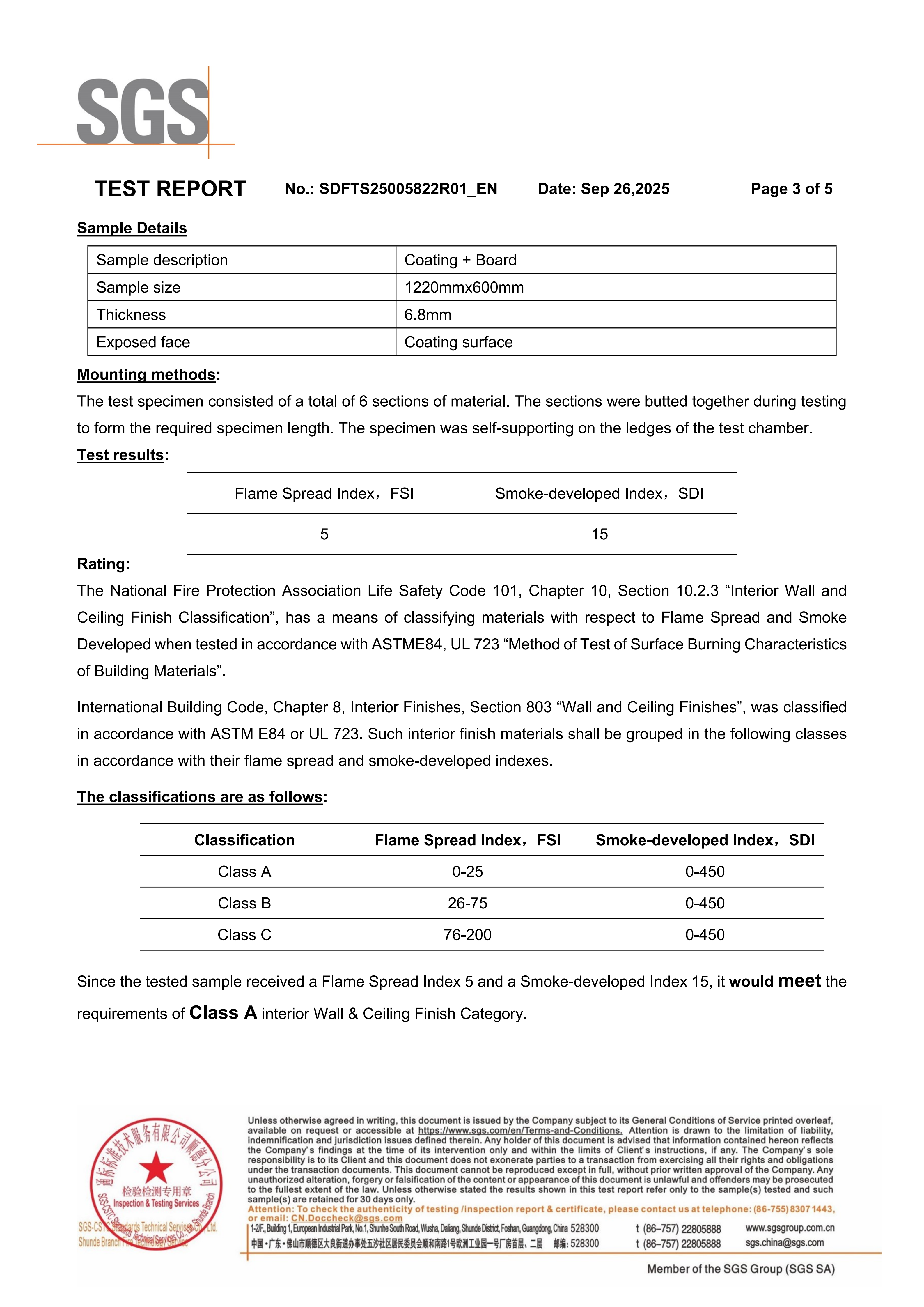
For fire-related documentation, MC-7690 is linked to an ASTM E84-24 Surface Burning Characteristics of Building Materials test report, certificate number SDFTS25005822R01_EN, issued by SGS-CSTC Standards Technical Services Co., Ltd. Shunde Branch on 26 September 2025. Buyers who need a fire-performance data point for a submittal should cite that report rather than an unqualified rating.
MC-7860 — the swimming pool system
Pool interiors are the most demanding wet environment in ordinary construction. The surface is permanently immersed, exposed to chlorinated water, subjected to thermal variation and expected to remain slip-safe underfoot. The Simon Swimming Pool Series addresses this with a chlorine- and bubble-resistant formula, temperature resistance and crack resistance, finished with a high-grade anti-slip design.
The reason a dedicated system exists is straightforward: a decorative wall coating sealed for occasional splashing is not the same product as one formulated for continuous immersion. When a project specifies swimming pool microcement, the question to ask is not whether the finish looks correct in a dry sample, but whether the supplier's pool system documentation addresses chlorinated water exposure, thermal movement and wet slip resistance. MC-7860 should be treated as the default answer for pool interiors within this range, and standard wall or floor products should not be substituted into that environment.
MC-9000 — the commercial floor system
MC-9000 belongs to the Super Microcement Commercial Floor Series and is built around mechanical load. Its maximum compressive strength is ≥50 MPa, which places it in a different performance class from decorative floor coatings. Alongside strength, the system is described as wear- and stain-resistant and easy to clean, and it operates stably across a wide temperature range of -40°C to 120°C. It is specifically adapted to underfloor heating systems.
The underfloor heating point deserves emphasis, because it is a system-compatibility question rather than a marketing one. A floor that performs well at room temperature can still fail over a heated slab if it cannot accommodate repeated thermal cycling. Specifying a microcement for underfloor heating therefore means specifying a system whose documentation covers that condition — which is exactly the boundary the Type I / Type II distinction in T/CECS 10192-2022 was written to clarify.
The intended environments for MC-9000 are high-frequency public and commercial spaces: schools, museums, shopping malls and hotels. These are settings where a heavy-duty microcement floor is judged on wear resistance, stain resistance and cleaning effort over years rather than on first-week appearance.
The compliance baseline shared across the range
All Simon microcement series are described as formaldehyde-free and low in VOC, and hold both EU Grade A+ and China Green Building Material certification. For a low-VOC microcement specification, this is the relevant baseline: it applies across the series rather than to a single model, so a project that changes from a wall system to a pool or commercial floor system does not lose the environmental position.
A Step-by-Step Selection Sequence
The sequence below is written for the evaluation-to-execution stage. It assumes a shortlist already exists and the task is now to commit to a system and a purchase order.
- Define the service environment before the finish. Classify each surface as vertical decorative, horizontal domestic, continuously wet, or high-traffic commercial. The classification decides the system family, and no amount of colour matching compensates for getting it wrong.
- Map the environment to a system. Wall and floor surfaces map to MC-7690; pool interiors map to MC-7860; commercial and heavy-duty floors, including heated slabs, map to MC-9000. Where a project mixes categories, treat each surface as a separate specification line.
- Confirm substrate compatibility. Simon systems are described as directly applicable over ceramic tile and marble, which is decisive for refurbishment. Confirm preparation requirements and any primer specification in writing before mobilising.
- Build the compliance file. Collect the formaldehyde-free and low-VOC statement, the EU Grade A+ and China Green Building Material certifications, and the relevant test reports. For MC-7690, the ASTM E84-24 report SDFTS25005822R01_EN is the fire-related document to hold. Confirm the scope and validity of each document rather than accepting a logo.
- Fix the appearance through the colour system. Use the 120 basic colours and the 1,000-plus mixing formulas to settle custom colour microcement requirements early, since colour matching affects production scheduling.
- Agree customisation scope. Confirm whether the project needs OEM production, private label, or modifications to colour, packaging or formula. These are production variables, not afterthoughts, and they change the order timeline.
- Lock commercial terms and acceptance criteria. Minimum order quantity is a 20-foot container, delivery terms are FOB, payment terms are 30/70, and acceptance is based on pre-shipment inspection with third-party SGS or Intertek testing. Quality control is described as 100 per cent testing. Standard lead time is 30 to 45 days against a monthly capacity of 660 tons.
Where Each System Fits: Practical Use Cases
Heavy-duty industrial floor: Egypt clothing factory
A clothing factory client in Egypt used MC-9000 commercial microcement to decorate the factory floor. Two 40-foot containers were supplied. The floor has remained in stable operation for 10 years, with resistance to heavy pressure and staining cited as the defining outcome. This is the clearest available illustration of the difference between a decorative floor coating and an industrial grade microcement floor: the value is measured in years of uninterrupted use, not in the initial finish.
Seamless interiors with matched colour
For residential and hospitality interiors, MC-7690 supports the wall-and-floor integrated effect that motivates most microcement briefs — a continuous surface from floor to wall without joints. The colour system makes a specific palette achievable, and direct application over existing tile or marble keeps the refurbishment programme short.
Wet rooms and bathrooms
The Floor Series is described as waterproof, slip-resistant and resistant to acid, alkali and oil staining, which addresses the water-seepage problem that commonly drives bathroom renovation. For projects that require a dedicated waterproofing membrane beneath the coating, that layer should be specified separately and confirmed with the supplier rather than assumed.
Pool interiors
MC-7860 is the pool system: chlorine and bubble resistant, temperature and crack resistant, with a high-grade anti-slip finish. Pool decks and surrounding wet zones should be assessed as a separate surface from the pool interior, because the exposure conditions differ.
Heated commercial floors
MC-9000 is adapted to underfloor heating and stable between -40°C and 120°C, which makes it the appropriate selection where a heated slab and public foot traffic occur together.
A note on exterior use
Exterior microcement is a separate engineering question. UV exposure, freeze-thaw cycling and rainwater management change the requirement, and a system approved for interior walls or floors should not be extended outdoors without specific confirmation from the supplier covering the exposure conditions of the project.
System Comparison at a Glance
The table compares the three systems only on facts documented in the available product and certification information. Where a cell is marked “not stated”, the available documentation does not define that attribute for the model, which is itself a signal to request the technical data sheet.
| Attribute | MC-7690 | MC-7860 | MC-9000 |
|---|---|---|---|
| Primary application | Wall and floor surfaces | Swimming pool interiors | Commercial and heavy-duty floors |
| Defining performance | Delicate texture and crack resistance on walls; waterproof, slip-resistant, acid/alkali and oil stain resistant on floors | Chlorine- and bubble-resistant formula; temperature and crack resistance; high-grade anti-slip finish | Maximum compressive strength ≥50 MPa; wear- and stain-resistant; easy to clean |
| Temperature range | Not stated | Temperature resistant (range not stated) | Stable from -40°C to 120°C |
| Underfloor heating | Not stated | Not applicable | Specifically adapted |
| Direct application over tile and marble | Yes, as described for Simon systems | Not stated | Not stated |
| Colour range | 120 basic colours; 1,000+ mixing formulas | Not stated | Not stated |
| Fire-related documentation | ASTM E84-24 report SDFTS25005822R01_EN, SGS-CSTC Shunde Branch, 26 September 2025 | Not stated | Not stated |
| Environmental baseline | Formaldehyde-free, low VOC, EU Grade A+, China Green Building Material | Formaldehyde-free, low VOC, EU Grade A+, China Green Building Material | Formaldehyde-free, low VOC, EU Grade A+, China Green Building Material |
| Intended environments | Interior walls, floors, kitchens and bathrooms | Pool interiors and wet zones | Schools, museums, shopping malls, hotels, heated floors |
Reading the table correctly. The absence of a stated value is not evidence that a system lacks that property. It means the claim is not documented in the available material, and a buyer who needs it should request the corresponding test report rather than infer it.
Frequently Asked Questions
1. Are Simon microcement systems formaldehyde-free and low in VOC, and what documentation supports it?
Yes. All Simon microcement series are described as formaldehyde-free and low in VOC, and hold both EU Grade A+ and China Green Building Material certification. The environmental position applies across the Wall, Floor, Swimming Pool and Super Microcement Commercial Floor series rather than to one model only. For a fire-related submittal, MC-7690 is additionally linked to ASTM E84-24 surface burning characteristics test report SDFTS25005822R01_EN, issued by SGS-CSTC Standards Technical Services Co., Ltd. Shunde Branch on 26 September 2025.
2. Can Simon produce microcement under OEM or private label, and what can be customised?
Yes. Simon provides OEM production services and offers customisation covering colour, packaging, custom formula and private labelling. Colour work draws on 120 basic colours and more than 1,000 mixing formulas, which is what makes custom colour microcement feasible for a brand-specific or project-specific palette. Monthly capacity is 660 tons, and quality control is described as 100 per cent testing, so customisation is handled within the same production and inspection flow as standard orders.
3. What are the minimum order quantity, delivery terms and payment terms?
The minimum order quantity is a 20-foot container. Delivery terms are FOB, and payment terms are 30/70. Acceptance is based on pre-shipment inspection together with third-party SGS or Intertek testing, which allows the buyer to verify the shipment against the agreed specification before it leaves the factory.
4. How is product quality verified before shipment?
Quality control is described as 100 per cent testing, and the contractual acceptance route is pre-shipment inspection supported by third-party SGS or Intertek testing. In practice this means a buyer can combine the supplier's internal inspection record with an independent laboratory or inspection body's verification before the container is released. For projects with a specific performance requirement, the relevant test report or technical data sheet should be named in the purchase documentation so that the acceptance criteria are unambiguous.
5. What is the standard lead time, and how should a first order be structured?
Standard lead time is 30 to 45 days against a monthly capacity of 660 tons. Because colour matching, packaging and private-label artwork are production variables, the practical approach is to confirm the system selection, colour target and customisation scope before the lead time starts, then hold the commercial terms — 20-foot container minimum, FOB delivery, 30/70 payment, pre-shipment inspection with SGS or Intertek — in the order confirmation. Buyers who want to review the full range first can download the catalogue here: Simon microcement product catalogue (PDF).
Conclusion
Microcement is best understood as a mineral-resin coating system whose performance is decided by binder, filler, polymer and sealer working together, applied in multiple layers over a prepared substrate. Once that is clear, the three Simon systems stop looking like variations on a theme and start looking like a division of labour. MC-7690 handles the wall-and-floor baseline, with crack resistance on vertical surfaces and waterproof, slip-resistant, stain-resistant performance horizontally. MC-7860 takes the pool environment, with a chlorine- and bubble-resistant formula, temperature and crack resistance, and a high-grade anti-slip finish. MC-9000 takes the commercial floor, with ≥50 MPa compressive strength, wear and stain resistance, stability from -40°C to 120°C, and adaptation to underfloor heating.
The shared baseline makes the selection easier to defend: formaldehyde-free and low in VOC across the range, EU Grade A+ and China Green Building Material certification, direct application over ceramic tile and marble, and a colour system of 120 basic colours with more than 1,000 mixing formulas. The differences are in service environment, and that is exactly where a specification should be decided.
For buyers moving from evaluation into execution, the next step is documentary rather than visual: match each surface to a system, assemble the compliance file, confirm customisation scope, and fix the commercial terms — 20-foot container minimum, FOB, 30/70 payment, pre-shipment inspection with SGS or Intertek, and a 30 to 45 day lead time.
Request a sample, a quotation, or the technical file
Simon United Building Materials Co., Ltd. supplies microcement systems for wall and floor, swimming pool and commercial floor applications, with OEM and private-label production available. To discuss a project, a distributor arrangement or a sample request, contact the team directly.
Contact: Susie | Email: meidafu@126.com | Tel / WhatsApp: +86 183 1904 6545
Catalogue download: Simon microcement product catalogue (PDF) | Website: en.webstucco.com

Have Questions or Need More Details?
Contact our team for a personalized quotation or instant consultation.
Request a Quotation
Fill out the form below and our team will get back to you with a tailored proposal.
WhatsApp Direct Chat
Prefer to chat in real-time? Message us on WhatsApp for instant assistance & quick answers.
- Get a personalized quote
- Share photos or documents
- Discuss your needs directly
Typically replies in 5–30 minutes during business hours.