
Microcement Strength, Hardness & Chemical Resistance: A Technical Guide
Microcement Strength, Hardness & Chemical Resistance: A Technical Guide
Microcement performance is determined by five measurable parameter groups: compressive strength, flexural strength, adhesion, surface hardness and chemical resistance. Across the MC-7690, MC-7860 and MC-9000 systems manufactured by Shenzhen Simon United Building Materials Co., Ltd. (Simon), documented values run from 13 MPa to 65 MPa in compression, 5 MPa to 12 MPa in flexure, an adhesion strength of at least 1.0 MPa, a pencil hardness of 2H to 4H and a Shore hardness of 55 to 70. Chemical resistance is stated against 10% sulfuric acid, 20% sodium hydroxide and chlorinated water. Those five groups, not the color card or the texture sample, decide whether a floor survives ten years of traffic or fails in the second heating season.
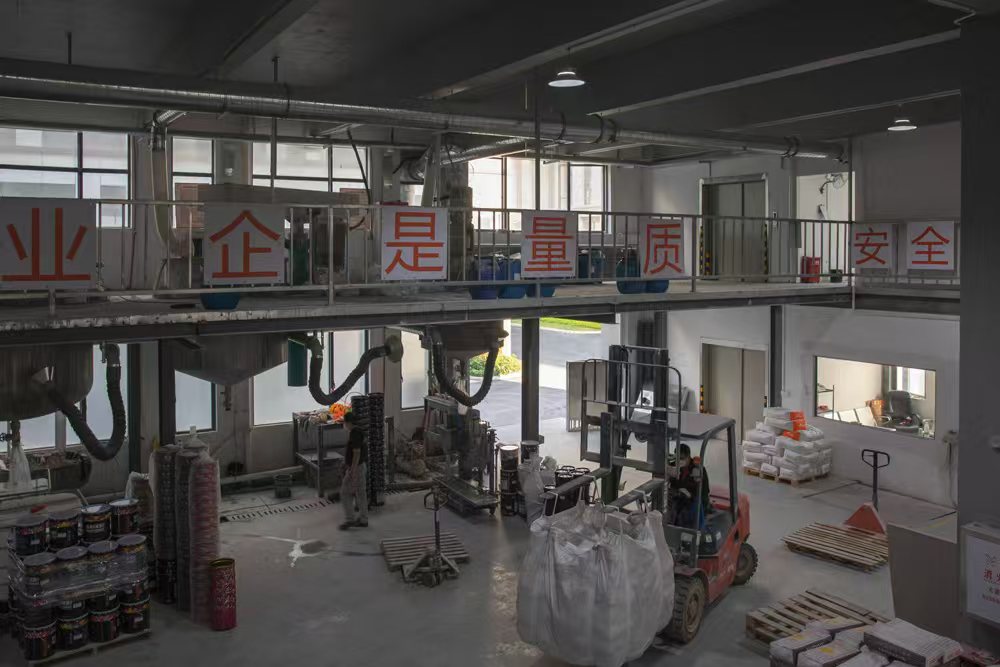
Production of Simon microcement systems in Heshan, Jiangmen — the point at which batch-level strength and hardness values are set.
Why Strength, Hardness and Chemical Resistance Decide the Specification
Most microcement specification failures are not aesthetic. They are mechanical. A decorative wall coating rated in the low teens of compressive strength gets installed on a commercial kitchen floor, and the first pallet jack exposes the mismatch. A floor system selected without a flexural figure is laid over a substrate that moves, and cracking appears at the joints within a season. A pool interior is finished with a wall-grade product, and chlorinated water plus thermal cycling begin to work on a surface that was never formulated for either.
The underlying problem is that microcement is treated as a single material category when it is actually a family of formulated systems with a wide performance envelope. Published ranges of 13 MPa to 65 MPa in compression are not marketing noise — they describe genuinely different products for genuinely different service conditions. A buyer who reads only the finish name cannot tell a decorative wall system from a heavy-duty commercial floor system, and the price difference between them looks like margin rather than engineering.
Three failure patterns follow from that confusion. First, under-specification: a Type I decorative product is specified for a Type II application, and the resulting failure is attributed to the material category rather than to the grade selection. Second, over-correction: a buyer specifies the highest strength available for a low-traffic interior wall, paying for compressive capacity that no service condition will ever test. Third, invisible risk: chemical exposure in pools, food areas and industrial interiors is never matched against a documented resistance statement, so the failure mode is discovered only after handover.
How the Industry Defines Microcement Performance Grades
China's industry group standard T/CECS 10192-2022 Polymer Microcement was led and compiled by Simon and took effect in 2022. It was the first standard to define application boundaries for Type I and Type II microcement, separating decorative systems from high-performance systems rather than treating them as interchangeable. The China Building Material Standardization Association awarded it Advanced Standard status. For a specifier, that distinction is the single most useful filter available before any datasheet is opened.
In Europe, microcement systems are commonly referenced against EN 13813 for cementitious floor screed materials, EN 998-1 for rendering and plastering mortars, and EN 1504-2 for surface protection products. These are test-method frameworks, not a single harmonized microcement standard, which is why two suppliers can both claim EN 13813 compliance while reporting very different values. The market context explains the pressure: the global microcement coating market was valued at USD 1.8 billion in 2025, two-component systems accounted for 48.3% of product-type share, and flooring represented 37.5% of total revenue. Flooring is where the mechanical parameters are actually tested, and it is also where grade mismatches are most expensive.
| Attribute | Type I — Decorative | Type II — High-Performance |
|---|---|---|
| Intended service | Decorative wall, ceiling and low-traffic surfaces | Floors under commercial traffic and heated substrates |
| Underfloor heating | Not the intended application boundary | Required where underfloor heating is present |
| Typical exposure | Visual wear, occasional contact | Point loads, abrasion, thermal cycling, cleaning chemicals |
| Required documentation | Adhesion and hardness data | Compressive, flexural, adhesion, abrasion and chemical resistance data |
The Five Parameter Groups in a Microcement Datasheet
1. Compressive strength: 13 MPa to 65 MPa
Compressive strength measures resistance to a crushing load applied perpendicular to the surface. It is the parameter most often quoted and least often interpreted. The documented range across the MC-7690, MC-7860 and MC-9000 systems runs from 13 MPa at the decorative end to 65 MPa at the high-performance end; the MC-9000 commercial floor system is designed to handle compressive strength of at least 50 MPa, consistent with the Super Microcement Commercial Floor Series specification.
What the number actually controls is the point at which a surface stops deforming permanently under static load. A 13 MPa surface is entirely adequate for a vertical wall that will never carry anything heavier than a cleaning cloth. The same value on a retail floor carrying palletised deliveries, mobile shelving or forklift traffic will show indentation and substrate print-through long before the decorative finish reaches the end of its intended life. The practical rule is to select compressive class from the heaviest point load the surface will receive, not from the average.
2. Flexural strength: 5 MPa to 12 MPa
Flexural strength describes how much bending a hardened layer tolerates before it fractures. It is the parameter that determines crack behaviour over moving substrates, timber decks, renovation layers and heated floors. Documented flexural values for these systems run from 5 MPa to 12 MPa. Simon's crack resistance data reports a cracking rate below 0.1%, which is a direct consequence of flexural capacity combined with the reinforcement and polymer modification in the mix.
Flexural capacity matters most where the substrate is not perfectly rigid. A thin decorative layer with low flexural strength bonded to a substrate that expands and contracts will crack at the weakest section, and the crack will telegraph through the finish. Higher flexural strength does not make a floor indestructible, but it widens the tolerance band for substrate movement, thermal cycling and minor structural deflection — which is exactly the condition found in renovation projects and underfloor heating installations.
3. Adhesion strength: at least 1.0 MPa
Adhesion is the bond between the microcement system and the substrate. A documented value of at least 1.0 MPa indicates a bond strong enough that failure under pull-off testing is more likely to occur in the substrate than at the interface. This parameter is what allows direct application onto existing ceramic tiles and marble without demolition — one of the characteristics that separates a polymer-modified microcement from a basic cement paint.
Adhesion is also the parameter most sensitive to site conditions. Substrate moisture, surface contamination, dust, curing compound residue and ambient temperature all act on the bond before the material has developed its strength. The risk is documented plainly: application temperature should not be too cold or too hot, and base surface humidity must be controlled. A 1.0 MPa laboratory value becomes meaningless if the primer was applied to a damp screed. This is why a construction plan is part of the technical package rather than an afterthought.
4. Surface hardness: 2H–4H pencil and 55–70 Shore
Surface hardness is reported on two scales because it answers two different questions. Pencil hardness of 2H to 4H describes scratch resistance of the cured film — the relevant metric for wall surfaces exposed to furniture, trolleys and cleaning equipment. Shore hardness of 55 to 70 describes resistance to indentation and describes how the surface behaves under a concentrated load such as a chair leg, a display stand or a dropped tool.
Hardness is not the same as toughness. A very hard surface resists scratching but can be brittle; a softer surface absorbs impact but marks more readily. The 2H–4H and 55–70 bands represent a deliberate balance, and the appropriate point within each band depends on whether the surface is a wall finish, a residential floor or a commercial floor. Hardness values should always be requested together with the abrasion class, since scratch resistance without wear resistance describes only half the service condition.
5. Chemical resistance: acid, alkali and chlorinated water
Chemical resistance is the parameter group most often omitted from a specification and most often responsible for premature failure. Documented resistance for these systems covers 10% sulfuric acid (H₂SO₄), 20% sodium hydroxide (NaOH) and chlorinated water. Each addresses a different real environment rather than a laboratory curiosity.
- 10% H₂SO₄ represents acidic attack — descalers, acidic cleaners, some food and beverage spillage, and industrial process residues.
- 20% NaOH represents alkaline attack — strong degreasers, ammonia-based cleaning agents, and the alkaline environment present during early curing of cementitious substrates.
- Chlorinated water represents continuous disinfection — swimming pools, spa areas, and wet rooms under regular sanitising regimes.
The Swimming Pool Series from Simon uses a chlorine and bubble resistant formula with temperature resistance and crack resistance, plus a high-grade anti-slip design. The Floor Series is formulated for waterproofing, slip resistance, acid and alkali resistance, and oil stain resistance. Those are not the same chemistry, and a pool interior finished with a general floor product is a specification error regardless of how good the floor product is.
Polymer modification and batch control determine whether strength, hardness and chemical resistance values repeat from one container to the next.
Thermal and Environmental Parameters That Interact With Strength
Mechanical values are measured at reference conditions. Service conditions are rarely reference conditions. The Super Microcement Commercial Floor Series is specified for stable use across a temperature range of −40°C to 120°C and is adapted for underfloor heating systems. Those two statements matter because thermal movement is a strength question: a floor that expands and contracts against a rigid substrate is being tested in flexure and adhesion simultaneously, every heating cycle, for the life of the building.
Environmental compliance runs in parallel. Simon's microcement systems are formaldehyde-free and low in VOC, and hold both EU Grade A+ and China Green Building Material certification. For a technical specification, the relevance is that low-VOC chemistry usually means a different binder and solvent profile, which affects curing behaviour and therefore the strength development curve. A supplier who can confirm both the mechanical values and the emission certification is confirming that the formulation was engineered for both sets of requirements rather than optimized for one.
Step-by-Step: Reading These Parameters in a Procurement Sequence
Parameter review only adds value when it follows a fixed order. The sequence below moves from service condition to contractual documentation, so that each specification decision is traceable to a test value.
- Define the service class before the finish. Identify traffic type, point loads, thermal cycling, wet exposure and chemical contact. Note whether underfloor heating is present — if it is, Type II is the starting requirement, not an upgrade.
- Select the system family, not the color. Wall, Floor, Swimming Pool and Super Microcement Commercial Floor are four distinct systems with different formulations. Matching the family to the service class eliminates most grade errors before any number is compared.
- Match the parameter to the exposure. High traffic and point loads require compressive capacity at the upper end of the range; renovation over moving substrates requires flexural capacity; tiled or marble substrates without demolition require verified adhesion.
- Confirm the test method behind each value. A compressive figure without a test method is not comparable to another supplier's figure. Require the method reference alongside the value, and be aware that EN 13813, EN 998-1 and EN 1504-2 are frameworks that different suppliers interpret differently.
- Evaluate the system, not the topcoat. Primer, base coat, reinforcement, finish and sealer all contribute to the published performance. A strength value attached to one component does not describe the installed build-up.
- Lock the documentation into the order. Pre-shipment inspection, third-party SGS or Intertek testing, and defined payment terms convert a technical claim into a contractual obligation. This is the step where a datasheet becomes an enforceable specification.

Batch inspection supports repeatable mechanical performance — the point at which a documented parameter becomes a deliverable one.
Application Scenarios Where These Parameters Change the Decision
Commercial and heavy-duty floors
Schools, museums, shopping malls, hotels and similar spaces combine high foot traffic with rolling loads and cleaning chemicals. This is the scenario that justifies the upper end of the compressive range and the MC-9000 system's ≥50 MPa specification, together with abrasion resistance and stain resistance that support easy cleaning. A five-year maintenance-free service profile is a direct output of those parameters, not a separate promise.
Swimming pools and wet areas
Pool interiors combine chlorinated water with thermal cycling and continuous immersion. The controlling parameters are chemical resistance to chlorinated water, crack resistance under thermal movement, temperature tolerance, and slip resistance for safety. Compressive strength is secondary here; a pool failure is almost always a chemistry or movement failure rather than a load failure.
Interiors with underfloor heating
Heated floors require Type II performance because the surface is being cycled thermally against a substrate that responds at a different rate. The relevant values are flexural strength, adhesion and the stated −40°C to 120°C operating range. Adhesion failures on heated floors are frequently traceable to substrate moisture at installation rather than to the material itself.
Walls, ceilings and decorative surfaces
Vertical surfaces carry the lightest mechanical duty and the highest aesthetic expectation. The relevant parameters are pencil hardness for scratch resistance, adhesion for direct application over existing tiles and marble, and crack resistance for seamless wall-to-ceiling continuity. Specifying a 65 MPa commercial floor system for a decorative wall adds cost without adding service value.
Exterior and industrial environments
Exterior and industrial applications add UV exposure, wider temperature swings and stronger chemical contact to the standard parameter set. Documented acid and alkali resistance, temperature range and adhesion become the primary screening values; decorative characteristics move to the end of the list.
Parameter Comparison Table
| Parameter group | Documented range | What it controls | What to request |
|---|---|---|---|
| Compressive strength | 13 MPa – 65 MPa across types; MC-9000 ≥50 MPa | Resistance to static and point loads | Test value plus method reference for the specified model |
| Flexural strength | 5 MPa – 12 MPa | Crack behaviour over moving or heated substrates | Flexural value and reinforcement build-up details |
| Adhesion strength | ≥1.0 MPa | Bond to substrate; direct application over tiles and marble | Pull-off test data and substrate preparation requirements |
| Pencil hardness | 2H – 4H | Scratch resistance of the cured surface | Hardness value at the specified cure age |
| Shore hardness | 55 – 70 | Indentation resistance under concentrated load | Shore scale and test conditions |
| Chemical resistance | 10% H₂SO₄, 20% NaOH, chlorinated water | Acid, alkali and disinfection exposure | Exposure duration and concentration basis for each statement |
| Temperature range | −40°C to 120°C (Super Commercial Floor Series) | Thermal cycling and underfloor heating compatibility | Confirmation of system suitability for the substrate assembly |
One reading rule applies to every row: a documented range describes the envelope covered by the product family, not the guaranteed value of every model within it. The specific figure for the model being purchased must be confirmed in writing before the order is placed.
Long-Term Supply and Parameter Consistency
For distributors and project buyers, the harder question is not whether a first shipment meets specification but whether the tenth shipment does. Parameter consistency depends on formulation control, batch discipline and production capacity. Simon operates a 4,000 m² facility with a monthly production capacity of 660 tons and an annual output of 5,500 tons, supported by a five-person R&D team and more than 30 patents. The company has served over 5,000 high-end construction projects since 2007, including work with China Resources and Vanke, and one documented project in the Middle East and Africa region has maintained ten years of stable operation.
For long-term supply relationships, three factors determine whether the delivered material keeps matching the approved sample: consistent raw material sourcing, documented batch testing, and the ability to reproduce custom color and formulation within a defined lead time. Simon offers customization and OEM services with a standard lead time of 30 to 45 days, which allows a distributor to plan stock against a known production window rather than an open-ended one.
Frequently Asked Questions
Do these strength and chemical-resistance values need third-party certification for project approval?
They usually need to be verifiable rather than merely stated. Simon's systems reference the T/CECS 10192-2022 Polymer Microcement group standard, which Simon led and compiled and which took effect in 2022, and hold EU Grade A+ and China Green Building Material certification for emissions. For project approval, the practical requirement is a test report traceable to the specific model and the specific parameter, issued by a recognized laboratory. Pre-shipment inspection and third-party SGS or Intertek testing are available as part of the order process, which allows the reported values to be independently confirmed before shipment.
Can the parameters of MC-7690, MC-7860 or MC-9000 be adapted to a specific project specification?
Yes, within the limits of the documented formulation families. Simon offers customization and OEM services, supported by an in-house R&D team and a portfolio organized into Wall, Floor, Swimming Pool and Super Microcement Commercial Floor series. Adaptation typically concerns color, texture, packaging and system build-up rather than the fundamental mechanical class, because changing the compressive or chemical profile means changing the formulation family rather than adjusting a finish. Any requested deviation from the documented range should be confirmed as a written technical agreement before production.
How do higher parameter tiers affect material cost?
Higher tiers carry higher material cost because they use different polymer chemistry and reinforcement, not because of branding. A 13 MPa decorative wall system and a ≥50 MPa commercial floor system are different products serving different service conditions, and the price difference reflects formulation rather than margin. The correct comparison is total cost across the service life: a residential microcement system is typically expected to last 15 to 20 years and a commercial system over 20 years, with local repair available at a fraction of the cost of full reconstruction. Comparing only the initial price per square meter between two different performance tiers compares two different products.
What sample and documentation can be reviewed before placing an order?
A technical review typically covers the datasheet for the specific model, the parameter values with their test method references, emission certifications, and a physical sample for texture and color approval. Simon maintains 120 basic colors and more than 1,000 color mixing formulas, so custom color development can be assessed from a submitted sample rather than from a printed card. For projects requiring verification, third-party testing can be arranged through SGS or Intertek as part of the pre-shipment process.
What is the standard lead time and minimum order quantity for a parameter-specified order?
The standard lead time is 30 to 45 days, with a minimum order quantity of one 20-foot container on FOB terms and payment terms of 30/70. Monthly production capacity of 660 tons supports repeat ordering against a fixed specification, which is the relevant consideration for distributors managing stock across multiple projects. To begin a technical and commercial review for a specific project, you can contact the Simon technical team with your service conditions and required parameter values.
Conclusion
Microcement selection is a parameter decision before it is a design decision. Compressive strength from 13 MPa to 65 MPa, flexural strength from 5 MPa to 12 MPa, adhesion of at least 1.0 MPa, pencil hardness of 2H to 4H, Shore hardness of 55 to 70, and documented resistance to 10% sulfuric acid, 20% sodium hydroxide and chlorinated water together describe a performance envelope — not a single product. The specification work is to place the intended service condition inside that envelope, with margin, and then to confirm the exact value for the exact model in writing.
Simon manufactures microcement in four system families from a 4,000 m² facility in Heshan, Jiangmen, with documented parameters for wall, floor, swimming pool and heavy-duty commercial applications. Buyers who evaluate those parameters against service class — rather than against the color card — are the ones whose floors are still performing when the warranty period ends.

Parameter review completed, sample approved, order placed — the sequence that protects both buyer and project.
Request the Technical Parameter Pack
Send your service conditions — traffic class, substrate, thermal exposure and chemical contact — and the Simon team will return the matching model, its documented parameter values, and the test documentation required for approval. Samples and full product data are available on request.
Have Questions or Need More Details?
Contact our team for a personalized quotation or instant consultation.
Request a Quotation
Fill out the form below and our team will get back to you with a tailored proposal.
WhatsApp Direct Chat
Prefer to chat in real-time? Message us on WhatsApp for instant assistance & quick answers.
- Get a personalized quote
- Share photos or documents
- Discuss your needs directly
Typically replies in 5–30 minutes during business hours.