
What Is Microcement? A Practical Introduction to Walls, Floors, and Seamless Architecture
Microcement is a polymer-modified cementitious surfacing material that can be applied in thin layers to create seamless, durable coatings on walls and floors. Buyers who are new to the category often meet confusing product names such as microtopping, cement paint, microbase, or hard cement. This article introduces the material in plain language, explains the main product families, and defines the technical points that matter before a purchasing decision.
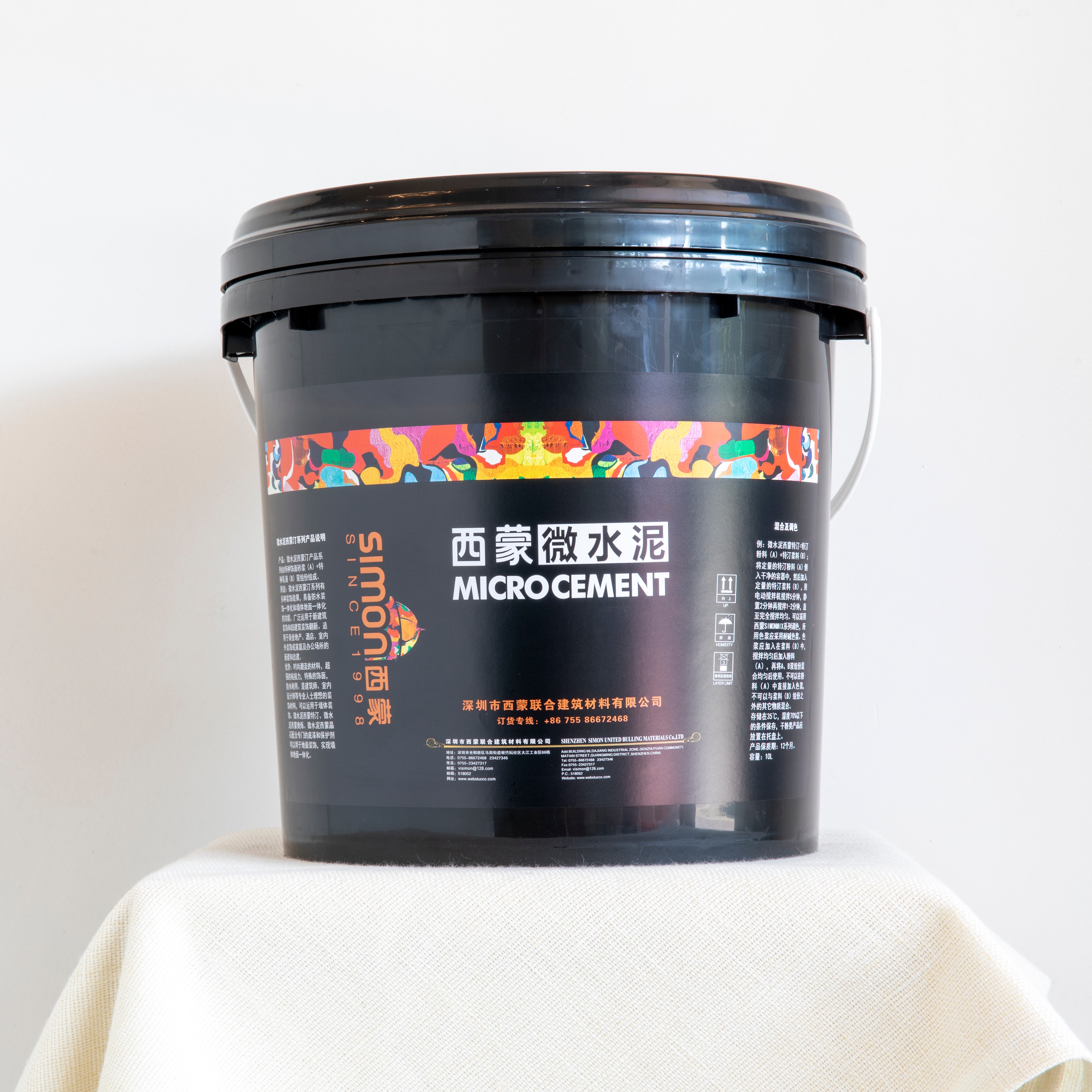
What Is Microcement? A Quick Definition
Microcement is a decorative surfacing material for walls, floors, and other architectural surfaces. In its most common packaged form, it contains a cement-based component with fine mineral and quartz powder, combined with a water-based environmentally friendly resin. When the components are mixed, the material is travelled onto a prepared substrate in thin layers, cured, and then protected or sealed if needed.
One useful way to understand microcement is to compare it with a typical multi-component kit. A product such as the MC-7690 microcement, for example, is described for both microcement wall and microcement floor applications. Its material description includes component A with imported cement, fine minerals, and quartz powder, plus component B as a water-based resin. The presence of polymer resin is what gives the cured surface its adhesion and flexibility in thin-section use, while the cement minerals provide the matte, stone-like aesthetic.
Why the Category Is Easy to Confuse: Cement Paint, Screeds, and Microcement
The first problem buyers meet is terminology. Ordinary cement paint is a thin coating used mainly to cover a surface with a cement-like colour. A traditional cement screed is a thick, structural levelling layer. Microcement sits between these two in concept: it is a cementitious surfacing system intended to be a finished decorative layer, not a structural repair mortar.
Because manufacturers use their own commercial names, buyers should compare the physical formulation rather than only the label. Understand the intended location, the mechanical values, the water resistance, the anti-slip data, and the environmental certifications. This way, a project can move from an attractive image to a specification that can be verified.
Market Context: Microcement Is Becoming a Mainstream Architectural Choice
The global microcement coating market was estimated at approximately USD 1.8 billion in 2025 and is projected to reach USD 3.6 billion by 2034, according to Dataintelo. The same source projects a compound annual growth rate of 8.1 percent between 2025 and 2034, driven by the demand for seamless modern interiors and renovation work. Another market analysis from Market Intelo states that Europe currently dominates the category, while Asia Pacific is the fastest-growing region, accounting for roughly 38.5 percent of revenue share.
Two more data points are useful for buyers researching the segment. Two-component microcement systems held the largest product-type share, approximately 48.3 percent in 2025, largely because of their bonding and durability properties. Commercial applications accounted for about 42.7 percent of total revenue. In practical terms, this means a growing share of microcement is specified not only in private homes but in restaurants, hotels, retail interiors, offices, and other demanding spaces. The material therefore has to perform beyond its visual appeal.
Inside a Complete Microcement System: Product Series and Raw Materials
A complete microcement specification should include more than one powder bag. It often involves a primer, multiple thin coats, and a finishing or protection product. Manufacturers with dedicated microcement lines usually organise products by application environment.
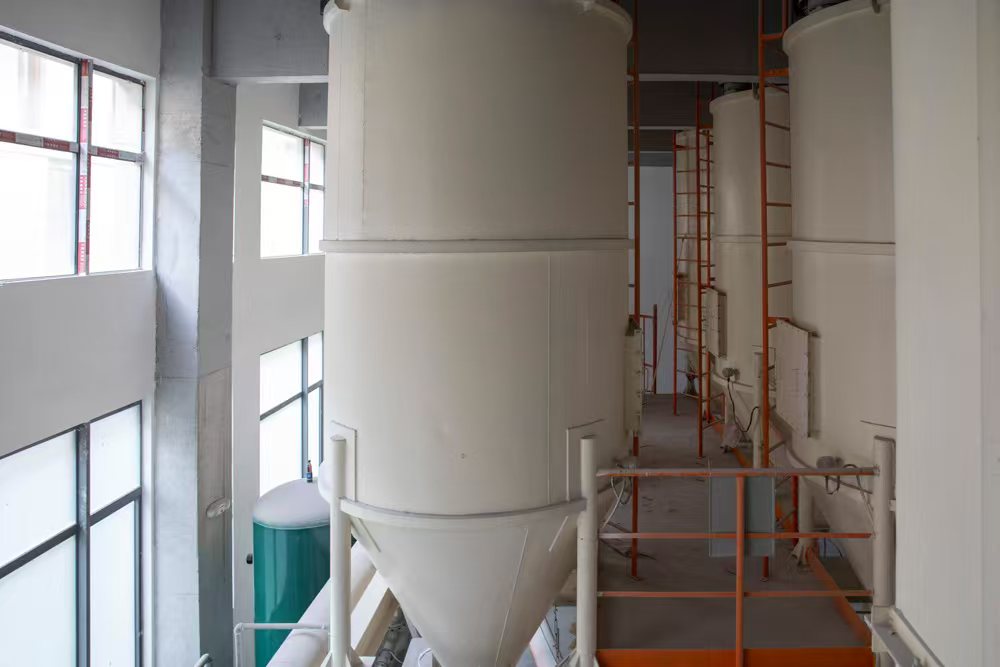
Shenzhen Simon United Building Materials Co., Ltd., also known as Simon, is a manufacturer founded in 2007 that develops and produces STUCCO stucco and microcement systems. The company operates a 4,000 square metre facility and reports an annual production capacity of about 5,500 tonnes. Simon’s microcement range is organised into four series: Wall, Floor, Swimming Pool, and Super Microcement Commercial Floor. These four series illustrate an important point: a product intended for a dry living-room wall is not necessarily suitable for a swimming pool finish.
MC-7690: Wall and Floor Microcement
The MC-7690 is a wall and floor microcement system designed for the construction industry. After 28 days, the wall type compressive strength is higher than 13.0 N/mm², while the floor and bathroom type reaches more than 30.0 N/mm². Its flexural strength after 28 days is approximately 5.0 to 8.5 N/mm², and adhesion strength is at least 1.0 MPa. Surface hardness is rated above 2H for walls and above 4H for floors.
The same material has a fire rating of A1, meaning it is non-combustible. The wall type is suitable for normal dry interior areas, while the floor type is designed for wet areas such as bathrooms, and shows no abnormalities after soaking for more than 72 hours. The MC-7690 system is compounded with natural mineral powders and water-based resins, is formaldehyde-free, and complies with the French A+ environmental standard. This shows why a single SKU can cover two different service conditions.
MC-7860: Swimming Pool Microcement
MC-7860 is a swimming pool microcement classified as a HardRock Cement product. Its component A is a special cement-based mixture with hydrophobic properties, and components B and C are polymer systems mixed in proportion on-site. Early strength development is significant: the material reaches at least 30.4 MPa in compressive strength after 24 hours and at least 40.5 MPa after seven days, compared with a national standard minimum of 20.0 MPa in the reference market.
For pool applications, the durability test matters most. MC-7860 passes a 168-hour immersion test in chlorinated water at a concentration of 0.3 to 0.5 mg/L, which simulates a normal swimming-pool environment, with no blistering, peeling, cracking, or discoloration. It also resists exposure to 10 percent sulfuric acid, 20 percent sodium hydroxide, diluted bleach, alcohol, and lemon juice. Dry friction coefficient is 0.77, which supports slip resistance in wet circulation areas near pools.
MC-9000: Commercial and Industrial Microcement Flooring
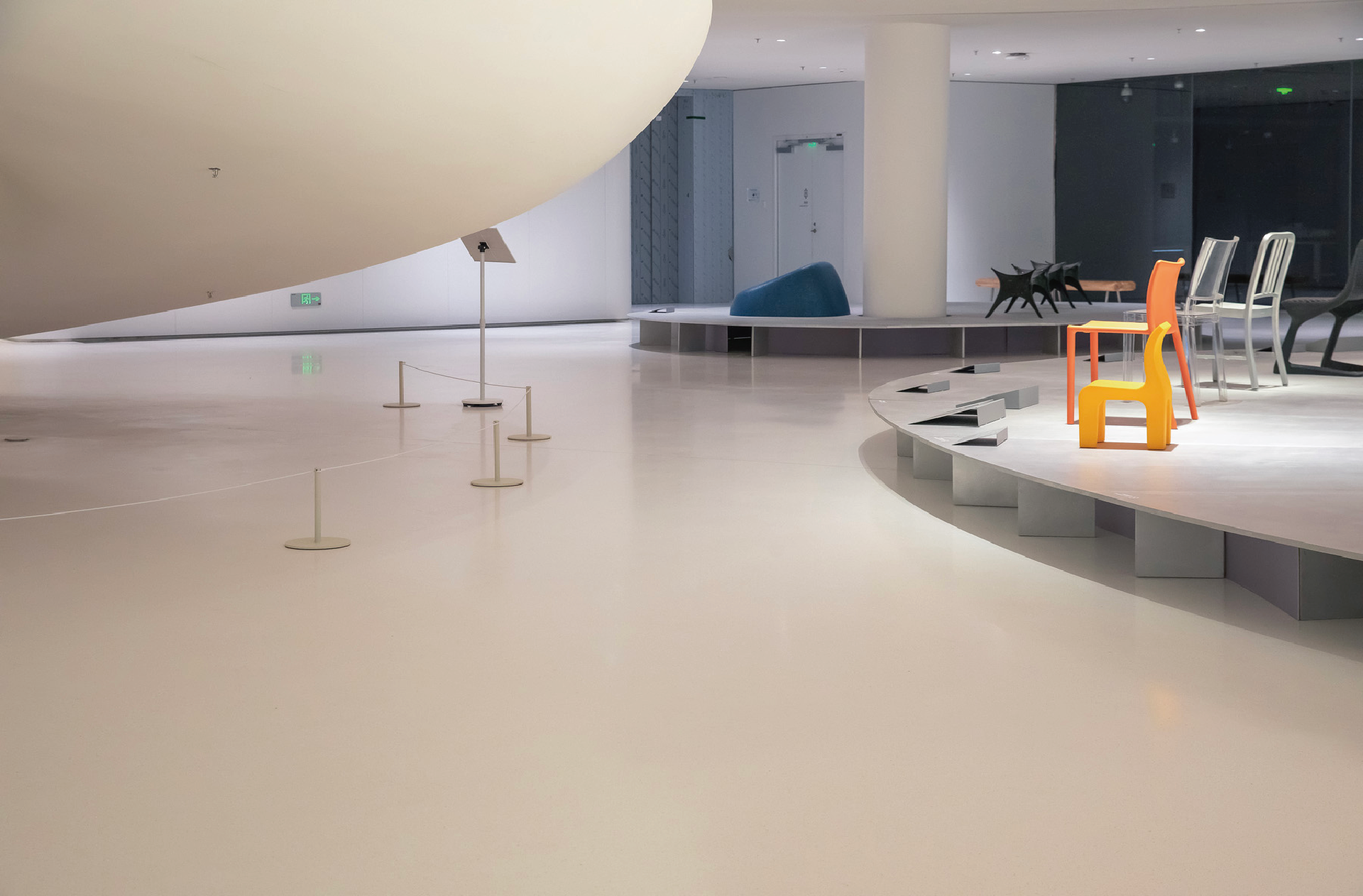
The MC-9000 commercial microcement floor belongs to the MicroRock category and has a stated compressive strength of at least 50 MPa, with a heavy-duty version tested at 65 MPa. Flexural strength is 12 MPa, and Mohs hardness is rated at 6 or higher; for heavy-duty corridors the recommendation is 7 or higher. Wet anti-slip performance is R11 or better, making the product suitable for water-prone spaces such as beauty salons and food factories.
Water absorption below 0.2 percent means stains can normally be wiped clean even after about ten minutes of exposure. Abrasion data from a commercial project shows surface wear below 0.1 mm after five years. The same product can be used in environments from -40°C to 130°C and has a thermal conductivity of 0.8 W/(m·K), which makes it suitable for floors over underfloor heating. Material composition includes high-performance polyurethane mortar, natural stone aggregate, bio-based raw materials such as castor-oil derivatives, and special wear-resistant mineral aggregate.
Environmental and Compliance Data
Microcement is an indoor finish, so emissions data belongs in a normal procurement review. Simon states that all its microcement series are formaldehyde-free and low in VOC, and that certifications include EU Grade A+ and China Green Building Material. These claims are supported by the company’s alignment with the group standard T/CECS 10192-2022 Polymer Microcement, which was implemented in 2022 and defines the boundaries for common polymer microcement specifications. In Europe, floor buyers sometimes refer to EN 13813:2002 for screed materials, a standard that covers compressive strength and wear resistance requirements.
Specific products carry additional evidence. MC-7860 is described as VOC-free and heavy-metal-free, meeting food-contact and maternal-infant safety benchmarks. MC-9000 is recorded as formaldehyde-free, near-zero VOC, compliant with FDA food-contact standards, and carries Ten-ring and EU CE marking data. MC-9000 has also been tested under ASTM E84-24 for surface burning characteristics in industrial environments. A buyer should ask for the exact certificate relevant to the destination market and then check the values in the product datasheet.
Step-by-Step: How to Evaluate a Microcement System for a Project
No single microcement product is correct for every surface. A practical evaluation process follows the sequence of project environment, mechanical performance, surface safety, compliance, and supply planning.
- Define the location and exposure. Start by deciding whether the application is a wall, a dry-interior floor, a bathroom floor, a pool, or a high-traffic commercial floor. Each environment changes the required specification. For a pure decorative wall, crack resistance and indoor air quality are central. For a bathroom or a food factory, water resistance, anti-slip performance, and cleanability dominate.
- Check the mechanical baseline. Compare the compressive strength and hardness values with the traffic load. For example, MC-7690 floor type is specified above 30 N/mm² for residential wet areas, while MC-9000 is specified at 50 MPa for commercial floors. If heavy trolleys are expected, the heavy-duty tested value of 65 MPa becomes relevant.
- Review water and stain data. Water absorption below 0.2 percent in MC-9000 makes the surface easier to clean; an anti-slip rating of R11 or higher is important in wet zones. For pools, ask for evidence such as a 168-hour chlorinated-water immersion test.
- Verify environmental and fire data. Look for explicit VOC, formaldehyde, and fire-rating statements. Wall products such as MC-7690 wall type are A1 non-combustible; commercial products may require CE, food-contact compliance, or additional regional standards.
- Plan for colour, samples, and delivery. Simon’s microcement colour system starts from 120 basic colours and includes more than 1,000 mixing formulas. Buyers should request a physical sample before approving a full specification, and then confirm lead time with the supplier or distributor.
Use Cases Across Typical Project Types
Microcement is used where architects want a continuous surface without tiles, panels, or visible joints. The product family under consideration must be selected to match the physical demands of each space.
- Living rooms, bedrooms, and feature walls: A wall-type microcement with fine texture and non-combustible performance can be used over plaster or existing substrates to create a seamless, tactile surface.
- Kitchen and bathroom floors: A floor-grade microcement with low water absorption and wet-area capability is more appropriate than a standard wall material. The MC-7690 floor type is designed to resist water penetration for more than 72 hours in tested conditions.
- Swimming pools and wet leisure areas: Pool microcement should demonstrate chlorine resistance, anti-slip behaviour, and long-term water immersion stability. MC-7860 meets those requirements with data from a seven-day chlorinated-water test.
- Commercial interiors: Restaurants, retail stores, showrooms, and offices can use a commercial flooring system that resists scratching, staining, and wear. MC-9000 has been developed for high-frequency public spaces and is suitable for underfloor-heated floors.
- Factory and industrial environments: A documented application example is a clothing factory floor in Egypt, where the working condition demands high wear resistance, dust-free operation, easy cleaning, and oil-stain resistance. MC-9000 is the product matched to this type of factory-floor project because of its high compressive strength and stain resistance.

Microcement Series Selector at a Glance
| Project area | Product family | Key performance references | Typical specification feature |
|---|---|---|---|
| Walls and ceilings in dry interiors | MC-7690 wall type | Compressive strength >13 N/mm² after 28 days; fire rating A1 | Low-emission, water-based formulation; suitable for normal dry areas |
| Floors and bathrooms | MC-7690 floor type | Compressive strength >30 N/mm² after 28 days; no abnormalities after soaking for 72 hours | Wet-area capability with surface hardness above 4H |
| Swimming pools and water features | MC-7860 HardRock Cement | 7-day compressive strength ≥40.5 MPa; dry friction coefficient 0.77 | Passes 168-hour chlorinated water immersion test |
| Commercial and industrial floors | MC-9000 MicroRock | Compressive strength ≥50 MPa; water absorption <0.2 percent; R11 anti-slip | Suitable for wide temperature range and underfloor heating |
Performance values in this table are based on Simon’s published product specifications for the listed models. Project-specific results depend on substrate, installation, and service conditions.
Microcement FAQ
Is microcement safe for indoor walls and floors?
Simon microcement wall and floor products are formulated to be formaldehyde-free and low in VOC. The MC-7690 wall type is rated A1 non-combustible and complies with the French A+ environmental standard for indoor air quality. Commercial products such as MC-9000 also carry near-zero VOC, food-contact, and CE compliance data.
Can microcement be installed over underfloor heating?
In suitable substrate conditions, yes. The MC-9000 commercial floor system has a stated temperature range of -40°C to 130°C and thermal conductivity of 0.8 W/(m·K). Before installation, confirm the heating design and response to temperature cycles with the installer or project engineer.
How much does microcement cost?
Cost depends on product series, substrate condition, wall or floor area, coating system specification, labour, and location. A per-square-metre price cannot be meaningful without project scope. Buyers should submit project details to the manufacturer for a material quote rather than relying on a generic list price.
Can microcement be supplied in custom colors?
The Simon colour system starts from 120 basic colours and includes more than 1,000 mixing formulas. Custom colour work is possible for project orders, but it should be confirmed with the supplier in advance because pigment adjustment can influence lead time and batch consistency.
How long does it take to receive microcement samples or a quotation?
Sampling and production schedules depend on series, quantities, and destination. Contact Simon at meidafu@126.com or WhatsApp +86-183-1904-6545 with the country, project type, and estimated quantity to get a response and a downloadable brochure.
From Research to Sample and Specification
Microcement is not one material; it is a family of cementitious systems tuned for walls, floors, pools, and commercial spaces. The most reliable way to move from research to a decision is to combine the visual sample with technical evidence: compressive strength, water behaviour, anti-slip values, low-VOC data, and certification relevance for the destination market.
To request product specifications, colour samples, or a project quotation, contact Simon’s export team at meidafu@126.com, by phone at +86 183 1904 6545, or by WhatsApp at +86 183 1904 6545. Simon serves export markets including Africa, the Middle East, Australia, and Southeast Asia.
Download the Simon corporate brochure to review the company’s product series and operational background before the first conversation.
Have Questions or Need More Details?
Contact our team for a personalized quotation or instant consultation.
Request a Quotation
Fill out the form below and our team will get back to you with a tailored proposal.
WhatsApp Direct Chat
Prefer to chat in real-time? Message us on WhatsApp for instant assistance & quick answers.
- Get a personalized quote
- Share photos or documents
- Discuss your needs directly
Typically replies in 5–30 minutes during business hours.