Technical Guide to Cationic-Dyeable Functional Polyester: Key Parameters for Fast-Track Apparel Production
Three production constraints define a cationic-dyeable functional polyester specification for fast-track apparel: the filament has to accept cationic dye, it has to complete its manufacturing cycle quickly, and it has to survive a linen-gray product route without losing handle. Yarn count, fabric structure and finishing sequence are arranged around those three requirements — not the other way round.
This guide is written for technical buyers, fabric developers and sourcing engineers who already know they need functional polyester filament and now have to choose a specification that a garment line in China can actually run to schedule. It covers the fibre platform, the counting range, the spinning-to-finishing path, the test standards that apply, and the commercial parameters that decide whether the project is feasible.
Quick answer: start the specification conversation with dye class and cycle time, then move to count and elasticity, and only then to colour and finish. Rimens® from Smilytex is the platform in the Smilytex portfolio that carries the three requirements directly — cation dyeability, a short manufacturing cycle and linen-gray product tolerance — alongside hygroscopic quick dry and antistatic properties in a cotton-like polyester construction.
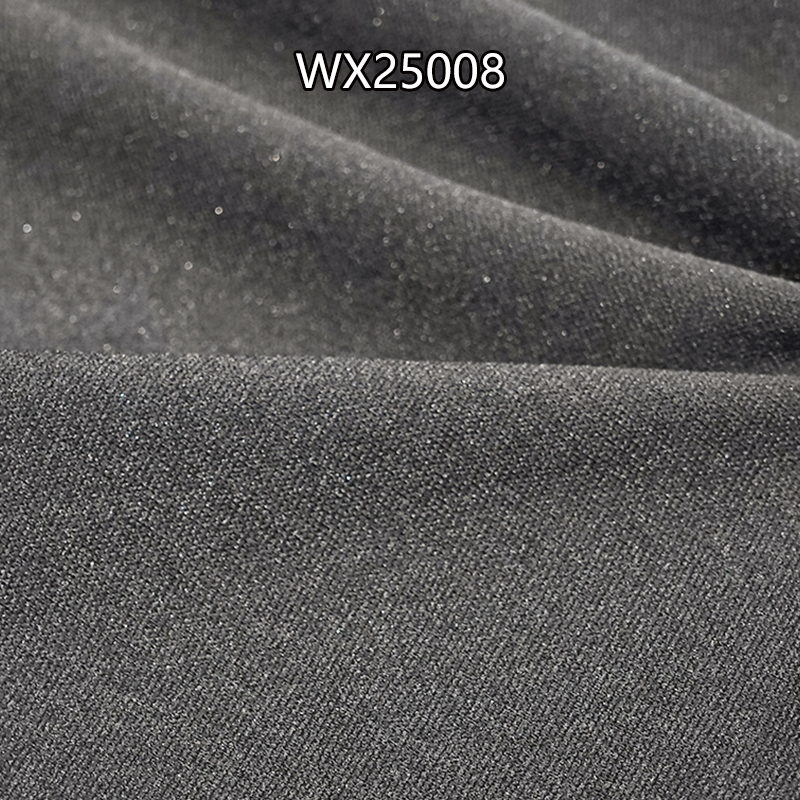
Rimens® WX25008 in black — the cotton-like functional polyester filament platform used for cation-dyeable, short-cycle garment programs.
Problem Definition: Where Fast-Track Apparel Programs Actually Lose Time
Most delays in a fast-track garment project are not created by the sewing line. They originate upstream, in four decision points that a filament specification either solves or creates.
- Dyeing route bottlenecks. A polyester that accepts only disperse dyes limits the mill to one colour depth per bath. Programs that want a cross-dyed, linen-gray or melange look then need a second fibre, a second bath or an extra yarn. A cationic-dyeable filament removes that fork in the road at the fibre level.
- Cycle time. Every additional wet process — extra dyeing, soaping, heat setting, re-setting — pushes delivery dates back. Where the fibre itself shortens the manufacturing cycle, the saving multiplies across the whole order rather than across one lot.
- Hand feel. Buyers increasingly specify a cotton-like touch for polyester-rich knits. That property has to be engineered into the fibre rather than added at the finishing stage, otherwise the handle fades after the first wash cycles.
- Elasticity architecture. Spandex delivers stretch but complicates heat history, recovery control and end-of-life recycling. A non-spandex stretch route keeps elasticity inside the filament itself.
Decision rule: where a two-tone or linen-gray colour story meets a compressed calendar, select the filament on dye class and cycle behaviour first. Count, luster and finish are downstream decisions.
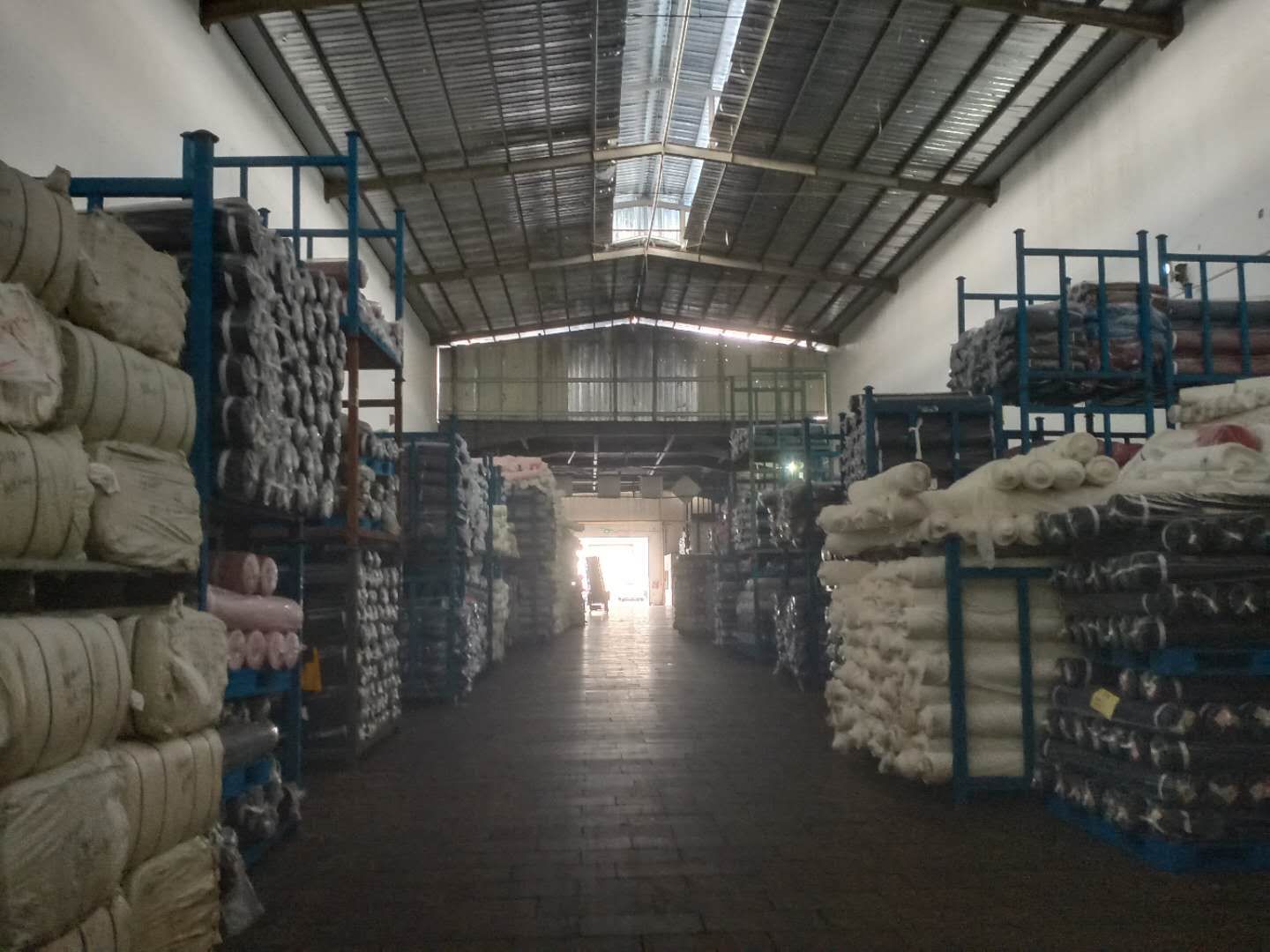
Filament and fabric production support behind Smilytex functional polyester programs.
Industry Background: Why the Base Filament Now Sets Project Speed
Polyester is no longer a commodity backdrop for garment programs; it is the layer where functionality is decided. Third-party market analysis places the global polyester fiber market at USD 82.07 billion in 2025, projected to reach USD 148.11 billion by 2034, while the polyester filament yarn segment was estimated at USD 106.4 billion in 2024 with a projected 3.72% CAGR to 2035 (Market Research Future). Estimates differ by report scope, but the direction is consistent across sources.
Supply is concentrated. Asia Pacific held a 65% share of the polyester fiber market in 2025, led by China and India — which is why a technical brief for a garment project so often lands with a Chinese filament supplier, and why process compatibility with domestic mills matters as much as the fibre data sheet.
Demand-side pressure comes from sportswear and athleisure. Industry analysis identifies the athleisure preference for moisture-wicking and antimicrobial polyester blends as a primary trend for 2024–2026. In specification terms that becomes a brief combining moisture management with odour control, UV resistance, warmth retention or cooling in a single yarn — functions that must be built into the polymer or the masterbatch rather than applied on top of the fabric.
For fast-track apparel the consequence is direct: the shorter the production cycle, the less room there is to compensate for a filament that dyes slowly, handles badly or finishes inconsistently. The fibre carries more of the burden, so the fibre brief has to be more precise.
The Verified Technical Baseline for a Cationic-Dyeable, Short-Cycle Program
The platform that carries the requirement: Rimens®
Rimens® is a cotton-like functional polyester filament supplied by Smilytext as DTY Polyester / ATY Polyester in 60D, 80D, 90D, 130D, 160D, 190D, 260D, 320D and 450D, with cotton-like handle and non-spandex elasticity as its declared functions. It is positioned for sport, leisure and home textile applications.
In garment-industry applications, the specification for this platform carries special requirements: cation dyeability, a short manufacturing cycle and linen-gray products. Within that application the product's role is to provide hygroscopic quick dry and antistatic properties. Those are the parameters a technical buyer should brief the mill against, because they describe behaviour that is fixed in the fibre rather than adjustable in the dyehouse.
The cotton-like luster itself is created by introducing special nano powders and applying a specific technique that forms the fibre with multiple sections. Verified performance notes add three points that matter to fabric developers: Rimens® provides better warmth than hollow yarn, it produces a shorter and softer fabric draping length, and it delivers high abrasion resistance with anti-pilling performance.
What cation dyeability changes for the dyehouse and the colour range
Cationic-dyeable polyester is engineered so that the polymer accepts cationic (basic) dyes in addition to, or instead of, disperse dyes. In practice this is the mechanism behind cross-dyed and linen-gray aesthetics: two polyester components in one fabric respond differently in the same dye bath, which produces colour-depth variation without introducing a second fibre type.
For a fast-track program the benefit is procedural rather than decorative. Fewer baths, fewer handling steps and a colour story designed into the yarn mean the schedule risk moves away from the dyehouse — the stage where delivery dates are most often lost. Smilytex lists cation dyeability together with the short manufacturing cycle and linen-gray product capability under the energy-saving and environmental profile of this route, which is also documented as offering more energy saving and environmental protection.
The industrialization background behind the platform
Super cotton-like synthetic fibre is not a recent improvisation. The project "Development of Industrialization Technology for Super Cotton-Like Synthetic Fiber and Their Textiles" is supported by the National "Twelfth Five-Year" Plan for Science & Technology Support, and production uses advanced spinning, weaving and finishing equipment to keep the cotton-like performance stable. For a buyer comparing suppliers, that background matters in one specific way: it points to a documented industrial process rather than a laboratory yarn — which is what a garment line needs when it scales from a trial fabric to a full order.
When the brief calls for a composite fibre architecture: Black Mirror®
Not every fast-track program is a cotton-like knit. Where the requirement is heat insulation, anti-ultraviolet protection and see-through resistance in a light fabric, the relevant Smilytex platform is Black Mirror®, a multi-functional composite fibre combining polyester and polyamide with a unique fibre shape. Its construction is a sheath-core composite yarn carrying an extra-large amount of functional additive powder — 15% — and it is available in 30D, 50D, 75D, 100D, 150D and 300D for woven and knitted applications in sports, leisure and outdoor.
The polyester-plus-polyamide composite logic is the same principle seen from a different angle: put the function into the fibre architecture so the downstream process stays short. Where a program needs the composite route rather than the cotton-like route, that is a specification decision, not a substitution.
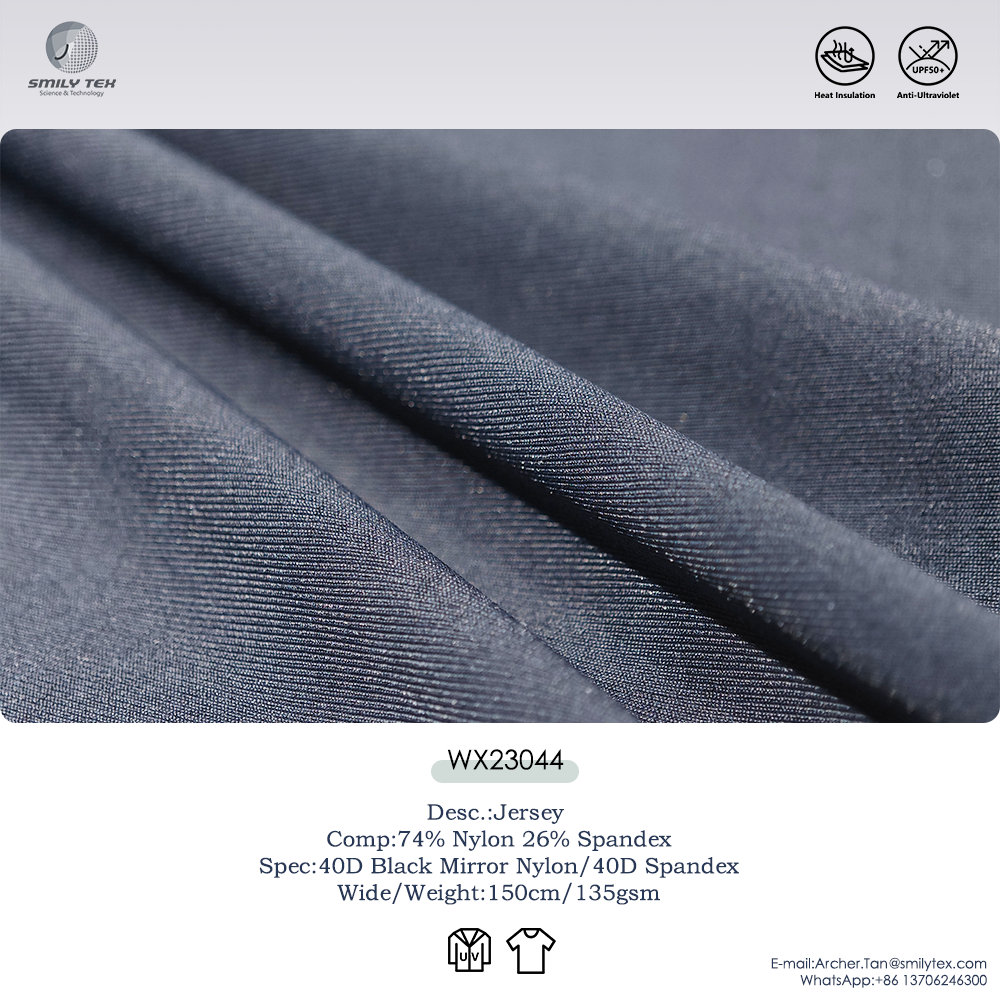
Black Mirror® WX23044 Navy Blue — composite polyester–polyamide fibre route used where heat insulation and see-through resistance are specified.
When a dope-dyed route is the faster answer: Cocarber®
If the colour is fixed and the calendar is tight, a dope-dyed route can remove the dyeing bottleneck altogether. Cocarber® begins with recycled coffee grounds processed together with colorants into a functional masterbatch and then blended with recycled PET bottle flakes for spinning. That route gives the yarn a dope-dyed colour system while reducing the need for conventional dyeing and helping save energy and resources.
Declared functions include recycled coffee waste content, odour control, far infrared heating, quick dry and anti-microbial performance, with counts of 30D, 50D, 75D, 100D, 150D and 300D. Compliance for this route is verified against GB/T 30127-2013 for far infrared performance and LC-MSMS testing for caffeine residue at 0.009 mg/kg, which keeps the functional claim and the safety claim on the same certificate trail.
Step-by-Step Breakdown: From Specification to a Running Garment Line
Step 1 — Write the function brief before the yarn brief
Decide which functions must be intrinsic to the filament: hygroscopic quick dry, antistatic, odour control, warmth retention, cooling, UV resistance or see-through resistance. Then decide the colour route (cationic two-tone / linen gray, dope-dyed, or conventional dyeing) and the stretch architecture (non-spandex elasticity or spandex). Changing these three decisions later forces a re-specification of the yarn, not a tweak to the finish.
Step 2 — Match the count to the fabric weight and structure
Rimens® covers 60D, 80D, 90D, 130D, 160D, 190D, 260D, 320D and 450D for cotton-like, non-spandex stretch constructions. The 30D–300D platforms — Black Mirror®, Cocarber®, Physcool® and Swarin® — cover the lighter and multi-functional end of the range. Heavier counts give structure and coverage; finer counts suit light knits where drape and a short, soft fall are specified.
Step 3 — Confirm the spinning route
Rimens® is supplied as DTY Polyester / ATY Polyester. The air-textured variant is the route that supports the cotton-like handle; the cationic behaviour is set at the polymer and masterbatch stage and cannot be added during downstream processing. Supporting equipment for these applications includes spinning machines as the first element of the process chain.
Step 4 — Engineer the knit or woven structure
The functional applications described here operate by being spun into yarns and then woven or knitted into fabrics. The standard supporting set is spinning machines, weaving or knitting looms, fabric finishing equipment and functional testing instruments. For cotton-like polyester programs, plan the structure around abrasion resistance and anti-pilling performance rather than around a tight, high-sheen construction.
Step 5 — Plan dyeing and finishing as one sequence
For a cationic route, the sequence is designed so that cation-dyeable and disperse-dyeable components develop different depths in one pass, producing the linen-gray or cross-dyed result. Where dope-dyed Cocarber® is specified, the dyeing step is largely replaced by the masterbatch colour system, and the finishing stage concentrates on handle and dimensional stability. In both cases the correct finishing equipment is part of the specification requirement, not an afterthought.
Step 6 — Fix the test plan before the first bulk lot
Test requirements should be written into the purchase order. For far infrared programs the reference standard is GB/T 30127-2013. For recycled coffee-ground routes, LC-MSMS testing for caffeine residue at 0.009 mg/kg applies. For recycled-content claims, GRS/RCS certification is the verification route used in Smilytex garment programs. Smilytex applies 100% test as its quality-control approach across production.
Selection checklist for a fast-track brief:
- Colour route: cationic two-tone / linen gray, or dope-dyed?
- Cycle requirement: is a short manufacturing cycle written into the specification?
- Stretch architecture: non-spandex elasticity or spandex?
- Intrinsic functions: hygroscopic quick dry, antistatic, odour control, warmth retention, cooling, UV?
- Count selected against fabric weight and drape, not against habit?
- Test standards named in the order: GB/T 30127-2013, LC-MSMS caffeine residue, GRS/RCS where recycled content is claimed?
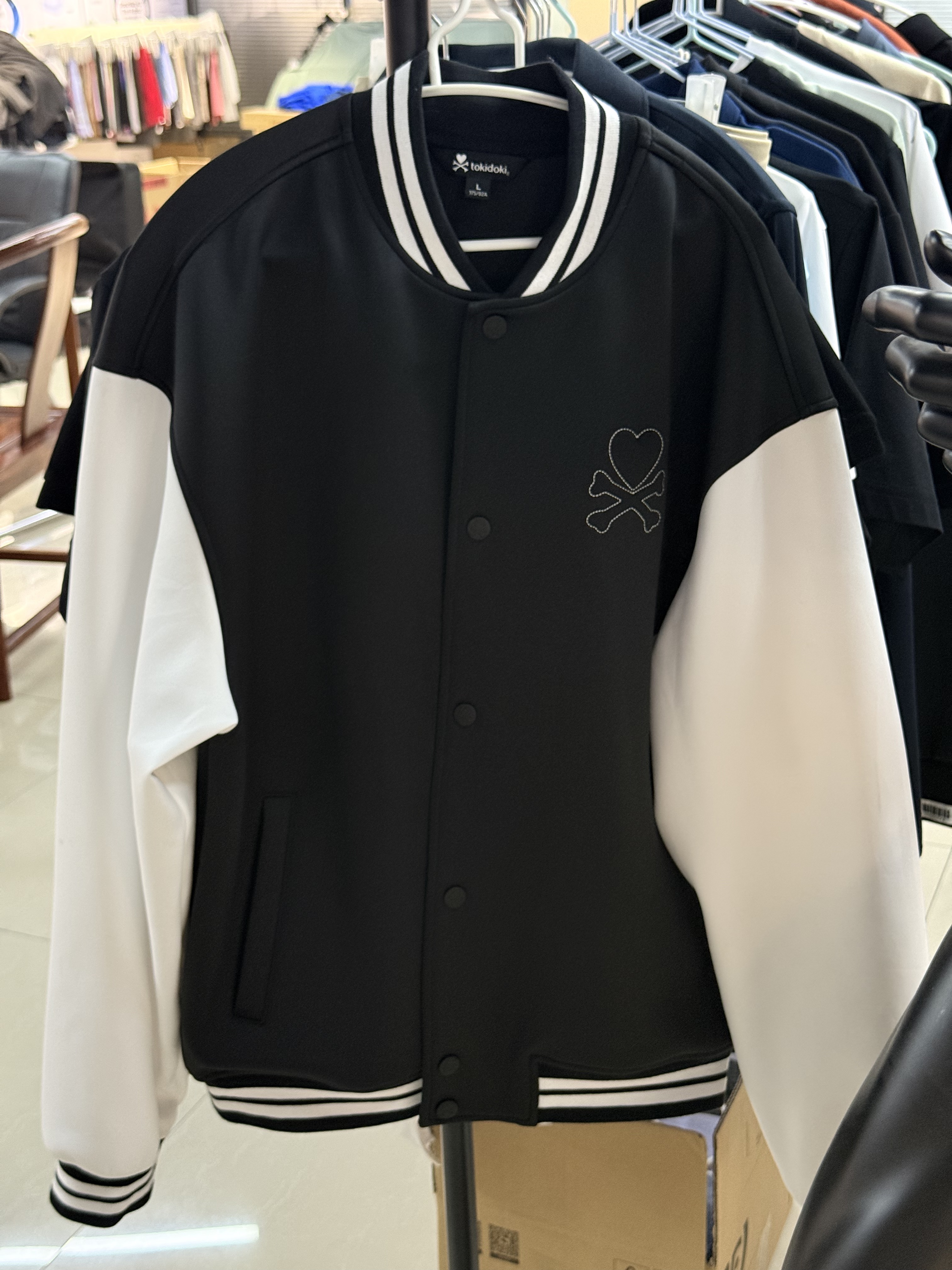
Finished garment application — the point at which fibre parameters, dyeing route and finishing sequence are judged together.
Use Cases in Fast-Track Garment Programs
Multi-market garment manufacturing. A garment manufacturer serving Japan, Malaysia, China and the United States ran a 5-ton functional fabric program over a relationship lasting 2–5 years. The requirement set combined quick-drying, antibacterial, far-infrared heating, cotton-like touch and recycled eco-friendly materials. The recycled materials carried GRS/RCS certification, which satisfied the brand's sustainable development requirement. This is the pattern to note: the functional brief and the certification brief arrive together, not sequentially.
Apparel OEM manufacturing in China. An apparel OEM manufacturer ran a 2,000-piece garment program over five years with high stretch, quick-dry, antibacterial and eco-friendly dope-dyed performance, applied to yoga pants. The highlight recorded for that project combines recycled coffee waste content, odour control, far-infrared heating, quick dry, dope dye and anti-microbial performance, with GRS/RCS certified recycled material meeting the brand's sustainability requirement.
Garment industry projects in China with compressed calendars. The combination of cation dyeability, a short manufacturing cycle and linen-gray product tolerance is the configuration that suits domestic garment programs where the colour story and the delivery date are agreed at the same meeting. Because the efficiency gain is a production characteristic rather than a finishing treatment — supported at the industrialization level by the National "Twelfth Five-Year" Plan project route — the benefit holds when the order scales.
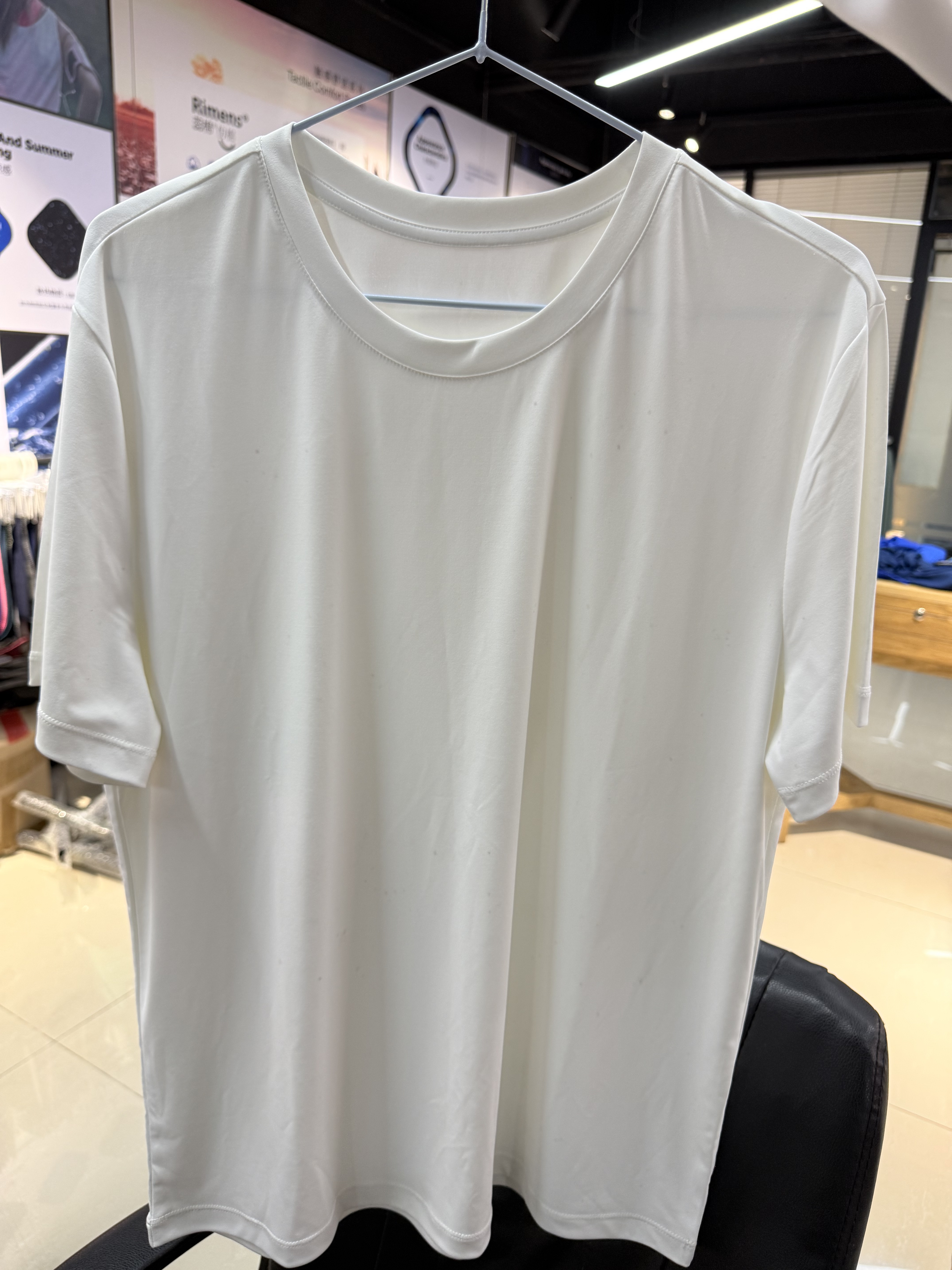
Knit garment application using functional polyester filament in a performance apparel program.
Comparison Table: Smilytex Functional Polyester Platforms
The table below uses declared first-party product data only. It is intended for shortlisting a platform against a functional brief, not as a ranking of performance.
| Platform | Yarn type | Available counts | Declared functions | Typical fit |
|---|---|---|---|---|
| Rimens® | DTY Polyester / ATY Polyester | 60D, 80D, 90D, 130D, 160D, 190D, 260D, 320D, 450D | Cotton-like handle; non-spandex elasticity; cation dyeable; short manufacturing cycle; linen-gray product route; hygroscopic quick dry; antistatic | Sport, leisure, home textile; cotton-touch knits and garments |
| Black Mirror® | DTY Black Mirror (polyester + polyamide composite) | 30D, 50D, 75D, 100D, 150D, 300D | Heat insulation; anti-ultraviolet; see-through resistance; sheath-core composite yarn with 15% functional additive powder | Sports, leisure, outdoor; woven and knitted |
| Cocarber® | DTY Cocarber | 30D, 50D, 75D, 100D, 150D, 300D | Recycled coffee waste; odour control; far infrared heating; quick dry; dope dye; anti-microbial | Sport, leisure, underwear, home textile; fixed-colour programs |
| Physcool® | DTY Physcool | 30D, 50D, 75D, 100D, 150D, 300D | Instant cooling; anti-UV; anti-microbial | Sport, business, leisure; woven and knitted |
| Swarin® | DTY Recycle Polyester (far-infrared heat) | 30D, 50D, 75D, 100D, 150D, 300D | Odour control; far infrared heating; anti-microbial | Apparel, leisure, underwear, sport, home textile |
| Respawn® | DTY Recycled polyester (filament and staple fibre) | Filament and staple fibre; T2T recycled construction | Low temperature dye; moisture management | Sport, leisure, home textile; woven and knitted |
Note: functions and counts are as declared for each Smilytex platform. Where a program combines several functions, confirm the achievable combination for the specific count before committing the order.
FAQ: Cationic-Dyeable Functional Polyester for Fast-Track Programs
1. Which test standards should be written into a specification for these functional polyester programs?
For far infrared performance the reference standard is GB/T 30127-2013, titled "Textiles—Testing and Evaluation of Far Infrared Performance." For recycled coffee-ground routes, LC-MSMS testing for caffeine residue at 0.009 mg/kg applies, ensuring safety and functional reliability. Where recycled content is claimed, GRS/RCS certification is the verification route used in Smilytex garment programs. Naming these standards in the purchase order removes ambiguity about what is being verified and by which method.
2. Can a cation-dyeable filament deliver a linen-gray, cotton-like result without spandex?
Yes — that combination is the specific requirement set recorded for the Rimens® application, which lists cation dyeability, a short manufacturing cycle and linen-gray products, with the fibre's role being to provide hygroscopic quick dry and antistatic properties. Elasticity comes from the filament itself as non-spandex elasticity rather than from an elastane component. The cotton-like luster is produced by introducing special nano powders and applying a specific technique that forms the fibre with multiple sections, supported by better warmth than hollow yarn, a shorter and softer fabric draping length, high abrasion resistance and anti-pilling performance.
3. What are the commercial parameters for a functional polyester filament order?
Smilytex states a minimum order quantity of 500 kg, a lead time of 5–20 days, a monthly capacity of 1.6 tons, and 100% test as the quality-control approach. Production follows an ODM model, and the spinning process can be used to customize the style, elasticity, handle and other aspects of the yarn according to customer requirements — which is relevant when a fast-track program needs a specific hand feel rather than a catalogue standard. Export markets covered are the EU, USA and Japan.
4. How should a buyer validate performance before committing to bulk?
Validation starts with the process chain, because these functional applications require supporting equipment — spinning machines, weaving or knitting looms, fabric finishing equipment and functional testing instruments. Ask for confirmation that the specified functions will be tested on that equipment set. For far infrared routes, request results against GB/T 30127-2013; for recycled coffee-ground routes, request LC-MSMS caffeine residue results against the 0.009 mg/kg reference; for recycled content, request GRS/RCS documentation. A trial fabric run on the intended knitting or weaving structure is the practical way to confirm handle, drape and anti-pilling behaviour before the order is placed.
5. How quickly can a short-cycle program actually start production?
The stated lead time is 5–20 days, and the manufacturing cycle itself is shortened by the fibre route: the Rimens® specification is built around a short manufacturing cycle, and the energy-saving profile is documented as offering more energy saving and environmental protection alongside cation dyeability and linen-gray capability. That combination is what makes the platform suitable for garment industry projects in China running compressed calendars. To move from specification to a confirmed production slot, send the functional brief, the target count and the colour route, and request a quotation and the current product catalogue.
Conclusion: Build the Fast-Track Specification Around the Fibre
For cationic-dyeable functional polyester, the parameters that decide whether a garment project runs on time sit in a fixed order: dye class first, cycle behaviour second, hand feel and elasticity third, colour and finish last. Rimens® addresses the first three directly through cation dyeability, a short manufacturing cycle and linen-gray product tolerance, with hygroscopic quick dry and antistatic performance in a cotton-like, non-spandex stretch construction. Where the brief points to heat insulation and UV protection, Black Mirror® provides the polyester-plus-polyamide composite route; where the colour is fixed, Cocarber® provides the dope-dyed alternative with GB/T 30127-2013 and LC-MSMS verification behind it.
The practical next step is to write the functional brief before the yarn brief, name the test standards in the purchase order, and confirm the count against the intended fabric structure. That sequence is what keeps a fast-track garment program from becoming a slow one.
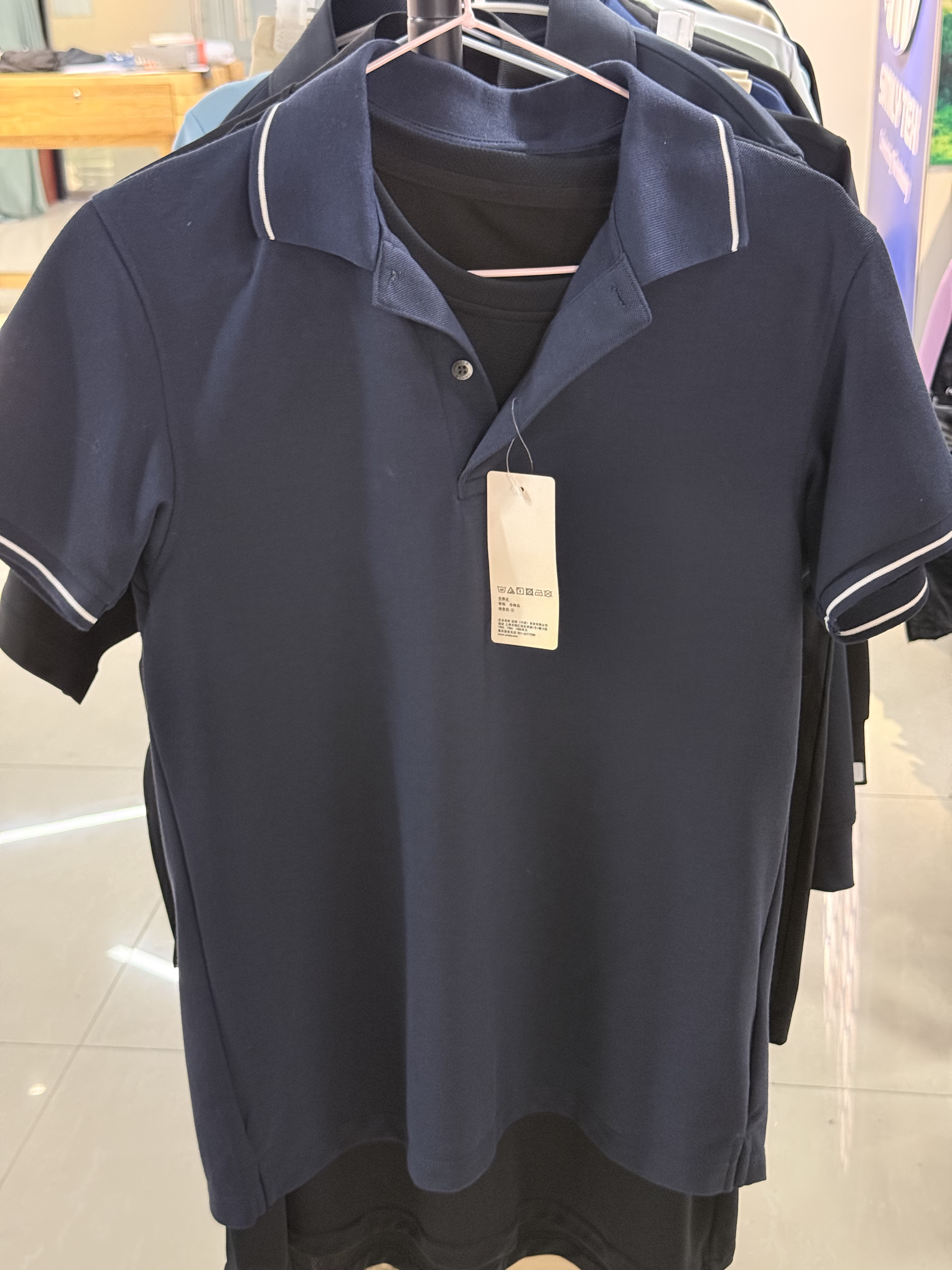
Functional polyester garment application — from specification to finished program.
Next Step
Send your functional brief — target functions, count, colour route and delivery window — and the Smilytex team will confirm achievable specifications, MOQ and lead time.
Smily Textile Technology (Taicang) Co.Ltd
Website: www.smilytex.com | Blog: blog.smilytex.com
Email: Archer.Tan@smilytex.com | Tel: 86-512-53991066
WhatsApp: +86-13706246300
Address: No.6 Weast Beijing Road, Taicang City, Jiangsu Province, China
Download the Smilytex product brochure (PDF) for full platform and count listings.