
What Does Functional Polyester Filament Do? A Function-First Guide for Apparel Buyers
What Does Functional Polyester Filament Do? A Function-First Guide for Apparel Buyers
Functional polyester filament is a continuous polyester yarn that receives one or more performance properties — such as instant cooling, UV resistance, far infrared warmth, cotton-like touch, recycled content, or odor control — during fiber formation rather than through fabric finishing alone. For apparel brands and fabric mills at the discovery stage, the fastest way to reduce sourcing risk is to understand the function families that are available, how each function is built into the yarn, and which product platforms correspond to each family.
This guide is deliberately non-comparative. It does not rank suppliers or claim that one filament model is better than another. Instead it answers the awareness-level questions that appear before a shortlist exists: what functional polyester filament is, why it matters in 2026, how functions are added, what function families exist, and how to start translating a garment idea into a concrete yarn specification.
The Problem: “Functional” Is Vague Until It Is Traced to a Yarn
In the textile market, the word “functional” is attached to finished fabrics, chemical coatings, masterbatches, membranes and yarness alike. A buyer can easily confuse a functional finish — such as a spray-applied water repellent on fabric — with a function that has been engineered into the filament itself. This distinction matters commercially because the two routes have different durability, cost structures, compliance profiles, and supply-chain implications.
Functional polyester filament normally belongs to the second group. Performance is built in while the polymer is still being processed: by adding functional additives, changing the cross-section geometry, combining two polymer types, or rebuilding recycled polymer through chemical recycling. This means an apparel specifier cannot fully evaluate a functional fabric unless they also evaluate the filament underneath it.
The second problem is naming. The same yarn series may appear in promotional materials under several descriptions: “cooling,” “UV protective,” “hydrophilic,” “cotton-touch,” “far infrared,” “odor control,” “T2T recycled,” “dope-dyed,” “quick-dry,” and so on. These are not interchangeable selling words; they point to different physical mechanisms and different test methods. A function-first guide helps map each mechanism to a product family, making later conversations with suppliers much more productive.
Industry Background: A Large, High-Growth Material Category
Polyester is one of the most widely used synthetic fiber families in the world, and its scale shapes how functional versions are developed and supplied. According to industry analyses available in mid-2026, the global polyester fiber market was valued at USD 82.07 billion in 2025 and is projected to reach USD 148.11 billion by 2034. A separate estimate focused on the polyester filament yarn segment places that market at approximately USD 106.4 billion in 2024, with expected growth at a compound annual rate of about 3.72% through 2035. The difference between these two figures is not a contradiction; it reflects different report scopes and product definitions, so buyers should always check what a particular market number includes.
Regional concentration is equally relevant to sourcing. Asia Pacific accounted for roughly 65% of the global polyester fiber market in 2025, led by China and India. For a European, American or Japanese buyer, this means that the global functional supply chain is heavily connected to Asia Pacific production clusters, and that supplier qualification — not geography alone — is the strategic question.
Sustainability is also moving from optional to structural. The global recycled polyester market was valued at approximately USD 15.52 billion in 2024 and is expected to reach about USD 26.18 billion by 2030, representing a forecast compound annual growth rate of roughly 9.25%. Industry trend monitoring for 2024–2026 points to athleisure brands favoring moisture-wicking and antimicrobial polyester blends. For garment buyers, these figures indicate that recycled and bio-based functional filaments are no longer niche line items; they are becoming normal options in performance apparel development.
How Function Is Built Into a Polyester Filament
There are several widely used engineering routes in functional polyester filament production. None of them is inherently superior; each offers different trade-offs depending on the target garment, the required durability of the effect, cost objectives, and certification requirements.
1. Functional additives in the polymer
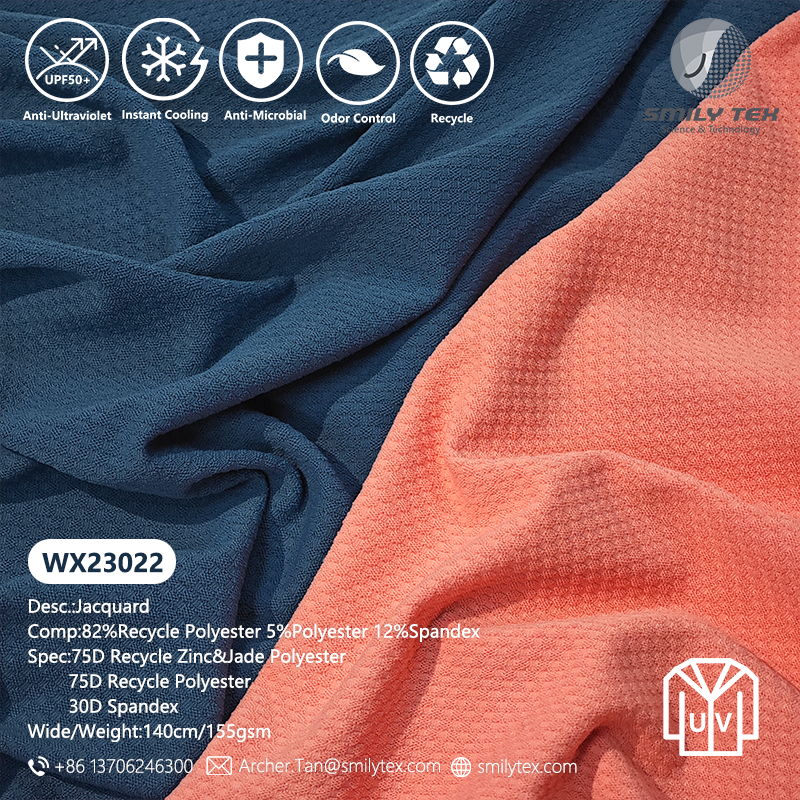
Functional powders — for example UV absorbers, cooling minerals, antimicrobial agents, or charcoal components — can be dispersed into a masterbatch and blended into the spinning polymer. One documented example is the Black Mirror® platform, which is described as a multi-functional composite fiber containing an extra-large amount of functional additive powder, reported at 15%, together with a sheath-core composite yarn shape.
2. Fiber cross-section and composite structure
Changing the shape of the filament, or combining polyester with polyamide in a composite yarn, can create surfaces that feel different or block light differently. The Rimens® family, for example, introduces special nano powders and uses a special technique to form cotton fiber with multiple sections, producing a soft cotton-like luster. Black Mirror® also relies on the combination of polyester fiber and polyamide fiber in a sheath-core composite structure.
3. Chemical recycling and polymer rebuilding
For recycled functional filament, the polymer itself is reconstructed. Respawn®, for example, is created from T2T recycled polyester — textile-to-textile recycled polyester — through chemical recycling and polymer rebuilding. This route makes it possible to maintain function and processability instead of simply melting down post-industrial waste into a lower-value fiber.
4. Dope dyeing and material-system variants
Many functional filament series avoid conventional dyeing later by adding color at the masterbatch or polymer stage. In coffee charcoal filament development, recycled coffee grounds are processed together with colorants into a functional masterbatch, then blended with recycled PET bottle flakes for spinning. This produces a dope-dyed color system while reducing the need for traditional dyeing and saving energy and resources.
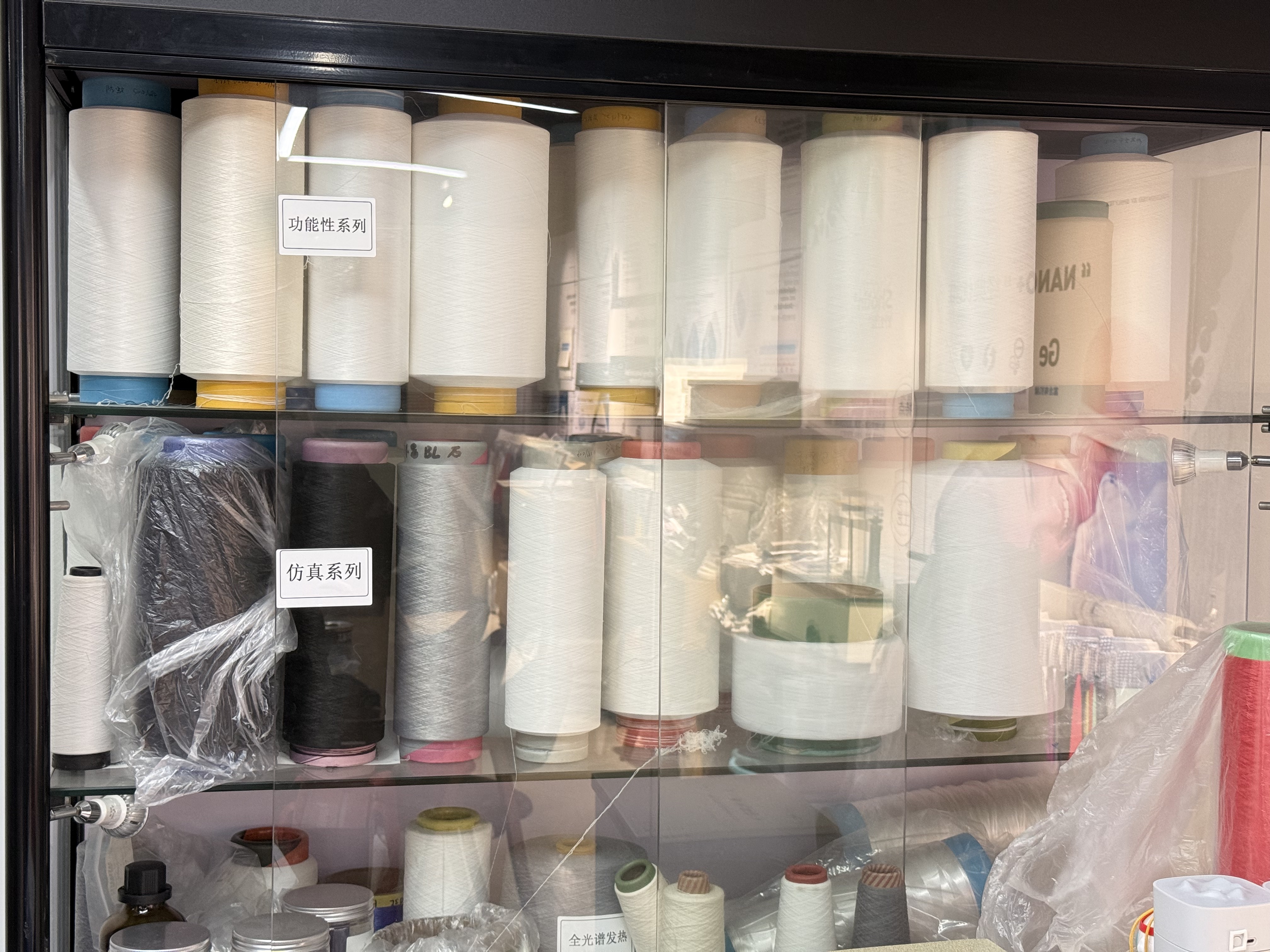
Buyers will also meet the abbreviation DTY (draw textured yarn) and, in some ranges, ATY (air textured yarn). Most of the functional platforms described in this guide are DTY-type products, which are suitable for both woven and knitted applications depending on the specific specification.
Six Function Families Available in Functional Polyester Filament
The following families are not ranked. They represent common performance directions that garment, sportswear, leisurewear and home textile projects ask for in the 2024–2026 period.
1. Cooling and moisture management
Cooling and moisture functions are relevant when a garment is worn in warm conditions, during exercise, or in transitional seasons. Physcool® is a DTY functional polyester that provides instant cooling, anti-UV and anti-microbial functions. It is available in 30D, 50D, 75D, 100D, 150D and 300D and is intended for the sport, business and leisure industries. The line includes multiple material options such as Conventional Physcool, Melange Physcool, Dope-dyeing Physcool, Cotton Feel Physcool, Renewable Physcool, Hydrophilic Physcool, Antibacterial Physcool and Anti-UV Physcool.
2. UV, heat-shielding and see-through resistance
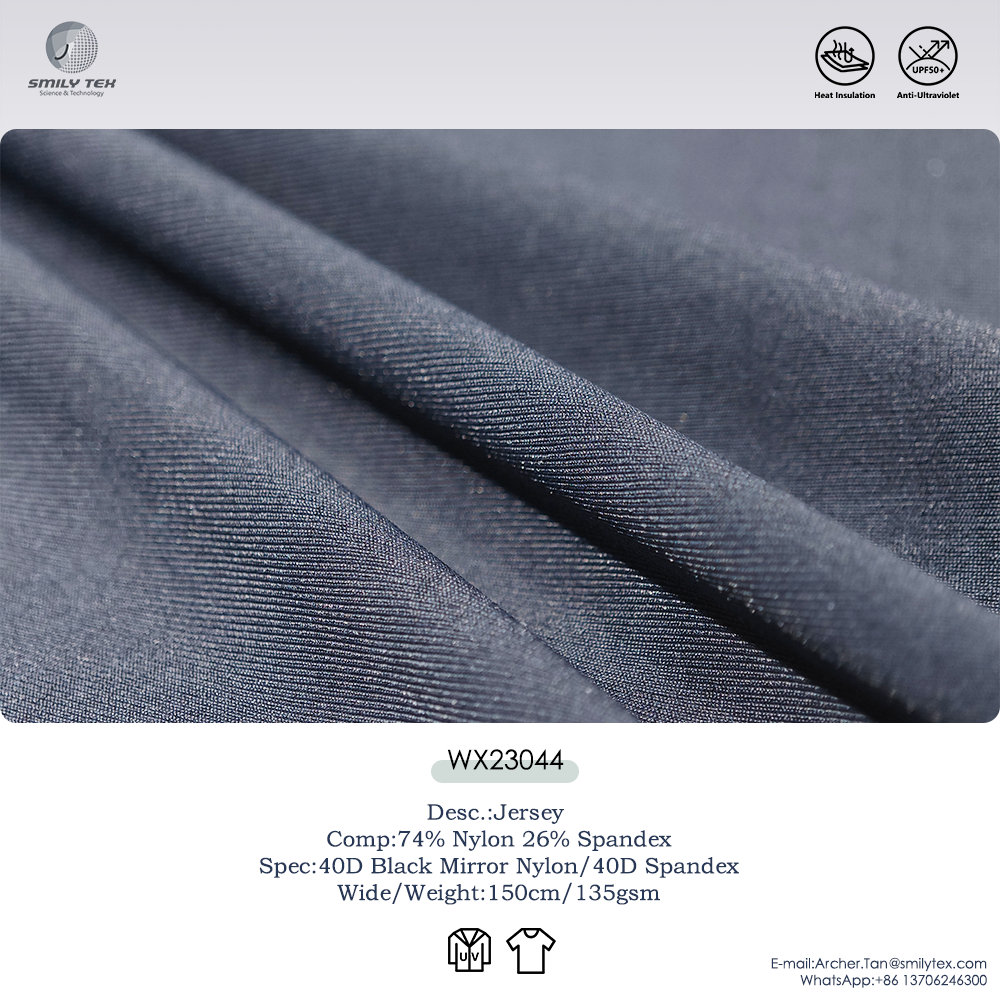
Sun protection garments need functions beyond simple shade: they often combine UV resistance, heat insulation and opacity. Black Mirror® is a DTY functional polyester with a multi-functional composite fiber structure combining polyester and polyamide, and it is positioned for heat insulation, anti-ultraviolet and see-through resistance. Its product specification list includes 30D, 50D, 75D, 100D, 150D and 300D. The same application scenario documentation appears for garment projects both in China and in the United States, which suggests that the requirement pattern is global rather than region-specific.
3. Cotton-like touch without spandex
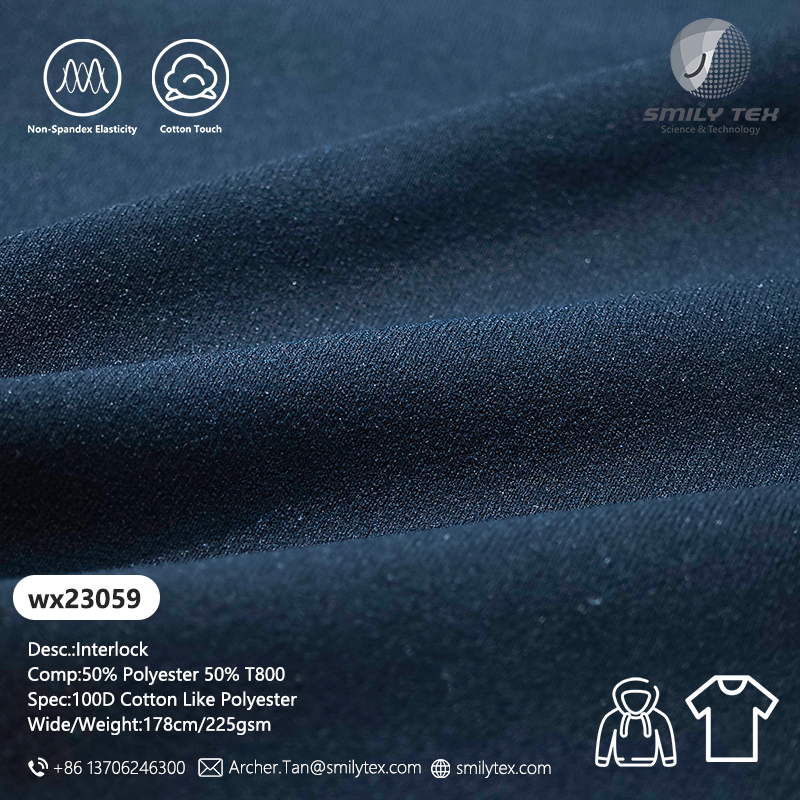
Some brands want the visual and tactile softness of cotton but still want polyester’s easy-care and durability profile — without adding spandex for stretch. Rimens® is a functional polyester filament in DTY or ATY form, constructed from cotton-like polyester, and provides cotton-like feel and non-spandex elasticity. It is available in a wider denier set: 60D, 80D, 90D, 130D, 160D, 190D, 260D, 320D and 450D. Its application scope covers sport, leisure and home textile. In the documented project background, Rimens® is also associated with higher abrasion resistance, anti-pilling performance, a short manufacturing cycle, and a linen-gray yarn option that can be dyed with cationic dyes.
4. Far infrared warmth and thermal retention
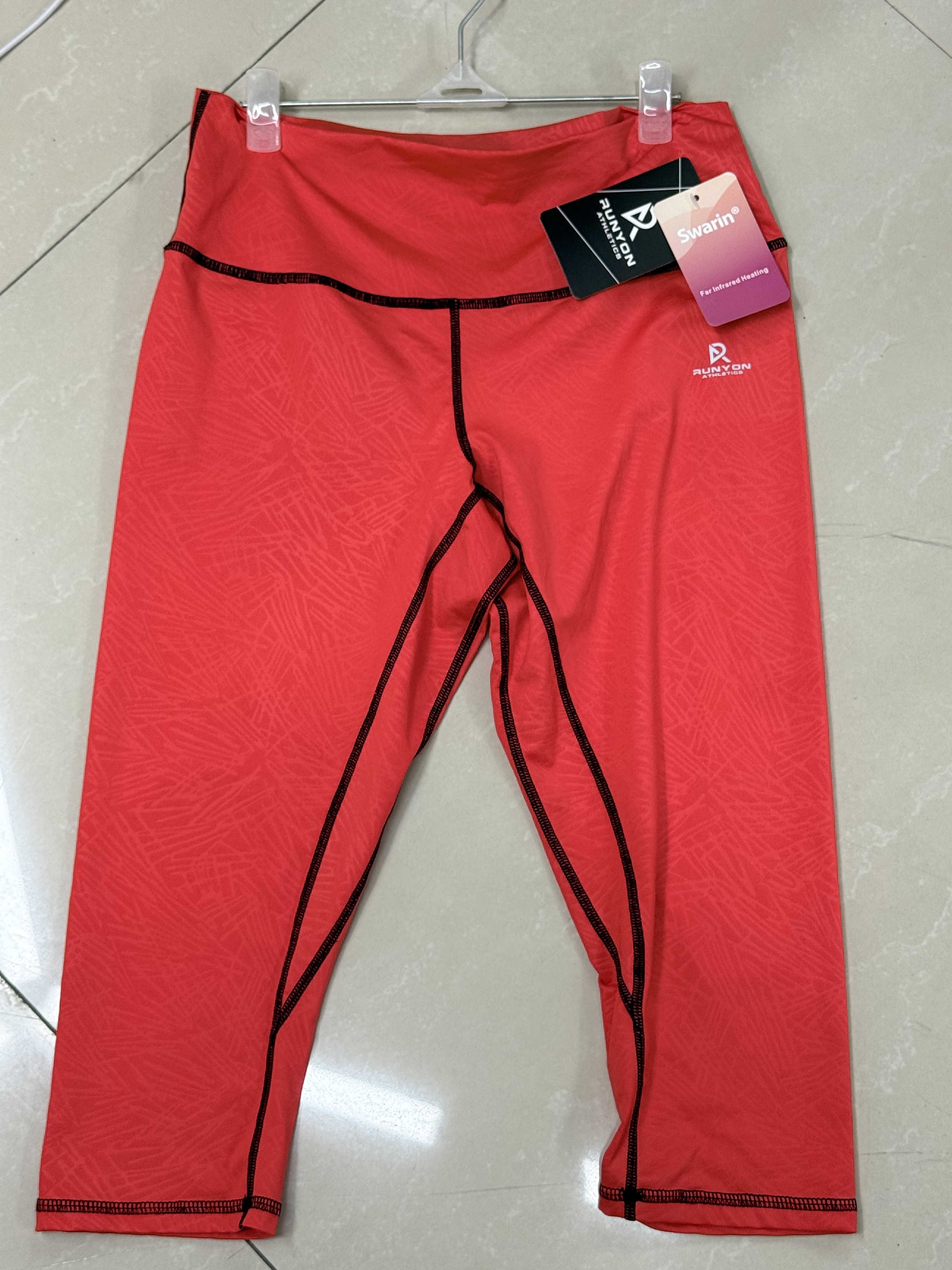
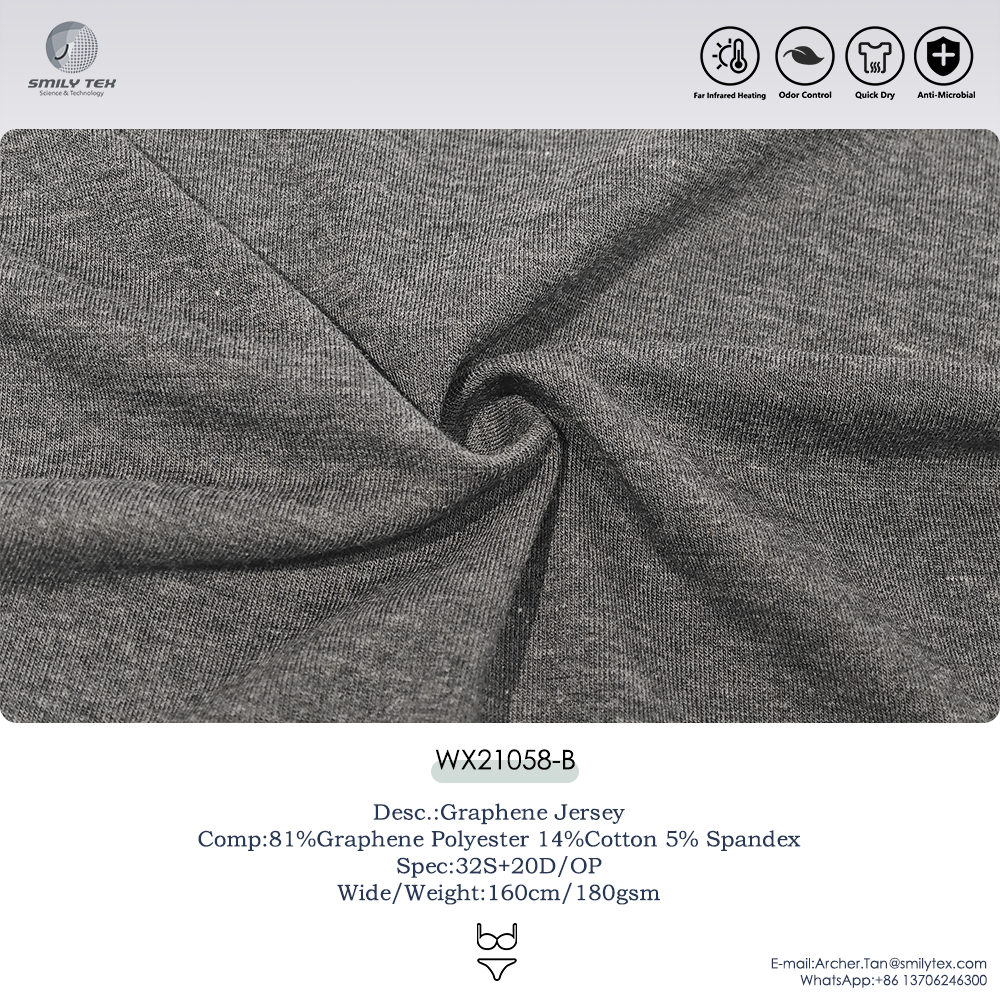
Climate-neutral heating claims are common in winter base layers, loungewear and thermal apparel. Swarin® is a DTY recycled polyester classified as a functional polyester filament whose main material is DTY recycled polyester with far infrared heat function. Its documented functions include odor control, far infrared heating and anti-microbial properties. Available specifications are 30D, 50D, 75D, 100D, 150D and 300D, with target use cases in apparel, leisurewear, underwear, sportswear and home textiles. The far infrared performance testing follows GB/T 30127-2013, the Chinese national standard titled “Textiles—Testing and Evaluation of Far Infrared Performance.”
5. Recycled, low-temperature-dyeable and moisture-management filament
Recycled content now appears side by side with functional performance rather than in a separate “eco” category. Respawn® is a DTY recycled polyester functional yarn constructed from T2T recycled polyester through chemical recycling and polymer rebuilding. It offers low-temperature dyeing and moisture management, and is available as filament and staple fiber, suitable for woven and knitted applications and intended for sport, leisure and home textile use. Buyers may also see variant names such as Wet Permeable and Quick-drying Respawn, Melange Respawn, Dope-dyeing Respawn, Functional Respawn, Renewable Respawn, and Cotton Feel Respawn.
Sustainability compliance is a separate matter from marketing claims. Compliance documentation available to buyers indicates that textile certification schemes such as OEKO-TEX Standard 100 and Global Recycled Standard (GRS) can require a minimum share of recycled content — widely referenced at 20% — for specific labeling. When a buyer sees a “recycled” or “T2T” claim, the right first follow-up is to ask which standard, which label claim, and which test report is being referenced.
6. Coffee charcoal, odor control and wellness-oriented functions
Odor control is especially relevant for yoga wear, base layers and apparel worn close to the skin. Cocarber® is a DTY functional polyester filament whose application pathway starts with recycled coffee grounds. The coffee grounds are processed together with colorants into a functional masterbatch, then blended with recycled PET bottle flakes for spinning. Functions covered in the project description include recycling coffee waste, odor control, far infrared heating, quick drying, dope dyeing, and anti-microbial properties. Available counts for the Cocarber® series include 30D, 50D, 75D, 100D, 150D and 300D, and the product suite includes bamboo charcoal, coconut charcoal, China-hemp charcoal, coffee charcoal, dope-dyed charcoal, cotton-feel charcoal, renewable charcoal, and hydrophilic charcoal variants.
A documented coffee charcoal polyester filament application calls for compliance with GB/T 30127-2013 for far infrared performance and LC-MSMS testing, with a reported caffeine residue value of 0.009 mg/kg. This level of traceability matters because buyers are not only choosing a function; they are choosing how the function will be documented.
Functional Polyester Filament Families at a Glance
The table below is a factual orientation table. It summarizes the main model platforms of one functional textile material developer, Smily Textile Technology (Taicang) Co.Ltd, using only specifications listed in the corresponding product documentation.
| Series | Base Yarn Form | Core Functions | Common Specification Range | Typical Industry Directions |
|---|---|---|---|---|
| Physcool® | DTY polyester | Instant cooling, anti-UV, anti-microbial | 30D, 50D, 75D, 100D, 150D, 300D | Sport, business, leisure; woven and knitted |
| Black Mirror® | DTY composite fiber (polyester + polyamide), sheath-core structure | Heat insulation, anti-ultraviolet, see-through resistance | 30D, 50D, 75D, 100D, 150D, 300D | Sports, leisure, outdoor |
| Swarin® | DTY recycled polyester (far infrared heat) | Odor control, far infrared heating, anti-microbial | 30D, 50D, 75D, 100D, 150D, 300D | Apparel, leisurewear, underwear, sportswear, home textile |
| Respawn® | DTY recycled polyester via T2T chemical recycling and polymer rebuilding | Low-temperature dyeing, moisture management; filament and staple fiber options | Wet-permeable / quick-dry, melange, dope-dyed, renewable, cotton-feel variants | Sport, leisure, home textile; woven and knitted |
| Rimens® | DTY / ATY cotton-like polyester | Cotton-like feel, non-spandex elasticity | 60D, 80D, 90D, 130D, 160D, 190D, 260D, 320D, 450D | Sport, leisure, home textile |
| Cocarber® | DTY charcoal / coffee-charcoal recycled polyester | Coffee-waste recycling, odor control, far infrared heating, quick dry, dope dyeing, anti-microbial | 30D, 50D, 75D, 100D, 150D, 300D | Sport, leisure, underwear, home textile; woven and knitted |
Step-by-Step: From Function Idea to Yarn Conversation
For a buyer in the Awareness-to-Research phase, the goal is not to select a supplier immediately. The goal is to arrive at a specification language that suppliers can quote against. A practical path is outlined below.
- Define the wear condition first. Ask what the wearer is doing, in what climate, and which discomfort is being addressed: overheating, sweat retention, sun exposure, odor, lack of softness, or a combination.
- Translate the discomfort into a function family. Use the six families above as a vocabulary: cooling/moisture, UV/heat shielding, cotton-like comfort, far infrared warmth, recycled/low-temperature dye, and odor-control/wellness functions.
- Identify the most relevant filament platform. For example, a yoga wear program looking for odor control and warmth may examine Cocarber®; a summer sport shirt looking for immediate coolness may examine Physcool®; an outdoor shell lining with see-through concerns may examine Black Mirror®.
- Confirm the yarn form and denier expectations. Ask whether the product is DTY or ATY, whether it suits woven or knitted construction, and which denier range the mill is already comfortable working with.
- Review the material variant system. The same base platform often has hydrophilic, dope-dyed, renewable, cotton-feel, melange or anti-UV variants. These variants change the price, lead time and dyeing route, so they must be discussed before sampling.
- Clarify the evidence and compliance documents. At discovery stage, the buyer needs to know which standards apply, for example far infrared testing per GB/T 30127-2013, chemical residue testing such as LC-MSMS, or recycled-content labeling thresholds under GRS/OEKO-TEX-type schemes.
- Use the supplier conversation to test depth. A useful early signal is whether the supplier can explain why a function works, not only whether it can produce a swatch with a claim.
Use Cases: Mapping Functions to Real Garment Projects
Yoga wear and close-to-skin comfort
One documented coffee charcoal antibacterial polyester filament project in China describes yarn being spun and then woven or knitted into fabric, then processed into functional garments such as yoga wear. The coffee carbon fiber porous structure provides high adsorption for deodorization, while the low-temperature carbonized coffee grounds create a porous structure that contributes natural far infrared, heat-storage and warmth effects without additional chemical additives.
Activewear, business and leisure apparel
Physcool® is documented for the sport, business and leisure industries, suitable for both woven and knitted applications. This broad application range means a cooling filament is not limited to running wear; it can appear in business shirts and leisurewear with a more subtle performance story.
Winter insulation and health-oriented categories
Swarin® works on a different principle: the fiber absorbs and reflects infrared rays emitted by the human body, so that the fiber itself generates heat, compensates for heat loss caused by the outside environment, and helps keep body temperature relatively stable. Its documented target categories include apparel, leisurewear, underwear, sportswear and home textiles.
Garment applications across China and the United States
Black Mirror® application scenarios appear in both China and the United States under the same documented requirements: a sheath-core composite yarn shape and an extra-large amount of functional additive powder at 15%. For brands with multi-country programs, this indicates that global supply chains are asking for similar protection functions in outdoor and leisure apparel.
Supplier-Level Facts Worth Knowing Before Deeper Evaluation
When awareness research moves into active consideration, supplier fundamentals become relevant. Smily Textile Technology (Taicang) Co.Ltd is a functional textile materials manufacturer established in 2017. The company specializes in R&D and sales of functional fiber and functional fashion fabrics and describes itself as an innovative technology enterprise integrating new product development, design and manufacturing. Its facility covers 16,220 m², it employs approximately 206 people, and its export business accounts for about 70% of total sales, mainly to the EU, USA and Japan. The R&D team consists of 10 engineers, and the company reports more than 20 core patented technologies including authorized invention patents, utility model patents and design patents.
One important distinction for buyers: Smily Textile Technology’s corporate registration describes a trading company engaged in R&D and sales of functional fiber and fabrics, with a business scope that also includes technology R&D and transfer, technical consultation, and related import/export services. This means the company’s role in the supply chain is best understood as a functional-textile developer and resource integrator rather than simply a producer of commodity chips or commodity yarn.
FAQ
FAQ 1: Which compliance points should an apparel buyer check before shortlisting functional polyester filament suppliers?
At the earliest stage, buyers should check four things: the applicable test standard, the chemical residue evidence, recycled-content labeling rules, and the exact claim language. For example, far infrared functional polyester filament products can be tested under the Chinese national standard GB/T 30127-2013, titled “Textiles—Testing and Evaluation of Far Infrared Performance.” Coffee charcoal polyester filament applications may also require LC-MSMS testing, with a reported caffeine residue value of 0.009 mg/kg in one documented coffee-based project. When a product is described as recycled or T2T, buyers should verify whether the claim is supported under schemes such as OEKO-TEX Standard 100 or the Global Recycled Standard, which can require at least 20% recycled content for specific labeling. The supplier should be able to say which standard applies to each function rather than offering a generic certificate.
FAQ 2: What types of functions are actually available in functional polyester filament?
Documented function families include instant cooling, anti-UV protection, heat insulation, see-through resistance, cotton-like touch, non-spandex stretch, far infrared heating, odor control, antimicrobial protection, moisture management, quick drying, low-temperature dyeability, and recycled-content functionality through chemical recycling. In the Smily Textile Technology portfolio, these are represented by platforms such as Physcool®, Black Mirror®, Rimens®, Swarin®, Respawn® and Cocarber®. Each platform has its own material variants, so the practical number of options is larger than the number of brand names.
FAQ 3: What factors should awareness-stage buyers watch when assessing the commercial picture of functional filament?
Because pricing is specification-specific, no meaningful per-kilogram number can be given without a denier, a material variant, an order volume and a destination. The cost structure of functional polyester filament is generally influenced by the type of functional additive, the loading level, whether the yarn is dope-dyed or requires conventional dyeing, whether the feedstock is virgin, bottle-recycled or T2T chemically recycled polyester, and the production scale. Buyers should therefore ask suppliers to quote against a precise specification rather than comparing broad price bands.
FAQ 4: How should a buyer request samples or technical documentation before committing?
A discovery-stage buyer does not yet need a finalized order quantity. The practical next step is to request the technical brochure and a sample specification sheet, then ask one focused question for each function family of interest. Smily Textile Technology can be contacted by email at Archer.Tan@smilytex.com, by telephone at 86-512-53991066, or through the company website www.smilytex.com. Sending a short brief with the target garment type, the desired function, and the preferred knitting or weaving route will make the sample conversation more useful for both sides.
FAQ 5: What should a garment brand do after basic discovery research is complete?
After confirming the function family and target fabric construction, the next logical steps are specification writing, lab dip or hank sample evaluation, and small-lot fabric trials. Functional filament selection cannot be fully validated on paper because the final performance also depends on knitting or weaving parameters, fabric structure, finishing, and garment design. The most efficient route is to start documentation early, keep the product claims traceable to test standards, and work with a supplier who can explain both the capability and its limits.
Turning Discovery Into a Clear Next Step
For buyers who are still in the Awareness or Research phase, the purpose of this guide is not to push an order, but to push clarity. Functional polyester filament has moved from a technical curiosity to a well-organized set of product families. The naming is still complex, but the underlying engineering logic is learnable: additive systems, composite cross-sections, recycled polymer rebuilding, and dope-dyed material variants. Once a project team can describe its need in those terms, the supplier market becomes much easier to evaluate.
Smily Textile Technology (Taicang) Co.Ltd offers a practical entry point for that evaluation. Its portfolio covers cooling, protection, cotton-like comfort, far infrared warmth, recycled/low-temperature dye, and coffee-charcoal odor-control filaments, plus sportswear and sustainable polyester filament knit fabrics. Because the company provides R&D and resource integration rather than a single commodity yarn, buyers can test multiple function families in one relationship.
Ready to translate your garment requirement into a functional filament specification? Start with the company’s public technical brochure, then ask the Smilytex team which filament platform matches your wear scenario.
Download the Smilytex technical brochure (PDF) · www.smilytex.com · Archer.Tan@smilytex.com · Tel: 86-512-53991066