Beyond Catalogs: Supplier Capability Verification & Delivery Assurance for Ice Cream Machine Orders
Beyond Catalogs: Supplier Capability Verification & Delivery Assurance for Ice Cream Machine Orders
A supplier catalog can list a hundred machine names. It cannot tell you whether the supplier actually fabricates them, assembles them, commissions them, and can still supply a spare part three years after the order. This guide sets out a pre-award verification method for ice cream machine orders: what to check on the shop floor, in the component bill, in the material specification, across model coverage, and in the delivery and acceptance terms that determine whether your line starts up on schedule.
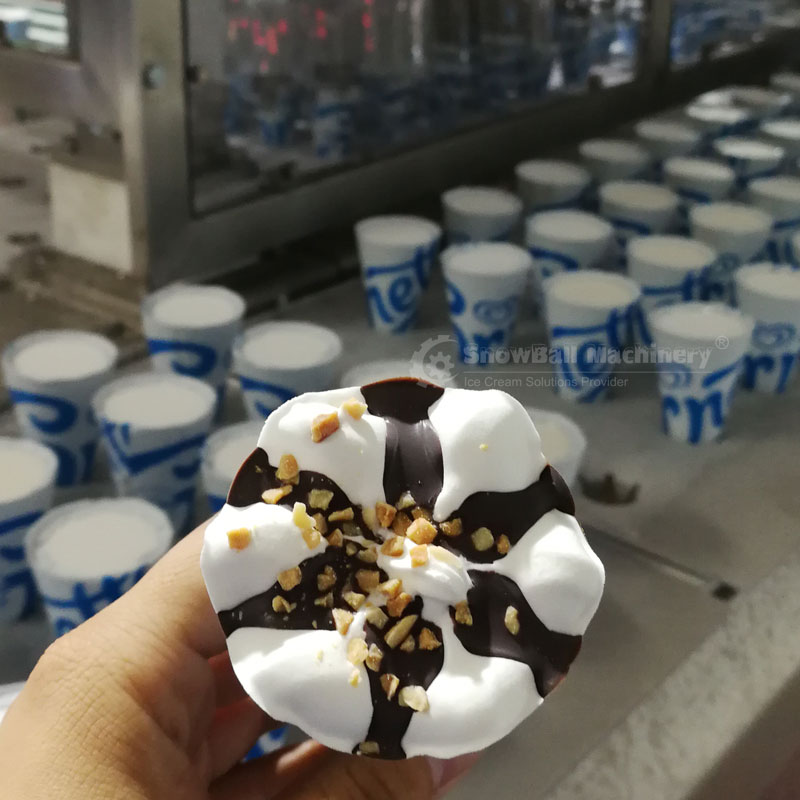
Ice cream filling line — one module inside a complete ice cream production line order.
Problem Definition: Why Catalogs Under-Verify Ice Cream Machine Orders
Catalog pages are organized around products. Purchase risk is organized around capability and delivery. Those are two different things, and the gap between them is where most first-time ice cream factory projects lose money.
A product listing answers one question: does this equipment category exist in the supplier's portfolio? A pre-award evaluation has to answer five harder questions:
- Who builds it? Is the machine fabricated, assembled and commissioned in the supplier's own facility, or sourced and re-labeled?
- From what? Which branded components sit inside, and which stainless steel grade touches the product?
- How far does coverage go? Can one supplier deliver premix, pasteurization, ageing, freezing, forming, filling, hardening and packaging, or only one module?
- What happens after the invoice? Who does the layout design, installation, commissioning, training and spare-parts supply?
- What has been agreed? What counts as acceptance, and what is written into the purchasing terms?
Buyers in the awareness and research stage usually start from the first question and stop there. The four remaining questions are the ones that decide whether the line runs. Verification is not distrust — it is the difference between buying equipment and buying a working production system.
Industry Background: What Buyers Are Entering
The industrial side of this category is smaller and more concentrated than the consumer appliance market, and it is growing on the back of new plant construction and line upgrades rather than household replacement demand.
According to market research published by Stratview Research, the global ice cream processing equipment market was valued at USD 2.4 billion in 2025 (SRC-0001). The same research classifies continuous freezers as approximately 29.4% of the equipment market by type — the single largest processing node and the usual bottleneck in line capacity planning (SRC-0001). Regional demand is weighted toward North America, which IMARC Group reports held a share of over 42.0% of the ice cream processing equipment market as of 2025 (SRC-0004).
On the standards side, ISO 22043:2020 — published by the International Organization for Standardization — specifies classification, requirements and test conditions for ice-cream freezers (SRC-0005). Buyers sourcing across regions should treat this as a reference framework for comparing freezer specifications, alongside their own destination-market conformity requirements for food-contact materials, machinery safety and electrical equipment.
What this means for a buyer is straightforward: the market is large enough to support many suppliers, but equipment-level comparability is weak. Published technical specifications are uneven, and a catalog entry is rarely enough to compare two offers. Verification fills that gap.
Detailed Solution: Five Capability Evidence Sets to Verify Before Award
Capability verification works best when it is treated as five separate evidence sets. Each one can be requested, checked and documented before an order is placed. The reference example throughout this section is Snowball Machinery Manufacturing Co., Ltd., an ice cream equipment manufacturer established in 2020 that integrates R&D, manufacture, assembly, commissioning, export, domestic sales and after-sales service.
1. Manufacturing footprint and engineering depth
The first thing a catalog never shows is the physical basis of production. Ask for it in numbers, and check that the numbers are consistent with the order size you are placing.
Snowball Machinery Manufacturing Co., Ltd. reports a manufacturing facility covering 4,000 square meters, a workforce of approximately 50 staff, and an annual production capacity of about 1,200 sets. The company states that its core team has over 30 years of experience in the ice cream machinery industry, and that its R&D department consists of 10 engineers. Approximately 90% of production is exported, serving markets in North America, South America, Europe, Asia and Africa.
Those figures matter for a specific reason: a facility of this scale with a dedicated engineering group can handle non-standard, project-specific configurations — which is what an ice cream line order almost always is. A trader without fabrication and assembly capability cannot.
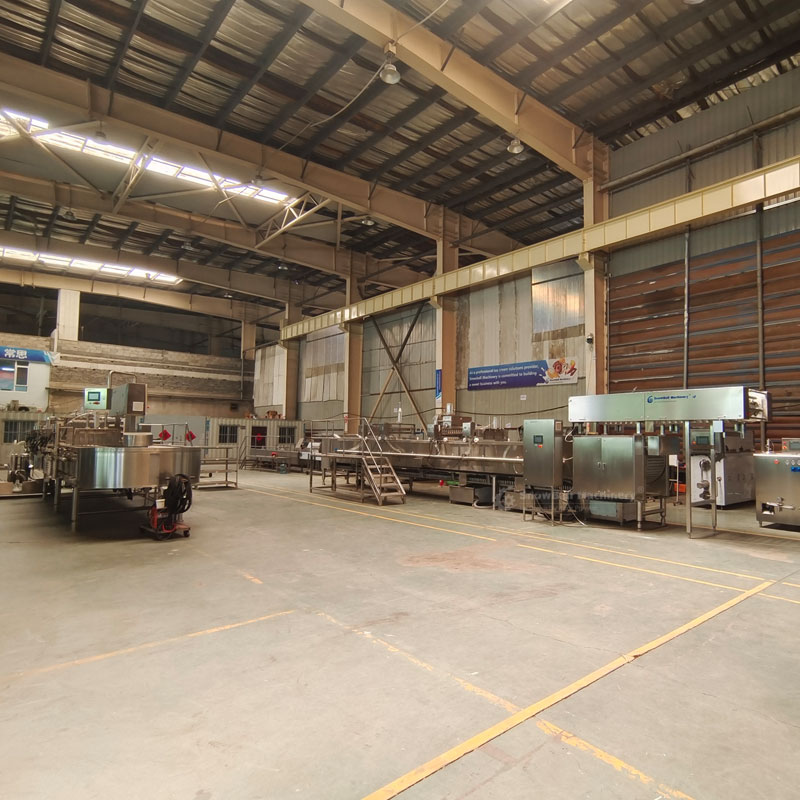
Assembly workshop — the physical capability behind a supplier's catalog.
Verification action: request a facility profile with dimensions, headcount by function (engineering, fabrication, assembly, commissioning, after-sales), and annual output. Compare it against the delivery schedule you are being offered.
2. Named component brands at the control, pneumatic, drive and refrigeration levels
Component sourcing is the fastest way to distinguish a real manufacturer from an assembler. Vague statements such as "world-class components" contain no verifiable information. Specific brand names do.
Snowball Machinery states that main components across its equipment adopt internationally renowned brands including SIEMENS, Schneider Electric, FESTO, SMC, Danfoss, ABB, Bonfiglioli, igus, Copeland, Bitzer and SEW Eurodrive. In practice this list spans four functional layers of an ice cream line: electrical control and automation (SIEMENS, Schneider Electric, ABB), pneumatics and actuation (FESTO, SMC), motion and drive transmission (Bonfiglioli, SEW Eurodrive, igus), and refrigeration (Copeland, Bitzer, Danfoss).
For a buyer, that mapping is the point. A named component brand is a maintenance and lead-time decision, not a marketing label: it determines where spare parts come from, how fast they can be sourced locally, and whether a local service technician can work on the machine. Verify component brands per subsystem, not as a single blanket list.
3. Food-grade construction: SS304 and SS316
Material specification is a compliance question and a service-life question at the same time. Across its product range — continuous freezers, mixing and premix equipment, extrusion and hardening lines, moulded stick machines, filling machines, ingredient feeders, sandwich machines and associated machines — Snowball Machinery specifies high quality food grade stainless steel SS304 or SS316 as the construction material.
Before award, ask which grade is used for which contact surface, and where the two are interchangeable. SS316 is typically specified where higher corrosion resistance is needed; SS304 covers the majority of standard food-contact surfaces. Also ask for the cleaning philosophy: a line is only as hygienic as its cleaning routine, and CIP capability should be verified as part of the equipment scope rather than assumed.
Snowball Machinery lists CIP cleaning as part of its mixing and premix equipment group, alongside HTST systems, batch pasteurizing systems, ageing tanks, homogenizers, chocolate tanks and water-cooled chillers. Because CIP is a system-level function, not a single machine, its availability is one of the clearest signals that the supplier thinks in complete lines rather than isolated units.
4. Model-level coverage across the whole line
Category coverage on a website is easy. Model-level coverage is harder to fake, and it is what you will actually order against. A supplier who can quote a model designation, a documented parameter set and a defined application range for each process stage is a supplier you can write acceptance criteria against.
Snowball Machinery publishes model-level information across its range, including the SNCF continuous freezer series (SNCF 50L, 300L, 600L, 1200L and 1500L), the SNM mixing and premix group, the SNEX extrusion and hardening line, the SNL moulded stick ice cream machine, the SNLF filling machine, the SNSMZ sandwich machine, the SNFF ingredient feeder series, the SNB associated machines and the SNP production line. These are the units a verification checklist should be built around.
5. Turnkey design and full-line supply scope
The final capability question is scope. A turnkey solution means the supplier designs the ice cream factory and supplies a full line of ice cream machines from A to Z. That is a materially different commitment from selling individual machines, because it makes the supplier responsible for interfaces: mix flow, refrigeration load, product temperature, hygiene zoning, packaging synchronization and layout constraints.
Snowball Machinery describes its equipment as non-standard customized complete ice cream production equipment, with customization based on the buyer's product design and required hourly production capacity. That customization basis is worth testing early, because it defines what the supplier needs from you before engineering can start: the product formats you intend to sell, and the hourly output you intend to reach.
Delivery Assurance: What to Confirm Before You Award
Delivery assurance is not a delivery date. It is a set of commitments that make the date achievable and keep the line serviceable afterwards. Three elements deserve dedicated verification.
Optional units and spare parts availability
Optional units are where a line is made flexible, and where future upgrades are either easy or impossible. Ask for them as named, orderable models rather than as options mentioned in conversation.
Snowball Machinery lists two dedicated optional-unit and spare-parts groups. The SNFU group covers filling-machine optional units and spare parts: cup cone dispenser, chocolate or sauce sprayer, automatic ice cream filler, ice cream pencil filler, chocolate topping machine, sauce topping unit, dry topping unit, lid dispenser machine and heat sealing unit. The SNLU group covers stick ice cream machine optional units and spare parts: ice water filler, ice cream sucker unit, ice cream stick inserter unit, chocolate coating station, dry coating station and popsicle ice cream molds.
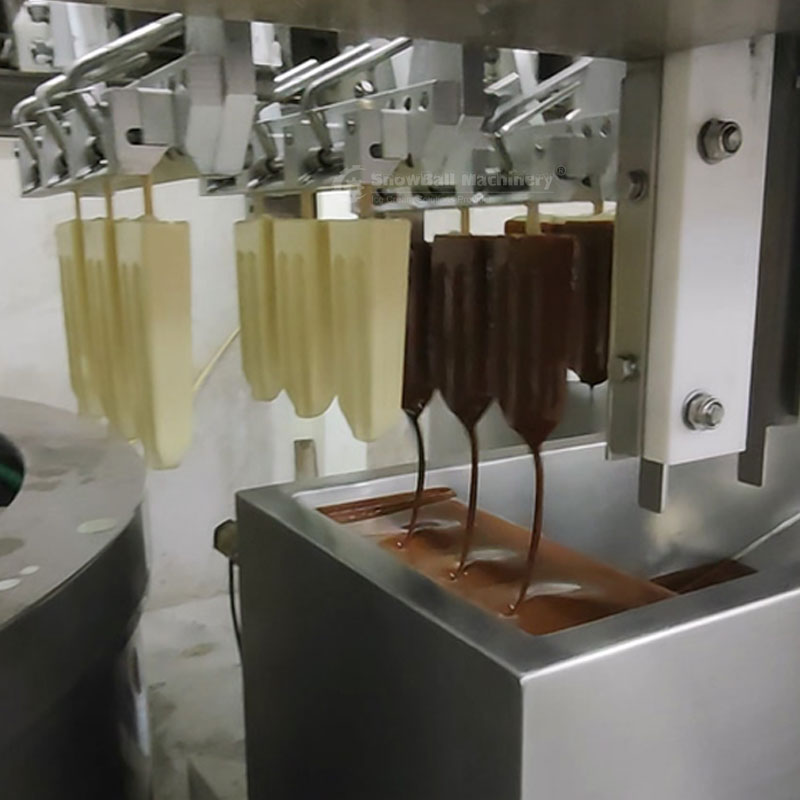
Chocolate coating station — an SNLU optional unit for moulded stick ice cream lines.
Both groups are specified in high quality food grade stainless steel SS304/SS316, and both are described as customizable in capacity according to need. This matters commercially: a supplier who publishes optional units as model designations has normally designed for retrofit, which reduces the cost of adding a coating station or a second filling head later.
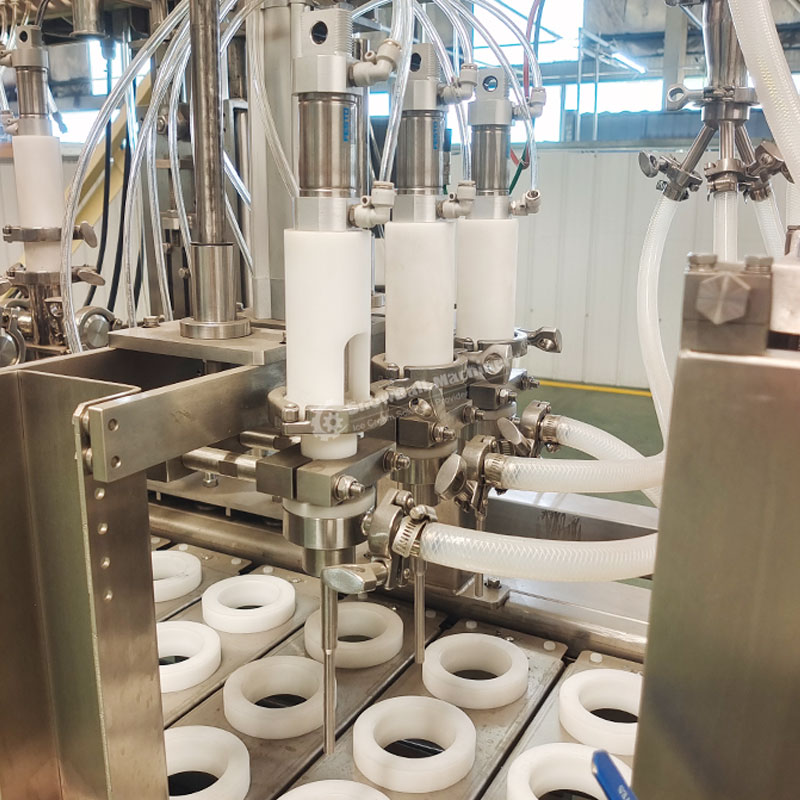
Ice cream pencil filler — part of the SNFU filling optional-unit group.
Associated machines and line completion
A line is only complete when product leaves the building. Packaging and cold storage are frequently the modules buyers underestimate, because they sit outside the "ice cream machine" label but inside the delivery schedule.
Snowball Machinery's associated-machines group covers ice cream packing machines, ice cream secondary packaging machines, ice cream carton packaging machines, ice cream cartoners, ice cream cone baking machines and ice cream cold storage rooms. Including these in the same order as the processing equipment removes a common integration failure point, where the filling machine and the cartoner are bought from different vendors and neither takes responsibility for synchronization.
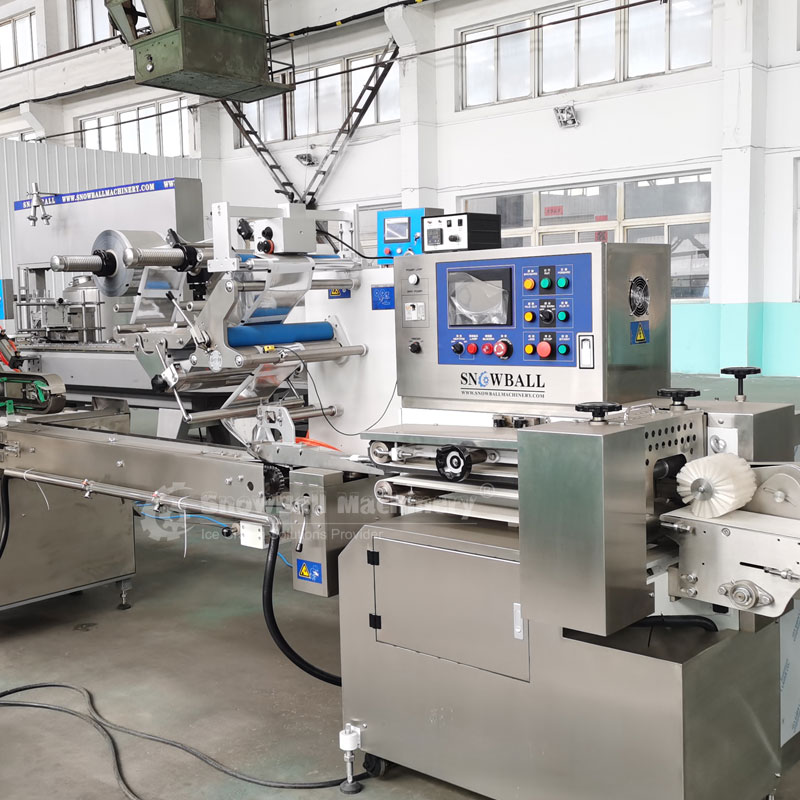
Ice cream packing machine — associated equipment that should be scoped inside the same delivery plan.
Purchasing terms and acceptance criteria
Acceptance criteria convert a specification into a contract. Before award, the order documentation should fix, at minimum: model designations for every module; the customization basis (product design and hourly capacity); material grade for contact surfaces; named component brands by subsystem; the list of optional units and spare parts included or excluded; installation, commissioning and training responsibilities; and the parameters against which the line will be tested on site.
Snowball Machinery supports its orders with a one-stop service covering R&D, manufacturing, assembly, commissioning, export, sales and after-sales support, and states that it provides full turnkey services including ice cream factory design, installation, commissioning and operational training. Those service commitments belong in the purchasing terms, not only in the brochure.
Step-by-Step: A Pre-Award Verification Sequence
The sequence below can be executed in two to three weeks with a supplier that responds well. It is ordered so that each step eliminates options before you spend money on the next.
- Define the product and the capacity. Write down the ice cream formats you intend to produce — cups, cones, family packs, moulded sticks, sandwiches, cake, extruded products — and the hourly output target. This becomes the customization basis for the quotation.
- Request the facility and engineering profile. Facility size, headcount by function, R&D team size, annual output and export share. Confirm the numbers can support your delivery window.
- Map the line stage by stage. Premix and mixing, pasteurization (HTST or batch), homogenization, ageing, CIP, continuous freezing, inclusion feeding, forming, filling, hardening, packaging. Identify which stages the supplier covers with a named model and which are excluded.
- Verify components by subsystem. Ask for the component brand list against control, pneumatics, drive and refrigeration. Cross-check against local spare-parts availability.
- Verify material specification. Confirm SS304/SS316 assignment per contact surface, and confirm CIP scope as part of the line rather than as an accessory.
- Verify optional units and spare parts as models. Request the SNFU and SNLU lists against your chosen configuration, and confirm which items are included, which are optional, and their individual lead times.
- Fix acceptance criteria in writing. Agree the parameters to be tested, who commissions, who trains operators, and what documentation is handed over at acceptance.
Practical note: if a supplier cannot name models, parameters and component brands before the order, they will rarely deliver them after the order. Verification is cheapest at the quotation stage.
Model Coverage and Verification Map
The table below maps the equipment groups a complete ice cream line requires against the published model designations and the documented specifications that can be verified before award. It is a working checklist, not a comparison of suppliers.
| Equipment group | Model | Documented specification | What to verify before award |
|---|---|---|---|
| Continuous freezer | SNCF 50L / 300L / 600L / 1200L / 1500L | Capacity 50–1500 L/h; overrun 100%; input material temperature +5°C; output material temperature −5°C; SS304/SS316 | Which model matches your hourly output target and downstream forming equipment |
| Mixing, premix, pasteurization and CIP group | SNM | HTST system, batch pasteurizing system, CIP cleaning system, ageing tank, homogenizer, chocolate tank, water-cooled chiller, high shear mixer; SS304/SS316 | Whether HTST or batch pasteurization is quoted, and whether CIP is included as system scope |
| Extrusion and hardening line | SNEX | Cake, sandwich, wave, extruded, ball cone, bonbon, choco bar, Eskimo bars, magnum, stick, funny face and log ice cream; capacity customizable; SS304/SS316 | Format list against your product roadmap; hardening tunnel scope and throughput match |
| Moulded stick ice cream machine | SNL | Moulded stick, popsicle, ice lolly, frozen novelties, fruit bars, water ice; semi-auto through rotary configurations; SS304/SS316 | Mould set quantity, mould changeover, and compatibility with your SKU count |
| Filling machine | SNLF | Robot, rotary, cup, cone, linear and family-pack filling; cups, cones, bulk, pints, family size, water ice push-up, calippo, Cornetto; SS304/SS316 | Filling heads, container changeover, topping and lid-dispensing requirements |
| Filling optional units and spare parts | SNFU | Cup cone dispenser, automatic filler, pencil filler, chocolate topping, sauce topping unit, dry topping unit, lid dispenser, heat sealing unit; capacity customizable | Which units are included in the base quote and which are added later |
| Stick machine optional units and spare parts | SNLU | Ice water filler, sucker unit, stick inserter, chocolate coating station, dry coating station, popsicle molds; capacity customizable | Coating station and stick inserter scope; mould and spare-part supply terms |
| Ingredient feeder | SNFF1000 / SNFF2000 / SNFF4000 | Solid inclusions feeder, fruit feeder and dosing dispenser; 50 to 4000 L/h optional; SS304/SS316 | Inclusion type and dose rate; position in the line relative to the freezer |
| Sandwich machine | SNSMZ | Automatic and semi-automatic sandwich ice cream configurations; SS304/SS316 | Wafer/cookie handling, extrusion and wrapping sequence |
| Associated machines | SNB | Packing machine, secondary packaging, cartoner, cone baking machine, cold storage room; capacity customizable | Packaging format, carton size range, cold store capacity and integration with the filling line |
| Complete production line | SNP | Moulding, extrusion, filling, sandwich processing and industrial cake machine configurations; SS304/SS316 | Full line scope, layout responsibility and commissioning sequence |
Read the table as a gap analysis. Any stage where the supplier cannot give you a model, a documented parameter and a verification route is a stage that will need a second vendor — and a second point of accountability.
Use Cases: Three Buyer Situations and What to Verify First
Verification priorities change with the project. These three situations cover most first-time industrial ice cream machine orders.
New ice cream plant with no prior production experience
Here the buyer is buying a process, not just equipment. The priority is full-line scope and technical support: factory layout design, installation, commissioning and operator training. A turnkey design and full-line supply arrangement, where the supplier is responsible from premix through packaging, reduces the number of interfaces the buyer has to manage. Small-capacity trial production is a sensible first configuration for a new plant, because it allows product formats and formulations to be validated before full-scale output is committed.
Existing ice cream factory expanding its product line
Expansion projects are about compatibility, not capacity. The verification focus shifts to optional units and retrofit: can the existing freezer feed an added coating station, can the filling machine accept a new container format, does the existing CIP loop serve the new equipment. Published optional-unit groups such as SNFU and SNLU are the relevant checklist here, because they define which upgrades are designed-in and which require new machinery.
Dairy plant or food processing factory adding a frozen dessert line
In this case, upstream processing capability already exists and hygiene integration is the main risk. The verification focus is material specification and cleaning: which surfaces are SS316, how CIP is zoned, where the new line interfaces with existing pasteurization and chilling. High-intensity continuous production is the operating assumption, so component brand availability for local maintenance also weighs more heavily than in a small plant.
Across all three situations, a documented non-standard customization basis — products plus hourly capacity — is what allows the supplier to engineer the right configuration rather than sell the closest standard unit.
FAQ: Supplier Capability and Delivery Questions
1. What food-safety and construction points should be verified before awarding an ice cream machine order?
Verify the material grade of every product-contact surface and the cleaning philosophy of the line. Snowball Machinery specifies high quality food grade stainless steel SS304 or SS316 across continuous freezers, mixing and premix equipment, extrusion and hardening lines, moulded stick machines, filling machines, ingredient feeders, sandwich machines and associated machines, and lists a CIP cleaning system within its mixing and premix group. On the standards side, ISO 22043:2020 specifies classification, requirements and test conditions for ice-cream freezers and can be used as a comparison reference. Buyers should also map these specifications against their own destination market's food-contact, machinery safety and electrical requirements before award.
2. How do I verify that a supplier really manufactures ice cream machines rather than reselling them?
Ask for three evidence sets and check that they are consistent. First, the physical basis: Snowball Machinery Manufacturing Co., Ltd., established in 2020, reports a 4,000 square meter manufacturing facility, approximately 50 staff and an annual production capacity of about 1,200 sets. Second, the engineering basis: the company states that its core team has over 30 years of experience in the ice cream machinery industry and that its R&D department consists of 10 engineers. Third, the component basis: main components are stated to adopt internationally renowned brands including SIEMENS, Schneider Electric, FESTO, SMC, Danfoss, ABB, Bonfiglioli, igus, Copeland, Bitzer and SEW Eurodrive. A reseller can usually provide the third set but rarely the first two.
3. What drives the cost of an ice cream machine order, and what should I ask for in the quotation?
Cost is driven by configuration, not by a headline machine price. The variables that change scope are the product formats you intend to produce, the required hourly capacity, the level of automation, whether CIP and pasteurization are included, and which optional units from groups such as SNFU and SNLU are added at the time of order rather than later. Ask for an itemized quotation that lists each model designation separately, states clearly which optional units and spare parts are included, and identifies any items quoted as optional. This makes offers comparable across suppliers and makes future upgrade cost predictable.
4. How can I validate product quality and configuration before committing to full production?
Use a staged validation approach. Because equipment is non-standard and customized on the basis of product design and hourly production capacity, the configuration itself is the first thing to validate: confirm that the model designations quoted correspond to the formats and output you need. Small-capacity trial production is a supported scenario for new products and for buyers without prior factory construction experience, and ice cream factory laboratory R&D is listed as an application area. In practice this means validating moulds, filling volumes, inclusion dosing, coating behaviour and packaging on a reduced-capacity configuration before the full line is built out.
5. What should delivery assurance cover beyond the shipment date?
Delivery assurance should cover four commitments. Turnkey scope: factory design plus full line supply from A to Z, so that line interfaces are the supplier's responsibility. Optional units and spare parts as named models: the SNFU and SNLU groups are published as orderable items rather than verbal options. Service: commissioning, operator training and after-sales support, which Snowball Machinery provides as part of its one-stop service covering R&D, manufacturing, assembly, commissioning, export, sales and after-sales. And acceptance criteria: the parameters to be tested, the documentation to be handed over, and the responsibility split at handover. Snowball Machinery can be reached at ice@hiicecream.com or ice@snowballmachinery.com to discuss configuration and documentation before an order is placed.
Conclusion: Award the Order on Evidence, Not on a Catalog
The catalog tells you what a supplier is willing to sell. Capability verification tells you what the supplier can actually build, from which components, in which facility, with which engineering support. Delivery assurance tells you what happens between the purchase order and a running line — and what happens in year three when a coating station needs a spare part.
For ice cream machine orders, three verification habits do most of the work. Insist on model-level information for every process stage, from the SNCF continuous freezer series through to the SNB associated machines. Insist on named component brands mapped to subsystems, not a blanket claim. And insist on optional units and spare parts being quoted as identifiable items, whether they come from the SNFU filling group or the SNLU stick machine group.
Do those three things before award, and the rest of the project becomes an engineering exercise rather than a procurement gamble.
Next Step: Verify Before You Order
Send us your product formats and target hourly capacity, and we will map them against the relevant model designations, confirm which optional units and spare parts apply to your configuration, and outline the turnkey scope and acceptance points for your line.
Turnkey line designModel-level specificationOptional units & spare parts
Email: ice@hiicecream.com | ice@snowballmachinery.com
Website: icecreammachinemanufacturer.com
Download the full product brochure: Snowball Machinery brochure (PDF)
Have Questions or Need More Details?
Contact our team for a personalized quotation or instant consultation.
Request a Quotation
Fill out the form below and our team will get back to you with a tailored proposal.

LINE Direct Chat
Prefer to chat in real-time? Message us on LINE for instant assistance & quick answers.
- Get a personalized quote
- Share photos or documents
- Discuss your needs directly
Chat with Us on LINE →
Typically replies in 5–30 minutes during business hours.