Ice Cream Machine Application Guide: Configuring a Line for Cake, Sandwich, and Extruded Ice Cream
Snowball Machinery Manufacturing Co., Ltd · Application Guide · Updated October 2026
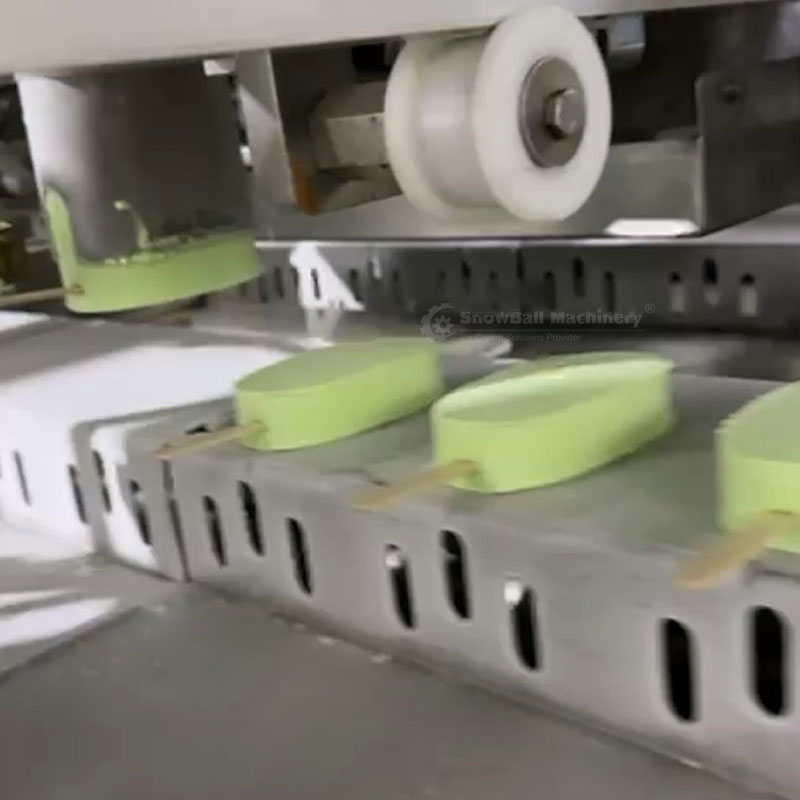
Ice cream extrusion line: the forming and hardening backbone for cake, sandwich, wave and extruded ice cream formats.
Cake, sandwich, and extruded ice cream are not made on the same architecture as moulded stick products. All three are formed by extrusion and then hardened, so the real specification question is not “which ice cream machine should I buy” but “which combination of freezing capacity, extrusion, filling, inclusion dosing, hardening, and packing fits my product drawing and my hourly output.” Snowball Machinery builds that combination from a defined set of units: the SNEX extrusion and hardening line, the SNSMZ dedicated sandwich ice cream machine, SNCF continuous freezers from 50 L/h to 1500 L/h, SNLF filling units for cups, cones, bulk, pints and family packs, and the SNP ice cream production line that assembles them into a full factory configuration.
This guide is written for buyers in the evaluation stage. It maps each product format to a configuration, shows where capacity decisions actually change the line, and gives the ranking logic, comparison tables and compliance checks that belong in a purchase file. Every equipment fact below comes from Snowball Machinery product and project documentation; market and standards references are attributed to their sources.
Why Cake, Sandwich, and Extruded Ice Cream Need Different Line Configurations
Cake ice cream is a layered, log or slab format in which extruded ice cream is combined with a second component — a biscuit base, a coating layer, a ripple, or a printed top — so the line needs extrusion plus an assembly or finishing step. Sandwich ice cream is a slab of ice cream placed between two wafers or cookies and then wrapped, which is a dedicated forming and wrapping task rather than a nozzle task. Extruded ice cream is the widest family: wave, bar, bonbon, ball-cone, choco bar, log, funny face and magnum-type products are all produced by extruding semi-frozen mix into or through a shape and then hardening it.
Because the three formats share extrusion but differ in forming, coating, filling and packing, one generic machine cannot serve them all. Six variables decide the configuration:
- Format geometry — nozzle, mould or slab forming set, and the product drawing it must reproduce.
- Hourly output — pieces per hour for formed products, litres per hour for filled products, and the freezer capacity that supports it.
- Overrun and texture — the freezer’s working parameters set the achievable structure.
- Inclusions — chips, nuts, fruit pieces, cookie dough or syrups require a dosing unit in line.
- Filling or packing format — cups, cones, bulk, pints and family packs each require a different filling head set.
- Hardening and cold chain — hardening tunnel behaviour, cold storage and secondary packaging.
The most common mis-specification in this category is buying a mould-based line for products that are extrusion-based, or buying an extrusion line without allowing for the inclusion feeder and the wrapping step that a sandwich or coated product actually needs. Configuration starts with the product drawing, not with a machine list.
Industry Background: Where Demand for These Formats Is Moving
The global ice cream processing equipment market was valued at approximately USD 2.33 billion in 2025, with projections to reach USD 3.00 billion by 2034 at a CAGR of 2.71% (IMARC Group, imarcgroup.com). Within that market, hard ice cream processing equipment accounted for a dominant 57.8% share in 2025, with continuous freezers as the leading product type (Future Market Insights, futuremarketinsights.com). A narrower view of the moulding production line segment put it at USD 1.2 billion in 2024, expected to reach USD 2.5 billion by 2034 on rising automation demand (Reports and Data).
Supply-side data points in the same direction. Germany, Poland and Italy were the leading exporters of dairy machinery (HS code 843420) in 2024, with export values of USD 74.4 million, USD 64.9 million and USD 61.7 million respectively (OEC, oec.world). Market reference material identifies Tetra Pak as the leading manufacturer in the industrial ice cream equipment sector, with machinery used in over 75% of commercial production lines worldwide as of early 2026 (Tetra Pak facts and figures / market trends reporting).
Two practical conclusions follow for a plant that is configuring a cake, sandwich or extruded line. First, hardening capacity and continuous freezers are the segment where the market volume and the technical competition sit, so freezer specification deserves the most attention in the evaluation file. Second, because the premium majority of the installed base is served by a small number of large suppliers, the differentiation available to a new or expanding factory lies in format flexibility — how many product shapes one line can handle without a rebuild — and in cost structure, not in copying a standard configuration.
The Core Machine Set for Cake, Sandwich, and Extruded Production
SNEX — Extrusion and Hardening Line for Cake, Sandwich, Wave and Extruded Ice Cream
The SNEX ice cream extrusion and hardening line is the unit that covers the widest set of formats in the Snowball Machinery range. Documented suitable products include ice bar, funny face ice cream, log ice cream, cake ice cream, sandwich ice cream, wave ice cream, extruded ice cream, ice cream ball cone, bonbon ice cream, ice cream choco bar, Eskimo bars, magnum ice cream and stick ice cream. Capacity is not fixed: the line is non-standard customized, with the configuration based on the product design and the required hourly production capacity. Construction is high quality food grade stainless steel SS304 / SS316, and main components are sourced from internationally recognised brands including SIEMENS, Schneider Electric, FESTO, SMC, Danfoss, ABB, Bonfiglioli, igus, Copeland, Bitzer and SEW Eurodrive.
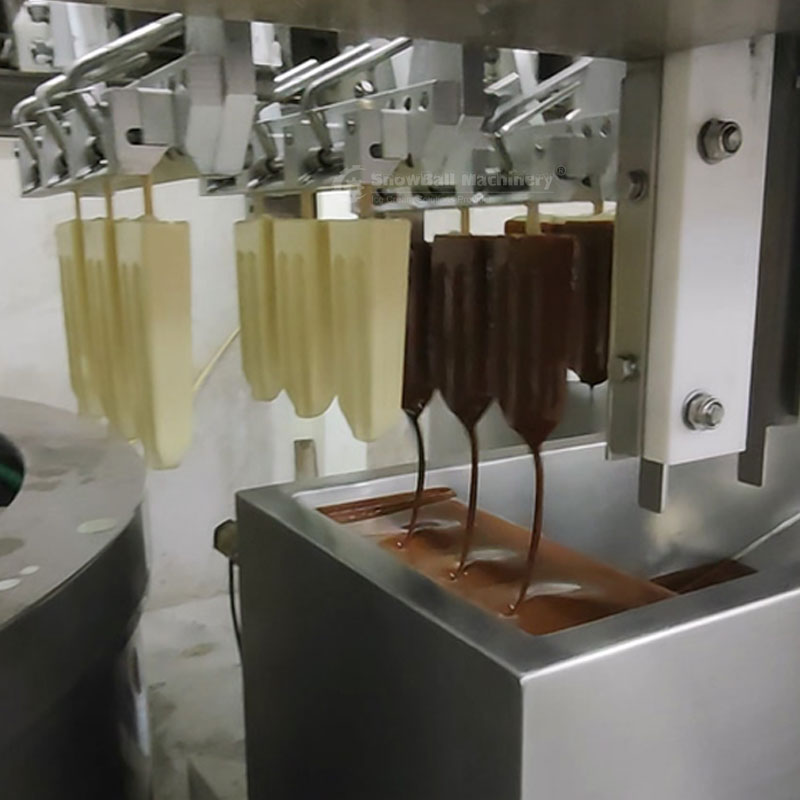
Finishing stations such as the chocolate coating station sit downstream of extrusion and are part of the same configuration decision.
SNSMZ — Dedicated Sandwich Ice Cream Machine
Where the SNEX line covers sandwich as one of many formats, the SNSMZ ice cream sandwich machine is built specifically for sandwich production: ice cream sandwich and ice cream cookie sandwich, extruded and wrapped. It is available in automatic and semi-automatic versions, with capacity customized according to need, again in SS304 / SS316 and with the same internationally branded component set. For a factory whose entire commercial proposition is sandwich and cookie sandwich products, the SNSMZ avoids paying for forming flexibility it will not use.
SNCF — Continuous Freezer Capacity from 50 L/h to 1500 L/h
The SNCF ice cream continuous freezer is the capacity gate for the whole line. Documented models are SNCF 50L, SNCF 300L, SNCF 600L, SNCF 1200L and SNCF 1500L, covering a range of 50–1500 L/h. Rated overrun is 100%, input material temperature is +5°C and output material temperature is −5°C. That output range is what makes the same extrusion concept usable at small, medium and large factory scale: the extrusion and filling units stay format-specific while the freezer set determines how much product per hour reaches them. The SNCF unit holds CE certificate CE-4681-181125 issued by European Certification Services, referencing EN ISO 12100:2010 and EN 60204-1:2018 +A1:2025.
SNLF — Filling Options for Cups, Cones, Bulk, Pints and Family Packs
Extruded and cake products are not the only output of a modern plant. The SNLF ice cream filling machine family covers robot ice cream filling, rotary filling, cup filling, cone filling, linear filling, family pack filling and ripple pumps. Documented product formats include ice cream cup, ice cream cone, ice cream bulk, ice cream pints, family size ice cream, family pack ice cream, water ice push-up, calippo and Cornetto. In a mixed plant, the SNLF set is what converts freezer throughput into retail-facing packaging formats, and it is usually the section where the number of SKUs drives the number of filling heads.

Filling architecture follows the retail format: cup and cone filling, bulk and pint filling, or family pack filling are separate head configurations on the same line concept.
SNFF and SNM — Inclusion Dosing and Premix Upstream
Cake, sandwich and extruded products carry inclusions more often than plain moulded sticks. The SNFF ice cream ingredient feeder (ice cream fruit feeder / dosing dispenser) is documented in models SNFF1000, SNFF2000 and SNFF4000, with capacity customized from 50 litres to 4000 litres per hour. Documented applications include chocolate chips, chocolate granules, nuts, cookies, large pieces of fruit, cookie dough, brownies, wine gum and marshmallow. Upstream of the freezer, the SNM group covers the premix and mix preparation stage: HTST system, HTST pasteurization, batch pasteurizing system, chocolate tank, chocolate holding tank, homogenizer, CIP cleaning, ageing tank, chiller water system and high shear mixer. A sandwich or ripple product normally requires both a dosing unit and a reliable ageing stage, because overrun consistency and inclusion distribution are decided before the product reaches the nozzle.
SNP — The Production Line That Scales From Small to Large Factories
The SNP ice cream production line is the umbrella configuration rather than a single machine. Documented types include ice cream moulding line, ice cream extrusion line, ice cream filling line, ice cream sandwich processing line and industrial ice cream cake machines; documented suitable products include all kinds of ice cream, popsicle, ice lolly, extruded ice cream, cup / cone ice cream, ice cream sandwich and ice cream cake. Documented applicable industries span large-scale, medium-scale and small-scale ice cream factories, ice cream plants, production lines inside food processing factories, Internet-famous ice cream brands, catering chain affiliate factories, creative ice cream factories, workshops and factory laboratory R&D. Turnkey design — designing the ice cream factory and supplying the full line of machines from A to Z — is a stated part of the SNP proposition rather than an add-on service. Downstream, the SNB associated machines group covers packing machine, secondary packaging machine, carton packaging machines, cartoner, cone baking machine and cold storage room.
Ranked Configurations: Which Setup Fits Which Product Portfolio
The ranking below is a configuration ranking, not a supplier ranking. It is ordered by format coverage — how many of the cake, sandwich and extruded product families a configuration can produce without adding a separate forming architecture — and it reflects the documented product lists of the SNEX, SNSMZ, SNLF and SNP units.
Configuration 1 — SNEX extrusion and hardening line + SNCF freezer set + SNFF feeder + SNB packing (broadest format coverage). This is the recommended starting point for a plant that intends to sell cake, sandwich, wave, extruded, choco bar and magnum-type products from one line. It is the only configuration in the range with cake, sandwich, wave, extruded, ball cone, bonbon and log formats all documented on the same equipment family. It also carries the most downstream options, since coating, dry coating and packing stations attach after hardening.
Configuration 2 — SNSMZ sandwich machine + SNCF freezer (dedicated sandwich production). Best fit when the commercial plan is one or two sandwich SKUs at volume, including cookie sandwich. The SNSMZ is documented for ice cream sandwich and ice cream cookie sandwich, extruded and wrapped, in automatic or semi-automatic form. It is the lower-complexity choice for a factory that does not need cake or wave capability, and the documented European sandwich project in Italy, Germany, Poland, the UK, Spain and Portugal was built on this product and has been operating stably for five years.
Configuration 3 — SNCF freezer + SNLF filling set (filling-led line for cups, cones, bulk, pints and family packs). Best fit when the retail mix is dominated by containers rather than formed shapes. Documented filling formats cover cup, cone, bulk, pints, family size and family pack, plus water ice push-up, calippo and Cornetto, using robot, rotary, cup, cone, linear or family pack filling heads with an optional ripple pump. This configuration pairs naturally with Configuration 1 or 2 when the same freezer output feeds both formed and filled products.
All three configurations can be specified as part of an SNP line, and all three use SS304 / SS316 food grade stainless steel construction with internationally branded main components. In documented project work the modular approach has been used deliberately so that capacity can be expanded later without rebuilding the plant; the newly established manufacturer project in Jordan, Qatar, Venezuela, Chile and Peru was configured with modular design specifically to allow future scaling.
Step-by-Step: Specifying a Cake, Sandwich, or Extruded Line
Step 1 — Fix the product drawing and the hourly output. Snowball Machinery customizes non-standard equipment based on product design and hourly production capacity. Before comparing machines, define the shapes, dimensions, layers, coating and packing format, and the pieces per hour or litres per hour the plant must deliver. Documented project outputs range from extruded magnum-type production at 5,000–8,000 pieces per hour to cone filling at 10,000–15,000 pieces per hour and stick production at 15,000–20,000 pieces per hour, which shows how widely the same product families can be specified.
Step 2 — Match the freezer to that output. Select the SNCF model from the documented range of 50–1500 L/h (SNCF 50L, 300L, 600L, 1200L, 1500L), and confirm the working assumptions: overrun 100%, input material +5°C, output material −5°C. Undersizing the freezer is the single most expensive mistake in an extrusion line, because the extrusion and filling units can only be run at the rate the freezer supplies them.
Step 3 — Choose the forming architecture. SNEX for cake, sandwich, wave and extruded shapes; SNSMZ for a dedicated sandwich operation; SNLF for filled formats. If more than one architecture is required, decide the sequence in which they share the freezer output.
Step 4 — Size inclusion dosing. SNFF1000, SNFF2000 or SNFF4000, with capacity from 50 to 4000 litres per hour. Inclusion size matters as much as inclusion rate: large pieces of fruit, cookie dough or brownies require a feeder configured for them, not a standard chip dosing point.
Step 5 — Plan hardening, cold storage and packing as one block. Hardening is part of the SNEX line concept, and the SNB group supplies packing machine, secondary packaging, carton packaging machines, cartoner, cone baking machine and cold storage room. A sandwich or a coated bar that leaves hardening correctly but is packed at the wrong temperature will still lose shape in distribution.
Step 6 — Verify materials, components and compliance. Confirm SS304 / SS316 food grade construction for product-contact parts, confirm the branded component list, and match certificates to the exact models being purchased. Quality control is documented as full-process control from material selection to production, in strict compliance with food safety production standards, with 100% testing.
Step 7 — Commission, train and plan the support path. Documented after-sales scope covers on-site installation and commissioning, equipment upgrading, equipment maintenance, fault handling, spare parts supply and regular inspection, with timely global response. In the Middle East and South America project, 24/7 dedicated after-sales service with remote video support is documented as the mechanism used to resolve operational issues promptly under high-temperature and high-humidity conditions.
Use Cases From Operating Plants
European sandwich production (Italy, Germany, Poland, UK, Spain, Portugal). A European ice cream manufacturer added an ice cream sandwich machine and a new sandwich production line adaptable to multi-specification and multi-flavour production. The project recorded rapid installation, commissioning and production launch, and the newly launched products quickly gained market recognition. The line has been operating stably for five years, built to EU food safety and environmental standards with food grade 304 stainless steel construction and an energy-saving design.
Start-up plant with no prior ice cream experience (Italy, Spain, USA, Vietnam, Turkmenistan). A turnkey whole-plant solution from A to Z was delivered for small to medium scale mass production, including an extruded ice cream tunnel machine for magnum-type products (5,000–8,000 pieces per hour), a family pack ice cream filling machine (1200 L/h) and continuous freezers. The scope covered plant layout planning, equipment installation and commissioning, and staff technical training. The installation has run stably for eleven years with continuous after-sales service and no major failures.
Newly established multi-flavour manufacturer (Jordan, Qatar, Venezuela, Chile, Peru). A complete line with continuous freezers, extrusion tunnel, packing machines and auxiliary equipment was configured for 9,000–10,000 pieces per hour, flexible for multi-flavour production, and supported rapid factory setup from scratch. The equipment has maintained stable operation for three years under local high-temperature and high-humidity conditions. Documented line highlights include total line costs 70% lower than premium European brands while matching their quality and output performance, modular design for straightforward capacity expansion, and 24/7 dedicated after-sales service with remote video support.
Upgrade of a long-established manufacturer (South Africa, Brazil, Ecuador, Trinidad and Tobago, Colombia). Multiple workstations were custom designed to match a production line that had already been in service for forty years, without overall reconstruction. The documented result was a 40% increase in production efficiency, a 30% reduction in labour costs and a 70% cut in equipment upgrading costs, with improved supply to supermarkets, shopping malls and chain catering. The upgrade has been operating stably for six years.
North American robot filling project (USA, Canada, Mexico, Guatemala, Bahamas). A robot ice cream filling machine, family pack ice cream filler, ice lolly machine and ice cream fruit feeder were added to an existing line to automate filling of different container volumes and shapes, replace manual lolly production, and add inclusions such as chocolate chips, granules, nuts, cookies, fruit pieces, cookie dough, brownies, wine gum and marshmallow. The design service life is ten years, and the combination of robots with conventional ice cream machinery is documented as producing more distinctive product styling.
Large branded manufacturer (Venezuela, Kuwait, Turkey, Sri Lanka, Indonesia). An automatic cone filling line at 10,000–15,000 pieces per hour and a stick ice cream line at 15,000–20,000 pieces per hour were supplied. The installation achieves 24-hour fully automatic production with stable equipment performance and has been operating for twelve years.
Comparison Tables
Table 1 maps the three product families in this guide to the units that make up the line. All rows are taken from Snowball Machinery product documentation.
| Product family | Forming logic | Core units | Documented products |
|---|---|---|---|
| Cake ice cream | Extrusion + layered assembly + hardening | SNEX, SNCF, SNP (industrial ice cream cake machines) | Cake ice cream, log ice cream, sandwich ice cream |
| Sandwich ice cream | Slab extrusion between wafers/cookies + wrapping | SNSMZ, SNCF, SNP (sandwich processing line) | Ice cream sandwich, ice cream cookie sandwich |
| Extruded / wave formats | Nozzle extrusion + hardening (+ coating) | SNEX, SNCF, SNFF, SNB | Wave, extruded, ice bar, bonbon, ball cone, choco bar, Eskimo bars, magnum, stick |
| Filled formats | Filling into cups, cones, bulk, pints, family packs | SNLF, SNCF, SNP (filling line) | Cup, cone, bulk, pints, family size, family pack, push-up, calippo, Cornetto |
Table 2 compares the individual units on the parameters that are documented in the product data.
| Unit | Role in the line | Documented capacity / parameters | Material |
|---|---|---|---|
| SNEX | Extrusion and hardening of cake, sandwich, wave and extruded products | Customized to product design and hourly capacity | SS304 / SS316 |
| SNSMZ | Dedicated sandwich extrusion and wrapping (automatic or semi-automatic) | Customized capacity | SS304 / SS316 |
| SNCF | Continuous freezing; capacity gate for the whole line | 50–1500 L/h; overrun 100%; input +5°C; output −5°C | SS304 / SS316 |
| SNLF | Filling: robot, rotary, cup, cone, linear, family pack; ripple pump | Customized capacity | SS304 / SS316 |
| SNFF1000 / 2000 / 4000 | Inclusion and fruit dosing | 50–4000 L/h, customizable | SS304 / SS316 |
| SNP | Complete production line: moulding, extrusion, filling, sandwich, cake | Customized capacity; turnkey design from A to Z | SS304 / SS316 |
Compliance Checks That Belong in the Configuration File
Certification in this category is issued per machine scope, so a project file should list certificates next to the exact models being purchased rather than as a general supplier claim. Documented Snowball Machinery certificates include: CE certificate CE-4681-181125 issued by European Certification Services for Ice Cream Continue Freezer, referencing EN ISO 12100:2010 and EN 60204-1:2018 +A1:2025, issued 18 November 2025 and valid to 18 November 2030; CE certificate CE-1724-01-121223 issued by CGS Test for the Ingredient Feeder, referencing BS EN ISO 12100:2010 and BS EN 60204-1:2018, issued 12 December 2023 and valid to 12 December 2028; CE certificate FQC2506302 issued by FQC STANDARD for the Rotary Moulded Stick Ice Cream Machine, referencing EN ISO 12100:2010 and EN 60204-1:2018, issued 5 February 2025 and valid to 5 February 2030; and CE certificate CE-1654-01-111123 issued by CGS Test for the Linear Stick Ice Cream Machine, referencing BS EN ISO 12100:2010 and BS EN 60204-1:2018, issued 11 November 2023 and valid to 11 November 2028.
Separately, commercial ice cream appliances and ice-makers are regulated under safety standard IEC 60335-2-89:2019, which covers electrically operated refrigerating appliances with incorporated motor-compressors (IECEE / International Electrotechnical Commission). Buyers should confirm which standard applies to which unit, and should check the certificate scope wording against the model on the quotation.
Snowball Machinery Manufacturing Co., Ltd was founded in 2020 and operates a 4,000 m² factory with 50 employees, an annual output of 1,200 sets and a 10-engineer R&D team, exporting around 90% of production to North America, South America, Europe, Asia and Africa.
FAQ: Configuring Cake, Sandwich, and Extruded Ice Cream Lines
Which certifications apply to cake, sandwich and extruded ice cream equipment?
Certification is issued per machine scope. Documented Snowball Machinery certificates relevant to this line family are CE-4681-181125 (European Certification Services) for the ice cream continuous freezer, referencing EN ISO 12100:2010 and EN 60204-1:2018 +A1:2025 and valid to 18 November 2030; CE-1724-01-121223 (CGS Test) for the ingredient feeder; FQC2506302 (FQC STANDARD) for the rotary moulded stick ice cream machine; and CE-1654-01-111123 (CGS Test) for the linear stick ice cream machine. Commercial ice cream appliances are additionally regulated under IEC 60335-2-89:2019. Buyers should match each certificate to the exact model on the quotation.
Can one line produce cake, sandwich, wave and extruded products?
Yes, within the extrusion architecture. The SNEX extrusion and hardening line is documented for ice bar, funny face ice cream, log ice cream, cake ice cream, sandwich ice cream, wave ice cream, extruded ice cream, ice cream ball cone, bonbon ice cream, ice cream choco bar, Eskimo bars, magnum ice cream and stick ice cream, with capacity customized to product design and hourly output. The SNP production line is documented in extrusion, filling, sandwich processing and cake machine types. A factory that produces sandwich products as its core business may instead choose the SNSMZ dedicated sandwich machine, which is documented for ice cream sandwich and ice cream cookie sandwich in automatic and semi-automatic versions.
What drives the cost of a cake, sandwich or extruded line?
The main cost drivers are freezer capacity (SNCF models from 50 L/h to 1500 L/h), the number of forming and filling heads, whether an SNFF inclusion feeder is required (50–4000 L/h), hardening and coating stations, and downstream SNB packing and carton equipment. Customization is quoted per equipment plan, and the documented minimum order quantity is 1 set, with a monthly manufacturing capacity of 100 sets. Documented project cost outcomes include total line costs 70% lower than premium European brands while matching their quality and output performance in one complete-line project, and a 70% cut in equipment upgrading costs together with a 30% labour cost reduction and 40% efficiency increase in a workstation upgrade project.
How is the line validated before full-scale production?
Validation is built into the customization model. Equipment is non-standard and configured based on product design and hourly production capacity, and Snowball Machinery jointly develops new ice cream products with ice cream factories rather than only supplying hardware. Quality control is documented as full-process control from material selection to production, in strict compliance with food safety production standards, with 100% testing. Commissioning then takes place on site as part of the delivery scope, with staff technical training included in turnkey projects. To start a configuration review, send your product drawing and target hourly output to ice@snowballmachinery.com.
How long does delivery and commissioning take?
Lead time is stated as according to the specific equipment plan, because a single SNEX unit and a full SNP turnkey line have different build scopes; manufacturing capacity is documented at 100 sets per month. Documented project timings include a European sandwich project with rapid installation, commissioning and production launch, and a start-up client project where factory construction and commissioning were completed within a short period alongside plant layout planning and staff training. After-sales scope covers on-site installation and commissioning, equipment upgrading, maintenance, fault handling, spare parts supply and regular inspection, with 24/7 remote video support documented in one multi-country project.
Conclusion: Configure From the Product, Then Scale the Capacity
Cake, sandwich and extruded ice cream share one production logic — extrude, harden, finish, pack — and differ in the forming, dosing and filling units that surround it. The configuration decision therefore reduces to four questions: which formats must the line produce, what hourly output must it deliver, which inclusions and filling formats are involved, and how much expansion headroom should the design carry. Snowball Machinery answers those questions with the SNEX extrusion and hardening line, the SNSMZ sandwich machine, SNCF continuous freezers from 50 L/h to 1500 L/h, SNLF filling units for cups, cones, bulk, pints and family packs, and turnkey SNP line design from A to Z.
For an evaluation-stage buyer, the practical next step is a configuration proposal built on your own product drawing rather than a catalogue selection. Download the full product brochure, or send your product list, target output and factory conditions to ice@hiicecream.com or ice@snowballmachinery.com for a line layout and equipment plan.
Download the Snowball Machinery brochure (PDF)
Have Questions or Need More Details?
Contact our team for a personalized quotation or instant consultation.
Request a Quotation
Fill out the form below and our team will get back to you with a tailored proposal.

LINE Direct Chat
Prefer to chat in real-time? Message us on LINE for instant assistance & quick answers.
- Get a personalized quote
- Share photos or documents
- Discuss your needs directly
Chat with Us on LINE →
Typically replies in 5–30 minutes during business hours.