
Rotary vs. Robot Ice Cream Filling Machines: Which Automation Strategy Wins?
Rotary filling and robotic filling are not two answers to the same question. They are answers to two different production profiles. Rotary indexing wins when one container format runs in long, stable campaigns. A robotic cell wins when the same line has to move between cups, cones, pints and novelty shapes without rebuilding the machine. The strategy that wins in your plant is the one that is still economical in year three, after the product mix has changed and the equipment has not.
This head-to-head comparison is written for buyers who have already passed the discovery stage and are now deciding how to automate filling on the SNLF filling platform and the wider ice cream line around it. It analyses where each strategy is strong, where each one is exposed, and which verification steps should be completed before a purchase order is issued.
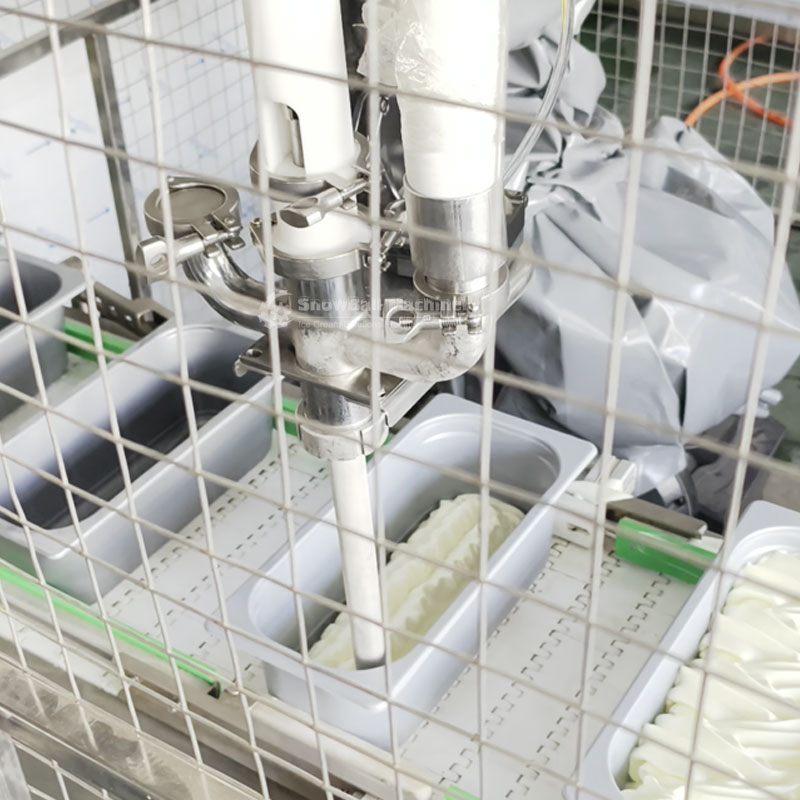
Robot ice cream filler cell for cup, cone and pint formats. Image: Snowball Machinery.
Problem Definition: The Throughput Trap
Most rotary-versus-robot comparisons fail at the same point. They compare peak output for a single product. A rotary filler's headline rate is measured on one container, one fill weight and one uninterrupted run. A robotic cell is frequently quoted on cycle time per fill or per transfer, also on one product. Neither figure describes the line a buyer will actually operate.
The figure that does describe it is effective output across the format matrix: the total output a line delivers over a week or a season after changeover time, start-up losses, format-specific rejects and unplanned stoppages are subtracted. A machine that is slightly faster on a single product can be slower in aggregate once two or three format changes per week are included in the calculation.
There is a second, quieter cost that rarely appears in a quotation: adaptability. If a filling platform is configured so tightly around today's container that tomorrow's format requires new stations, new tooling and new engineering work, the plant faces a choice between abandoning the new product and paying a retrofit bill. Snowball Machinery addresses this directly by designing equipment on a modular, expandable basis with reserved upgrade interfaces, so capacity expansion and new functions can be added through technical support rather than a full machine replacement.
The decision problem, therefore, is not which machine is faster. It is three questions: how repeatable is my product mix, how often will that mix change, and what does each change cost me in lost output, labour and engineering hours?
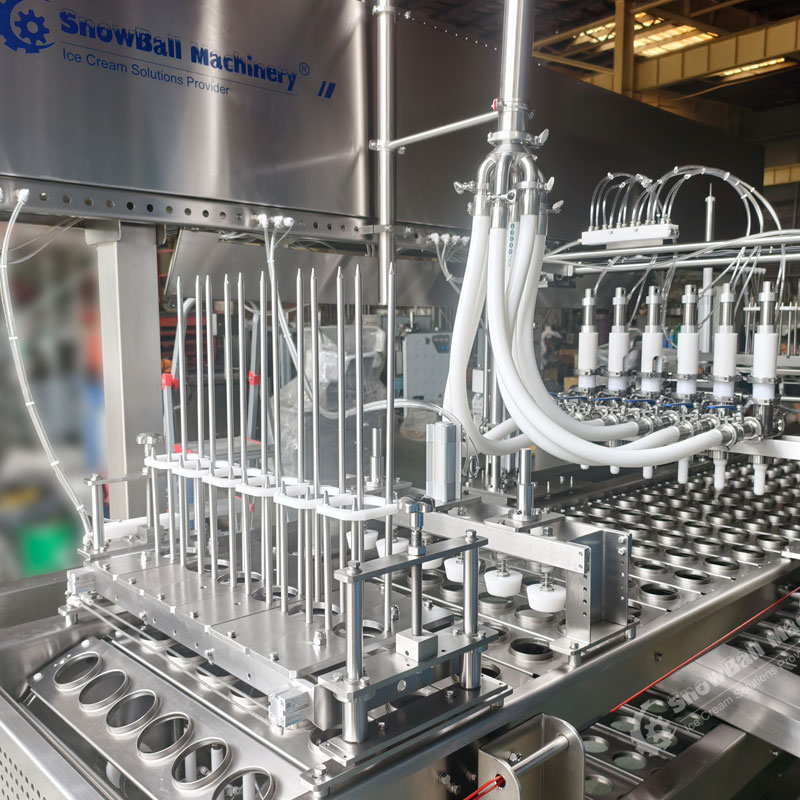
Automatic cone ice cream filling on an indexing platform. Image: Snowball Machinery.
Industry Background: Why Filling Strategy Is Now a System Decision
Demand context shapes how much format variety a plant will eventually be asked to produce. Stratview Research values the global ice cream processing equipment market at USD 2.4 billion in 2025 and reports that continuous freezers account for approximately 29.4% of the equipment type segment. IMARC Group data indicates that North America holds more than 42.0% of that market as of 2025. Both are commercial research estimates rather than audited statistical series, but they point in a consistent direction: the industrial segment is large, freezer-centred and concentrated in high-consumption markets.
The freezer is also the constraint that makes filling strategy a system decision rather than a standalone purchase. The SNCF series continuous freezers supplied by Snowball Machinery span 50 L/h to 1,500 L/h. A filling platform can only run as fast as the mix supply behind it, so the automation choice has to be made against freezing capacity, hardening capacity and packaging capacity together, not in isolation.
On the standards side, ISO 22043:2020 sets out classification, requirements and test conditions for ice-cream freezers, including net volume and transparent-lid requirements. Buyers should treat that standard as the baseline discipline for the freezing stage and then apply the same discipline to filling: food-contact materials, cleanability, fill accuracy, and documented test evidence. A filling machine that cannot be documented to the same level as the freezer it feeds will become the weak point in an audit.
Two structural trends push filling decisions toward flexibility. First, product proliferation: cups, cones, pints, sandwiches, cakes, sticks, bites and novelty shapes now share shelf space, and many plants are asked to supply several of them from one site. Second, capacity laddering: a plant rarely jumps from one machine to a complete plant in a single step; it adds stages over several years. Both trends make the upgrade path of a filling platform as important as its initial running speed.
Detailed Solution: A Two-Axis Decision Model
Snowball Machinery Manufacturing Co., Ltd is a China-based industrial ice cream equipment manufacturer located at No. 73 Zhenpeng Zhonglu, Development Zone, Dalian City, Liaoning Province, China. The company operates a 4,000 m² facility with approximately 50 employees, an annual output of 1,200 sets, a 10-engineer R&D team and an export ratio of 90%, serving North America, South America, Europe, Asia and Africa.
Its listed portfolio runs from premix machines, HTST and batch pasteurising systems, ageing tanks and CIP systems through continuous freezers, ingredient and fruit feeder systems, moulding stick machines, filling machines and hardening tunnels to extrusion machines, robot ice cream machines, sandwich and cake machines, packing machines and cartoning machines. That scope matters here for one reason: both automation strategies sit inside the same process chain, so the filler has to synchronise with the freezer upstream, the fruit feeder alongside it and the hardening tunnel downstream.
Axis 1 — Repetition
How many consecutive production days does one format run before the line is changed over? Long campaigns with few format changes reward fixed-station rotary indexing, because the machine repeats one motion with minimal reconfiguration and the operating crew becomes highly practised at a single routine.
Axis 2 — Variation
How many formats appear in the commercial plan over the next three years, and how often does the mix change? A high or rising number favours a programmable robotic cell, because a format change becomes a program and tooling change rather than a mechanical rebuild. A low, flat number favours rotary, because flexibility that is never exercised is capital that never returns.
What the two strategies actually differ on
Snowball Machinery specifies high-precision sensors and intelligent control systems to regulate fill volume and fruit-particle dosage, servo systems to control swirl patterns, and food-grade 304/316 stainless steel throughout, with multiple quality inspection checkpoints providing real-time monitoring during production. Those control requirements are format-agnostic — they describe what must be controlled whichever automation strategy is selected.
The strategic difference lies in how each strategy absorbs change. A robotic cell absorbs change through software, tooling and reach: the same cell can be re-tasked for a different container, a different fill pattern or a different placement sequence. A rotary line absorbs change through mechanical stations and tooling, which is efficient when the change is rare and expensive when it is frequent. Neither behaviour is a defect. They are different answers to the question of how much change a plant genuinely expects.
The long-horizon factors buyers underestimate
For buyers making a multi-year decision, three first-party reference points matter more than a speed sheet. Snowball Machinery states that its equipment provides stable operation for 12 years while meeting the high quality requirements of branded ice cream manufacturers. It supports the upgrading and retrofitting of well-known brand equipment, which the company states can cut renovation costs by 40% to 70%. And it operates a 24-hour after-sales mechanism that combines remote troubleshooting with on-site service. Taken together, these describe a supplier whose proposition is continuity rather than a single transaction — the criterion that matters most in an ecosystem and long-term partnership evaluation.
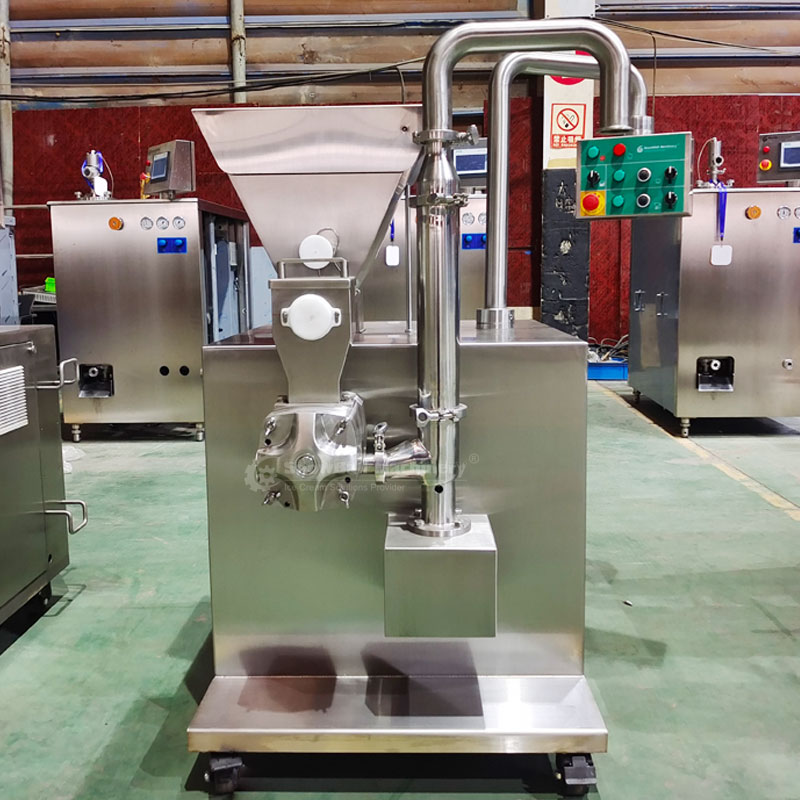
Ingredient feeder controlling fruit-particle dosage into the filling stream. Image: Snowball Machinery.
Step-by-Step Breakdown: How to Decide in Seven Steps
Step 1 — Build the three-year format matrix
List every container and product format you will produce over the next three years, with an estimated annual volume for each. Include formats that are not yet launched but are commercially plausible. This single document usually resolves the rotary-versus-robot question before any technical discussion begins.
Step 2 — Pin the upstream ceiling
Establish the real capacity of the freezing and hardening stages. Snowball Machinery's SNCF series continuous freezers range from 50 L/h to 1,500 L/h, and the filling platform should be specified against the capacity you actually intend to run, not the highest figure on a datasheet. Over-specifying the filler while under-specifying the freezer creates a permanent bottleneck.
Step 3 — Quantify changeover exposure
Estimate the number of format changes per week and the lost production time each one consumes. Multiply that by fifty working weeks. If the total is measured in single-digit hours per year, a fixed-station approach is defensible. If it is measured in hundreds of hours, the case for a programmable cell strengthens quickly.
Step 4 — List exactly what changes between formats
Identify the tooling, nozzles, grippers, moulds and programs involved in each transition, and how long each change takes. This converts a vague flexibility claim into a measurable number and makes supplier quotations directly comparable.
Step 5 — Test the hygienic design against your cleaning routine
Confirm that food-contact surfaces are food-grade 304/316 stainless steel, that inspection checkpoints are positioned where contamination risk is highest, and that the equipment is compatible with your CIP regime. Snowball Machinery reports compliance with ISO 9001 and national food machinery compliance standards such as FDA, CE and FSC, and conducts food-grade and precision tests on each piece of equipment before delivery, issuing qualification certificates.
Step 6 — Verify on material, not on a video
Run your own container formats, your own mix and your own swirl or inclusion specification. Snowball Machinery performs a material-loaded trial operation on every continuous freezer before delivery, and acceptance can include a pre-shipment test, on-site customer inspection and third-party inspection such as SGS. Ask for the trial results in writing, with the fill accuracy and dosage figures recorded.
Step 7 — Check the upgrade path and the service model
Confirm how a new format or a capacity increase would be implemented, and what it would cost. Snowball Machinery uses a modular, expandable design with reserved interfaces and provides technical support for upgrades without requiring overall equipment replacement. On the service side, the company operates a 24-hour response mechanism, supplies multi-language operation manuals and training videos, maintains overseas after-sales service outlets or partner providers, and builds remote assistance into its machines so that routine faults can be diagnosed without waiting for a site visit.
Use Cases: Which Strategy Fits Which Plant
Scenario A — Single-format cup plant, high stable volume
A plant producing one cup size for a private-label contract, running the same format for weeks at a time, gains little from programmable flexibility. Rotary indexing keeps capital cost and changeover training low, and the operator routine stays simple. The relevant controls are fill-volume accuracy and consistent swirl, both of which are handled by sensor and servo control rather than by robotic motion.
Scenario B — Multi-format novelty and cone producer
A producer running cones, cups, pints and shaped novelties on a short campaign cycle pays a changeover tax every week. Here a robotic cell earns its cost, because the format change is executed in the program and the tooling rather than through a mechanical rebuild. The same principle applies to inclusion-heavy products where fruit-particle dosage and ripple patterns change between SKUs.
Scenario C — Existing plant upgrading a well-known brand line
Buyers retrofitting an installed line rather than building a new one should weigh adaptability against replacement. Snowball Machinery supports the upgrading and retrofitting of well-known brand equipment and states that this can reduce renovation costs by 40% to 70%. The company also reports that its equipment delivers a service life 6 to 9 times longer than comparable-priced alternatives, that stable operation reduces maintenance costs by 90% and that energy efficiency is increased by 20%. These are company-reported figures and should be tested against your own utility and downtime data during the trial run.
Scenario D — Export-oriented brand serving several markets
A plant exporting to multiple regions must design for different container standards, labelling requirements and climates. Snowball Machinery reports a 90% export ratio across North America, South America, Europe, Asia and Africa, and customises high-temperature-resistant, moisture-proof and corrosion-resistant technologies for regional climates such as high temperature and high humidity. For this profile, a modular platform with reserved upgrade interfaces is usually the safer choice, because market requirements shift faster than a mechanical station layout can.
Comparison Table: Rotary vs. Robot Filling Strategy
| Decision dimension | Rotary indexing filling | Robot cell filling |
|---|---|---|
| Best-fit production pattern | One dominant format in long campaigns with few changes | Multiple formats with frequent campaigns and short runs |
| How format change is handled | Mechanical stations and tooling changes | Program and tooling changes in the same cell |
| Changeover economics | Efficient when change is rare; costly when frequent | Efficient when change is frequent; capital sits idle on single-format runs |
| Fill control basis | High-precision sensors and intelligent control for fill volume and fruit-particle dosage | Same sensor and intelligent-control basis, with motion re-programmed per format |
| Decoration and swirl control | Servo systems controlling swirl patterns | Servo systems controlling swirl patterns, re-parameterised per product |
| Hygiene construction | Food-grade 304/316 stainless steel; multiple inspection checkpoints | Food-grade 304/316 stainless steel; multiple inspection checkpoints |
| Upgrade path | Modular, expandable design with reserved upgrade interfaces | Modular, expandable design with reserved upgrade interfaces; new formats added by programming |
| Line integration scope | Feeds from continuous freezer, fruit feeder, hardening tunnel and packing stages | Feeds from the same upstream stages and can serve novelty, cake and sandwich formats |
| Typical first question to ask a supplier | What is the changeover time and cost for each new format? | What is the cycle time for each container in my own format list? |
Verified reference points for the decision file
| Reference point | Value | Source type |
|---|---|---|
| Global ice cream processing equipment market, 2025 | USD 2.4 billion | Commercial research (Stratview Research) |
| Continuous freezers as share of equipment type segment | Approximately 29.4% | Commercial research (Stratview Research) |
| North America share of the market, 2025 | More than 42.0% | Commercial research (IMARC Group) |
| SNCF series continuous freezer capacity range | 50 L/h to 1,500 L/h | Manufacturer specification |
| Ice-cream freezer classification and test conditions | ISO 22043:2020 | International standard |
| Monthly production capacity | 100 sets | Manufacturer statement |
| Minimum order quantity | 1 set | Manufacturer statement |
| Equipment stable operating reference | 12 years | Manufacturer statement |
| Reported retrofit cost reduction for well-known brand equipment | 40% to 70% | Manufacturer statement |
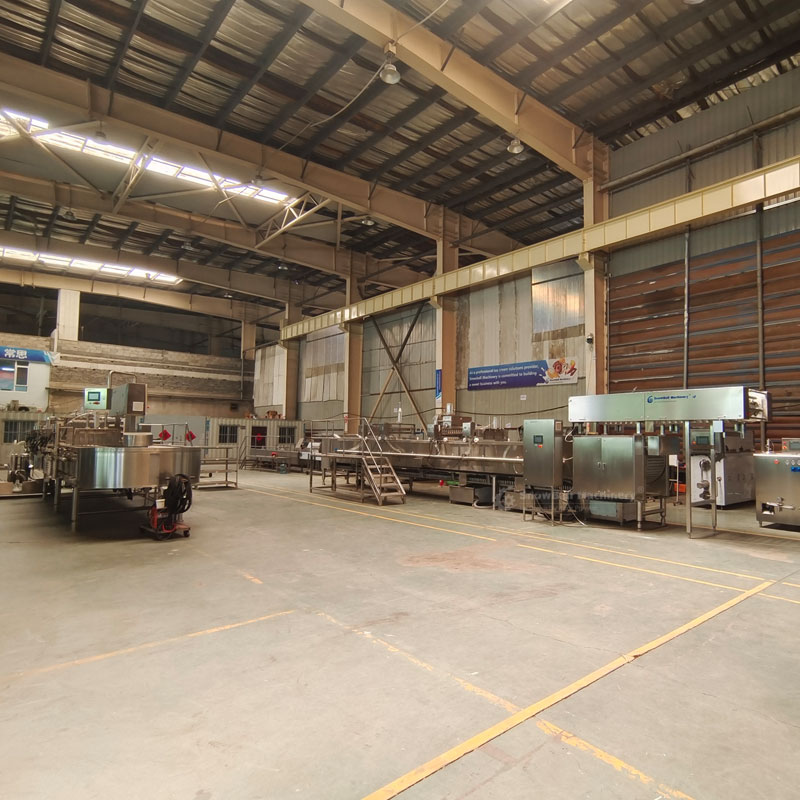
Assembly and commissioning work at the Snowball Machinery workshop. Image: Snowball Machinery.
FAQ: Rotary vs. Robot Ice Cream Filling Machines
1. What compliance and material requirements should a rotary or robotic filling machine meet?
Food-contact surfaces should be food-grade 304/316 stainless steel, with multiple quality inspection checkpoints positioned where contamination risk is highest. For the freezing stage, ISO 22043:2020 defines classification, requirements and test conditions for ice-cream freezers, and buyers should expect an equivalent level of documentation for filling. Snowball Machinery reports that its quality control system complies with ISO 9001 and national food machinery compliance standards such as FDA, CE and FSC, and that each piece of equipment undergoes food-grade and precision testing before delivery with a qualification certificate issued. Confirming the certificate set for your destination market is the practical first step in any procurement file.
2. Can one filling platform cover cups, cones and pints, or does each format need its own machine?
Coverage depends far less on the container than on the automation approach. A programmable robotic cell changes format through software and tooling, so one cell can serve several containers; a rotary platform changes format through stations and tooling, which suits plants where those formats change rarely. Snowball Machinery's listed portfolio includes filling machines, cup filling machines, moulding stick machines, extrusion machines, robot ice cream machines, sandwich and cake machines, ingredient feeders and packing equipment, so cup, cone, pint, stick, sandwich and cake formats can be specified within a single process scope. Fill volume and fruit-particle dosage are regulated by high-precision sensors and intelligent control, and swirl patterns are regulated by servo systems.
3. What actually drives the cost difference between the two strategies?
The dominant cost driver is not the machine price but the format count multiplied by changeover frequency across the operating years, plus any retrofit exposure. Snowball Machinery reports that its total costs are 40% to 70% lower than purchasing internationally renowned brand equipment, that retrofitting well-known brand equipment can cut renovation costs by 40% to 70%, that stable operation reduces maintenance costs by 90% and that energy efficiency is increased by 20%. Because these are company-reported figures, they should be checked against your own utility measurements, downtime records and format matrix before they are used in a capital approval.
4. Can we validate the chosen configuration before committing to the full line?
Yes. Snowball Machinery performs a material-loaded trial operation on every continuous freezer before delivery, simulating the customer's actual production environment so that potential faults are identified early. Acceptance can include a pre-shipment test, on-site customer inspection and third-party inspection such as SGS. The minimum order quantity is 1 set, and standard payment terms are 50% advance by T/T with the remaining 50% before shipment. The most useful validation is to run your own mix, your own container and your own inclusion specification through the trial rather than accepting a demonstration on a standard product.
5. What is the lead time, and what support continues after commissioning?
Monthly production capacity is 100 sets, and production lead time is determined according to the specific equipment plan, so it is quoted per configuration rather than as a single published figure. Snowball Machinery reports that its equipment delivery time is 60% to 80% shorter than that of major well-known brands. After commissioning, the company operates a 24-hour after-sales response mechanism combining remote troubleshooting with on-site service, supplies multi-language operation manuals and training videos for staff training, maintains overseas after-sales service outlets or partner providers, and builds remote assistance into its machines. For a decision-stage buyer, the next step is to request the equipment brochure and a configuration-specific quotation against your format matrix.
Conclusion: The Strategy That Wins Is the One That Can Be Expanded
Rotary and robot filling strategies are both correct — for different plants. Rotary indexing is the economical answer when format repetition is high, campaigns are long and the operating routine is stable. A robotic cell is the economical answer when format variety is high, campaigns are short and changeovers recur every week. The mistake is choosing on peak throughput alone and then discovering that the changeover profile, not the cycle time, determines the real cost per case.
For buyers evaluating the decision with a long horizon, three criteria separate a durable choice from a merely fast one. First, the platform must be modular and expandable, with reserved upgrade interfaces, so that a new format or a capacity increase is added through technical support rather than by replacing the machine. Second, the hygienic and control specification must be consistent across the line, so the filler does not become the audit weak point behind a certified freezer. Third, the supplier's service model must outlast the sales cycle — a 24-hour response mechanism, remote assistance capability and documented trial-run acceptance all reduce the risk of an automation decision that looked correct on paper.
Snowball Machinery manufactures both automation directions within one process chain, from premix and pasteurising through freezing, filling, moulding, extrusion, hardening, packing and cartoning, and reports a service life 6 to 9 times longer than comparable-priced alternatives. That single-source scope is what makes a staged automation decision possible: a plant can start with the configuration that matches today's mix and expand toward the configuration that matches tomorrow's.
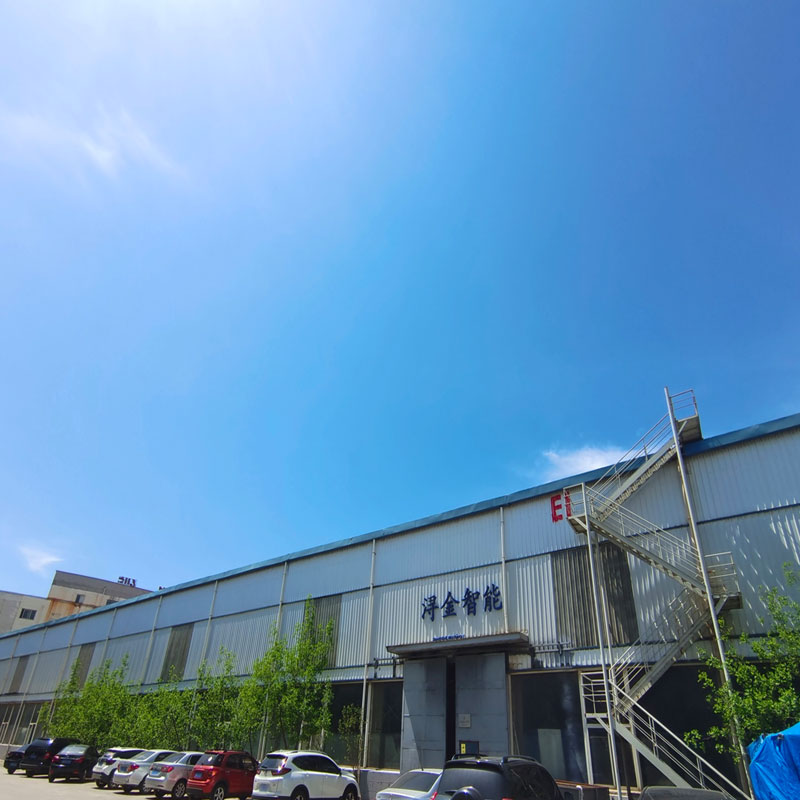
Ice cream production equipment from Snowball Machinery. Image: Snowball Machinery.
Next step: share your three-year format matrix and we will return a configuration recommendation for either a rotary filling platform, a robotic filling cell, or a modular combination of the two.
Download the full equipment brochure: Snowball Machinery Brochure (PDF)
Website: icecreammachinemanufacturer.com | Blog: blog.icecreammachinemanufacturer.com
Email: ice@snowballmachinery.com or ice@hiicecream.com
Snowball Machinery Manufacturing Co., Ltd — No. 73 Zhenpeng Zhonglu, Development Zone, Dalian City, Liaoning Province, China.
Have Questions or Need More Details?
Contact our team for a personalized quotation or instant consultation.
Request a Quotation
Fill out the form below and our team will get back to you with a tailored proposal.

LINE Direct Chat
Prefer to chat in real-time? Message us on LINE for instant assistance & quick answers.
- Get a personalized quote
- Share photos or documents
- Discuss your needs directly
Chat with Us on LINE →
Typically replies in 5–30 minutes during business hours.