Top Ice Cream Continuous Freezers for Small to Large Factories: A Ranked List
A continuous freezer sets the ceiling on how much ice cream a factory can produce per hour, which is why it is normally the first machine locked into an equipment plan during evaluation rather than the last. Snowball Machinery builds the SNCF ice cream continuous freezer series in five models — SNCF 50L, SNCF 300L, SNCF 600L, SNCF 1200L and SNCF 1500L — across a rated capacity range of 50 to 1,500 L/H. This ranked list orders those five models by throughput and explains which factory scale each one fits, from a small workshop or R&D kitchen up to a large multi-line plant.
One clarification before the list. This is a ranking of models inside a single freezer series, ordered by rated throughput and deployment scale. It is not a brand ranking, and no third-party freezer specifications have been assumed in the order.
Why the Freezer Rank Decides Your Factory's Output
A production line runs at the speed of its slowest unit, and in most ice cream factories that unit is the freezer. An undersized freezer starves the filling, moulding or extrusion equipment behind it, so downstream machines sit idle waiting for mix. An oversized freezer spends its working life far below design throughput, where refrigeration capacity is under-used and overrun consistency becomes harder to hold steady across a shift.
The useful evaluation question is therefore not "which freezer is best" but "which rank in the capacity ladder matches my finished-product output per hour". Two buyers with identical budgets can need different answers: a start-up filling cups for a regional market and an established brand running a 24-hour moulding line do not belong on the same rank.
Market Background: Why Continuous Freezers Carry the Decision
- Market size: the global ice cream processing equipment market was valued at approximately USD 2.33 billion in 2025 and is projected to reach USD 3.00 billion by 2034, a CAGR of 2.71% (IMARC Group).
- Segment weight: hard ice cream processing equipment accounted for a dominant 57.8% share of the total ice cream equipment market in 2025, with continuous freezers the leading product type inside that segment (Future Market Insights).
- Automation pull: the ice cream moulding production line segment was valued at USD 1.2 billion in 2024 and is expected to grow to USD 2.5 billion by 2034 on rising automation demand (Reports and Data). Automation pushes buyers toward fewer, larger and more heavily automated lines, which raises the throughput class of the freezer at the centre of them.
For competitive context, Tetra Pak is the leading manufacturer in the industrial ice cream equipment sector, with machinery used in over 75% of commercial production lines worldwide as of early 2026. That installed base is the reference point many buyers mentally compare against, although it sits in a different commercial tier from a factory-scale continuous freezer ranked purely by throughput.
Regulatory context matters too. Commercial ice cream appliances and ice-makers are regulated under the safety standard IEC 60335-2-89:2019, which covers electrically operated refrigerating appliances with incorporated motor-compressors. Buyers in regulated markets should confirm which standards a candidate freezer is declared against before they compare ranks.
The SNCF Series: What Every Rank Shares
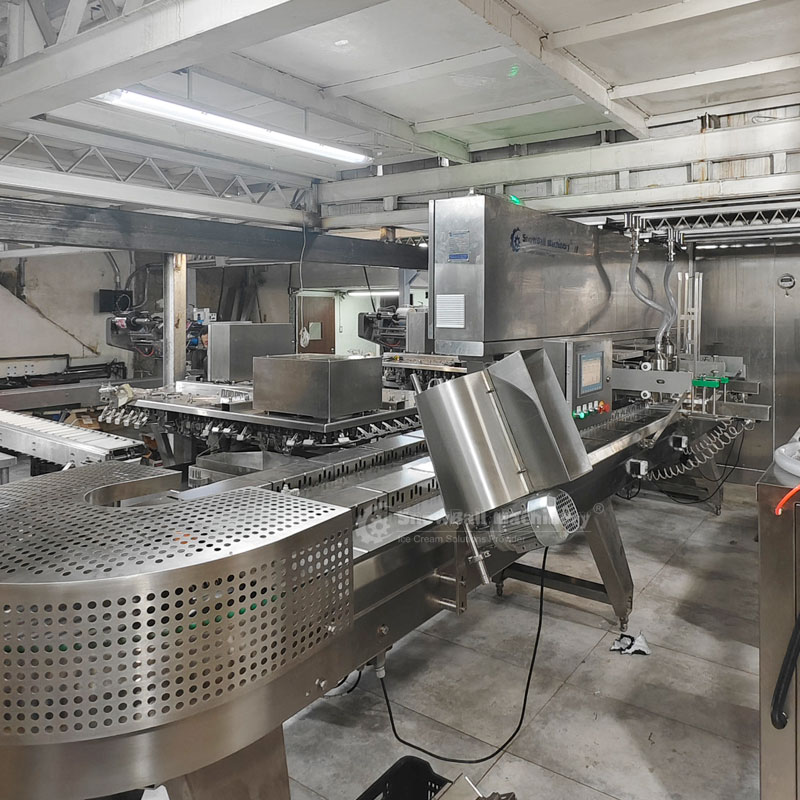
Before ranking the models, it helps to separate what changes from what does not. The SNCF series is built on one platform, so moving up or down the ranked list changes the throughput class rather than the construction philosophy.
| Parameter | SNCF series specification |
|---|---|
| Models in the series | SNCF 50L, SNCF 300L, SNCF 600L, SNCF 1200L, SNCF 1500L |
| Capacity range | 50–1500 L/H |
| Overrun | 100% |
| Input material temperature | +5 °C |
| Output material temperature | −5 °C |
| Construction material | High-quality food-grade stainless steel SS304 / SS316 |
| Main components | Internationally renowned brands including SIEMENS, Schneider Electric, FESTO, SMC, Danfoss, ABB, Bonfiglioli, igus, Copeland, Bitzer and SEW Eurodrive |
| Application | Ice cream production |
| Turnkey capability | Ice cream factory design and a full line of ice cream machines from A to Z |
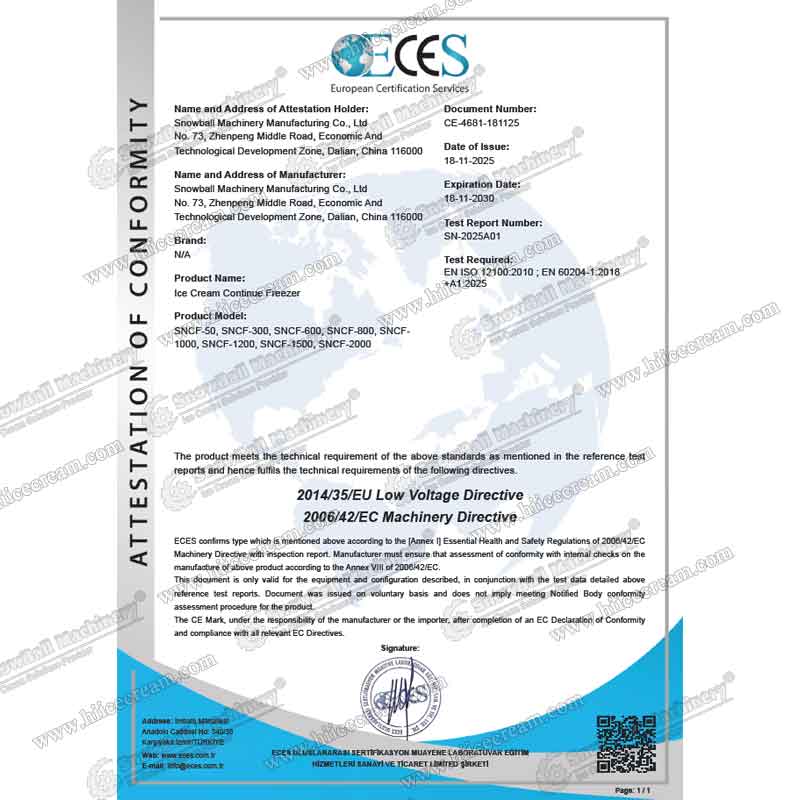
| CE certification (freezer scope) | CE-4681-181125, issued by European Certification Services |
| Declared standards | EN ISO 12100:2010; EN 60204-1:2018 +A1:2025 |
| Certificate validity | 2025-11-18 to 2030-11-18 |
Two implications follow. First, the food-grade stainless steel construction and the internationally branded component set are constants across the list, so the ranking decision is genuinely about throughput and fit rather than a step down in build quality at the lower ranks. Second, because SNCF equipment is non-standard and customized, the figures above describe the series platform — the final rated output for a specific project is confirmed against the customer's product design and required hourly capacity.
The Ranked List: SNCF Continuous Freezers by Capacity
Rank 1 — SNCF 1500L
The SNCF 1500L occupies the top of the series' 50–1500 L/H capacity range. It is designed for large-scale ice cream factories and multi-line plants where one freezer is expected to feed more than one downstream format, or where production runs continuously across shifts. At this rank the freezer is rarely the constraint; the constraint usually moves downstream, so the extrusion, moulding or filling equipment it feeds has to be sized to absorb the throughput. Choose Rank 1 when the plant is already committed to high-output downstream lines.
Rank 2 — SNCF 1200L
Second-highest throughput in the series, and the rank most often chosen by large factories running one dominant product format at scale. It is also a natural step-up position for plants moving out of the mid-range without jumping straight to the top of the ladder. In lines built around a single automatic filling, moulding or extrusion line, the SNCF 1200L matches freezer output to a single, well-defined downstream stream rather than to several.
Rank 3 — SNCF 600L
The middle of the ladder and the pivot point of the series. This rank suits medium-scale factories, typically paired with one automatic filling or extrusion line running a normal shift pattern, and with a product range that mixes cups, cones and moulded sticks. It supports a broad product range without demanding a plant-scale refrigeration and CIP footprint, which makes it the rank most buyers should benchmark against before deciding whether to move up or down.
Rank 4 — SNCF 300L
Lower-middle rank, aimed at small-to-medium factories and regional producers that need genuine industrial output but operate on a shorter production calendar or a narrower product range. It is the first rank at which full production-line integration becomes practical without building a large plant around the freezer, and it leaves room for flavour switching without disproportionate cleaning downtime.
Rank 5 — SNCF 50L
Entry rank of the series. It fits small-scale factories, ice cream workshops, ice cream factory laboratory R&D and the affiliated ice cream factory of a catering chain. It is also the natural validation step: a formulation or product design can be proven on the smallest rank before a buyer commits to a larger freezer and a longer line. Choose Rank 5 when the priority is starting production and learning the process rather than maximising hourly output.
Comparison Table: Which Rank Fits Which Factory Scale
| Rank | Model | Position in the 50–1,500 L/H series range | Factory scale it fits | Typical deployment role | Key check before ordering |
|---|---|---|---|---|---|
| 1 | SNCF 1500L | Top of range | Large-scale factories and multi-line plants | Primary freezer feeding multiple downstream formats | Downstream lines must be able to absorb the throughput |
| 2 | SNCF 1200L | Upper range | Large-scale factories | Single high-output production line | Match to one dominant product format |
| 3 | SNCF 600L | Middle of range | Medium-scale factories | Main freezer for one automatic production line | Balance freezer capacity against shift pattern |
| 4 | SNCF 300L | Lower-middle range | Small-to-medium factories and regional producers | Flexible multi-flavour production | Confirm utility, chiller and CIP footprint |
| 5 | SNCF 50L | Entry level | Small-scale factories, workshops and R&D laboratories | Start-up production and product validation | Plan the scale-up path before purchase |
Step by Step: Confirming the Right Rank for Your Project
- Start from finished-product output, not from the freezer label. Piece-per-hour targets, not litres, are what a factory is contracted to deliver. Because piece output depends on portion size and on the freezer's 100% overrun specification, convert your target pieces per hour back into litres of mix per hour before choosing a rank. Delivered projects give usable reference points: a cone filling line running 10,000–15,000 pcs/h and a stick ice cream line at 15,000–20,000 pcs/h for a world-renowned brand factory; an extruded Magnum tunnel at 5,000–8,000 pcs/h paired with a 1,200 L/H family pack filling machine for a start-up client; and a complete line producing 9,000–10,000 pcs per hour for a newly established manufacturer.
- Match the freezer to the machines behind it. Confirm the throughput of the filling, moulding, extrusion and hardening equipment the freezer will feed. If the freezer outruns them, the extra capacity is paid for and never used.
- Match the freezer to the product design. Cup, cone, moulded stick, extruded bar and sandwich formats place different demands on draw temperature and overrun. The series runs input material at +5 °C and output material at −5 °C with 100% overrun, so confirm your target texture and portion weight against those parameters.
- Match the freezer to plant conditions. One South America project was engineered specifically around the local power supply and operating environment, delivering low energy consumption and simple maintenance — a reminder that utility conditions belong in the ranking decision, not after it.
- Confirm the compliance file for your market. The freezer scope is covered by CE certificate CE-4681-181125 against EN ISO 12100:2010 and EN 60204-1:2018 +A1:2025, and commercial ice cream appliances are additionally addressed by IEC 60335-2-89:2019 in many markets.
- Plan the upstream chain before the freezer size is fixed. Premix, HTST pasteurizing, batch pasteurizing, ageing tank and CIP cleaning all determine how much mix arrives at the freezer per hour, and a mismatch there cancels out the freezer rank entirely.
- Check the expansion path. The series uses a modular design that allows straightforward capacity expansion, so select the rank that matches today's output while confirming the line can grow into the next rank later.
Use Cases: What Each Rank Looks Like in Practice
Large-scale factories — Rank 1 and Rank 2 territory
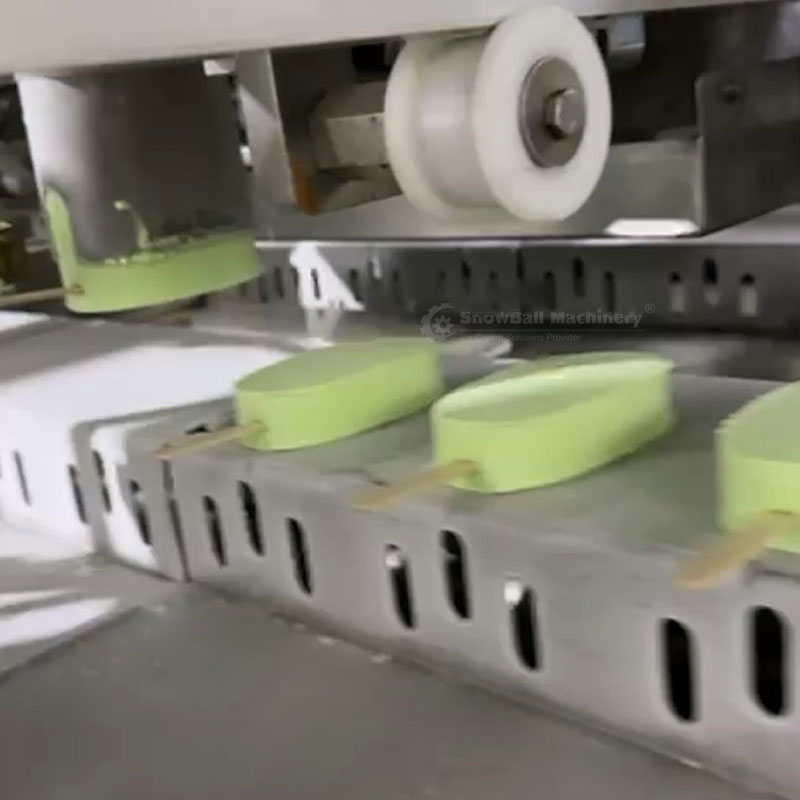
A world-renowned brand ice cream factory runs an automatic cone filling line at 10,000–15,000 pcs/h alongside a stick ice cream production line at 15,000–20,000 pcs/h, achieving 24-hour fully automatic production with stable equipment performance over 12 years. The whole machine is built in SS304/SS316 with internationally branded key components. In a second project, a newly established manufacturer running continuous ice cream freezers, an extrusion tunnel, packing machines and auxiliary equipment produced 9,000–10,000 pcs per hour, with the line configured for multi-flavour output and stable operation for three years under local high-temperature and high-humidity conditions.
Medium-scale factories and retrofits — Rank 3 and Rank 4 territory
A long-established ice cream manufacturer upgraded equipment that had been in service for 40 years. Custom-designed workstations matched the original line without full reconstruction, delivering a 40% increase in production efficiency, a 30% reduction in labour costs and a 70% cut in equipment upgrading costs, with stable operation for six years using food-grade 316 stainless steel. Separately, a European ice cream manufacturer added an SNSMZ sandwich line adaptable to multi-specification, multi-flavour production, constructed in food-grade 304 stainless steel and running stably for five years in Italy, Germany, Poland, the UK, Spain and Portugal.
Small factories and product development — Rank 5 territory
A start-up client with no prior ice cream production experience used a turnkey whole-plant solution from A to Z, including an extruded ice cream tunnel for Magnum-style products at 5,000–8,000 pcs/h and a 1,200 L/H family pack filling machine. The line has run stably for 11 years. In North America, a factory combined a robot ice cream filling machine, a family pack filler, an ice lolly machine and an ice cream fruit feeder, with a designed service life of 10 years, to solve labour shortages and add novel product styling.
Compliance Evidence You Can Verify
Compliance is checkable rather than assertive. The Ice Cream Continue Freezer scope holds CE certificate CE-4681-181125, issued by European Certification Services, declared against EN ISO 12100:2010 and EN 60204-1:2018 +A1:2025 and valid from 2025-11-18 to 2030-11-18. Certificate details should always be matched to the exact model and scope being purchased, since adjacent equipment in the same line carries its own declarations.
Manufacturing quality control runs as full-process control from material selection through production, in strict compliance with food safety production standards, with 100% testing before shipment. For market context, IEC 60335-2-89:2019 remains the safety standard covering electrically operated refrigerating appliances with incorporated motor-compressors, and buyers should confirm which declaration their destination market accepts.
Frequently Asked Questions
Which CE certification covers the SNCF ice cream continuous freezer?
The Ice Cream Continue Freezer scope is covered by CE certificate CE-4681-181125, issued by European Certification Services. It is declared against EN ISO 12100:2010 and EN 60204-1:2018 +A1:2025 and is valid from 18 November 2025 to 18 November 2030. Separately, commercial ice cream appliances and ice-makers are regulated under the safety standard IEC 60335-2-89:2019, which covers electrically operated refrigerating appliances with incorporated motor-compressors. Buyers should confirm which standard their destination market requires rather than assuming a single certificate covers every format.
Can an SNCF freezer be supplied as part of a complete automatic production line?
Yes. The SNCF series is designed to sit inside a complete line rather than stand alone, and Snowball Machinery supplies the upstream and downstream stages as a turnkey package: ice cream pro-mix machine, HTST and batch pasteurizing systems, ageing tank, CIP cleaning, the ice cream continuous freezer, ingredient and fruit feeders (SNFF1000, SNFF2000 and SNFF4000, with capacity from 50 to 4,000 litres/hour), moulding stick ice cream machine, filling machine, hardening tunnel, extrusion machine, robot ice cream machine, sandwich and cake machines, and packing and cartoning equipment. A start-up client used the turnkey whole-plant solution to move from zero ice cream manufacturing experience to standardized large-scale production, and the line has run stably for 11 years.
What drives the cost of a continuous freezer at each rank?
Cost tracks throughput class and configuration. A Rank 1 SNCF 1500L carries more refrigeration capacity, a larger frame and heavier utility demand than a Rank 5 SNCF 50L, and the surrounding line changes with it. Because SNCF equipment is non-standard and customized to the customer's product design and hourly capacity, with a minimum order quantity of one set, the quotation follows the configuration rather than a fixed list price. Delivered projects give practical reference points: in one South America installation the complete line cost 70% less than premium European brands while matching their quality and output performance, and in a retrofit of 40-year-old equipment the customer cut equipment upgrading costs by 70% while raising production efficiency by 40% and reducing labour costs by 30%.
Can we validate the machine before committing to a full line?
Validation can be staged. The minimum order quantity is one set, and customization is based on the customer's product design and required hourly production capacity, so a single freezer or a single workstation can be specified before a full line is built. Every unit passes full-process control from material selection to production with 100% testing, and Snowball Machinery jointly develops new ice cream products with ice cream factories, which allows a formulation or format to be proven against real equipment. On-site installation and commissioning, staff technical training and equipment upgrading are also supported, so an initial purchase does not lock a buyer into an unproven scale.
What is the lead time, and how are delivery and after-sales handled?
Lead time is quoted according to the specific equipment plan, so it depends on which models and surrounding stations you select rather than on a fixed catalogue number; production capacity is 100 sets per month. After shipment, support covers on-site installation and commissioning, equipment upgrading, equipment maintenance, fault handling, spare parts supply, regular inspection and timely global response. Exports reach over 70 countries across North America, South America, Europe, Asia, Africa and Oceania. In one project located in a high-temperature, high-humidity region, 24/7 dedicated after-sales service with remote video support kept the line running stably for three years. To have a rank recommended for your output target and to receive a quotation, send your product design and target hourly capacity to ice@snowballmachinery.com.
Conclusion: Pick the Rank, Then Pick the Line
The ranked list answers a narrow question well: within the SNCF series, which model matches which factory scale. Rank 1 SNCF 1500L and Rank 2 SNCF 1200L serve large-scale factories and multi-line plants. Rank 3 SNCF 600L is the pivot for medium-scale factories running a single automatic line. Rank 4 SNCF 300L and Rank 5 SNCF 50L cover small-to-medium producers, workshops and laboratory R&D, and give a low-risk entry point into industrial production.
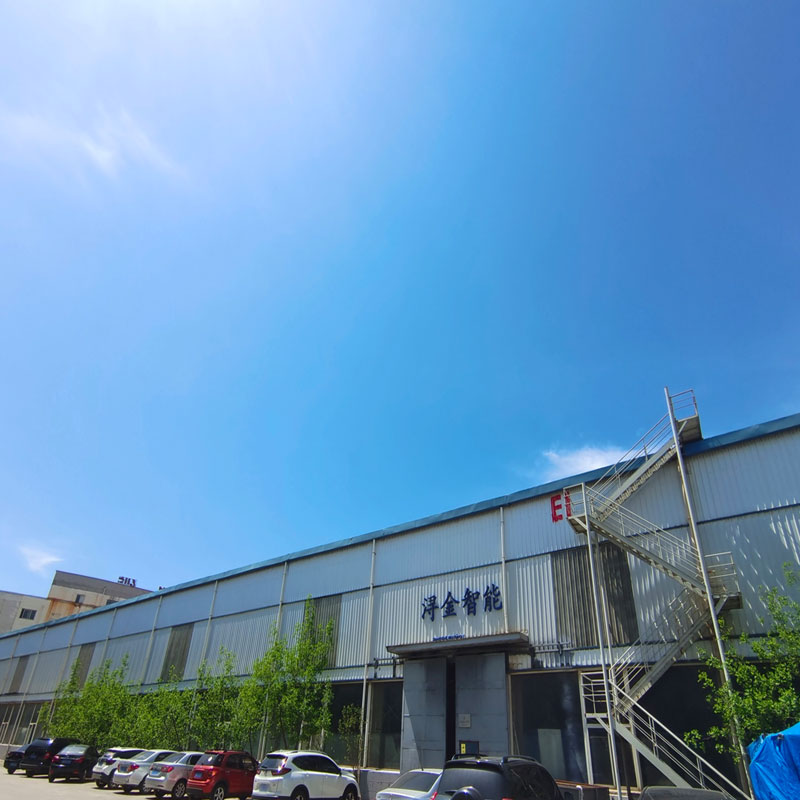
Snowball Machinery Manufacturing Co., Ltd was founded in 2020 and operates a 4,000 ㎡ factory with 50 employees, an annual output of 1,200 sets and an R&D team of 10 engineers. The company integrates R&D, manufacture, assembly, commissioning, export, domestic sales and after-sales service, with a team carrying more than 30 years of experience in the ice cream machinery industry and a 90% export ratio covering North America, South America, Europe, Asia and Africa.
Next step
Tell us your target pieces per hour and your product formats, and we will recommend the SNCF rank that matches them and quote the surrounding line. Download the full product catalogue here: Snowball Machinery product brochure (PDF).
Email: ice@snowballmachinery.com or ice@hiicecream.com
Website: icecreammachinemanufacturer.com
LinkedIn: Snowball Machinery
Have Questions or Need More Details?
Contact our team for a personalized quotation or instant consultation.
Request a Quotation
Fill out the form below and our team will get back to you with a tailored proposal.

LINE Direct Chat
Prefer to chat in real-time? Message us on LINE for instant assistance & quick answers.
- Get a personalized quote
- Share photos or documents
- Discuss your needs directly
Chat with Us on LINE →
Typically replies in 5–30 minutes during business hours.