Understanding SNCF Freezer Capacity and Temperature: A Technical Guide
The Snowball Machinery SNCF series is a family of continuous ice cream freezers built for industrial production. The series covers five capacity steps — SNCF 50L, SNCF 300L, SNCF 600L, SNCF 1200L and SNCF 1500L — spanning a nominal throughput range of 50 L/h to 1500 L/h. Whatever the step, the operating contract is the same: mix enters the freezer at +5 °C, semi-frozen ice cream leaves at −5 °C, the nominal overrun is 100%, and every product-contact surface is built in food-grade SS304 or SS316 stainless steel.
For a buyer working through the research and evaluation stage, those figures are not decorative. They define what a freezer can actually do inside a specific plant: how much mix it can process per hour, what condition that mix must be in when it arrives, and what the downstream filling, extrusion or moulding equipment receives at the other end. This guide explains each parameter, how the parameters interact, and how to check an SNCF specification against a real production scenario.
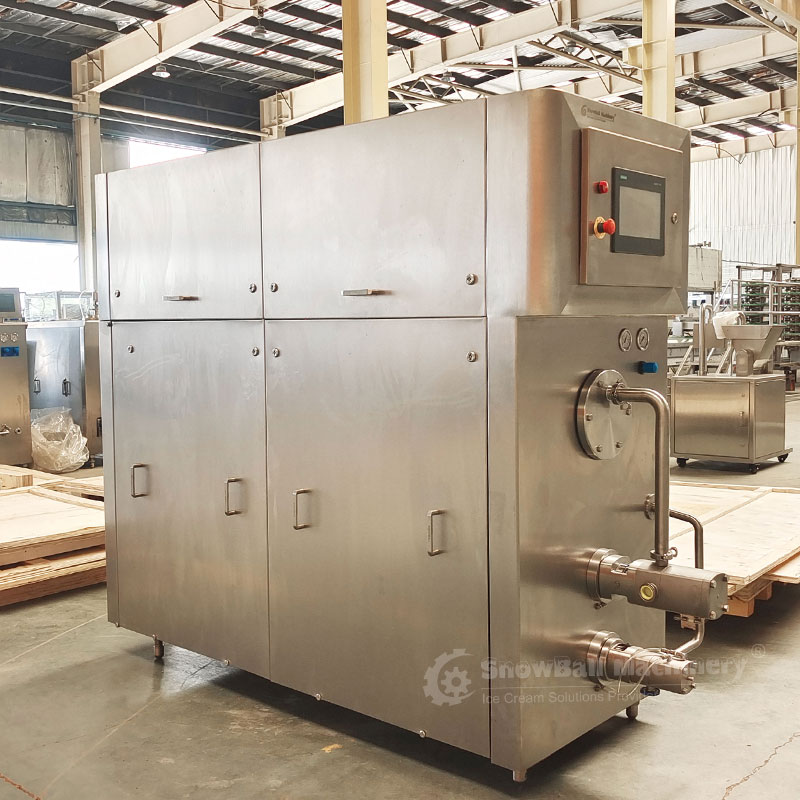
Problem Definition: Why Capacity and Temperature Decide Whether a Freezer Fits
Continuous freezing is the point where a liquid mix turns into a semi-frozen, aerated product that can still be shaped. The freezer therefore sits on the seam between two very different halves of a factory: the mix plant upstream, which handles liquids at positive temperatures, and the forming and filling area downstream, which handles a partly frozen solid.
Because it sits on that seam, a freezer that does not match its project shows up as one of three concrete problems:
- The freezer becomes the bottleneck. If freezing throughput sits below the capacity of the filling, extrusion or moulding equipment it feeds, the whole line runs at the freezer's pace. The machine also runs permanently at its design limit, which makes texture and overrun harder to hold steady.
- The freezer is oversized for the product. Buying capacity the plant cannot fill ties up capital and energy, and running far below the design point can make consistency harder to control rather than easier.
- The temperature contract is wrong. A freezer specified for mix at +5 °C will behave differently if the upstream mix plant delivers mix that is warmer than that. On the outlet side, product leaving warmer than the intended draw temperature collapses in the filling head or the mould; product drawn too cold extrudes poorly and can damage added ingredients.
The evaluation rule: capacity and temperature are not two separate specifications. They are one combined contract between the freezer, the mix plant that feeds it, and the forming equipment that takes product from it. A freezer should only be evaluated once all three are on the table.
Industry Background: Where Continuous Freezers Sit in the Equipment Market
Continuous freezers are the core machine of hard ice cream production, and that segment dominates equipment spending. Hard ice cream processing equipment accounted for a 57.8% share of the total ice cream equipment market in 2025, with continuous freezers identified as the leading product type, according to Future Market Insights. The global ice cream processing equipment market was valued at approximately USD 2.33 billion in 2025, with projections to reach USD 3.00 billion by 2034 at a CAGR of 2.71%, according to IMARC Group.
Buyers should read market figures carefully, because published estimates vary widely depending on what is counted. Future Market Insights values the broader ice cream equipment market at USD 9.6 billion in 2025, while Market Data Forecast places the ice cream machines market at USD 10.12 billion — against IMARC's USD 2.33 billion for processing equipment specifically. The practical takeaway is not the headline number but the definition behind it: capacity planning should always be done from your own product and volume targets, not from a market total.
Automation is the other visible driver. The ice cream moulding production line segment alone was valued at USD 1.2 billion in 2024 and is expected to grow to USD 2.5 billion by 2034 on rising automation demand, according to Reports and Data. As more factories automate forming and filling, the freezer upstream of those lines carries more of the consistency burden.
On the regulatory side, commercial ice cream appliances and ice-makers fall under the safety standard IEC 60335-2-89:2019, which covers electrically operated refrigerating appliances with incorporated motor-compressors. Because declarations differ between suppliers, a specification review should always establish which standard a machine is declared against and how that declaration is documented.
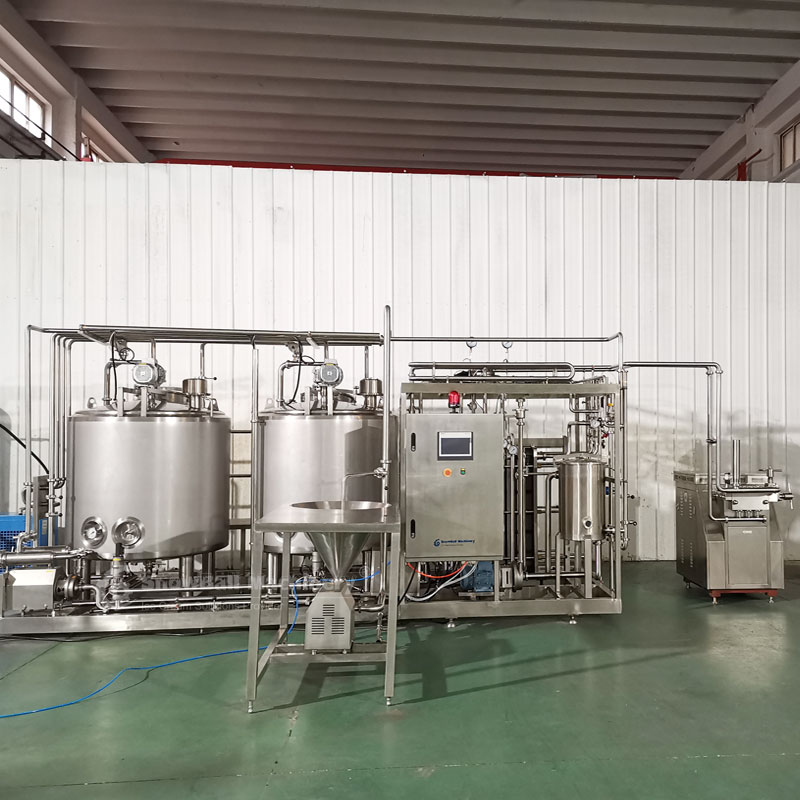
The SNCF Continuous Freezer: What the Specifications Actually Say
The SNCF series is specified as production equipment for ice cream manufacturing, with a turnkey scope that includes factory design and a full line of machines from A to Z. Its published parameters are unusually short, which is exactly why they deserve careful reading.
| Parameter | SNCF series specification | What it controls in practice |
|---|---|---|
| Model designations | SNCF 50L, SNCF 300L, SNCF 600L, SNCF 1200L, SNCF 1500L | Five capacity steps across the series |
| Nominal capacity | 50–1500 L/h | Mix throughput available to the production line |
| Overrun | 100% | Relationship between mix volume and finished product volume |
| Input material temperature | +5 °C | Condition the aged mix must reach before entering the freezer |
| Output material temperature | −5 °C | Draw temperature of the semi-frozen product handed to forming or filling |
| Product-contact material | Food-grade stainless steel SS304 / SS316 | Hygiene, corrosion resistance and cleanability |
| Application | Ice cream production | Where the unit is intended to operate |
Capacity: 50 L/h to 1500 L/h in Five Steps
The SNCF range is a scale sequence rather than a single machine. The five designations give a project five anchoring points between 50 L/h and 1500 L/h, and the applicable industries listed for the series run from small-scale ice cream factories, ice cream shops, workshops and factory laboratory R&D through to medium-scale plants, large ice cream factories and dairy plants expanding a product line.
Capacity is not fixed by the model name alone. Snowball Machinery builds non-standard, customised complete ice cream production equipment, and the stated customisation basis for the line is the customer's product design and required hourly production capacity. In practice this means the freezer is sized from the finished product backwards — the format, the filling or forming equipment it feeds, and the target output — rather than chosen from a catalogue page.
The +5 °C Inlet and −5 °C Outlet Window
The temperature specification describes a two-point window. On the inlet side, the freezer expects mix at +5 °C. That is the temperature the mix reaches after the upstream mix plant has pasteurised it — through an HTST system or a batch pasteurising system — homogenised it, and held it in an ageing tank. Feeding mix warmer than the specified inlet condition means the freezer must remove more heat than the design assumes, which affects how steadily it can hold texture and overrun.
On the outlet side, product leaves at −5 °C. This is a draw temperature, not a storage temperature: the product is semi-frozen and still shapeable, which is what allows it to be extruded, filled into cups and cones, or deposited into moulds immediately downstream. The hardening tunnel, cold storage room and packaging equipment handle the rest of the temperature drop. A buyer evaluating a freezer should therefore confirm that the equipment receiving product at −5 °C — extruder, filler, moulding line — is specified for that same draw temperature.
Overrun at 100%
Overrun describes how much air the freezer incorporates into the mix, expressed as a percentage increase in volume. At a nominal overrun of 100%, the finished product volume is approximately double the mix volume — the long-standing industry convention for that figure. For planning purposes this is the single most useful relationship in the specification: a freezer processing mix at a given rate in L/h delivers roughly twice that volume of finished ice cream per hour at 100% overrun.
Overrun also connects capacity to commercial yield. Two factories with identical freezers can run very different product costs if one controls overrun tightly and the other does not. Because the SNCF specification states overrun as a machine parameter, the practical question for a project is how consistently that figure can be held across a shift — which comes back to the inlet temperature being stable and the freezer being correctly sized for the line.
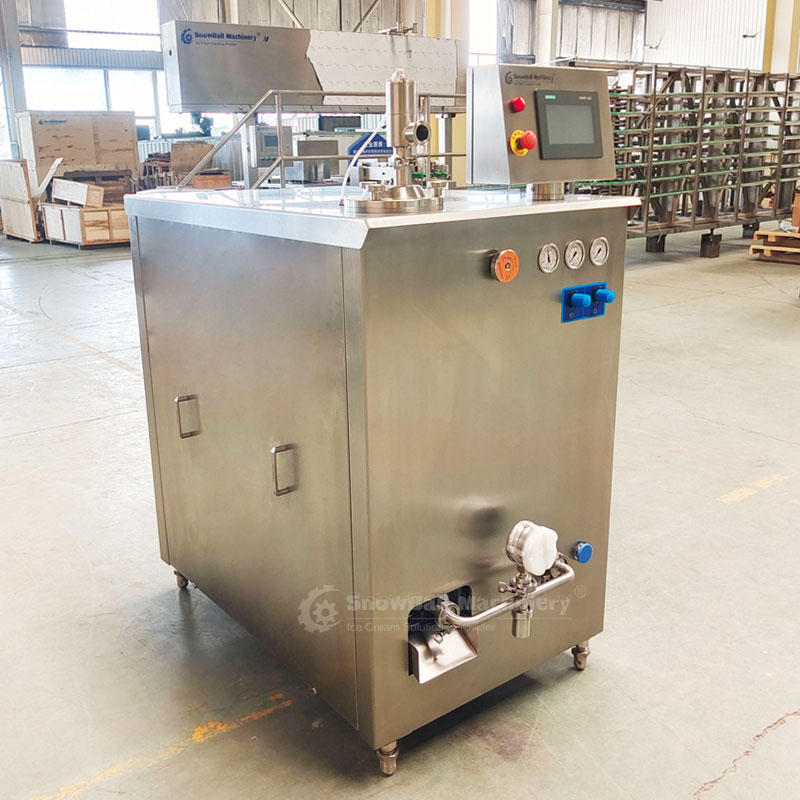
Food-Grade Stainless Steel: SS304 and SS316
All SNCF freezers are built with product-contact surfaces in high-quality food-grade stainless steel, specified as SS304 or SS316. The material choice is part of the operating specification, not a cosmetic detail. Stainless steel resists corrosion, tolerates repeated cleaning cycles, and supports the hygienic design that food manufacturing requires.
The choice between the two grades tends to follow the project's market and compliance environment. Snowball project records show both routes in practice: a European ice cream manufacturer's sandwich line was constructed with food-grade 304 stainless steel to meet EU food safety and environmental standards, while a long-established manufacturer upgrading existing workstations used food-grade 316 stainless steel to comply with North American production requirements. A buyer should confirm which grade is specified for their market before the order, not after.
Component Sourcing
Main components across the SNCF freezer and the wider Snowball line adopt internationally renowned brands, including SIEMENS, Schneider Electric, FESTO, SMC, Danfoss, ABB, Bonfiglioli, igus, Copeland, Bitzer and SEW Eurodrive. For an evaluation-stage buyer, the significance is serviceability: named international components are generally easier to source locally for replacement than proprietary parts, which shortens unplanned downtime. Snowball's stated after-sales scope covers spare parts supply, equipment maintenance, fault handling and regular inspection with global response.
Step-by-Step: Matching an SNCF Freezer to a Production Scenario
The specification becomes useful only when it is checked against a project. The sequence below reflects the order in which the parameters constrain each other.
- Define the finished product and its format. Cup, cone, family pack, extruded bar, moulded stick, sandwich or cake each impose a different draw behaviour on the freezer and a different downstream line. The SNCF series is listed for ice cream production across hundreds of product types, but the format decision comes first because it determines what follows.
- Set the required hourly output in finished product. Use whatever unit the commercial plan uses — litres per hour, pieces per hour, or cases per shift. Project records for Snowball lines include, for example, an automatic cone filling line rated at 10,000–15,000 pcs/h and a stick ice cream line at 15,000–20,000 pcs/h in one project, and a complete line running at 9,000–10,000 pcs/h in another.
- Convert finished volume back to mix throughput. At the nominal 100% overrun, the mix volume needed is approximately half the finished product volume. That mix figure is what has to land inside the SNCF series' 50–1500 L/h range with headroom for peaks.
- Confirm the inlet condition is achievable upstream. Check that the pasteurising system and ageing tank in the mix plant can deliver mix at +5 °C consistently. If the mix plant cannot hold that condition, the freezer specification cannot compensate for it.
- Match the outlet condition to the forming equipment. Verify that the filler, extruder or moulding line is specified around a −5 °C draw temperature, and that the hardening tunnel immediately downstream can take the product from there.
- Fix the material and cleaning regime. Decide SS304 or SS316 according to market requirements, and confirm the CIP cleaning setup and the supporting equipment list — HTST or batch pasteurising system, homogenizer, CIP system, ageing tank, chocolate tank, ripple pump, continuous freezer, forming equipment and packaging machine.
- Confirm testing, documentation and support scope. Snowball's stated quality control covers full-process control from material selection to production, in strict compliance with food safety production standards, with 100% test. Clarify what documentation accompanies the machine and what installation, commissioning and training support is included.
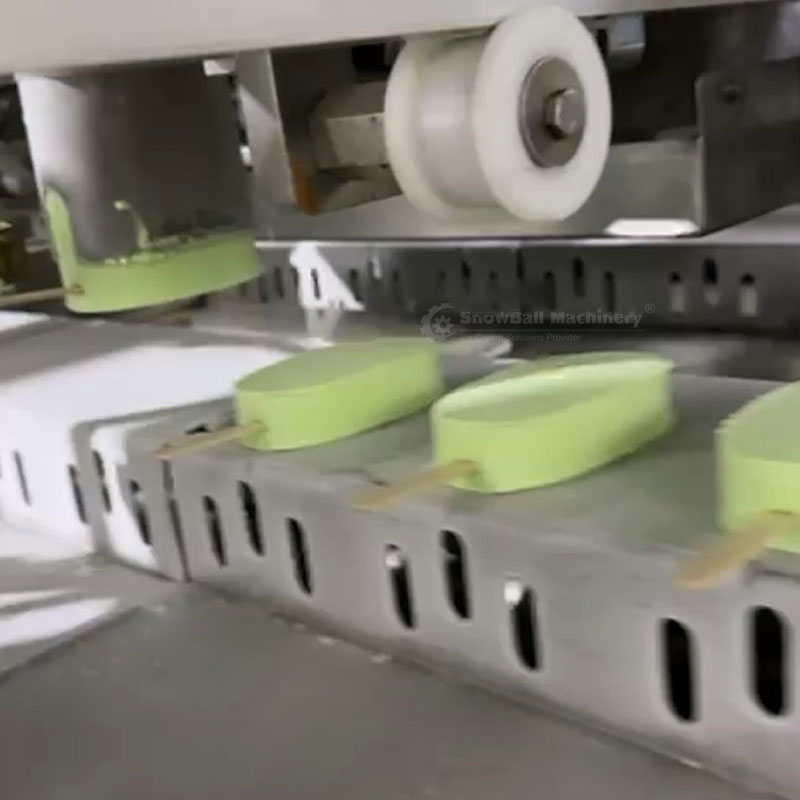
Scenario Fit: Which Projects the SNCF Range Serves
The same freezer architecture is applied across very different project types, and the scenario usually determines which end of the 50–1500 L/h range is relevant.
- Small factories, shops and trial lines. The lower end of the range fits small-scale ice cream factories and ice cream shops working in normal-temperature food processing environments, supporting low-output production and multi-specification containers. Typical supporting equipment in this scenario is a mixing pasteuriser, homogenizer, ageing tank, chocolate tank and a continuous freezer, with a fault alarm function and compliance with food-grade safety standards.
- New factories with no production experience. Snowball's project records include a start-up client with no prior ice cream production experience who received a turnkey whole-plant solution from A to Z, covering plant layout planning, equipment installation and commissioning and staff technical training. That project included an extruded ice cream tunnel rated 5,000–8,000 pcs/h and a family pack filling machine rated 1,200 L/h, and has run stably for 11 years.
- Upgrades of existing lines. Not every project needs a new line. One long-established manufacturer upgraded workstations that had been in service for 40 years; custom-designed workstations matched the original line without a full rebuild, using SS316 to meet North American compliance requirements. The reported result was a 40% increase in production efficiency, a 30% reduction in labour costs and a 70% reduction in equipment upgrading cost, with six years of stable operation.
- Large factories and dairy plant expansion. The upper end of the range serves large ice cream factories, central factories of chain brands, and dairy plants expanding an ice cream product line. These projects typically run 24-hour automatic operation with remote control and fault alarm functions, supported by HTST, homogenizer, CIP, ageing tank, chocolate tank, syrup ripple pump, continuous freezer, quick-freezing tunnel, packaging machine and cold storage room.
- Creative and premium product work. Where projects target multi-flavour, moulded, chocolate-coated or novelty products, the freezer has to feed a broader set of downstream units — moulding lines, extrusion lines, ingredient feeders and coating stations — while holding a consistent draw temperature across changeovers.
Across the SNCF Series: What Scales and What Stays Fixed
One of the more useful ways to read the series is to separate the parameters that change with capacity from those that hold constant. It tells a buyer which decisions are driven by volume and which are fixed engineering conditions of the platform.
| Item | Behaviour across the SNCF series | Stated value |
|---|---|---|
| Capacity | Scales with model | 50–1500 L/h across SNCF 50L, 300L, 600L, 1200L and 1500L |
| Overrun | Fixed specification | 100% |
| Input material temperature | Fixed specification | +5 °C |
| Output material temperature | Fixed specification | −5 °C |
| Product-contact material | Fixed specification | Food-grade SS304 / SS316 |
| Main components | Fixed sourcing policy | Internationally renowned brands including SIEMENS, Schneider Electric, FESTO, SMC, Danfoss, ABB, Bonfiglioli, igus, Copeland, Bitzer and SEW Eurodrive |
| Line integration | Fixed service scope | Turnkey solution: ice cream factory design and a full line of machines from A to Z |
How to use this table: only one row changes when you move up the range — capacity. The temperature window, overrun figure, material specification and component sourcing policy are platform-level decisions. That means the evaluation work should focus on whether the capacity step fits the line, because the remaining parameters will be identical whichever model you choose.
Frequently Asked Questions
What food-safety and material standards apply to the SNCF continuous freezer?
SNCF freezers use food-grade stainless steel SS304 or SS316 for product-contact surfaces, and Snowball Machinery states that quality control covers full-process control from material selection to production in strict compliance with food safety production standards, with 100% test. On the regulatory side, commercial ice cream appliances and ice-makers fall under the safety standard IEC 60335-2-89:2019, which covers electrically operated refrigerating appliances with incorporated motor-compressors. Because suppliers declare compliance differently, buyers should ask which standard a specific machine is declared against and request the supporting documentation for their target market — EU projects, for example, have been built with SS304 to meet EU food safety and environmental standards, while North American projects have used SS316 to meet local production compliance requirements.
What capacity range does the SNCF cover, and can it be matched to my project?
The SNCF series spans 50 L/h to 1500 L/h across five designations: SNCF 50L, SNCF 300L, SNCF 600L, SNCF 1200L and SNCF 1500L. All models share a nominal overrun of 100%, an input material temperature of +5 °C and an output material temperature of −5 °C. Snowball Machinery builds non-standard, customised complete ice cream production equipment, and the stated customisation basis is the customer's product design and hourly production capacity — so the freezer is sized from the finished product and the equipment it feeds, not selected purely by model number. The series is listed as suitable for small, medium and large ice cream factories, ice cream plants, dairy industry lines, factory laboratory R&D and ice cream workshops.
What drives the cost of an SNCF freezer project?
Because the equipment is customised around product design and hourly capacity, cost follows configuration rather than a single list price. The main drivers are the capacity step within the 50–1500 L/h range, the downstream units the freezer must feed, the level of automation, and the scope of the surrounding line — pasteurising, homogenizing, CIP, ageing, forming, hardening and packaging. Minimum order quantity for the line is 1 set. For context on how configuration affects project economics, one Snowball project record for a newly established ice cream manufacturer supplying supermarket and retail channels states a total line cost 70% below premium European-brand equivalents, and an upgrade project reported a 70% reduction in equipment upgrading cost by matching custom workstations to an existing line instead of rebuilding it.
Can we validate the freezer against our own recipe before committing to a full line?
Snowball Machinery states that it jointly develops new ice cream products with ice cream factories, and ice cream factory laboratory R&D is listed as an applicable environment for both the production line and the freezer series. For projects moving from evaluation into execution, the stated service scope includes ice cream factory layout design, installation, commissioning and operational training — a start-up client with no prior ice cream production experience has received exactly this A-to-Z support. A one-set minimum order quantity also means a project can begin with the units it actually needs rather than committing to a full line at once.
What is the lead time, and what support follows delivery?
Lead time is quoted according to the specific equipment plan, since the SNCF freezer is built as part of a customised line; Snowball Machinery's stated monthly production capacity is 100 sets. After-sales scope covers on-site installation and commissioning, equipment upgrading, equipment maintenance, fault handling, spare parts supply and regular inspection, with timely global response. The company exports to North America, South America, Europe, Asia, Africa and Oceania, with an export share of 90%. To discuss a specific capacity and temperature requirement for your project, contact Snowball Machinery at ice@snowballmachinery.com or ice@hiicecream.com, or download the product brochure for the full equipment range.
Conclusion: Check the Two Parameters Before Anything Else
The SNCF continuous freezer is defined by a short specification: 50–1500 L/h of capacity across five model designations, mix entering at +5 °C, product leaving at −5 °C, a nominal 100% overrun, and food-grade SS304 or SS316 contact surfaces supported by internationally branded components. Everything else about a project — the pasteurising system, the ageing tank, the filling or moulding line, the hardening tunnel, the packaging — has to agree with those two numbers.
For buyers in the research and evaluation stage, the practical sequence is straightforward. Establish the finished product and its hourly output, convert that back to mix volume using the overrun figure, confirm that the mix plant can deliver +5 °C mix consistently, and confirm that downstream equipment is built around a −5 °C draw temperature. If all four checks hold, the freezer fits the project. If any one of them does not, no amount of capacity elsewhere in the line will fix it.
Next Step

Snowball Machinery is an ice cream equipment manufacturer integrating R&D, manufacture, assembly, commissioning, export and after-sales service, with a 4,000 m² factory, 50 employees, an annual output of 1,200 sets and a 10-engineer R&D team. Share your product format, hourly output target and market requirements, and the team can confirm the matching SNCF capacity step and the surrounding line configuration.
Download the full product brochure: Snowball Machinery brochure (PDF)
Website: icecreammachinemanufacturer.com
Email: ice@snowballmachinery.com | ice@hiicecream.com
Have Questions or Need More Details?
Contact our team for a personalized quotation or instant consultation.
Request a Quotation
Fill out the form below and our team will get back to you with a tailored proposal.

LINE Direct Chat
Prefer to chat in real-time? Message us on LINE for instant assistance & quick answers.
- Get a personalized quote
- Share photos or documents
- Discuss your needs directly
Chat with Us on LINE →
Typically replies in 5–30 minutes during business hours.