What Is a Turnkey Ice Cream Factory? Explaining the Full-Line Approach
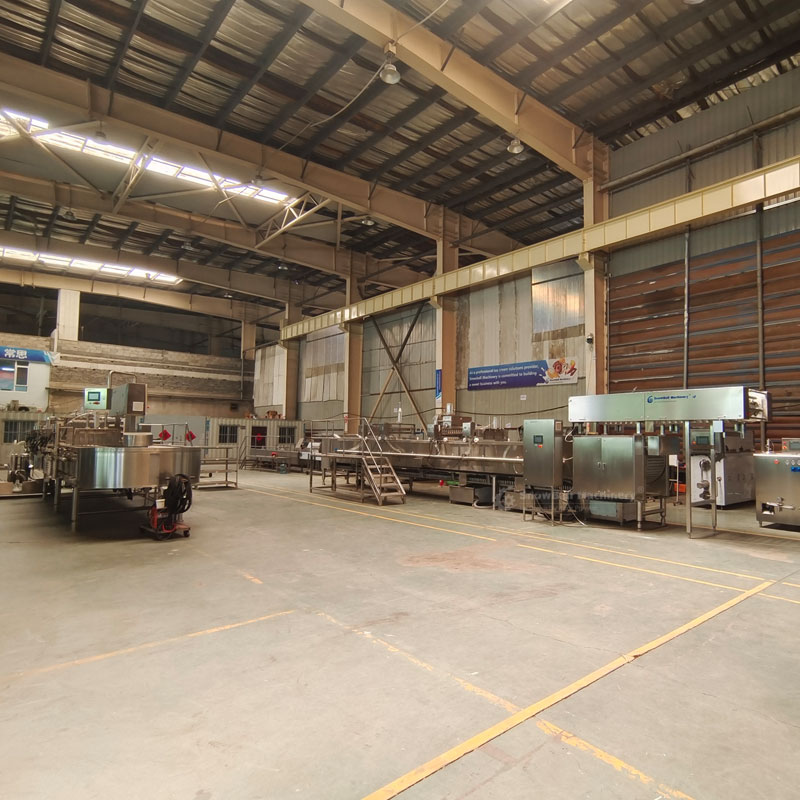
A turnkey ice cream factory is a complete ice cream production plant that one supplier designs, equips, installs and commissions as a single system. Instead of buying a freezer from one vendor, a filling machine from a second and a packing machine from a third, the buyer receives one contract covering factory layout, the full line of machines from mixing to packing, installation, commissioning, operator training and after-sales support — with one point of responsibility when something needs to be corrected.
That definition matters most to newcomers. An industrial ice cream factory is not one ice cream machine; it is a sequence of process stages, and every stage has to be matched to the stage before and after it. Mixing, pasteurising, homogenising, ageing, continuous freezing, inclusion feeding, forming, filling, hardening and packing all sit on the same line, share the same utilities and have to run at compatible hourly rates.
Snowball Machinery Manufacturing Co., Ltd is an ice cream equipment manufacturer and turnkey solution provider based in China. The company was established in 2020, operates a 4,000 m² factory with 50 employees, including a team of 10 mechanical design and drawing engineers, and reports an annual output of 1,200 sets. Snowball Machinery reports that around 90% of its output is exported to North America, South America, Europe, Asia and Africa, and that its team brings more than 30 years of experience in the ice cream machinery industry.
This article explains what the full-line, single-supplier approach actually contains: the process stages involved, the Snowball Machinery model families that cover them (from SNM mixing to SNB packing), the steps a turnkey project follows, and the certification, budget and delivery questions buyers should ask before signing.
Why an Ice Cream Factory Is Not One Machine: The Integration Problem
The most common misconception among first-time buyers is that an industrial ice cream factory equals one large ice cream machine. In reality, a production line is made up of separate process groups, each of which can be supplied by a different manufacturer — and that is exactly where project risk appears.
Consider the sequence a stick ice cream or cup ice cream product has to travel: raw material storage and premix preparation, pasteurisation (HTST or batch), homogenisation, ageing, continuous freezing with overrun control, ingredient feeding, forming or filling into the final shape, hardening, and packaging into cartons. Each stage uses different equipment with different control systems, different utility requirements and different maintenance routines.
When those stages are bought separately, four problems typically appear.
- Capacity mismatch. A continuous freezer that produces a given number of litres per hour must feed a filler or a moulding line that can consume that same volume. If the freezer is oversized, the line idles; if it is undersized, downstream equipment runs below its design rate. Matching hourly capacity is a design decision, not a purchase decision.
- Process interface mismatch. The continuous freezer discharges product at a defined temperature and texture — the Snowball Machinery SNCF series takes mix in at +5 °C and discharges at −5 °C with 100% overrun. Forming, filling, hardening and packaging equipment must be configured around that product condition rather than against it.
- Utility and control fragmentation. Refrigeration, chilled water, compressed air, CIP circuits and electrical supply have to be planned for the whole plant. When each machine arrives with its own control philosophy, commissioning becomes a negotiation between vendors instead of an engineering task.
- Split responsibility after start-up. If output drops, the freezer supplier points at the filler, the filler supplier points at the mix, and the buyer pays for the diagnosis. With a single line supplier, responsibility for the whole sequence sits in one place.
The same fragmentation shows up in documentation. Compliance files, machine manuals and spare-part lists arrive from several manufacturers in several formats, which makes internal audits and market-access checks harder than they need to be. A single-source line produces one documentation set, one spare-parts route and one technical contact.
Industry Background: Where Industrial Ice Cream Equipment Stands in 2026
The demand environment for ice cream production equipment remains substantial. According to Stratview Research, the global ice cream processing equipment market was valued at USD 2.4 billion in 2025. The same report segments the market by equipment type and places continuous freezers at approximately 29.4% of that type segment, which makes freezing the largest single equipment category in the industrial processing chain.
Regionally, IMARC Group reports that North America holds more than 42.0% of the ice cream processing equipment market as of 2025. For buyers outside that region, the practical implication is that most installed reference lines and most published machine documentation come from North American and European production environments, while demand continues to expand across Asia, South America and Africa. Snowball Machinery's reported export distribution — roughly 90% of output shipped to North America, South America, Europe, Asia and Africa — reflects a similarly broad customer base.
On the standards side, ISO 22043:2020 sets out classification, requirements and test conditions for ice-cream freezers, including requirements relating to transparent lids. Standards of this kind define how freezer performance is classified and tested, and they sit alongside machinery safety standards such as EN ISO 12100:2010 and EN 60204-1:2018, which are commonly referenced in CE documentation for food processing machinery.
One caution is worth stating plainly: aggregate market reports do not publish factory-level procurement benchmarks. Lead time by configuration, minimum order quantity for a turnkey line, spare-parts terms and customer retention rates are not available in the public research covering this category. Buyers therefore have to obtain those figures directly from the supplier being evaluated, and should treat market-size data as background rather than as procurement input.
The Full-Line Solution: What "A to Z" Actually Covers
A full-line, turnkey approach means the supplier's own portfolio covers every process group on the line, so capacity matching, control logic and documentation are handled by one engineering team. At Snowball Machinery, that portfolio is organised into model families that map onto the production sequence.
Stage 1 — Premix, Pasteurising, Homogenising and Ageing (SNM)
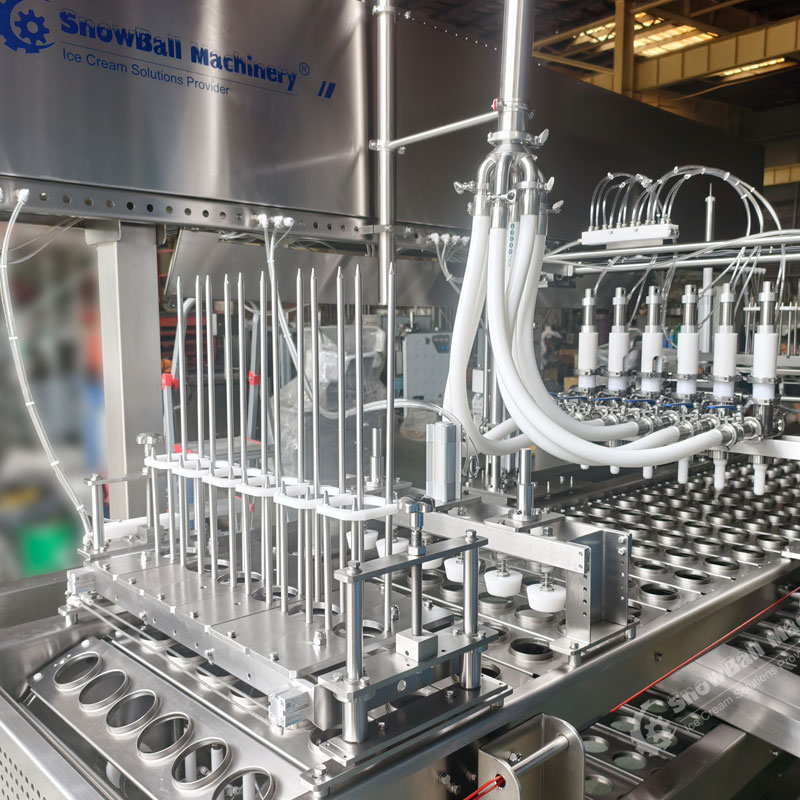
The mixing group, designated SNM, covers the front of the line: HTST systems and HTST pasteurisation, batch pasteurising systems, homogenisers, chocolate tanks and chocolate holding tanks, CIP cleaning systems, ageing tanks (ageing vats), chiller water systems and high shear mixers. Capacity across this group is customised according to the product design and the required hourly output, and the equipment is built in food-grade stainless steel SS304 or SS316.
For a new plant, this group determines mix quality — and mix quality determines everything downstream: overrun, texture, melt behaviour and the consistency of fill weights.
Stage 2 — Continuous Freezing (SNCF)
Continuous freezing is the core of the line. The Snowball Machinery SNCF series is offered in 50 L, 300 L, 600 L, 1,200 L and 1,500 L models, with a documented capacity range of 50–1500 L/h, 100% overrun, a mix inlet temperature of +5 °C and a product outlet temperature of −5 °C. The ice cream continuous freezer is also one of the machines covered by published CE documentation (certificate CE-4681-181125).
Because the freezer sets the hourly rate for the rest of the plant, its capacity choice drives the sizing of the filler, the moulding or extrusion line, the hardening tunnel and the packing machine.
Stage 3 — Inclusion and Ingredient Feeding (SNFF)
Solid inclusions — fruit pieces, nuts, chocolate chips, cookie dough and similar ingredients — are added by an ingredient feeder rather than blended into the base mix. Snowball Machinery offers the SNFF1000, SNFF2000 and SNFF4000, with capacity customisable from 50 litres to 4,000 litres per hour. The ingredient feeder carries CE documentation under certificate CE-1724-01-121223.
Stage 4 — Forming: Moulded Sticks, Extrusion and Sandwich Lines (SNL, SNEX, SNSMZ)
Forming determines the product portfolio the factory can sell. Three families cover the main product shapes:
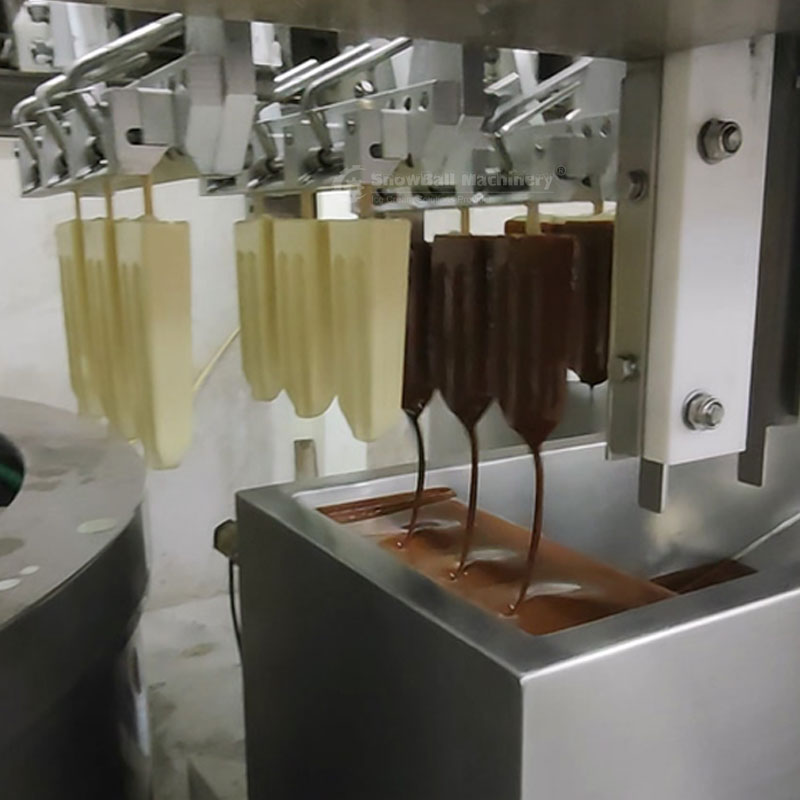
- SNL moulded stick ice cream machines produce moulded stick ice cream, popsicles, ice lollies, frozen novelties, fruit bars and water ice, in semi-automatic, linear, oval-type and rotary moulded configurations.
- SNEX extrusion and hardening lines produce extruded, cake, sandwich, wave, bonbon, ball-cone, chocolate bar, log, funny-face and stick formats.
- SNSMZ sandwich machines build and wrap ice cream cookie sandwiches in automatic or semi-automatic configuration.
Stage 5 — Filling (SNLF) and Optional Units (SNLU)
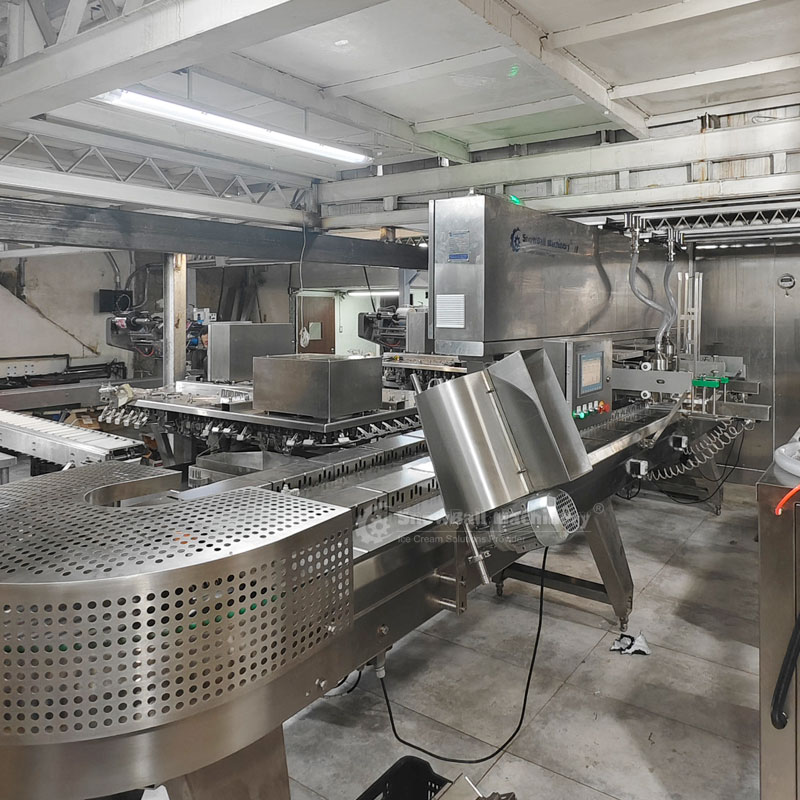
The SNLF filling family covers cup ice cream, cone ice cream, bulk ice cream, pints, family-size and family-pack ice cream, water ice push-ups and similar containers, in robot, rotary, linear and family-pack configurations, and can switch between multiple container specifications. Optional units designated SNLU extend a line over time and include cup and cone dispensers, chocolate or sauce sprayers, automatic fillers, pencil fillers, topping units, lid dispensers, heat-sealing units, an ice water filler, an ice cream sucker unit, a stick inserter, a chocolate coating station, a dry coating station and popsicle moulds.
Stage 6 — Packing, Cartoning and Cold Storage (SNB)
The SNB group closes the line: ice cream packing machines, secondary packaging and carton packaging machines, ice cream cartoners, cone baking machines and cold storage rooms. Capacity is configured to match the upstream line rate.
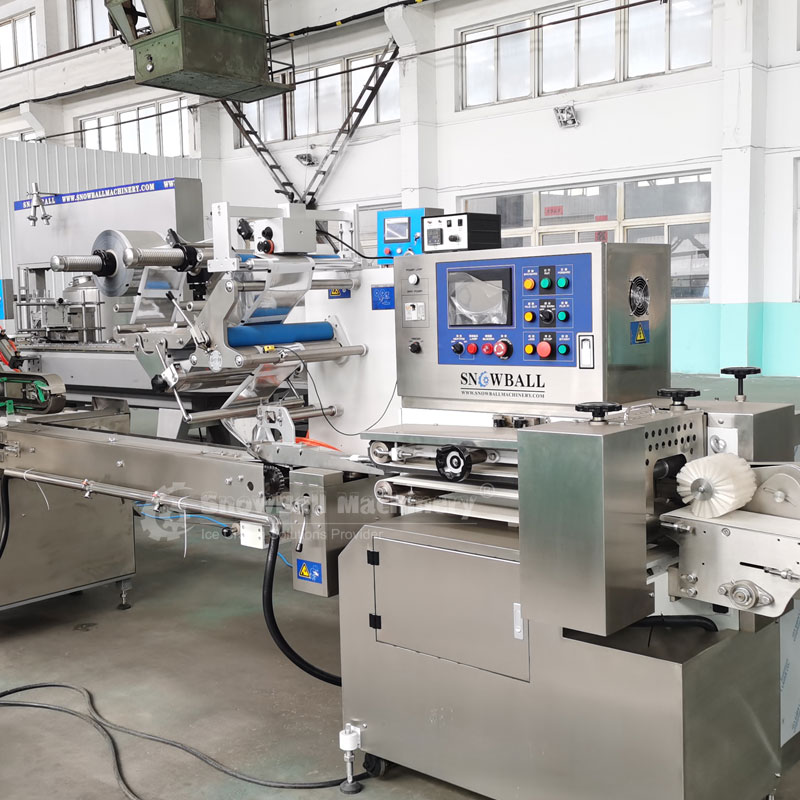
What Stays Constant Across the Line
Three engineering constants run through the full-line approach. The first is material: equipment uses high-quality food-grade stainless steel, either SS304 or SS316. The second is component sourcing: main components are drawn from internationally recognised suppliers including SIEMENS, Schneider Electric, FESTO, SMC, Danfoss, ABB, Bonfiglioli, igus, Copeland, Bitzer and SEW Eurodrive. The third is configuration logic: every line is non-standard, built to the buyer's product design and hourly production capacity rather than assembled from a fixed catalogue.
Step-by-Step: How a Turnkey Ice Cream Factory Is Delivered
A turnkey project follows a predictable sequence. Buyers who understand the sequence can judge a supplier's real capability at each stage rather than only at the quotation stage.
- Product and capacity definition. The buyer defines the product portfolio — sticks, cups, cones, sandwiches, cakes, extruded novelties — and the target hourly output. Customisation is based on product design and hourly production capacity.
- Factory design and layout. The supplier designs the ice cream factory: process flow, equipment positions, utilities, hygiene zoning and room for expansion. Snowball Machinery provides ice cream factory layout design as part of its service scope.
- Line configuration and quotation. Machines are selected from the relevant families (SNM, SNCF, SNFF, SNL, SNLF, SNEX, SNSMZ, SNB and SNLU) and matched to one another. Minimum order quantity is 1 set, and monthly manufacturing capacity is reported at 100 sets.
- Manufacturing and testing. Production follows full-process control from material selection onwards, in compliance with food safety production standards, with 100% testing of equipment before shipment.
- Delivery, installation and commissioning. The supplier ships the line and then carries out on-site installation and commissioning, supported by remote commissioning functions and fault alarm functions on the control system.
- Training and after-sales. Operators are trained on the actual line. After-sales scope covers equipment upgrading, maintenance, fault handling, spare parts supply and regular inspection, with global response.
Use Cases: What Turnkey Delivery Looks Like in Practice
Four reported projects illustrate how the full-line approach is applied from different starting points.
First-time entrant with no production experience. A start-up client with no prior ice cream manufacturing experience wanted to build its own brand. The project used a turnkey whole-plant solution suitable for small to medium-scale mass production, including an extruded ice cream tunnel at 5,000–8,000 pieces per hour, a family pack filling machine at 1,200 L/h, a continuous freezer and related equipment. The line has reportedly run stably for 11 years. The scope included plant layout planning, installation, commissioning and staff technical training — which is what allows a company with no factory experience to reach production.
New factory in a demanding climate. A newly established manufacturer targeting supermarket and retail channels received a complete line including continuous freezers, an extrusion tunnel, packing machines and auxiliary equipment, with an output of 9,000–10,000 pieces per hour and a flexible configuration for multi-flavour production. The line was engineered to suit the local power supply and operating environment, and has reportedly operated stably for three years under high-temperature, high-humidity conditions. For this project, Snowball Machinery reports total line costs 70% lower than premium European brand alternatives, with a modular design that allows later capacity expansion.
Equipment upgrade for a long-established manufacturer. A long-established ice cream manufacturer needed to upgrade equipment that had been in service for 40 years without rebuilding the whole plant. Custom-designed workstations were matched to the original line using food-grade 316 stainless steel to meet North American production compliance requirements. The reported outcome after upgrading: production efficiency up 40%, labour costs down 30%, and equipment upgrading costs cut by 70%, with the line running stably for six years.
High-volume branded production. A well-known brand ice cream factory operates an automatic cone filling line at 10,000–15,000 pieces per hour and a stick ice cream production line at 15,000–20,000 pieces per hour, running 24-hour fully automatic production with stable performance for a reported 12 years. Material and component standards match those used across the portfolio: SS304/SS316 construction with internationally branded components.
In all four cases the pattern is the same: the supplier takes the whole sequence — design, equipment, installation, commissioning, training and support — rather than a single machine.
Comparison Table: The Full Line from SNM to SNB
The tables below map the Snowball Machinery line stage by stage, using the company's published product and specification data.
| Process stage | Model family / models | Function on the line | Documented data |
|---|---|---|---|
| Premix, pasteurising, homogenising, ageing, CIP | SNM | HTST system, batch pasteurising system, homogeniser, chocolate tank and holding tank, CIP cleaning, ageing tank, chiller water system, high shear mixer | Capacity customised to product design and hourly output; SS304 / SS316 |
| Continuous freezing | SNCF 50L, 300L, 600L, 1200L, 1500L | Freezes mix and controls overrun | 50–1500 L/h; overrun 100%; mix in +5 °C; product out −5 °C |
| Inclusion feeding | SNFF1000, SNFF2000, SNFF4000 | Adds solid inclusions and fruit to the frozen stream | 50–4000 L/h, customisable |
| Moulded stick forming | SNL | Moulded stick ice cream, popsicle, ice lolly, fruit bars, water ice | Capacity customised; SS304 / SS316 |
| Extrusion and hardening | SNEX | Extruded, cake, sandwich, wave, bonbon, ball-cone, choco bar, log, funny-face formats | Capacity customised to product design |
| Filling | SNLF | Cup, cone, bulk, pint, family-pack filling; robot, rotary or linear configuration | Capacity customised; multi-container changeover |
| Sandwich forming | SNSMZ | Builds and wraps ice cream cookie sandwiches | Automatic or semi-automatic configuration |
| Packing and secondary packaging | SNB | Packing machine, cartoner, cone baking machine, cold storage room | Capacity customised to line rate |
| Optional units and spares | SNLU | Ice water filler, sucker unit, stick inserter, chocolate coating station, dry coating station, popsicle moulds | Configurable at order or added later |
Certification Coverage by Machine
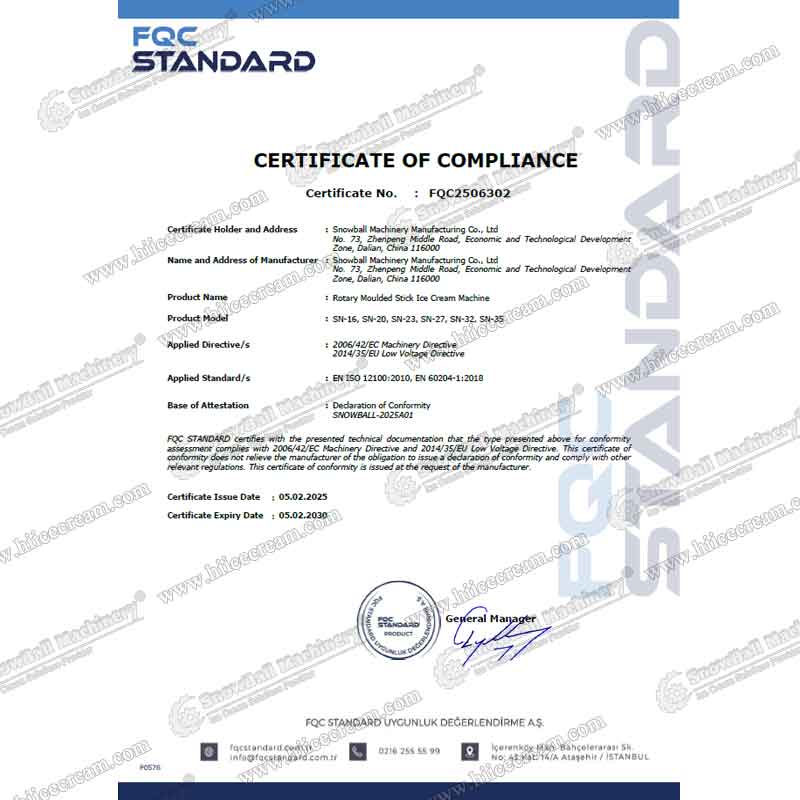
| Equipment | Standards referenced | Certificate number | Issuing body | Market coverage |
|---|---|---|---|---|
| Ice cream continuous freezer (SNCF) | EN ISO 12100:2010; EN 60204-1:2018 +A1:2025 | CE-4681-181125 | European Certification Services | Global |
| Molded stick ice cream machine (SNL) | EN ISO 12100:2010; EN 60204-1:2018 | FQC2506302 | FQC STANDARD | Global |
| Linear stick ice cream machine (SNL) | BS EN ISO 12100:2010; BS EN 60204-1:2018 | CE-1654-01-111123 | CGS Test | Global |
| Ingredient feeder (SNFF) | BS EN ISO 12100:2010; BS EN 60204-1:2018 | CE-1724-01-121223 | CGS Test | Global |
FAQ: Turnkey Ice Cream Factory Questions Buyers Ask
Does a turnkey ice cream line come with CE certification?
CE coverage is documented machine by machine, not line by line. For Snowball Machinery, the published certificates are: the ice cream continuous freezer under certificate CE-4681-181125 issued by European Certification Services, referencing EN ISO 12100:2010 and EN 60204-1:2018 +A1:2025; the molded stick ice cream machine under certificate FQC2506302 issued by FQC STANDARD, referencing EN ISO 12100:2010 and EN 60204-1:2018; the linear stick ice cream machine under certificate CE-1654-01-111123 issued by CGS Test, referencing BS EN ISO 12100:2010 and BS EN 60204-1:2018; and the ingredient feeder under certificate CE-1724-01-121223 issued by CGS Test, referencing BS EN ISO 12100:2010 and BS EN 60204-1:2018. All four certificates are stated as valid for the global market. Because certification is issued per machine, buyers should confirm that each model in their configuration has a certificate whose scope matches the quoted model, and should check destination-market requirements separately.
Can one supplier really deliver the full line from mixing to packing?
The practical test is portfolio completeness. Snowball Machinery's published product range covers premix machines, HTST systems, batch pasteurising systems, ageing tanks, CIP systems, continuous freezers, fruit feeder systems, moulding stick ice cream machines, filling machines, hardening tunnels, extrusion machines, robot ice cream machines, sandwich machines, cake machines, packing machines and cartoning machines — the same sequence from SNM mixing to SNB packing described above. Configuration is non-standard and based on product design and hourly capacity; minimum order quantity is 1 set and monthly manufacturing capacity is reported at 100 sets. Buyers should still verify model-level specifications such as throughput, utilities, footprint and changeover time before contracting.
What drives the cost of a turnkey ice cream factory?
There is no fixed price list, because every line is a non-standard configuration. The main cost drivers are the product formats the line must produce, the required hourly capacity, the automation level at the filling stage (robot, rotary, linear or family-pack), the number of optional units such as coating stations, topping units and lid dispensers, the packaging format, and the quantity of stainless steel within the line. Public research covering industrial ice cream equipment does not publish verified price or total-cost-of-ownership benchmarks, so an itemised configuration quotation is the only reliable basis for comparison — headline figures from different configurations are not comparable.
Can our recipe and product design be validated before the full line is built?
Yes — product design is the starting point rather than an afterthought. Customisation is based on product design and hourly production capacity, and Snowball Machinery reports jointly developing new ice cream products with ice cream factories. The equipment is also used in ice cream factory laboratory and R&D settings, which allows product and process questions to be resolved before a full line is committed. Every machine goes through full-process control from material selection to production, with 100% testing before shipment, and on-site installation and commissioning then validate the line using the buyer's own mix.
How long does delivery and start-up take, and what happens after installation?
Lead time is quoted according to the specific equipment plan rather than as a fixed number, because the line is built to the buyer's product design and capacity; monthly manufacturing capacity is 100 sets and minimum order quantity is 1 set. As reference points, Snowball Machinery reports that one new factory completed construction and commissioning within a short period, and that a European sandwich line moved from installation to production launch rapidly. After start-up, support covers equipment upgrading, maintenance, fault handling, spare parts supply and regular inspection, with remote video support for operational issues. To begin a configuration discussion, send your product design and target hourly capacity to ice@snowballmachinery.com, or download the company brochure below.
Conclusion: One Interface, One Responsibility
A turnkey ice cream factory is best understood not as a product but as a delivery model: one supplier, one design, one full line from SNM mixing to SNB packing, one installation and commissioning scope, and one point of responsibility after start-up. For a newcomer, this removes the hardest part of the project — matching capacity, temperature and control logic between machines that were never designed to work together.
The model only works, however, if the supplier's portfolio genuinely covers the whole sequence and if the buyer verifies specifications, certification scope and delivery terms machine by machine. That is the practical difference between a full-line supplier and a company that simply resells several machines under one invoice.
Snowball Machinery Manufacturing Co., Ltd designs, manufactures, assembles, commissions and exports industrial ice cream production lines, with a reported annual output of 1,200 sets and exports to North America, South America, Europe, Asia and Africa. The full equipment range can be reviewed at icecreammachinemanufacturer.com.
Planning a turnkey ice cream factory? Send your product design, target hourly capacity and destination market, and Snowball Machinery will respond with a configuration proposal covering the line from mixing to packing.
Download the product brochure: Snowball Machinery brochure (PDF)
Email: ice@snowballmachinery.com
Have Questions or Need More Details?
Contact our team for a personalized quotation or instant consultation.
Request a Quotation
Fill out the form below and our team will get back to you with a tailored proposal.

LINE Direct Chat
Prefer to chat in real-time? Message us on LINE for instant assistance & quick answers.
- Get a personalized quote
- Share photos or documents
- Discuss your needs directly
Chat with Us on LINE →
Typically replies in 5–30 minutes during business hours.