
Aluminium Spacer Bar Types Ranked: Standard, Bendable, Black, Embossed, Butyl
Soleron Building Materials (Hebei) Co., Ltd. is an insulating glass materials manufacturer based in Renqiu, Hebei Province, China, producing aluminium spacer bars, warm edge spacers, sealants, molecular sieve desiccants and related glass accessories for IGU processors and window and door manufacturers. Its aluminium spacer bar range is offered in five formats, and this guide ranks those five types by how broadly they fit real double glazing production — with the verified specification behind each position.
Ranked by breadth of application fit across mainstream double glazing orders, the order is: 1) standard, 2) bendable, 3) black, 4) embossed, 5) butylated. The standard profile is the format most orders can run unchanged. The bendable profile removes corner connectors from the process. Black and embossed are surface-led specifications. The butylated profile answers the narrowest — and most seal-critical — requirement: an integrated butyl primary seal inside a double glazing assembly.
- Standard aluminium spacer bar — the default specification for conventional insulating glass lines.
- Bendable aluminium spacer bar — for in-line corner forming instead of corner connectors.
- Black aluminium spacer bar — for dark sightlines and appearance-controlled units.
- Embossed aluminium spacer — for a textured surface specification.
- Butylated aluminium spacer bar — for integrated butyl primary sealing with butyl tape.
Why Aluminium Spacer Bar Type Selection Is a Decision-Stage Problem
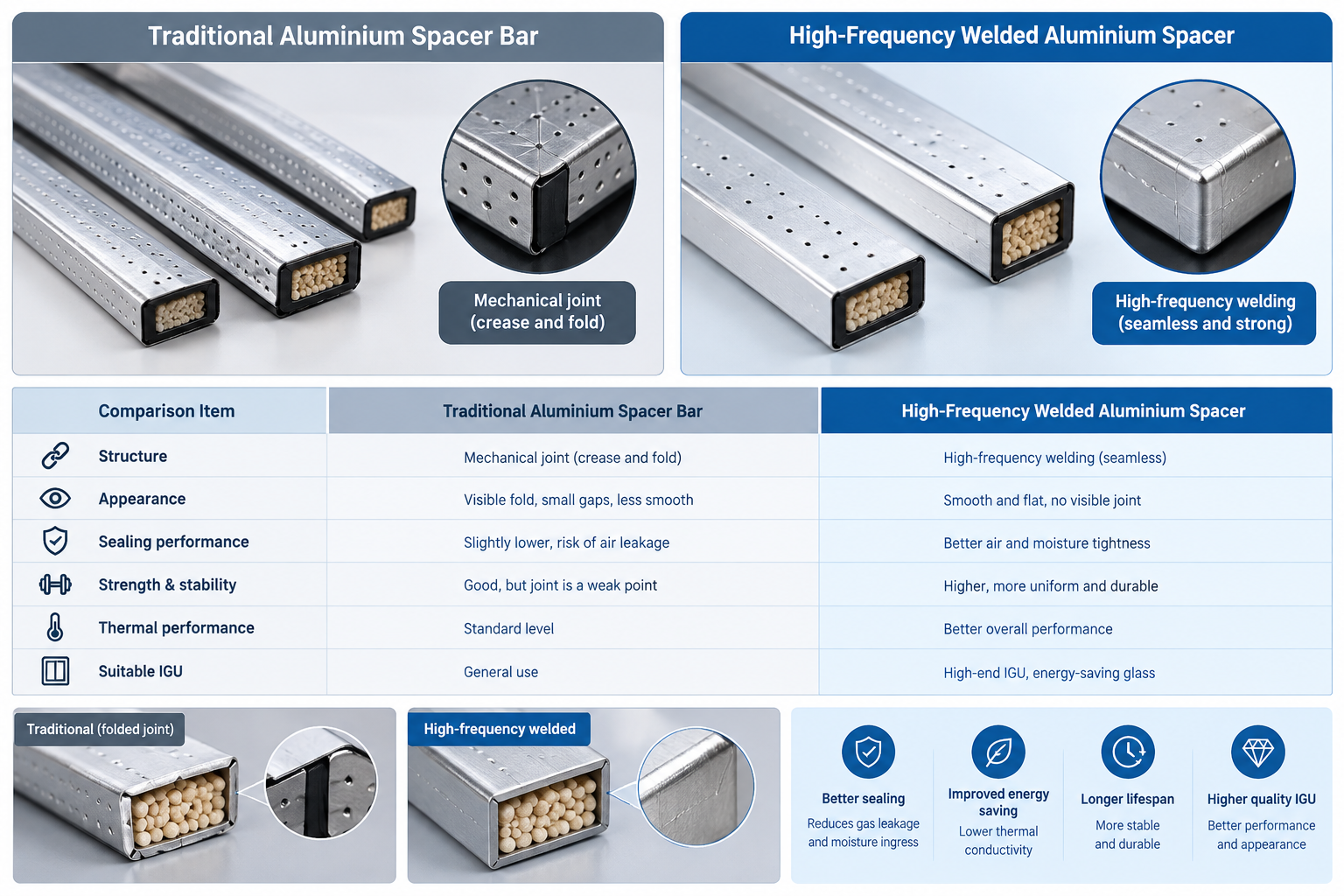
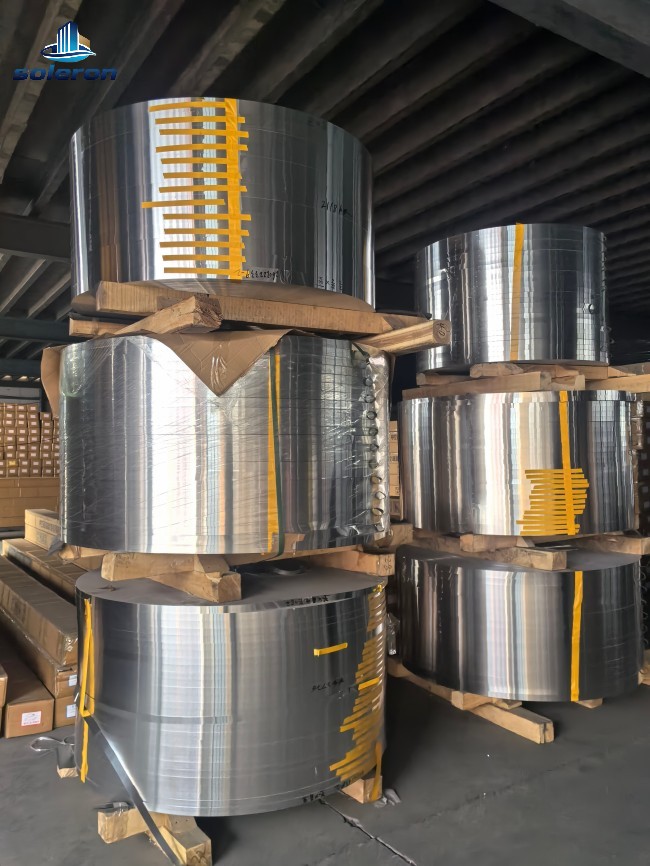
All five types share one base specification. They are formed from 3003 and 1100 series aluminium coil into hollow profiles with welded joints, sized from 5.5 mm to 50 mm, with wall thickness from 0.16 mm to 0.35 mm, standard 5 m lengths, and a quoted quality guarantee of 5 years. What separates them is not the metal. It is the processing behaviour, the visible surface, and the way the primary seal is formed around the edge.
That difference becomes a purchasing decision at the point where a fabricator commits to a profile for a live order, and the cost of a wrong choice appears late — in bending rework, in a sightline that reads differently from the drawing, or in a primary seal that has to be added as a separate operation because the spacer was not supplied in the required format. Three questions remove most of that risk: what the glass edge will look like in the finished window, how the corner will be formed, and how the primary seal will be applied.
Why the edge matters at all is worth stating precisely. The spacer bar holds the glass panes at a fixed distance from each other and establishes the size of the interpane space, and it also provides the channel for the desiccant and helps form the edge seal. Everything about type selection flows from those three duties.
Industry Background: An Expanding IGU Market Pulling the Edge Specification Forward
Downstream demand. The global insulated glass market was valued at USD 92.7 billion in 2024 and is projected to reach USD 101.3 billion in 2026 and USD 121.7 billion by 2030, according to Grand View Research. Spacer, sealant and desiccant demand moves with that volume, because every insulating glass unit contains an edge assembly.
Where growth is concentrated. The warm edge spacer segment was valued at USD 1.1 billion in 2024 and is projected to reach around USD 1.90 billion by 2035, per Meticulous Research. For this ranking the signal is practical rather than theoretical: aluminium profiles remain the volume baseline, while warm edge systems are the specification many energy-driven projects move toward. Knowing which aluminium format to run during that transition is an operational decision, not a marketing one.
The desiccant side. The 3A grade segment of the molecular sieve desiccant market was valued at USD 1.80 billion in 2024 (Mordor Intelligence). Desiccant is not a separate decision from spacer choice: a hollow aluminium spacer bar is the channel that carries the desiccant inside the unit, and common IGU desiccants are molecular sieves or blends of silica gel with molecular sieves, used to adsorb residual water and solvent vapour in the sealed space.
Compliance environment. Edge assemblies are normally qualified as part of an IGU system rather than as isolated parts. EN 1279-2 sets a moisture penetration test with a pass criterion of an average index Iav ≤ 0.20 and individual specimen I ≤ 0.25, and permits several desiccant moisture determination methods, including 540 °C drying, Karl Fischer titration, gravimetric and dew-point methods. AS/NZS 4666:2012 covers long-term type testing, periodic manufacturing testing, traceability, desiccant suitability and shelf life. ASTM C1249-18 describes dual-seal construction — polyisobutylene (PIB) as the primary seal and silicone as the secondary seal — as the configuration with the required durability for structural silicone glazing, a description also used by Cardinal in its IGU technical literature. None of these documents tells a buyer which spacer format to purchase. They do define which performance questions a supplier should be able to answer before an order is placed.
Trade classification. Aluminium spacer bars fall under HS 7604.21 for hollow profiles or 7604.29 for other aluminium profiles, depending on the form. Importers should confirm the applicable code with their customs broker before the first shipment.
How This Ranking Was Built
Five criteria were applied consistently to all five types, using the specification data published for this product family:
- Base construction consistency. Whether the format uses the same 3003 and 1100 series aluminium coil, hollow welded joint construction and size range as the standard profile, so it can enter an existing specification without re-engineering.
- Production-line compatibility. Whether the format runs on conventional insulating glass equipment — spacer bar bending machines, molecular sieve filling machines, butyl extruders and standard IGU production lines.
- Edge-seal integration. Whether the format fits the desiccant channel and the primary seal route without adding a separate operation.
- Application fit. Whether the surface and geometry match the finished unit: visible sightline, bent or cornered frames, decorative or exposed edges.
- Supply and customization. Size availability from 5.5 mm to 50 mm, wall thickness from 0.16 mm to 0.35 mm, custom lengths and packaging, stock availability, and the quoted 5-year quality guarantee.
Ranking position reflects breadth of fit across mainstream double glazing orders. A lower rank does not mean a weaker product — it means the format answers a narrower specification, which is exactly what makes it the right answer in that specific case.
The Five Aluminium Spacer Bar Types, Ranked
1. Standard Aluminium Spacer Bar — The Default Specification
This is the format the rest are measured against, and it is the one most double glazing orders can accept without changing equipment settings or edge design.
- Material: 3003 and 1100 series aluminium coil.
- Construction: hollow profile with welded joints.
- Size range: 5.5 mm to 50 mm; common air-space widths from 6A to 24A.
- Wall thickness: 0.16 mm to 0.35 mm.
- Length: 5 m standard, custom lengths supported.
- Quality guarantee: 5 years.
Documented characteristics for this family include good mechanical strength, easy processing, dimensional stability and compatibility with conventional insulating glass production lines. The technical description also cites precise dimensions, stable quality, strong sealant compatibility and customizable specifications for insulating glass production lines as the core differentiators against traditional spacer bars.
Why it ranks first. It is the format with the widest tolerance for change: bending, desiccant filling and butyl extrusion can all run on the same equipment train, and only the profile width usually changes between jobs. For a fabricator with mixed order books, that is the least disruptive base specification to standardize on.
Where the limits sit. Aluminium is a thermally conductive metal. Published property data place aluminium thermal conductivity at roughly 160–200 W/mK, compared with 0.13–0.25 W/mK for warm edge materials, and warm edge technology is described as reducing thermal bridging by up to 90% compared with aluminium. Where a project specifies an energy-driven edge, the standard aluminium profile is the baseline — not the performance target.
2. Bendable Aluminium Spacer Bar — For In-Line Corner Forming
The bendable format keeps the same base metal and the same dimensional envelope: 3003 and 1100 series aluminium coil, hollow welded joints, 5.5 mm to 50 mm sizes, 0.16 mm to 0.35 mm wall, 5 m or customized lengths, 5-year quality guarantee.
The specification emphasis shifts to forming. The special requirements stated for this product family include high dimensional accuracy, excellent bending performance, a clean and smooth surface, good sealant compatibility, moisture resistance, low thermal conductivity, excellent durability, and customized sizes and packaging. The matched equipment list for insulating glass production includes a spacer bar bending machine, molecular sieve filling machine, butyl extruder and full IGU production line.
Why it ranks second. It converts corner assembly from a connector operation into part of the forming cycle. Fabricators who bend corners generally still stock connectors — plastic corner connectors, steel straight connectors, Georgian bar connectors and end caps in 5.5 mm to 50 mm, in black, white or customized colours — for frames that are not bent.
Limits to confirm before tooling. Bending behaviour depends on the wall thickness selected within the 0.16–0.35 mm range and on the required corner radius. A 0.16 mm wall and a 0.35 mm wall do not behave identically under the same tooling, so the radius should be confirmed with the supplier before production is set.
3. Black Aluminium Spacer Bar — Sightline and Appearance Control
The black format applies a black surface finish to the same base construction and keeps the identical size and wall options: 5.5 mm to 50 mm, 6A to 24A common widths, 0.16 mm to 0.35 mm wall, 5 m or customized lengths, 5-year quality guarantee.
Application fit. Black coating is specified where the spacer edge remains visible and the drawing calls for a dark sightline, and where the unit has to read consistently against dark window frames. Because the visible edge in those assemblies often includes the connector, matching black corner connectors in 5.5 mm to 50 mm are part of the same specification package.
Limits. Colour is a surface specification. It does not change the thermal properties of the aluminium core and does not replace a warm edge spacer in a specification driven by energy performance. Treat black as an appearance decision with the same mechanical behaviour as the standard profile.
4. Embossed Aluminium Spacer — A Textured Surface Specification
The embossed variant carries a patterned surface rather than a smooth mill finish, on the same 3003 and 1100 series aluminium coil, the same 5.5 mm to 50 mm size range, the same 0.16 mm to 0.35 mm wall thickness and the same 5-year quality guarantee.
Application fit. Surface pattern is a design-level specification. Buyers choose it when the appearance of the profile surface itself is part of the finished look, or when they want the spacer surface to be visually distinguishable from a plain mill finish in the unit or in the sample phase.
Limits — and an honest gap. No comparative performance data between embossed and smooth aluminium spacer surfaces is available in the material reviewed for this article. Treat the embossed surface as an appearance specification. If a performance claim is central to your qualification, ask the supplier for documented test data rather than assuming a textured surface performs differently.
5. Butylated Aluminium Spacer Bar — Integrated Butyl Primary Sealing
The butylated format is supplied for lines that form the primary seal with butyl. It shares the base construction of the other four types and is specified together with the butyl materials in the same accessory range: butyl tape, plus butyl sealant SOL-803 and hot melt and two-component silicone sealants SOL-717, based on butyl rubber, silicone polymer and EVA, with a 10-year quality guarantee on the sealant range.
Application fit in double glazing. Dual-seal construction — a polyisobutylene primary seal with a silicone secondary seal — is the composition described in ASTM C1249-18 as having the required durability for structural silicone glazing, and the same PIB primary / silicone secondary structure is described by Cardinal in its IGU literature. A butylated spacer bar places that primary seal directly into the edge assembly with the spacer, instead of relying on a separate extrusion or tape application step.
Why it ranks fifth but leads its niche. Its specification window is the narrowest of the five, which is why it sits last on breadth of fit. Where the requirement is a butyl primary seal with butyl tape, however, it removes an operation and gives tighter control over primary seal geometry. Where that requirement does not exist, a standard or bendable profile used with butyl tape delivers the same functional edge.
Aluminium Spacer Bar Types: Side-by-Side Comparison
| Rank | Type | Base material and joint | Size and wall | Surface or seal integration | Best-fit application | Guarantee |
|---|---|---|---|---|---|---|
| 1 | Standard | 3003 and 1100 series aluminium coil; hollow welded joints | 5.5–50 mm; common widths 6A–24A; wall 0.16–0.35 mm | Smooth mill finish; sealing applied separately with butyl tape or extruded PIB | Conventional IGU lines; general double glazing production | 5 years |
| 2 | Bendable | Same base construction | Same size and wall range | Corner radii formed on a spacer bar bending machine instead of corner connectors | Frames with formed corners; bending-intensive production | 5 years |
| 3 | Black | Same base construction | Same size and wall range | Black-coated surface; matching black corner connectors available (5.5–50 mm) | Dark sightlines, dark frames, appearance-controlled units | 5 years |
| 4 | Embossed | Same base construction | Same size and wall range | Patterned, non-smooth surface finish | Buyers specifying a textured surface appearance | 5 years |
| 5 | Butylated | Same base construction | Same size and wall range | Butyl coating used with butyl tape for the primary seal | Lines forming the primary seal with butyl in double glazing | 5 years |
For reference, the table below positions the aluminium family against the warm edge spacer range sold alongside it. This is context for specification decisions, not a like-for-like replacement claim.
| Attribute | Aluminium spacer bar (all five types) | Warm edge spacer (reference) |
|---|---|---|
| Material | 3003 and 1100 series aluminium coil, hollow welded joints | Fiberglass, stainless steel, PP; composite (plastic + stainless steel); flexible warm edge; butyl sealing spacer |
| Size range | 5.5–50 mm; common air-space widths 6A–24A; wall 0.16–0.35 mm | 6–27A |
| Thermal conductivity | Approximately 160–200 W/mK (aluminium) | 0.13–0.25 W/mK |
| Heat transfer behaviour | Higher heat transfer at the edge | Up to 50–70% lower thermal conductivity than conventional aluminium spacers under comparable glazing conditions |
| Cost position | Baseline cost | Slightly higher initial cost, with better long-term cost-effectiveness from improved thermal insulation and energy efficiency |
| Maintenance and life | Low maintenance, long service life, stable sealing performance, reduced replacement requirements | Same low-maintenance profile from the same product family |
Step-by-Step: Specifying the Right Type for a Live Order
- Fix the air space and profile width. Common aluminium widths run from 6A to 24A inside the 5.5 mm to 50 mm size range. Confirm the width against the glazing cavity drawing before anything else, because width changes are what most often force a re-quote.
- Set the wall thickness against your line. The available wall range is 0.16 mm to 0.35 mm. Confirm that the selected wall holds the required dimension and corner radius on your equipment — this is the single most common source of bending rework.
- Decide bent or cornered assembly. Bent corners point to the bendable profile; connectors and end caps (5.5–50 mm, black, white or customized) point to the standard profile.
- Decide the visible surface. Plain mill finish, black coating or embossed pattern. Answer this from the finished-window appearance, not from the workshop's stock list.
- Decide how the primary seal is formed. Separate butyl tape, an extruded butyl route, or a butylated spacer bar with butyl tape. If the unit is a structural silicone glazing system, remember that the durability description in ASTM C1249-18 refers to a dual seal with PIB primary and silicone secondary.
- Confirm the compliance and documentation route. Ask which standard your IGU system is qualified to — EN 1279-2 and AS/NZS 4666:2012 are common reference points — and how spacer, desiccant and sealant selections support it. For imports, confirm HS 7604.21 or 7604.29 with your broker.
- Confirm supply, then sample. Standard length is 5 m with custom lengths available, packaging can be customized, and spacer bars are quoted with a 5-year quality guarantee. Run a sample before the first production order.
Use Cases: Matching Type to Project
- General double glazing production with visible edges. Standard profile as the base specification; switch to black if the sightline must read dark.
- Residential and commercial windows with dark frames. Black spacer bar plus black corner connectors so the visible edge stays consistent.
- Bending-intensive shops. Bendable profile formed on a spacer bar bending machine, with connectors held in stock only for non-bent frames.
- Structural silicone glazing and curtain wall systems. Dual-seal construction with a PIB primary seal and silicone secondary seal, as described in ASTM C1249-18; the butylated profile is the logical spacer partner where butyl forms the primary seal.
- Energy-driven projects — energy-efficient windows and doors, passive houses. Warm edge spacer types (fiberglass, composite plastic and stainless steel, PP, flexible warm edge, butyl sealing spacer, 6–27A) with a 3A molecular sieve desiccant in 0.5–0.9 mm, 1.0–1.5 mm or 1.5–2.0 mm grades.
- Decorative units with Georgian bars. Standard spacer plus Georgian bar connectors and end caps to keep the decorative grid aligned with the cavity.
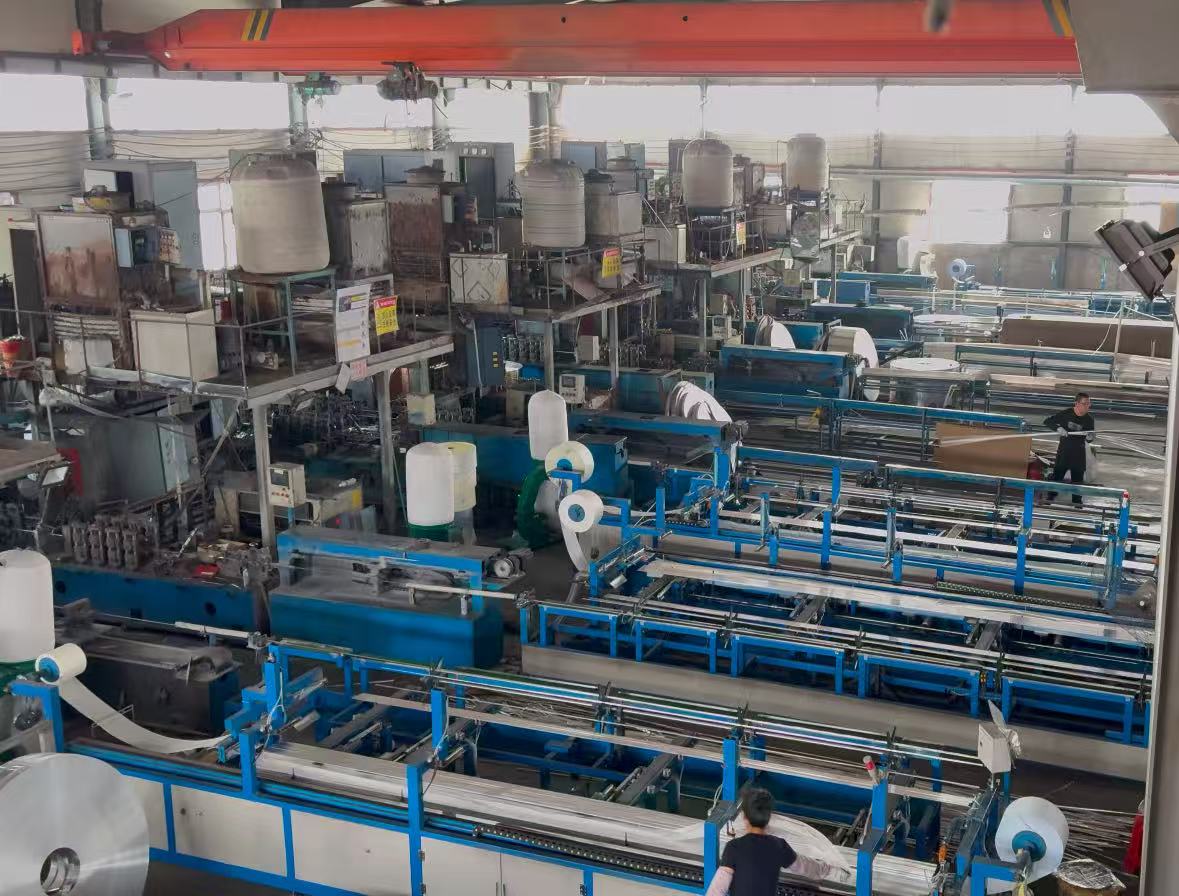
- Workshop conditions across all of the above. Clean, dry, temperature-controlled and humidity-controlled production areas, with spacer, desiccant, sealant and gas filling handled as one sequence.
Frequently Asked Questions
Do all five aluminium spacer bar types meet the same compliance requirements?
The five formats share one base construction — 3003 and 1100 series aluminium coil formed into hollow profiles with welded joints — so they are qualified as part of an IGU edge assembly rather than as separately certified parts. The test framework belongs to the unit: EN 1279-2 sets an average moisture penetration index of Iav ≤ 0.20 with individual specimens ≤ 0.25, while AS/NZS 4666:2012 covers long-term type testing, periodic manufacturing testing, traceability, desiccant suitability and shelf life. Before ordering, ask the supplier which standard your IGU system is being qualified against and how the spacer, desiccant and sealant combination supports it.
What sizes, wall thicknesses and surface options are available across the five types?
All five types are produced from 3003 and 1100 series aluminium coil in sizes from 5.5 mm to 50 mm, with common air-space widths from 6A to 24A and wall thickness from 0.16 mm to 0.35 mm. Standard length is 5 m, with custom lengths and customized packaging available, and the spacer bars carry a 5-year quality guarantee. Surface and sealing options are plain, black coated, embossed and butylated, and matching corner connectors are available from 5.5 mm to 50 mm in black, white or customized colours.
Is a warm edge spacer worth the premium over an aluminium spacer bar?
In material terms, warm edge spacers are quoted at 0.13–0.25 W/mK thermal conductivity against roughly 160–200 W/mK for aluminium, and warm edge technology is described as reducing thermal bridging by up to 90% compared with aluminium. Soleron states that thermal conductivity can be up to 50–70% lower than conventional aluminium spacers under comparable glazing conditions. The stated trade-off is a slightly higher initial cost with better long-term cost-effectiveness, supported by reduced condensation, improved energy efficiency, low maintenance and reduced replacement requirements.
Chinese or European aluminium spacer bar suppliers for double glazing — how should a buyer decide?
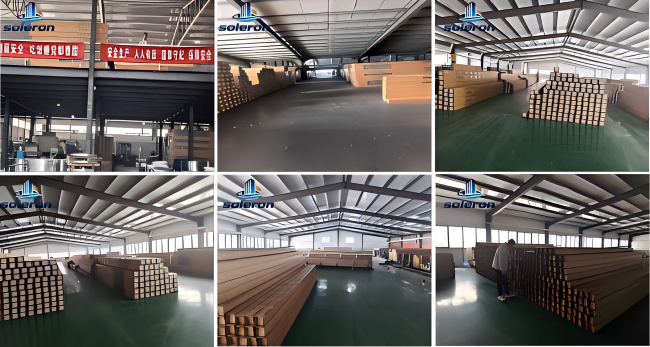
The decision should be driven by specification match rather than geography. Check the three points that cannot be adjusted later: base material (3003 or 1100 series aluminium coil with hollow welded joints), the size and wall combination (5.5–50 mm and 0.16–0.35 mm), and the surface or sealing variant your line actually needs. Then confirm the compliance documentation for the standard your IGU system is tested against, the stock and lead-time position, and the warranty being quoted. Soleron Building Materials (Hebei) Co., Ltd. is a manufacturer in Renqiu, Hebei Province, China, serving markets including Europe, North America, Asia, the Middle East, Latin America and Africa, and holds more than 100 pieces of regular aluminium spacer bars and warm edge spacers in stock to shorten delivery time on urgent orders.
How do samples and delivery work before a bulk order?
Sample and quotation requests are handled directly: send the profile width, wall thickness and the surface or sealing variant you intend to run to James at soleron.buildingmaterials@gmail.com or +86 138-3340-3347 (WhatsApp on the same number), and confirm the sample against your own production trial. Spacer bars are quoted with a 5-year quality guarantee, custom sizes and packaging are supported, and stock of regular aluminium spacer bars and warm edge spacers is held specifically to shorten delivery time on urgent orders. The full range — spacer bars, warm edge spacers, sealants, molecular sieve desiccants, connectors and Georgian bars — is listed in the downloadable catalog below.
Conclusion: Match the Type to the Line, Not the Other Way Around
The ranking in this guide is a decision tool, not a quality ladder. Standard aluminium spacer bars rank first because they accept the widest range of production conditions with the least disruption. Bendable profiles rank second because they remove an entire operation — corner connectors — from bending-based production. Black and embossed formats rank third and fourth because they are surface-led choices that change appearance rather than geometry. The butylated profile ranks fifth on breadth and first on one specific job: forming an integrated butyl primary seal in a double glazing assembly.
The safest sequence for a live order is short: fix the width (6A–24A inside the 5.5–50 mm range), fix the wall (0.16–0.35 mm), decide bent or cornered, decide the visible surface, decide how the primary seal is formed, and validate the choice with a sample before the first production run. Get those six decisions right and the spacer bar stops being a variable in the project.
Request a Sample or Quotation
Soleron Building Materials (Hebei) Co., Ltd. supplies aluminium spacer bars (Standard, Bendable, Black, Embossed, Butylated), warm edge spacers, sealants, 3A molecular sieve desiccants, connectors and Georgian bars from Renqiu, Hebei Province, China.
Download the full range here: Soleron product catalog (PDF) — or send your profile width, wall thickness and surface requirement to James: iguglassunit.com.
Have Questions or Need More Details?
Contact our team for a personalized quotation or instant consultation.
Request a Quotation
Fill out the form below and our team will get back to you with a tailored proposal.
WhatsApp Direct Chat
Prefer to chat in real-time? Message us on WhatsApp for instant assistance & quick answers.
- Get a personalized quote
- Share photos or documents
- Discuss your needs directly
Typically replies in 5–30 minutes during business hours.