
Evaluating an Insulating Glass Materials Supplier: Range, Equipment, and Delivery Checks
An insulating glass materials supplier should be evaluated on three verifiable dimensions before price is discussed: whether the declared range covers every line item on the buyer's bill of materials, whether the equipment and capacity behind that range can support the order volume, and whether delivery terms — packaging formats, net weights, guarantee periods and acceptance criteria — can be confirmed in writing. A supplier that documents all three is a lower-risk shortlist candidate than one that documents only a catalogue.
This guide is written for buyers at the evaluation stage, when several suppliers are still in play and the decision is about qualification rather than negotiation. It sets out what to ask for, which documents actually answer each question, and where a supplier's claims stop and verified evidence begins.
Why insulating glass materials are difficult to evaluate
An insulating glass unit is a sealed system, not a parts list. The spacer bar holds the glass panes at a fixed distance and establishes the size of the interpane space. The desiccant — commonly a molecular sieve, or a blend of silica gel with molecular sieve — adsorbs residual water and solvent vapour inside the sealed cavity. A primary seal and a secondary seal close the edge. Published technical descriptions of dual-seal construction, including ASTM C1249-18, describe polyisobutylene as the primary seal and silicone as the secondary seal for structural glazing applications.
Because these components come from four different process families — metal profiling, desiccant chemistry, sealant chemistry and accessory moulding — a supplier can be genuinely strong in one family and thin in another. The result is a familiar procurement problem: quotations arrive in different units, specifications are described by generic category rather than model code, and documentation covers the product family but not necessarily the exact item ordered.
That gap is what a structured evaluation closes. The question is not whether a supplier lists insulating glass materials, but whether each listed item can be tied to a model code, a size range, a test document and a delivery term.
Industry background: why verification standards are tightening
Demand across the material families has grown at the same time as the choice of suppliers. The global insulated glass market was valued at USD 92.7 billion in 2024 and is projected to reach USD 121.7 billion by 2030, according to Grand View Research. Meticulous Research values the warm edge spacer market at USD 1.1 billion in 2024, with a projected figure of around USD 1.90 billion by 2035. The 3A molecular sieve segment alone was valued at USD 1.80 billion in 2024, based on Mordor Intelligence. More volume and more suppliers means more shortlisting work for the buyer, not less.
Standards have moved in the same direction. EN 1279-2 sets moisture penetration criteria for insulating glass units at an average index of no more than 0.20, with individual specimens at no more than 0.25, and recognises four desiccant moisture determination methods: 540 °C drying, Karl Fischer titration, gravimetric and dew-point methods. AS/NZS 4666:2012 covers long-term type testing, periodic manufacturing testing, traceability, desiccant suitability, shelf life and desiccant exposure limits.
The practical consequence for evaluation is straightforward. Acceptance criteria should be written against the standard the finished unit will be certified to, and a supplier's documents should reference that same standard. A document that does not name a standard answers a different question than the one being asked.
The three-gate evaluation model
Soleron Insulating Glass Materials is the insulating glass materials line of Soleron Building Materials (Hebei) Co., Ltd., a manufacturer based in Renqiu, Hebei Province, China, supplying aluminium spacer bars, warm-edge spacers, sealants, desiccants and related IGU components. Its published data is used below as a worked example of what each gate should produce — not as a substitute for checking any other candidate the same way.
Gate 1 — Range: map coverage line by line
A range claim should be converted into a matrix before it is accepted. Every BOM line gets a category, a model code and a size range. A supplier that answers in categories rather than codes has not yet demonstrated coverage.
On the record reviewed here, Soleron declares an aluminium spacer bar range of 5.5–50A, a warm edge spacer bar range of 6–27A, a corner connector range of 5.5–50 mm, and sealant models SOL-803 and SOL-717. Two further categories matter for a complete evaluation. Georgian bar is a decorative profile with its own material and compatibility questions, and sodium sulfate appears on some buyers' bills of materials as a separate line item. Where a category is not confirmed on the supplier's record, treat it as a separate verification line rather than assuming it is included in a full-range claim.
Range also determines which technical family you are buying into. Published comparisons place aluminium spacer thermal conductivity at roughly 160–200 W/mK and warm-edge profiles at roughly 0.13–0.25 W/mK. A supplier that offers both allows the same edge-seal design to be specified in either direction; a supplier that offers one should be evaluated against the performance target of the project, not against a general preference.
Gate 2 — Equipment: ask at module level
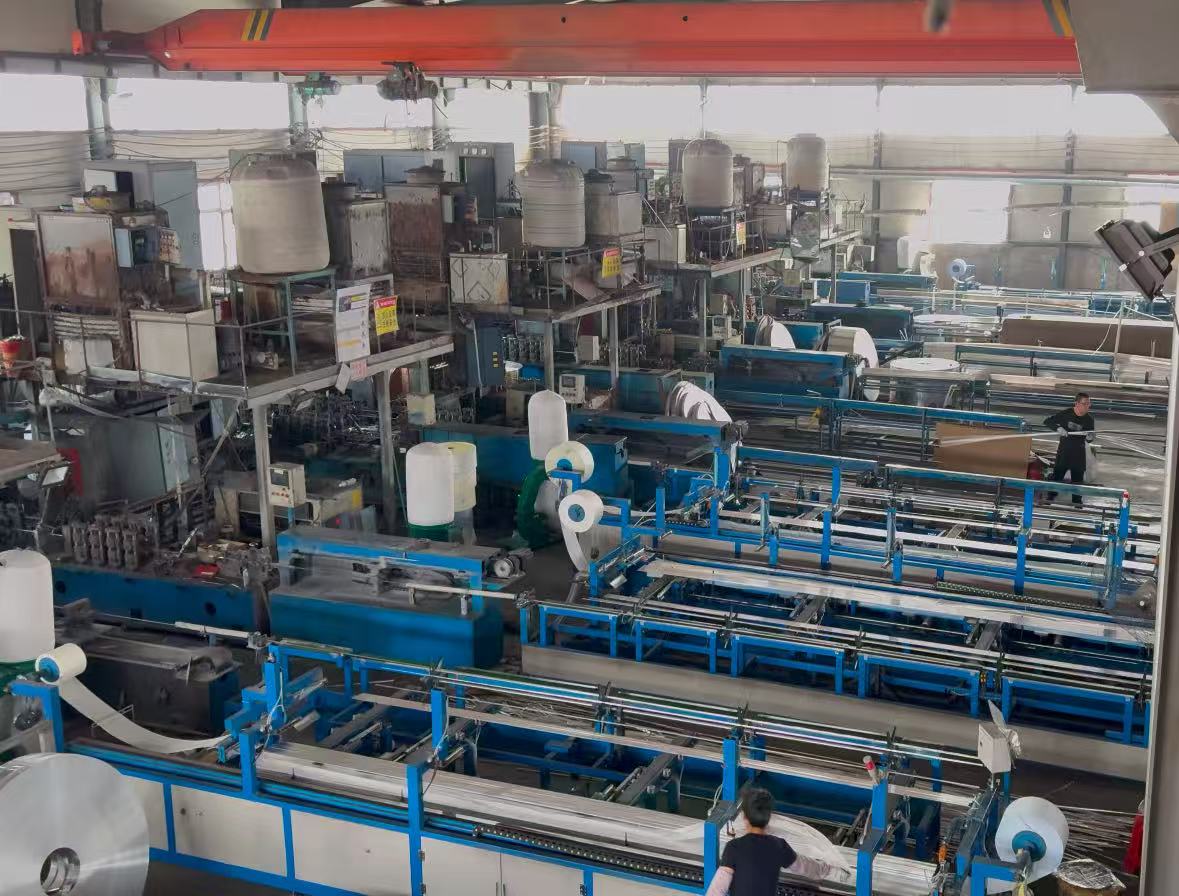
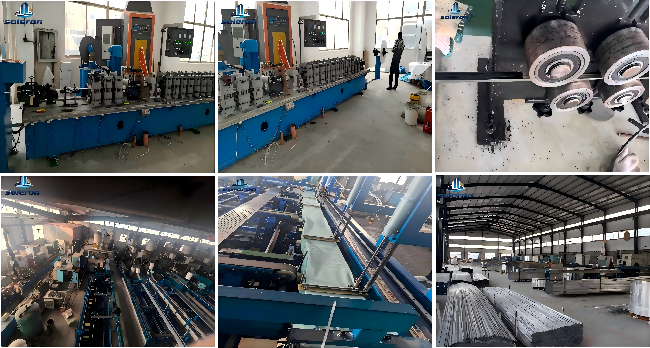
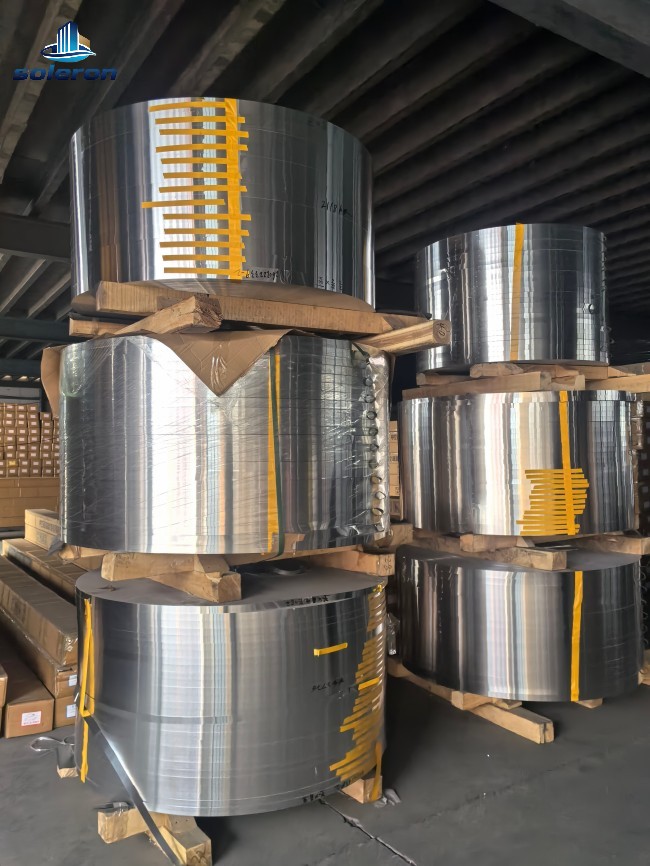
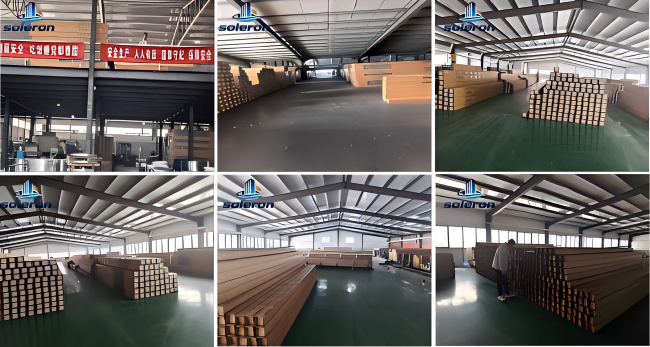
Line counts are a starting point, not proof. What matters is whether the modules behind the range correspond to the products ordered. On the record reviewed here, Soleron operates 10 automatic aluminium spacer bar production lines, 8 semi-automatic production lines and 10 warm edge spacer production lines, holds more than 100 regular aluminium and warm-edge spacer items in stock, reports a monthly capacity of 500 tons, and applies random inspection for quality control.
The equipment question becomes sharper when processing equipment is part of the order. The SOL-2 insulating glass processing line is listed with glass washing, butyl sealant and two-component sealant modules. These three modules correspond to three distinct risk points in IGU production: cavity cleanliness before sealing, primary seal application, and secondary seal chemistry. A buyer should therefore ask which module handles which seal layer, what the commissioning and acceptance procedure is, and what utilities the line requires — questions that a single line photograph cannot answer.
Where a supplier also offers OEM/ODM production, the equipment check should extend to whether customisation affects the process. Soleron lists OEM/ODM with logo, size and packaging customisation, which means artwork approval and packaging specification become part of the same acceptance conversation rather than a separate side agreement.
Gate 3 — Delivery: convert promises into terms
Delivery reliability is the gate most often left to email. It should be reduced to five written items: the minimum order quantity, the lead time window, the packaging format, the declared net weight, and the guarantee period with its acceptance criteria. On the record reviewed here, Soleron states a minimum order quantity of 5 cartons, a lead time of 20–45 days, OEM/ODM customisation covering logo, size and packaging, and remote after-sales support.
Two items require explicit confirmation rather than inference. Packaging format — bags or boxes — affects handling, storage and damage rates, and should be specified per SKU. Net weight should be declared per bag and per carton so that incoming quantity checks can be performed against a stated figure. Guarantee period is not stated in the records reviewed here, which is exactly why it belongs in the purchase order as a product-specific written term rather than an assumption drawn from a general brochure.
Market coverage is part of the delivery check too. Soleron exports to the EU, Middle East and Southeast Asia, and reports main markets that include Germany, France, the United Kingdom, the United States, Canada, Japan, South Korea, India, the UAE, Saudi Arabia, Brazil, Mexico and Chile, with an export ratio of about 80%. For a buyer in any of those markets, the relevant follow-up is which documents accompany the shipment, not whether the market appears on a list.
Which checks to run first, ranked by cost of failure
Not every check carries the same penalty if it is skipped. The order below ranks the ten checks by the downstream cost of discovering the gap late.
- Compliance document scope. A missing or mis-scoped certificate can block a shipment or a project sign-off; it is the only check that can stop the order entirely.
- Range coverage per BOM line. An uncovered line means a second supplier, a second approval cycle and a mixed-source edge seal.
- Acceptance criteria. Without them, a nonconformance becomes a negotiation instead of a return.
- Guarantee period in writing. Undefined warranty terms shift durability risk to the buyer.
- Equipment module fit. Wrong module configuration shows up as a process problem months after commissioning.
- Packaging format and labelling. Handling damage and mis-labelled cartons cost time at the receiving dock, not at the supplier.
- Declared net weight. Quantity disputes are expensive to resolve after delivery.
- Lead time window. A 20–45 day window requires planning, not hoping.
- Capacity versus order volume. Relevant mainly for repeat and seasonal volumes.
- After-sales channel. Remote support is adequate for most issues, but the escalation path should be known in advance.
Step-by-step: running the evaluation in eight moves
- Freeze the BOM. List every insulating glass material line — spacer, spacer connector, primary and secondary sealant, desiccant, Georgian bar, tape, sodium sulfate and accessories — with the width, model and quantity required.
- Request a range sheet with codes, not categories. Compare each returned code against your BOM line. Width ranges such as 5.5–50A for aluminium spacer bar or 6–27A for warm edge spacer should be stated explicitly.
- Ask for one document per category and read the scope line. The scope must name the exact item, the standard referenced and the market it covers.
- Verify the equipment behind the range. Ask for the line count, the module list for any processing line, and the inspection regime. Soleron, for example, applies random inspection.
- Do the capacity arithmetic. Compare your monthly requirement against the stated monthly capacity — 500 tons on the record reviewed here — and ask how allocation is handled in peak periods.
- Fix packaging, net weight and labelling. Choose bags or boxes per SKU, confirm the logo and size customisation route, and obtain declared net weights in writing.
- Write the acceptance criteria before the first shipment. Define the sampling method, what counts as a nonconformance, and who bears the cost of replacement.
- Record the guarantee period and the delivery window. A 20–45 day lead time is manageable when it is contracted; it is unmanageable when it is remembered.
Use cases: where these checks change the decision
High-volume IGU processors. When a single spacer width runs continuously, stock depth and line count matter more than range breadth. A supplier holding more than 100 regular spacer items in stock can shorten the response time for urgent orders, which is a delivery argument rather than a price argument.
Window and door fabricators buying a basket. Fabricators that buy spacer, sealant, desiccant and connectors together gain most from range verification. Soleron states that its products have been used by insulating glass manufacturers, window and door manufacturers, and glass accessories distributors, and its case record covers 500 tons of spacer bars supplied across 33 countries in the Middle East, Asia, Europe, Africa and the Americas.
Distributors and stockists. For a distributor, the deciding variable is usually the minimum order quantity and packaging format. A minimum order quantity of 5 cartons with logo, size and packaging customisation supports smaller resale configurations that a container-only supplier cannot serve.
Export buyers with market-specific documentation needs. Where the destination market requires hazard communication documents, the supplier's document set becomes a shortlisting criterion in its own right. Soleron holds a Safety Data Sheet for its corner connector under Regulation (EC) No 1907/2006, Regulation (EC) No 1272/2008 and Regulation (EU) No 2020/878.
Comparison tables
The first table converts a range claim into a per-category verification matrix. The second converts commercial promises into terms that can be written into a purchase order.
| Material category | Declared specification on record | Document to request | Status to confirm |
|---|---|---|---|
| Aluminium spacer bar | 5.5–50A range | CNAS test report WT20251854(E), reference JC/T2069-2011, issued 21 November 2025 | Test report referenced |
| Warm edge spacer bar | 6–27A range | Profile-level test data for the specific width ordered | Range declared; request profile data |
| 3A molecular sieve / desiccant | Listed within the insulating glass components range | Desiccant certificate plus a moisture content test method statement | Confirm grade and scope per order |
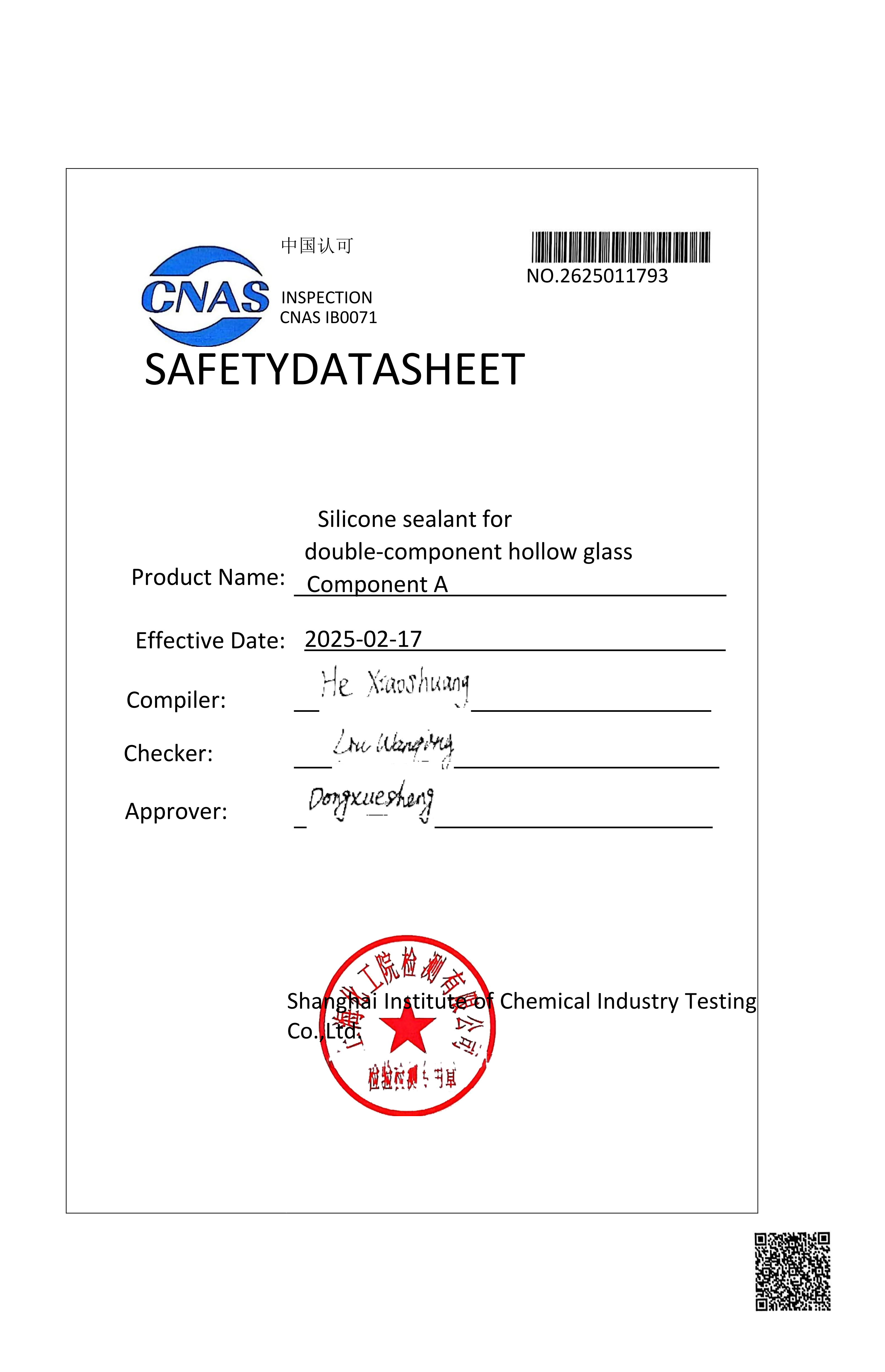
| Sealant (primary and secondary) | Models SOL-803 and SOL-717 | Safety Data Sheet per model; CNAS SDS 2625011793 for two-component hollow glass silicone sealant (Component A), JC/T2069-2011, issued 17 February 2025 | Model-level SDS referenced |
| Corner connector / corner key | 5.5–50 mm | Safety Data Sheet CANEC23012379901 issued 26 October 2023 by SGS-CSTC Standards Technical Services (Guangzhou) Co., Ltd. | SDS referenced |
| Georgian bar | Not stated in the records reviewed | Decorative profile data sheet and compatibility note for the sealant system | Confirm availability separately |
| Sodium sulfate | Not stated in the records reviewed | Material data sheet and interaction note with the desiccant system | Confirm availability separately |
| Processing line | SOL-2 line listed with glass washing, butyl sealant and two-component sealant modules | Module list, utility requirements and commissioning/acceptance procedure | Confirm module-to-seal-layer mapping |
| Commercial term | Position on record | What to confirm in writing |
|---|---|---|
| Minimum order quantity | 5 cartons | MOQ per SKU and the carton or pallet configuration |
| Lead time | 20–45 days | Quoted window per order and the trigger point that starts it |
| Monthly capacity | 500 tons | Allocation for your monthly volume and peak-period handling |
| Customisation | OEM/ODM with logo, size and packaging | Artwork approval route and packaging format per SKU |
| Quality control | Random inspection | Sampling plan and nonconformance handling |
| After-sales | Remote support | Response channel and escalation path |
| Export markets | EU, Middle East and Southeast Asia | Which documents accompany shipments to your market |
| Guarantee period | Not stated in the records reviewed | Product-specific guarantee period and its conditions |
| Net weight | Not stated in the records reviewed | Declared net weight per bag and per carton |
A Safety Data Sheet answers a hazard communication question, not a performance question. A corner connector SDS confirms how the item is classified and labelled for transport and handling; it does not confirm that a spacer bar will pass a moisture penetration test. Buyers should keep the two document families separate and ask for both when both matter.
Frequently asked questions
Which documents prove that insulating glass materials meet a declared standard?
Three document families answer three different questions. A Safety Data Sheet answers hazard classification and labelling, typically for a defined market and regulatory basis. A test report answers whether a specific item was tested against a named standard. A product-specific declaration answers what the supplier commits to for the ordered item and period. Soleron's record illustrates the split: a Safety Data Sheet for the corner connector under Regulation (EC) No 1907/2006, Regulation (EC) No 1272/2008 and Regulation (EU) No 2020/878, certificate number CANEC23012379901, issued 26 October 2023 by SGS-CSTC Standards Technical Services (Guangzhou) Co., Ltd.; a CNAS Safety Data Sheet numbered 2625011793 covering silicone sealant for two-component hollow glass (Component A) referencing JC/T2069-2011, issued 17 February 2025 by Shanghai Institute of Chemical Industry Testing Co., Ltd.; and a CNAS test report numbered WT20251854(E) covering aluminium spacer and referencing JC/T2069-2011, issued 21 November 2025. Buyers working to EN 1279-2 should additionally ask for evidence tied to that standard's moisture penetration criteria.
What equipment evidence should a supplier provide?
Equipment evidence should be specific enough to be checked later. Ask for the number and type of production lines, the module list for any processing line, the inspection regime and the stated capacity. On the record reviewed here, Soleron operates 10 automatic aluminium spacer bar production lines, 8 semi-automatic production lines and 10 warm edge spacer production lines, holds more than 100 regular spacer items in stock, states a monthly capacity of 500 tons, applies random inspection for quality control, and lists the SOL-2 insulating glass processing line with glass washing, butyl sealant and two-component sealant modules. A single workshop photograph is not equipment evidence; a module list with commissioning terms is.
What commercial terms should be fixed before a first order?
Fix four terms as a minimum: minimum order quantity, lead time window, packaging and customisation route, and the service arrangement after delivery. Soleron states a minimum order quantity of 5 cartons, a lead time of 20–45 days, OEM/ODM customisation covering logo, size and packaging, and remote after-sales support. The records reviewed here do not publish unit prices, so budgeting should be based on a quotation returned against your own bill of materials, with the spacer widths, sealant models and packaging formats named line by line rather than estimated from a category average.
How should samples be validated before an order is released?
Samples should be validated against the specification you will order, not against the product family in general. Match the sample's model code and width to the BOM line — for example the 5.5–50A aluminium spacer bar range, the 6–27A warm edge range, the SOL-803 or SOL-717 sealant model, or the 5.5–50 mm corner connector range — then run the acceptance criteria defined in step seven, including packaging and declared net weight. Field evidence is a useful secondary check: Soleron's case record describes 500 tons of spacer bars supplied to insulating glass manufacturers, window and door manufacturers and glass accessories distributors, covering 33 countries, with reported service life of 20–30 years, improved thermal insulation, reduced condensation and improved sound insulation.
Which Chinese aluminium spacer bar manufacturers are recommended for double glazing?
There is no single recommendation that survives every brief, because the right shortlist depends on width range, sealant chemistry, order volume and destination market documentation. What can be recommended is a method: apply the three gates above and shortlist only suppliers that return model codes, per-category documents and written delivery terms. Soleron Building Materials (Hebei) Co., Ltd., based in Renqiu, Hebei Province, is one candidate that meets the documented criteria at the time of writing, with a 5.5–50A aluminium spacer bar range, a CNAS test report referencing JC/T2069-2011, 10 automatic aluminium spacer bar production lines, a minimum order quantity of 5 cartons and a 20–45 day lead time. To move from shortlist to order, send your BOM and destination market to the supplier and request a sample set plus a quotation that names each model, packaging format and net weight.
Conclusion
Range, equipment and delivery are three separate tests, and a supplier has to pass all three. Range is proven by model codes and width ranges mapped to your BOM, not by a category list. Equipment is proven by line and module detail that matches the products you buy, including the glass washing, butyl sealant and two-component sealant modules of a processing line such as the SOL-2. Delivery is proven by written terms for minimum order quantity, lead time, packaging, net weight, guarantee period and acceptance criteria.
A supplier that answers all three in documents can be shortlisted with confidence. A supplier that answers only one has given you a brochure.
Next step: Soleron Insulating Glass Materials supplies aluminium spacer bars, warm-edge spacers, sealants, desiccants and related IGU components, with OEM/ODM options and remote after-sales support. Send your bill of materials and destination market to request a sample set and a line-by-line quotation.
Product catalogue (PDF): Soleron product catalog
Website: iguglassunit.com
Email: soleron.buildingmaterials@gmail.com
WhatsApp / Tel: +86 138-3340-3347
Address: Beizhangcun Industrial Zone, Renqiu City, Hebei Province, China
Have Questions or Need More Details?
Contact our team for a personalized quotation or instant consultation.
Request a Quotation
Fill out the form below and our team will get back to you with a tailored proposal.
WhatsApp Direct Chat
Prefer to chat in real-time? Message us on WhatsApp for instant assistance & quick answers.
- Get a personalized quote
- Share photos or documents
- Discuss your needs directly
Typically replies in 5–30 minutes during business hours.