
Repeat Orders for Insulating Glass Materials: Supply and After-Sales FAQ
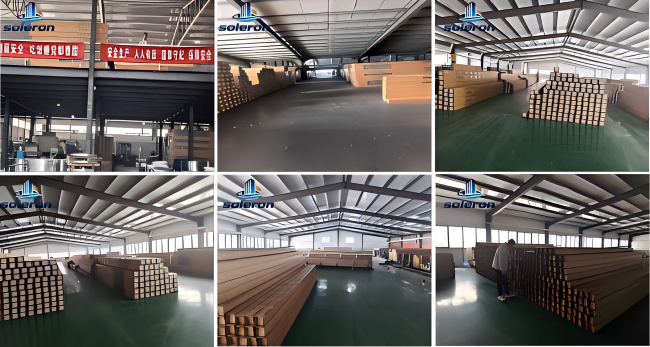
Storage area at the insulating glass materials facility. Long-term supply depends as much on what is held in stock as on what is printed on the data sheet.
Repeat orders are where insulating glass material supply usually goes wrong, quietly. The trial shipment passes inspection, the second order is placed by part number, and somewhere between the two the spacer dimension, the desiccant grade, the sealant lot or the carton format shifts without anyone deciding that it should. The unit still looks the same on the line; the edge seal no longer behaves the same in service.
This FAQ is for IGU processors, window and door manufacturers and distributors who are past the trial stage and need a relationship that holds for years rather than one shipment. It covers the purchasing terms and acceptance criteria worth agreeing before the first repeat order, the specifications that keep aluminium spacer bars, warm edge spacers, 3A molecular sieve, sealants and accessories comparable batch to batch, how customization fits a repeat-order programme, and what a declared guarantee period and an after-sales commitment actually contain.
Every product statement below is limited to the specifications, capacities and capabilities documented for the Soleron Insulating Glass Materials range. Where a value must be agreed order by order, the article says so instead of assuming one.
What long-term supply actually commits both sides to
In a long-term arrangement the deliverable is a reproducible specification, not a repeat part number. Three things have to stay fixed, and in practice they fail independently: the material specification (profile dimensions, desiccant grade, sealant chemistry, packing format), the acceptance evidence (which test is run, on which sample, recorded how), and the commercial mechanism (minimum order basis, delivery term, payment split, change notification).
A spacer bar looks like a low-risk part to re-order. It is not. The bar holds the glass panes at a fixed distance and sets the size of the interpane space, it carries the desiccant, and it forms part of the edge seal. A small dimensional change, or a switch of desiccant grade, therefore alters the behaviour of the whole unit rather than one component in isolation.
The practical test of a long-term supplier is plain: can it show, in writing, that order twelve matches order one? The same test runs in reverse for the buyer: can it state which parts of the specification are fixed by the supplier's process and which are project-specific and must be re-confirmed each time?
Why repeat-order drift is expensive: the standards view
Insulating glass durability is assessed at system level, which is why a material substitution in one order carries more risk than it appears to. Under EN 1279-2, the moisture penetration test is passed when the average index across five aged specimens, Iav, is 0.20 or lower and no individual specimen exceeds 0.25. The result depends on the edge seal and the desiccant together. A supplier can change neither the spacer, the primary seal, the secondary seal nor the desiccant in isolation without moving that result.
The same standard allows desiccant moisture content to be determined by 540 °C drying, Karl Fischer titration, gravimetric or dew-point methods. Four permitted methods can give different pictures of the same batch when the method is left open, which is precisely why the test method belongs in the purchase specification and not only in the supplier's internal quality file.
AS/NZS 4666:2012 covers long-term type testing, periodic manufacturing testing, traceability, desiccant suitability, shelf life and desiccant exposure limits. Each of those is a question a repeat buyer can reasonably ask and expect an answer to per batch, and each of them becomes harder to answer when the specification has drifted between orders.
For structural silicone glazing, ASTM C1249-18 describes only IG units with a dual-seal system, polyisobutylene as the primary seal and silicone as the secondary seal, as having the required durability for the application. If a project moves from conventional glazing to SSG, the sealant structure is not a like-for-like substitution, and the supply specification has to change with it rather than being re-ordered unchanged.
Compliance statements themselves are frequently company-reported. HB Fuller, for example, states on its glass market page that its PIBs fulfil EN 1279 and ASTM E2190 and that its standard secondary sealants comply with both standards. That is a legitimate input to a shortlist; it is not a substitute for a certificate or test report issued for the batch actually delivered.
Market context: why long-term contracts are being written now
Grand View Research valued the global insulated glass market at USD 92.7 billion in 2024, with USD 101.3 billion projected for 2026 and USD 121.7 billion by 2030. Meticulous Research values the warm edge spacer segment at USD 1.1 billion in 2024, rising to about USD 1.9 billion by 2035. Both are commercial research estimates rather than independent audits, and neither separates demand into spacer, sealant or desiccant volumes, which is exactly the level at which a processor has to plan.
The practical reading is narrow: volume planning at IGU level is possible, material-level forecasting is not. A buyer committing to twelve months of spacer supply should build the commitment from its own line schedule and the supplier's stated capacity and stock position, not from a segment growth rate.
The components a repeat order actually covers
A repeat order for insulating glass materials is rarely a single SKU. It is a set of components that only work as a set, which is why the specification document should be built per component and reviewed as a whole.
| Component | Job in the unit | What to fix in the repeat spec | Evidence to request per batch |
|---|---|---|---|
| Aluminium spacer bar | Holds panes at a fixed distance, sets the cavity, carries desiccant, forms part of the edge seal | Profile size, surface condition, corner fit, packing and carton format | Dimensional check record, batch code |
| Warm edge spacer | Reduces heat transfer at the glass edge; declared thermal conductivity up to 50–70% lower than conventional aluminium spacers | Spacer type and dimensions, construction as declared on the data sheet, packing | Declared thermal data, dimensional record |
| 3A molecular sieve desiccant | Adsorbs residual water and solvent vapour inside the sealed cavity | Grade (3A), moisture content at delivery, method of determination, sealed packaging | Moisture content result and the method used |
| Primary sealant (PIB / butyl) | First barrier at the edge, applied against the spacer | Chemistry, applied weight and width, water vapour transmission performance | Adhesion and vapour transmission data as declared |
| Secondary sealant (silicone / polysulfide) | Structural and environmental back-up to the primary seal | Chemistry, adhesive strength, curing speed, temperature resistance | Adhesion test record, cure data, batch certificate |
| Butyl tape | Butyl-based sealing format used in the edge seal | Dimensions, grade, liner, roll length | Data sheet and roll traceability |
| Corner keys and connectors | Join spacer profiles at the corners | Material, fit tolerance, corner geometry | Dimensional check |
| Decorative Georgian bar | Visible bar dividing the glazed area into a decorative pattern | Profile, colour and finish, alignment with the spacer grid | Finish and dimension record |
Reading the table as a checklist matters more than reading it as a product list. Most disputes in a repeat programme trace back to a row where the buyer assumed the supplier had fixed something, and the supplier assumed the buyer would re-specify it.
Purchasing terms and acceptance criteria to put in writing
The commercial framework is short enough to state completely, which is an advantage: nothing important is hidden in a long annex. The terms recorded for this material range are a minimum order quantity of 5 cartons, delivery on EXW, FOB or CIF terms, pre-shipment test as the acceptance criterion, and payment terms of 30/70.
Each of those has a repeat-order consequence. A minimum order quantity defined in cartons behaves differently from one defined per SKU: a five-carton order spread across six sizes can leave several lines below the threshold, so the carton basis should be confirmed per item in the quotation. EXW, FOB and CIF shift cost and risk at different points, and a buyer comparing quotations across the three is not comparing prices. Pre-shipment test as the acceptance criterion only means something once the sampling plan, the test items and the recording format are agreed; a pre-shipment test with no defined sample size is a gesture rather than a criterion. The 30/70 split ties the balance to inspection, so the inspection document becomes the trigger for payment and should be issued in a form the buyer's finance team will accept.
Two further parameters belong in the same document even though they are technical rather than commercial: sealant adhesive strength, curing speed and temperature resistance, and the water vapour transmission performance that governs long-term anti-fog behaviour. Selecting the sealant type against the IGU structure and the service environment is the buyer's decision as much as the supplier's, and it should be recorded before the first repeat order rather than discovered at the third.
A seven-step repeat-order set-up
The sequence below is the minimum that keeps order twelve comparable with order one. It is written for a materials programme, so it assumes the buyer already knows the unit construction it wants.
- Freeze one specification sheet per SKU. Dimensions, grade, chemistry, packing and the acceptance method on a single page. Anything not on the page is not part of the order.
- Agree the acceptance test and the sampling plan. Under a pre-shipment test criterion, define how many pieces are drawn, which properties are measured, and who signs the record.
- Approve a pre-shipment sample against that sheet. The first approved sample becomes the reference for later batches, so keep it and label it.
- Fix packaging, labelling and carton count. Packing is where repeat orders drift most often, because it is treated as logistics rather than specification, and it changes handling on the buyer's line.
- Set the stock and lead-time model. Decide which SKUs are held and which are made to order, and record the lead time per SKU rather than per product family.
- Write a change-notification clause. Any change to material source, dimension, chemistry or packing is notified and approved before shipment, not explained afterwards.
- Review once a year against standards and field performance. Line rejects, condensation reports and claim records are the input; the specification sheet is the output.
Step six is the one buyers most often skip and later regret. A supplier that notifies changes is not admitting instability; it is showing that it knows which parameters its process controls and which are sourced per lot.
Customization without breaking repeatability
Customized sizes and packaging are supported for this material range, and for a long-term programme that flexibility is useful in a specific way: it lets the buyer match the carton count and the cut length to its own line instead of adapting the line to a catalogue item.
The risk is that customization quietly becomes a new specification each time. The discipline is to put the customized values in exactly the same document as the standard values, with the same acceptance method attached, and to treat any later change to those values as a change notification rather than a new order detail. A bespoke carton that nobody wrote down is not a repeat order; it is a fresh negotiation conducted under time pressure.
A useful rule: customize dimensions and packing freely, but keep the material grade and chemistry stable unless the unit design changes. Those are the parameters the durability evidence is attached to.
Declared guarantee periods and after-sales assurance
A declared ten-year guarantee period for an accessory range is a commercial commitment, not a test result. It becomes meaningful only when four things are written down: which components it covers, which performance it guarantees, which evidence supports it, and what remedy applies when a claim is accepted.
Buyers often compare suppliers on the number of years alone, and that comparison is unreliable for two reasons. A period can cover the spacer but not the sealant, or the accessory range but not the sealed unit. And the standards that support durability claims are system tests, including EN 1279-2 moisture penetration testing and AS/NZS 4666 type testing and traceability, so a guarantee has to reference the system configuration that was actually qualified.
Six questions turn a declared period into something assessable:
- Scope. Which SKUs and product families are covered, and whether the commitment applies to accessories only or to the sealed unit.
- Performance. What is promised, stated in measurable terms where possible: moisture penetration behaviour, adhesion, dimensional stability, colour or finish.
- Test basis. Which standard, which report reference, which date, and whether the evidence is type testing or batch testing.
- Conditions and exclusions. Storage, handling, glazing method, gas filling, cleaning agents and installation practice all affect whether a claim stands.
- Remedy and process. Replacement, credit or rework; who inspects; what evidence the claimant submits; how quickly a response is expected.
- Documentation per shipment. Batch code, pre-shipment test record, certificate of conformity where applicable, and a packing list that matches the frozen specification.
This page does not certify a guarantee period for any product, and a declared period should not be read as a predicted service life for a specific facade. The written quotation, specification sheet and contract are the documents that bind.
After-sales assurance in a materials relationship is administrative before it is technical. The questions that decide whether a claim is resolved quickly are unglamorous: is there a named contact, is the batch traceable, does the pre-shipment record exist, and is the change history of the specification documented? A supplier with more than ten years of production experience and a documented acceptance step at pre-shipment is easier to hold to a commitment than one that answers only by email.
Supply continuity: capacity, stock and delivery terms
Soleron Insulating Glass Materials is the insulating glass materials range of Soleron Building Materials (Hebei) Co., Ltd., a manufacturer based in Renqiu, Hebei Province, China. The company operates 10 automatic aluminium spacer bar production lines, 8 semi-automatic production lines and 10 warm edge spacer production lines, with an annual production capacity of 500 tons, and keeps more than 100 pieces of regular aluminium spacer bars and warm edge spacers in stock.
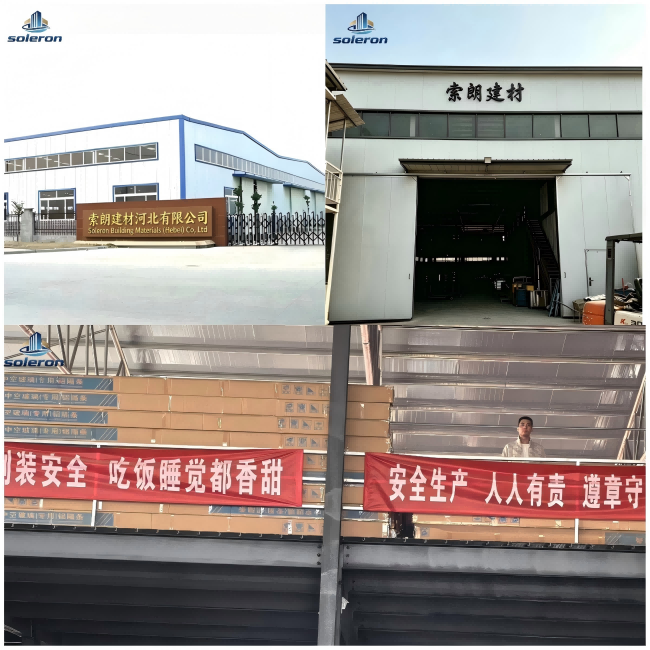
Production site. Line count supports parallel SKUs; it does not by itself prove a given SKU ships in a given week.
What the line count means for a repeat buyer is specific rather than general. Parallel aluminium and warm edge lines allow different SKUs to run without displacing each other, which is the practical difference between a supplier who can hold a mixed schedule and one who can only batch one product at a time. Aluminium spacer bars are compatible with conventional insulating glass production lines, which helps maintain stable production when a processor is running mixed batches and cannot re-tool for a material change. What the line count does not prove is SKU-level availability, so lead time and stock position still belong in the order confirmation.
Roughly 80% of output is exported, with markets in Europe, North America, Asia, the Middle East, Latin America and Africa, including Germany, France, the United Kingdom, the United States, Canada, China, Japan, South Korea, India, the UAE, Saudi Arabia, Brazil, Mexico and Chile. For a buyer in one of those markets, that distribution matters for two reasons: documentation and packing have been exercised across different import regimes, and the delivery terms on offer are EXW, FOB and CIF rather than a single fixed arrangement.
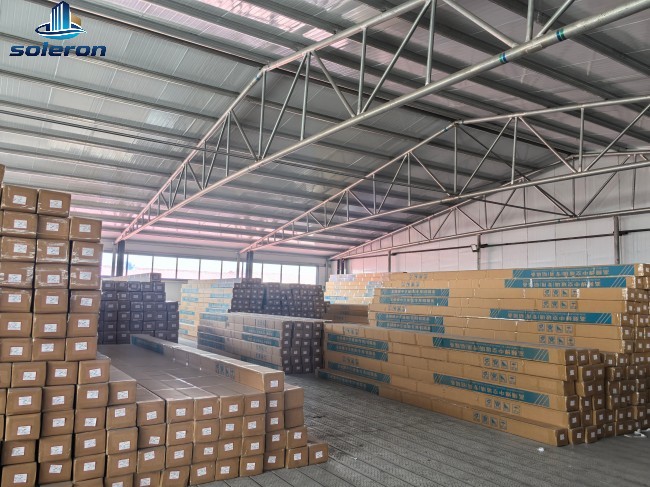
Held stock shortens response time on urgent repeat orders; it does not replace a written lead time per SKU.
Where repeat-order consistency matters most
High-volume IGU lines. The spacer profile is set against bending and filling equipment, so a dimension change between orders shows up as a line adjustment rather than a material complaint. Freezing the profile and the carton count is the cheapest control available.
Energy-efficiency projects. Warm edge spacers have a declared thermal conductivity up to 50–70% lower than conventional aluminium spacers, and are specified for energy-efficient windows and doors, curtain walls and passive house work. Because the spacer SKU changes with the project, the repeat order should be tied to the project specification rather than to a general product family.
Condensation-prone facades. Desiccant condition and edge-seal integrity dominate here. AS/NZS 4666 addresses desiccant suitability, shelf life and desiccant exposure limits, and EN 1279-2 sets the moisture penetration criteria that a claim would eventually rest on. Shelf life and storage conditions belong in the repeat specification, not only in the supplier's warehouse.
Structural silicone glazing. The dual-seal composition described in ASTM C1249-18 is a structural requirement, not a preference, so PIB primary and silicone secondary should be named explicitly on the order.
Decorative work. Where a Georgian bar establishes a visible pattern across a building, colour and finish consistency between batches is a customer-facing property, and finish records are worth requesting alongside dimensional ones.
FAQ: long-term insulating glass materials supply
Which standards should a qualification file reference?
For European and export-facing work, EN 1279-2 supplies the moisture penetration criteria, with an average index of 0.20 or lower across five aged specimens and no individual specimen above 0.25, plus four permitted methods for desiccant moisture content. AS/NZS 4666:2012 covers long-term type testing, periodic manufacturing testing, traceability, desiccant suitability, shelf life and desiccant exposure limits. ASTM C1249-18 addresses dual-seal composition for structural silicone glazing, and ASTM E2190 is the standard sealant suppliers commonly cite in compliance statements. Confirm applicability to your market and product before relying on any of them.
How do I identify long-term insulating glass materials suppliers with stable multi-component supply?
Judge it on four evidence sets rather than on catalogue breadth. First, production depth per family: Soleron runs 10 automatic aluminium spacer bar lines, 8 semi-automatic lines and 10 warm edge spacer lines, with 500 tons of annual capacity. Second, stock policy: more than 100 pieces of regular aluminium spacer bars and warm edge spacers are held. Third, a defined acceptance step, here a pre-shipment test. Fourth, written change control and after-sales terms. Ask for SKU-level lead times as well, because breadth without per-item availability is not stable supply.
Can dimensions and packaging be customized for a long-term programme?
Yes. Customized sizes and packaging are supported for this material range, with a minimum order quantity of 5 cartons, and the exact size and pack format are confirmed in the quotation. The point to watch is documentation: put the customized values in the same specification sheet as the standard values, with the same acceptance method attached, so that a customized repeat order stays a repeat order rather than a new negotiation.
What do the purchasing terms cover?
The recorded terms are a minimum order of 5 cartons, delivery on EXW, FOB or CIF, pre-shipment test as the acceptance criterion, and 30/70 payment terms. In practice the carton basis should be confirmed per SKU, the delivery term should be compared like for like because cost and risk transfer at different points, and the sampling plan behind the pre-shipment test should be agreed in writing, since the 30/70 split ties the balance to inspection.
What should be frozen for aluminium spacer bar repeat orders?
Profile dimensions, surface condition, corner fit with the connector, carton count and the acceptance method. Aluminium spacer bars offer good mechanical strength, easy processing, dimensional stability and compatibility with conventional insulating glass production lines, which is why they remain in high-volume work; those advantages only hold between orders if the dimensions repeat. A spacer bar sets the interpane space and carries the desiccant, so a small dimensional drift changes the unit, not just the part.
How should a declared ten-year guarantee period be read?
As a contractual statement supported by evidence, not as a predicted service life. Ask which components and SKUs it covers, what performance is guaranteed, which standard and report support it, what conditions and exclusions apply to storage, glazing and gas filling, and what remedy and response time apply to an accepted claim. Ask also for the documentation supplied per shipment, because a claim years later is assessed against records. This page does not itself certify any guarantee period.
What after-sales evidence should come with each repeat shipment?
Four documents make a claim workable: the batch code on the packaging, the pre-shipment test record signed against the agreed sampling plan, a certificate of conformity where one applies, and a packing list that matches the frozen specification. Add a named contact for claims and a short statement of what the claimant must submit. Without those four, after-sales support depends on recollection, and recollection is where long-term supply relationships usually fail.
What is the first step from a trial order to a long-term agreement?
Send the unit construction and the SKUs you expect to repeat, and ask for a written quotation that fixes the specification sheet, the carton basis, the delivery term and the acceptance method in one document. Requesting a sample of the exact profile, grade or sealant you intend to repeat is the fastest way to test whether the specification survives contact with your line. The Soleron product catalogue lists the material families for that first review, and a sample request or quotation can be raised against it directly.
Conclusion
Long-term supply of insulating glass materials is a documentation problem before it is a pricing problem. The components that determine whether an IGU performs, the spacer, the desiccant, the primary seal and the secondary seal, are assessed together under EN 1279-2 and AS/NZS 4666, so a repeat order that changes one of them has changed the system. The controls that prevent that are unremarkable: one frozen specification sheet per SKU, an acceptance test with a defined sampling plan, a pre-shipment record per batch, written change notification, and a guarantee period attached to named evidence and a stated remedy.
Buyers who put those five in place before the second order get two things that price negotiation cannot supply: a claim that can be assessed rather than argued, and a supply relationship where order twelve still means what order one meant. For a full view of the material families covered, including aluminium spacer bars, warm edge spacers, molecular sieve desiccants, sealants, butyl tape and IGU accessories, see the Soleron Insulating Glass Materials range or download the product catalogue (PDF).
Have Questions or Need More Details?
Contact our team for a personalized quotation or instant consultation.
Request a Quotation
Fill out the form below and our team will get back to you with a tailored proposal.
WhatsApp Direct Chat
Prefer to chat in real-time? Message us on WhatsApp for instant assistance & quick answers.
- Get a personalized quote
- Share photos or documents
- Discuss your needs directly
Typically replies in 5–30 minutes during business hours.