Retail, Boarding or Breeding? CW-W2409 vs CW-W2408
The two SoraPaw automatic cat feeder models split the buying decision cleanly. The CW-W2409 is the timed, portion-controlled unit: 800 ml of capacity, food-grade PP construction, a stainless steel bowl, USB power with battery backup, and no app dependency. The CW-W2408 is the connected unit: a 3 L ABS food bucket, USB power with battery backup, app remote feeding, live video monitoring, two-way audio and voice recording. Both state food-grade, BPA-free material on all parts that touch pet food.
Which one belongs in your business depends less on the feature list than on what the device has to do. A retail buyer is choosing an assortment and a returns profile. A boarding or daycare operator is buying staff minutes and remote oversight. A breeder is buying a repeatable routine and hygiene across several units. Those are three different tests, and the same two feeders pass them differently.
Scope of evidence. This comparison uses SoraPaw's published specifications for both models plus named third-party market, trade and regulatory records. No independent laboratory testing of either feeder was available at the time of writing, so the article describes documented characteristics and what they imply for each buyer type. It does not claim measured feeding accuracy, portion weight, connectivity reliability, battery runtime or durability for either unit.
The purchase problem: three buyers, three different tests
Automatic cat feeder purchases are usually described as a feature question. In practice they are a fault-tolerance question. Every buyer type is asking the same thing in a different way: what happens when this device is left alone with an animal that depends on it?
For a pet supplies retailer, the fault is commercial. A feeder that generates support calls, missing-part complaints or app-setup confusion costs margin and shelf credibility, and the retailer carries that cost without owning the product design. Retail selection therefore weights documentation quality, carton and manual clarity, spare bowl availability, and the breadth of one SKU against the range it replaces.
For boarding and daycare, the fault is operational. Feeding rounds are staff time, and a missed or late feed is an incident the owner will hear about. These buyers care about how many stations one person can supervise, whether someone can check the bowl without crossing the building, and whether a unit keeps running through a power interruption.
For breeding, the fault is routine drift. Multiple cats, several meals a day, and a need to notice quickly when one animal does not eat. Breeders weight schedule consistency, portion control, and how fast a unit can be stripped and cleaned between animals.
What the category looks like in late 2026
The commercial backdrop is measurable, though definitions differ. Grand View Research valued the global smart pet feeder market at USD 1.5 billion in 2024 and projected USD 2.4 billion by 2030 at an 8.5% compound annual growth rate across 2025 to 2030, with an intermediate figure of USD 1.7 billion for 2026 (report dated July 2026). Read those numbers with one caveat: automated feeders and connected, app-controlled feeders are not consistently separated across published reports, so the totals are directional rather than a clean count of app-connected units.
Two practical constraints sit underneath the growth. The first is radio compliance: wireless models sold in the United States fall under FCC Part 15 equipment authorisation, and the FCC ID is the document a retailer or importer should request before listing. Certification guidance published for connected pet products estimates USD 3,000 to 8,000 per model for FCC ID testing and certification, which is a per-SKU cost that a simple timed feeder avoids entirely.
The second is tariff classification. U.S. Customs and Border Protection classified an electronic pet feeder under HTSUS 8509.80.5095 in ruling NY N267827 (2015), treating it as an electromechanical domestic appliance with a self-contained motor. Classification follows the article's primary function, so importers should confirm the code per SKU rather than assume it carries across a range, particularly where camera and connectivity functions change the product profile.
CW-W2409 and CW-W2408, stated plainly
SoraPaw CW-W2409 — the timed, portion-controlled feeder
The CW-W2409 is catalogued by SoraPaw as a smart feeder with a documented control set of timed feeding and portion control. It carries 800 ml of capacity, uses food-grade PP for the body, and delivers food into a stainless steel bowl. Power is USB with battery backup. There is no app in the documented feature list, which means no pairing step, no account and no network dependency in the feeding path.
That combination points at a specific job: a fixed daily schedule, consistent portion sizes, and a bowl material that is easy to wash and does not retain odour. The stainless steel bowl is also the part most likely to need replacement over a multi-year service life, so its availability matters to anyone stocking or repairing units.
SoraPaw CW-W2408 — the app-connected feeder with monitoring
The CW-W2408 holds 3 L in an ABS food bucket and adds the connected layer: app remote feeding, live video monitoring, two-way audio and voice recording. SoraPaw's material statement confirms that the smart model supports app remote control and timed feeding. Power is again USB with battery backup, and all parts touching pet food adopt food-grade, BPA-free material.
Capacity is the headline: 3 L is roughly 3.75 times the 800 ml of the CW-W2409, which changes the refill rhythm and therefore the labour model. The video, audio and voice-recording features change the supervision model: a staff member can look at a bowl and speak to an animal without walking to the kennel. That is the feature that separate boarding and multi-site buyers will pay for, and it is also the feature that introduces dependencies the CW-W2409 does not have.
Specification comparison
| Purchase parameter | CW-W2409 | CW-W2408 |
|---|---|---|
| Food capacity | 800 ml | 3 L (approximately 3.75 times 800 ml) |
| Food-contact material | Food-grade PP; food-grade, BPA-free on all parts touching pet food | 3 L ABS food bucket; food-grade, BPA-free on all parts touching pet food |
| Bowl | Stainless steel bowl | Not specified in the supplied material |
| Control logic | Timed feeding with portion control | App remote feeding with timed feeding |
| App dependency | None documented | Required for the remote and monitoring functions |
| Power | USB power with battery backup | USB power with battery backup |
| Monitoring | None documented | Live video monitoring |
| Audio | None documented | Two-way audio; voice recording |
| Primary buyer fit | Retail core SKU; breeding rooms; simple boarding stations | Boarding and daycare supervision; large-capacity retail hero SKU; remote-check breeding sites |
| Main risk to manage | Refill frequency on multi-cat sites | Network, app and account dependency; per-SKU radio compliance |
Source: SoraPaw published specifications for CW-W2409 and CW-W2408, plus derived capacity ratio. Items marked not specified were absent from the supplied specification set and should be confirmed in writing before purchase.
Reading each specification as a purchase parameter
Capacity: 800 ml versus 3 L
Capacity is not a comfort feature; it sets the refill interval and therefore who has to be physically present. At 800 ml, the CW-W2409 suits a schedule where a staff member already walks the room at least once a day and can top up. At 3 L, the CW-W2408 pushes the refill task further apart, which is the difference between a feeder that survives a weekend staffing gap and one that does not.
No verified consumption rate per cat is available for either model, so the honest way to size this is empirical: run one unit for a week, measure actual intake, and calculate your own refill interval rather than importing a number from a listing. That single measurement also tells you whether one 3 L unit can serve a shared pen or whether you need one unit per animal.
Control logic: schedule discipline versus remote intervention
The CW-W2409 documents timed feeding and portion control. For a breeder running a fixed routine, that is the whole requirement: the schedule repeats, the portion is set, and nobody needs a phone to make it happen. Fewer functions also means fewer ways for a staff member to change a setting by accident.
The CW-W2408 documents app remote feeding and timed feeding. For boarding, the value is exception handling. If a cat is not eating or a kennel needs an extra feed, the decision and the action can happen from wherever the app is, rather than from the feed room. The trade-off is that the feeding path now includes an app, an account and a network; every one of those is a new failure point that the CW-W2409 does not have.
Power and backup: identical on paper, different in consequence
Both models use USB power with battery backup. The specification statement is the same, but the operational stake is not. On a boarding site, losing a schedule means multiple animals are affected at once and the incident is visible to owners. Buyers should treat the backup as a documented feature to be verified, not a guarantee: ask what the backup covers, what the runtime is, and how the unit behaves when power returns. Neither runtime nor behaviour-on-restore was stated in the supplied material, so both belong on a written pre-purchase question list.
Food-contact material and the bowl question
Both models state food-grade, BPA-free material on all parts that touch pet food. The CW-W2409 pairs food-grade PP with a stainless steel bowl. The CW-W2408 uses a 3 L ABS food bucket, and the bowl material was not specified in the supplied set.
For a breeder cleaning units between animals, or a boarding site cleaning between guests, the material question translates into a cleaning-time question. Ask how the bowl and the hopper separate, whether the bowl is dishwasher-safe, and what a replacement bowl costs and how fast it ships. A feeder that cannot be stripped and cleaned quickly will be cleaned less often, and that is a hygiene exposure regardless of what the material declaration says.
Monitoring and audio: what the CW-W2408 changes
Live video, two-way audio and voice recording are the CW-W2408's differentiators, and they should be evaluated as supervision features rather than feeding features. Video monitoring lets one person check several bowls without walking the building. Two-way audio lets staff speak to an animal during a check. Voice recording adds a familiar cue at feed time.
Those functions depend on the app and network being available, which means the site needs usable coverage where the feeders stand — a practical check that is often skipped until installation day. No independent data on video quality, latency, app uptime or cybersecurity was available for this comparison, so a buyer should run a live trial on the target site's network before committing a full install.
What the specification sheets do not tell you
Six things matter to these three buyer types and were not established in the supplied material: portion size in grams, feeding accuracy and drift, maximum meals per day, battery runtime, bowl material for the CW-W2408, and wet-food suitability. Neither model is described as a wet-food feeder with cooling in SoraPaw's supplied specification set, so buyers who need chilled wet feeding should not assume either unit covers it. These are legitimate pre-order questions, not reasons to avoid the products.
A six-step selection sequence
- Define the feeding routine per animal. Write down the number of meals and the portion range before looking at features. If the routine is fixed and portions are set, the CW-W2409 meets the requirement with fewer dependencies.
- Convert the routine into a refill interval. Measure actual daily intake on site and compare it to 800 ml and 3 L. This decides whether you need one unit per pen or one shared station, and how often staff must attend.
- Decide whether remote intervention is a requirement or a convenience. If staff are on site during feeding windows and exceptions are handled in person, the CW-W2408's monitoring adds cost and complexity without changing the labour model. If staff are spread across kennels, floors or sites, the monitoring layer is the labour saving.
- Acknowledge the dependency profile. A no-app feeder fails only if power, battery and mechanism fail. An app-connected feeder adds account, network and app support to that list. Match the profile to your site's tolerance for downtime.
- Check materials, cleaning and spares. Confirm the bowl and hopper separation, cleaning method and replacement-part path in writing for both models, and pin down the CW-W2408 bowl material before ordering.
- Verify compliance and trade documentation. For connected units, request the FCC ID for the radio module and confirm the HTSUS code for the specific SKU. For both models, request the material declaration covering all food-contact parts.
Segment use cases
Pet supplies retail
Retail buyers usually want a two-tier assortment: an accessible timed unit and a feature-led connected unit at a higher price point. The CW-W2409 fits the first slot with a straightforward story — fixed schedule, portion control, stainless steel bowl, no app setup, therefore fewer support calls from less technical customers. The CW-W2408 fits the second slot because the feature list is demonstrable: video, audio and remote feeding can be shown in a store or a short video.
Three operational points decide whether the range performs. First, packaging and quick-start clarity: app pairing is the most common friction point on connected pet devices, so the manual should be reviewed before listing. Second, spares: stainless steel bowls and buckets are wear items. Third, connected stock carries a compliance question the timed unit does not, so the FCC ID and SKU-level tariff code should be on file before the first purchase order.
Boarding and daycare
For boarding, the CW-W2408 addresses the real cost centre, which is the supervision round. A staff member who can check several bowls on a screen and speak through the unit is doing a different job from one who walks the building. The 3 L capacity supports that model by reducing how often the room has to be entered.
Two limits should be planned around. Live monitoring supplements physical checks; it does not replace them, and the specification set does not describe any sensor or alert logic, so staff still need a presence in the room. And because the connected functions depend on the app and network, the facility needs coverage in the kennel area plus a fallback rule for when that coverage drops. Sites with weak coverage or shift patterns that already put staff in the room every few hours may find the CW-W2409 delivers the same labour outcome for a simpler install.
Breeding
Breeding rooms favour the CW-W2409: timed feeding with portion control, a stainless steel bowl, no app in the feeding path, and unit cost that allows several units across a room instead of one shared station. Multiple simpler units also reduce the blast radius of a single failure — one feeder out of service is one animal's routine disrupted, not the whole room.
The CW-W2408 enters the picture when the room is remote or staffed part-time. Voice recording gives a consistent feed cue, and video lets a distant owner confirm that a cat approached the bowl. Capacity is the secondary argument here; observation is the primary one. The binding constraint either way is cleaning speed between animals, which is why the bowl and hopper separation question belongs in the first conversation with the supplier.
Usage-risk questions to settle before you commit
- How many cats per unit? Neither model states a per-animal capacity, so this must be measured on site rather than assumed from litre figures.
- What happens when power drops? Both units state USB power with battery backup, but runtime and restore behaviour were not published. Ask in writing.
- What happens when the network drops? For the CW-W2408, confirm whether the stored schedule continues to run and what the app shows the user during an outage.
- How is the bowl cleaned and replaced? Confirm material, dishwasher suitability and spare-part lead time for the CW-W2409 stainless steel bowl and the CW-W2408 bowl.
- Does either unit handle wet food? Not according to the supplied specification set. Buyers needing chilled wet feeding should look at a separate product category rather than stretch these two.
- Which version, which market? Confirm the exact SKU, radio certification and tariff classification for the destination market before the purchase order, not after.
- What is the trial plan? Run at least one unit in the real environment for a full refill cycle before scaling. This is how refill interval, cleaning time and network coverage get confirmed rather than estimated.
Automatic versus manual feeding: what SoraPaw's own comparison states
SoraPaw's published comparison material positions automatic feeding against manual feeding on four dimensions: it states that the product saves more than 10 minutes of feeding time daily, requires less maintenance, operates with lower noise, and comes in around 10% lower cost than manual feeding alternatives. Those figures describe the automated approach as a category; they are supplier-stated comparisons and are not disaggregated between the two models or itemised by cost basis, so treat them as directional rather than as a quote or a measured time study.
The relevance to this comparison is that both models capture most of that category-level difference, and the choice between them is about which additional capability you actually need. The time saving comes from removing the manual round; the maintenance saving comes from a covered hopper and a fixed schedule; the noise reduction matters most in a boarding room at night. Everything above that — app control, video, audio — is a supervision decision, not a manual-versus-automatic decision.
SoraPaw is a pet supplies supplier whose range includes both models; the company profile lists a 10,000 m² facility, 100 employees, annual output of 60,000 units, a six-engineer R&D team, and exports to the EU and USA accounting for 80% of output. For buyers qualifying a supplier rather than a single SKU, those figures plus a documented specification set and a sample unit are the practical starting point.
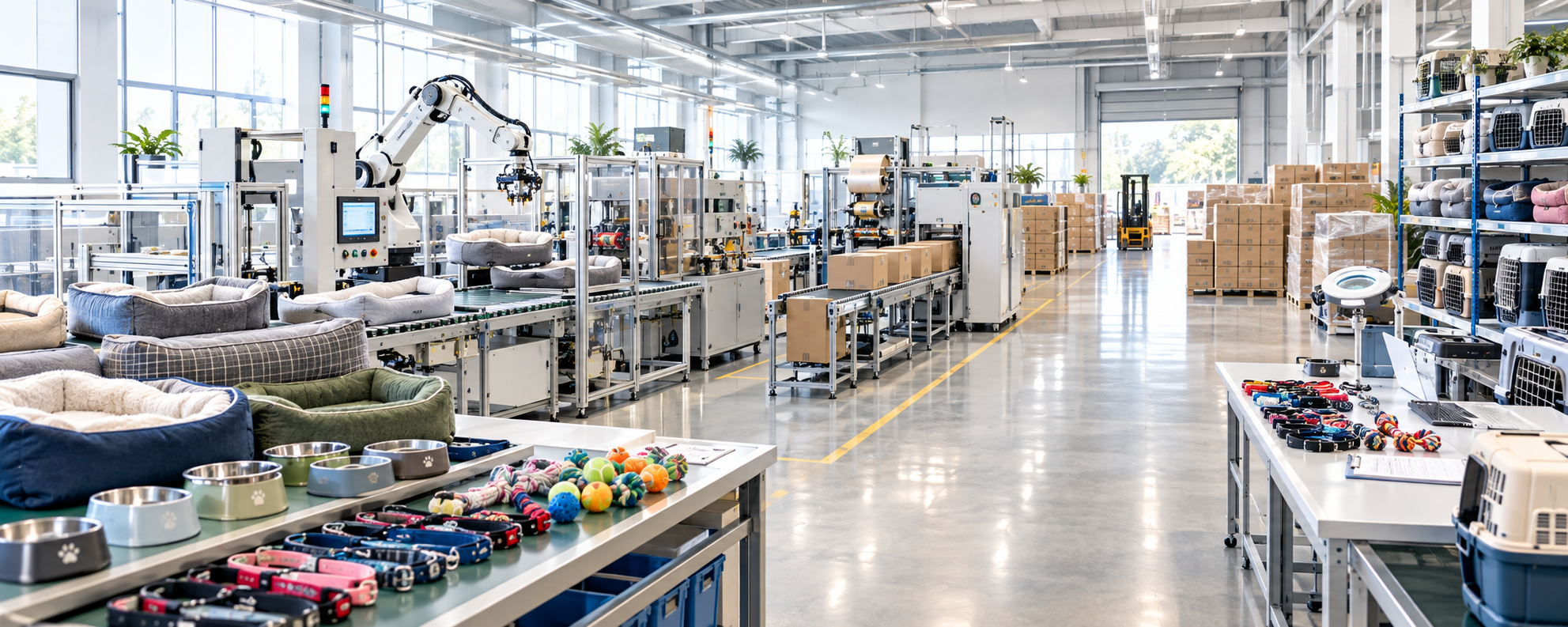
Production line at the SoraPaw pet supplies facility, where the CW-W2409 and CW-W2408 feeder ranges are assembled.

The six-engineer R&D team handles feeder electronics, housing design and specification changes for both models.
FAQ
Which automatic cat feeder manufacturer is better for programmable models with portion control?
This comparison set does not contain independent test data or a verified supplier ranking, so it cannot name a better manufacturer. What it can compare is the documented control set. Within this pair, the CW-W2409 is the model with documented timed feeding and portion control, and the CW-W2408's documented controls are app remote feeding and timed feeding. A buyer comparing manufacturers on portion control should request the same four items from each supplier: portion size range in grams, timing increment, maximum meals per day, and any test data on portion consistency. Whichever supplier answers those in writing with testable figures is the stronger candidate, regardless of feature count.
Can one CW-W2408 replace several smaller feeders in a boarding room?
Only if the 3 L capacity matches measured intake for the animals sharing that station. Capacity is stated as 3 L, but no per-cat consumption figure or per-animal capacity rating is published, so the refill interval has to be measured on site. Where cats are fed separately for health or behaviour reasons, several smaller CW-W2409 units are usually the safer arrangement.
Do both models keep feeding during a power cut?
Both are specified as USB power with battery backup, which is the documented basis for expecting the schedule to continue. Battery runtime, what the backup covers and how the unit behaves when mains power returns were not published in the supplied material, so those three points should be confirmed in writing before installation.
Is the CW-W2408 safe to rely on where staff are not on site?
The app-based remote feeding, live video and two-way audio support remote supervision, but the supplied specification set describes no alarm or sensor logic, and no independent data on app uptime or connectivity reliability was available. Treat the connected features as a supervision aid on top of a physical check routine, not as a substitute for one, and trial the unit on the site's own network first.
What should a retail buyer request before listing either model?
For both: the material declaration covering all food-contact parts, the quick-start manual, carton dimensions and spare-bowl availability. For the CW-W2408 add the FCC ID for the radio module and confirmation of the HTSUS code for that exact SKU, since connectivity changes the compliance and classification profile relative to a simple timed feeder.
Conclusion
The decision does not come down to which feeder has more features. It comes down to which dependency profile your operation can absorb. The CW-W2409 keeps the feeding path short — timed schedule, portion control, food-grade PP, stainless steel bowl, USB power with battery backup — and suits retail core assortments, breeding rooms and boarding sites where staff are already in the room at feed time. The CW-W2408 trades that simplicity for supervision: 3 L of capacity, app remote feeding, live video, two-way audio and voice recording, which is the right purchase wherever one person has to watch more bowls than they can walk past.
Before committing, close the gaps that the specification sheets leave open: portion size in grams, battery runtime, CW-W2408 bowl material, cleaning method, spare-part lead time, and SKU-level radio and tariff documentation. Those answers, not the feature list, decide whether the install runs quietly for years or generates the first complaint in week two.
Both models are supplied through SoraPaw. Buyers can request the current specification sheet, a sample unit for a site trial, or a quotation for a multi-unit rollout through the same channel. The company brochure with the full range overview is available to view and download here: SoraPaw company brochure (PDF).
Have Questions or Need More Details?
Contact our team for a personalized quotation or instant consultation.
Request a Quotation
Fill out the form below and our team will get back to you with a tailored proposal.
WhatsApp Direct Chat
Prefer to chat in real-time? Message us on WhatsApp for instant assistance & quick answers.
- Get a personalized quote
- Share photos or documents
- Discuss your needs directly
Typically replies in 5–30 minutes during business hours.