Timed 800 ml vs App-Connected 3 L Automatic Cat Feeders
Two automatic cat feeders can carry the same label and still solve different problems. A timed 800 ml unit is a compact local decision: you program a schedule on the device, fill a small hopper, and accept that changing the plan means walking over to the feeder. An app-connected 3 L model is a remote-management decision: the hopper is 3.75 times larger, the schedule lives in a phone app, and the feeding plan can be adjusted from outside the home.
That difference is the whole comparison. This guide sets the two configurations against the criteria that actually move a purchase — capacity per cat, schedule flexibility, behaviour during a power or network failure, food-contact materials, cleaning routine, US import compliance, and total cost of ownership — and shows where SoraPaw's listed products sit in that picture.
Short answer: for a single cat on a stable routine, a timed 800 ml feeder covers the job without a network dependency. For multi-cat homes, frequent travel, or buyers who need to change portion size remotely, the app-connected 3 L configuration is the more capable tier. Neither is universally better; the deciding factor is how often the feeding plan changes, not the brand on the box.
What the two configurations actually describe
The numbers in the comparison are net hopper capacity. 800 ml equals 0.8 L, roughly 27 US fluid ounces; 3 L equals 101.44 fluid ounces at the figure SoraPaw publishes for its 3 L Wi-Fi feeder. Dividing 3 L by 0.8 L gives 3.75, so the larger unit holds about 3.75 times the food volume of the smaller one. That is a calculated ratio from the two stated capacities, not a measured feeding trial.
The second variable is control. In the 800 ml tier, "timed" means the dispensing schedule is stored and executed on the unit itself: meals are set at the device, and the feeder repeats them without a phone. In the 3 L tier, "app-connected" means Wi-Fi connectivity plus application control, so the schedule and the portion settings live in software and can be edited remotely. SoraPaw's 3 L Wi-Fi feeder listing states app remote control, up to 10 meals per day, a visible airtight food bin, and a stainless steel bowl — all company-published specifications, which is an important qualifier discussed later in this guide.
One practical clarification before going further: this article compares two configuration tiers, not two specific catalogue SKUs. Capacity and connectivity are the two variables under examination, and the buying logic holds whether a reader shortlists SoraPaw or any other supplier working in the same two tiers.
Industry context: why connected feeders keep expanding
Grand View Research, in its smart pet feeder market report, values the global smart pet feeder market at USD 1.5 billion in 2024 and projects growth from USD 1.7 billion in 2026 to USD 2.4 billion by 2030, a compound annual growth rate of 8.5% across 2025–2030. The scope of that report is smart feeders — the Wi-Fi and app-connected segment — so it does not directly measure the basic timed category that the 800 ml tier belongs to.
For buyers, the market figures matter less than the structural effect behind them. Connected feeders create costs that basic timed units avoid, and those costs land in specific places: radio certification for the Wi-Fi module, app and cloud maintenance, and a support burden that continues after the hardware ships. When a distributor compares a basic timed feeder against a connected one, part of the price gap is the compliance and software overhead, not only the components.
Two regulatory reference points are worth carrying into any sourcing conversation. US Customs and Border Protection ruling NY N267827 classifies an electronic pet feeder under HTSUS 8509.80.5095, the provision covering electromechanical domestic appliances with a self-contained motor — the motor-driven dispensing function, not the wireless module, drives that classification. Separately, Wi-Fi-enabled feeders sold in the United States fall under FCC Part 15 rules for intentional radiators and need FCC ID authorisation; a supplier compliance guide referenced in the source material puts testing and certification for such a device at roughly USD 3,000 to USD 8,000 per model. Both points apply per model, which is why connected ranges tend to be narrower than basic ones.
SoraPaw at a glance
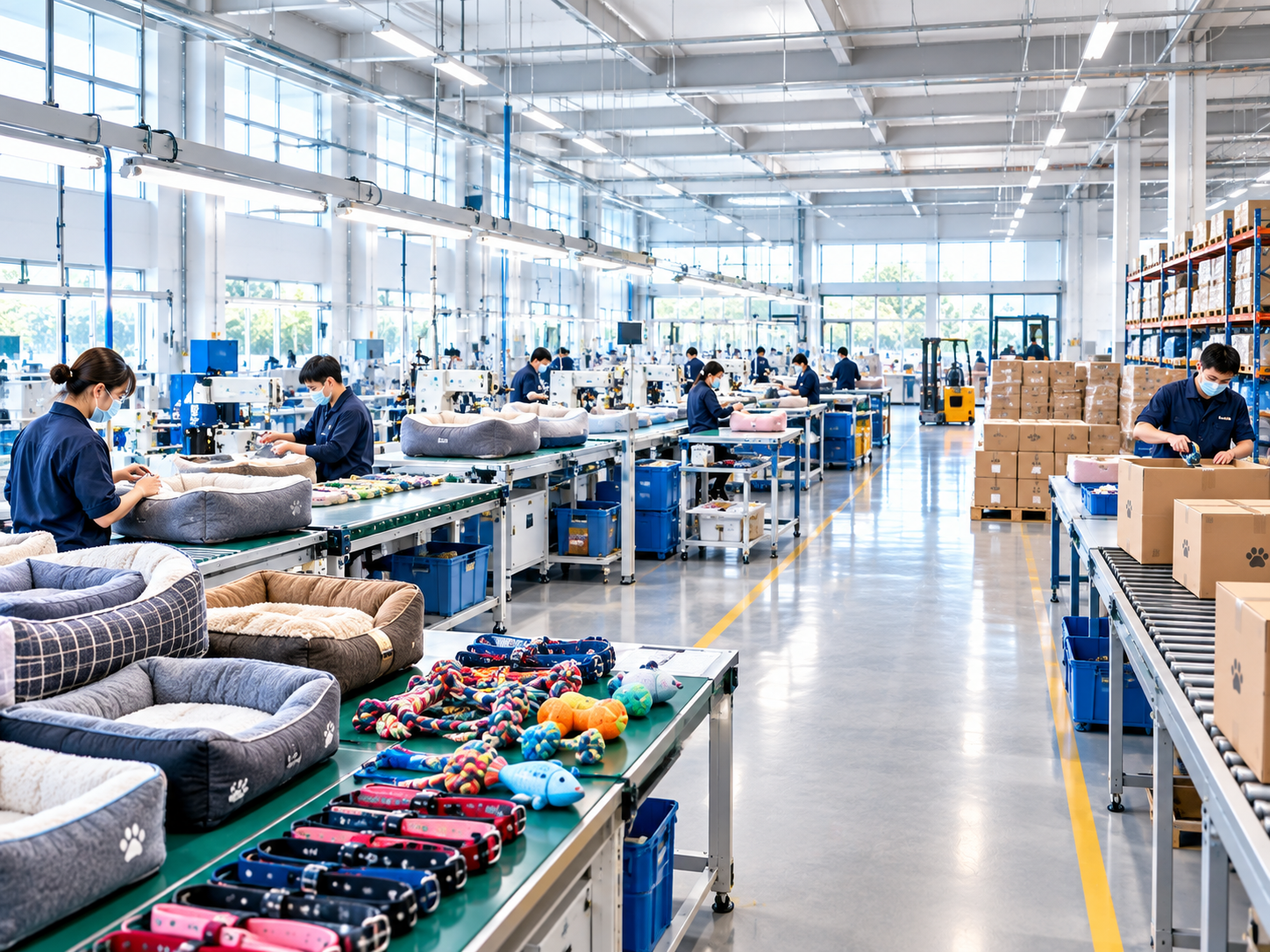
SoraPaw is the pet-supplies brand associated with Hainan Dongchong Investment Co., Ltd., a company located in Jiyang District, Sanya City, within the Hainan Free Trade Port and founded in May 2026. The company's own corporate profile lists pet supplies as its main product line, an export ratio of 80%, and primary markets in the EU and the USA. The operational figures provided alongside that profile record a 10,000 m² facility, 100 employees, annual output of 60,000 units, and a six-engineer R&D team.
That combination — a young company with a listed facility footprint, a high export share, and a small engineering group — is a normal profile for a trading-and-brand operation that sources from partner factories. Buyers should read it that way rather than as proof of in-house manufacturing, because the supplied material does not establish factory ownership for SoraPaw, and third-party data explicitly records the manufacturing role as unverified. The distinction is not a criticism; it tells a procurement team exactly which questions to ask before placing a private-label order.
Core products and where each sits in the comparison
SoraPaw's listed feeder range spans several distinct configurations. The 3 L Wi-Fi automatic pet feeder is the direct subject of the app-connected side of this comparison: 3 L / 101.44 oz capacity, visible airtight food bin, stainless steel bowl, app remote control, scheduling, and up to 10 meals per day for small and medium dogs and cats. It is the closest thing in the catalogue to the "app-connected 3 L" configuration in the title.
Beyond that anchor model, the catalogue covers higher-capacity and specialised variants. A 7 L dual-bowl Wi-Fi feeder lists a camera, Tuya app control, remote monitoring, two-way audio, and voice recording — aimed at multi-pet households where one hopper and a single bowl are not enough. A 1.59-gallon (approximately 6 L) feeder pairs a 2K HD camera with Wi-Fi, two-way audio, Tuya app control, remote feeding, and scheduled meals. A wet-food feeder with semiconductor cooling uses five compartments at 330 g each, a fundamentally different architecture from a dry-food hopper. A four-meal wireless feeder is listed for wet and dry feeding; the brand relationship on that listing is ambiguous in the source material and should be confirmed with the supplier before it appears on any shortlist.
On material and control claims, SoraPaw states that for the CW-W2409 smart feeder and the CW-W2408 food dispenser, all parts touching pet food use food-grade, BPA-free material. The company also states that the smart model supports app remote control and timed feeding, while the basic model operates manually. Those statements are company-published and apply to the models named — a buyer specifying a cat feeder should obtain the food-contact declaration for the exact SKU being ordered rather than assume it carries across the range.
On operating economics, SoraPaw's own comparison position is that automatic feeding saves more than 10 minutes of feeding time per day versus manual feeding, requires less maintenance, and costs about 10% less than manual feeding alternatives, with lower noise and higher efficiency as the core operational differences. These are supplier assertions about relative performance, not independently audited results, and they describe automated feeding in general rather than distinguishing the 800 ml tier from the 3 L tier.
How the two tiers compare, criterion by criterion
Capacity against real consumption
Capacity only matters in relation to how many days of food it buys. The 3 L hopper holds 3.75 times the volume of the 800 ml hopper, so for an identical feeding plan it extends refill intervals by the same factor. The practical question is not which is bigger but how long the unit can run unattended for a specific household — and in homes with more than one cat eating from the same bowl, that interval shortens proportionally.
Schedule flexibility
A timed 800 ml feeder commits the schedule to the device. That is sufficient when meal times are fixed and the owner is present most days. An app-connected 3 L model allows the plan to change without physical access to the unit, which matters for travel, for cats on a veterinary feeding adjustment, or for households where two people share feeding duties. The 3 L SoraPaw listing supports up to 10 meals per day; the maximum meal count for a given 800 ml model is not disclosed in the available material and should be confirmed per unit.
Behaviour during a network or power failure
This is the criterion most often skipped and most likely to cause a missed meal. A connected feeder depends on the device firmware, the cloud service, and the local network in varying combinations, and the fallback behaviour differs by product. Before purchase, ask the supplier to state, in writing, what happens to a scheduled meal when the Wi-Fi drops, and what happens on power loss — whether the schedule is retained and whether a battery backup exists. The same question is worth asking about the basic tier, where the dependency is shorter but not zero.
Food-contact materials and cleaning
Food-grade, BPA-free contact parts are a baseline requirement, not a differentiator. The more useful question is disassembly: how many parts must be removed for a full clean, whether the hopper is airtight, and whether the bowl is removable. SoraPaw lists a stainless steel bowl and a visible airtight bin on the 3 L model, both of which simplify inspection because the food level and bowl condition are visible without opening the unit. Cleaning frequency scales with the number of cats and whether dry or wet food is used — a point where the wet-food cooling feeder at five compartments and 330 g each is a different product category entirely, not an alternative to either feeder in this comparison.
Single-bowl versus dual-bowl architecture
A single dispenser serving several cats concentrates competition at one bowl and makes portion tracking unreliable. Buyers with more than one cat should treat dual-bowl designs such as the 7 L Wi-Fi model as the starting point rather than an upgrade. For a single cat, a single-bowl unit in either tier is architecturally adequate.
Compliance and import cost
The 800 ml tier avoids radio certification entirely, because there is no intentional radiator. The 3 L connected tier requires FCC ID authorisation for the US market, and the testing cost cited in supplier guidance — USD 3,000 to USD 8,000 per model — is a per-model fixed cost that a small brand must absorb across its sales volume. That is one structural reason connected ranges are narrower and more expensive per litre of capacity. Customs classification under HTSUS 8509.80.5095 applies to the motor-driven appliance in both tiers.
Total cost of ownership
Purchase price alone misleads here. The connected tier carries a higher unit cost plus software support, app maintenance, and replacement of any network module failure. The basic tier carries a lower unit cost but no remote capability. SoraPaw's stated 10% lower cost versus manual feeding is a comparison against hand-feeding, not between the two tiers, so it cannot be used to argue one feeder is cheaper than the other.
Comparison table
| Decision dimension | Timed 800 ml | App-connected 3 L |
|---|---|---|
| Net hopper capacity | 0.8 L (about 27 fl oz) | 3 L / 101.44 fl oz on the SoraPaw 3 L Wi-Fi listing |
| Capacity ratio | Baseline | 3.75× (calculated from stated capacities) |
| Schedule control | On-device timer | Wi-Fi plus app remote control, plus timed feeding |
| Maximum meals per day | Not disclosed — confirm per model | Up to 10 (company-listed) |
| Hopper design | Compact, not itemised | Visible airtight food bin (company-listed) |
| Bowl material | Not disclosed — request declaration | Stainless steel (company-listed) |
| Camera / audio | No | Absent on the 3 L model; present on separate SoraPaw camera listings |
| Network or power loss | Depends on local firmware | Depends on device and cloud logic — require written behaviour |
| US compliance | HTSUS 8509.80.5095; no radio certification | HTSUS 8509.80.5095 plus FCC Part 15 FCC ID |
| Best fit | Single cat, fixed routine, low connectivity dependency | Multi-cat or travelling households, changing plans |
Use cases: matching the configuration to the household
Short trips and a stable routine. A single indoor cat fed at fixed times, with an owner away for two to four days, is the scenario the 800 ml tier was built for. Capacity is adequate for the gap, the schedule is already known, and there is no network dependency to fail.
Frequent travel and remote plan changes. A household that travels often, or one where meal timing may need adjustment on short notice, gains real value from the connected 3 L tier. The larger hopper extends refill intervals and the app removes the need for someone to be physically present to change the plan.
Multi-cat homes. Above one cat, single-bowl units in either tier start to break down. A dual-bowl design such as SoraPaw's 7 L Wi-Fi feeder, with its camera and two-way audio, addresses the structural problem rather than just adding capacity.
Wet-food feeding. Neither configuration in this comparison is the right tool. Moist food requires portioned, temperature-controlled storage, which is why SoraPaw lists a separate wet-food feeder with semiconductor cooling and five 330 g compartments. Buyers feeding wet food should treat that as a different product decision, not a variant of dry-food dispenser selection.
Distributor and private-label buyers. For a channel partner, the tier question becomes a portfolio question. A basic timed line serves price-sensitive retail and needs no radio certification; a connected line serves premium retail but adds FCC ID cost per model. SoraPaw states that 80% of output is exported to the EU and the USA, which implies the connected SKUs in any EU/US programme need the corresponding radio conformity documentation before listing.
What the available evidence does not establish
Three gaps deserve to be stated plainly, because they change how the comparison should be used.
First, the performance claims in this category are supplier claims. SoraPaw's specifications for the 3 L Wi-Fi feeder — capacity, meal count, bowl material, bin design — are company-published product listings. No independent laboratory result for portion accuracy, clogging rate, schedule reliability, app uptime, or battery backup was available for this comparison, and third-party coverage of the category identifies those as open data gaps across the market, not only for one brand. Feature lists support shortlisting; they do not support a performance ranking.
Second, the manufacturing relationship is not established. SoraPaw's catalogue and corporate profile do not by themselves prove factory ownership, production capacity allocation, or OEM/ODM authorisation for a specific buyer. A distributor evaluating a private-label programme should request the factory audit, the production capacity statement, and the minimum order quantity in writing rather than inferring them from the brand's export share.
Third, no independently verified price data exists for either tier. Displayed e-commerce prices were not accepted as comparable evidence because currency, Incoterm, order volume, and landed cost basis were not established. Any cost comparison between the two tiers should be built from a quoted, landed figure at a defined volume.
The practical implication is that the 800 ml versus 3 L decision can be made now on architecture, capacity, connectivity, and compliance — all of which are structural, published, and verifiable. The performance decision requires sample testing.
Verification steps before ordering
A five-step check covers the gaps that specification sheets leave open.
- Confirm the configuration in writing. State capacity in litres and fluid ounces, meal count, and whether the unit is timed-only or app-connected. Ask for the exact SKU, not the collection page.
- Request the network-failure behaviour. In writing, ask what happens to a scheduled meal when Wi-Fi drops and on power loss, and whether a battery backup is fitted. This is the single highest-risk specification in the connected tier.
- Obtain the food-contact declaration. Ask which parts contact food and what material they are, for the SKU being ordered. SoraPaw states food-grade, BPA-free contact material for the CW-W2409 and CW-W2408 models; the same written confirmation should be obtained for any cat feeder SKU.
- Verify radio certification for the destination market. For the US, request the FCC ID for the connected model and confirm it resolves in the FCC database. For the EU, request the applicable radio conformity documentation.
- Test a sample before committing volume. Weigh dispensed portions across a week, log any missed or doubled meals, and record the clean-down time. Portion accuracy and schedule reliability are the two variables that determine whether a feeder is usable, and neither can be assessed from a listing.
The same discipline applies to production capability. SoraPaw's listed facility data — 10,000 m², 100 employees, 60,000 units annual output, a six-engineer R&D team — describes scale. A buyer placing a private-label order should verify how much of that capacity is allocated to feeders, what the tooling and customisation scope is, and what lead times apply at the requested volume.

Frequently asked questions
Which automatic cat feeder manufacturer is better for programmable models with portion control?
No manufacturer can be declared better in general without comparable test results for portion accuracy, schedule reliability, and food-contact compliance — and those results are not publicly available for this category. The defensible approach is to shortlist manufacturers that supply, in writing, the dispensed-portion tolerance, the meal-count maximum, the food-contact material declaration for the exact SKU, and the required radio certification for the destination market. A supplier that provides these documents and passes sample testing is the better choice for that buyer, regardless of brand recognition. SoraPaw positions portion-controlled programmable feeding across its connected range, including a 3 L Wi-Fi model with up to 10 meals per day, but the same documentation request should be applied to it as to any alternative.
Is a 3 L app-connected feeder too large for a single cat?
Capacity is not a problem for a single cat, but it is usually surplus. A 3 L hopper holds 3.75 times the volume of an 800 ml hopper, which mainly extends refill intervals. The reason to choose 3 L for one cat is remote schedule control, not capacity. Conversely, a smaller hopper in a humid climate can be an advantage, because food sits in the bin for a shorter time.
What happens to an app-connected feeder when the Wi-Fi drops?
Behaviour varies by product and must be confirmed per model. Some connected feeders retain the schedule locally and continue dispensing; others depend on the cloud for schedule execution and stop. The same question applies to power loss, and the answer determines whether a battery backup is needed. Buyers should request this in writing rather than assume either behaviour.
Are the food-contact parts of these feeders safe?
Safety depends on the specific SKU, not the brand. SoraPaw states that for the CW-W2409 smart feeder and the CW-W2408 food dispenser, all parts touching pet food use food-grade, BPA-free material, and lists a stainless steel bowl on its 3 L Wi-Fi feeder. Those are company statements for named models. For any feeder, request the material declaration for the exact SKU, confirm which parts contact food, and check that removable parts are dishwasher-suitable if that matters to the household.
What compliance checks apply before importing a Wi-Fi cat feeder into the United States?
Two separate checks apply. Customs classification for a motor-driven electronic pet feeder falls under HTSUS 8509.80.5095 per Customs ruling NY N267827. Radio equipment additionally requires FCC Part 15 authorisation as an intentional radiator, with an FCC ID for the connected model; supplier guidance referenced in the source material places that testing and certification at roughly USD 3,000 to USD 8,000 per model. A basic timed feeder without wireless avoids the radio step entirely, which is a genuine cost advantage at the low end of a range. Buyers preparing a first order can request SoraPaw's product catalogue, sample units, and quotation through the company's wholesale site before finalising a specification.
Conclusion
The 800 ml versus 3 L decision resolves on one question: how often does the feeding plan change without someone present to change it? Where the answer is rarely, a timed 800 ml feeder delivers the core benefit — automated, quieter, and less maintenance-intensive than manual feeding, with the supplier claiming more than 10 minutes of feeding time saved daily and roughly 10% lower cost than manual alternatives — without carrying network dependency or radio certification. Where the answer is often, the app-connected 3 L configuration earns its extra cost through remote control and a hopper that holds 3.75 times the volume.
SoraPaw sits across both tiers rather than in one. Its catalogue runs from timed and programmable units through the 3 L Wi-Fi model to 7 L dual-bowl and camera-equipped designs, plus a separate wet-food cooling feeder, and it states food-grade, BPA-free contact materials for its named feeder models. Its profile — founded in 2026 in Sanya, 10,000 m² facility, 100 employees, 60,000 units annual output, six-engineer R&D team, 80% export to the EU and USA — is that of a young, export-oriented brand. Buyers should treat that profile as a starting point for due diligence rather than a conclusion, verify manufacturing role and certifications directly, and confirm performance through samples, because published specifications in this category remain supplier-reported.
For specifications, product images, and quotation requests, the company site is SoraPaw wholesale. The corporate brochure is available for download: SoraPaw company brochure (PDF).
Have Questions or Need More Details?
Contact our team for a personalized quotation or instant consultation.
Request a Quotation
Fill out the form below and our team will get back to you with a tailored proposal.
WhatsApp Direct Chat
Prefer to chat in real-time? Message us on WhatsApp for instant assistance & quick answers.
- Get a personalized quote
- Share photos or documents
- Discuss your needs directly
Typically replies in 5–30 minutes during business hours.