
Cutting Labor Dependence and Equipment Failures in Home Appliance and Auto Lines: Robot Solutions
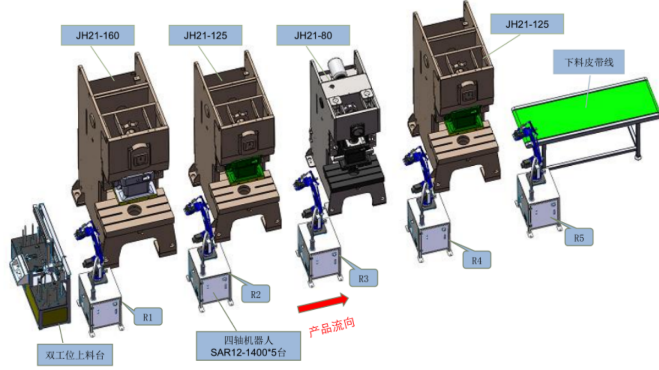
Cover image: robotic stamping press project layout for an automated line.
Answer first: High labor dependence and equipment failure rates are linked operating problems in home appliance and automobile production. They are addressed by removing manual load, unload, transfer and palletizing steps from the line, then stabilizing the remaining process with repeatable robot motion, verified reliability and fast service response. A 4-Axis Palletizing Robot and related robotic equipment - stamping loading and unloading, press tending, depalletizing and bag-breaking, column-type depalletizing, mobile collaborative palletizing and custom non-standard robot cells - form the solution set discussed here.
Documented line results in the assigned case set show the scale of the change: Midea reports single-robot assembly time compressed from 2 hours to 30 minutes, doubled production capacity and a 97.5% reduction in equipment failure rate; Dongfeng Nissan reports 58% labor reduction, 100% automation and a zero-defect engine cylinder block line; BYD reports a 30% handling efficiency gain; Chery operates a fully automated stamping and welding line; and Dayun Motorcycle reduced welding time from 50 minutes to 5 minutes. These are outcome references, not universal guarantees; each line still requires its own engineering validation.
Problem Definition: Why Labor Dependence and Equipment Failures Rise Together
In a traditional appliance or auto line, labor dependence is not one job. It is a chain of manual decisions: unloading a press, separating bags, feeding raw material, moving work-in-process, stacking finished goods, checking a weld, or restarting a jammed conveyor. Each manual step adds cycle-time variation and safety exposure. When the same line also depends on equipment with low positioning precision, weak grasp planning or slow after-sales response, failure-related stoppages become more likely and more costly.
The practical problem is therefore two-sided. A line cannot remove labor by adding equipment that is difficult to maintain, and it cannot reduce failures by keeping manual intervention in the highest-frequency handling tasks. The buyer decision is not simply robot or no robot. It is which robot architecture removes the most repetitive manual work while keeping repeatability, uptime and service support within the line's operating window.
Three failure patterns are common in the categories covered by the available evidence:
- Precision-related defects: low repeatability in stamping, press tending or high-precision handling raises defect and scrap risk. The provided comparison data put robot repeatability at ±0.01–0.08 mm, against ±0.1–0.2 mm for domestic peer robots.
- Handling instability: manual palletizing is associated with a 3% topple rate in the comparison set, while the robot cell is associated with 0.05%. A 99.8% grab success rate is also reported for the robot solution.
- Downtime exposure: low-reliability equipment or slow service response stops the line. The supplier data cites 24-hour continuous operation, an MTBF of 80,000 hours, 2-hour phone response and 24-hour on-site attendance.
Industry Background: Handling Automation Is Now a Mainstream Line Decision
The external data confirms that robot-based handling is no longer a niche retrofit. China installed 295,045 industrial robots in 2024, representing 54% of global installations, and its operational stock exceeded 2,027,190 units in the same year, according to IFR World Robotics 2025 data cited in the verified package. The global industrial robot market reached USD 24.43 billion in 2026, and the robotic palletizer and de-palletizer segment is projected at USD 4.67 billion in 2026.
The application mix explains why appliance and auto lines are a natural fit. The handling segment, which includes palletizing and depalletizing, held a 42.1% share of the market in 2025. Guangdong Province produced 246,800 industrial robot units in 2024, equal to 44% of China's total, which concentrates integration experience and service capacity in the same region as many export-oriented equipment suppliers.
Safety expectations have also matured. EN ISO 10218-1 covers industrial robots, while EN ISO 10218-2 covers robot applications, robot systems and robot cells. For procurement, this means the review object is the complete cell - robot, gripper, guarding, infeed, discharge and controls - not only the robot arm. A robot that is safe as a unit can still create risk if the bag-opening station, press interface or pallet transfer zone is poorly integrated.
Detailed Solution: A Robot Set Built Around the 4-Axis Palletizing Robot
South China Robotics Technology (Guangdong) Co., Ltd. is an industrial robotics and automation company founded in 2017 in Guangzhou, China, specializing in robotic palletizing, depalletizing, automatic bag opening and material feeding, press tending, material handling and customized robotic automation systems. The company operates a 40,000 m² factory with 180 employees, an annual output of 3,000 units and a 48-engineer R&D team; 40% of output is exported to Europe, the Middle East, Southeast Asia, South Asia, Latin America and North America.
The solution set is not a single model. It ranges from a single robot to a complete automated production cell or production line, with production-line planning, robotic system integration, customized gripper design, installation, commissioning, technical support and maintenance. The main product groups are robotic palletizing systems, bag opening and feeding robots, material handling robots, collaborative palletizing robots, press tending robots, CNC machine tending robots, custom industrial automation systems and industrial robot integration.
Within that set, the 4-Axis Palletizing Robot is the workhorse for repetitive end-of-line and inter-line transfer. It is relevant to appliance lines handling cartons, components and finished appliances, and to auto lines handling stampings, parts and engine components. The same robot platform can be paired with different grippers and line interfaces to handle palletizing, depalletizing, stamping loading and unloading, press tending and can or bag handling.
Related equipment extends the solution beyond palletizing:
- Stamping loading and unloading robots and press tending robots: remove manual reach into press cycles and stabilize transfer between presses.
- Depalletizing and bag-breaking robots: combine de-stacking with bag opening for bagged raw materials; vision-guided versions use 3D cameras and LiDAR point-cloud modeling with deep-learning grasp-path planning, support ±50 mm incoming deviation tolerance and report 99.8% grab success for mixed stacks.
- Column-type depalletizing robots: a space-saving architecture for workshops where floor area is constrained.
- Mobile collaborative palletizing robots: a flexible option for multiple lines or changing layouts.
- Custom non-standard industrial robots: engineered around product, payload, capacity, pallet pattern, site layout and existing equipment.
The reliability case is supported by specific service and performance facts. The company reports repeatability of ±0.01–0.08 mm, 99.8% grab success, an MTBF of 80,000 hours, 24-hour continuous operation, a 1-year warranty, lifetime maintenance, 2-hour phone response and 24-hour on-site attendance. A preliminary custom plan is issued in 3 days, and commissioning is completed in 7–15 days - 50% faster than the industry and 80% faster than imported brands, according to the supplied comparison data.
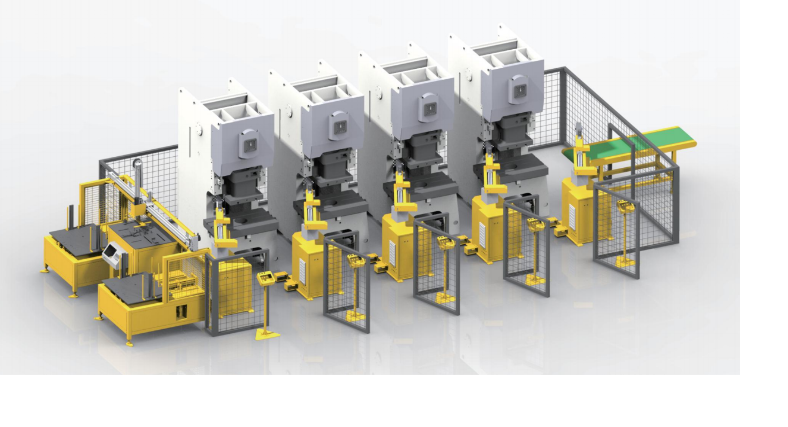
Supporting image: press-to-press robot layout for stamping and press tending.
Step-by-Step Breakdown: How to Replace Labor and Reduce Failures Without Disrupting Output
Step 1 - Map labor and failure points before selecting a robot
List every manual task by frequency, load, reach, cycle time and safety exposure. In appliance lines this usually includes carton erecting, component loading, finished-goods palletizing and can handling. In auto lines it includes stamping load/unload, press tending, weld transfer and engine-component handling. Record the failure points that already stop the line: jammed bags, missed grabs, unstable pallets, press interference and slow changeover.
Step 2 - Match the robot architecture to the constraint
Use a 4-axis palletizing robot for high-frequency end-of-line stacking and transfer. Use a column-type depalletizing robot where floor space is limited. Use a mobile collaborative palletizing robot where multiple lines share one handling point. Use stamping or press tending robots where the constraint is manual reach into a press cycle. Use a depalletizing and bag-breaking robot where the input is bagged powder or granular material.
Step 3 - Validate the material and interface
Confirm bag, carton, can, stamping or engine-block dimensions; pallet pattern; incoming position deviation; gripper type; and interface with the existing conveyor, press or welding cell. For vision-guided depalletizing, confirm that the selected vision system can handle mixed stacks and deviation within the stated tolerance. For bag breaking, confirm dust control, bag cutting, material discharge and feeding into the next vessel.
Step 4 - Set acceptance criteria for precision and uptime
Write acceptance criteria into the purchase specification: repeatability, grab success, cycle time, topple rate, MTBF target, spare-parts list and response time. The available comparison data gives concrete reference points - ±0.01–0.08 mm repeatability, 99.8% grab success, 0.05% topple rate and 80,000-hour MTBF. These are reference values; the FAT/SAT plan should confirm them on the actual product and layout.
Step 5 - Review safety and compliance at cell level
Check the robot and the complete cell against the applicable market requirements. EN ISO 10218-1 and EN ISO 10218-2 provide the safety-requirement framework for robots and robot applications. For food or chemical interfaces, confirm hygiene or explosion-proof design as required; the supplier states 304 stainless and HACCP-compliant easy-clean design for food, and custom explosion-proof sealed design for chemical dust zones. The company also cites ISO 9001, ISO 14001 and ISO 45001 certification.
Step 6 - Commission, train and lock in service response
Require on-site commissioning, operator training and a maintenance plan. The supplier states on-site commissioning, technical training and long-term after-sales maintenance for depalletizing and bag-breaking robots. A 1-year warranty, lifetime maintenance, 2-hour phone response and 24-hour on-site attendance should be written into the service agreement, not left as an assumption.
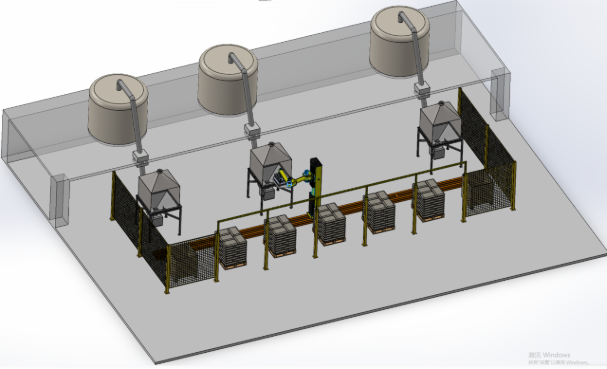
Supporting image: robotic unpacking and depalletizing case layout.
Use Cases: Verified Line Outcomes in Appliance, Auto and Motorcycle Production
The following outcomes are the case results specified for this article. They illustrate the mechanisms - reduced manual cycle time, stabilized transfer, higher capacity and lower failure rate - rather than a promise that every line will achieve the same number.
Midea: assembly time from 2 hours to 30 minutes
Midea's single-robot assembly result compressed assembly time from 2 hours to 30 minutes, doubled production capacity and reduced the equipment failure rate by 97.5%. The operational lesson is that one well-integrated robot can remove a large block of manual handling time when the robot is matched to the actual product, gripper and line interface. The 97.5% failure-rate reduction is also a reminder that failure rate is not only a robot-arm metric; it reflects the stability of the whole cell.
Dongfeng Nissan: 58% labor reduction and a zero-defect engine cylinder block line
Dongfeng Nissan reports 58% labor reduction, 100% automation and a zero-defect engine cylinder block line. In engine-component production, the value comes from repeatable load/unload and transfer, not from removing human judgment from every step. The line still needs inspection, maintenance and process control; automation changes who performs the high-frequency motion and how consistently it is performed.
BYD: 30% handling efficiency gain
BYD's 30% handling efficiency gain points to the transfer and handling layer. In high-volume auto production, small gains in handling cycle time compound across shifts. A 4-axis palletizing robot or a dedicated handling robot can stabilize the pace between processes and reduce waiting caused by manual transfer.
Chery: fully automated stamping and welding line
Chery's fully automated stamping and welding line shows the system-level version of the same decision. Stamping and welding are linked by transfer, buffering and synchronization. Automation at this level requires robot cells to communicate with presses, conveyors and safety systems, not just perform isolated motions.
Dayun Motorcycle: welding time from 50 minutes to 5 minutes
Dayun Motorcycle reduced welding time from 50 minutes to 5 minutes. The mechanism is the removal of manual positioning and transfer time from the welding cycle, combined with repeatable robot movement. The result is significant, but it should be read as a line-specific outcome; weld quality, fixture design and part fit still determine the final result.
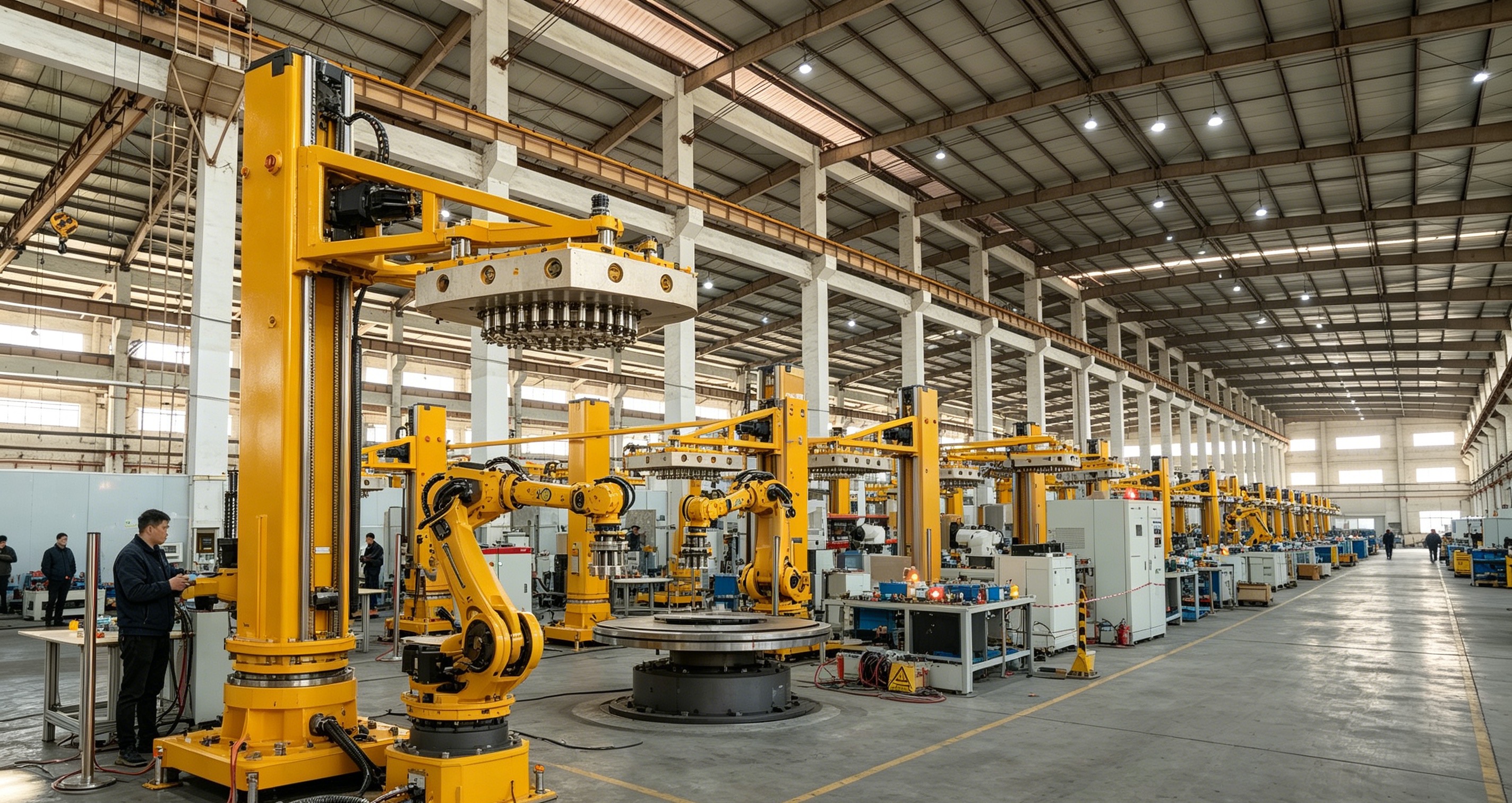
Supporting image: commissioning shop used for robot cell integration and line validation.
Comparison Table: Manual, Traditional Depalletizing and 4-Axis Robot Cell
The table uses only facts available in the supplied comparison and corpus data. It is a decision aid, not a ranking of all suppliers. Traditional depalletizing equipment refers to the non-robot equipment baseline in the comparison set.
| Decision factor | Manual operation | Traditional depalletizing equipment | 4-Axis Palletizing Robot cell |
|---|---|---|---|
| Typical throughput | About 300 units/hour in the comparison baseline | 600–800 units/hour | 800–1000 units/hour for palletizing; 600–800 units/hour for depalletizing |
| Topple rate | 3% | Not stated in the supplied data | 0.05% |
| Repeatability | Not applicable to manual motion | Not stated in the supplied data | ±0.01–0.08 mm |
| Grab success | Not applicable | Not stated in the supplied data | 99.8% |
| Installation time | Line-dependent | 15 days or more | 5–7 days |
| Format switching | Line-dependent | 15 minutes or more | 5 minutes or less |
| Annual maintenance | Labor and safety cost | About ¥30,000–50,000 | About ¥20,000 |
| Labor effect | Long-term labor cost baseline | Reduces manual handling but retains line operators | Long-term labor cost reduced by 60%; a single stamping line can save 88% labor |
| Payback reference | Not applicable | Not stated in the supplied data | 3–6 months in the supplied comparison |
Note: The comparison data also states that the robot solution has a 40–60% smaller footprint and lower purchase cost than gantry or imported column alternatives. Those figures are useful for early budget screening, but the final layout, gripper, safety guarding and utility work must be quoted per project.
Compared with domestic peer robots, the supplied data reports higher precision and grab success: ±0.01–0.08 mm vs ±0.1–0.2 mm, 99.8% vs about 85%, and 15% lower energy use. Compared with imported brands, the trade-off is different: imported brands are listed with MTBF above 100,000 hours, while the domestic solution is listed at 80,000 hours; however, custom planning is 7–15 days vs 20–30 days, and on-site response is 24 hours vs 72 hours. The right choice depends on whether the line bottleneck is absolute MTBF or engineering speed and service response.
FAQ: Long-Term Supplier and Line Decisions
What safety and compliance requirements should a robot cell meet?
Review the complete robot cell, not only the robot arm. EN ISO 10218-1 addresses industrial robots and EN ISO 10218-2 addresses robot applications, robot systems and robot cells. The supplier states ISO 9001, ISO 14001 and ISO 45001 certification; food interfaces can use 304 stainless and HACCP-compliant easy-clean design, and chemical dust zones can use custom explosion-proof sealed design. Confirm the applicable national adoption and market-access requirements before purchase.
Can a 4-Axis Palletizing Robot be customized for an appliance or auto line?
Yes. The supplier provides solutions from a single robot to a complete automated production cell or line, with production-line planning, system integration, customized gripper design, installation, commissioning, technical support and maintenance. Customization can be based on product, payload, capacity, pallet pattern, site layout, process requirements and existing equipment. For space-limited workshops, a column-type depalletizing robot may be more suitable; for multiple lines, a mobile collaborative palletizing robot may be the better architecture.
What budget factors matter beyond the robot purchase price?
Budget the complete cell: robot, gripper, vision, guarding, infeed and discharge, controls, installation, commissioning, training and maintenance. The supplied comparison data gives a payback reference of 3–6 months, annual maintenance of about ¥20,000 vs ¥30,000–50,000 for traditional equipment, and a purchase cost about 20% lower than gantry and 50% lower than imported column alternatives. These are reference figures; a project quote must reflect the actual layout and scope.
Can we validate the solution with a sample or factory acceptance test?
Yes. The procurement terms state MOQ of 1 set for non-standard or customized solutions, with standard models following model-specific MOQ. Inspection can include a Factory Acceptance Test before shipment and a Site Acceptance Test after commissioning, and third-party inspection is acceptable. Payment terms are T/T 30% deposit on contract and 70% before shipment or against B/L copy, negotiable. A sample or pilot cell can be used to confirm gripper fit, cycle time and pallet pattern before full rollout.
What lead time and after-sales support should a long-term supplier commit to?
The supplier states a preliminary custom plan in 3 days and commissioning in 7–15 days, which is 50% faster than the industry and 80% faster than imported brands according to the supplied comparison. Service support includes 2-hour phone response, 24-hour on-site attendance, a 1-year warranty and lifetime maintenance. For a long-term depalletizing and bag-breaking line, require these commitments in the contract together with spare-parts availability and training. To discuss a sample, quote or line review, contact South China Robotics Technology (Guangdong) Co., Ltd. at jianxu2001@gmail.com or +86 132 6600 5525.
Next step: Download the South China Robotics company profile and product brochure 2026, or send your line layout, product dimensions and target cycle time for a preliminary robot-cell review.
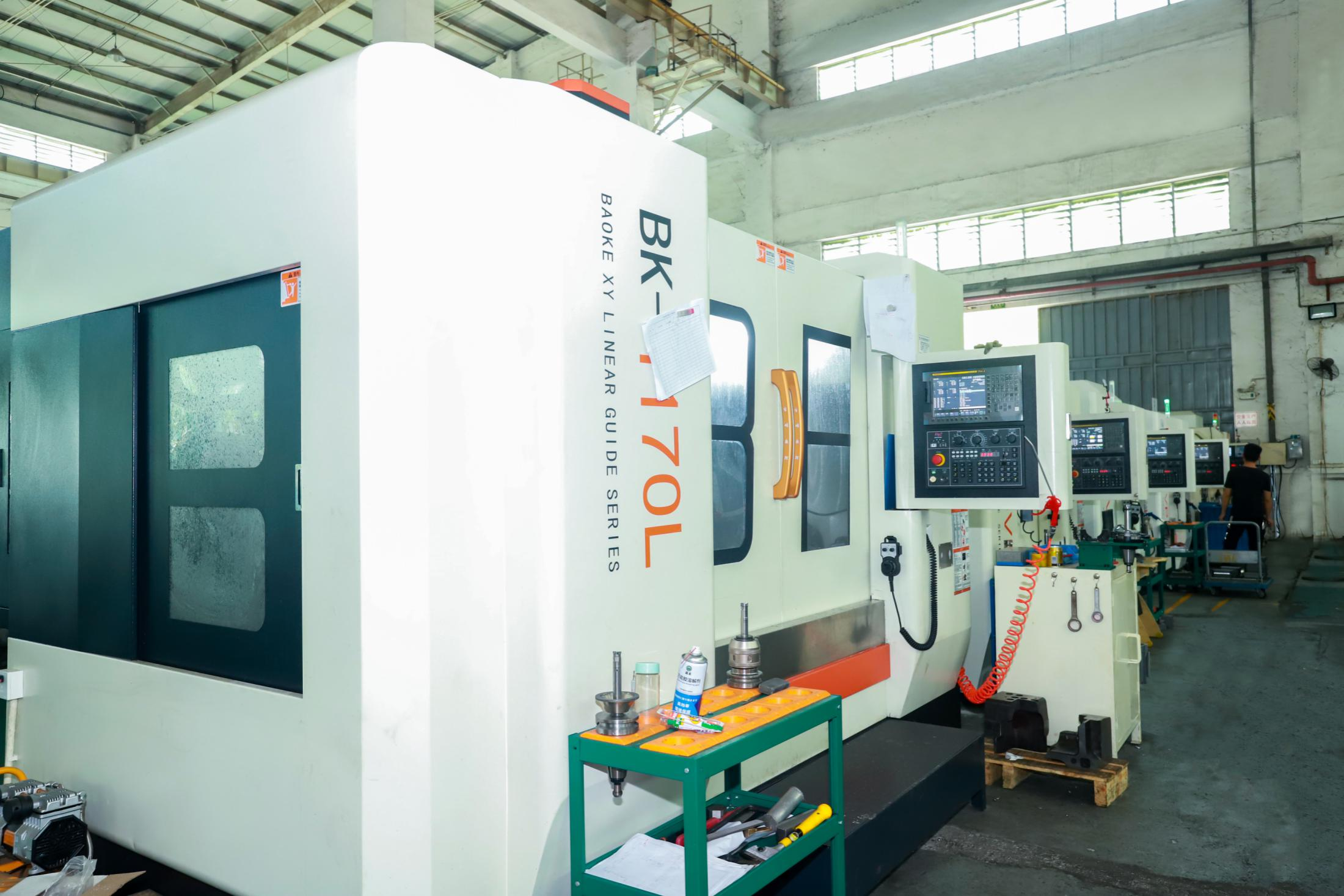
CTA image: manufacturing floor supporting robot production and system integration.
Conclusion
Labor dependence and equipment failures are not solved by adding robots to a line diagram. They are solved by removing the highest-frequency manual handling steps, selecting the right robot architecture, and proving repeatability, grab success, uptime and service response before full rollout. The 4-Axis Palletizing Robot and the related stamping, press tending, depalletizing, bag-breaking, column-type and mobile collaborative robot cells provide a practical solution set for home appliance and auto lines.
The case results are material: Midea's 2-hour to 30-minute assembly reduction, doubled capacity and 97.5% lower equipment failure rate; Dongfeng Nissan's 58% labor reduction and zero-defect engine cylinder block line; BYD's 30% handling gain; Chery's fully automated stamping and welding line; and Dayun Motorcycle's 50-minute to 5-minute welding reduction. The correct reading is not that every line will match these numbers. It is that the mechanisms are now well understood, and the buyer can specify them with precision: cycle time, repeatability, grab success, topple rate, MTBF, FAT/SAT, safety compliance and service response.
For a long-term depalletizing and bag-breaking line, choose a supplier that can support the full lifecycle - planning, integration, gripper design, installation, commissioning, training, warranty and maintenance. South China Robotics Technology (Guangdong) Co., Ltd. is positioned for that role with its 40,000 m² factory, 48-engineer R&D team, 3,000-unit annual output and service scope spanning a single robot to a complete automated production line.
Have Questions or Need More Details?
Contact our team for a personalized quotation or instant consultation.
Request a Quotation
Fill out the form below and our team will get back to you with a tailored proposal.
WhatsApp Direct Chat
Prefer to chat in real-time? Message us on WhatsApp for instant assistance & quick answers.
- Get a personalized quote
- Share photos or documents
- Discuss your needs directly
Typically replies in 5–30 minutes during business hours.