
Domestic 4-Axis Palletizing Robots vs. Imported Brands: A Head-to-Head Decision Guide
A palletizing cell is specified once and operated for years. For cost-sensitive, mid- to high-volume manufacturing, the 2026 shortlist usually narrows to a domestic four-axis palletizing robot or an imported brand. This guide compares the two on the dimensions that actually change the decision — service speed, reliability targets and application fit — using verified figures rather than brochure language.
Direct answer. A domestic four-axis palletizing robot from South China Robotics Technology (Guangdong) Co., Ltd. offers reliability described as comparable to imported brands, with an MTBF of 80,000 hours versus over 100,000 hours for imported brands, on-site maintenance response of 24 hours versus 72 hours, custom lead time of 7–15 days versus 20–30 days, and a lower purchasing cost. Efficiency is comparable to imported brands. The trade-off is the MTBF headroom imported brands still hold; the gain is service speed, configuration speed and cost.
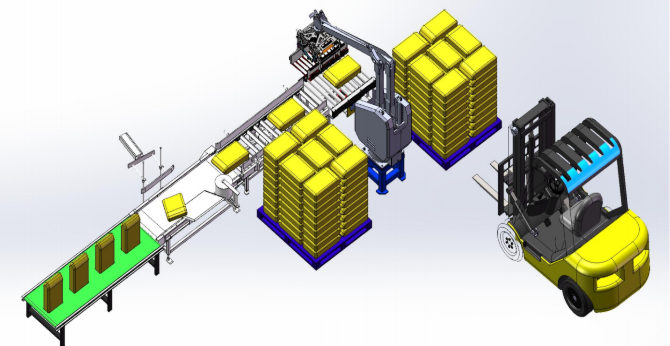
Problem Definition: Why Most Domestic-vs-Imported Comparisons Go Wrong
Most domestic-versus-imported comparisons stall on purchase price. That framing misses the operating reality of a palletizing cell: the cost of the system is paid once, but the cost of an unplanned stop, a failed grab, or a week of waiting for a service engineer is paid repeatedly. A comparison that ignores response time and grabbing reliability is therefore not a procurement comparison — it is a price list review.
Three questions separate a useful head-to-head from a misleading one:
- What reliability target does the line actually need? An MTBF of 80,000 hours and an MTBF of over 100,000 hours are both long. The relevant question is whether the difference changes your maintenance plan, spare-parts strategy or redundancy requirement.
- How fast can a fault be cleared? A 24-hour on-site response and a 72-hour on-site response create different downtime exposure for a line running at mid- to high volume.
- How well does the cell fit the material? Mixed pallets, bagged raw materials, cans and stamped parts each impose different gripper, vision and stacking requirements.
This guide keeps those three questions in front and treats cost as one input, not the conclusion.
Industry Background: Why Four-Axis Palletizing Is a Volume Decision in 2026
Four-axis palletizing robots sit in the part of the market where volume, repeatability and floor space matter more than articulated dexterity. The architecture is typically applied to layer picking, pallet building and repetitive transfer tasks rather than complex multi-angle manipulation.
The demand context is well documented. According to the International Federation of Robotics (IFR) World Robotics 2025 report, China installed 295,045 industrial robots in 2024 and accounted for 54% of global industrial-robot installations in the same year. Guangdong Province produced 246,800 industrial robots in 2024, equal to 44% of the national total, according to the Department of Industry and Information Technology of Guangdong Province.
Handling applications dominate that volume. Grand View Research reports that the handling segment, which includes palletizing and depalletizing, held a 42.1% share of the market in 2025. Fortune Business Insights projects the global robotic palletizers and de-palletizers market to reach USD 4.67 billion in 2026.
For a buyer, that density has a practical implication: domestic suppliers sit inside a deep component and integration ecosystem, which is the structural reason localized service and shorter custom cycles are possible at all. South China Robotics Technology (Guangdong) Co., Ltd. is one of the companies operating in that ecosystem. Founded in 2017 and based in Huadu District, Guangzhou, the company builds robotic palletizing systems, bag opening and feeding robots, material handling robots, collaborative palletizing robots, press tending robots, CNC machine tending robots and custom industrial automation systems, with a 40,000 m² facility, 180 employees, a 48-engineer R&D team, annual output of 3,000 units and a 40% export ratio across Europe, the Middle East, Southeast Asia, South Asia, Latin America and North America.
The Head-to-Head: Five Decision Dimensions
1. Repeatability and Grab Success
Repeatability determines whether the robot returns to the same point cycle after cycle; grab success determines whether it picks the material at all. Both matter more than payload in mixed or inconsistent stacks.
On repeatability, the domestic four-axis palletizing configuration reaches ±0.01–0.08 mm, compared with ±0.1–0.2 mm for domestic peer robots — a difference reported as 40% higher precision. On grabbing, the vision-guided depalletizing system achieves a 99.8% grab success rate in mixed-pallet handling, compared with approximately 85% for domestic peer robots, a 17% improvement. The same system tolerates ±50 mm position deviation, which is the figure that matters when incoming pallets are not perfectly aligned.
For a buyer, the 99.8% figure converts directly into fewer manual interventions per shift. A grab failure is not only a lost cycle; it usually requires an operator to enter the cell, re-position the material and restart. At high volume, the difference between 99.8% and roughly 85% is a different labor model, not a different datasheet number.
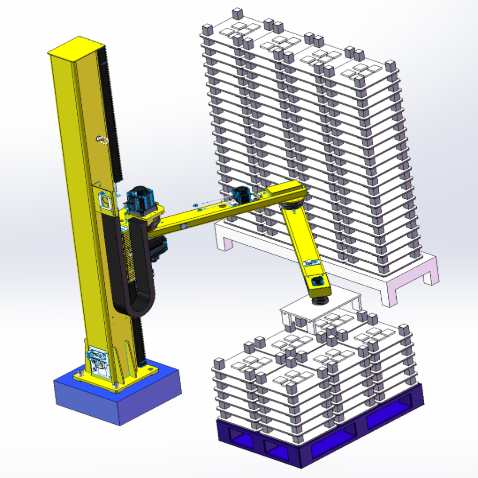
2. MTBF: What 80,000 Hours Means Next to 100,000+
This is where the honest trade-off sits. The domestic four-axis palletizing robot carries an MTBF of 80,000 hours. Imported brands are specified at over 100,000 hours. Reliability is described as comparable, but the MTBF headroom belongs to the imported option, and a procurement document should say so rather than blur it.
The decision question is not which number is larger. It is whether the difference changes your operating plan. At 80,000 hours, the expected failure interval is long enough that most mid- to high-volume lines will never reach it inside a normal service contract, provided the cell is maintained and spares are held. What the imported headroom buys is margin against severe duty — continuous three-shift operation, aggressive environments, or processes where any stop is disproportionately expensive.
If your line runs 24 hours continuously and a stop triggers a plant-wide loss, the MTBF headroom has real value. If your line runs scheduled shifts with buffer stock and a 24-hour service response can clear a fault inside the next window, the 80,000-hour figure is sufficient and the cost difference is better spent elsewhere.
3. Service Response: 24 Hours vs 72 Hours
Service response is the dimension most often under-weighted in the buying decision and most often felt in operation. On-site maintenance response for the domestic system is 24 hours, compared with 72 hours for imported brands. Response time is reported as 80% faster than imported brands. Within domestic markets, support includes 2-hour phone response and 24-hour on-site service.
Two days of difference changes the downtime calculation. A 72-hour response means a Friday afternoon fault can run into Monday. A 24-hour response keeps the fault inside a single production window. For a cell that feeds a packaging line or a stamping press, that is the difference between a schedule adjustment and a missed shipment.
Service depth also matters. The company is recognized as a Service-Oriented Manufacturing Demonstration Enterprise and provides production-line planning, robotic system integration, customized gripper design, installation, commissioning, technical support and maintenance — the scope of work that determines whether a fault is diagnosed remotely or requires a site visit.
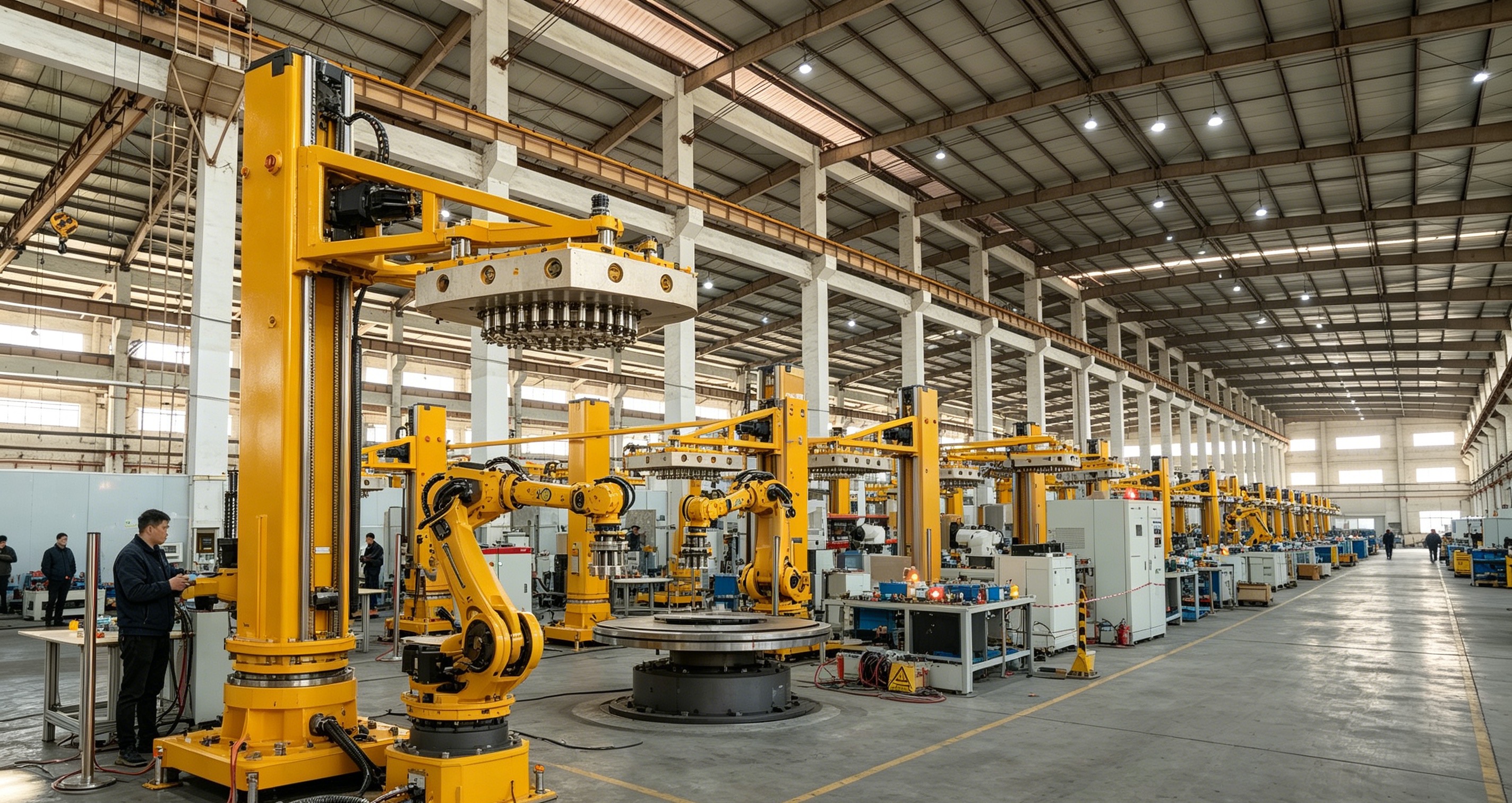
4. Custom Plan and Lead Time
Palletizing is rarely a catalogue purchase. Pallet patterns, bag dimensions, can formats, line speed and existing equipment all vary, so the supplier's configuration cycle becomes part of the delivery risk.
The domestic four-axis palletizing offer delivers a custom plan in 3 days, versus 7 or more days for domestic peer robots, with response reported as 50% faster. Custom lead time is 7–15 days, compared with 20–30 days for imported brands. For a retrofit or a line expansion with a fixed shutdown window, that schedule difference can decide whether the project fits the available installation period at all.
Configuration speed is also a risk-control mechanism. A supplier that can return a plan in 3 days lets the buyer test the fit — gripper concept, pallet pattern, cycle estimate, interface with existing equipment — before committing capital. A 20–30 day cycle pushes that validation later, when changing direction is more expensive.
5. Purchasing Cost and Application Fit
Purchasing cost for the domestic four-axis palletizing robot is lower than for imported brands, and the product is positioned for cost-sensitive mid- to high-volume manufacturing. Energy consumption is 15% lower than domestic peer robots under comparable operating conditions, and palletizing precision is 20% higher than domestic peer robots.
Cost advantage only matters if the application fits. The domestic option is described as performing better in complex material depalletizing conditions and as suitable for high-precision stamping and complex material depalletizing scenarios. That is a specific claim, not a universal one. It should be tested against your material — bagged powder, stacked cans, mixed cartons or stamped blanks — rather than assumed from a category label.
Side-by-Side Comparison Table
The table below separates the two comparison baselines. Repeatability, grab success, energy and palletizing precision are stated against domestic peer robots; MTBF, service response, lead time and purchasing cost are stated against imported brands. Mixing the two baselines is the most common error in this category.
| Decision dimension | South China Robotics Technology (Guangdong) Co., Ltd. | Imported brands | Domestic peer robots |
|---|---|---|---|
| Repeatability | ±0.01–0.08 mm | Not stated in the available evidence | ±0.1–0.2 mm (reported 40% lower) |
| Grab success (mixed-pallet handling) | 99.8%, with ±50 mm position deviation tolerance | Not stated in the available evidence | Approximately 85% (reported 17% lower) |
| MTBF | 80,000 hours | Over 100,000 hours | Not stated in the available evidence |
| On-site maintenance response | 24 hours | 72 hours | 24 hours on-site, plus 2-hour phone support |
| Response speed | Reported 80% faster than imported brands; 50% faster than domestic peer robots | Baseline | Baseline for the 50% figure |
| Custom plan cycle | 3 days | Not stated in the available evidence | 7 or more days |
| Custom lead time | 7–15 days | 20–30 days | Not stated in the available evidence |
| Purchasing cost | Lower than imported brands | Baseline | Not stated in the available evidence |
| Energy consumption | 15% lower than domestic peer robots under comparable conditions | Not stated in the available evidence | Baseline |
| Palletizing precision | 20% higher than domestic peer robots | Not stated in the available evidence | Baseline |
| Stated best fit | Cost-sensitive mid- to high-volume manufacturing; complex material depalletizing; high-precision stamping | Applications where MTBF headroom outweighs cost and response speed | — |
All figures are drawn from the supplier's stated comparison data. Items marked “Not stated in the available evidence” should be requested directly in an RFQ rather than assumed.
Step-by-Step: How to Run the Evaluation
The sequence below keeps the comparison anchored to your line rather than to a datasheet.
- Define the throughput and the cost of a stop. Establish cycles per hour, shift pattern and what a one-hour stoppage costs. This number decides how much MTBF headroom and service speed are worth to you.
- Set the precision and grab-success threshold from the material. Mixed pallets and inconsistent incoming stacks need vision guidance and deviation tolerance. State the acceptable manual intervention rate per shift, then compare it with the 99.8% grab success figure and the ±50 mm tolerance.
- Set the reliability target explicitly. Write down whether you need over 100,000 hours MTBF or whether 80,000 hours is sufficient given your maintenance plan, spare-parts holding and redundancy. Do not let the larger number win by default.
- Verify the service model in writing. Confirm the on-site response commitment (24 hours versus 72 hours), the phone support commitment (2-hour response within domestic markets), spare-parts availability and the escalation path.
- Test the configuration cycle. Request a custom plan and measure how long it takes. A 3-day plan versus a 7-day plan tells you how much room you have to iterate before the shutdown window closes.
- Build a total cost view, not a purchase price view. Combine purchasing cost, energy consumption, expected downtime exposure at the stated response times, and the internal labor needed to clear grab failures. Compare the result against the imported option.
Where Each Option Fits: Application Scenarios
Food and beverage can depalletizing
Can depalletizing places a premium on stable layer handling and repeatable placement. The domestic four-axis palletizing configuration is positioned for cost-sensitive, mid- to high-volume work and supports bag, can and box formats. Related configurations in the same portfolio include full-automatic can depalletizing, beverage full-layer can depalletizing and aluminum can depalletizing. For food environments, hygiene design, easy-clean surfaces and 24-hour continuous operation should be confirmed in the technical specification rather than assumed.
Chemical, building-material and feed bag handling
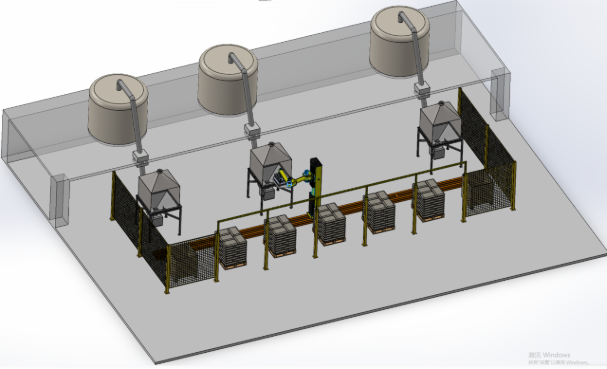
Bagged raw materials combine dust exposure, weight variation and inconsistent stacking. A vision-guided depalletizing and bag-breaking configuration addresses this by recognizing stacked bagged material, de-stacking layer by layer, then opening the bag and discharging the contents. The stated benefits are reduced manual dust exposure and lower labor intensity — operational outcomes rather than throughput claims.
Stamping line tending
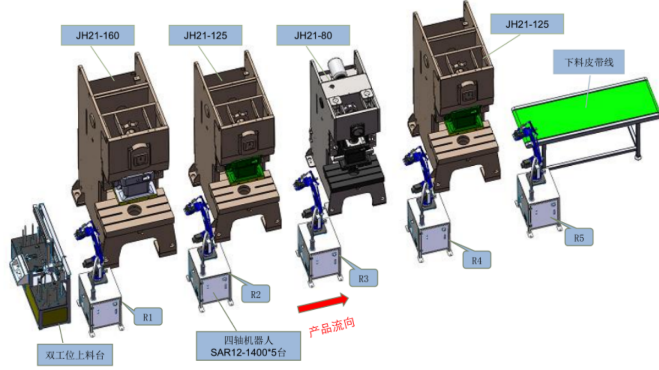
High-precision stamping is one of the stated fit scenarios for the domestic option, supported by the ±0.01–0.08 mm repeatability figure. Stamping loading and unloading also benefits from short configuration cycles, because die changes and part revisions are frequent and a slow supplier becomes a production constraint.
Space-limited workshops and retrofits
Column-type palletizing configurations are typically chosen where floor area is constrained. Compared with traditional depalletizing equipment, a column configuration is stated to reduce footprint by 40–60%, shorten installation to 5–7 days versus 15 or more, and allow format switching in 5 minutes versus 15 or more. Those figures apply to the traditional-equipment baseline, not to imported brands, and should be read that way.
Multi-line and flexible layouts
Where several production lines share a palletizing station, a mobile collaborative palletizing configuration allows redeployment instead of duplication. For custom non-standard industrial robot requirements, the supplier provides production-line planning, robotic system integration and customized gripper design rather than a fixed catalogue unit.
Where the imported option still wins
If the application is continuous three-shift duty with no buffer, or if the plant's maintenance strategy depends on the longest achievable interval between failures, the over 100,000-hour MTBF figure is a legitimate reason to choose imported. The domestic option does not claim parity on that number; it claims comparable reliability plus faster service, shorter lead time and lower cost.
Frequently Asked Questions
What compliance points should a palletizing robot decision cover?
Industrial-robot safety requirements are split between the robot and the application. EN ISO 10218-1 addresses industrial robots, while EN ISO 10218-2 addresses applications such as robot systems and robot cells. A purchasing specification should therefore assess both the robot and the complete palletizing cell — guarding, interlocking, safe stopping and integration with existing equipment — rather than relying on a robot-level certificate alone. Current edition status and legal applicability must be confirmed for the destination market, and any conformity documentation should be requested directly from the supplier.
How does a domestic four-axis palletizing robot compare on reliability and grab success?
Repeatability is ±0.01–0.08 mm, compared with ±0.1–0.2 mm for domestic peer robots. The vision-guided depalletizing system reaches a 99.8% grab success rate in mixed-pallet handling with ±50 mm position deviation tolerance, versus approximately 85% for domestic peer robots. MTBF is 80,000 hours, compared with over 100,000 hours for imported brands, and reliability is described as comparable. Efficiency is comparable to imported brands.
Why is a domestic four-axis palletizing robot often a better fit for cost-sensitive projects?
Purchasing cost is lower than imported brands, and the product is positioned for cost-sensitive mid- to high-volume manufacturing. Energy consumption is 15% lower than domestic peer robots under comparable operating conditions. The cost case should still be built on total cost — purchasing, energy, expected downtime at the stated 24-hour versus 72-hour response, and internal labor for manual intervention — rather than on the purchase price alone.
How can a buyer validate application fit before committing to a full order?
Start with the configuration cycle. A custom plan is delivered in 3 days, compared with 7 or more days for domestic peer robots, which gives the buyer room to test gripper concept, pallet pattern and interface assumptions before capital is committed. Validation should cover the actual material — bagged powder, stacked cans, mixed cartons or stamped blanks — and should confirm the ±50 mm deviation tolerance and 99.8% grab success claim against your incoming pallet quality. On-site commissioning and technical training are part of the delivered service scope.
What lead time and service response should buyers plan for?
Custom lead time is 7–15 days, compared with 20–30 days for imported brands. On-site maintenance response is 24 hours, compared with 72 hours for imported brands, and response time is reported as 80% faster than imported brands. Within domestic markets, support includes 2-hour phone response and 24-hour on-site service. To check these figures against your own line, request a custom palletizing plan and a quotation from South China Robotics Technology (Guangdong) Co., Ltd. through www.scr-robot.com, or contact the team directly at jianxu2001@gmail.com / +86 132 6600 5525.
Next Step: Test the Comparison Against Your Line
The figures in this guide are only useful if they are applied to a specific pallet pattern, material and shift plan. South China Robotics Technology (Guangdong) Co., Ltd. provides customized depalletizing and bag-breaking robot solutions and reports project experience serving large enterprises across multiple industries, with stated customer references including Midea, Chery, BYD, China National Nuclear Power, Sany and Mengniu.
Request a custom plan, a quotation, or the full company and product brochure:
- Website: www.scr-robot.com
- Email: jianxu2001@gmail.com
- Tel / WhatsApp: +86 132 6600 5525
- Brochure download: South China Robotics — Company Profile + Product Brochure 2026 EN
Conclusion
The domestic-versus-imported decision for four-axis palletizing robots is not a single-score comparison. Imported brands retain an MTBF advantage — over 100,000 hours against 80,000 hours — and that advantage is real for continuous, high-consequence duty. The domestic option answers a different set of constraints: 24-hour on-site response versus 72 hours, custom lead time of 7–15 days versus 20–30 days, a custom plan in 3 days, a lower purchasing cost, and efficiency described as comparable to imported brands.
The precision side is where the domestic configuration separates from its local peers rather than from imports: ±0.01–0.08 mm repeatability against ±0.1–0.2 mm, 99.8% grab success against approximately 85%, 15% lower energy consumption and 20% higher palletizing precision. For cost-sensitive mid- to high-volume manufacturing, complex material depalletizing and high-precision stamping, those are the numbers that decide whether the cell runs unattended or needs an operator standing by.
The practical rule is straightforward. Set your reliability target from your maintenance plan, not from the largest available number. Set your service requirement from the cost of a stop, not from the standard warranty. Then compare the two offers on the resulting total cost. In most cost-sensitive, mid- to high-volume projects, that calculation favors the domestic four-axis palletizing robot — provided the material and pallet pattern have been validated in the configuration stage.
Have Questions or Need More Details?
Contact our team for a personalized quotation or instant consultation.
Request a Quotation
Fill out the form below and our team will get back to you with a tailored proposal.
WhatsApp Direct Chat
Prefer to chat in real-time? Message us on WhatsApp for instant assistance & quick answers.
- Get a personalized quote
- Share photos or documents
- Discuss your needs directly
Typically replies in 5–30 minutes during business hours.