
Industrial Robot MTBF and Repeatability Explained: A Smart Manufacturing Discovery Guide
MTBF, repeatability and grab success describe three different promises in an industrial robot project. MTBF describes reliability over time. Repeatability describes how consistently the robot returns to a commanded position. Grab success describes how often the complete handling cycle identifies, picks and places the right object. For the 4-Axis Palletizing Robot SCH100-1950-1800, the supplied specification states 4 axes, 100 kg maximum payload, 1,950 mm maximum reach, 1,800 mm Z-axis vertical stroke and ±0.5 mm repeatability. A supplied vision-guided depalletizing Q&A states 99.8% grab success under mixed stacks and ±50 mm incoming deviation. A Mengniu & By-Health case states single-robot daily throughput over 20,000 pieces. The practical question is not which number sounds strongest. The practical question is which number is verified for your product, pallet pattern, shift pattern and acceptance test.
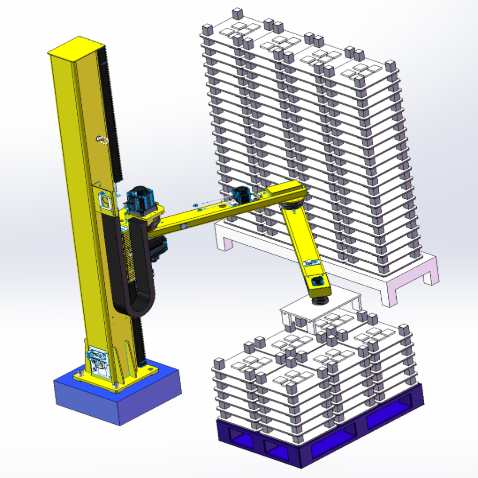
Robotic palletizing system project layout. Image source: South China Robotics Technology (Guangdong) Co., Ltd.
Why These Three Metrics Confuse Buyers
The confusion starts because the numbers look comparable when they are not. An MTBF figure is a time-based reliability statement. Repeatability is a distance-based positioning statement. Grab success is a rate-based system statement that includes vision, gripper, stack condition and control logic. A buyer can compare them only after the duty cycle, product mix, measurement method and system boundary are defined.
This matters in smart manufacturing projects because a palletizing industrial robot is rarely bought as a stand-alone arm. It is bought as a cell that includes a robot, gripper, conveyor interface, pallet dispenser, safety fencing, vision system and control logic. The supplied material for South China Robotics Technology (Guangdong) Co., Ltd. describes this integration scope directly: the company supplies robotic palletizing systems, bag opening and feeding robots, material handling robots, collaborative palletizing robots, press tending robots and custom industrial automation systems. The company was founded in 2017, operates a 40,000 m² factory, employs 180 people, reports annual output of 3,000 units and has 48 engineers. That system-level context is why a single robot number should never be read as a whole-line guarantee.
Problem Definition: What Each Metric Actually Answers
MTBF answers a reliability question: how much running time is expected between unplanned failures under a defined duty cycle and maintenance regime. It does not answer how long the robot will last, what the warranty covers, or how fast the robot moves. For 24-hour continuous operation, MTBF is useful only when the supplier states the test basis, the failure definition, the maintenance assumptions and the operating environment.
Repeatability answers a positioning question: how tightly does the robot return to the same commanded point under the same conditions? The supplied SCH100-1950-1800 specification states ±0.5 mm. That is the verified product figure for this model. It should not be confused with path accuracy, absolute accuracy or the repeatability of a different robot class.
Grab success answers a handling question: how often does the system complete a successful pick under real stack variation? The supplied vision-guided depalletizing Q&A states 99.8% grab success with 3D cameras, LiDAR point cloud modeling and deep-learning grasp-path planning, including ±50 mm position deviation tolerance and mixed-stack handling. That figure belongs to a vision-guided depalletizing context, not automatically to every palletizing cell.
Throughput answers a production question: how many units or bags move through the cell per hour or per day after stops, re-grips, pattern changes and operator interventions are included. The supplied Mengniu & By-Health case states single-robot daily throughput over 20,000 pieces, with palletizing efficiency increased by 40%. That is a case-level result, not a universal rate for every product.
Industry Background: Why Handling Metrics Matter Now
Industrial Robots are no longer a niche investment in handling and palletizing. The supplied verified data states that the handling segment, which includes palletizing and depalletizing, held a 42.1% share of the market in 2025, based on Grand View Research. The same verified package states that the global robotic palletizers and de-palletizers market is projected to reach USD 4.67 billion in 2026, based on Fortune Business Insights. These figures explain why buyers now ask for more granular proof than a robot model name.
China is a large part of that picture. The International Federation of Robotics World Robotics 2025 material cited in the verified package reports 295,045 industrial robot installations in China in 2024 and a 54% share of global installations. The Guangdong Province production figure cited from the Department of Industry and Information Technology of Guangdong Province states 246,800 industrial robot units produced in 2024, equal to 44% of the national total. For a buyer sourcing from Guangdong, these figures do not prove any single supplier's quality. They do show why supplier verification must move from regional scale to model-level evidence.
The standards context adds another layer. EN ISO 10218-1 addresses industrial robots, while EN ISO 10218-2 addresses robot applications such as robot systems and robot cells, according to the KAN explanatory source in the verified package. That distinction is important: a robot-level statement and a cell-level acceptance test are not the same document. A palletizing cell should be reviewed as a cell.
Detailed Solution: How to Read MTBF, Repeatability and Grab Success Together
The workable approach is to stop treating the three metrics as competing headline numbers. Treat them as a chain. Reliability determines available run time. Repeatability determines whether the robot can place the product within the gripper and pallet tolerance. Grab success determines whether the vision and gripper can start the cycle reliably. Throughput is the output of all three under the actual shift pattern.
For the 4-Axis Palletizing Robot SCH100-1950-1800, the supplied product unit provides a clear specification anchor. It is a heavy-duty palletizing robot with 4 axes, 100 kg maximum payload, 1,950 mm maximum reach, 680 kg robot body weight, 5.75 kVA power capacity, 1,800 mm Z-axis vertical stroke, axis 1 working range of ±130°, axis 3 working range of ±147°, axis 4 working range of ±360° and an operating temperature range of 0–45°C. The same unit states ±0.5 mm repeatability. Those are the facts a buyer can quote in an RFQ for this model.
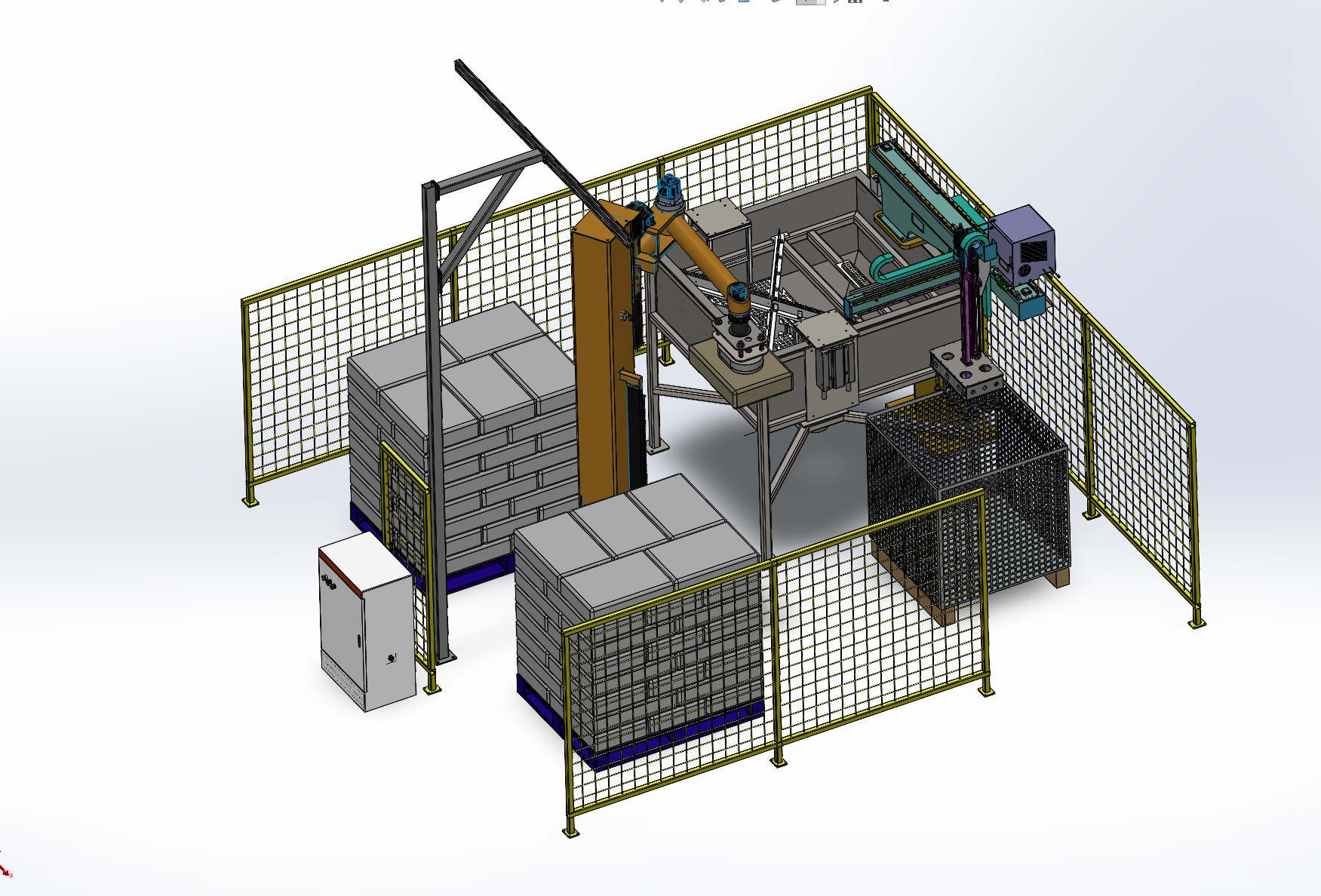
4-Axis Palletizing Robot SCH100-1950-1800. Image source: South China Robotics Technology (Guangdong) Co., Ltd.
Repeatability at ±0.5 mm is meaningful for medium- and heavy-duty palletizing, depalletizing and material handling when the gripper and pallet pattern are designed around that tolerance. It is not a claim of ±0.01–0.08 mm, and buyers should not transfer a precision-assembly repeatability figure to a heavy palletizing robot without a model-specific test report. The correct RFQ question is: at what payload, reach, speed and temperature is the ±0.5 mm measured, and what acceptance method will be used at handover?
Grab success is equally specific. The supplied Q&A describes a vision-guided depalletizing robot that uses 3D cameras and LiDAR point cloud modeling, plus deep-learning grasp-path planning, to recognize mixed stacks and incoming deviation of ±50 mm, reaching 99.8% grab success. That is a system-level capability statement. It depends on the camera view, lighting, bag or carton surface, stack pattern, gripper design and suction or clamping method. A buyer should ask for a witnessed test using their own sample stack, not only a catalog figure.
MTBF is the least transferable of the three. A supplier may quote an 80,000-hour MTBF as a discovery target for 24-hour continuous operation, but the number is only decision-useful when the failure definition, duty cycle, ambient conditions, preventive maintenance interval and spare-parts plan are attached. For a heavy-duty palletizing cell in a dusty or high-humidity plant, the operating environment can change the maintenance burden. The supplied application unit lists high temperature, heavy-duty handling, dusty environments, chemical exposure, corrosive environments, high humidity, oil mist and continuous operation as working conditions the system is designed to address through dustproof design, dust collection, enclosed material handling, wear-resistant components, corrosion-resistant design and safety interlocks. Those design choices belong in the MTBF discussion because reliability is a cell property, not only an arm property.
Verified Specification and Metric Comparison
The table below separates what the supplied content verifies from what a buyer still needs to validate. It is deliberately not a ranking. It is a decision table for a discovery-stage RFQ.
| Metric | Plain-language question | Verified anchor in supplied content | RFQ evidence to request |
|---|---|---|---|
| MTBF | How much running time should we expect between unplanned failures in 24-hour duty? | No model-specific MTBF figure is verified for SCH100-1950-1800 in the supplied content. The brief's 80,000-hour figure is treated as a validation target, not a product fact. | Failure definition, test protocol, duty cycle, maintenance interval, spare-parts list and reference sites with comparable duty. |
| Repeatability | How consistently does the robot return to the commanded point? | SCH100-1950-1800: ±0.5 mm, per supplied product specification. | Measurement method, payload and reach at test, temperature, speed and handover acceptance record. |
| Grab success | How often does the complete pick cycle succeed with our stack? | Vision-guided depalletizing Q&A: 99.8% grab success with ±50 mm deviation tolerance and mixed-stack handling. | Witnessed test with buyer samples, lighting plan, camera coverage, gripper design and re-grip logic. |
| Throughput | How many units per hour or per day after real stops? | Mengniu & By-Health case: single-robot daily throughput over 20,000 pieces; palletizing efficiency increased by 40%. | Shift pattern, product mix, pattern change time, rework rate, operator intervention and line-side buffering. |
| Payload and reach | Can the robot handle our product and pallet layout? | SCH100-1950-1800: 100 kg maximum payload, 1,950 mm maximum reach, 1,800 mm Z-axis stroke. | Tooling weight, center-of-gravity, product dimensions, pallet height and reach envelope drawing. |
| Continuous operation | Is the design intended for 24/7 duty? | Supplied application unit: fully automatic, 24/7 continuous operation, with dustproof and safety-interlock requirements. | Thermal review, maintenance access plan, cleaning routine and operator response plan. |
Step-by-Step Breakdown: How to Validate the Numbers Before You Buy
- Define the duty cycle before comparing metrics. State the product, bag or carton weight, pallet pattern, layers per pallet, shift pattern and expected stop time. A 24/7 continuous operation claim is only useful when the duty is described in the same document.
- Separate robot-level and cell-level promises. The SCH100-1950-1800 specification covers the robot. Grab success and daily throughput belong to the complete cell. Ask for a boundary drawing that shows the robot, gripper, conveyor, vision, safety fencing and control system.
- Request the MTBF basis in writing. If a supplier cites 80,000 hours or another MTBF target, ask what counts as a failure, what test or field data supports it, and what maintenance is assumed. Do not accept a single number without the definition.
- Test repeatability at the real payload and reach. For SCH100-1950-1800, the supplied repeatability is ±0.5 mm. Confirm the measurement conditions and ask for a handover check at the pallet height and reach you will actually use.
- Run a grab-success test with your own stack. The 99.8% grab success figure is tied to vision-guided depalletizing with 3D cameras, LiDAR point cloud modeling and deep-learning grasp-path planning. Test mixed stacks, damaged bags or cartons, reflective surfaces and incoming deviation up to ±50 mm where relevant.
- Convert the result into realistic throughput. Use your own product mix and shift pattern to check the daily throughput claim. The Mengniu & By-Health case states over 20,000 pieces per day, but a different product, pattern or line buffer can change the result.
- Review the safety and compliance scope. Confirm whether the review covers the robot only or the complete robot cell. EN ISO 10218-1 and EN ISO 10218-2 address different scopes, and the supplied KAN source is explanatory, not a certificate for any specific supplier.
- Confirm support and spare-parts planning. The supplied capability unit lists remote technical support and a 1-year warranty. Ask how spare parts, remote diagnostics and on-site commissioning are handled for your region.
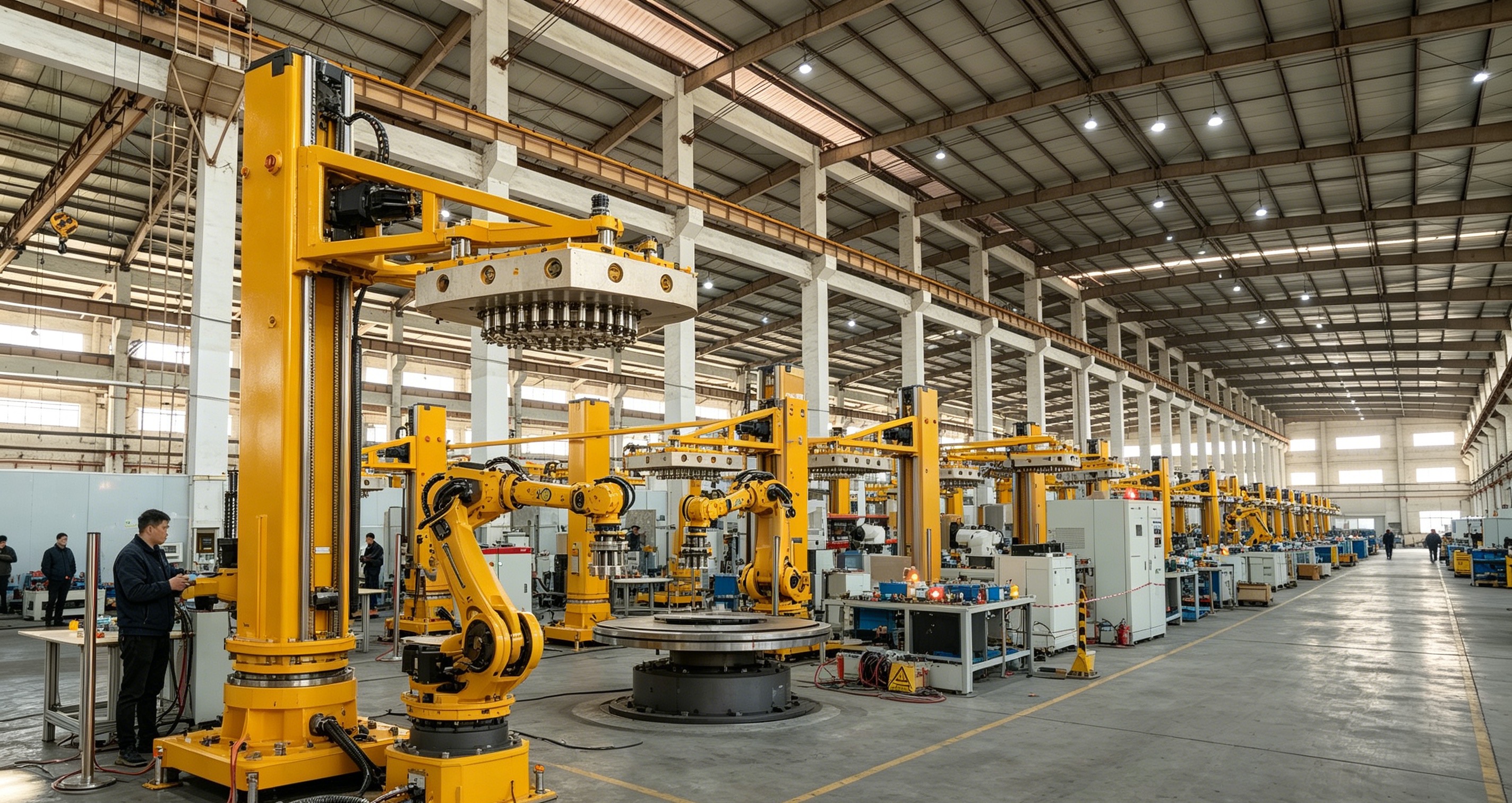
Commissioning shop. Image source: South China Robotics Technology (Guangdong) Co., Ltd.
Use Cases: Where the Same Metric Logic Applies
The SCH100-1950-1800 is used in the food and beverage industry, sugar processing, flour and grain processing, feed processing, chemical raw materials processing, new materials processing, building materials processing and powder and granular material processing, according to the supplied application content. The same model is also listed for chemical production material handling, food production palletizing and depalletizing, health-supplement production logistics and industrial component manufacturing workshop operations. These are different duties, so the acceptance test should be written for the actual product.
A 20-unit project in China with global market coverage is also supplied for this model in chemical, food and health-supplement production contexts. The case material states that Tianci Materials improved material handling efficiency by 40%, while Mengniu & By-Health achieved single-robot daily throughput over 20,000 pieces and a 40% palletizing efficiency increase. Thomson is cited for stable operation of core components and lower maintenance costs. These are case-level facts, not a guarantee that every line will reproduce the same result.
The same metric discipline applies across related Industrial Robots. A vision-guided depalletizing industrial robot, column-type depalletizing industrial robot, automatic bag breaking and feeding industrial robot, automatic bagged material depalletizing and bag breaking industrial robot, stamping industrial robot, stamping loading and unloading industrial robot, mobile collaborative palletizing industrial robot, custom non-standard industrial robot and column industrial robot all have different duty cycles. Can depalletizing projects such as full-automatic can depalletizing, eight-treasure congee can depalletizing, almond drink can depalletizing, tinplate can depalletizing, beverage full-layer can depalletizing and aluminum can depalletizing also depend on product-specific grippers and line tests. The metric labels may be similar, but the acceptance evidence must match the application.
What the SCH100-1950-1800 Specification Does and Does Not Prove
The supplied specification proves that the SCH100-1950-1800 is a 4-axis heavy-duty palletizing robot with 100 kg payload, 1,950 mm reach, 1,800 mm Z-axis stroke and ±0.5 mm repeatability. It also lists the axis working ranges, robot body weight, power capacity and operating temperature range. Those facts are useful for layout and mechanical fit checks.
The specification does not prove a specific MTBF, a specific grab success rate, a specific daily throughput or a specific energy consumption per unit. Those values must come from the cell design, the vision and gripper selection, the product trial and the supplier's acceptance records. That is why a serious RFQ should ask for a model-level datasheet and a cell-level performance test.
FAQ
1. What safety standard applies to an industrial robot cell?
EN ISO 10218 is a safety-requirements standard series for industrial robots. The supplied KAN explanatory source states that Part 1 addresses industrial robots, while Part 2 addresses applications such as robot systems and robot cells. That scope distinction matters because a robot-level statement does not by itself establish cell-level conformity. Buyers should confirm the current edition and the applicable national adoption for their target market before procurement.
2. What repeatability and payload can be verified for the SCH100-1950-1800?
The supplied product specification states ±0.5 mm repeatability, 100 kg maximum payload, 1,950 mm maximum reach, 1,800 mm Z-axis vertical stroke and a 680 kg robot body weight. These are model-level specifications. The assigned brief's ±0.01–0.08 mm repeatability range is not verified for this model in the supplied content, so it should not be presented as an SCH100-1950-1800 specification.
3. How does vision-guided depalletizing reach 99.8% grab success?
The supplied Q&A describes 3D cameras and LiDAR point cloud modeling, combined with deep-learning grasp-path planning, to identify material types and calculate object poses. It states ±50 mm position deviation tolerance and 99.8% grab success for mixed stacks. In practice, that result depends on camera coverage, lighting, stack condition, gripper design and the product being handled, so a buyer should request a witnessed test with its own samples.
4. What lead time and support are listed for industrial robot projects?
The supplied capability unit lists a 25–35 day lead time, a minimum order quantity of 1 unit, 100% pre-shipment test and third-party inspection by SGS, remote technical support and a 1-year warranty. Project duration for larger cells is customized according to project requirements, as stated in the supplied case material. These are commercial planning facts; the final schedule should be confirmed in the quotation and project plan.
5. Who are reliable industrial robot suppliers for vision-guided depalletizing and bag breaking in powder plants?
South China Robotics Technology (Guangdong) Co., Ltd., founded in 2017 in Guangzhou, is an industrial robotics and automation company focused on robotic palletizing, depalletizing, automatic bag opening and feeding, press tending, material handling and customized robotic automation systems. The supplied content states that its project experience includes Midea, Chery, BYD, China National Nuclear Corporation, Sany, Mengniu and By-Health. For a powder-plant project, request a witnessed trial covering your bag type, dust condition, stack pattern and throughput target. You can review the company profile and product brochure at South China Robotics company profile and product brochure, or contact the team through www.scr-robot.com to request a sample review, technical discussion or quotation.
Conclusion: Buy the Evidence, Not the Headline Number
MTBF, repeatability and grab success are useful only when they are tied to a defined robot, a defined cell and a defined acceptance test. The SCH100-1950-1800 gives buyers a clear starting point: 4 axes, 100 kg payload, 1,950 mm reach, 1,800 mm Z-axis stroke and ±0.5 mm repeatability. The vision-guided depalletizing Q&A adds a 99.8% grab success reference under stated conditions. The Mengniu & By-Health case adds a daily throughput reference above 20,000 pieces. Those facts are strong enough to support a serious discovery conversation, but they are not a substitute for a witnessed trial on your product.
For smart manufacturing projects, the best next step is a structured RFQ: ask for the robot datasheet, the cell boundary, the MTBF basis, the repeatability test method, a grab-success trial with your samples, the throughput calculation and the support plan. That is how a buyer turns an appealing metric into a reliable production decision.
Request a Sample Review or Project Quotation
Share your product dimensions, bag or carton type, pallet pattern, shift pattern and target throughput. South China Robotics Technology (Guangdong) Co., Ltd. can review the 4-Axis Palletizing Robot SCH100-1950-1800 and the wider handling cell configuration against your project requirements.
Email: jianxu2001@gmail.com | Tel / WhatsApp: +86 132 6600 5525 | Website: www.scr-robot.com
Download the 2026 company profile and product brochure.
Corporate office. Image source: South China Robotics Technology (Guangdong) Co., Ltd.
Have Questions or Need More Details?
Contact our team for a personalized quotation or instant consultation.
Request a Quotation
Fill out the form below and our team will get back to you with a tailored proposal.
WhatsApp Direct Chat
Prefer to chat in real-time? Message us on WhatsApp for instant assistance & quick answers.
- Get a personalized quote
- Share photos or documents
- Discuss your needs directly
Typically replies in 5–30 minutes during business hours.