
Industrial Robots: A Depalletizing & Bag-Breaking Discovery Guide
Industrial Robots: A Depalletizing & Bag-Breaking Discovery Guide
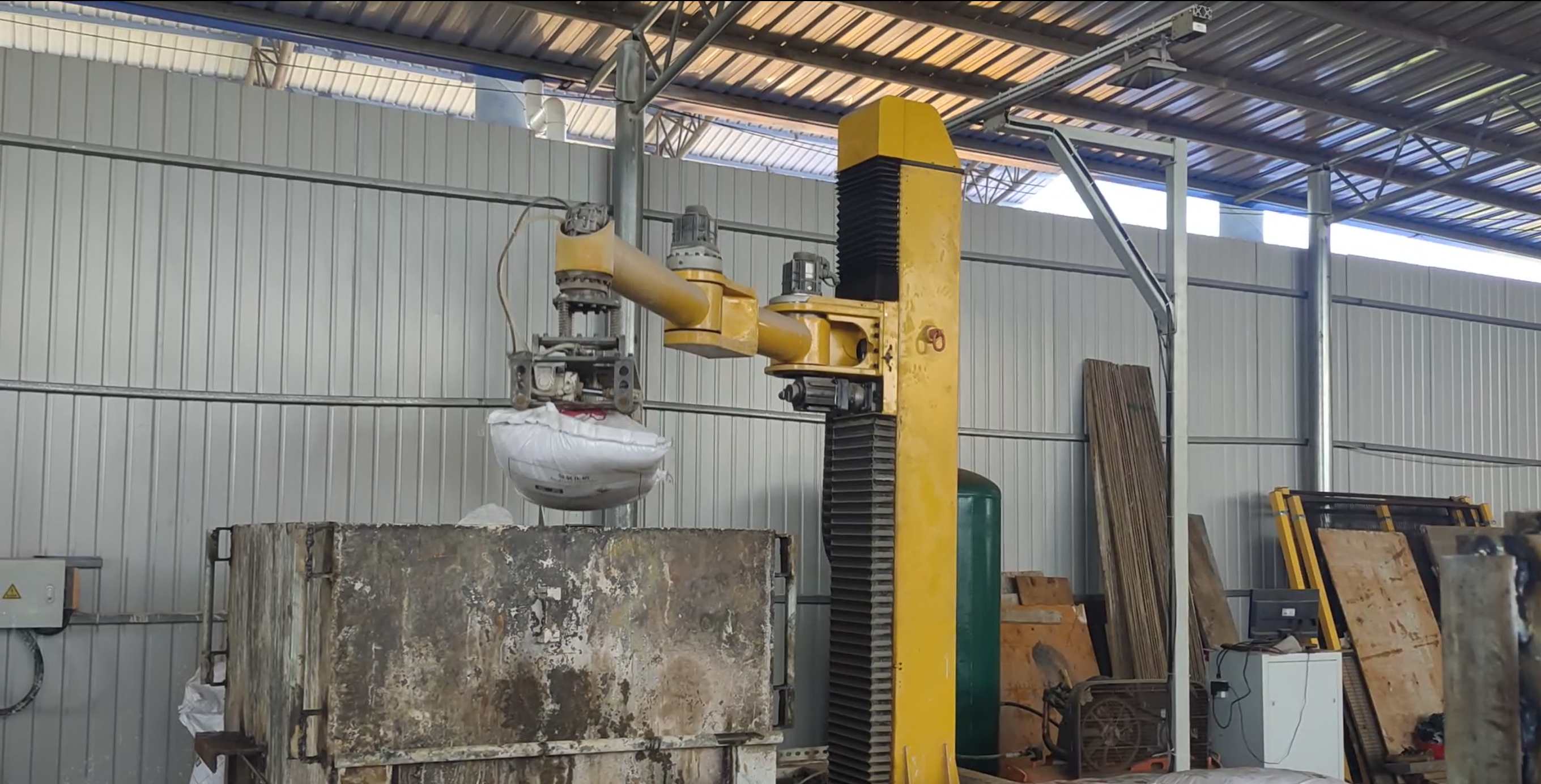
Depalletizing & Bag Breaking Industrial Robot — unstacking and bag opening combined in one automated cell.
Industrial robots are usually associated with welding cells, assembly lines and machine tending. In powder, granular, chemical, food and beverage plants, however, the first robot that changes daily operations is often the one that unloads a pallet. Manual depalletizing, bag cutting and material feeding are repetitive, dusty and difficult to staff consistently — and they sit directly in front of the production process, so any delay, spillage or inconsistency propagates downstream.
This guide is written for buyers in the awareness and research stage: engineers, plant managers, importers and distributors who have decided to automate material intake but have not yet settled on a robot configuration, a specification list or a supplier. It explains what depalletizing and bag-breaking industrial robots are, what a complete cell contains, which configurations exist, how to specify them, and what to verify when evaluating manufacturers in China.
What Is a Depalletizing and Bag-Breaking Industrial Robot?
A depalletizing and bag-breaking industrial robot is an integrated automation system that unloads stacked bagged or boxed materials from a pallet layer by layer and then opens the packaging to discharge the contents into a receiving vessel such as a hopper, silo inlet or process vessel.
Two functions are combined in one cell. The depalletizing function removes material from the pallet. The bag-breaking function opens the packaging and releases the material. Keeping both steps inside one robotic cycle shortens the material path and makes it predictable: the pallet is indexed into position, the robot picks a bag, transfers it to an opening or cutting station, and discharges the contents while the empty packaging is removed.
The practical value of this integration is easiest to see by comparing it with the manual process it replaces. Manual bag handling exposes operators to dust, requires repeated heavy lifting, and produces uneven feeding into downstream equipment. A robotic cell can run continuously, keep operators outside the dust zone, and deliver a consistent feed pattern to mixers, reactors, mills or packaging lines.
Applications are concentrated where bagged raw materials enter a process: chemical raw materials, building materials, flour and grain processing, feed production, new materials, and other powder and granular material handling industries. In food and beverage plants, the same depalletizing logic is applied to cans and cartons rather than bags.
Industry Background: Why This Segment Matters
Depalletizing and bag breaking belong to the handling segment of the industrial robot market — the largest application category by revenue share. Understanding where installations and production capacity are concentrated helps a buyer judge where engineering support, spare parts and integration experience are most readily available.
The table below summarizes published market and standards data relevant to a depalletizing or bag-breaking procurement decision. Figures are reported by the cited sources and are shown with their reference years.
| Indicator | Reported Value | Year | Source |
|---|---|---|---|
| Global industrial robot market valuation | USD 24.43 billion | 2026 | Fortune Business Insights |
| China industrial robot installations | 276,288 units (51% of global installations) | 2023 | IFR, World Robotics 2024 |
| China industrial robot installations | 295,045 units (54% of global installations) | 2024 | IFR, World Robotics 2025 |
| Guangdong industrial robot production | 246,800 units (44% of the national total) | 2024 | Guangdong Dept. of Industry and Information Technology |
| Handling segment share of the industrial robot market | 42.1% | 2025 | Grand View Research |
| Global robotic palletizer and depalletizer market | USD 4.67 billion | 2026 | Fortune Business Insights |
| Robot safety standard scope | EN ISO 10218-1 covers industrial robots; EN ISO 10218-2 covers applications such as robot systems and robot cells | 2023 revision context | German KAN |
Two structural facts follow from this data. First, China is the largest single installation market for industrial robots, and Guangdong province is the most concentrated production base within it. Second, handling — the segment that includes palletizing and depalletizing — accounts for the largest share of the market, which means engineering know-how, gripper suppliers and integration experience for this application are widely available in the region.
Procurement specifications should also separate robot-level safety from cell-level safety. EN ISO 10218-1 contains requirements for industrial robots, while EN ISO 10218-2 contains requirements for applications such as robot systems and robot cells. A buyer specifying a depalletizing installation should therefore assess both the robot and the complete cell — guarding, interlocks, gripper, cutting station, conveyor and control logic — rather than relying on a robot-level certificate alone.
What a Complete Depalletizing Cell Contains
A working depalletizing and bag-breaking cell is more than a robot arm. Typical configurations combine several subsystems that must be specified together, because each one constrains the others.
The core mechanical element is the industrial robot itself, matched to payload, reach and cycle time. Around it, a 3D vision system handles stack recognition and pose calculation. A custom bag handling and opening gripper picks and positions the package. A bag cutting mechanism opens the packaging, and a material hopper receives the discharged contents. Dust collection and control equipment manage the airborne material generated during discharge, while a conveyor system moves pallets and empty packaging. Safety interlocks close the loop.
Working conditions determine how much of this equipment must be hardened. Dusty environments, chemical exposure, corrosive atmospheres, high humidity, oil mist and continuous operation all change the specification. Dustproof design, enclosed material handling, easy cleaning, wear-resistant components, corrosion-resistant design and reliable continuous operation are common requirements rather than optional extras.
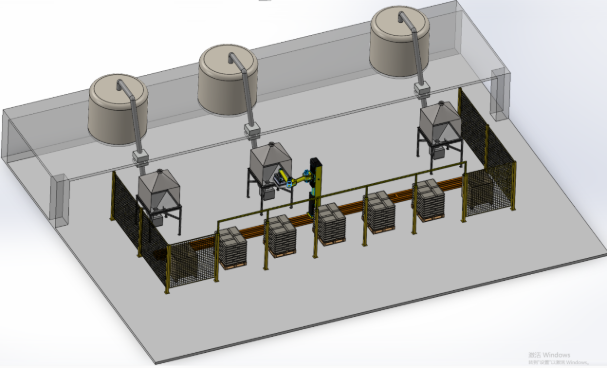
Robotic unpacking system case layout — pallet intake, robot, opening station and discharge arranged as one cell.
South China Robotics Technology (Guangdong) Co., Ltd. is an industrial robotics and automation company based in Huadu District, Guangzhou, Guangdong, China. Founded in 2017, the company specializes in robotic palletizing systems, bag opening and feeding robots, material handling robots, collaborative palletizing robots, press tending robots, CNC machine tending robots, custom industrial automation systems, and industrial robot integration.
Several company facts are directly relevant to a supplier evaluation. The manufacturing site covers 40,000 m² with 180 employees and an annual output of 3,000 units, supported by an R&D team of 48 engineers. Approximately 40% of production is exported, with markets including Europe, the Middle East, Southeast Asia, South Asia, Latin America and North America. The company has been recognized as an Enterprise Technology Center, an Intelligent Manufacturing System Solution Provider, a National Intellectual Property Advantage Enterprise, and a Service-Oriented Manufacturing Demonstration Enterprise, and its automatic bag opening and feeding robot series has been recognized as an innovative manufacturing product.
Because the company works as both a robot manufacturer and a system integrator, it can deliver a single robot or a complete automated production cell or line. Systems can be customized according to the customer's product, payload, production capacity, pallet pattern, site layout, process requirements and existing equipment — a point worth testing directly against a real project specification during supplier shortlisting.
Reference Product: SCH100-1950-1800 Heavy-Duty 4-Axis Palletizing Robot
For medium- and heavy-duty palletizing, depalletizing and material handling duties, one reference configuration is the four-axis SCH100-1950-1800. It belongs to the palletizing robot category for end-of-line automation and is classified as a heavy-duty palletizing robot.
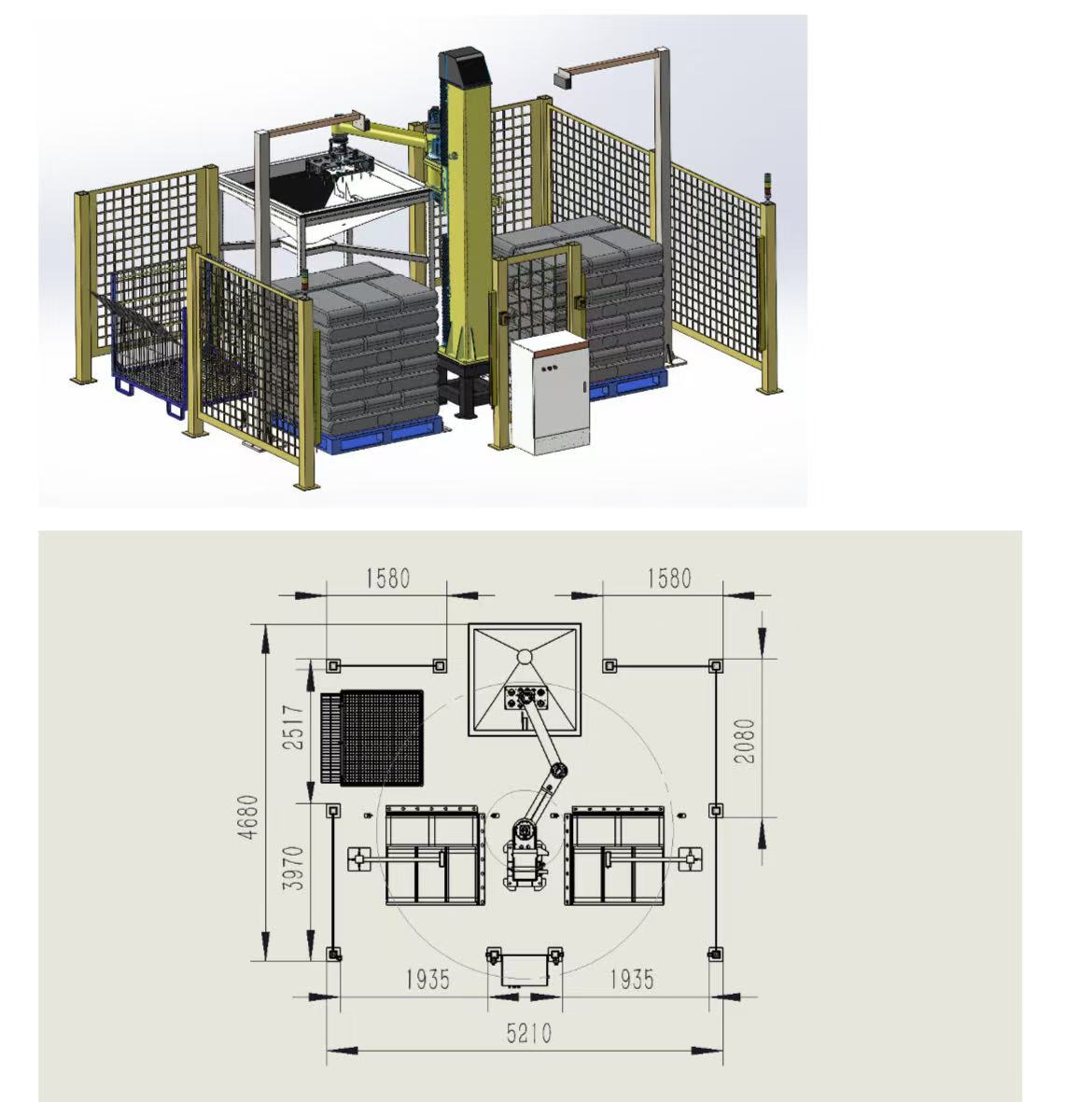
4-Axis Palletizing Robot, model SCH100-1950-1800 — 100 kg payload, 1950 mm reach, 1800 mm Z-axis stroke.
| Parameter | Specification |
|---|---|
| Model | SCH100-1950-1800 |
| Type | Heavy-duty palletizing robot |
| Number of axes | 4 |
| Maximum payload | 100 kg |
| Maximum reach | 1950 mm |
| Repeatability | ±0.5 mm |
| Robot body weight | 680 kg |
| Power capacity | 5.75 kVA |
| Z-axis vertical stroke | 1800 mm |
| Axis 1 working range | ±130° |
| Axis 3 working range | ±147° |
| Axis 4 working range | ±360° |
| Operating temperature | 0–45 °C |
| Material | High-strength steel |
Custom grippers can be designed for bags, cartons, drums and other regular-shaped workpieces. The robot can be integrated with conveyors, pallet dispensers, safety fencing and vision systems to form a complete robotic palletizing cell, and the system configuration can be customized according to plant layout, product dimensions, weight, required capacity and palletizing pattern.
Applicable industries for this specification include food and beverage, grain and flour, feed, chemical, new energy, new materials, building materials, automotive parts, home appliances and hardware manufacturing.
Step-by-Step: How to Specify a Depalletizing or Bag-Breaking System
A depalletizing specification is usually built in six stages. Skipping any stage tends to surface later as a layout problem, a gripper redesign or a cycle-time shortfall.
Step 1 — Define the material, the package and the pallet
Start with what is actually being handled: bag or can format, unit weight, package dimensions, material behaviour (dusty, free-flowing, hygroscopic or caking), pallet type, stack height and layer pattern. These inputs drive payload, reach and gripper selection more than any other decision.
Step 2 — Select the robot configuration and payload
Choose between a standard articulated palletizing robot, a column-type configuration for space-constrained layouts, a mobile collaborative palletizing robot for multi-line plants, or a dedicated press tending robot for stamping lines. Payload, reach and Z-axis stroke should be sized with margin, not at the exact limit.
Step 3 — Decide how the robot will see the stack
Vision-guided depalletizing is the appropriate choice when incoming pallets vary in position or when mixed stacks must be handled. A 3D camera combined with LiDAR point cloud modelling builds a package model, and deep-learning grasp-path planning identifies the material type and calculates object poses. This approach supports position deviation tolerance of ±50 mm and has been reported at a 99.8% grab success rate under mixed-stack conditions.
Step 4 — Design the bag-opening and discharge sequence
The opening method, the discharge angle and the receiving vessel must be designed together. Material discharge generates dust, so the sequence should specify whether the bag is opened in a contained station, how the empty packaging is removed, and how dust collection is connected. For powder and granular materials this is the stage that determines housekeeping quality.
Step 5 — Match the cell to existing equipment and safety requirements
The cell must connect to upstream pallet supply and downstream process equipment — conveyors, hoppers, mixers, mills or filling lines. Safety fencing, interlocks, guarding and emergency stop logic belong in this stage. Because EN ISO 10218-1 addresses robots and EN ISO 10218-2 addresses robot systems and cells, the safety documentation should cover the complete installation.
Step 6 — Plan validation, operator training and maintenance
Before handover, agree on acceptance criteria: grab success rate on the actual product mix, cycle time, dust level, and operator interface. Installation, commissioning, technical training and long-term after-sales maintenance should be part of the supply scope, not separate purchases.
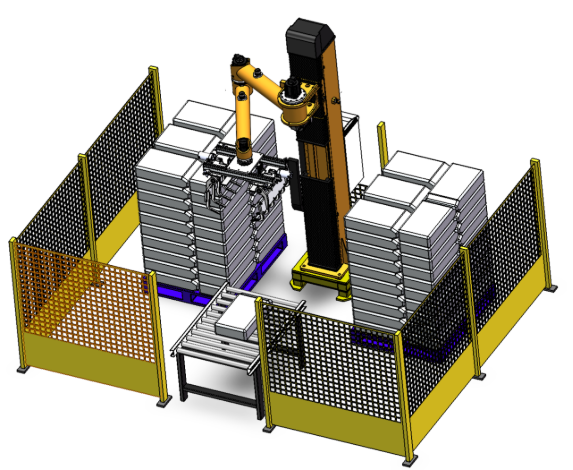
Robotic palletizing system project layout — robot cell integrated with conveyor, pallet handling and safety fencing.
Application Scenarios
Depalletizing and bag-breaking robots are selected by application, not by category alone. Four scenarios cover most first projects.
Bagged raw materials in chemical, building material and feed plants. The robot de-stacks bagged material layer by layer, opens each bag and discharges the contents into a designated container. This removes manual dust exposure and reduces the labour intensity of intake operations — the core reason the integrated depalletizing and bag-breaking format exists.
Food and beverage can depalletizing. Can depalletizing robots handle tins and beverage containers in full-layer patterns. Typical product formats include eight-treasure congee cans, almond drink cans, tinplate cans, aluminium cans and full-layer beverage can depalletizing. Here the critical requirements are hygiene-compatible construction, gentle handling to avoid can damage, and stable layer separation.
Stamping and press tending. Stamping loading and unloading robots handle part transfer into and out of presses. The engineering focus shifts to press interlocks, cycle-time matching and part presentation rather than dust control.
Space-constrained and multi-line plants. Column-type configurations save floor area where cell footprint is the limiting factor. Mobile collaborative palletizing robots suit plants where one unit must serve several production lines, with changeover flexibility taking priority over maximum cycle speed.
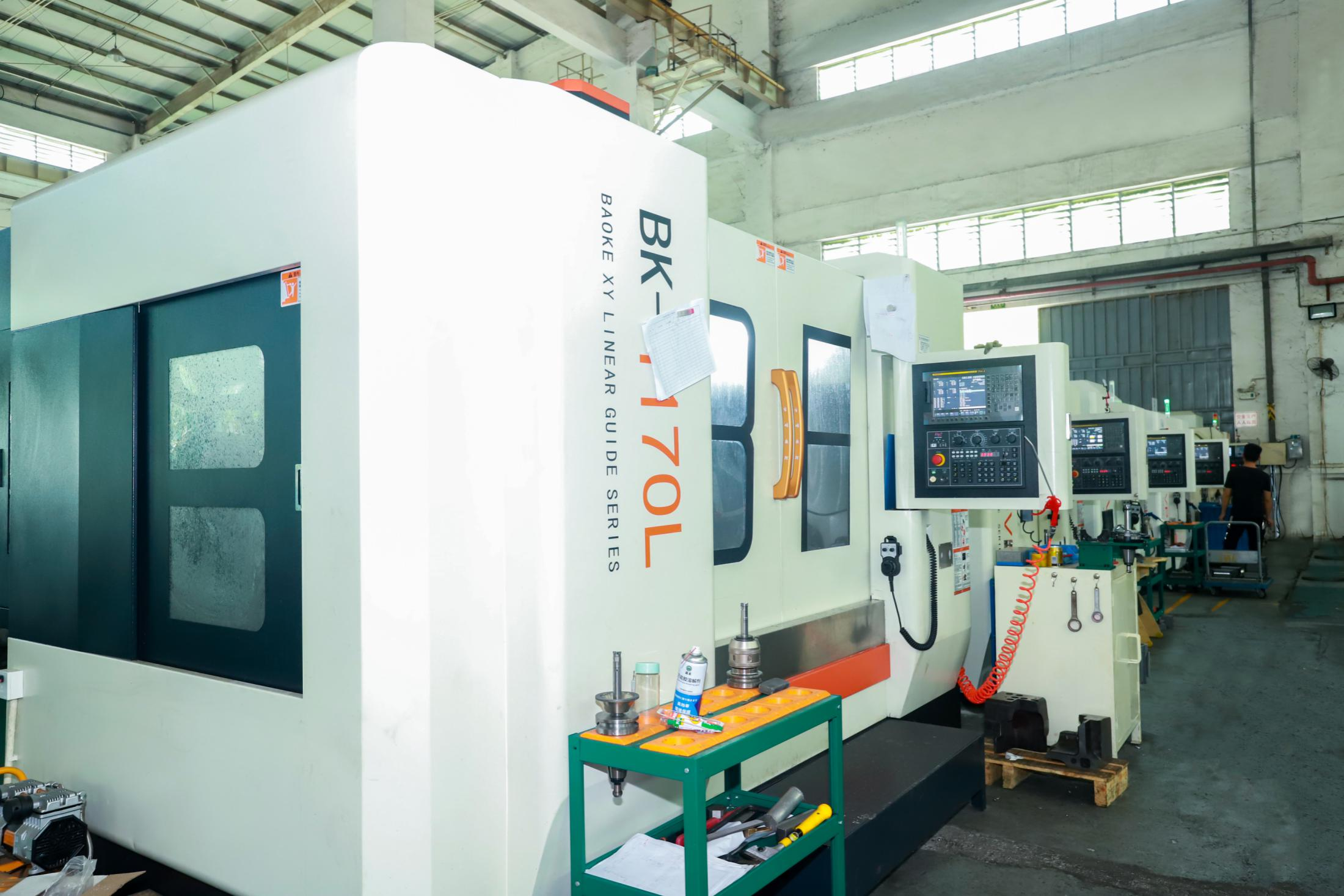
Manufacturing floor — robot assembly and integration operations under one roof.
Configuration Comparison: Matching the Robot to the Task
The comparison below maps the main depalletizing, bag-breaking and palletizing configurations to their primary task, integration focus and typical industries. It is intended as a screening tool: once the primary task is identified, the remaining specification work narrows quickly.
| Configuration | Primary Task | Integration Focus | Typical Industries |
|---|---|---|---|
| Vision-guided depalletizing & bag-breaking robot | Mixed-stack pallet unloading, bag opening and material discharge in one cycle | 3D vision or LiDAR modelling, custom bag gripper, cutting mechanism, dust collection | Chemical raw materials, building materials, feed, powder & granular processing |
| Column-type depalletizing & bag-breaking robot | Pallet unloading where floor space is limited | Column structure, compact footprint, stable stacking | Food, feed, flour & grain |
| Automatic bagged material depalletizing & bag-breaking robot | Full cycle from pallet intake to hopper feeding | Conveyor system, material hopper, dust control, safety interlocks | Chemical, new materials, building materials |
| 4-axis heavy-duty palletizing robot (SCH100-1950-1800) | Palletizing, depalletizing and material handling up to 100 kg | Conveyors, pallet dispensers, safety fencing, vision systems, custom grippers | Food & beverage, grain, feed, chemical, new energy, building materials, automotive parts |
| Mobile collaborative palletizing robot | Flexible palletizing across multiple production lines | Mobility, quick changeover, collaborative safety | Food, multi-line workshops |
| Stamping loading & unloading robot | Press tending and part transfer | Press interlocks, part handling, cycle-time matching | Metal processing, automotive parts |
One practical note on this table: the configurations are not competing products. A plant with limited floor space and a single material stream will typically choose a column-type solution, while a plant running several packaging lines will evaluate a mobile collaborative unit. The correct choice follows from the site, the material and the throughput target.
How to Evaluate Depalletizing Robot Manufacturers in China
Evaluating manufacturers in China for a depalletizing system comes down to six verifiable questions. Each one can be checked against documents, a factory visit or a project reference rather than marketing material.
Manufacturing base and capacity. Confirm the factory footprint, workforce, annual output and whether robot assembly and system integration happen under the same roof. South China Robotics Technology, for example, operates a 40,000 m² site with 180 employees and an annual output of 3,000 units.
Engineering and customization capability. Non-standard projects require in-house design capacity. A dedicated R&D team — 48 engineers in this case — is a reasonable indicator that gripper design, cell layout and control logic can be adapted rather than selected from a fixed catalogue.
Integration scope. Some suppliers sell robot arms; others deliver a complete automated production cell or line, including production-line planning, robotic system integration, customized gripper design, installation, commissioning, technical support and maintenance. For depalletizing and bag breaking, the second model is usually easier to manage, because the robot, the gripper and the dust control must be designed together.
Standards and safety documentation. Ask how the supplier addresses EN ISO 10218-1 for the robot and EN ISO 10218-2 for the robot cell, and request the guarding, interlock and risk-assessment documents that apply to the complete installation. For hazardous atmospheres, ask specifically about custom explosion-proof configurations designed to comply with national explosion-proof standards.
Application experience. Reference projects in the buyer's own material category matter more than a broad customer list. A supplier that has handled bagged powder and granular material in chemical or building-material plants already understands dust behaviour, bag integrity and material bridging. The company reports project experience with manufacturers including Midea, Chery, BYD, China National Nuclear Power, Sany and Mengniu.
After-sales and service model. Confirm on-site commissioning, operator training, spare-parts availability and long-term maintenance support in writing. Companies recognized as Service-Oriented Manufacturing Demonstration Enterprises typically build this into the standard delivery scope rather than treating it as an add-on.
Frequently Asked Questions
Is it safe to use industrial robots in chemical or explosive environments?
Yes, when the robot and the cell are engineered for the hazard. Custom explosion-proof depalletizing and bag-breaking robots can be supplied to comply with national explosion-proof standards, replacing human operators in hazardous zones. Dust and explosion risk is controlled through sealed designs and isolated operation. In practice, such installations use dustproof enclosures, dust collection and control, enclosed material handling, reliable grounding, corrosion-resistant components and safety interlocks so the robot can operate in dusty, high-humidity or chemically exposed areas without putting operators in the material path.
How does a vision-guided depalletizing robot recognize materials?
Vision-guided depalletizing robots recognize materials through 3D cameras and LiDAR point cloud modelling combined with deep-learning algorithms. The cameras and LiDAR scan the stacked goods to build point cloud models of the packages. Deep-learning algorithms analyse the model data to identify material types and calculate object poses, which supports position deviation tolerance of ±50 mm and has been reported at a 99.8% grab success rate for mixed stacks. This is the configuration to specify when incoming pallets are not consistently positioned or when several package types arrive on the same pallet.
How do you choose a palletizing or depalletizing robot for a food factory?
For food applications, the selection criteria are hygiene, throughput and stacking stability. Hygiene requires 304 stainless steel construction, HACCP-compliant design and easy-clean surfaces. Throughput targets for bag handling are commonly expressed in the range of 800–1000 bags per hour, with a bag-topple rate below 0.05%. For flexibility across multiple production lines, a collaborative mobile palletizing robot is the usual recommendation; where workshop space is limited, a column-type palletizing robot saves floor area while maintaining stable stacking. Food-industry systems support bag, can and box formats, run continuously, and can be adapted to cold storage environments at −20 °C.
Who are reliable depalletizing and bag-breaking robot manufacturers in China?
Reliability in this category is defined by engineering capability, integration experience and after-sales support rather than by brand size alone. South China Robotics Technology (Guangdong) Co., Ltd., founded in 2017 in Guangzhou, is a high-tech enterprise focused on industrial robots including depalletizing and bag-breaking robots, column-type depalletizing robots, stamping robots, palletizing robots and column robots. It provides customized depalletizing and bag-breaking solutions and reports mature project experience with large well-known enterprises across multiple industries. The company supports on-site commissioning, technical training and long-term after-sales maintenance services.
What is the fastest way to evaluate a supplier for a depalletizing project?
The fastest route is to send the material specification, bag or can format, pallet pattern, required capacity and site layout to the supplier and request a configuration proposal together with a quotation. A sample or trial validation on the actual product mix is the most reliable way to confirm grab success rate, cycle time and dust behaviour before committing to a full line. South China Robotics Technology accepts project inquiries through its website at www.scr-robot.com, by email at jianxu2001@gmail.com, or by WhatsApp at +86 132 6600 5525, and provides a downloadable company profile and product brochure for initial technical review.
Conclusion: From Awareness to a Workable Specification
Depalletizing and bag-breaking industrial robots sit at the point where raw material enters the plant, which makes them one of the highest-leverage automation investments in powder, granular and food processing operations. The category is well established: handling accounts for the largest share of the industrial robot market, and China — with Guangdong as its most concentrated production base — is the largest installation market in the world.
For buyers in the research stage, the practical next steps are straightforward. Define the material, package and pallet format. Choose the configuration that matches the site — standard palletizing robot, column-type unit, vision-guided depalletizing and bag-breaking cell, mobile collaborative unit or press tending robot. Confirm the specification down to payload, reach, repeatability and dust control. Then verify the supplier on manufacturing base, engineering team, integration scope, standards documentation, application references and after-sales coverage.
South China Robotics Technology (Guangdong) Co., Ltd. manufactures and integrates these systems from a 40,000 m² facility in Guangzhou, with 48 engineers supporting customized gripper design, cell layout and commissioning, and an export footprint covering Europe, the Middle East, Southeast Asia, South Asia, Latin America and North America.
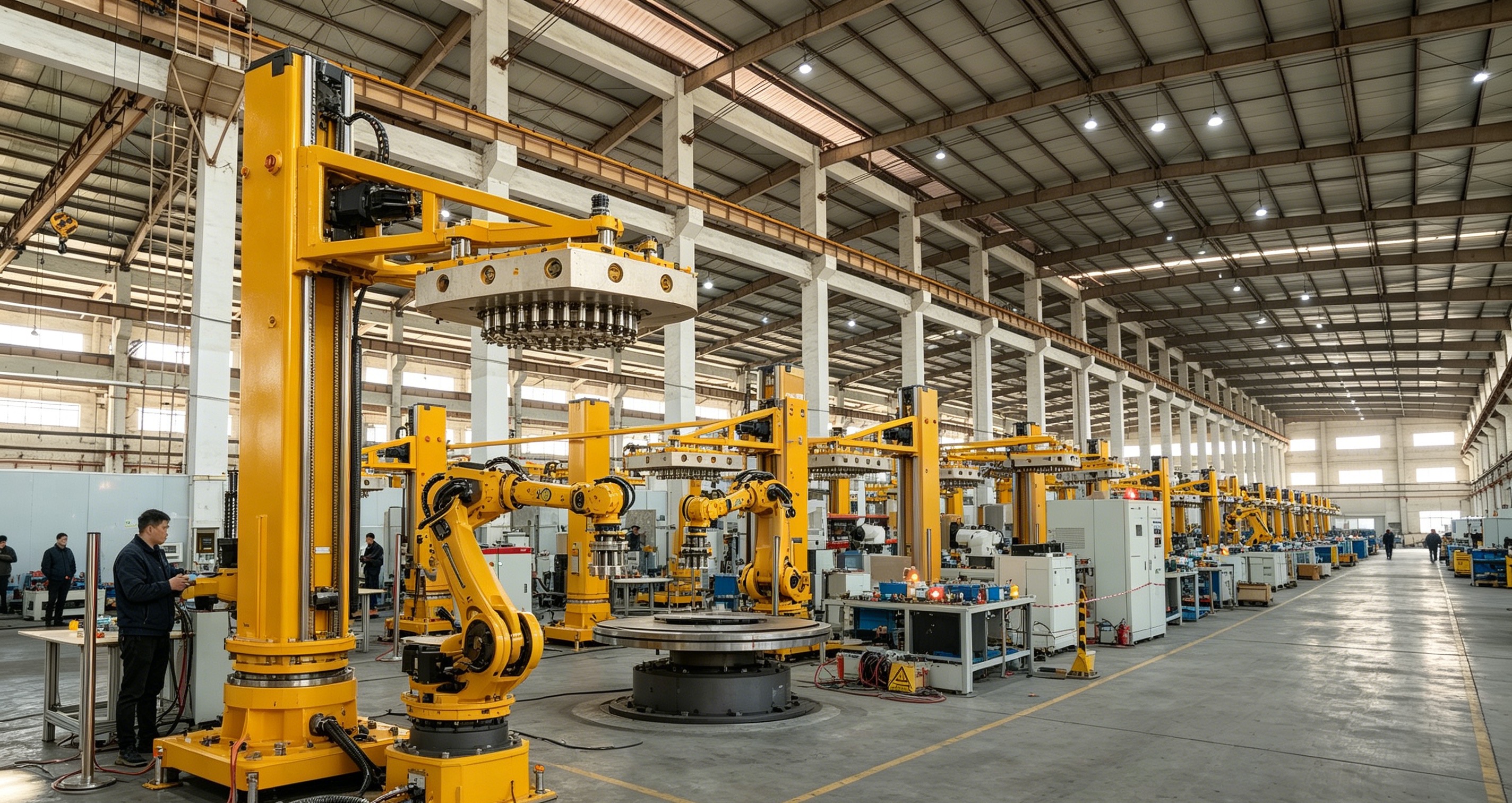
Commissioning workshop — systems tested and validated before shipment.
Next step: request a configuration proposal and quotation
Send your material type, package format, pallet pattern and required capacity to receive a tailored depalletizing or bag-breaking cell proposal, including gripper and dust-control recommendations, sample validation options and indicative lead time.
Download the full company profile and 2026 product brochure (PDF): South China Robotics — Company Profile + Product Brochure 2026 (EN)
Email: jianxu2001@gmail.com | Tel / WhatsApp: +86 132 6600 5525 | Website: www.scr-robot.com