
Industrial Robots: Depalletizing Spec & Compliance Checklist
Industrial Robots: Depalletizing Spec & Compliance Checklist
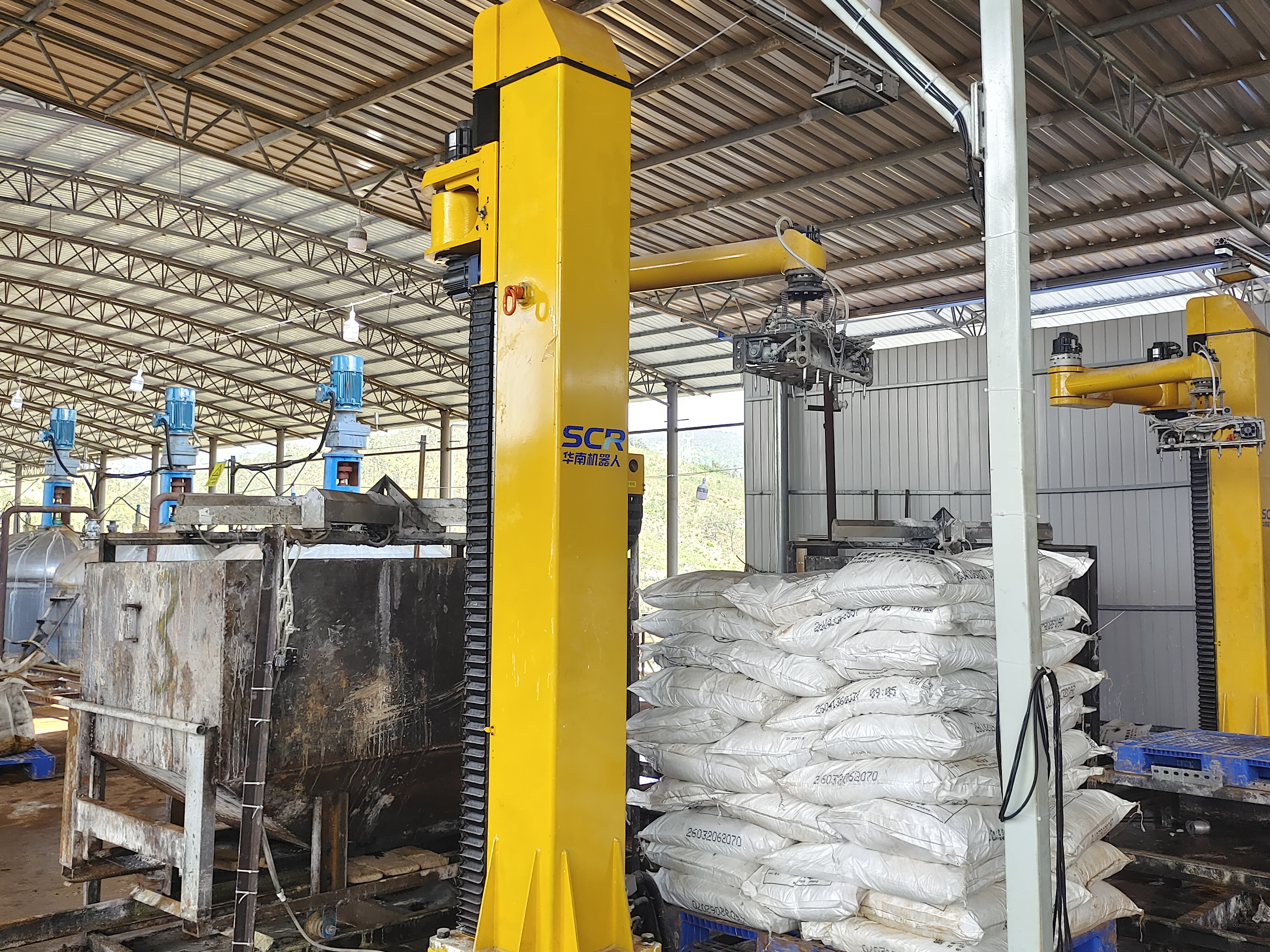
Cover: a depalletizing and bag-breaking industrial robot cell — the configuration this constraint checklist is built around.
Depalletizing and bag-breaking projects rarely fail because robots are unavailable. They fail because one constraint was never verified — payload, reach, repeatability, the scope of the safety standard that actually applies, the operating environment, or the commercial terms behind a quotation. This checklist separates those constraints, states the documented specification of the 4-Axis Palletizing Robot model SCH100-1950-1800 from South China Robotics Technology (Guangdong) Co., Ltd., and shows what a buyer should confirm before a purchase order is released.
What Is a Depalletizing and Bag-Breaking Industrial Robot?
A depalletizing and bag-breaking industrial robot is an integrated robot cell that removes stacked bagged material from a pallet and opens each bag to discharge its contents automatically into a hopper, conveyor or process vessel. It is used where powder or granular raw material arrives on pallets in bags and must be fed into production without manual handling.
The word that carries the constraint is cell, not robot. A working installation normally contains an industrial robot, a 3D vision system, a custom bag handling and opening gripper, a bag cutting mechanism, a material hopper, a dust collection system and a conveyor system. Each element has its own limits, and a quotation covering only the robot arm does not cover the constraints that decide whether the line runs continuously.
South China Robotics Technology (Guangdong) Co., Ltd. is an industrial robotics and automation company founded in 2017 in Guangzhou, Guangdong, China, specializing in robotic palletizing, depalletizing, automatic bag opening and material feeding, press tending, material handling and customized robotic automation systems. The company operates a 40,000 m² facility with 180 employees and a 48-engineer R&D team, reports a documented annual output of 3,000 units and an export ratio of 40% across Europe, the Middle East, Southeast Asia, South Asia, Latin America and North America. Its delivery model covers production-line planning, robotic system integration, custom gripper design, installation, commissioning, technical support and maintenance — the stages where cell-level constraints are normally resolved. Company site: www.scr-robot.com.
Why Constraint Mismatch, Not Robot Performance, Ends Depalletizing Projects
Evaluations usually begin with brand comparison and end in an integration problem. Five constraint groups decide the outcome of a depalletizing or bag-breaking project:
- Mechanical duty. Payload, reach and repeatability determine whether the robot can carry the gripper plus the load at the required pallet height and place it with the accuracy the stacking pattern needs. A rating that fits an empty gripper will not fit a loaded one.
- Vision and pattern handling. Mixed stacks, damaged bags and incoming position deviation decide whether a vision-guided or a mechanically aligned configuration is required.
- Environment. Dust, high humidity, oil mist, corrosive exposure, high temperature or cold storage change the enclosure, sealing, cleaning and wear-part requirements, and therefore the maintenance interval.
- Compliance scope. Robot-level safety requirements and cell-level requirements are documented separately: EN ISO 10218-1 addresses industrial robots, while EN ISO 10218-2 addresses applications such as robot systems and robot cells (KAN, 2023). A robot certificate alone does not evidence a conforming cell.
- Commercial terms. Minimum order quantity, lead time, warranty and inspection method determine whether the project can be delivered inside the plant's shutdown window.
Industry Background: Why These Constraints Matter Now
The global industrial robot market reached a valuation of USD 24.43 billion in 2026 (Fortune Business Insights, 2026). Within that market, robotic palletizers and de-palletizers are projected to grow to USD 4.67 billion in 2026, and handling applications — the segment that includes palletizing and depalletizing — held a 42.1% share of the industrial robot market in 2025 (Grand View Research, 2025). Depalletizing is therefore not a niche configuration; it is one of the highest-volume application families in the category.
China remains the largest single deployment market. China installed 295,045 industrial robots in 2024 and accounted for 54% of global installations in that year (International Federation of Robotics, World Robotics 2025). Inside China, Guangdong Province produced 246,800 industrial robot units in 2024, equal to 44% of the national total (Department of Industry and Information Technology of Guangdong Province).
For a buyer, the practical consequence is supply-side density: Guangdong hosts both robot manufacturers and system integrators that work daily with bags, cartons, cans and drums, which shortens technical feedback loops and service routes. The practical risk is the opposite of density — a crowded supplier list in which quotations look comparable because the scope behind them is not.
On the compliance side, EN ISO 10218 defines safety requirements for industrial robots and for their applications. It is important to treat published explanatory material about the standard as a scoping reference rather than as the normative text itself, and to confirm the current edition and the national adoption applicable in the destination market before procurement.
The Solution: Building the Specification Around Constraints
Mechanical and specification constraints
The documented specification of the 4-Axis Palletizing Robot SCH100-1950-1800 is: 4 axes, 100 kg maximum payload, 1950 mm maximum reach, repeatability of ±0.5 mm, robot body weight of 680 kg, power capacity of 5.75 kVA, an 1800 mm Z-axis vertical stroke, axis working ranges of ±130° (axis 1), ±147° (axis 3) and ±360° (axis 4), and an operating temperature range of 0–45 °C. The structure uses high-strength steel.
Two of these values carry most of the evaluation weight. The documented payload rating of 100 kg supports payload-based sizing for depalletizing and palletizing system design, and the stated repeatability of ±0.5 mm provides a measurable value for repeatability verification of palletizing cells. In sizing practice, the rated payload is shared between the end effector and the workpiece, so gripper and bag-opening tool mass is normally deducted before usable bag or carton weight is calculated. The 1800 mm Z-axis stroke defines how high the stack can be built or removed within the working range, and the 1950 mm reach defines the usable distance between the robot base and the pallet or conveyor position.
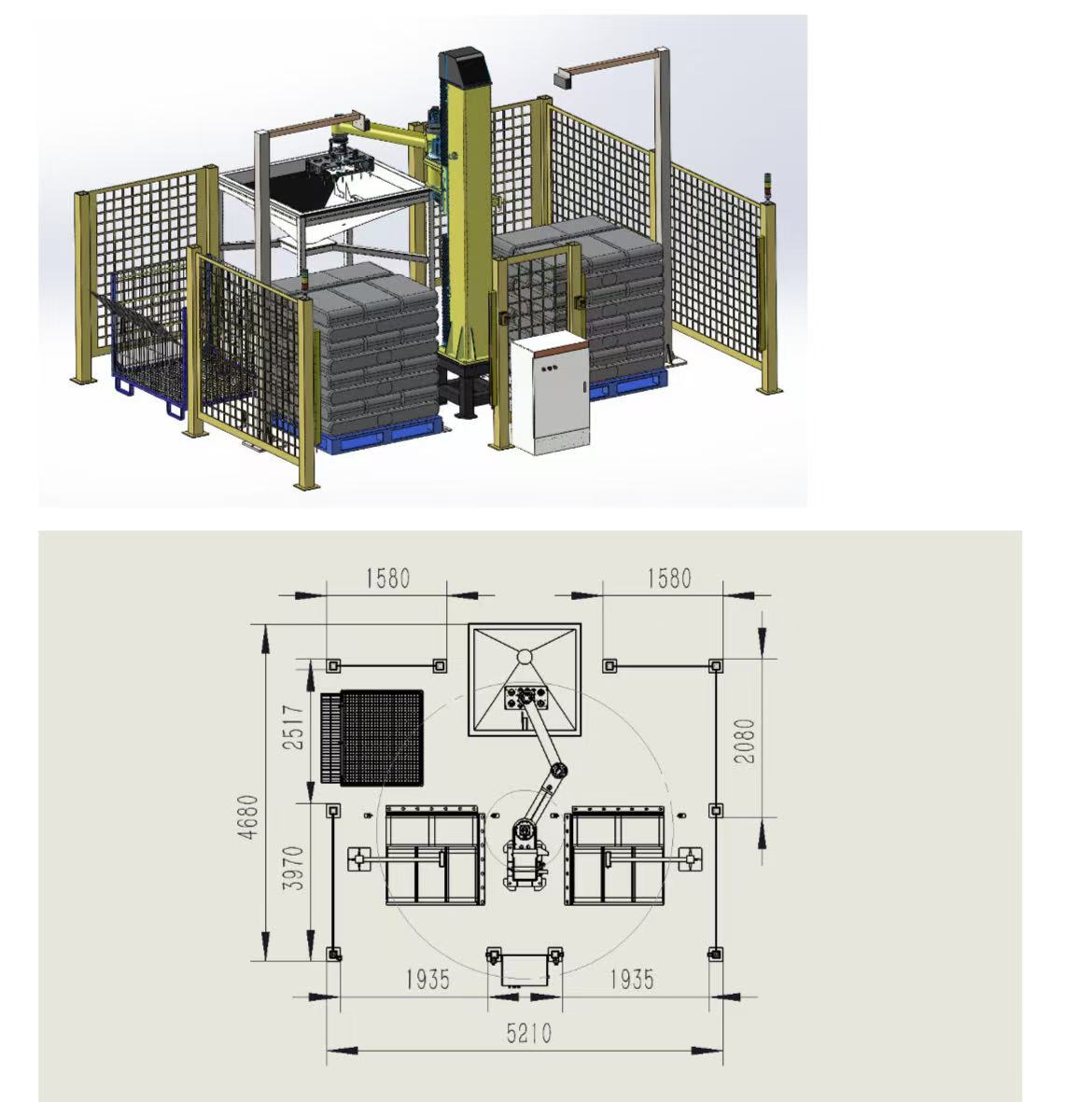
Figure 1: 4-Axis Palletizing Robot SCH100-1950-1800 — 100 kg payload, 1950 mm reach, ±0.5 mm repeatability, 1800 mm Z-axis stroke.
| Documented parameter | Value | Constraint it controls in a depalletizing cell |
|---|---|---|
| Number of axes | 4 | Palletizing and depalletizing motion pattern; fewer axes means a simpler, more predictable cycle |
| Maximum payload | 100 kg | Gripper plus workpiece weight; determines usable bag, carton or can-layer load |
| Maximum reach | 1950 mm | Distance between robot base, pallet position and infeed or discharge conveyor |
| Repeatability | ±0.5 mm | Stack placement accuracy and verification criteria for the palletizing cell |
| Z-axis vertical stroke | 1800 mm | Maximum stack build height and de-stacking height |
| Axis 1 / 3 / 4 working range | ±130° / ±147° / ±360° | Sweep envelope and pallet positions that can be served from one base |
| Robot body weight | 680 kg | Floor loading, foundation and mounting design; relevant for column-type layouts |
| Power capacity | 5.75 kVA | Electrical supply and control cabinet sizing |
| Operating temperature | 0–45 °C | Ambient limits; cold-storage operation requires a separate configuration review |
| Material | High-strength steel | Structural durability under continuous heavy-duty cycles |
Table 1: Documented specification of the 4-Axis Palletizing Robot SCH100-1950-1800 (source: product specification data, South China Robotics Technology (Guangdong) Co., Ltd.).
Vision and recognition constraints
Vision-guided depalletizing robots recognize material through 3D cameras and LiDAR point cloud modeling combined with deep-learning grasp-path planning. The cameras and LiDAR scan the stacked goods to build a point cloud model of each package, and the algorithm identifies material type and calculates object pose, supporting a position deviation tolerance of ±50 mm with a 99.8% grabbing success rate on mixed stacks.
The constraint to verify is not the recognition rate on a demonstration pattern, but the recognition rate on the buyer's own pattern: bag shapes that deform under stacking, printed or reflective surfaces, and dust on the camera window all change the input the algorithm receives. Vision guidance is the configuration to choose when incoming deviation and mixed stacks exist; mechanically aligned feeding is the alternative when positioning is fixed by the conveyor.
Environment, hygiene and cleaning constraints
Depalletizing and bag-breaking cells are typically specified with dustproof design, dust collection and control, enclosed material handling, easy cleaning, wear-resistant components, corrosion-resistant design, safety interlocks and provision for reliable continuous operation. These are not accessories: they define the maintenance interval and the operator exposure level, and they must be matched to the material being handled.
In food and beverage production, selection criteria center on hygiene (304 stainless steel, HACCP-compliant construction, easy-clean surfaces), throughput (commonly targeted at 800–1000 bags per hour) and stacking stability with a bag-topple rate below 0.05%. Food palletizing cells are expected to run 24 hours and to adapt to cold-storage environments down to −20 °C. In chemical and other hazardous zones, custom explosion-proof depalletizing and bag-breaking robots are built to national explosion-proof standards, with sealed designs and isolated operation replacing personnel in the hazardous area.
Compliance constraints: robot standard versus cell conformity
Industrial robot procurement must distinguish robot-level safety requirements from application and robot-cell requirements. EN ISO 10218-1 contains requirements for industrial robots; EN ISO 10218-2 contains requirements for applications such as robot systems and robot cells (KAN, 2023). A purchasing specification should therefore assess the complete depalletizing, bag-breaking, palletizing, stamping or can-handling cell rather than relying on robot certification alone.
In practice this means the buyer asks for the cell risk assessment, the guarding and safety-interlock design, the electrical and control documentation, the commissioning records, and the declaration that covers the assembled machinery for the destination market — and asks which legal entity issues it. The current edition of the standard and its national adoption vary by market and must be confirmed during evaluation, not assumed.
Commercial constraints
The commercial envelope documented for this supplier is: minimum order quantity of 1 unit, lead time of 25–35 days, OEM/ODM cooperation, quality control consisting of a 100% pre-shipment test plus third-party inspection (SGS), and after-sales support comprising remote technical support and a 1-year warranty. Expo markets served include the EU, the US, the Middle East and Southeast Asia.
Step-by-Step: Six Constraint Checks Before You Order
Step 1 — Define the load, the bag format and the pallet pattern
Record bag or can dimensions, filled weight, material behaviour (free-flowing, bridging, dusty, hygroscopic), pallet size, stack height, layers per pallet and whether incoming pallets arrive aligned or deviated. This single document determines every later constraint.
Step 2 — Size payload, reach and repeatability against documented ratings
Deduct gripper, bag-cutting tool and any vacuum or clamping hardware from the 100 kg payload rating to obtain the usable workpiece weight. Check the 1950 mm reach against the real distance from base to pallet, and check the 1800 mm Z-axis stroke against the intended stack height. Confirm that ±0.5 mm repeatability satisfies the pattern tolerance required by the customer's pallet specification.
Step 3 — Choose the configuration, not the brand
Column-type palletizing and depalletizing robots suit workshops with limited floor space because they save floor area while keeping stacking stable at a low bag-topple rate, and they handle bags, cans and boxes. Collaborative mobile palletizing robots suit factories with multiple production lines because they can be redeployed, run 24 hours and adapt to cold-storage areas. Vision-guided depalletizing and bag-breaking configurations suit mixed stacks and deviating incoming material. Custom non-standard and press-tending configurations suit non-standard layouts and stamping lines.
Step 4 — Fix the compliance scope and the responsible entity
Decide in writing who supplies the cell risk assessment, who signs the conformity documentation for the assembled machinery, and which standard edition applies in the destination market. This step is where CE-related discussions usually stall, and it is cheaper to settle it before the order than after installation.
Step 5 — Verify environment, utilities and cleaning requirements
Confirm ambient temperature against the 0–45 °C operating range, confirm electrical supply against the 5.75 kVA power capacity, and confirm floor loading for the 680 kg robot body plus column or base structure where applicable. Then confirm dust extraction, enclosure level, cleaning method and, for food production, hygiene construction and cold-storage adaptation.
Step 6 — Confirm commercial terms and the acceptance test
Agree minimum order quantity, lead time, warranty period, spare-part supply and the acceptance test method. The documented pre-shipment test plus third-party inspection (SGS) gives the buyer an inspection checkpoint to write into the purchase order rather than an informal promise.
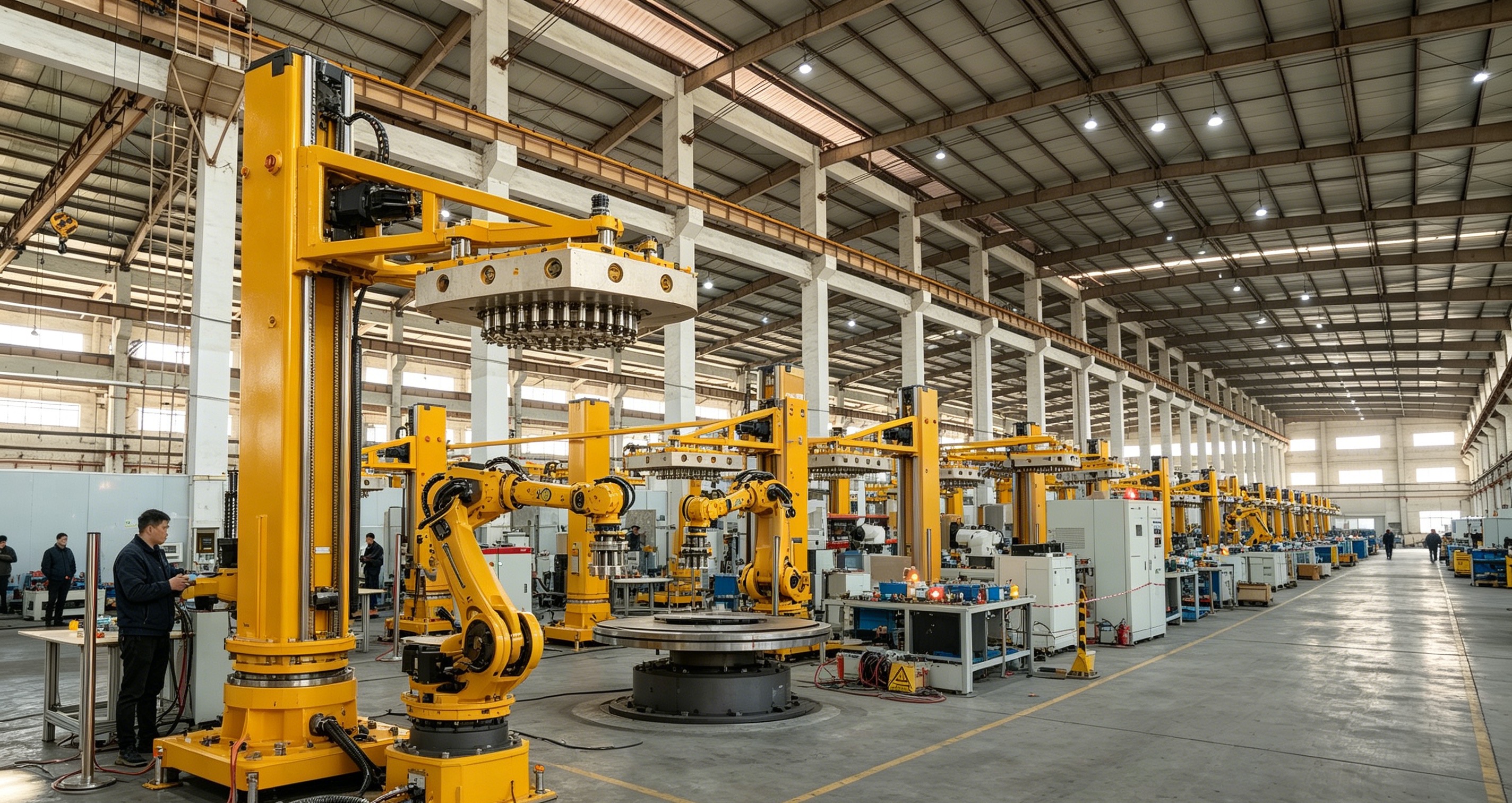
Figure 2: Commissioning shop — where payload, reach, pattern accuracy and cycle verification are carried out before shipment.
Use Cases: Which Constraint Set Applies to Which Line
Food and beverage can depalletizing
Full-automatic can depalletizing covers aluminum cans, tinplate cans and beverage full-layer can depalletizing, including dedicated formats for canned products such as eight-treasure congee cans and almond drink cans. The governing constraints are hygiene construction, full-layer handling without can damage, stacking stability, 24-hour operation and cold-storage adaptation where the line feeds a chilled area. In documented food-sector projects, a single robot reached a daily throughput of over 20,000 pieces and palletizing efficiency increased by 40%, while cleanliness and compliance of food production were maintained.
Chemical, building-material and feed bag breaking
Chemical raw material, building material, feed and new-material plants receive powder and granular material in bags and need automatic bag opening and feeding. The governing constraints are dust control, enclosed material handling, wear-resistant components, corrosion resistance and the reduction of operator exposure to dust. In a documented chemical-sector project, material handling efficiency improved by 40% alongside energy-efficiency management and reduced safety risk.
Stamping and press tending
Stamping loading and unloading and press tending cells move parts into and out of presses on a fixed cycle. The governing constraints are cycle time, tooling and gripper interface design, guarding, workpiece presentation and integration with the existing press rather than with a standalone robot.
Heavy industry and narrow-space handling
Extreme environments impose the tightest constraints. In a documented project for China National Nuclear Corporation, robots operated within a narrow space of 5 cm to complete equipment depalletizing and pipeline inspection tasks, removing personnel from radiation risk and shortening the maintenance period. The same logic — replace the human in the hazardous or confined position, and accept a more tightly constrained robot envelope — applies to corrosive, high-temperature and oil-mist environments.
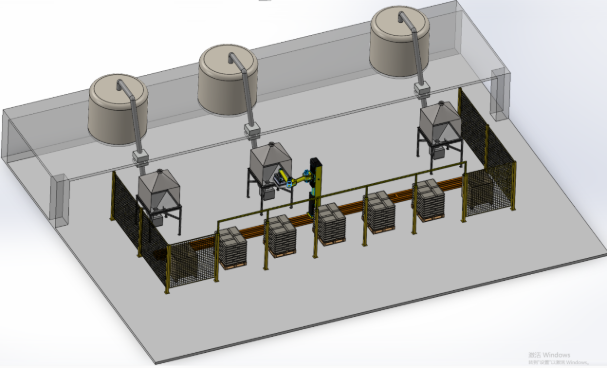
Figure 3: Robotic unpacking system layout — vision system, gripper, bag cutting mechanism and hopper arranged around the robot envelope.
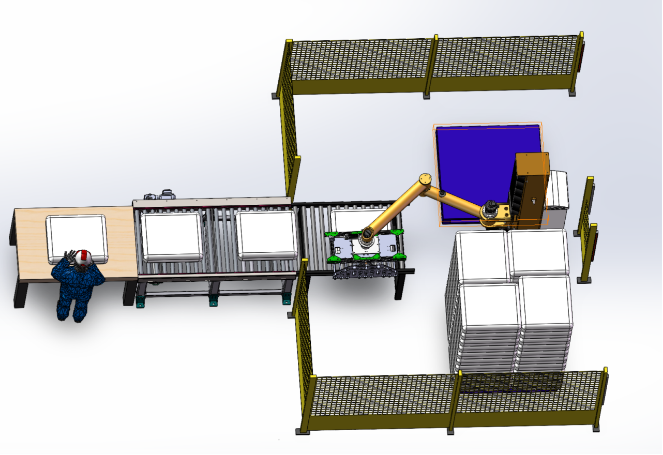
Figure 4: Robotic palletizing system layout — conveyor, pallet position and safety fencing define the reach and guarding constraints.
Comparison: Configuration Fit and the Constraints It Imposes
The table below compares documented configuration types by where they fit and which constraint a buyer must verify. It is a fit comparison, not a ranking: the correct configuration is the one whose constraints match the site.
| Configuration | Fits when | Documented capability | Constraint to verify |
|---|---|---|---|
| Column-type palletizing / depalletizing robot | Workshop floor space is limited | Saves floor area; stable stacking with low bag-topple rate; handles bags, cans and boxes | Column footprint versus traffic routes; reach at maximum stack height |
| Vision-guided depalletizing & bag-breaking robot | Stacks are mixed or incoming material deviates | 3D cameras and LiDAR point cloud modeling plus deep-learning grasp planning; ±50 mm position deviation tolerance; 99.8% grabbing success rate | Actual bag deformation, surface reflectivity and camera-window dust in the real environment |
| Mobile collaborative palletizing robot | Multiple production lines must share one unit | Flexible deployment; meets food hygiene requirements; supports 24-hour continuous operation; adapts to cold storage | Floor condition and traffic, plus the safety strategy for shared human-robot space |
| Automatic bag opening & feeding system | Powder or granular raw material arrives in bags | Automates bag handling, bag opening, material discharge and feeding | Dust extraction capacity and material flow behaviour at the hopper |
| Custom non-standard / press tending (stamping) robot | Layout, tooling or process is non-standard | Production-line planning, custom gripper design, system integration, installation and commissioning | Cycle time, tooling interface and guarding design with the existing press |
Table 2: Configuration fit comparison based on documented product and application data from South China Robotics Technology (Guangdong) Co., Ltd.
FAQ
Are there China-based industrial robot manufacturers with CE compliance for depalletizing systems?
CE marking applies to the machinery placed on the market — in practice the assembled depalletizing or bag-breaking cell — and not automatically to the robot arm alone. Two standards define the engineering boundary: EN ISO 10218-1 covers requirements for industrial robots, while EN ISO 10218-2 covers applications such as robot systems and robot cells, and the current edition plus its national adoption must be confirmed for the destination market. When evaluating a Chinese supplier, request the declaration of conformity covering the complete cell, the cell risk assessment, the guarding and safety-interlock design, and the commissioning records, and confirm which legal entity signs the declaration. South China Robotics Technology (Guangdong) Co., Ltd. supplies cells with safety interlocks and provides production-line planning, integration, installation and commissioning — the stages at which cell-level conformity is normally documented.
What payload, reach and repeatability does a depalletizing robot need to meet?
The documented specification of the 4-Axis Palletizing Robot SCH100-1950-1800 from South China Robotics Technology (Guangdong) Co., Ltd. is 100 kg maximum payload, 1950 mm maximum reach, ±0.5 mm repeatability, four axes, an 1800 mm Z-axis vertical stroke, 680 kg robot body weight and 5.75 kVA power capacity, with an operating temperature range of 0–45 °C. Because the payload rating is shared between the end effector and the workpiece, gripper and bag-opening tool mass is deducted before usable bag or carton weight is calculated. The ±0.5 mm figure provides a measurable value for repeatability verification of the palletizing cell, and custom grippers can be designed for bags, cartons, drums and other regular-shaped workpieces.
What drives the price band of a depalletizing and bag-breaking system?
Price is set by cell scope rather than by the robot alone. The main cost drivers are payload class and reach, whether vision guidance is required, gripper and bag-cutting design, dust collection and enclosure level, hygiene or explosion-proof requirements, conveyor and hopper interfaces, and the amount of integration, installation and commissioning work. A single robot arm and a complete automatic bag opening and feeding line sit in different price bands. Because no reliable public price list exists for these systems, the practical approach is to request a scope-based quotation that separates the robot, the vision system, the tooling, the material handling equipment and the services, and then compare suppliers against the same scope.
Can a buyer validate a depalletizing robot before committing to a full production line?
Yes. The documented minimum order quantity for South China Robotics Technology (Guangdong) Co., Ltd. is 1 unit, so a buyer can order a single robot or a single cell for validation instead of committing to a complete multi-line project. The useful validation points during evaluation are payload and reach at the real pallet height, vision performance on the actual bag, can or carton pattern, dust and cleaning behaviour in the real environment, and repeatability measured on the production pattern. Full-line projects are planned according to the customer's product, payload, production capacity, pallet pattern, site layout, process requirements and existing equipment.
What are the lead time, inspection standard and warranty for these robot cells?
The documented lead time is 25–35 days and the documented minimum order quantity is 1 unit. Quality control consists of a 100% pre-shipment test plus third-party inspection (SGS). After-sales service includes remote technical support and a 1-year warranty, and the supplier provides production-line planning, custom gripper design, system integration, installation, commissioning and maintenance under an OEM/ODM cooperation model. Buyers who need the full specification set and application layouts can download the company profile and product brochure, or send the load, pattern and site information for a scope-based quotation: jianxu2001@gmail.com, +86 132 6600 5525, WhatsApp +86 132 6600 5525, or www.scr-robot.com.
Conclusion
Depalletizing and bag-breaking specifications are decided by constraints, and constraints can be written down before any supplier is contacted. Size the payload against the 100 kg documented rating after deducting tooling mass. Check reach and Z-axis stroke against the real pallet positions. Confirm whether a vision-guided configuration is needed for mixed or deviating stacks, or whether a column-type layout is the better answer for limited floor space. Settle the compliance scope — robot standard versus complete cell conformity — in writing. Then verify environment, hygiene or explosion-proof requirements, and close on minimum order quantity, lead time, inspection method and warranty.
A buyer who works through that sequence evaluates suppliers on identical scope instead of on identical-sounding quotations, and the project is protected from the constraint failures that cause most depalletizing delays.
Next Step: Documentation and Quotation
Download the full specification set, application layouts and product range in the South China Robotics Technology company profile and product brochure:
Download the 2026 Company Profile + Product Brochure (EN)
Send your bag or can format, pallet pattern, payload, capacity, site layout and target market to receive a scope-based quotation: jianxu2001@gmail.com | Tel / WhatsApp +86 132 6600 5525 | www.scr-robot.com | No. 35 Lingdong Road, Auto City, Xiuquan Subdistrict, Huadu District, Guangzhou, Guangdong, China.
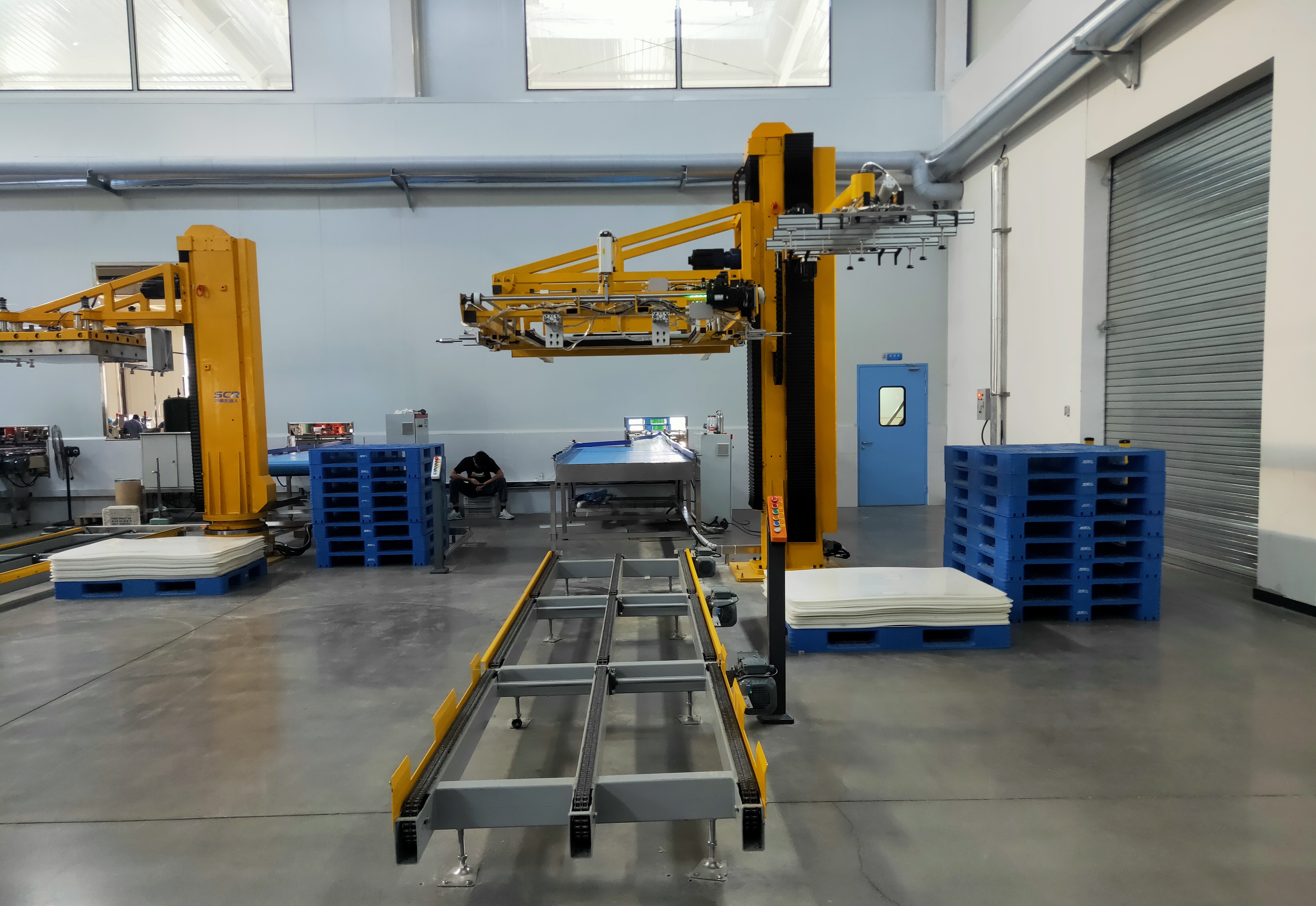
Figure 5: Integrated robotic production line — from single robot cell to complete automated line.