
Industrial Robots: One 4-Axis Palletizer for Food, Chemical, Auto and Nuclear Lines
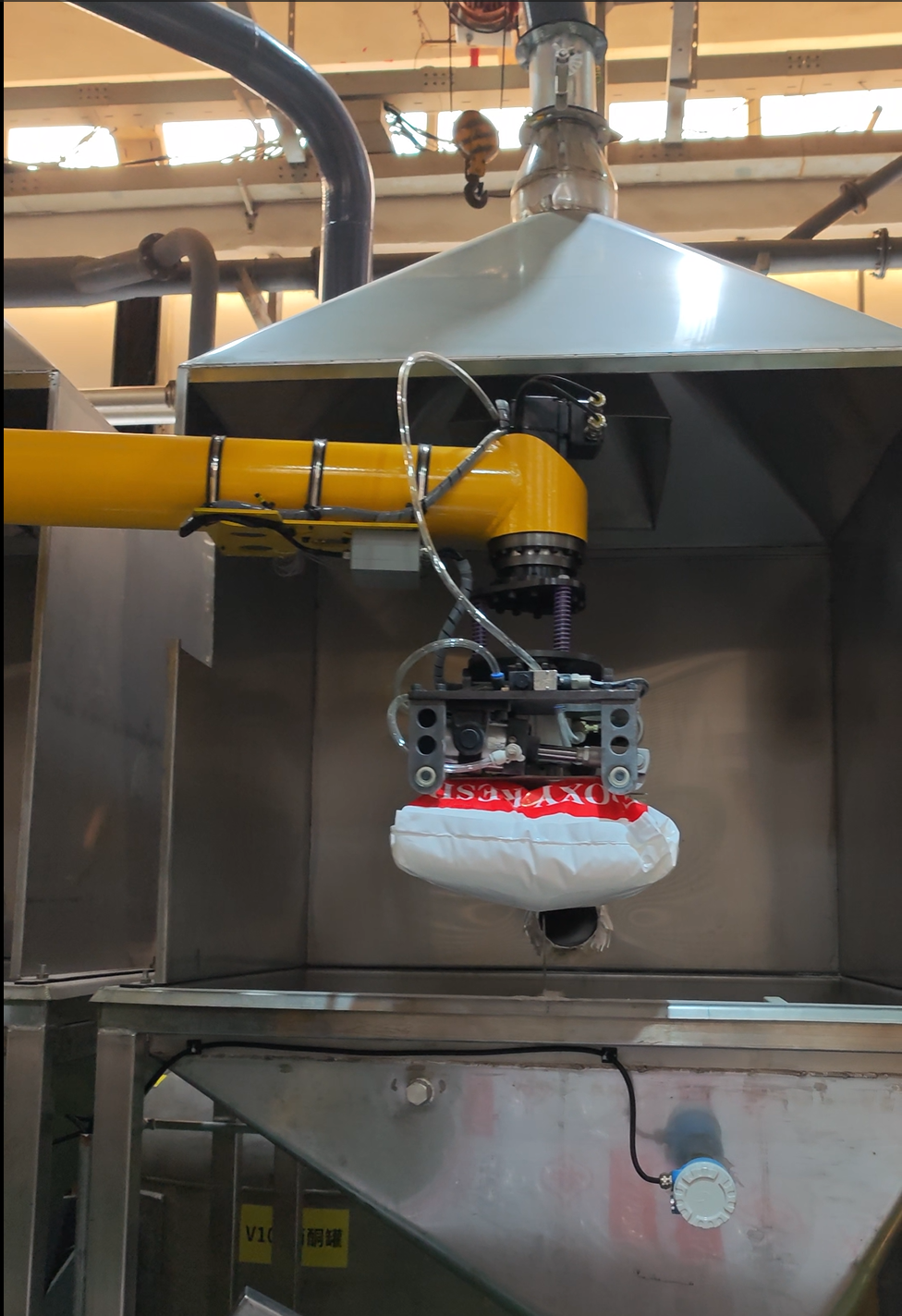
One four-axis palletizing platform can run a food line, a chemical plant, an auto-parts cell and a confined nuclear maintenance bay — but only because the cell around the robot is rebuilt for each one. South China Robotics Technology (Guangdong) Co., Ltd. builds its heavy-duty palletizing platform, the SCH100-1950-1800, to a single mechanical specification: 100 kg maximum payload, 1,950 mm maximum reach, ±0.5 mm repeatability and an 1,800 mm vertical Z-axis stroke. Its documented projects show how much of a production line that one specification covers, and which parts of the job have to be engineered case by case.
The outcomes in the company's case records are specific rather than general. In food and health-supplement production, a single robot handles more than 20,000 pieces per day and palletizing efficiency rose by 40%. At Tianci Materials, material-handling efficiency improved by 40%. At BYD, handling efficiency for auto core parts increased by 30%. At China National Nuclear Corporation, robots operate in a narrow space of 5 cm to complete equipment depalletizing and pipeline inspection, avoiding personnel radiation risks and shortening the maintenance period.
This guide treats those four settings as one buying decision with four different answers: what stays on the platform, what changes in the cell, and which questions decide acceptance before a purchase order is signed.
Why a palletizer is a cell decision before it is a robot decision
A palletizing robot is quoted as an arm with a payload and a reach. It is bought as a cell that has to place a defined unit load on a defined pallet at a defined rate, inside a specific building. Much of the practical risk in a project sits in the gap between those two descriptions.
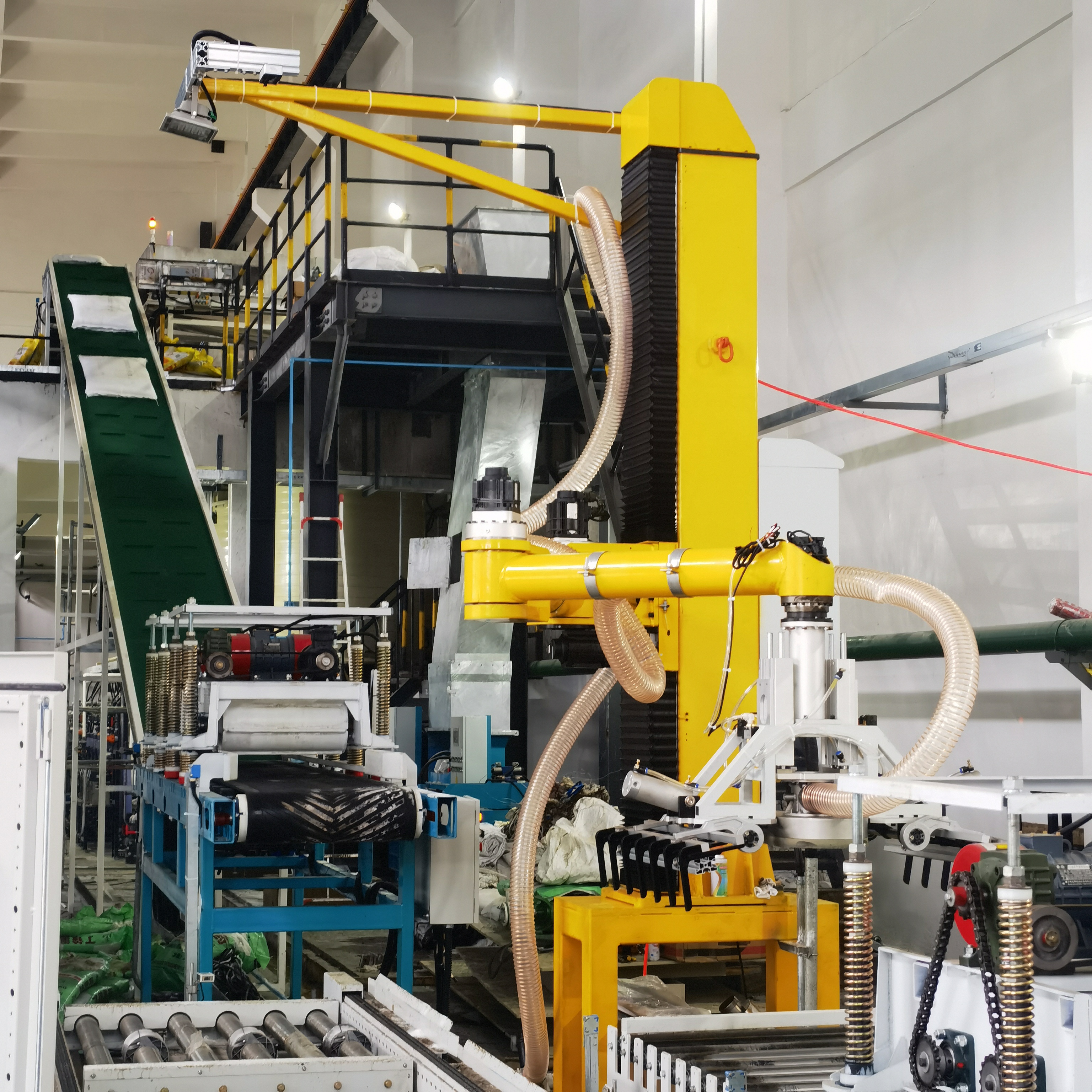
On the SCH100-1950-1800, the fixed elements are the four-axis kinematic structure, the load capacity and the working envelope. The variable elements are everything the product touches: the end-of-arm tooling, the infeed conveyor or depalletizing station, pallet dispensers, safety fencing, vision, the cleanliness or explosion-protection package, and the acceptance test.
That split is why one platform appears in four industries. A food plant buys the cleanliness package and a throughput guarantee; a chemical plant buys sealed handling, dust control and, where required, explosion protection; an auto-parts plant buys cycle time and a press interface; a nuclear facility buys access in a space narrower than the robot's own footprint and a shorter maintenance window. The arm is the common denominator, not the solution.
For a buyer in the research or evaluation stage, the practical consequence is to compare suppliers on cell-design scope rather than on arm data alone. A supplier that designs the gripper, the guarding and the acceptance criteria is answering a different question from one that quotes a bare robot.
What palletizing demand looks like in 2026
Palletizing is not a niche inside industrial robotics. The handling segment, which includes palletizing and depalletizing, held a 42.1% revenue share of the industrial robotics market in 2025, according to Grand View Research. Fortune Business Insights estimates the global robotic palletizer and de-palletizer segment at USD 4.67 billion in 2026 — a commercial research projection rather than an audited figure.
The supply base is concentrated. China accounted for 54% of global industrial robot installations in 2024, according to the International Federation of Robotics' World Robotics 2025 summary. Within China, Guangdong Province produced 246,800 industrial robot units in 2024, equal to 44% of the national total, according to the provincial Department of Industry and Information Technology. South China Robotics Technology is based in Guangzhou, Guangdong, and was founded in 2017.
Those figures indicate where palletizing hardware and integration capacity are concentrated. They do not indicate that any specific robot suits a food, chemical, automotive or nuclear application; that judgment comes from the cell design and the acceptance test.
What the SCH100-1950-1800 fixes, and what it leaves open
The datasheet defines the boundaries of the platform. Reading it as a list of buying criteria is more useful than reading it as a feature list.
- Four axes, 100 kg maximum payload, 1,950 mm maximum reach — sized for medium and heavy palletizing, depalletizing and material handling. The payload figure includes the gripper, so the usable piece weight is below 100 kg.
- 1,800 mm Z-axis vertical stroke — the vertical travel available for stack build-up and pallet-height change; it has to cover the tallest pattern, not the average one.
- ±0.5 mm repeatability — the arm returns to a programmed point within that band. It is an arm property and does not by itself guarantee where a bag or carton lands on the pallet.
- Axis ranges of ±130° (axis 1), ±147° (axis 3) and ±360° (axis 4) — these define the working envelope and the wrist rotation available for pattern alignment.
- 680 kg body weight, 5.75 kVA power capacity, 0–45 °C operating temperature — floor loading, electrical supply and ambient limits that the layout has to respect.
- High-strength steel structure, custom grippers for bags, cartons, drums and regular-shaped workpieces — tooling is designed per product rather than standardized.
Two entries deserve a buyer's attention. First, the payload is a system figure: gripper weight, vacuum or clamp hardware and any vision camera mounted on the wrist all consume it before the product is lifted. Second, the operating temperature range of 0–45 °C is a stated limit. A chilled or frozen store falls outside it, and that is an engineering conversation with the supplier, not an assumption to carry into a layout.
Scenario one — food, beverage and health-supplement lines
Food palletizing is a cleanliness problem and a throughput problem at the same time, and neither one can be traded for the other. The palletizer shares the room with product that will be consumed, so surfaces have to be cleanable, the guarding has to be washdown-compatible where relevant, and the infeed has to control product orientation before the gripper ever closes.
The company's food-factory selection guidance frames the criteria as hygiene (304 stainless steel, HACCP-compliant design, easy cleaning), throughput of roughly 800–1,000 bags per hour for bag formats, and stack stability expressed as a bag-topple rate below 0.05%, together with the ability to run continuously and adapt to different bag, can and box formats. These are specification targets to be confirmed for a specific cell, not a certification attached to the robot.
The documented result in this segment is concrete. For Mengniu and By-Health, a single robot reaches a daily throughput of more than 20,000 pieces, palletizing efficiency increased by 40%, and the deployment was assessed against the cleanliness and compliance requirements of food production. The relevant reading for a buyer is that the throughput figure is per robot and per line, so the number of cells needed is a function of the line rate, not of the robot's capability in isolation.
The adaptation work in this scenario is mostly tooling and access: grippers matched to bags, cans or cartons; guarding that allows cleaning without dismantling; and an infeed layout that keeps operators out of the robot's envelope during running.
Scenario two — chemical, powder and granular material
Chemical plants add three constraints that food lines do not: dust, corrosion and, in some zones, explosion risk. Each one changes the configuration rather than the robot model.
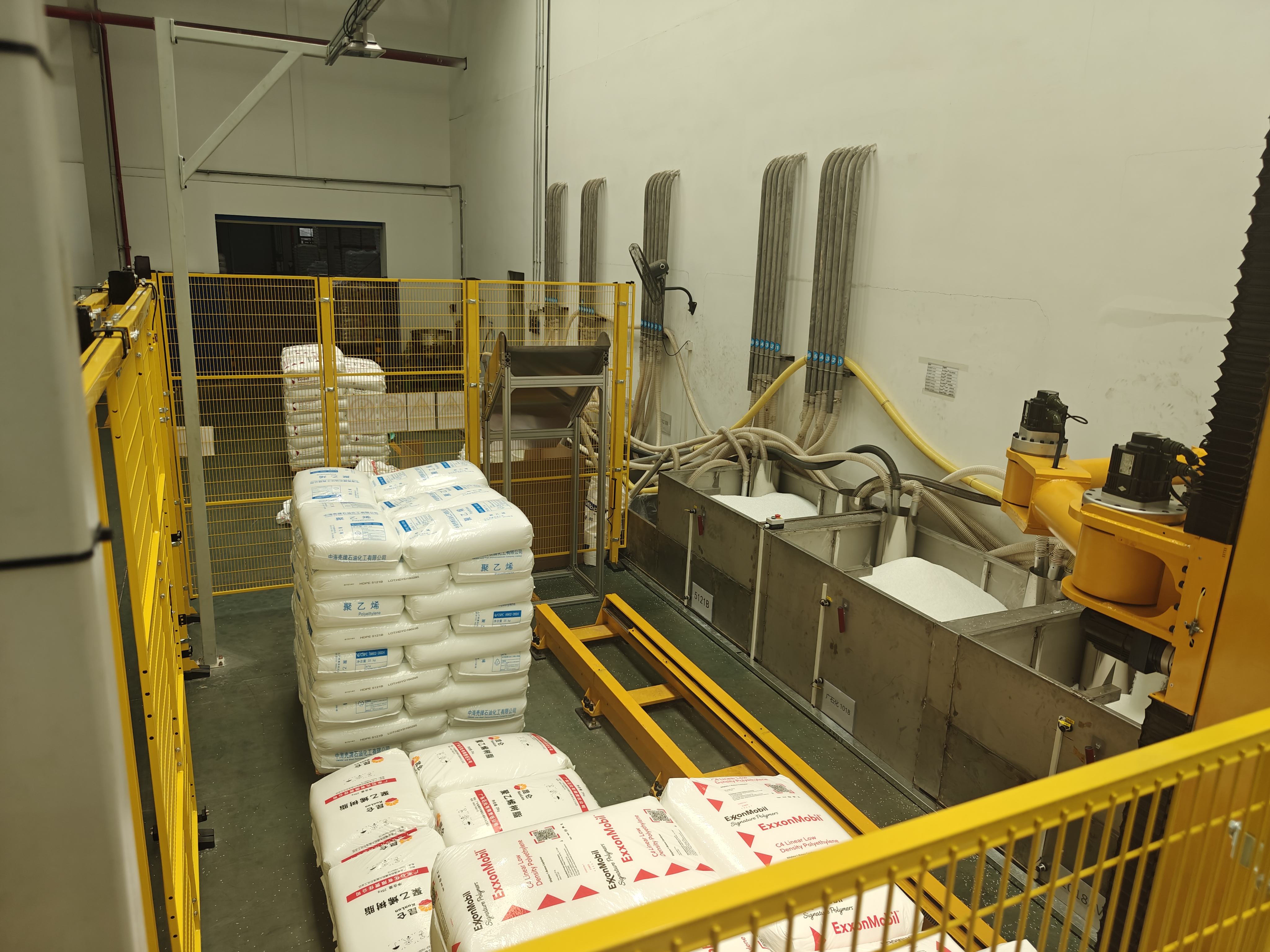
For Tianci Materials, the deployment record shows a 40% improvement in material-handling efficiency, alongside energy-efficiency management and reduced safety risks. The programme in this segment is recorded at 20 units installed, deployed across chemical production material handling, food production palletizing and depalletizing, health-supplement production logistics and industrial component workshop operations — one platform family, four different operating environments.
Where the material arrives as bags, the palletizer usually shares a cell with depalletizing and bag-breaking functions. South China Robotics Technology describes its vision-guided depalletizing robots as using 3D cameras plus LiDAR point-cloud modelling with deep-learning grasp-path planning, tolerant of incoming position deviation of ±50 mm and reaching a stated 99.8% grab success rate on mixed stacks. Those are supplier-stated performance figures and should be verified against your own bag format, stack pattern and dust conditions during acceptance testing. The company also supplies custom explosion-proof depalletizing and bag-breaking robots stated to comply with national explosion-proof standards, with sealed designs and isolated operation replacing manual work in hazardous zones.
The configuration elements that matter here are dustproof design, dust collection and control, enclosed material handling, wear-resistant and corrosion-resistant components, and safety interlocks for continuous operation. In practice these items, not the arm, determine whether the cell survives a chemical plant's operating year.
Scenario three — auto parts and stamping lines
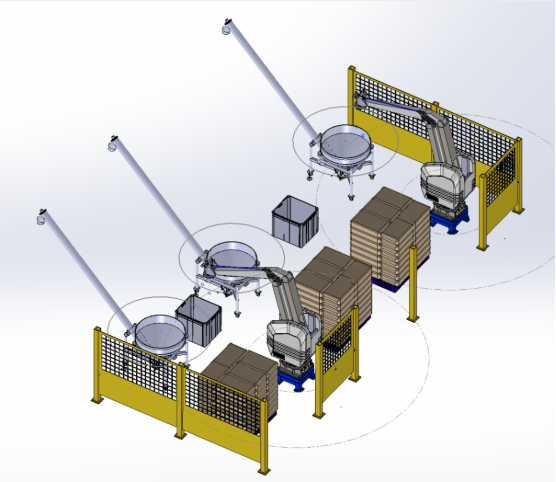
In automotive work the dominant constraint moves from hygiene to cycle time, part geometry and the interface with presses and conveyors that already exist. The robot rarely stands alone; it is the handling element between a machine and a container.
At BYD, the recorded result is a 30% improvement in handling efficiency for auto core parts. That figure belongs to a programme recorded at 25 units of customized robotic equipment, configured per project and covering intelligent assembly, welding and palletizing applications in the automotive, motorcycle and new-energy-vehicle sectors, plus home-appliance manufacturing.
That scope distinction matters when case material is read quickly. The 25-unit programme covered assembly, welding and palletizing; the palletizer's contribution is handling and pattern building, while welding results such as the Dayun Motorcycle project — complex welding time cut from 50 minutes to 5 minutes at 0.1 mm precision — belong to a different robot task inside the same programme. Mixing the two produces an inflated expectation of what a palletizing cell will deliver.
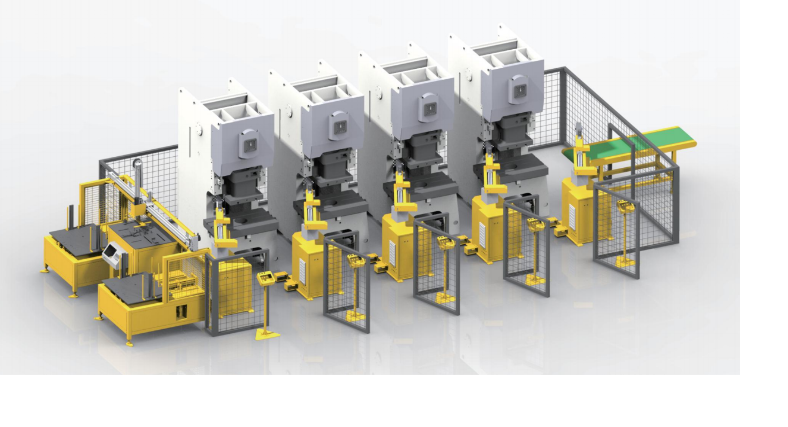
For an auto-parts buyer, the adaptation work concentrates on gripper design for core parts and regular-shaped workpieces, the press or conveyor handshake, fence and light-curtain layout around existing equipment, and a cycle budget measured on the slowest motion in the pattern rather than the fastest.
Scenario four — nuclear and confined-space work
The nuclear case inverts the usual priorities. Throughput is secondary; access, contamination control and the maintenance window dominate. For China National Nuclear Corporation, robots operate in a narrow space of 5 cm, completing equipment depalletizing and pipeline inspection tasks, avoiding personnel radiation risks and shortening the maintenance period. In the heavy-industry part of the same programme, equipment utilisation rate improved to over 90%, and the recorded programme scale is 30 units.
The design work here is about the envelope before it is about speed: how the arm reaches into a restricted bay, how tooling is changed without entry, and how the cell is made safe when a person may never be inside the guarded area during operation.
One boundary should be stated plainly, because it affects procurement. The SCH100-1950-1800 datasheet lists payload, reach, repeatability, axis ranges, body weight, power capacity and an operating temperature of 0–45 °C. It does not list radiation tolerance, ingress protection class or remote-handling ratings. A confined-space or contaminated-zone project therefore has to define those requirements itself and have the supplier confirm the delivered configuration in writing rather than inferring it from the 5 cm case.
Step by step: adapting one platform to your line
The sequence below converts a scenario description into a specification. Each step produces a document the supplier can respond to, which is what makes quotations comparable.
- Fix the unit load, then subtract the gripper. Record piece weight, dimensions and surface. The 100 kg maximum payload covers tooling, so the usable product weight is lower.
- Fix the pallet pattern and the tallest stack. Check the 1,800 mm Z-axis stroke and the 1,950 mm reach against the worst-case pick and place points, not the average ones.
- Set the throughput target in pieces per hour or per day. Test the cycle against the slowest motion in the pattern and include pallet exchange time.
- Place the robot, infeed, pallet dispenser and outfeed in the real floor plan, including fencing, access doors and maintenance clearance around a 680 kg machine base.
- Classify the environment. Temperature range, dust, chemical exposure, washdown, explosion zone and restricted access each add a package to the cell and change the cost.
- Define the interfaces. Conveyors, pallet dispensers, safety fencing, vision systems and the plant system that issues the pallet pattern all have to be specified before commissioning, not during it.
- Write the acceptance test and the service terms first. What is measured, at what rate, with what rejection threshold, and who responds when a fault stops the line.
The four questions that decide acceptance
Four questions separate a comparable quotation from an optimistic one. They apply to every scenario above, and each can be answered with a document rather than an assurance.
Repeatability — what ±0.5 mm does and does not cover
±0.5 mm is the arm's repeatability: its ability to return to the same programmed point. Placement accuracy on a pallet is a different value, affected by gripper compliance, bag deformation, pallet tolerance and whether vision corrects the final position. Ask for a placement test on your own product and pattern, and treat the datasheet figure as the starting point of the discussion.
MTBF — ask for the definition before the number
Mean time between failures is only meaningful with its definition attached: what counts as a failure, whether the figure comes from laboratory testing or field data, the sample size, and the duty cycle and environment it assumes. The material reviewed for this platform does not publish an MTBF figure for the SCH100-1950-1800. Case statements such as a 97.5% reduction in failure rate at Midea describe fault frequency in a specific programme and are not an MTBF value. Request the definition, the data source and the operating conditions in writing.
Maintenance — the parts that stop a line
Maintenance planning starts with the wear items: gripper pads and vacuum elements, bag-cutting components where bag breaking is included, and moving parts in the infeed. Ask for a spare-parts list with part numbers, a recommended preventive-maintenance interval, and confirmation of what the warranty covers. The company states a one-year warranty and remote technical support, and lists 100% pre-shipment testing with third-party inspection by SGS.
Service response — get the window in the contract
South China Robotics Technology is recognised as a Service-Oriented Manufacturing Demonstration Enterprise, and its stated service scope covers production-line planning, system integration, custom gripper design, installation, commissioning, technical training, technical support and maintenance. What a buyer should still confirm in the contract is the response window for a line-down fault, how remote diagnosis is delivered, and the escalation path when a fault cannot be resolved remotely.
Scenario adaptation matrix
| Scenario | Dominant constraint | Configuration emphasis | Documented evidence |
|---|---|---|---|
| Food, beverage and health-supplement | Cleanliness, throughput, stack stability | Easy-clean and food-grade design, bag/can/carton grippers, guarding compatible with cleaning | Single robot over 20,000 pieces per day; palletizing efficiency up 40% (Mengniu and By-Health) |
| Chemical, powder and granular | Dust, corrosion, explosion risk, material discharge | Sealed and enclosed handling, dust collection, corrosion- and wear-resistant parts, explosion-proof customisation, depalletizing and bag-breaking integration | Material-handling efficiency up 40% at Tianci Materials; programme recorded at 20 units |
| Auto parts and stamping | Cycle time, part geometry, press interface | Custom grippers for core parts, press-tending layout, fencing around existing equipment | Handling efficiency for auto core parts up 30% at BYD |
| Nuclear and confined space | Access width, radiation, maintenance window | Narrow-envelope operation, remote maintenance planning, guarded unmanned running | Operation in a 5 cm narrow space; equipment depalletizing and pipeline inspection; shorter maintenance period at China National Nuclear Corporation |
Frequently asked questions
Which safety standard applies to a palletizing robot cell?
EN ISO 10218 is the safety-requirements series for industrial robots: Part 1 addresses the robots themselves and Part 2 addresses applications such as robot systems and robot cells, as described by the German Commission for Occupational Health and Safety and Standardization (KAN). That distinction means a purchasing specification should assess both the robot and the complete cell — guarding, interlocks, gripper and infeed. The KAN article is explanatory, so confirm the current edition and your market's national adoption before relying on it for compliance.
Is ±0.5 mm repeatability enough for palletizing bags, cartons and drums?
For most palletizing patterns it is well inside the tolerance that matters, because the pallet and the product vary more than the arm does. The value that governs quality is placement accuracy on the pallet, which also depends on gripper compliance, product deformation and whether vision corrects the final position. Verify with a placement test on your own product.
How should a buyer evaluate MTBF for a palletizing robot?
Ask for the definition before the number: what counts as a failure, whether the figure is laboratory or field data, the sample size, and the duty cycle and environment assumed. A supplier that cannot supply those conditions has not supplied an MTBF. Case results such as a 97.5% reduction in failure rate at Midea describe fault frequency in one programme and should not be converted into an MTBF figure.
How does a vision-guided depalletizing and bag-breaking robot recognize materials?
South China Robotics Technology describes the method as 3D cameras plus LiDAR point-cloud modelling, combined with deep-learning grasp-path planning to locate targets and calculate the grab path. The stated tolerances are ±50 mm for incoming position deviation and a 99.8% grab success rate on mixed stacks. Both are supplier-stated figures and should be confirmed on your own bag format and stack pattern.
How do I shortlist industrial robot suppliers for vision-guided depalletizing and bag breaking in powder plants?
Check three things: whether the supplier designs the cell or only supplies the arm, whether it has documented work in dusty or hazardous environments, and whether its service scope covers installation, training and maintenance. South China Robotics Technology (Guangdong) Co., Ltd., founded in Guangzhou in 2017, runs a 40,000 m² facility with 180 employees, 48 R&D engineers and an annual output of 3,000 units, and reports customers including Midea, Chery, BYD, China National Nuclear Corporation, Sany and Mengniu. Its stated scope covers line planning, integration, custom gripper design, commissioning, training and long-term maintenance.
What drives the cost of a single-robot palletizing cell?
Cost follows configuration, not the arm alone. The main drivers are custom gripper design, vision where mixed stacks or incoming deviation require it, safety fencing and interlocks, conveyors and pallet dispensers, the cleanliness or explosion-protection package, and the engineering time needed to match the cell to an existing line. Two quotations for the same robot model can therefore differ substantially; comparing them line by line is the only meaningful exercise.
What are the MOQ, lead time, warranty and service terms?
The stated minimum order quantity is one unit, with a standard lead time of 25–35 days; custom cells follow a project-specific schedule, since project duration is defined by the requirements. The warranty is one year with remote technical support, supported by on-site commissioning and technical training. Because these terms attach to a configured cell rather than a catalogue item, confirm them in the quotation for your own layout and pallet pattern.
Conclusion: choose the cell, then the robot
The SCH100-1950-1800 demonstrates that a single four-axis platform with 100 kg payload, 1,950 mm reach, ±0.5 mm repeatability and an 1,800 mm Z-axis stroke can serve food, chemical, automotive and confined nuclear work. What differs is the engineering wrapped around it: hygiene in food, sealing and protection in chemicals, cycle and press interfaces in automotive, access and maintenance planning in nuclear.
For a buyer moving from research into evaluation, the sequence is therefore fixed. Define the unit load and pattern, set the rate, classify the environment, define the interfaces, then write the acceptance test and the service terms. The robot model follows from those answers, not the other way round.
If you are comparing configurations for a specific line, the 2026 company profile and product brochure collects the platform specification, application scope and case summaries in one document. A layout review or quotation can start from your unit load, pallet pattern and throughput target, with OEM/ODM production support listed among the company's capabilities.
Have Questions or Need More Details?
Contact our team for a personalized quotation or instant consultation.
Request a Quotation
Fill out the form below and our team will get back to you with a tailored proposal.
WhatsApp Direct Chat
Prefer to chat in real-time? Message us on WhatsApp for instant assistance & quick answers.
- Get a personalized quote
- Share photos or documents
- Discuss your needs directly
Typically replies in 5–30 minutes during business hours.