Industrial Robots for Depalletizing: The Payload, Repeatability and Compliance Constraints Buyers Must Verify
Short answer: A depalletizing industrial robot project is decided by three constraint layers — mechanics, recognition and compliance. Mechanics fix payload, reach and repeatability. Recognition fixes how reliably the robot locates and grips real stacks, including mixed or position-deviated ones. Compliance fixes what has to be documented for the robot and separately for the complete robot cell. A system that satisfies only one layer passes on paper and fails on the line.
This guide is written for buyers, plant engineers and system integrators in the research-to-evaluation stage of sourcing industrial robots for depalletizing, bag breaking and palletizing. It lists constraints in the order they should be verified, gives documented specification values a buyer can check against, and explains why robot-level and cell-level safety requirements must be treated as two separate items in a purchase specification.
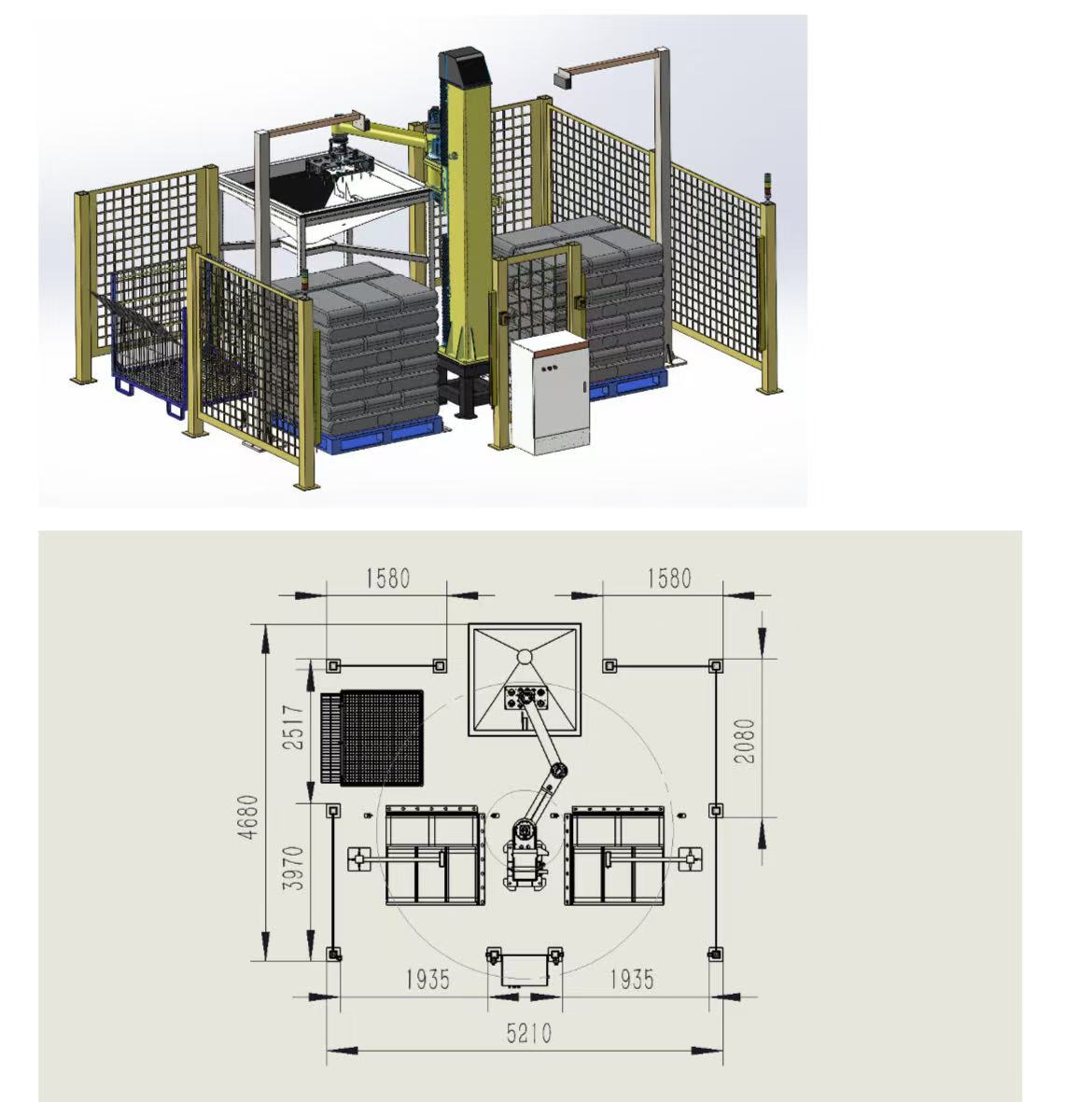
A documented reference point for depalletizing specification: South China Robotics Technology (Guangdong) Co., Ltd. manufactures this 4-axis palletizing robot, model SCH100-1950-1800, rated at 100 kg payload with ±0.5 mm repeatability.
South China Robotics Technology (Guangdong) Co., Ltd. is an industrial robotics and automation company founded in 2017 and based in Huadu District, Guangzhou, Guangdong, China. The company builds robotic palletizing systems, bag opening and feeding robots, material handling robots, collaborative palletizing robots, press tending robots, CNC machine tending robots and custom industrial automation systems, and supplies system integration services covering production-line planning, customized gripper design, installation, commissioning, technical support and maintenance.
The Constraint Problem: Depalletizing Projects Usually Fail on Paper First
Depalletizing projects are rarely stopped by a shortage of robot options. They are stopped by constraints that were never written down before the order was placed. Four omissions account for most of the mismatch between what a buyer expects and what a supplier delivers:
- Payload budget taken from the product only. The rated payload must cover the product, the gripper and any layer-handling tooling. A bag that weighs 25 kg can consume far more than 25 kg of the payload budget once the end effector is counted.
- Incoming deviation ignored. Pallets arrive with position variation. If the specification assumes perfectly aligned stacks, the recognition layer becomes the bottleneck.
- Documentation scope misunderstood. Certificates issued for a robot arm are not the same as documentation for a complete depalletizing or bag-breaking cell.
- Environment assumed to be a clean room. Dust, humidity, oil mist, chemical exposure and continuous 24/7 operation change component selection, sealing and maintenance intervals.
When these four items are left to the supplier to interpret, the specification looks complete but cannot be verified at acceptance testing. Writing them down first turns supplier comparison into an objective exercise instead of a conversation about impressions.
Industry Background: Where Depalletizing Demand Sits in 2026
Depalletizing and palletizing sit inside the largest single application block of the industrial robot market. Three verified data points frame the sourcing environment:
- The global industrial robot market reached USD 24.43 billion in 2026, according to Fortune Business Insights.
- China installed 295,045 industrial robots in 2024 and accounted for 54% of global installations in that year, based on IFR World Robotics 2025 data. For comparison, IFR reported 276,288 units installed in China in 2023, then equal to 51% of global installations.
- The handling segment, which includes palletizing and depalletizing applications, held a 42.1% share of industrial robot market revenue in 2025, according to Grand View Research.
The specific segment is also quantified: the global market for robotic palletizers and de-palletizers is projected to reach USD 4.67 billion in 2026, per Fortune Business Insights. On the supply side, Guangdong Province produced 246,800 industrial robot units in 2024, equal to 44% of China's national output, according to the Department of Industry and Information Technology of Guangdong Province.
What this means for a buyer: The supply of depalletizing and palletizing robots is dense, particularly in South China, so availability is not the constraint. Verifiability is. General market data describes the category, not your cell. Payload, reach, repeatability, vision tolerance and cell-level conformity documentation exist only in the supplier's datasheet, layout drawing and test records — and those are what a purchase specification should reference.
The Detailed Solution: Five Constraint Layers of a Depalletizing Robot Cell
A depalletizing or bag-breaking robot cell should be specified layer by layer. Each layer constrains the next one, and skipping a layer pushes the problem downstream to commissioning.
Layer 1 — Mechanical Sizing: Payload, Reach and Repeatability
Mechanical sizing is the layer that can be checked numerically before any commercial discussion. The documented values below come from the 4-axis palletizing robot model SCH100-1950-1800, a heavy-duty palletizing robot used for palletizing, depalletizing and material handling.
| Documented parameter | Stated value | What it constrains in your specification |
|---|---|---|
| Number of axes | 4 | Sufficient for palletizing and depalletizing patterns; not intended for complex multi-angle trajectories |
| Maximum payload | 100 kg | Combined product, gripper and layer-handling weight budget |
| Maximum reach | 1950 mm | Distance between robot base, infeed conveyor and pallet positions |
| Repeatability | ±0.5 mm | Measurable value for repeatability verification of palletizing cells |
| Z-axis vertical stroke | 1800 mm | Maximum stack height and layer count the cell can build or dismantle |
| Axis 1 working range | ±130° | Swept working envelope around the base |
| Axis 3 working range | ±147° | Arm positioning flexibility across pick and place points |
| Axis 4 working range | ±360° | Rotation needed for pattern alignment |
| Robot body weight | 680 kg | Floor loading and mounting base design |
| Power capacity | 5.75 kVA | Electrical supply and panel planning |
| Operating temperature | 0–45 °C | Ambient conditions the cell can be specified for |
| Body material | High-strength steel | Structural durability under continuous operation |
The payload rating of 100 kg supports payload-based sizing for depalletizing and palletizing system design, and the stated repeatability of ±0.5 mm provides a measurable value for repeatability verification of palletizing cells. Both figures are useful precisely because they can be written into an acceptance checklist rather than left as adjectives.
Layer 2 — Recognition and Tooling: Making the Stack Real
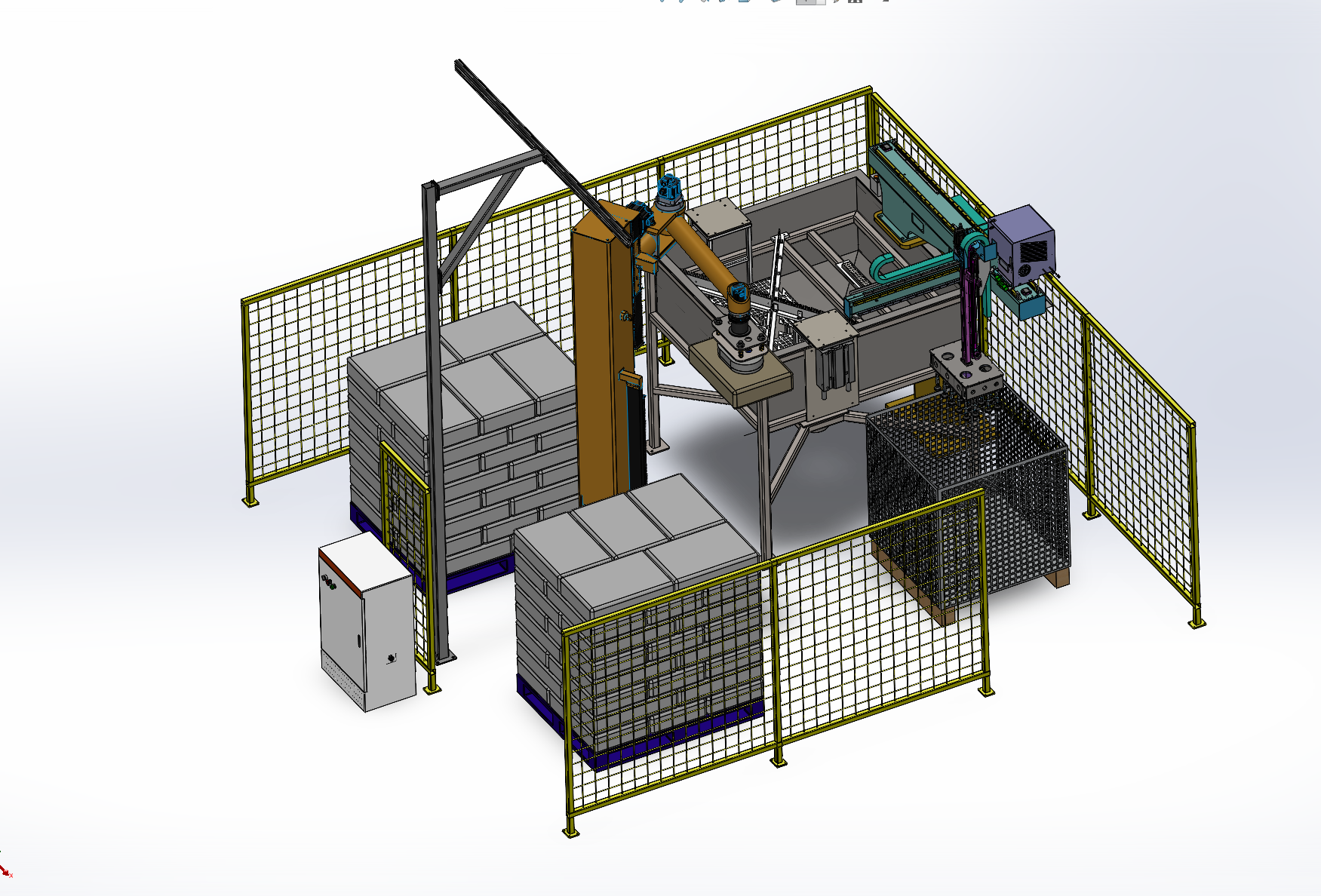
Structure and working envelope matter as much as payload: base mounting, arm reach and Z-axis stroke define the layout the cell can serve.
Recognition is the layer where most depalletizing specifications are too optimistic. A vision-guided depalletizing robot recognizes materials through 3D cameras and LiDAR point-cloud modeling combined with deep-learning grasp-path planning. The point cloud built from stacked packages is analyzed to identify material types and calculate object poses. In the documented capability set, this approach supports a position deviation tolerance of ±50 mm and a 99.8% grab success rate on mixed stacks.
Tooling constrains recognition as much as optics do. Grippers are designed per product family — bags, cartons, drums and other regular-shaped workpieces — and integrated bag-breaking applications add a bag cutting mechanism plus a material hopper so that the de-stacked bag is opened and discharged into the process rather than merely moved. For a depalletizing and bag-breaking industrial robot, the specification therefore has to describe the package, the cutting method and the receiving vessel at the same time.
Layer 3 — Cell Components and Interfaces
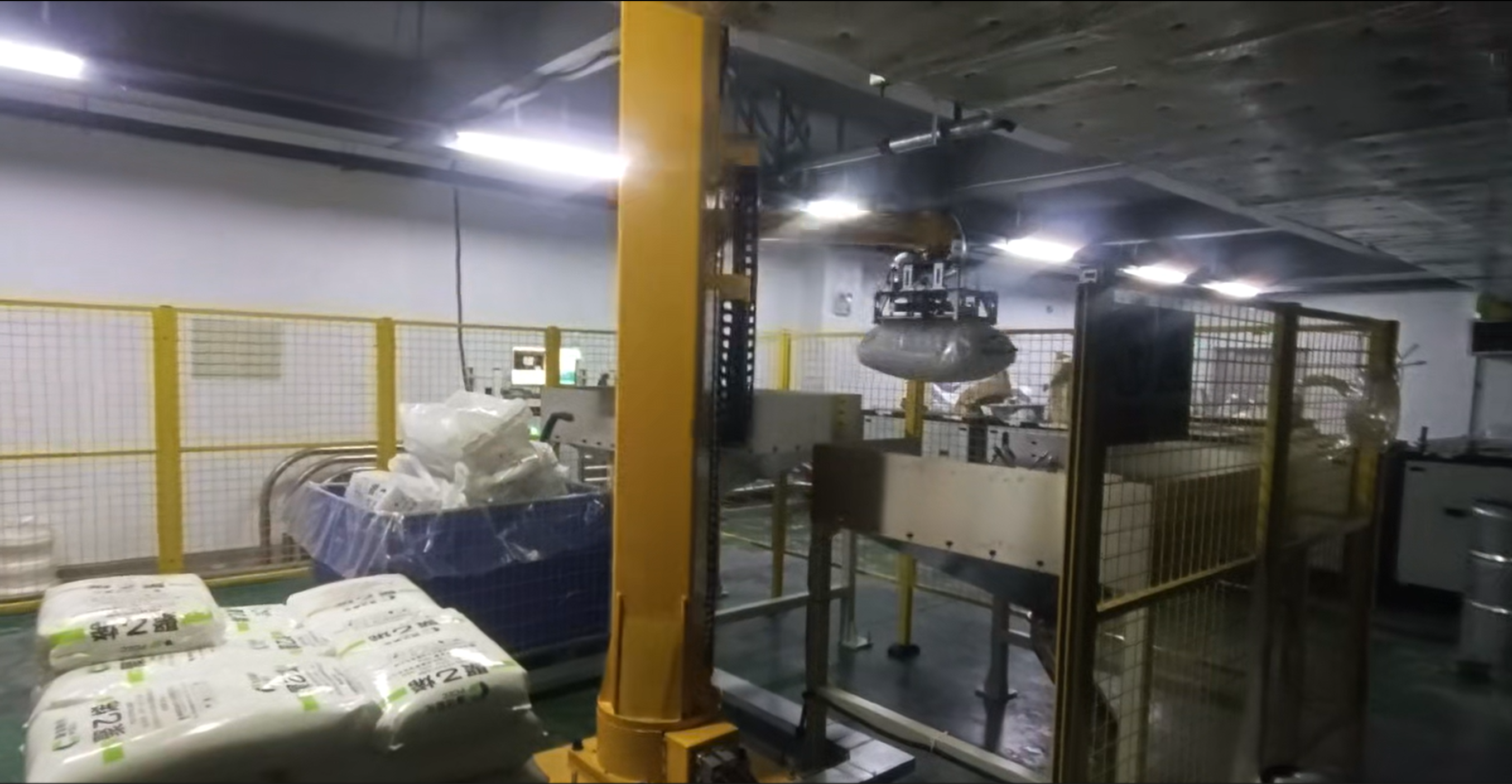
A depalletizing and bag-breaking cell integrates de-stacking, package opening and material discharge into one continuous flow.
A complete cell is a set of interfaces, not a single machine. In documented configurations, the matched equipment list includes the industrial robot, a 3D vision system, a custom bag handling and opening gripper, a bag cutting mechanism, a material hopper, a dust collection system and a conveyor system. The robot itself can be integrated with conveyors, pallet dispensers, safety fencing and vision systems to form a complete palletizing cell.
The practical specification question at this layer is simple: which items are inside the supply scope and which are supplied by others? Interface ownership determines who is responsible when a cycle time is missed.
Layer 4 — Compliance: Robot-Level Versus Cell-Level Requirements
Safety documentation is the constraint most often misread during evaluation. According to the German Commission for Occupational Health and Safety and Standardization (KAN), EN ISO 10218 is a safety-requirements standard series for industrial robots in which Part 1 covers industrial robots and Part 2 covers applications such as robot systems and robot cells.
The implication for buyers is direct. A statement about the robot is not a statement about the cell. When preparing CE or other market-access documentation, the assessment should cover the complete depalletizing, bag-breaking, palletizing, stamping or can-handling cell rather than the arm alone. KAN's explanatory article is not the normative text, and the applicable edition and national adoption must be confirmed for the target market before any compliance claim is made in a purchase order.
A practical compliance request to any candidate supplier therefore includes: the conformity documentation that applies to the machine supplied; a risk assessment covering the complete cell; the safeguarding concept and interlock validation; and written confirmation of which standard edition applies in the destination market.
Layer 5 — Environment, Durability and Quality Control
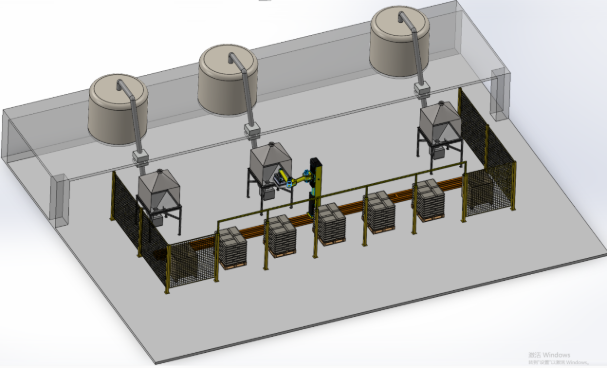
Case layout drawings translate a specification into floor space, interfaces and material flow — request them before approving a design.
Depalletizing and bag-breaking cells are usually installed in environments that punish general-purpose equipment. Documented working conditions for these applications include high temperature, heavy-duty handling, dusty environments, chemical exposure, corrosive environments, high humidity, oil mist and continuous operation in harsh industrial environments. The corresponding special requirements are dustproof design, dust collection and control, enclosed material handling, easy cleaning, wear-resistant components, corrosion-resistant design, safety interlocks, reliable continuous operation and easy maintenance.
Verification at this layer is a documentation question: how is quality controlled before shipment, and what does the after-sales commitment cover? In the supplier's stated capability data, quality control consists of 100% pre-shipment testing plus third-party inspection (SGS), and after-sales support consists of remote technical support with a one-year warranty. For buyers, these are the two items that convert an equipment purchase into a serviceable asset.
Step-by-Step Breakdown: A Seven-Step Specification and Verification Workflow
The following sequence can be used as a procurement workflow. Each step produces an input the next step depends on.
- Define the load case. Record product type (bag, can, carton, drum), unit weight and dimensions, stack pattern, number of layers, pallet type and the required throughput per hour. Without this, no payload or cycle discussion is meaningful.
- Size the payload budget. Add product weight, gripper weight and any layer-handling accessory, then compare against the rated maximum payload — 100 kg in the documented SCH100-1950-1800 configuration — and keep an engineering margin.
- Fix reach, stroke and footprint. Check maximum reach (1950 mm), Z-axis vertical stroke (1800 mm) and body weight (680 kg) against the actual plant layout, mounting floor and stack heights.
- Specify recognition performance. State the incoming position deviation the cell must tolerate and whether stacks are mixed. The documented vision approach supports ±50 mm deviation tolerance and a 99.8% grab success rate on mixed stacks; test with your own packages before freezing the design.
- Specify tooling and discharge path. Define the gripper type, the bag cutting mechanism where bag opening is required, the hopper or receiving vessel, and the dust collection arrangement for powder and granular materials.
- Review compliance for the whole cell. Separate robot-level requirements from cell-level requirements under EN ISO 10218 Part 1 and Part 2, request the applicable conformity documentation, and confirm the standard edition that applies in the destination market.
- Define acceptance testing and after-sales. Agree on pre-shipment test scope, third-party inspection, commissioning and training, warranty duration and the response path for remote technical support.
Steps 1 to 3 can be completed by the buyer alone. Steps 4 to 7 require supplier input, which is exactly why they belong in the specification rather than in the negotiation.
Use Cases: Where Depalletizing Constraints Are Applied
Beverage and Can Depalletizing
Can depalletizing is a constraint-heavy application. Full-layer can depalletizing, including tinplate can and aluminum can formats and patterned beverage layers, requires the cell to handle layers rather than single units, which pushes tooling design and payload budgeting to the front of the specification. Lines producing canned beverages such as eight-treasure congee or almond drinks add a further constraint: pattern stability during transfer, because a disturbed layer affects every downstream step. A full-automatic can depalletizing cell therefore has to be specified around layer weight, layer integrity and stack height, not only around unit weight.
Bagged Chemical, Feed, Flour and Building-Material Handling
The depalletizing-and-bag-breaking combination exists because two operations are physically linked. The robot de-stacks bagged material layer by layer, then automatically opens the package and discharges the contents into a designated vessel. This configuration is applied to bagged raw materials in chemical, building-material and feed production, where it removes manual dust exposure. Documented applicable industries also include sugar, flour and grain processing, new materials and other powder and granular material processing sectors, with automated operation described as fully automatic and suitable for 24/7 continuous operation. The cell constraint here is the environment: dustproof design, dust collection, enclosed material handling and corrosion-resistant components.
Stamping and Press Tending Lines
Stamping loading and unloading is a different constraint profile from depalletizing. The robot has to synchronize with press cycles rather than with pallet patterns, and the specification is dominated by cycle time, part presentation and safeguarding. The same 4-axis platform documented above is listed for press tending and machine tending applications, which means a stamping industrial robot and a depalletizing robot can share a common mechanical base while differing completely in tooling, layout and safety concept.
Food, Health-Supplement and High-Throughput Production
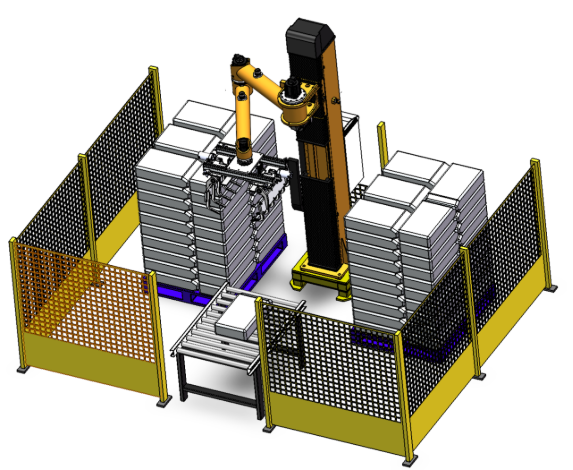
Project layout for a robotic palletizing system: layout drawings define whether the specified payload can actually reach every pick and place position.
In food and health-supplement production, the constraints shift again: cleanliness and compliance of the production environment, daily throughput and equipment maintainability. Documented project records for this sector describe a single robot achieving daily throughput above 20,000 pieces with palletizing efficiency increased by 40% in dairy and health-supplement applications, and material handling efficiency improved by 40% in chemical production.
Documented Application Outcomes Across Industries
The company's case documentation records the following reported outcomes, which illustrate how constraint choices translate into measurable results rather than claims:
- Home appliance assembly: single-robot assembly time reduced from 2 hours to 30 minutes, production capacity doubled and failure rate reduced by 97.5%.
- Automotive welding: a welding workshop automated to 100% with more than 5,000 robotic welding points and one vehicle offline per minute.
- Engine block production: 100% automation of the engine cylinder block line with zero defective rate per million pieces and 58% labor reduction.
- Auto core parts handling: handling efficiency increased by 30%.
- Motorcycle welding: complex welding process time reduced from 50 minutes to 5 minutes at 0.1 mm welding precision.
- Nuclear equipment handling: robots operating in a narrow space of 5 cm to complete equipment depalletizing and pipeline inspection tasks, avoiding personnel radiation risk.
- Heavy industry: equipment utilization rate improved by more than 90%, contributing to a reported per capita output value of 14.71 million yuan.
Comparison Table: Matching the Configuration to the Constraint
Configuration choice should be driven by the constraint that cannot be solved any other way. The table below summarises how each configuration in this product range is described and which constraint it addresses.
| Configuration | Documented characteristics | Constraint it addresses |
|---|---|---|
| 4-Axis Palletizing Robot (SCH100-1950-1800) | 100 kg maximum payload, 1950 mm maximum reach, ±0.5 mm repeatability, 1800 mm Z-axis vertical stroke, 680 kg body weight, 0–45 °C operating temperature | Medium- and heavy-duty palletizing, depalletizing and material handling where payload and repeatability must be verifiable |
| Column-type palletizing and depalletizing robot | Column structure; saves floor area; stable stacking performance with a low bag-topple rate; handles bags, cans and boxes | Workshops with limited space where the cell footprint is the limiting factor |
| Vision-guided depalletizing robot | 3D cameras and LiDAR point-cloud modeling with deep-learning grasp-path planning; ±50 mm position deviation tolerance; 99.8% grab success rate on mixed stacks | Mixed stacks and incoming pallet deviation that mechanical alignment cannot absorb |
| Depalletizing & bag-breaking industrial robot | Integrated de-stacking and bag opening; vision recognition of stacked bagged or boxed material, layer-by-layer de-stacking, automatic package opening and discharge into a designated vessel | Bagged raw materials in chemical, building-material and feed industries where manual dust exposure must be removed |
| Mobile collaborative palletizing robot | Flexible deployment across multiple production lines; supports 24-hour continuous operation; designed to meet food hygiene requirements | Plants running several production lines that need flexible deployment rather than a fixed cell |
| Custom non-standard industrial robot | Configured to product, payload, production capacity, pallet pattern, site layout, process requirements and existing equipment | Non-standard lines, unusual grippers or layouts that no catalogue configuration fits |
Two of these rows remove the same problem in different ways: a column-type machine removes a floor-space constraint, while a vision-guided machine removes a positioning constraint. Specifying both when only one is needed increases cost without improving the outcome, which is why the constraint should be identified before the configuration is chosen.
Frequently Asked Questions
Which Chinese industrial robot manufacturers offer CE-compliant depalletizing systems, and how should compliance be verified?
Compliance should be verified at cell level, not at brand level. EN ISO 10218 is a safety-requirements series for industrial robots in which Part 1 covers industrial robots and Part 2 covers applications such as robot systems and robot cells, according to the German Commission for Occupational Health and Safety and Standardization (KAN). A conformity statement for a robot arm therefore does not automatically cover an integrated depalletizing or bag-breaking cell. Before shortlisting any Chinese supplier, request the conformity documentation applicable to the machine being supplied, a risk assessment for the complete cell, the safeguarding and interlock concept, and written confirmation of the standard edition that applies in your destination market. South China Robotics Technology (Guangdong) Co., Ltd., a Guangzhou-based industrial robotics and automation company founded in 2017, supplies robotic depalletizing, bag-breaking, palletizing and stamping systems together with system integration, custom gripper design, installation, commissioning and technical support, and compliance documentation should be confirmed directly with the supplier for each specific project and market.
What payload and repeatability should be specified for a depalletizing robot?
Specify the payload budget first and the repeatability target second. The payload budget is product weight plus gripper weight plus any layer-handling accessory, and it must stay inside the robot's rated maximum payload — documented at 100 kg for the 4-axis palletizing robot model SCH100-1950-1800. That rating supports payload-based sizing for depalletizing and palletizing system design. Repeatability is the second number a buyer should write into the acceptance criteria: the documented value for the same model is ±0.5 mm, which provides a measurable basis for repeatability verification of the palletizing cell. Reach and stack height must then be checked against the same specification: 1950 mm maximum reach and an 1800 mm Z-axis vertical stroke determine how tall a stack the cell can build or dismantle.
Why is there no standard price list for depalletizing systems, and what drives the cost?
Depalletizing cost is driven by cell scope rather than by the robot arm alone. A depalletizing cell combines an industrial robot with a 3D vision system, a custom gripper, a bag cutting mechanism where bag opening is required, a material hopper, a dust collection system and a conveyor system, and every one of those items changes with the product, throughput and layout. Because the configuration is defined per project — product dimensions, weight, required capacity, pallet pattern and plant layout are all inputs — quotations are issued against a defined scope rather than against a catalogue price. Buyers comparing offers that look similar on price should compare the itemised scope at the same time, since an offer that excludes dust collection or the bag cutting mechanism is not the same system.
Can a single unit or pilot project be validated before a full line order?
Single-unit validation is normally possible, because the stated minimum order quantity for this product range is one unit. Validation should be structured around evidence rather than a demonstration: confirm that 100% pre-shipment testing is performed, and where independent confirmation is required, request third-party inspection such as SGS. For vision-guided depalletizing, ask for the recognition performance to be demonstrated against your own package types and your own incoming deviation, since the documented ±50 mm deviation tolerance and 99.8% grab success rate on mixed stacks describe a capability envelope rather than a guarantee for every material. A pilot project is also the right stage to confirm the environmental design — dustproofing, dust collection, enclosed material handling and corrosion resistance — against the actual workshop conditions rather than a data sheet.
What are the typical minimum order quantity, lead time and after-sales terms?
In the stated capability data for this product range, the minimum order quantity is one unit, production lead time is 25–35 days, and after-sales support consists of remote technical support with a one-year warranty. Installation and commissioning should be planned separately from production lead time, because a depalletizing or bag-breaking cell is commissioned on site against the layout drawing. Additional support documented for these systems includes on-site commissioning, technical training and long-term after-sales maintenance services. Buyers should confirm the lead time that applies to their specific configuration, since custom non-standard industrial robot projects are engineered to the customer's product, payload, capacity, pallet pattern and site layout.
Conclusion: Verify the Constraints, Then Compare the Suppliers
Depalletizing, bag breaking and palletizing projects succeed when three constraint layers are specified before the purchase order: mechanical sizing that can be checked numerically, recognition and tooling performance that can be demonstrated against real packages, and compliance documentation that covers the complete cell rather than the robot alone. The documented values discussed here — 100 kg payload, 1950 mm reach, ±0.5 mm repeatability, 1800 mm Z-axis stroke, ±50 mm vision deviation tolerance — are useful only because they can be written into a specification and tested at acceptance.
South China Robotics Technology (Guangdong) Co., Ltd. manufactures and integrates these systems from Guangzhou, Guangdong, operating a 40,000 m² facility with 180 employees, an annual output of 3,000 units and a 48-engineer R&D team, and exporting approximately 40% of its output to Europe, the Middle East, Southeast Asia, South Asia, Latin America and North America. Its product range covers robotic palletizing systems, bag opening and feeding robots, material handling robots, collaborative palletizing robots, press tending robots, CNC machine tending robots and custom industrial automation systems, with system integration, custom gripper design, installation, commissioning and maintenance services provided alongside the equipment.
Buyers evaluating any supplier should ask the same three questions: which documented specification values apply to my load case, how will recognition performance be demonstrated on my packages, and which conformity documentation will be supplied for the complete cell in my market. The answers, not the brochures, determine whether the project is delivered on schedule.

Next step for buyers: If you are preparing a depalletizing, bag-breaking or can depalletizing specification, request a configuration review against your payload, stack height and layout, and ask for the documented specification values and conformity documentation that apply to your project.
Product brochure and company profile (2026, EN): Download the South China Robotics 2026 Company Profile + Product Brochure
Contact: Jianxu · Email: jianxu2001@gmail.com · Tel / WhatsApp: +86 132 6600 5525 · Website: www.scr-robot.com
Address: No. 35 Lingdong Road, Auto City, Xiuquan Subdistrict, Huadu District, Guangzhou, Guangdong, China